Call Drop Improvement in the Cellular Network
by Reducing the Bit Error Rate
Dhanya1, Dr. Perumal Sankar2
PG Student [WT], Dept. of ECE, TocH Institute of Science and Technology, Arakkunnam, Kerala, India1
Assistant Professor, Dept. of ECE, TocH Institute of Science and Technology, Arakkunnam, Kerala, India2
ABSTRACT: Global System for Mobile Communication (GSM) is a standard to describe protocols for 2G digital
cellular networks used by the mobile phones. Call Drop Rate (DCR) in GSM network is an important KPI (key Parameter Indicator) that directly affects the customerssatisfaction.Call drop happening when traffic channel is released abnormally after it is occupied successfully.One of the importantreasons for call drop outs is high Bit Error Rate (BER). In general, many existingwireless systems set a threshold BER before a call is dropped. In this work, it is intent to reduce the call drop out due to high BER Here introduced a new signal processing subsystem at the receiver section to improve the BER and thereby improvethe end-to -end performance of the system.The block incorporated the subsystems to generate the two mixtures of signal and noise, centreing and whitening In particular, the calculation of un-mixing matrix and automated identification for distinguishing separated signals was carried out using independent component analysis (ICA) system. ICA is a technique to separate linearly mixed sources. It is a computational method for separating a multivariate signal into additive subcomponents assuming mutual statistical
independence of the
source signals.
KEYWORDS: GSM,calldrop,BER,ICA,TEMS
I. INTRODUCTION
Global System for Mobile Communication (GSM)was the world’s first 2G technology cellular system to specify digitalmodulation and network level architectures mainly for voice communication. Call drop rate is one of the major KPI (key performance indicator)that affects the performance of live GSMnetwork for measuring the Quality of Service (QoS). Today,call drop is one of the major problem facing the cellular industry. The TCH drop is the abrupt disconnection ofcall after traffic channel is allocated.Once the call is established, the maintenance of the call becomes crucial for customer satisfaction.Accordingto the Telecom Regulatory Authority of India’s(TRAI) service performance indicators for January –March 2015,many of the service providers did not meet the 3 percent benchmark of call drop rate. Call drop can be cause due to different reasons like interference, handover, radio link failure, hardware failure, coverage, network capacity, high bit error rate etc.
Call drop is caused due to lack of available radio channels which in turn may be caused by the propagation factors such asmultipath fading path loss, distance losses, shadowing and RF interference.Some other channel capacity varying factors are handover and service prioritization as the signal travels from the transmitting antenna to the receiving antenna, it loses strength radio link failures. This may be due to the phenomenon of path loss, or it may be due to the Rayleigh effect. Rayleigh (or Rician) effect is due to the fast variation of the received signal level both in terms of amplitude and phase between the transmitting and receiving antennas when there is no line of sight(LOS).
II. RELATED WORK
Call drop is one of the major issue which affect the quality of service of the telecom network. Call drop improvement is a key objective for any cellular operator to provide continuous call maintenance after it is established for customer satisfaction which is linked with therevenue of the company. There are many studies conducted measure the call dropping probability in the cellular network [7,4] The call drop can be due to many factors likehardware failure, transmission problem, Version upgrade problem, Parameter settingissues, Intra-network and inter-network interferences, overshooting from neighbouring BTS, Imbalances between uplink and downlink, Repeater problem, coverage problem as blind spots, , Antenna system problem, High bit error rate etc.
Many research works are done to reduce this problem and to provide better quality.To minimize the call drop rateauthor[11] proposed a GA based fault tolerant channel algorithm to optimize the channel allocation in a mobile computing network system under resource planning model. A mobility-aware call admission scheme for cellular communication systems, called Regulated Call Dropping (RCD)with Fractional Channel Reservation (FCR) (RCD-FCR)[1]is proposedfor effective utilization of channel.Handover is one of the major reason for call dropping in the network.Guard Channel Schemes[3] where some channel is reserved for handover calls and whenever that channel is released, it is return back to the common pool of channels and
a
Call drop minimization techniques[13] are important schemes employed to reduce the number of calls dropped in mobile cellular networks.A Call admission control (CAC)[10] algorithm is also an effective method for proper termination of call. Overshooting problem can be solved by tilting the antenna [ 11] electrical or mechanically. But the tilting angle will be limited and this will affect the coverage alsoAll the above methods speaks about the call drop because of channelunavailability. These works aim to improve call drop out by controlling the channelassignment schemes. The availability of spectrum is limited and the channel allocation is not solve the problem completely. This method tries to reduce the call drop by reducing the bit error rate.Bit error rate is main reason for the dropped calls. QoS is normally defined in relation with the BER in digital transmission systems. The Quality of service requirement for the voice users is generally expressed as BER less than10−3 in order to ensure quality of communication. Thus if the BER for the system is improved , the problem of call drop can bereduced. The BER quantifies reliability of the entire system from the bits send and received.
III. ANALYSIS OF CALL DROP
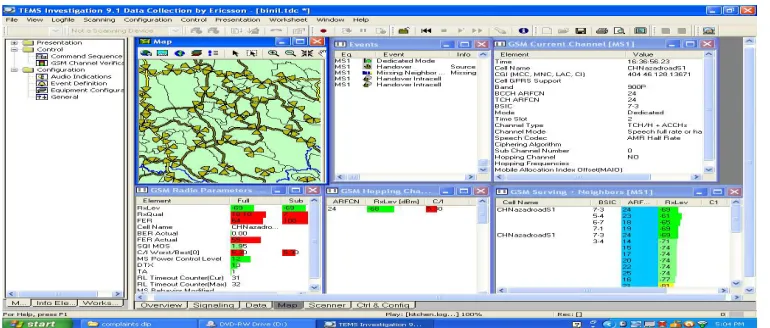
We analyzed the different factors that affect the call drop in the cellular network using the TEMS drive test tool .TEMS consists of a laptop having TEMS tool ,mobile phone and a GPS to know the location of the test. In the software the cell id and name of the BTS is displayed and the different parameter values like received signal strength, RSRP, BER, SQI, FER etc. The drive test is conducted in Kochi city where there is a frequent call drop. We check the different call condition like long call ,shot call and idle mode and the dropping probability .Call is dropped due to different factors and the BER is reached 10 the call is dropped. So from the drive test we could understood that BER is a factor for call drop in the network.
Fig1:Screen shot of drive test to analyzing the call drop using TEMS
Fig 2:Screen shot of drive test showing relation between BER and call drop
IV. METHODOLOGY
Wireless communication system: A mobile communication system consists of a transmitter, a receiver and a channel
Fig 3:Block diagram of a typical wireless cellular system
Fig 4:Block diagram of a cellular system with SPB block
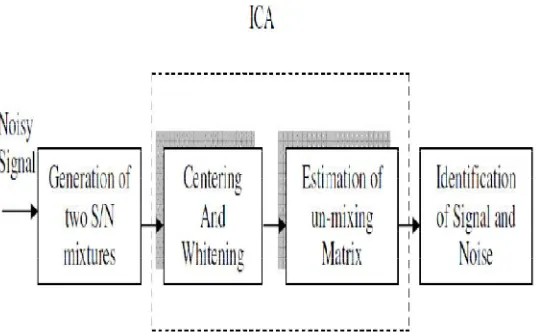
The Signal Processing Block(SPB) proposed block to be simulated at the front end of the receiver. The SPB mainly consist of following subblocks,
• Generation of two signal and noise mixtures • preprocessing of the mixture
• Estimation of the un-mixing matrix • Identification and separation of signal
GENERATION OF TWO SIGNAL AND NOISE MIXTURES
The input at the receiver section of a wireless communication system is a mixture of noise and data sample. Since we are trying to reduce the effect of noise from the actual data, we require two mixtures. The fact that the noise added in a wireless communication system is modeled as AWGN is used to generate another mixture. The mixture of signal and noise is first input to this block wherein another mixture is generated. Now there are two mixtures which can be represented in matrix form as follows:
AX = S
Where, X = signal mixture S = Source Signal or pure signal
A = mixing matrix
After this, the mixture is input to the next sub-block for centering and whitening.
CENTERING AND WHITENING
The generated mixtures are input to the next sub-block, where centering and whitening are performed. Centering and whitening are preprocessing stages implemented to simplify the calculation.. Centering a vector X means calculating its mean and subtracting it from the vector X. Whitening is performed to transform the observed vector X so an uncorrelated component of the vector is resulted.
ESTIMATION OF UN-MIXING MATRIX
The estimation of un-mixing matrix is achieved using the gradient ascent rule. Gradient ascent rule is an optimization method that maximizes a function of multiple parameters by iteratively improving an initial guess using the gradient, which points in the direction of maximum slope Initially, we assume the un-mixing (Y) to be an identity matrix (I). Then by using the gradient ascent rule the un-mixing matrix is evaluated iteratively as,
Ynew= Yold+ l [I-f(U)U^T] Yold
where, U = YX is the intermediate output, where X is the input mixture of signal and noise after whitening, l is the learning rate typically chosen to be 0.001 but can be varied to get the optimum result , f(u) is the logistic transfer function given as
f(u)=1 1+ ^
Thus, the gradient algorithm helps to evaluate the un-mixing matrix (W) from which it can determine the original source signals. At the output, will get a reasonab
ly noise-free signal (henceforth simply called as signal) and
noise.
IDENTIFICATION OF SIGNAL AND NOISE
The output of the un-mixing matrix estimator gives the signal and noise. At this point, the system needs to distinguish between the signal and noise. The identification is achieved by exploiting the autocorrelation property of white Gaussian noise. If n is the white Gaussian noise then the autocorrelation is given as,
RXX (n,n+m) = σ 2δ (m)
The signal as compared to noise will be more correlated due to up-sampling and interpolation performed at the transmitter section even though the initial data of ones and zeros which is the output of the source encoder are uncorrelated. Hence, the autocorrelation plot of the signal is more widely spread with peak at the measure.
V. RESULT AND DISCUSSION
In the fig 1, it shows the Comparison graph of BER VsEb/N0 with and without SPB.From the graph we can analyse that the bit error rate of the cellular system with SPB is reduced.
Fig.6: Comparison graph of BER VsEb/N0 with and without SPB.
VI. CONCLUSION
High bit error rate is one of the major factor for call drop in the network. This work aim to design a signal processing block(SPB) at the receiver end of the wireless system and then simulated the physical layer of a wireless system to reduce the bit error rate of the system Initially simulated the overall block diagram for a typical mobile communication system and measured its BER. Thereafter, introduced a new signal processing subsystem at the receiver section to improve the BER and thereby improve the end-to -end performance of the system. The SPB block is actually a noise filtering block to filter the source signal from received signal. In the proposed system, SPB block utilizes the concept of Independent Component Analysis (ICA) algorithm and the source signal is filtered from noise. The propsed block is compared with the typical block diagram.The bit error rate of the wireless system with SPB block is less and hence the call drop can be reduced in the cellular communication system.
REFERENCES
[1] Felipe A. Cruz-Pérez, LauroOrtigoza-Guerrero “Mobility-Aware Regulated Call Dropping Scheme for Capacity Optimisation in Wireless Communication Systems”,inIEEEInterational conference, 2004.
[2] G. Boggia, P. Camarda, A. D’Alconzo, A. De Biasi and M. Siviero“ Drop Call Probability in Established Cellular Networks: from data Analysis to Modelling ”,in IEEE, 2005.
[3] Yuguang Fang “Guard channel scheme to reduce the handover failure”, in IEEE, Vol2,2005.
[4] AapoHyvärinen “Blind Source Separation and Independent Component ` Analysis”, Neural Information Processing-letters and review, Vol 6,2007
[5] Mahmud Syubli Abdul Rahman, Mohammad Faizal Ismail, KaharudinDimyati “ Uplink Call Admission Control with Adaptive Bit Rate Degradation for WCDMA” ,in Proceedings of the 2009 IEEE 9th Malaysia International Conference on Communications ,15 -17 December 2009.
[6] William A. Gardner “Suppression ofCochannel Interference in GSM by Pre-demodulation Signal Processing”, in International
confrenence,2010.
[7] K.R. Sudhindra“Root Cause Detection of Call drops in Live GSM Network”, in IEEETENCON,2011 .
[8] Nathaniel S. Tarkaa, Joseph M. Mom, Cosmas I. Ani “ Drop Call Probability Factors in Cellular Networks”, in International Journal of
Scientific & Engineering Research Vol 2, No 10, Oct-2011 ,ISSN 2229-5518,2011.
[9] LinaLan, Xuerong Gou, Jingli Mao, WenyuanKe “GSM Co-Channel and Adjacent Channel Interference Analysis and Optimization”,inTSINGHUA SCIENCE AND TECHNOLOGY Vol 16, No 6, December 2011.
[11] Kaushlendra Singh Chauhan, “Genetic Algorithm Based Call Drop Reduction Model During Handoff in Mobile Communication”, in IJCST
Vol 3, No 3, July - Sept 2012.
[12] Michael Grimm, Rajesh Kumar Sharma,Matthias Hein and Reiner S. Thomä “Improved BER Performance in GSM by Mitigating Non-linear Distortions in the Receiver” ,in 43rd European Microwave Conference,2013.
[13] AniokeChidera Linda, Cosmas I. Ani“A Reservation and Retrial Queue Analysis for Cellular Networks”, in International Journal of
Engineering Research & Technology (IJERT)Vol 3, No 2, February – 2014.
[14] M.EkpenyongUyo, AkwaIbom State “Modeling the Effect of Dropped Calls on Cell Traffic inEstablished3G-Based Cellular Networks”, in
IEEE African Journal of Computing & ICT Vol 7, No 2 - June, 2014.
[15] Prabhjot Singh, Mithilesh Kumar, AmbarishDas“Effective Frequency Planning To Improved Kpi's, TCH And SDCCH Drops For A Real GSM Cellular Network”, inIEEE,2014.
[16] Chidera L. Anioke, Obinna C. Nnamani, Cosmas I. Ani “Call Drop Minimization Techniques for Handover Calls in Mobile Cellular Networks”,inInternational Journal of Scientific & Engineering Research, Vol 6, No 3, March-2015 .
[17] MamathaShankarappa “Challenges of poor performance in cellular mobile systems”, in International Journal of Recent Advances in