Water Quality Management System Using IoT
T.G.Dhaarani, K.Gowthamraj, R.Mithunprabhu, L.Nandhini, J.Sabari pon vignesh
Assistant Professor, Dept. of ECE, Nandha Engineering College (Autonomous), Tamil Nadu, India
UG Student, Dept. of ECE, Nandha Engineering College (Autonomous), Tamil Nadu, India
UG Student, Dept. of ECE, Nandha Engineering College (Autonomous), Tamil Nadu, India
UG Student, Dept. of ECE, Nandha Engineering College (Autonomous), Tamil Nadu, India
UG Student, Dept. of ECE, Nandha Engineering College (Autonomous), Tamil Nadu, India
ABSTRACT: Effective and efficient management of water resources is becoming unprecedentedly more important nowadays due to the increasing demand from a growing population, increasing standards of living and changing supply due to climate change. Due to the high usage of fertilizers in farming fields and other chemicals in industries contributed immensely to the overall reduction of water quality globally.Water is an essential need for human survival and therefore there must be mechanism that should be done to test the quality of water that made available for drinking in town and city articulated supplies. In earlier days, chlorination process was done to purify the quality of water. But that process is not effective due to the contamination of unwanted pollutants. This study aims to detect, purify and control the contamination in water. It will monitor the pollution level in water continuously and it will generate the database automatically. This helps us to view the information at any time from the control board. The pH, turbidity and temperature level can be viewed through real time android application, which works under IoT.
KEYWORDS: Arduino controller, android application, Internet Of Things, water quality monitoring.
I.INTRODUCTION
The water quality is not only important for drinking water but also for agricultural, industrial, human life and ecosystem. But today, the rate of water pollution is very high. The water pollution occurs due to contaminants, that caused by three major sources. Those are sewage, industrial and agricultural waste. Such contaminants have the potential to harm humans, wildlife and native plants. Many chemicals also cause contamination to water. Some of them are chemical outlets from industries, usage of agricultural chemicals in farms. In order to prevent the water from chemical contamination technology supports to a greater extent. The newer technologies proved to be very efficient for human beings. The method followed in last decades is placing electrodes in particular place like river, lakes, pond and analysing the chemical change occurring in the electrode manually. According to changes, pH level is calculated. There are some demerits in those methods. The drawbacks like time management, non-effective results that are due to data loss occur in the collected samples. There is a need in monitoring the water quality continuously. The real time monitoring techniques have paved a way to monitor the water under surveillance.
II. INTERNET OF THINGS
III. PROPOSED SYSTEM
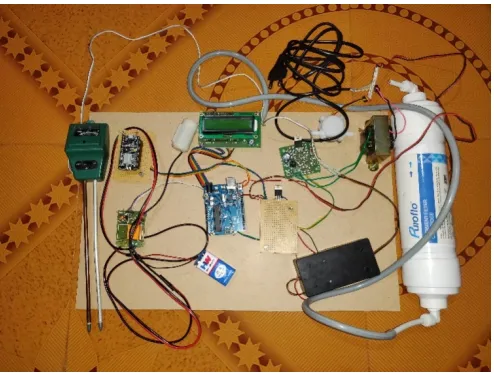
The system architecture of water quality management system consists of arduino uno, pH sensor, flow sensor, solenoid valve, relay and ESP8266 (IoT module).
The purpose of designing water disinfection and improving the current distribution system for the good health of people. This helps to supply each and every households with clean water under manageable pressures. Currently, small reservoirs scattered throughout the community do not provide proper system storage, robbing community members at higher elevations of water and creating negative pressures in the distribution system. This proposed system is helpful to overcome the drawbacks that occurred in the earlier system. This water quality monitoring system with portable devices provides advantages like low initial start-up cost and low periodical maintenance costs.And also this enhances the quality of water by monitoring the system automatically. The intial working of this system starts with the sensors. This circuit consists of microcontroller arduino uno which is connected to the pH sensor and flow sensor. The microcontroller is coded with the flow sensor by using arduino IDE. The Arduino IDE offers to support the languages C and C++ using special rules of code structuring. The flow sensor which is connected in this circuit has three lines, Vcc line, ground line and pulse line. There are three wires coming from the flow rate sensor. They are 5V Vcc, the GND, and the signal/pulse (usually yellow) line. The Vcc and GND of the flow meter is connected to the arduino's Vcc and GND. The pulse line of the flow rate sensor is connected to arduino’s digital pin. The flow meter code is uploaded to the arduino board. The code uses an external interrupt on arduino’s digital pin 2. This is used to read the pulses that comes from the flow meter. When the Arduino detects the pulse, it triggers the pulse counter() function immediately. This function then counts the number of pulses. This flow sensor is connected with the solenoid valve which makes the automation of fluids.
IV. HARDWARE DESCRIPTION
A.ARDUINO UNO
The Arduino Uno is a microcontroller board based on the microchip ATmega328. It has 20 digital input/output pins (of which 6 can be used as PWM outputs and other 6 can be used as analog inputs), a 16 MHz resonator, a connection with USB, a power jack, an in-circuit system programming (ICSP) header, and a reset button. Arduino microcontoller is a physical programmable circuit board (PCB) and a piece of software called Arduino Integrated Development Environment (IDE) that runs on computer, used to write and upload computer code to the board. The Arduino IDE uses a simplified version of C, making it easier to learn program. Arduino provides a standard form that breaks out the functions of the micro-controller into a more accessible package. The Arduino Uno is one of the most popular boards in the Arduino family and a great choice for beginners.
B. ESP 8266 CHIP
ESP8266 is a wifi system on a chip produced by Espressif Systems . It is an highly integrated chip which is designed to provide full internet connectivity in a small package. This ESP8266 microchip can be used as an external Wifi module, using the standard AT Command set Firmware by connecting it to any microcontroller using the serial UART, or directly serve as a Wifi-enabled micro controller, by programming a new firmware using the provided Software Development Kit (SDK ). This can be easily programmed by using the arduino IDE.It connects to the Arduino hardware to upload required programs and communicate with them.
C. pH SENSOR
The most commonly used pH sensors consists of glass electrodes. The glass electrode method has high reproducibility, and it is used to measure pH of various solutions. The majority of pH electrodes are combination of electrodes that have both the glass electrode and the reference electrode conveniently placed in one housing. While the reference electrode and the pH measuring electrode are physically combined into one electrode, the electrodes still function independently, and characteristic problems remain.
D. SOLENOID VALVE
A solenoid valve is an electromechanical device used for controlling liquid flow. The solenoid valve is controlled by electric current, which is run through a coil. When the coil is energized, a magnetic field is created, causing a plunger to move. The most commonly used solenoid valve has two ports an inlet port and an outlet port. Advanced designs may have three or more ports. Some designs utilize a manifold-type design. Solenoid valve helps to control fluid and gas flow automatically. Modern solenoid valves offers fast operation, high reliability, long service life, and compact design.
E. FLOW SENSOR
Water flow sensor consists of a plastic valve body, a rotor, and a hall-effect sensor. When water flows through the rotor, it rolls. Its speed changes according to the different rate of flow. The hall-effect sensor produces output as corresponding pulse signal. The differential pressure sensors are suitable for measuring the volume flow rate of gases according to the differential pressure procedure. The sensors records the minimum drop in pressure on a flow element (e.g. screen, nozzle, laminar flow element) which is equal to a measurement of volume flow rate. Robust, highly accurate and extremely low differential pressure sensors reliably monitor how much of the medium flows through the line at any given time.
F. RELAY
not usually control power consuming devices except for smaller motors and the solenoids that runs under low amps. Inspite of that, relays can control larger voltages and amperes by having an amplifying effect because a small voltage
applied to a relays coil.
Protective relays offer preventing the equipment damage by detecting electrical abnormalities, including over current, undercurrent, overloads and reverse currents. In addition to that, relays are also widely used to switch starting coils, heating elements, pilot lights and audible alarms.
V. BLYNK APP DESCRIPTION
Blynk is a Platform connected with iOS and Android apps to control Arduino, Raspberry Pi and the likes over the Internet. It is a digital dashboard where it helps to build a graphic interface for the project by simply dragging and dropping widgets. When Arduino or Raspberry Pi is linked to the Internet over Wi-Fi, Ethernet or this new ESP8266 chip, Blynk will get online and ready for the Internet Of Things. This has high speed acquisition of data and high interpretation of data. This application is helpful for the water quality monitoring and measurement.
Fig 1. Experimental setup
VI. CONCLUSION
Water not only sustains the life, but also determines the quality of life. Assessing the water quality is just as important as quantity in water resources planning and management. This paper presents the design of portable and low-cost. Method of design and measurement of real time monitoring of water quality parameters in IoT environment. By focusing the issues in the previous methods, this project could develop a system with high efficiency and processing capability, analysis and transmit of data. All the required data can be viewed anywhere in the world using this blynk application. This management system has been successfully implemented based on water quality parameter to the ultimate user to ensure water quality.The results obtained matches with the expected results obtained through simulation.
REFERENCES
[1] Gupta, I., & Kaur, R. (2013). “Design and Development of Industrial Pollution Control System” using Lab VIEW. International Journal of Advanced Research in Computer Engineering & Technology, 2(11),november 2013.
[2] Kortuem, G., Kawsar, F., Sundramoorthy, V., & Fitton, D. (2010).”Smart objects as building blocks for the Internet of things”, IEEE Internet Computing, 14(1), 44-51.
[4] V. Raut and S. Shelke, "Wireless acquisition system for water quality monitoring", 2016 Conference on Advances in Signal Processing (CASP), Pune, 2016, no. 371-374.
[5] T. P. Lambrou, C. C. Anastasiou, C. G. Panayiotou, M. M. Polycarpou, “A low-cost sensor network for real-time monitoring and contamination detection in drinking water distribution systems”, vol.14, no. 8, Aug. 2014.
[6] N. Nasser, A. Ali, L. Karim, and S. Belhaouari, “An efficient wireless sensor network-based water quality monitoring system”, in Computer Systems and Applications, 2013.
[7] S. Silva, H. N. Nguyen, V. Tiporlini,and K. Alameh, “Web based water quality monitoring with sensor network: employing Zigbee and Wimax technologies” , in High Capacity Optical Networks and Enabling Technologies, Riyadh, 2011, no. 138-142.
[8] K. Kondratjevs, A. Zabasta, N. Kunicina, and L. Ribickis, “Development of pseudo autonomous wireless sensor monitoring system for water distribution network” ,in Industrial Electronics, Istanbul, 2014,no. 1454-1458.
[9] Majewski P, Luong J, Stretton K, "The application of surface engineered silica for the treatment of sugar containing wastewater", 65(1),no.46-52, 2012.
[10] Daosheng deng, Wasim Aouad, Martin Z.Bassant,Sven Schulmberger,Mathew .E.Suss, ”Water purification by shock elecrodialysis”, 2014. [11] LichaoHuang, SenlinCheng, “Unmanned Monitoring System of Rivers and Lakes Based on WSN”, 19-20 May 2012 International Conference on Systems and Informatics(ICSAI 2012), pages 495-498.