An efficient approach in ANPR using the
Block-Based ANN in MATLAB
1
Ms. Shilpi Chauhan, Research Scholar, Dept. of CSE, Arya Insitute of Engineering and IT,
Jaipur
2
Mr. Vishal Srivastava, Associate Professor, Dept. of CSE, Arya College of Engg. and IT,
Jaipur
1
[email protected]
Abstract- Automatic Number Plate Recognition (ANPR) framework is profoundly precision demanding application for auto distinguishing proof. This paper introduces another strategy for square based (Block Based) ANPR framework for acknowledgment of Indian auto permit number plates. Since number plate rules are not entirely rehearsed in India and wide varieties found on these plates as far as text style sort, character size, screws/dabs and so forth., it frequently gets to be hard to effectively distinguish the non-standard number plate characters. This proposed strategy functions admirably with both standard and non-standard Indian number plate pictures taken under different light conditions. By utilizing the piece based component extraction handle this strategy for acknowledgment gives a high acknowledgment rate of 98.2% and pace up the preparing time of every character to 2.9 ms when utilizing a database of 2550 character pictures.
Index Terms: Block-Based Character Recognition, Image acquisition, Image enhancement, Neural Networks, Segmentation.
I. INTRODUCTION
Automatic Number Plate Recognition (ANPR) framework is a picture preparing framework under Digital Image Processing, which lies under the PC vision field. It has been an extraordinary territory of enthusiasm because of its numerous applications, for example, for activity law implementation; find stolen autos, parking areas and observations [4]. ANPR is utilized to distinguish vehicles by catching tags and perceive the characters. The product of acknowledgment process for the most part made out of four principle stages: 1) Image upgrade, 2) Segmentation, 3) Feature extraction and 4) Character acknowledgment. This paper will talk about these stages in point of interest. A wide assortment of procedures have been created before, however the vast majority of them worked under confined conditions and causes challenges in acknowledgment undertaking, for example, projections and pixel availability are the most well-known strategies for division [1], [6], [7], [8]. There are additionally some paper proposed division techniques are utilizing earlier information of characters
For the acknowledgment of the characters, numerous classifiers can be utilized, for example, the most widely recognized utilized Artificial Neural Networks (ANN) is food forward ANN which has a basic design when contrasted with the other regular example coordinating procedures like Self-Organizing neural system having issue with joined and missed characters, format coordinating which can perceive just single text style, altered size characters [1], [4], [9], [11]. Different strategies like Normalized Cross-Correlation (NCC) and Support Vector Machine (SVM) having high computational cost, HNN requires an excessive amount of memory and fluffy rationale does not function admirably with awful quality pictures [13], [3], [2], [4]. The present techniques for ANPR framework worked in like manner to the directing parameters of particular nation activity standards and models [5]. In spite of the fact that, in India, number plate benchmarks exists, yet they are once in a while rehearsed. Subsequently, wide varieties are found in the number plates, regarding textual style sort, character size, screws/spots and area of the number plate, additionally numerous pointless characters are available on the number plate. Different issues included in the number plate acknowledgment as far as plate and natural varieties. The point of this study is to build up a Block-Based ANPR framework for acknowledgment of Indian auto permit number plates by determining these issues with non-standard number plates, to give high acknowledgment rate and to accelerate the handling time when contrasted with the other ANPR framework in light of neural system in [13]. The proposed calculation has been executed and tried with a database of 2550 Indian twofold character
pictures utilizing MATLAB.
II.METHODOLOGY
Figure 1: picture pre-preparing framework and projection profiles for division, piece based component extraction utilizing edge thickness estimations and neural system for acknowledgment.
The models of the Proposed System: Image Acquisition – Image Processing – Character Segmentation – Block Based Feature Extraction – Recognition.
Every progression of the proposed ANPR framework contains a few handling steps and nitty gritty depiction of every module is given taking into account its significance given in the proposed approach of the proposed ANPR framework.
A. Image Acquisition
The information to the proposed ANPR framework is the first pictures of auto number plates caught by normal determination camera of 14 Mega pixels which are edited physically. The caught pictures are removed from 5-12 feet from the vehicle mounted with standard high security Indian number plates and typical number plates.The two separate arrangements of 1000-trimmed tag pictures are then obtained in MATLAB for further preparing of preparing and testing of ANN.
B. License Plate Image Pre-Processing
The steps below demonstrates the essential piece outline of the pre-preparing steps. The square shows diverse procedures that are performed for enhancing the picture quality.
Grey Processing – Image Processing – Filtering – Binarization – Thresholding – Morphological Operation
a. Converting RGB to Gray-Scale Images
Grey scale handling is an imperative stride in a picture pre-preparing; its outcomes are the establishment of later steps. The real nature to dark scale transformation is performed by utilizing Matlab Code. Where Gray is the new pixel quality and RGB are the red, green, and blue estimations of the first pixel.
b. Image Enhancement
The standard target of the picture upgrade is to prepare a picture for a particular assignment so that the handled picture is preferred seen over the first picture [1]. The strategy of picture pre-handling falls into picture improvement. Because of different constraints of the picture extraction gadgets, pictures procured by them are inclined to blunders like spatial and worldly confinements. The impact of every one of these restrictions incorporates commotion, awful brightening and obscure in the obtained pictures. Picture examination required regularly pre-handling in which
diverse channels are connected for uprooting the commotion by saving clinically vital structures. This may enhance the execution of consequent undertakings [6]. It regularly comprises of two undertakings, commotion evacuation and binarization. Basic spatial straight channel like mean channel that is anything but difficult to execute and used to evacuate rash commotion is utilized for smoothing purposes as a part of the proposed ANPR framework.
c. Binarization
The picture of different dim level intensities are changed over, into paired picture with one speaking to white and zero speaks to dark [11]. This is utilized for two purposes: highlighting characters and stifling the foundation [1]. Binarization incredibly influences the character division and precision of character acknowledgment [5]. The proposed strategy utilizes Otsu’s technique for binarization.
This technique is all around embraced which would expand handling speed as contrast with the Niblack’s Method. The extent of the grayscale tag picture has M columns and N lines that characterize f(x,y) (0 ≤ x< M, 0 ≤ y <N) as a dim pixel, so binarization can be communicated at any pixel if the estimation of the pixel f(x,y) > Th. It is changed over into white (1) pixel else dark (0).
d. Morphological Operations
Some morphological operationsare performed on the double imageconsists of three stages :
Image (Picture) Erosion – Removing Small Objects – Image Filling
i. Image Erosion : Paired disintegration is performed in which the parallel items i.e. characters and numbers in the competitor picture that are consolidated with the undesirable little protests are dissolved or shrinked somewhat by the little sum utilizing organizing component (SE) of plate shape having breadth 2 for the proposed framework. This stride refines the paired picture, which are further handled for other morphological operations to evacuate little questions and picture filling on the picture.
number plate, and all other little and undesirable articles are expelled from the plate picture.
C. Character Segmentation : To facilitate the procedure of distinguishing the characters, it is desirable over gap the separated plate into various pictures, each containing one disconnected character [10]. Division is a stage where plates components i.e. characters and numbers are being removed from the plate‟s foundation [11]. Division of the characters of the number plate is finished by extricating each associated parts from the parallel plate locale, which are either 4-associated or 8-associated, and as a matter of course, it is 8-associated [11].The proposed division process as appeared in the Figure 4 can manage the issue of characters like joined or broken characters, diverse character text style sorts and so on and in addition gives great results for terrible quality pictures (obscured pictures), some level of slant, and filthy plates pictures to fragment the characters from the number plate.
Connected-Component Analysis
Connected-Components are the individual components or objects in an image that are formed by pixel connectivity.After morphologicaloperations, label the each 8-connected-component in the binary license plate image with a unique number to make an indexed image. The components in the indexed image consists the large size components of blobs of characters and numbers with small line and rectangular components. This image is further analysed to find components of blobs from an indexed image.
b. Centre-Line Rule
This is an important step of segmentation process where main task is to extract only the characters and numbers of the number plate from the plate region and eliminate all other unwanted connected-components like unnecessary textual details mostly found at the bottom of the Indian number plates. This centre-line rule works on the principal that, for each connected component in the binary plate image this rule check, if the surface of character or number touch with the centre-line of the binary image where this centre-line is calculated by taking half the image of the row dimension as shown in Figure 5. Thus, the resulting indexed image contains only the required blobs from the number plate image.
Centre-Line of license plate image
Figure : Centre Line Method
c. Blob Extraction
In order to extract each blob from the plate image, the image is processed vertically and horizontally to find the starting and ending positions of each blob using maximum and minimum parameters.
In this height and width of each blob is calculated by taking its minimum and maximum row and column dimensions. In this, the horizontal segmentation is first executed, in which top and bottom edges of the characters and numbers are found by examining the minimum and maximum value of row dimension of the characters, by adding and subtracting 10 pixels from both values (min and max) and using the left most boundaries of the binary plate image. Similarly,thevertical segmentation of the characters is based on finding the left and right boundaries of the characters by examining the minimum and maximum value of column dimension of the characters, as shown in Figure 6.
Min ( c ) Max ( c ) Min ( r )
Max ( r )
Figure 6: Starting and Ending Positions of Character
Finally, after analysing the height to width ratio of each blob only useful blobs of characters and numbers are extracted. After extracting each blob of the plate images from the database these extracted blobs are further processed for recognition process and these are re-sized to a common fixed size..
D. Block-Based Character Recognition
Edge Detection
Character Feature
Block Based Extraction
Edge Density Character
Calculation Recognition
Character Recognition
Figure 8: Block Based Character Recognition
a. Character Feature Extraction.
The block-based feature extraction process is used in the proposed system to extract the specific features of each single segmented blob of the number plate rather than all the character pixels. It consists of two steps: edge detection and edge density calculation.
i. Edge Detection
Find edges of each blob for calculating edge density of each blob in the next step. The edge is composed by a set of joined pixels, which lies on the region of the blobs images. In this method, scan every horizontal line of the image, then get the value of zeroes and ones between white and black pixel for every line. In the up and down scanning of lines the change value of pixel at character region is more than other lines. The up and down horizontal scanning of lines will produce the up and down border of the character image. The boundary object image for each extracted blob can be created as shown in Figure 9 and is further used for edge density calculation.
Figure 9: Boundary Object Image
ii. Edge density calculation
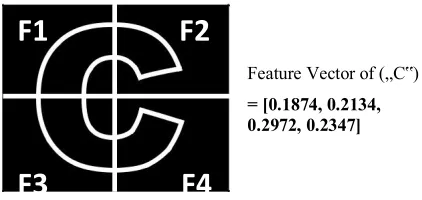
In this method, initially the character is divided into four equal blocks and four features are extracted from every block [15]. These features are formed by calculating edge density in each block. Then these features are used to obtained feature vector of each character, which is compared with feature vectors of all the stored templates. For each block k=1 to 4, the features vector of four features are { f1, f2, f3, f4 } where, f1 is the first feature which is formed by edge density calculation in first block using the following equation:
Where, Bk (i,j) is the edge magnitude of each block, m and n are the dimensions of boundary object image.
F1
F2
Feature Vector of („C‟)
= [0.1874, 0.2134, 0.2972, 0.2347]
F3
F4
Figure 10: Edge Density Calculation
Similarly, f2 is formed by edge density calculation in second block and so on as shown in the Figure 10. The value of the four window blocks represents the
feature vector of that character as feature vector of C character.
After calculating the edge density in each block the 2-D binary image is converted into 1-D feature vector for each character. The feature vector table of these values are used as inputs to the neural network for training purpose of the proposed system. Separate FVT of outputs is maintained for setting the target categories of zeroes and ones of the neural networks to classify the inputs patterns.The feature vector needs to be calculated now.
b. Character Recognition
After feature extraction, feed-forward Artificial Neural Network is employed for character recognition at the second level. The proposed system gives more recognition accuracy; reduce the complexity of the network and increase the processing speed of recognition of characters.
i. Learning Mechanism
Figure : Two-Layered Feed Forward Network
At the point when every competitor character taught to the neural system, it has a relating weight lattice. As the learning of the system advances, this weight grid is redesigned which is instated to zero due to regulated preparing. The Scaled Conjugate Gradient (SCG) calculation is utilized as a part of this as a preparation technique for the neural system, because of its points of interest that it is a speedier strategy and give preferred results over the conventional back spread calculation [13]. The system utilizes the accompanying initiation capacity for both covered up and yield layers:
For the neural system, utilizing more neurons as a part of the shrouded layer will give the more character acknowledgment rate yet this will results in higher number of augmentations, which altogether build the size of the neural system. Along these lines, the created framework upgrades the quantities of neurons give a substantial point of preference of diminishing multifaceted nature.
.
IV CONCLUSION
In this paper, the ANPR framework for Indian number plates is exhibited, as the proposed framework comprise of five fundamental modules, in which by utilizing morphological operations, the issues with the awful quality pictures are determined and by advancing the division process, which gives a decent results for division of characters and numbers, having awesome effect on the acknowledgment precision. Utilizing piece based acknowledgment process which remove just specific components of the characters and numbers, by preparing just valuable pixels of character pictures, rather than utilizing pixels for the entire picture. This framework additionally functions admirably for joined or broken characters, messy pictures, can deal with some level of slant and have great results with the terrible quality pictures, which the other ANPR frameworks have issue with these pictures. This framework can be further enhanced to perceive distinctive states of number plates like square plates and having plates with shaded foundations. More change in framework can be, done in perceiving of shadow pictures and pictures have glare.
REFERENCES
[1] Shyang-Lih Chang, Li- Shien Chen and Yun-Chung Chung, "Automatic license plate recognition," IEEE Transaction on intelligent transportation system, vol.5, no.1, pp.42-53, March 2004.
[2] Hung-Pin Chen, Ming-Hwa Chan and Yn-Her Juang, "Recognition of blurred plate numbers using a novel algorithm based on Hopfield Neural Network,” IEEE International Conference on Systems, Man and Cybernetics, pp. 4744 – 4749, 2004.
[3] Foody, G.M. and Mathur, “A relative evaluation of multiclass image classification by Support Vector Machines,” IEEE Transaction on
Geoscience and Remote Sensing, vol.6, pp.1335-1343, 2004.
[4] Thanin K., Mashohor S. and Al-Faqheri W., “An improved Malaysian Automatic License Plate Recognition (M-ALPR) system using hybrid fuzzy in C++ environment,” International
Conference on
Innovative Technologies in Intelligent Systems and Industrial Applications, pp.51-Feng Yang, ”Character recognition using BP neural network,” International Conference on Audio, Language and Image Processing, pp.1595 – 1599, 7-9, July 2008.
[5] Feng Yang, ”Character recognition using BP neural network,”
International Conference on Audio, Language and Image Processing, pp.1595 – 1599, 7-9, July 2008.
[6] Ankush Roy and Ghoshal, “Number plate recognition for use in different countries using an improved segmentation,” second National Conference on Emerging Trends and Applications in Computer Science (NCETACS), pp.1-5, 4-5, March 2011.
[7] Leelasantitham, “Position-Varied plate utilized for a Thai license plate recognition,” SICE Annual Conference, pp.3303 – 3307, 18-21, Aug.2010.
[8] He Gaunglin and Guo Yali, “Simple and Fast method of recognizing license plate number,”International Forum on Information Technology and Applications, pp.16-20, March 2010.
[9] Jong T.Lee, Matthew Riley and J.K. Aggarwal, “Real-Time illegal parking detection in outdoor environments using 1-D transformation,” IEEE Transaction on Circuits and Systems for Video Technology, vol. 19, no.7, pp. 1014-1024, July 2009.