Available online: https://edupediapublications.org/journals/index.php/IJR/ P a g e | 773
A Study of Comparison between Different Types of Document
Clustering Techniques in Data Mining
G Venkanna1
Asst.Proffesor
Syed Thayyab Hussain2
Asst.Proffesor
1,2Netaji Institute of Engineering & Technology
Abstract:- This paper displays the
aftereffects of a trial investigation of some basic document clustering methods. Specifically, we contrast the two primary methodologies with document grouping, agglomerative Hierarchical clustering and K-means. (For K-means we utilized a "standard" K-means calculation and a variation of K-means, "bisecting" K-means.) Hierarchical grouping is regularly depicted as the better quality clustering approach, yet is constrained due to its quadratic time multifaceted nature. Conversely, K-means and its variations have a period multifaceted nature which is straight in the quantity of documents, however are thought to create mediocre clusters. Now and then K-means and agglomerative Hierarchical methodologies are joined in order to "defeat both
universes." In any case, our outcomes show that the bisecting K-means system is superior to anything the standard K-means approach and in the same class as or superior to anything the progressive methodologies that we tried for an assortment of group assessment measurements. We propose a clarification for these outcomes that depends on an examination of the specifics of the clustering calculations and the way of document information.
Keywords:-Clustering, K-means,
bisecting K-means, Hierarchical
clustering
INTRODUCTION
Available online: https://edupediapublications.org/journals/index.php/IJR/ P a g e | 774
clusters that are sound inside, yet generously not quite the same as each other. In plain words, questions in a similar cluster ought to be as comparable as could be expected
under the circumstances, while
protests in one group ought to be as disparate as conceivable from items in
alternate clusters . Programmed
document clustering has assumed an essential part in many fields like data recovery, information mining, and so forth. The point of this proposal is to enhance the proficiency and exactness of document clustering. We talk about two clustering calculations and the fields where these perform superior to
the known standard clustering
calculations. The principal approach is a change of the chart parceling strategies utilized for document clustering. In this we preprocess the chart utilizing a heuristic and afterward apply the standard diagram dividing calculations. This enhances the nature of groups all things considered.
The second approach is a totally extraordinary approach in which the words are grouped first and afterward the word cluster is utilized to cluster the documents. This lessens the
commotion in information and
consequently enhances the nature of
the clusters. In both these
methodologies there are parameters which can be changed by the dataset in order to enhance the quality and effectiveness.
Document clustering is the
demonstration of gathering
comparable documents into canisters, where similitude is some capacity on
a document. The clustering
calculations executed for LEMUR are depicted in "A Correlation of Document Clustering Methods", Michael Steinbach, George Karypis
and Vipin Kumar. TextMining
Workshop. KDD. 2000. Except for
Probabilistic Inert Semantic
Examination (PLSA), all utilization cosine similitude in the vector space display as their metric.
The LEMUR clustering support gives two guideline APIs, the Group
Programming interface, which
Available online: https://edupediapublications.org/journals/index.php/IJR/ P a g e | 775
there is a solitary SimilarityMethod, CosSim, characterized.
Clustering Methods
1. K-Means
K-means is the most important flat clustering algorithm. The objective function of
K-means is to minimize the average squared distance of objects from their cluster centers, where a cluster center is defined as the mean or centroid μ of the objects in
a cluster C:
1 ∑x | C |
x∈C
The ideal cluster in K-means is a sphere with the centroid as its center of gravity.
Ideally, the clusters should not overlap. A measure of how well the centroids
represent the members of their clusters is the Residual Sum of Squares (RSS), the
squared distance of each vector from its centroid summed over all vectors
RSSi = ∑|| x −μ (Ci ) ||2
x∈Ci
K
RSS = ∑RSSi
i=1
K-means can start with selecting as initial clusters centers K randomly chosen
objects, namely the seeds. It then moves the cluster centers around in space in
order to minimize RSS. This is done iteratively by repeating two steps until a
stopping criterion is met
1. reassigning objects to the cluster with closest centroid
2. recomputing each centroid based on the current members of its cluster. We can use one of the following termination conditions as stopping criterion
• A fixed number of iterations I has been completed. • Centroids μi do not change between iterations.
Available online: https://edupediapublications.org/journals/index.php/IJR/ P a g e | 776
threshold. Algorithm for K-Means
1. procedure KMEANS(X,K)
2. {s1, s2, · · · , sk} SelectRandomSeeds(K,X)
3. for i←1,K do
4. μ(Ci) ← si
5. end for
6. repeat
7. mink~xn−~μ(Ck)k Ck = Ck [ {~xn}
8. for all Ck do
9. μ(Ck) = 1
10. end for
11. until stopping criterion is met 12.end procedure
Hierarchical Clustering
Hierarchical Clustering clustering approaches endeavor to make a progressive disintegration of the given document accumulation consequently accomplishing a progressive structure. Hierarchical techniques are normally arranged into Agglomerative and Divisive strategies relying upon how the progressive system is developed.
Agglomerative strategies begin with an underlying clustering of the term space, where all documents are considered speaking to a different group. The nearest clusters utilizing a
given between group similitude
measure are then consolidated
persistently until just 1 cluster or a predefined number of groups remain.
Straightforward Agglomerative
Clustering Calculation:
1. Compute the likeness between all sets of groups i.e. ascertain a likeness lattice whose ijth passage gives the closeness between the ith and jth clusters.
2. Merge the most comparable
(nearest) two groups.
3. Update the likeness network to mirror the pairwise closeness between the new cluster and the first groups.
Available online: https://edupediapublications.org/journals/index.php/IJR/ P a g e | 777
Divisive clustering calculations begin with a solitary group containing all
documents. It then constantly
partitions clusters until all documents are contained in their own particular group or a predefined number of clusters are found.
Agglomerative calculations are
typically ordered by the between
cluster similitude measure they
utilize. The most prevalent of these
are single-connection, finish
connection and gathering normal. In the single connection technique, the separation between groups is the base separation between any match of components drawn from these clusters (one from each), in the entire connection it is the most extreme
separation and in the normal
connection it is correspondingly a normal separation
The Vector Space Model and Document Clustering
Many issues specific to
documents are discussed more fully in
information retrieval texts [Rij79,
Kow97]. We briefly review a few
essential topics to provide a sufficient
background for understanding
document clustering.
For our clustering algorithms
documents are represented using the
vector-space model. In this model,
each document, d, is considered to be
a vector, d, in the term-space (set of document “words”). In its simplest
form, each document is represented
by the (TF) vector,
dtf = (tf1, tf2, …, tfn),
where tfi is the frequency of the ith
term in the document. (Normally very
common words are stripped out
completely and different forms of a
word are reduced to one canonical
form.) In addition, we use the version
of this model that weights each term
based on its inverse document
frequency (IDF) in the document
collection. (This discounts frequent
words with little discriminating
power.) Finally, in order to account
for documents of different lengths,
each document vector is normalized
so that it is of unit length.
Available online: https://edupediapublications.org/journals/index.php/IJR/ P a g e | 778
documents must be measured in some
way if a clustering algorithm is to be
used. There are a number of possible
measures for computing the similarity
between documents, but the most
common one is the cosine measure,
which is defined as
cosine( d1, d2 ) = (d1•d2) / ||d1|| ||d2|| ,
where • indicates the vector dot product and ||d|| is the length of vector d.
Given a set, S, of documents and their corresponding vector representations,
we define the centroid vector c to be which is nothing more than the vector
obtained by averaging the weights of the various terms present in the documents of
S. Analogously to documents, the similarity between two centroid vectors and
between a document and a centroid vector are computed using the cosine measure,
i.e.,
cosine( d, c ) = (d • c) / ||d|| ||c|| = (d• c) / ||c|| cosine( c1, c2) = (c1 • c2) / ||c1||
||c2||
Note that even though the document
vectors are of length one, the centroid
vectors will not necessarily be of unit
length. (We use these two definitions
in defining two of our agglomerative
hierarchical techniques in Section 7,
the “intra-cluster similarity and “centroid similarity” techniques,
respectively.)
For K-means clustering, the
cosine measure is used to compute
which document centroid is closest to
a given document. While a median is
sometimes used as the centroid for
K-means clustering, we follow the
common practice of using the mean.
The mean is easier to calculate than
the median and has a number of nice
mathematical properties.
For example, calculating the
dot product between a document and
Available online: https://edupediapublications.org/journals/index.php/IJR/ P a g e | 779
calculating the average similarity
between that document and all the
documents that comprise the cluster
the centroid represents. (This
observation is the basis of the
“intra-cluster similarity” agglomerative
hierarchical clustering technique in
section 7.) Mathematically,
Also the square of the length of
the centroid vector is just the average
pairwise similarity between all points
in the cluster. (This includes the
similarity of each point with itself,
which is just 1.) In the following
section, we will use this average
pairwise similarity as the basis for one
of the measures for quantifying the
goodness of a clustering algorithm.
Bisecting k-Means Algorithm
Like any calculation, there are
negatives to the k-Means for
Clustering. To start with, there are settled Circles, which means it's a quadratic calculation in the most pessimistic scenario for the Enormous
Goodness Calculation, which means the execution on vast informational collections is not the best. Besides, separate metric utilized inside the settled Circle is done genuinely, in this manner making for what may be tractability worries for the calculation.
Finally, however in particular
however, is that the calculation has been known to be [1] tend to fall on neighborhood minima rather than worldwide minima because of poor instatement in all likelihood in light of the introduction of the K number of centroids to their separate focuses. All things considered, how can one know what point a given centroid ought to be appointed to? Moreover, no doubt surmises irregular focuses for every centroid (in the most pessimistic scenario) could likewise reason for an execution punishment if the arbitrarily relegated focuses are far away from where the centroids really wind up being. A potential solution for this, is to do a post-preparing of the made Clustered Demonstrate, where the Group to be part is singled out which Group has the most astounding SSE (Aggregate of Squared Mistakes).
Available online: https://edupediapublications.org/journals/index.php/IJR/ P a g e | 780
(i =1..N) ((y (anticipated esteem) - y (genuine esteem)) squared
This will ideally yield for a SSE between the two resultant youngster clusters that is not as much as the SSE for their parent group. Truth be told, this is reason for the calculation known as the Bisecting K-Means calculation which is appeared as underneath.
Summed up Bisecting k-Means Calculation
Beginning Conditions
Begin with the greater part of the focuses in one centroid (i.e. Cluster)
Be that as it may, at present choose the aggregate number of groups fancied
Circle: until the halting condition for the quantity of Clusters has been come to
Circle: for ever cluster
Measure the aggregate mistake for the parent cluster in this current circle's cycle
Apply the K-Means Calculation to the cluster with k= 2
Measure the aggregate SSE mistake of the youngsters groups contrasted with their parent cluster
Picked the group split that gives the most minimal blunder and submit this split
End Circle
End Circle
Not at all like with the K-Means Calculation, you require not introduce a K Number of centroids before the calculation begins since we begin with one group; recall that, it is the arbitrary instatement of centroids to focuses for each cluster before the primary calculation of the K-Means calculation begins that can help for falling on nearby minima rather than worldwide minima. Like with the K-Means Calculation, a foreordained number of groups still should be
settled on before the primary
calculation is begun, which fills in as
the ceasing condition for the
Available online: https://edupediapublications.org/journals/index.php/IJR/ P a g e | 781
conceivable metric to utilize would base on the rate (subordinate) of what amount the SSE is diminishing as parts are being finished?
Be that as it may, back to the fundamental impulse for Bisecting K-means, is that the group whose split is to be conferred, is that parent cluster which when part, brings about the two kids groups that have the most reduced aggregate SSE contrasted with it, when contrasted with all other relative SSE contrasts of other parent/youngster cluster parts. This would propose that it can't be expected that the Cluster with the most astounding SSE is the one that will bring about the least accumulated SSE among its youngsters groups. Every single other split are disposed of.
In conclusion, take note of that the cluster split is finished with the great old k-Means calculation recorded above, aside from that k is set
equivalent to 2 (k=2). The
fundamental point however, is that Bisecting K-Means calculation has been appeared to bring about better group task for information focuses, joining to worldwide minima as than
that of stalling out in nearby minima as K-Means does.
Comparison of Agglomerative Hierarchical Techniques
In this section we compare
three different agglomerative
hierarchical schemes against one
another. We will then compare the
“best” of these algorithms against our
K-means and bisecting K-means
algorithms.
Before describing the results,
we briefly describe the different
hierarchical clustering algorithms that
we used. As mentioned before, the
only real difference between the
different hierarchical schemes is how
they choose which clusters to merge,
i.e., how they choose to define cluster
similarity.
Techniques
Intra-Cluster Similarity
Technique (IST): This hierarchical
technique looks at the similarity of all
the documents in a cluster to their
cluster centroid and is defined by
Available online: https://edupediapublications.org/journals/index.php/IJR/ P a g e | 782
= åcosine(d, c) , where d is a
document in cluster, X, and c is the centroid of cluster X. The
d∈ X
choice of which pair of clusters to
merge is made by determining which
pair of clusters will lead to smallest
decrease in similarity. Thus, if cluster
Z is formed by merging clusters X and
Y, then we select X and Y so as to
maximize Sim(Z) – (Sim(X) +
Sim(Y)). Note that Sim(Z) – (Sim(X)
+ Sim(Y)) is non-positive.
Centroid Similarity
Technique (CST): This hierarchical
technique defines the similarity of two
clusters to be the cosine similarity
between the centroids of the two
clusters.
UPGMA: This is the UPGMA scheme as described in [DJ88, KR90]. It defines the
åcosine(d1, d2 )
d1∈ cluster1
cluster similarity as follows,
similarity(cluster1, cluster2) =
d2∈ cluster 2
size(cluster1) * size(cluster2) where d1 and d2 are, documents, respectively, in cluster1 and cluster2.
Results
The F-measure results are shown in table 8 – larger is better. UPGMA is the
best, although the two other techniques are often not much worse.
Data Set UPGMA Centroid Cluster
Similarity Similarity
re0 0.5859 0.5028 0.5392
re1 0.6855 0.5963 0.5509
wap 0.6434 0.4977 0.5633
tr31 0.8693 0.7431 0.7989
Available online: https://edupediapublications.org/journals/index.php/IJR/ P a g e | 783
Fbis 0.6717 0.6470 0.6233
la1 0.6963 0.4557 0.5977
la2 0.7168 0.4531 0.5817
Table 2: Comparison of the F-measure for Different Clustering Algorithms
The entropy results are shown
in figures 1 - 8. Notice that UPGMA
and IST are the best, with similar
behavior with respect to entropy. CST
does poorly. Figures 1, 5, and 6
indicate that CST does about as well
with respect to entropy as do IST and
UPGMA in the initial phases of
agglomeration, but, at some point,
starts “making mistakes” as to which
clusters to merge, and its performance
diverges from the other schemes from
then on. In the cases represented by
the other figures, this divergence
happens earlier. UPGMA shows
similar behavior, but only when the
number of clusters is very small.
Overall, UPGMA is the best
performing hierarchical technique that
we investigated and we compare it to
K-means and bisecting K-means in
the next section
Comparison of K-means, Bisecting K-means and UPGMA
Here we provide some brief details of how we performed the runs that produced the results
we are about to discuss.
For these experiments we
equalized the number of runs for
bisecting K-means versus customary
K-means. In the event that ITER is
the quantity of trial bisections for
each period of bisecting K-means
and K is the quantity of groups
looked for, then a bisecting K-means
run is identical to log2 (K) * ITER
customary K-means runs. (There are
what might as well be called ITER
K-means keeps running for the entire
arrangement of documents for each
of the log2 (K) levels in the
Available online: https://edupediapublications.org/journals/index.php/IJR/ P a g e | 784
bisecting K-means, we set ITER = 5.
We did 10 keeps running of the
bisecting K-means and for each keep
running of the bisecting K-means we
performed log2 (K) * ITER keeps
running of a standard K-means.
Since Hierarchical clustering
produces a similar outcome without
fail, there was no compelling reason
to lead numerous keeps running for
UPGMA.
There is additionally another
issue that must be specified. Both
bisecting K-means and Hierarchical
clustering produce clustering comes
about that can be further "refined" by
utilizing the K-means calculation.
That is, if the centroids of the groups
delivered by these two methods are
utilized as the underlying centroids
for a K-means clustering calculation,
then the K-means calculation will
change these underlying centroids
and rearrange the clusters. The key
question here is whether such
refinement will enhance the nature of
the clusterings created.
We likewise say that
progressive clustering with a
K-means refinement is basically a
Hierarchical K-mean half breed that
is like procedures that other
individuals have attempted.
Specifically, the
Disseminate/Assemble framework
[CKTP92] utilizes Hierarchical
clustering to create "seeds" for a last
K-means stage.
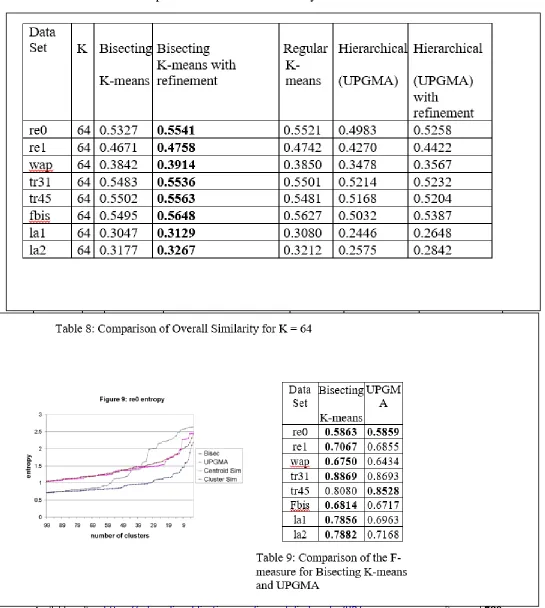
Tables 3 - 5 demonstrate the
entropy aftereffects of these runs,
while tables 6 - 9 demonstrate the
general likeness comes about. Figure
10 additionally indicates entropy
comes about and is simply Figure 1
with the entropy comes about for
bisecting K-means included. Table 8
Available online: https://edupediapublications.org/journals/index.php/IJR/ P a g e | 785
between F values for bisecting
K-means and UPGMA. We express the
three principle comes about
concisely.
• Bisecting K-means, with
or without refinement is superior to
anything standard K-means and
UPGMA, with or without
refinement, as a rule. Indeed, even in
situations where different plans are
better, bisecting K-means is just
marginally more terrible.
• Refinement
fundamentally enhances the
execution of UPGMA for both the
general comparability and the
entropy measures.
• Regular K-means, albeit
more terrible than bisecting
K-means, is by and large superior to
anything UPGMA, even after
refinement.
We make a couple brief
remarks on the way that we did
different keeps running of K-means
and bisecting K-means. For bisecting
K-means, this did not enhance the
outcomes much as this calculation
tends to create generally predictable
outcomes. For standard K-means, the
outcomes do change a lot starting
with one run then onto the next. In
this way, one keep running of
customary K-means may create
comes about that are not in the same
class as those delivered by UPGMA,
even without refinement.
In any case, even many keeps
running of means or bisecting
K-means are altogether speedier than a
solitary keep running of a hierarchal
clustering calculation, especially if
the informational collections are
vast. For instance, for the
Available online: https://edupediapublications.org/journals/index.php/IJR/ P a g e | 786
3204 documents and 31,472 terms, a
solitary progressive clustering run
takes well in overabundance of a
hour on a cutting edge Pentium
framework. By correlation, a solitary
bisecting K-means rush to discover
32 groups takes not as much as a
moment on a similar machine.
Data
Set K Bisecting Bisecting Regular Hierarchical Hierarchical
K-means
K-means with refinement
K-means (UPGMA) (UPGMA)
with
refinement
re0 16 1.3305 1.1811 1.3839 1.9838 1.4811
re1 16 1.6315 1.7111 1.6896 2.0058 1.7361
wap 16 1.5494 1.5601 1.8557 2.0584 1.8028
tr31 16 0.4713 0.4722 0.5228 0.8107 0.5711
tr45 16 0.6909 0.6927 0.7426 1.1955 0.8665
fbis 16 1.3708 1.4053 1.3198 1.8594 1.3832
la1 16 0.9570 0.9511 1.0710 2.4046 1.2390
Available online: https://edupediapublications.org/journals/index.php/IJR/ P a g e | 787
Table 3: Comparison of the Entropy for Different Clustering Algorithms for K = 16
Data
Set K Bisecting Bisecting Regular Hierarchical Hierarchical
K-means
K-means with refinement
K-means (UPGMA) (UPGMA)
with
refinement
re0 32 1.0884 1.1085 1.2064 1.5850 1.3969
re1 32 1.4229 1.3148 1.4290 1.5360 1.2138
wap 32 1.3314 1.2482 1.4422 1.7201 1.5252
tr31 32 0.2940 0.3327 0.4281 0.5123 0.4641
tr45 32 0.5676 0.4991 0.5293 0.7312 0.4730
fbis 32 1.1872 1.2060 1.2618 1.4538 1.2841
la1 32 0.8659 0.9149 1.0626 1.5375 1.0111
la2 32 0.8969 0.8463 0.9659 1.3568 0.9623
Table 4: Comparison of the Entropy for Different Clustering Algorithms for K = 32
Data
Set K Bisecting Bisecting Regular Hierarchical Hierarchical
K-means
K-means with refinement
K-means (UPGMA) (UPGMA)
with
refinement
re0 64 1.0662 0.9428 0.9664 1.3215 1.1764
re1 64 1.0249 0.9869 1.1177 1.1655 0.9826
wap 64 1.1066 1.0783 1.2807 1.3742 1.2825
tr31 64 0.3182 0.2743 0.3520 0.3985 0.3855
tr45 64 0.4613 0.4199 0.4308 0.4668 0.3913
fbis 64 1.0456 1.0876 1.0504 1.2346 1.1430
la1 64 0.8698 0.8748 1.0084 1.3082 1.0066
Available online: https://edupediapublications.org/journals/index.php/IJR/ P a g e | 788
Table 5: Comparison of the Entropy for Different Clustering Algorithms for K = 64
Data
Set K Bisecting Bisecting Regular Hierarchical Hierarchical
K-means
K-means with refinement
K-means (UPGMA) (UPGMA)
with
refinement
re0 16 0.4125 0.4137 0.4158 0.3157 0.3784
re1 16 0.3325 0.3341 0.3317 0.2703 0.3084
wap 16 0.2763 0.2771 0.2703 0.2440 0.2533
tr31 16 0.4212 0.4231 0.4204 0.3560 0.3619
tr45 16 0.4182 0.4204 0.4190 0.3561 0.3739
fbis 16 0.4464 0.4496 0.4514 0.3657 0.4189
la1 16 0.2228 0.2244 0.2198 0.1420 0.1995
la2 16 0.2282 0.2299 0.2276 0.1694 0.2019
Table 6: Comparison of the Overall Similarity for K = 16
Data
Set K Bisecting Bisecting Regular Hierarchical Hierarchical
K-means
K-means with refinement
K-means (UPGMA) (UPGMA)
with
refinement
re0 32 0.4677 0.4788 0.4778 0.4136 0.4421
re1 32 0.3957 0.4009 0.4009 0.3369 0.3690
wap 32 0.3226 0.3258 0.3235 0.2786 0.2876
tr31 32 0.4802 0.4866 0.4795 0.4373 0.4441
tr45 32 0.4786 0.4827 0.4763 0.4299 0.4382
fbis 32 0.4989 0.5071 0.5110 0.4435 0.4827
la1 32 0.2606 0.2640 0.2596 0.1922 0.2247
Available online: https://edupediapublications.org/journals/index.php/IJR/ P a g e | 789
Table 7: Comparison of Overall Similarity for K = 32
Available online: https://edupediapublications.org/journals/index.php/IJR/ P a g e | 790
CONCLUSION
This paper introduced the
consequences of a test investigation of
some basic document clustering
procedures. Specifically, we
contrasted the two principle
approaches with document clustering,
agglomerative Hierarchical clustering
and K-means. For K-means we
utilized a standard K-means and a
variation of means, bisecting
K-means. Our outcomes show that the
bisecting K-means procedure is
superior to anything the standard
K-means approach and as great or
superior to anything the Hierarchical
approaches that we tried. All the more
particularly, the bisecting K-means
approach creates altogether better
clustering arrangements reliably as
indicated by the entropy and general
similitude measures of cluster quality.
Besides, bisecting K-means appears to
be reliably to improve at creating
document progressive systems (as
measured by the F measure) than the
best of the Hierarchical methods,
UPGMA. What's more, the run time
of bisecting K-means is exceptionally
appealing when contrasted with that
of agglomerative Hierarchical
clustering procedures - O(n) versus
O(n2).
The reason that our relative
positioning of K-means and
Hierarchical calculations contrasts
from those of different scientists
could be because of many elements.
To begin with we utilized many keeps
running of the customary K-means
calculation. In the event that
agglomerative Hierarchical clustering
methods, for example, UPGMA are
contrasted with a solitary keep
running of K-means, then the
correlation would be a great deal
Available online: https://edupediapublications.org/journals/index.php/IJR/ P a g e | 791
procedures. Besides, we utilized
incremental refreshing of centroids,
which likewise enhances K-means.
Obviously, we additionally utilized
the bisecting K-means calculation,
which, as far as anyone is concerned,
has not been already utilized for
document clustering. While there are
numerous agglomerative Hierarchical
strategies that we didn't attempt, we
tried a few different methods which
we didn't report here. The outcomes
were similar– bisecting K-means
executed also or
better then the progressive systems
that we tried. At last, take note of that
Hierarchical clustering with a
K-means refinement is basically a half
breed progressive K-means plot like
other such plans that have been
utilized before [CKPT92]. What's
more, this plan was superior to any of
the Hierarchical procedures that we
attempted, which gives us extra trust
in the generally great execution of
bisecting K-means opposite
progressive methodologies.
We alert that the primary point our
paper is not an announcement that
bisecting K-means is "predominant"
to any conceivable varieties of
agglomerative Hierarchical clustering
or conceivable half breed blends with
K-means. Nonetheless, given the
direct run-time execution of bisecting
K-means and the reliably great nature
of the clusterings that it produces,
bisecting K-means is a fantastic
calculation for clustering a substantial
number of documents.
We contended that agglomerative
Hierarchical clustering does not do
well due to the way of documents,
i.e., closest neighbors of documents
frequently have a place with various
classes. This makes agglomerative
Hierarchical clustering methods
Available online: https://edupediapublications.org/journals/index.php/IJR/ P a g e | 792
the progressive plan. Both the
K-means and the bisecting K-K-means
calculations depend on a more
worldwide approach, which viably
sums to taking a gander at the
closeness of focuses in a group
concerning every single other point in
the cluster. This view likewise
clarifies why a K-means refinement
enhances the entropy of a Hierarchical
clustering arrangement.
At long last, we set forward the
possibility that the better execution of
bisecting means versus general
K-means is because of certainty that it
creates moderately consistently
measured clusters rather than groups
of broadly differing sizes.
REFERENCES
[1.] Steinbach, M., Karypis, G., &
Kumar, V. (2000, August). A
comparison of document clustering
techniques. In KDD workshop on
text mining (Vol. 400, No. 1, pp.
525-526).
[2.] Jain, A. K. (2010). Data clustering:
50 years beyond K-means. Pattern
recognition letters, 31(8), 651-666.
[3.] Fung, B. C., Wang, K., & Ester, M.
(2003, May). Hierarchical document
clustering using frequent itemsets. In
Proceedings of the 2003 SIAM
International Conference on Data
Mining (pp. 59-70). Society for
Industrial and Applied Mathematics.
[4.] Jing, L., Ng, M. K., & Huang, J. Z.
(2007). An entropy weighting
k-means algorithm for subspace
clustering of high-dimensional
sparse data. IEEE Transactions on
knowledge and data engineering,
19(8).
[5.] Kanungo, T., Mount, D. M.,
Netanyahu, N. S., Piatko, C. D.,
Silverman, R., & Wu, A. Y. (2002).
An efficient k-means clustering
algorithm: Analysis and
implementation. IEEE transactions
Available online: https://edupediapublications.org/journals/index.php/IJR/ P a g e | 793 intelligence, 24(7), 881-892.
[6.] Beil, F., Ester, M., & Xu, X. (2002,
July). Frequent term-based text
clustering. In Proceedings of the
eighth ACM SIGKDD international
conference on Knowledge discovery
and data mining (pp. 436-442).
ACM.
[7.] Zhao, Y., & Karypis, G. (2002,
November). Evaluation of
hierarchical clustering algorithms for
document datasets. In Proceedings of
the eleventh international conference
on Information and knowledge
management (pp. 515-524). ACM.
[8.] Zhao, Y., Karypis, G., & Fayyad, U.
(2005). Hierarchical clustering
algorithms for document datasets.
Data mining and knowledge
discovery, 10(2), 141-168.
[9.] Pantel, P., & Lin, D. (2002, August).
Document clustering with
committees. In Proceedings of the
25th annual international ACM
SIGIR conference on Research and
development in information retrieval
(pp. 199-206). ACM.
[10.] Pantel, P., & Lin, D. (2002,
July). Discovering word senses from
text. In Proceedings of the eighth
ACM SIGKDD international
conference on Knowledge discovery
and data mining (pp. 613-619).
ACM.
[11.] Boley, D., Gini, M., Gross,
R., Han, E. H. S., Hastings, K.,
Karypis, G., ... & Moore, J. (1999).
Partitioning-based clustering for web
document categorization. Decision
Support Systems, 27(3), 329-341.
[12.] Hassan-Montero, Y., &
Herrero-Solana, V. (2006, October).
Improving tag-clouds as visual
information retrieval interfaces. In
International conference on
multidisciplinary information
sciences and technologies (pp.
25-28).
[13.] Berkhin, P. (2006). A survey
of clustering data mining techniques.
In Grouping multidimensional data
(pp. 25-71). Springer Berlin
Heidelberg.
[14.] Archetti, F., Campanelli, P.,
Fersini, E., & Messina, E. (2006,
June). A hierarchical document
clustering environment based on the
Available online: https://edupediapublications.org/journals/index.php/IJR/ P a g e | 794 International Conference on Flexible
Query Answering Systems (pp.
257-269). Springer Berlin Heidelberg.
G Venkanna
Assistant Professor
Netaji Institute of Engineering
& Technology
Syed Thayyab Hussain
Assistant Professor
Netaji Institute of Engineering