Pyramidal Algorithm for Image Sharpening
& Edge Detection Using DWT-UM
Sakshi Setia1 & Mr. Sajjan Singh2
1Electronics & Communication Engg. Department
BRCM COLLEGE OF ENGINEERING & TECHNOLOGY, Bahal,India
2Electronics & Communication Engg. Department
BRCM COLLEGE OF ENGINEERING & TECHNOLOGY, Bahal,India
Abstract:
Digital Image Processing(DIP) which is a field under Image Processing may be subdivided into the following categories: restoration, enhancement, coding, and understanding. The objective is to obtain a symbolic description of the scene, leading to autonomous machine reasoning and perception and to enhance the image for purpose of human interpretation and improving visual appearance. It is built on a base of 1D and 2D signal processing theory. Sharpening is one of the most impressive transformations one can apply to an image since
it seems to bring out image details that were not there before. A large number of algorithms have been designed for this purpose such as Unsharp Masking (UM),. we have also measured the amount of sharpness by using the percentage of rise in values parameter. Finally the results for the image enhancement by using UM and DWT-UM techniques have been compared and have shown that there is enormous enhancement in image reproduction by using the proposed algorithm.
Keywords:
Digital Image Processing,
1. Introduction
We depend heavily on our vision to make sense
of the world around us. We not only look at
things to recognize them, but we can scan for
differences, and obtain an overall rough feeling
for a scene with a quick look. Humans have very
exact visual skills: we can recognize a face in an
instant; we can differentiate colors; we can
process a large amount of visual information very
quickly. For our purposes, an image is a single
picture which represents something. It may be a
picture of a person, of people or nature [1], [2],
or of an outdoor scene, or the result of medical
imaging, or a microphotograph of an electronic
component, An image is represented as a Two
Dimensional (2D) array of coefficients also
called pixels, each coefficient representing the
brightness level in that point.
It is not possible to differentiate between
coefficients, which are more important ones, and
lesser important ones. Most natural images have
smooth color variations, with the fine details
being represented as sharp edges in between the
smooth variations. In this paper we will describe
a brief knowledge of all techniques and
algorithms for sharpening the images and also
about the DWT. The fundamental idea of image
sharpening is to add to the input signal a
high-pass filtered version of the signal itself. Wavelet
coefficients provide multi-resolution high
frequency components of an image. Making use
of this property, a sharpening algorithm is
proposed in this paper.
2. Proposed Algorithum
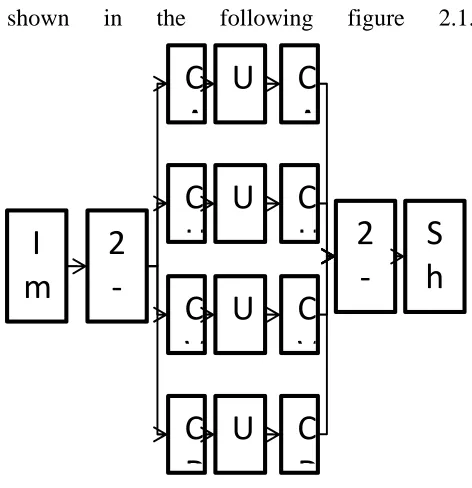
Here we propose an algorithm [3] that used the
both UM and 2-D DWT transform. After taking
the 2-D DWT transform of image, we got the
approximation (CA) and detail coefficients (CH,
CV, CD). Then these coefficients are modified
by processing with UM. The complete process is
shown in the following figure 2.1.
Figure 2.1: Proposed algorithm to compute the
sharper image using 2D DWT and UM
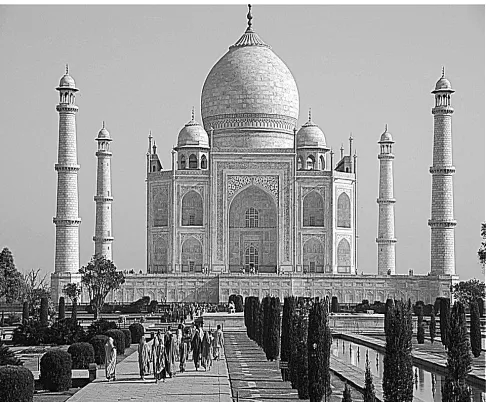
In this we modified the coefficients by passing
them through the UM, and got new coefficients
difference between 1 level 2-D DWT transform
shown in fig.2.2 and modified 2 level 2-D DWT
transform of the Taj Mahal image shown in
fig.2.3 [4] The main purpose of using UM on the
transform is to obtain the high-frequency spatial
detail.
Figure 2.2: Modified 1 level 2D DWT of Taj
Mahal
Figure 2.3: Modified 2 level 2D DWT of the Taj
Mahal
3. DWT and UM Based
Technique
In this paper introduction and importance of
DWT in digital image processing is described
[5]. Combining DWT and UM we proposed a
new technique to sharp the edges in gray scale
images. UM and our proposed
algorithm(DWT-UM) are applied to the test image in fig.3.1 and
fig.3.2 & 3.3 compares the operation of proposed
algorithm to the UM. In this process, only 1 level
resolution is taken, since a higher level tends to
give a very excessive overshoot on the edges.
Figure 3.2: Processed with Unsharp
Masking(UM)
Figure 3.3: Processed with our proposed
scheme (DWT-UM)
Comparison between UM and DWT-UM
We can see that image shown in figure 3.3
obtained from our proposed algorithm is much
more sharp and better than that obtained from
UM shown in figure 3.2.
4. Results
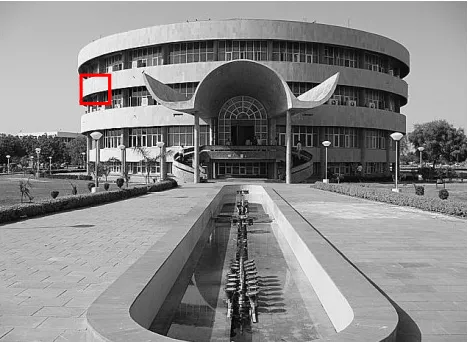
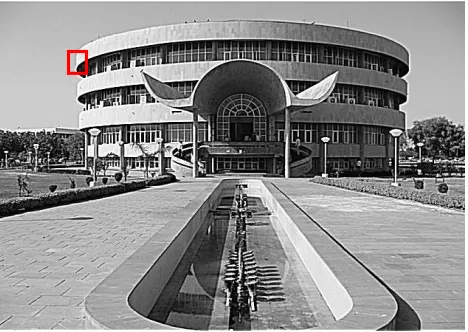
To observe the modification in coefficient
values, before and after processing with
DWT-UM, we have taken a part of sample picture
shown in figures 4.1, 4.2, and 4.3 [6]. Small part
for observation inside the red rectangle has an
edge. The values of the pixels inside this box are
shown in tables. Red values in the table presents
low frequency elements left to the edge of
building, and green values represents the edge.
From the tables we observe that there is increase
in values at once just after the red values. This
shows the occurrence of high frequency elements
or pixels or we can say the presence of edge.
Table 4.1: Values of pixels in a small part of
original image
Amount of Sharpness:
Average value of red values in 5th column ( ) =0.7792,
Average value of green values in 6th column
( ) =0.8651,
Percentage of rise in values ( ) =
( )×
=
( . . )×
. = 11.02%.
Figure 4.2: Sharpen image with Unsharp
Masking (UM)
Table 4.2: Values of pixels in a small part of
image processed with UM
Amount of Sharpness:
Average value of red values in 5th column ( ) =0.7047,
Average value of green values in 6th column
Percentage of rise in values ( ) =
( )×
=
( . . )×
. = 28.85%.
So by using UM technique, the amount of
sharpening increased from 11.02% to 28.85%.
Figure 4.3: Sharpen image after processed with
DWT-UM
Table 4.3: Values of pixels in a small
part of image processed with DWT- UM
Amount of Sharpness:
Average value of red values in 5th column ( ) =0.6582,
Average value of green values in 6th column
( ) =0.9194,
Percentage of rise in values ( ) =
( )×
= ( . . )×
. = 39.38%.
Using rise value parameter, it is observed that
there is 11.02%, 28.85% and 39.38% [8]rise in
values near the edge of original sample image,
image after processed with UM method and
image after processed with DWT-UM method
respectively. So there is a large enhancement in
5. Applications of DIP
Image processing has an enormous range of
applications; almost every area of science and
technology can make use of image processing
methods. Here is a short list just to give some
indication of the range of image processing
applications.
5.1Medicine
• Inspection and interpretation of images obtained from X-rays, MRI or CAT
scans,
• Analysis of cell images, of chromosome types.
5.2 Agriculture
• Satellite/aerial views of land, for example to determine how much land is
being used for different purposes, or to
investigate the suitability of different
regions for different crops,
• Inspection of fruit and vegetables distinguishing good and fresh produce
from old.
5.3 Industry
• Automatic inspection of items on a production line,
• Inspection of thesis samples.
5.4 Law enforcement • Fingerprint analysis,
• Sharpening or de-blurring of speed-camera images.
6. Conclusion
The objective of the paper we have proposed a
new algorithm that makes use of both DWT and
UM techniques to update the coefficients values.
The algorithm makes use of the correlation
between different wavelet planes to select a set of
high frequency coefficients describing the edges
of the original image. The updated coefficients
are used to calculate the inverse DWT,
generating a new image with enhanced visual
quality.
7. Future Work
The knowledge is ever expanding and so are the
problems which the mankind strive to solve. This
work focused on gray-scale images. The future
scope of this work can be extended to improve
the sharpening of color images.
REFERENCES:
[1] Joshua Gluckman, “Higher order whitening of natural images”,
[2] Alasdair McAndrew, “Introduction to
digital image processing with Matlab”,
[3] Takeshi Agui, Toru Yamanouchi And
Masayuki Nakajima, “An Algebraic
Description of Painted Digital Pictures”,
[4] “A historical building
image”http://www.partenia.org/images/2
00702/SacreCoeur5.jpg
[5] Houtan Haddad Larijani, Gholamali
Rezai Rad, “A New Spatial Domain
Algorithm for Gray Scale Images Watermarking”,
[6] G.J.U.S.&T. Library”
http://www.iitmgju.org/images/gju%20b
uilding.jpg.
[7] O. Rioul and M. Vetterli, “Wavelet and
signal processing”, IEEE Signal Processing Magazine, vol. 8, no. 4, pp.
14–38, 1991
[8] Math Works, “Matlab help files, Image
Processing Toolbox”, version 7.5.0.342,