ISSN 2348 – 7968
Muffler Optimization for Increased Fuel Efficiency
Iterations Using Taguchi Orthogonal Array for Controlling CO
2
Mylaudy Dr. S. Rajadurai1, Naveen. S2
1
Head of Research and Development, Sharda Motor Industries Limited, Chennai, Tamil Nadu-603002, India
2
Senior Engineer, Sharda Motor Industries Limited – R&D, Chennai, Tamil Nadu-603002, India
Abstract
In a pursuit towards improving the fuel efficiency and carbon di-oxide (CO2) control, the paper shall be confined to optimize exhaust systems to have a reduced back pressure (BP) output which has a direct influence on fuel efficiency. This objective is achieved by an experimental study and to reduce the huge number of iterations; Design of Experiments (DoE) technique is used which shall pave way for reduced number of experimental analysis on different setups of exhaust systems. Results are achieved using Flow Analysis-Flow Lab and Engine Lab with constant inlet mass flow rate and inlet temperature (engine conditions). This methodology shall give a direct behavior of different exhaust setups for the same engine conditions and the exhaust system setup that achieves the most reduced BP output shall be chosen as the optimized assembly.
Keywords: Fuel efficient vehicle, muffler optimization, back pressure reduction, design of experiments (DoE), CO2 control
1. Introduction
The objective of this project is to investigate the various factors that have a direct relation with back pressure created in the exhaust system. Experiments are carried out using different exhaust setup and DOE methodology is implemented to reduce the number of experimentations carried out. The parameters considered for optimization are percentage openness in baffle, number of baffles in muffler, inlet profile of the muffler, outlet profile of the muffler, tail pipe, diameter of the pipe and number of bends in exhaust pipe [2]. Experiment has been done with seven factors at two levels. An orthogonal array of L16 is created for the statistical design of experiments based on Taguchi method.
The testing was conducted on a SI engine but the science holds good for both CI and SI engines. Only the fuel efficiency target achieved shall have a different number
compared to CI engine and CO2 reduction will have an exponential variation.
In any engine the exhaust back pressure has a direct impact on %fuel consumption. They have an exponential relation wherein any increase in BP will reduce fuel efficiency exponentially. The paper shall explain an experimental methodology to optimize the exhaust muffler to increase the fuel efficiency of the vehicle. The iterations assure 11-12% increase in fuel efficiency. From the data measured and tabulated, CO2 released from exhaust system based on fuel used can be calculated because fuel consumption has a direct correlation with CO2 released. This leads the project aiming at two important results of increasing the fuel efficiency of a vehicle through exhaust optimization to reduce back pressure and also in hand control CO2 emission through exhaust. CO2 emission control to an extent of 63% is estimated to be possible.
ISSN 2348 – 7968
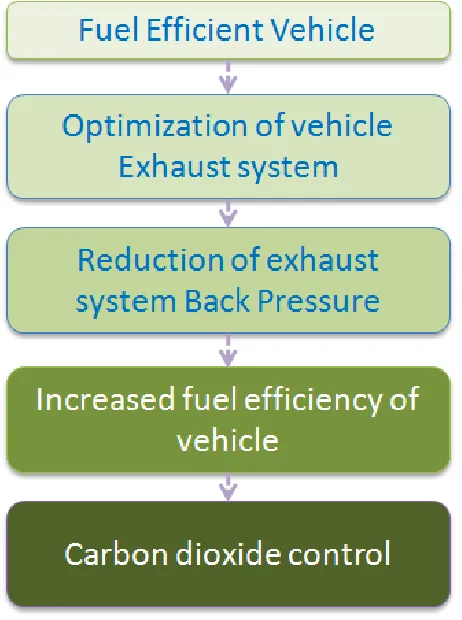
Fig. 2 Dependence criteria of exhaust system and fuel consumption
2. Steps in Experimentation
The experimenter must clearly define the purpose and scope of the experiment.
The objective of the experiment may be, for example to determine the optimum operating conditions for a process to evaluate the relative effects on product performance of different sources of variability or to determine whether a new process is superior to the existing one.
The experiment will be planned properly to collect data in order to apply the statistical methods to obtain valid and objective conclusions. The following seven steps procedure may be followed:
1) Problem statement
2) Selection of factors, levels and range 3) Selection of response variable 4) Choice of experimental design 5) Experiment Setup and Conditions 6) Analysis of data
7) Inference from analysis of variance
2
.1 Problem Statement
To find the optimum solution to design an exhaust system for increased fuel efficiency needs various experiments and iterations. The time and resources for conducting experiments incurs more cost. Design of analysis and experiments is the tool to reduce the time and number of experiments and to find the optimal solution.
2.2 Selection of Factors, Levels and Ranges
These factors include the design factory which can be controlled during experimentation. Identification of these factory leads to the selection of experimental design. Often, the experience and the specialized knowledge of engineers and scientists dominate the selection of factors.
The Various factors considered for the iterations are chosen after close consideration and quantitative comparison of its effect on the exhaust back pressure value. To bring clarity, a comparison graph is plotted with different diameter of pipes used inside the muffler and the variations between mass flow rate and back pressure are reflected as shown in the graph.
Fig. 3 Performance comparison between tubes with different perforations
ISSN 2348 – 7968
Fig. 5 Reduced number of baffle plated for Back Pressure reduction
2.3.1 Factors
A total of seven factors were selected by taking opinion from several experts.
Percentage of openness in baffle of muffler.
Number of baffles in muffler
Inlet profile of muffler
Outlet profile of muffler
Diameter of pipe
Number of restrictions
Tail pipe.
2.3.2 Response
Backpressure reading.
Corresponding CO2 level in exhaust gas
2.4. Choice of Experimental Design
Experimentation design is a body of knowledge and techniques that assist the experimenter, to conduct iterations economically, analyze data and make connections between the conclusions from the analysis and the original objectives of the investigation. [4]
The traditional approach in the industrial and the scientific investigation is to employ trial and error methods to verify and validate the theories that may be advanced to explain some observed phenomenon. This may lead to prolonged experimentation and without good results. Some of the approaches also include one factor at time experimentation, several factors one at a time and several factors all at the same time.
2.5 Experimentation Setup and Conditions
The exhaust system is divided in to two parts, hot end and cold end. The region between Exhaust manifold and a catalytic converter is hot end, catalytic converter to muffler
for the exhaust system of a definite petrol engine and the measured readings are correlated to find the optimum result.
Fig. 6 Exhaust System Classification
2.5.1 Setting the Boundary Conditions
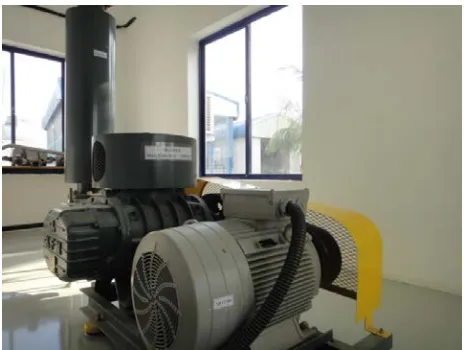
A blower is a machine for moving volumes of a gas with moderate increase of pressure.
Fig. 7 Blower – Experimental apparatus for setting engine conditions
ISSN 2348 – 7968
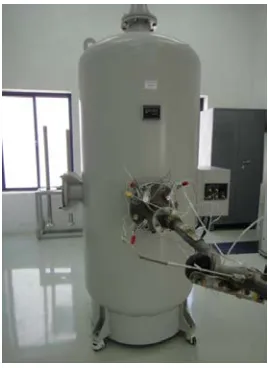
Fig. 8 Blower Tank – Experimental apparatus for setting engine conditions
In the experimental setup, the pressure sensor measures the backpressure at the exit of the exhaust system. From the CO2 emission report, the CO2 emission level will be extrapolated against the measured backpressure.
BSFC=r/p g/kWh
P can be obtained from engine specification r =BSFC*p kg/h
We know,
1ltr petrol = 750 grams; this shall help to convert r from
kg/hr to l/h and for every 1l of petrol, CO2 emission =
2392 grams (at fixed rpm and mass flow rate for 1 hour)
CO2 output for the amount of fuel consumed =
2392*r kg/h
CO2 emitted for consumed amt of petrol per
minute = 2392*r*60 kg/m
2.6 Analysis of Data
2.6.1 Choice of Orthogonal Array
Degrees of freedom required,
Main factors = 7(each factor has one degree of
freedom)
Total degrees of freedom = 7
To accommodate 7df, we will use L8(27) or L12(211) or L16(215) OA.
Here L16(215) OA is chosen for better results.
Table 1: Factors under consideration for orthogonal array
Table 2: Orthogonal Array
ISSN 2348 – 7968
Table 3: Ranking of factors
Average response Ȳ= Grand total of all observations / Total number of observations
Ȳ= 539.1875
Fig. 9 Mititab interpolation
2.6.2 Predicting Optimum Conditions
Based on the objective of the experiment, in each level minimum value is taken for optimum condition.
B2 E2 G1 F2 A2 D1 C2
µ prediction=Ȳ+(B2-Ȳ)+(F2-Ȳ)+(G1-Y)+(E2-Ȳ)+(A2-Ȳ)+(D1-Ȳ)+(C2-Ȳ)
µ
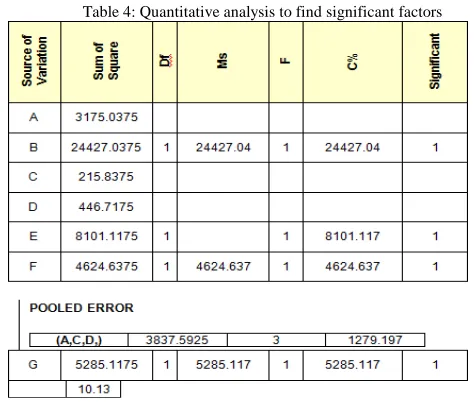
prediction : 978.05 Correction Factor : 4651570.653Table 4: Quantitative analysis to find significant factors
2.7 Inference from Analysis of Variance
Table 5: Measured back pressure and calculated CO2 readings
ISSN 2348 – 7968
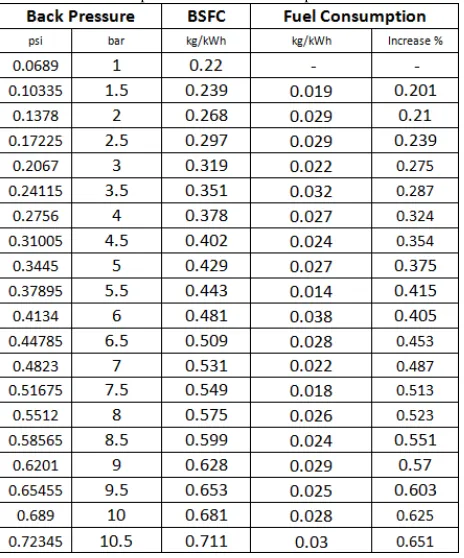
Table 6:Back pressure and fuel consumption correlation
2.7.1 Correlation
of results
This completes examining the effects of various mounting design of exhaust system and the effects of various factors of internals in the muffler. The experimental inlet conditions and boundary conditions were set appropriately that it represented the conditions encountered by a gasoline vehicle exhaust system.
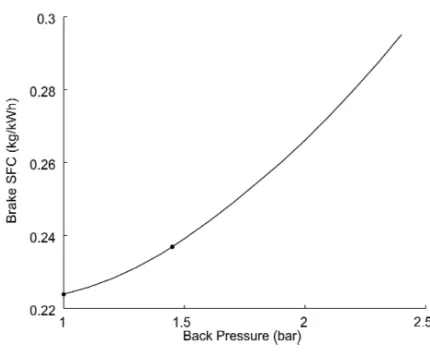
Figure 10: Back pressure Vs brake specific fuel consumption
From figure 10 it is evident that any increase in back pressure has a significant impact on the fuel consumption. The measured readings in table 8, shows a clear comparison between Back pressure and BSFC. The large-scale analysis predicts a linearity between the two but by micro managing the relation between the two and
considering real time situations like driving capability of the driver, climate and road conditions, aerodynamics of the vehicle they have an exponential relation that is, any increase in back pressure has an exponential and adverse effect on the operation and reliability of the engine. It reduces the fuel economy of the vehicle in particular.
Figure 11: Back pressure Vs CO2 emission
Figure 11 shows the correlation and is derived from the direct relation between fuel consumption and the amount of CO2 released to the atmosphere. The estimation is for a definite engine at a defined condition and hence will vary between different driving conditions.
3. Conclusion
The iterations conclude that, number of baffles in the exhaust muffler contributes more than 52% of back pressure increase in the exhaust system. The increase in back pressure has an exponential relation with fuel efficiency and directly reduces fuel efficiency of the vehicle.
With optimized design CO2 control to an extent of 63% is estimated to be possible and also 11-12% increase in fuel efficiency can also be achieved with exhaust system optimization.
4. Future Works
The project shall be refined and a full exhaust system shall be optimized to give more efficient exhaust system. For this the factors under consideration for experimentation shall include;
4.1 Emission Control Components
Substrate - Flow through Catalytic Converters
Wall Flow Traps included in hot end (Particulate Filters, HC traps, NOx traps etc.)
ISSN 2348 – 7968
recirculation of exhaust air. Direct Injection. Lean burn trap.
Packaging or Routing
4.2 NVH Components
Shell routing and shape
Internals of muffler (baffle plate, perforated pipes)
Integrated Muffler (in-built Converters)
5. References
[1] MurariMohon Roy, Mohammad UzzalHossainJoardder and Md. ShazibUddin, (2010), “Effect of Engine Backpressure on the Performance and Emissions of a CI Engine” The 7th Jordanian International Mechanical Engineering Conference (JIMEC’7) 27 - 29 September 2010, Amman – Jordan. [2] HONG Han-chi, HUANG Hong-wu, BAI Yi-jie, (2012)
“Optimization of Intake and Exhaust System for FSAE Car Based on Orthogonal Array Testing”, International Journal of Engineering and Technology Volume 2 No. 3, March, 2012.
[3] Rajadurai.S, Anulatha.R.K (2012) “Carbon Dioxide Fixation - The Must and the Path”, International Journal of Science and Advanced Technology (ISSN 2221-8386) Volume 2 No 5 May 2012.
[4] K.Krishnaiah, P. Shahabudeen, (2012) “Applied Design of Experiments and Taguchi methods” published by PHI Learning Pvt. Ltd, ISBN-978-81-203-4527-0.
[5] Raghu. N. Kacker, eric. S. Lagergren, James. J. Filliben, (1991) National Institue of Standards and Technology, Gaithersburg, MD 20899, “Taguchi’s Orthogonal Arrays are Classical Design of Experiments”
[6] G. Taguchi, Orthogonal Arrays and Linear Graphs, American Supplier Institute, Inc, Dearborn, MI (1986)
[7] Anderson, S. I. Parry, JM. Salle and C. Fischer (2010), Automobile Fuel Economy Standards; Impacts, Efficiency and Alternatives, Resources for Future, Washington DC, USA
[8] EPA (2010), “ Lighgt-Duty Automotive Technology, Carbon Dioxide Emissions and Fuel Economy Trends: 1975 Through 2010”
[9] Peter Hield, Maritime Platforms Division-Defence Science and Technology Organization-DSTO-TR-2531, “ The Effect of Back Pressure on the Operation of a Diesel Engine” [10] Atul A. Patil, L.G Navale, V.S. Patil, Mechanical
Department-Nortg Maharashtra University, India-ISSN (online): 2279-0039, ISSN (Print): 2279-0020, “ Design, Analysis of Flow Characteristics of Exhaust System and Effect of Back Pressure on Engine Performance”
[11] Sudharshanan Dilip Pangavhane, Amol Bhimarao Ubale, Vikram A Tandon, Dilip R Pangavhane, Symbiosis Internal University, Pune, India, “Experimental and CFD Analysis of a Perforated Inner Pipe Muffler for the Prediction of Backpressure”
1
Mylaudy Dr.S. Rajadurai, born in Mylaudy, Kanyakumari District, Tamil Nadu, India, received his Ph.D. in Chemistry from IIT Chennai in 1979. He has devoted nearly 36 years to scientific innovation, pioneering theory and application through the 20th century, and expanding strides of advancement into the 21st century. By authoring hundreds of published papers and reports and creating several patents, his research on solid oxide solutions, free radicals, catalyst structure sensitivity and catalytic converter and exhaust system design has revolutionized the field of chemistry and automobile industry.
As a corporate executive in the United States and India for over three decades, Dr. Rajadurai managed strategy on power train development and emission control for low, ultra low, super ultra low and partial zero-emission systems. From 1990-1996, he was the Director of Research at Cummins Engine Company. He was the Director of Advanced Development at Tenneco Automotive between 1996 and 2002 and subsequently Emission Strategist and Director of Emissions at ArvinMeritor until 2004. From 2004-2009, he was Vice-President of ACS Industries and since 2009 as Head of R&D Sharda Motor Industries Ltd.
Dr. Rajadurai has held leadership positions on the Board of Directors for the U.S. Fuel Cell Council, Manufacturers of Emission Control Association (MECA), Chairman of MECA Committee on Advanced Technologies and Alternate Fuels and Walker Exhaust India. He is an active participant in Clean and Green Earth Day demonstrations since 1997 and US Clean Diesel School Bus Summit (2003). He was a panelist of the Scientists and Technologists of Indian Origin, New Delhi 2004. He is a Fellow of the Society of Automotive Engineers. He was the UNESCO representative of India on low-cost analytical studies (1983-85). He is a Life Member of the North American Catalysis Society, North American Photo Chemical Society, Catalysis Society of India, Instrumental Society of India, Bangladesh Chemical Society and Indian Chemical Society.
2