ISSN (Print) : 2320 – 3765 ISSN (Online): 2278 – 8875
I
nternational
J
ournal of
A
dvanced
R
esearch in
E
lectrical,
E
lectronics and
I
nstrumentation
E
ngineering
(An ISO 3297: 2007 Certified Organization)
Vol. 3, Issue 11, November 2014
Application of EP to Multiple Fuel Options
Economic Dispatch
V.Srinivasan
1, T.Saravanan
2Assistant Professor, Dept of ETC, Bharath University, Chennai, Tamil Nadu, India1
Professor, Dept of ETC, Bharath University, Chennai, Tamil Nadu, India2
ABSTRACT: This paper presents the Accelerated Evolutionary Programming (AEP) to solve economic dispatch with valve point effects and multiple fuel options. Also this paper is aimed to explore the comparison of performance of the different evolutionary programming (EP) techniques. The six EP techniques considered for comparison are: 1.Classical Evolutionary Programming (CEP), 2.Fast Evolutionary Programming (FEP), 3.Mean Fast Evolutionary Programming (MFEP), 4.Improved Fast Evolutionary Programming (IFEP), 5.Modified Evolutionary Programming (MEP) and 6.Accelerated Evolutionary Programming (AEP). Two bench mark problems are considered to show the relative performance of the different EP techniques. First test problem considers multiple fuel options alone and the next problem addresses both valve-point effects and multi-fuel options. AEP is compared with the results of (i) Conventional Genetic Algorithm with multiplier updating (CGA_MU) and (ii) Improved Genetic Algorithm with multiplier updating (IGA_MU) methods for the same bench mark problems. The results show that the AEP gives the minimum generation cost than any other methods.
KEYWORDS: Economic Dispatch, Valve point effects, Multiple fuel options, Accelerated Evolutionary Programming
1. INTRODUCTION
The economic dispatch problem is one of the important optimization tasks in power system operation for allocating generation among the committed units such that the constraints imposed are satisfied. Improvements in scheduling the unit outputs can lead to significant cost savings. Traditionally, in the economic dispatch problem, the cost function for each generator has been approximately represented by a single quadratic function, and the valve-point effects were ignored. This would often introduce inaccuracy in the resulting dispatch. Since the cost curve of a generator is highly nonlinear, containing discontinuities, the cost function is more realistically denoted as a segmented piecewise nonlinear function [1,2] rather than a single quadratic function. Additionally, the generating units supplied with multi-fuel sources (coal, nature gas, or oil) have the problem of selection of the most economic fuel to burn.
In literature, the economic dispatch problems with valve-point and multi-fuel effects are represented as a non-smooth optimization problem with equality and inequality constraints. In [3] dynamic programming (DP), [9] Tabu search, [4] genetic algorithm (GA), [5, 11] evolutionary programming (EP), [10] hybrid EP combined with sequential quadratic programming (EP-SQP), and [12] particle swarm optimization technique with the SQP method (PSO-SQP) consider only valve-point effects in the economic dispatch problem.
ISSN (Print) : 2320 – 3765 ISSN (Online): 2278 – 8875
I
nternational
J
ournal of
A
dvanced
R
esearch in
E
lectrical,
E
lectronics and
I
nstrumentation
E
ngineering
(An ISO 3297: 2007 Certified Organization)
Vol. 3, Issue 11, November 2014
point effects and multiple fuel options into account. Chao-Lung Chiang [13] solved this problem using improved genetic algorithm with multiplier updating (IGA_MU) technique.
Yao et al. [17] a Cauchy-mutation-based EP, called fast EP (FEP), which demonstrated much better performance than CEP in converging to a near-global optimum point on some benchmark mathematical functions. Chellapilla and Fogel [18] a fast EP using the weighted mean of Gaussian and Cauchy mutations, called henceforth MFEP, with an objective of having a step size greater than Gaussian mutation and smaller than Cauchy mutation so that advantages of both Gaussian as well as Cauchy mutations can be exploited. Yao et al. [19] an improved FEP (IFEP) that uses both Gaussian and Cauchy mutations to create offspring from the same parent and better ones are chosen for next generation. The performances of FEP, MFEP, and IFEP have been tested on economic dispatch problems with valve point effects by Nidul Sinha et al. [20]. P.Venkatesh et al. [21] an EP approach using non linear scaling factor to improve the convergence performance. Jong-Hwan Kim et al. [16] and Ping Wang et al. [23] solved control system problems using Accelerated Evolutionary Programming (AEP).
In this paper, the following EP techniques are applied to economic dispatch problem with valve-point effects and multiple fuel options:
i) CEP with Gaussian mutation
ii) FEP with Cauchy mutation
iii) MFEP with mean of Gaussian and Cauchy mutations
iv) IFEP with better of Gaussian and Cauchy mutations
v) MEP with step size scaling factor
vi) Accelerated Evolutionary Programming (AEP)
The above EP techniques are applied to the economic dispatch problems and compared using two bench mark problems. The first bench mark problem considers 10-generators system with multiple fuel options. The second test problem addresses both valve-point effects and multiple fuel options. The performances of CEP, FEP, MFEP, IFEP MEP and AEP are compared. The results are compared with the results of Conventional Genetic Algorithm with Multiplier Updating technique (CGA_MU) and Improved Genetic Algorithm with Multiplier Updating technique (IGA_MU). Comparative results indicate that the AEP is more effective than the other methods.
II. FORMULATION OF ECONOMIC DISPATCH PROBLEM
2.1. Economic Dispatch with Smooth Cost Functions:
The economic dispatch problem is to find the optimal combination of power generations that minimizes the total generation cost while satisfying an equality constraint and inequality constraints. The most simplified cost function of each generator can be represented as a quadratic function:
n
Minimize C =
C (Pj)(1)
j 1 2
b
jP
j
c
j(2)
C
(
P
j)
a
jP
jn
(1)
ISSN (Print) : 2320 – 3765 ISSN (Online): 2278 – 8875
I
nternational
J
ournal of
A
dvanced
R
esearch in
E
lectrical,
E
lectronics and
I
nstrumentation
E
ngineering
(An ISO 3297: 2007 Certified Organization)
Vol. 3, Issue 11, November 2014
(i)Power Balance Constraint:
The power balance constraints of the system and the subsystem, which consists of group of units belonging to same area, are given by,
n
Pj PD 0(3)
j 1
(ii)Operation Unit Constraint:
The MW output of an on-line unit must be allocated within the range bounded by its lower and upper limits of real power generation.
Pj (min) Pj Pj (max)
j 1,2,3 (4)
2.2. Economic Dispatch Problem with Non-smooth Cost Functions
1) Non-smooth Cost Functions With Valve Point Effects: The generator cost function is obtained from a data point taken during “heat run” tests, when input and output data are measured as the unit slowly varies through its operating region. Wire drawing effects, which occur as each steam admission valve in a turbine starts to open, produce a rippling effect on the unit curve. To consider the accurate cost curve of each generating unit, the valve-point effects must be included in the cost model. Therefore, the sinusoidal function is incorporated into the quadratic function [4]. Typically, the valve point results in. as each steam valve starts to open, the ripples like in Fig.1. The cost function addressing valve-point loadings of generating units is accurately represented as [4], [11].
C(P ) a P 2 b P c j
e j
sin( f j
(P j min
P ) (5)
j j j j j j $/MW
3Valv
e
2
Valv
e
Val
ve
1
Power (MW)
Fig.1. Cost Function with Valves
2) Non-smooth Cost Functions with Multiple fuel options:
The main objective of “Economic Dispatch with multiple fuel option" is to find which fuel is most economical to burn. Say, for example, a plant consisting of many generating units, which are supplied with numerous (Coal, Nature gas and Oil) of fuel may be faced with the dilemma of determining which fuel is most economical to burn. The piecewise quadratic function is used to represent multiple fuel options and the cost and incremental cost functions are illustrated in Fig.2. The hybrid cost function with the inequality constraints are given by,
C
(
P
)
a P
2
b P
c
;k
F
if P
P
P
ijijk ij ijk ij ijk 1 ij(min)ij L1j
ISSN (Print) : 2320 – 3765 ISSN (Online): 2278 – 8875
I
nternational
J
ournal of
A
dvanced
R
esearch in
E
lectrical,
E
lectronics and
I
nstrumentation
E
ngineering
(An ISO 3297: 2007 Certified Organization)
Vol. 3, Issue 11, November 2014
ijk ij ijk ij ijk 2 L1j ij L2j
a P
2
b P
c
;k
F
if P
P
P
ijk ij ijk ij ijk 3 L2j ij ij(max)
3) Non-smooth Cost Functions With both Valve Point Effects and Multiple fuel options:
To obtain an accurate and practical economic dispatch solution, the realistic operation of the economic dispatch problem should be considered both valve-point effects and multiple fuel options. This paper incorporated cost model, which combines the valve-point loadings and the fuel changes into one frame. Therefore, the cost function should combine (5) with (6), and can be realistically represented as,
C
(
P
)
a
P
2
b
P
c
ijk
e
sin (
f
ijk
(
P
j 2 min
P
))
; k
F
j
ijk ij ijk ij ijk ij 1
if
P
ij(min)
P
ij
P
L1 j
a
ijk
P
2
b
P
c
ijk
e
sin (
f
ijk
(
P
P
))
; k
F
ij ijk ij ijk j 2 min ij 2
(7)
if
P
L1j
P
ij
P
L 2 j
a
ijk
P
2
b
P
c
ijk
e
sin (
f
ijk
(
P
j 2 min
P
))
; k
F
ij ijk ij ijk ij 3
if
P
L2j
P
ij
P
ij (max)
III. APPLICATION OF EP TO MULTIPLE FUEL OPTIONS ECONOMIC DISPATCH
1) Representation of solution:
In economic dispatch with multiple fuel options, the solution needs to represent both economic dispatch and fuel selection.
2) Initialization:
The initial population of parent individuals Pij for i = 1,2,...m is selected randomly from a feasible range for each
ISSN (Print) : 2320 – 3765 ISSN (Online): 2278 – 8875
I
nternational
J
ournal of
A
dvanced
R
esearch in
E
lectrical,
E
lectronics and
I
nstrumentation
E
ngineering
(An ISO 3297: 2007 Certified Organization)
Vol. 3, Issue 11, November 2014
3) Creation of Off Spring:
A new offspring population of the solution is produced from the existing parent population by
mutating each individual. Let Pij' be generation of jth unit of the ith individual in off-spring.
The new power generation Pij' is formed from the old generation Pij by adding it with a
Gaussian random number N as
P
ij'
P
ij
N
(0,
ij2)
(8)
The Gaussian random numbers have a mean of zero and a standard deviation of •ij2 (Mutation Factor). The
expression designed for
ij is,ij
(
P
j max
P
j min
)
C
j
C
min
(9)
The objective function is,
n
Minimize C
C j (Pij ) (Pdc Pd'
) 2
(10)
j 1
where,
= penalty co-efficient whose value is large
The initial population and their offspring created by mutation form a combined population of 2m individuals.
4) Competition and Selection:
The parent trial vector Pj and the corresponding off-spring Pj' compete for survival with each other within the competing pool and the selection is done by comparing the objective function of parent vectors with the corresponding objective function of off-spring vectors in the population. The best vectors having minimum cost, whether parent vector Pj or offspring vector Pj' are selected as new parents for the next generation.
5) Stopping Rule:
During initialization, the maximum number of generations is fixed and it is checked for convergence. If the convergence condition is not met the Mutation and Competition processes will run again.
IV. DIFFERENT EP METHODS TO SOLVE ED PROBLEM
(i) Classical Evolutionary Programming (CEP):
In this method, an offspring vector P'ij is created from each parent by adding to each component of Pij ,a Gaussian random variable with a zero mean and a standard deviation proportional to the scaled cost values of the parent trial solution, i.e.,
where N(0, ij
2
) represents a Gaussian random variable with mean 0 and standard deviation
P
'
P
N
(0,
2)
for j =1,2,….n
(11)
ij ij ij
(ii) Fast Evolutionary Programming (FEP):
ISSN (Print) : 2320 – 3765 ISSN (Online): 2278 – 8875
I
nternational
J
ournal of
A
dvanced
R
esearch in
E
lectrical,
E
lectronics and
I
nstrumentation
E
ngineering
(An ISO 3297: 2007 Certified Organization)
Vol. 3, Issue 11, November 2014
P
'
P
ij
.
C
ij
(0,1) ,
for j =1,2,….n
(12)
ij ij
where Cij (0,1) is a Cauchy random variable with scale parameter t = 1 centered at zero that is
generated anew for each value of j.
(iii)Combined Gaussian and Cauchy mutations (MFEP):
In this method,
an offspring is created as
P
'
P
(
ij
/ 2)
N
ij
(0,1)
C
ij
(0,1)
(13)
ij ij
where N
ij(0,1) and
C
ij(0,1)
are Gaussian and Cauchy random variables, respectively, to be
generated anew for each value of j .
(iv)Improved Fast Evolutionary Programming (IFEP):
P
'
P
ij.
N
ij
(0,1)
1ij ij
P
'
P
ij
.
C
ij
(0,1)
(14)
2ij ij
Using the method of choosing the better from two offspring generated from each parent, one by Gaussian mutation and the other by Cauchy mutation (in IFEP). Let P1'ij and P2'ij be the two offspring generated from the parent Pij The values of the objective function value of both offspring are evaluated, compared and better individuals are chosen as parents for next generation.
(v) Modified Evolutionary Programming (MEP):
This modified EP (MEP) method is different from above four methods [21]. In this method, step and nonlinear scaling factor are used to obtain the best solution. The decrement step (g) for step size scaling factor is evaluated as follows:
g
•
max
•
min(15)
N m(k)
where N m(k) is the maximum number of generations.
In this paper, nonlinear scaling factor is used. For the first 30% of total number of generations N1(k), the decrement (g1)of the scaling factor is computed as follows:
g
1
•
max
•
mid
(16)
N
1(k)
where
•
midis the midpoint of scaling factor range.
For the remaining 70% of the total number of generations N2(k) , the decrement ( g2 ) of the scaling factor is given
by
g
2
•
mid
•
max
(17)
N
2(k)
(vi) Accelerated Evolutionary Programming (AEP):
ISSN (Print) : 2320 – 3765 ISSN (Online): 2278 – 8875
I
nternational
J
ournal of
A
dvanced
R
esearch in
E
lectrical,
E
lectronics and
I
nstrumentation
E
ngineering
(An ISO 3297: 2007 Certified Organization)
Vol. 3, Issue 11, November 2014
EP. Another variable “age” is introduced which enhances the diversity of the search and prevents individuals from remaining in the local minima. In the AEP, new parents are selected by one-to-one competition between a child and its parent.
The vector of a solution is extended for the ith vector as,
Z
i
z
1i
,...,
z
ni
,
dir
(
z
1i
),...,
dir
(
z
n i),
age
i
T(18)
where
dir(
z
ij)
1,
1
for all
z
ij
is the evolving „direction” of the j
th
parameter
z
ijin the i
th
vector, and agei denotes the duration of the life in an integer type in the ith vector. The following two rules are employed for perturbing the parents to generate their offspring. RULE 1:
IF
f
(
z
i[
k
]
f
(
z
i[
k
1])
THEN
dir
(
z
i[
k
]
sgn(
z
i[
k
]
z
i[
k
1]),
age
i[
k
]
1
ELSE
age
i[
k
]
age
i[
k
1]
1
i
1,2,...,
N
p
,
j
1,2,...
n
where z ij [k] denotes the jth parameter in the ith vector at the kth generation, dir( z i [k]) denotes
the evolving direction z ij [k] , and “sgn” is a sign function. f (Z i ) is the cost function of the vector Zi.
Based on RULE 1, the mutation occurs as follows, RULE 2:
IF
age
i[
k
]
1
THEN
i
1
f
(
z
i[
k
])
z
ij[
k
]
z
ij[
k
1]
dir
(
z
ij)
N
(0,
i)
ELSE
i
2
f
(
z
i[
k
]
age
i)
z
ij[
k
]
z
ij[
k
1]
N
(0,
i)
i
1,2,...,
N
p
,
j
1,2,...
n
where
dir
(
z
ij)
N
(0,
i)
is the realization of a Guassian distributed random variable which is
polarized in the direction of dir(zij ) and i , i 1,2, are positive constants.
The above mentioned six EP methods have been applied to two examples on this test system. In the first case, multiple fuel optimization problem has been solved without considering valve point effects. While in the second case study, multiple fuel optimization problem has been solved considering valve point effects.
V. CASE STUDIES
A. Test Case I
This test case, adapted from [1] and [6], comprises ten generating units with non-smooth cost functions considering multiple fuel options. The total system demand is varied from 2400 MW to 2700 MW with 100 MW increments.
Parameters:
ISSN (Print) : 2320 – 3765 ISSN (Online): 2278 – 8875
I
nternational
J
ournal of
A
dvanced
R
esearch in
E
lectrical,
E
lectronics and
I
nstrumentation
E
ngineering
(An ISO 3297: 2007 Certified Organization)
Vol. 3, Issue 11, November 2014
Maximum generations = 1000
Each individual Pj contains 10 generator power outputs, such as P1, P2, P3,…and P10, which are generated randomly.
The dimension of the population is equal to 10x50.
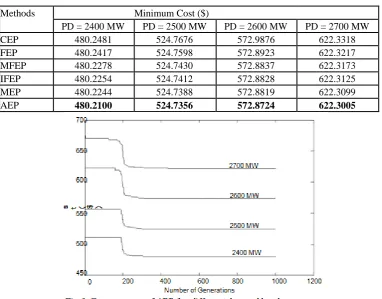
The experimental results are shown in Tables I, which also satisfy the system constraints for PD= 2400 MW – 2700
MW. IFEP has the highest probability of achieving better solutions followed by FEP; however, the convergence rate and solution time of IFEP in achieving the minimum cost is slightly slower than FEP because of increased mutation time. CEP showed the poorest performance amongst the six EPs in terms of convergence rate and observed likelihood of attaining the minimum cost. MEP converged faster and attained lower minimum cost than CEP and FEP methods. The AEP achieves a better solution quality and convergence than the other EP methods. The Fig.3 shows the convergence of AEP for different demand levels.
TABLE-I Comparison of EP Methods
Methods Minimum Cost ($)
PD = 2400 MW PD = 2500 MW PD = 2600 MW PD = 2700 MW
CEP 480.2481 524.7676 572.9876 622.3318
FEP 480.2417 524.7598 572.8923 622.3217
MFEP 480.2278 524.7430 572.8837 622.3173
IFEP 480.2254 524.7412 572.8828 622.3125
MEP 480.2244 524.7388 572.8819 622.3099
AEP 480.2100 524.7356 572.8724 622.3005
(B) Test Case II
Test case II is the economic dispatch problem with non-smooth cost functions considering both valve point effects and multiple fuel options. The same bench mark problem is considered here with the parameters as given in test case I.
Table II shows the comparisons of the results obtained by the various EP methods for 2700 MW. The AEP gives a better economic cost ($ 624.5074) than the other methods. Table III depicts the frequency of attaining a cost within the specific ranges out of 100 runs for each of
ISSN (Print) : 2320 – 3765 ISSN (Online): 2278 – 8875
I
nternational
J
ournal of
A
dvanced
R
esearch in
E
lectrical,
E
lectronics and
I
nstrumentation
E
ngineering
(An ISO 3297: 2007 Certified Organization)
Vol. 3, Issue 11, November 2014
Table IV. It shows the maximum cost, mean cost and minimum cost achieved by CEP, FEP, MFEP, IFEP, MEP and AEP methods. Table III reveals that AEP method has provided the global solution with a high probability to demonstrate its effectiveness and efficiency. Moreover, as shown in Table IV, AEP has a better economic cost than the other methods. Therefore, Tables III and IV clearly show that the AEP is more robust than the other methods. The Fig.4 shows the comparison of EP methods with AEP for PD = 2700 MW. AEP converged faster and attained
lower minimum cost than any other methods.
TABLE-II
Comparison of EP Methods (PD= 2700 MW)
Unit CEP FEP MFEP IFEP MEP AEP (j) k P (MW) k P (MW) k P (MW) k P (MW) k P (MW) k P (MW)
1 2 225.5602 2 221.5854 2 219.7551 2 220.9376 2 219.9962 2 218.2499 2 1 211.5180 1 212.2371 1 213.1851 1 212.6096 1 212.7648 1 211.6626 3 1 283.5344 1 282.7309 1 284.0275 1 283.5811 1 283.7391 1 280.7228 4 3 241.2873 3 239.2387 3 240.4534 3 240.0089 3 240.5205 3 239.6315 5 1 282.9452 1 282.0070 1 282.9303 1 282.8920 1 282.3127 1 278.4972 6 3 241.0563 3 240.6119 3 239.9359 3 240.4739 3 240.5387 3 239.6315 7 1 290.4849 1 293.9857 1 292.2646 1 292.9792 1 293.0846 1 288.5845 8 3 239.3561 3 241.1574 3 240.2247 3 240.1989 3 240.2886 3 239.6315 9 3 406.6017 3 406.9181 3 406.9599 3 406.9988 3 406.9797 3 428.5216 10 1 277.6558 1 279.5280 1 280.2634 1 279.3199 1 279.7752 1 274.8667 Total 2699.9999 2700.0002 2699.9999 2699.9999 2700.0001 2699.9998
Cost($) 625.0874 624.9370 624.9218 624.9064 624.9035 624.5074 TABLE-III
ISSN (Print) : 2320 – 3765 ISSN (Online): 2278 – 8875
I
nternational
J
ournal of
A
dvanced
R
esearch in
E
lectrical,
E
lectronics and
I
nstrumentation
E
ngineering
(An ISO 3297: 2007 Certified Organization)
Vol. 3, Issue 11, November 2014
Fig.4. Comparison of EP methods with AEP for PD = 2700 MW
In [13] IGA_MU method results are compared with HM, HNN, AHNN, EP and CGA_MU methods for 2700 MW demand. The AEP results are compared with CGA_MU and IGA_MU and given in Table V. The proposed algorithm also yields better solution quality than other methods, and is more efficient and effective than the CGA_MU and IGA_MU in the economic dispatch problem. Table V shows the comparisons of the results obtained by AEP with IGA_MU and CGA_MU [13]. The AEP gives a better economic cost ($ 624.5074) than the other methods.
TABLE-V
Comparison of Optimization Methods (PD= 2700 MW)
Unit CGA-MU IGA-MU AEP (j) P (MW) Fuel P (MW) Fuel P (MW) Fuel
1 222.0108 2 219.1261 2 218.2499 2 2 211.6352 1 211.1645 1 211.6626 1 3 283.9455 1 280.6572 1 280.7228 1 4 237.8052 3 238.4770 3 239.6315 3 5 280.4480 1 276.4179 1 278.4972 1 6 236.0330 3 240.4672 3 239.6315 3 7 292.0499 1 287.7399 1 288.5845 1 8 241.9708 3 240.7614 3 239.6315 3 9 424.2011 3 429.3370 3 428.5216 3 10 269.9005 1 275.8518 1 274.8667 1 Total 2700.0000 2700.0000 2699.9998
ISSN (Print) : 2320 – 3765 ISSN (Online): 2278 – 8875
I
nternational
J
ournal of
A
dvanced
R
esearch in
E
lectrical,
E
lectronics and
I
nstrumentation
E
ngineering
(An ISO 3297: 2007 Certified Organization)
Vol. 3, Issue 11, November 2014
VI. CONCLUSION
Few reports have been made at units considering both valve-point effects and multiple fuels for the realistic economic dispatch problem, which always exist in real power systems simultaneously. In this paper six different evolutionary programming techniques demonstrated to solve such practical economic dispatch operation. It is observed that EP techniques are capable of finding the optimal or near optimal solutions even for economic dispatch problems with any type of cost functions. However, the performance of the AEP approach provides better solution than all other EP techniques in terms of convergence rate, solution time, minimum cost and probability. However, the constraints like ramp rate limit, security constraints are not considered in this paper. Moreover, the AEP gives better solution than the CGA_MU and IGA_MU methods. Simulation results demonstrate that the AEP approach can give a cheaper total generation cost than any other considered methods.
REFERENCES
[1] C. E. Lin and G. L. Viviani, “Hierarchical economic dispatch for piecewise quadratic cost functions,” IEEE Trans. Power App. Syst., vol. PAS-103, no. 6, pp. 1170–1175, June 1984.
[2] Shanthi B., Revathy C., Devi A.J.M., Parameshwari P.J., Stephen T., "Serum 25(OH)D and type 2 diabetes mellitus", Journal of Clinical and Diagnostic Research, ISSN : 0973 - 709X, 6(5) (2012) pp.774-776.
[3] A. J. Wood and B. F. Wollenbergy, Power Generation, Operation, and Control. New York: Wiley, 1984.
[4] Madhubala V., Subhashree A.R., Shanthi B., "Serum carbohydrate deficient transferrin as a sensitive marker in diagnosing alcohol abuse: A case - Control study", Journal of Clinical and Diagnostic Research, ISSN : 0973 - 709X, 7(2) (2013) pp.197-200.
[5] J. H. Park, Y. S. Kim, I. K. Eom, and K. Y. Lee, “Economic load dispatch for piecewise quadratic
cost function using Hopfield neural network,” IEEE Trans. Power Syst., vol. 8, pp. 1030–1038, Aug. 1993.
[6] Khanaa V., Thooyamani K.P., Saravanan T., "Simulation of an all optical full adder using optical switch", Indian Journal of Science and Technology, ISSN : 0974-6846, 6(S6)(2013) pp.4733-4736.
[7] D. C.Walters and G. B. Sheble, “Genetic algorithm solution of economic dispatch with the valve point loading,” IEEE Trans. Power Systems, vol. 8, pp. 1325–1332, Aug. 1993.
[8] Nagarajan C., Madheswaran M., "Stability analysis of series parallel resonant converter with fuzzy logic controller using state space techniques", Electric Power Components and Systems, ISSN : 1532-5008, 39(8) (2011) pp.780-793.
[9] H. T. Yang, P. C. Yang, and C. L. Huang, “Evolutionary programming based economic dispatch for units with non-smooth fuel cost functions,” IEEE Trans. Power Syst., vol. 11, no.1,pp. 112–118, Feb.1996
[10]Bhat V., "A close-up on obturators using magnets: Part I - Magnets in dentistry", Journal of Indian Prosthodontist Society, ISSN : 0972-4052 , 5(3) (2005) pp.114-118.
[11]K. Y. Lee, A. Sode-Yome, and J. H. Park, “Adaptive Hopfield neural network for economic loaddispatch,” IEEE Trans. Power Syst., vol. 13, pp. 519–526, May 1998.
[12]Y. M. Park, J. R. Won, and J. B. Park, “A new approach to economic load dispatch based on improvedevolutionary programming,” Eng. Intell.Syst. Elect. Eng. Commun., vol. 6, no. 2, pp. 103–110, June 1998.
[13]T. Jayabarathi and G. Sadasivam, “Evolutionary programming-based economic dispatch for units withmultiple fuel options,” Eur. Trans. Elect. Power, vol. 10, no. 3, pp. 167–170, 2000.
[14] W. M. Lin, F. S. Cheng, and M. T. Tsay, “An improved Tabu search for economic dispatch with multipleminima,” IEEE Trans. Power Syst., vol. 17, pp. 108–112, Feb. 2002.
[15] P. Attaviriyanupap, H. Kita, E. Tanaka, and J. Hasegawa, “A hybrid EP and SQP for dynamiceconomic dispatch with nonsmooth fuel cost function,” IEEE Trans. Power Syst., vol. 17, no. 2, pp. 411–
416, May 2002.
[16]N. Sinha, R. Chakrabarti, and P. K. Chattopadhyay, “Evolutionary programming techniques foreconomic load dispatch,” IEEE Evol. Comput., vol. 7, no. 1, pp. 83–94, Feb. 2003.
[17]T. A. A. Victoire and A. E. Jeyakumar, “Hybrid PSO-SQP for economic dispatch with valve- pointeffect,” Elect. Power Syst. Res., vol. 71, pp.51–59, 2004.
[18]Chao-Lung Chiang, “Improved Genetic Algorithm for Power Economic Dispatch of Units With Valve-PointEffects and Multiple Fuels”, IEEE Trans. Power Syst., vol. 20, no. 4, pp. 1690– 1699,November 2005.
[19] Jong-Bae Park, Ki-Song Lee, Joong-Rin Shin, and Kwang Y. Lee,A, “Particle Swarm Optimization for Economic Dispatch With Nonsmooth Cost Functions”, IEEE Trans. Power Syst., Vol. 20, No. 1, pp. 34-42,Feb. 2005
[20] Jong-Bae Park, Yun-Won Jeong, Woo-Nam Lee, and Joong-Rin Shin, “An Improved Particle SwarmOptimization for Economic Dispatch Problems with Non-Smooth Cost Functions”, IEEE Power EngineeringSociety General Meeting, June 2006. (1-4244-0493-2).
[21] Jong-Hwan Kim, Hong-Kook Chae, Jeong-Yul Jeon and Seon-Woo Lee, “Identification and Control ofSystems with Friction using Accelerated Evolutionary Programming”, IEEE Trans on Control Systems,pp.38-47 August 1996
[22] X.Yao, Y.Liu, “Fast Evolutionary Programming”, Proc. of the 5 th Annual Conference on Evolutionary Programming, MIT Press, pp.451- 460, 1996.
[23] K. Chellapilla and D. B. Fogel, “Two new mutation operators for enhanced search and optimization in
evolutionary programming,” in SPIE Int. Symp. Optical Science and Engineering Instrum. Conf., 3165:
ISSN (Print) : 2320 – 3765 ISSN (Online): 2278 – 8875
I
nternational
J
ournal of
A
dvanced
R
esearch in
E
lectrical,
E
lectronics and
I
nstrumentation
E
ngineering
(An ISO 3297: 2007 Certified Organization)
Vol. 3, Issue 11, November 2014
[24] X. Yao, Y. Liu, and G. Lin, “Evolutionary programming made faster,” IEEE Trans. Evol. Comput., vol. 3, pp. 82–102, July 1999. [25] Nidul Sinha, R. Chakrabarti, and P. K. Chattopadhyay, “Evolutionary Programming Techniques forEconomic Load Dispatch” IEEE Trans. Evol. Comput., Vol. 7, No.1 pp. 83–94, Feb.2003.
[26] P. Venkatesh, R. Gnanadass, and Narayana Prasad Padhy, “Comparison and Application of EvolutionaryProgramming Techniques to Combined Economic Emission Dispatch With Line Flow Constraints” IEEETrans. Power Syst., Vol. 18, No. 2, pp. 688-697, May 2003. [27] Ping Wang, Qingjie Zhao and Ruqing Yang, “Using Accelerated Evolutionary Programming in Self-turning Control for Uncertainty
Systems”,Sixth International Conference on Intelligent Systems Designand Applications, IEEE, 2006.
[28]T. Saravanan and R.Udayakumar, 2013, Comparision of Different Digital Image watemarking techniques, Middle-East Journal of Scientific Research, ISSN:1990-9233, 15(12), pp.1684-1690 Srinivasan V,Saravanan T, , 2013, Analysis of Harmonic at Educational Division Using C.A. 8332, Middle-East Journal of Scientific Research, ISSN:1990-9233, 16(12), pp.1768-1773
[29]Srinivasan V,Saravanan T, , 2013, Reformation and Market Design of Power Sector, Middle-East Journal of Scientific Research, ISSN:1990-9233, 16(12), pp.1763-1767
[30]Srinivasan V,Saravanan T, R.Udayakumar, , 2013, Specific Absorption Rate In The Cell Phone User‟s Head, Middle-East Journal of Scientific Research, ISSN:1990-9233, 16(12), pp.1748-1750
[31]T. Saravanan and R.Udayakumar, 2013, Optimization of Machining Hybrid Metal matrix Composites using desirability analysis , Middle-East Journal of Scientific Research, ISSN:1990-9233, 15(12), pp.1691-1697
[32]T. Saravanan and R.Udayakumar, 2013, Simulation Based line balancing of a single piece flow line, Middle-East Journal of Scientific Research, ISSN:1990-9233, 15(12), pp.1698-1701
[33] B Karthik, TVU Kirankumar, MS Raj, E BharathKumaran,Simulation and Implementation of Speech Compression Algorithm in VLSI, Middle-East Journal of Scientific Research 20 (9), PP 1091-1092, 2013.
[34] A.Geetha, Face Recognition Using OPENCL, International Journal of Advanced Research in Electrical, Electronics and Instrumentation Engineering , ISSN (Print) : 2320 – 3765, pp- 7148-7151, Vol. 3, Issue 2, Febuary 2014.
[34] A.Geetha, Universal Asynchronous Receiver / Transmitter (UART) Design for Hand Held Mobile Devices, International Journal of Advanced Research in Electrical, Electronics and Instrumentation Engineering, ISSN: 2231-5381, pp 25-26, Volume 3 Issue 1 No1 – January 2012.
[35] D.Sridhar raja, Comparison of UWB Band pass filter and EBG embedded UWB Band pass filter, International Journal of Advanced Research in Electrical, Electronics and Instrumentation Engineering, ISSN 2278 – 8875,pp 253-257 ,Vol. 1, Issue 4, October 2012
[36] D.Sridhar raja, Performances of Asymmetric Electromagnetic Band Gap Structure in UWB Band pass notch filter, International Journal of Advanced Research in Electrical, Electronics and Instrumentation Engineering, ISSN (Online): 2278 – 8875,pp 5492-5496, Vol. 2, Issue 11, November 2013