Experimental Study of Solar Powered Heating and Cooling
System Using Thermo-Electric Module
1
Sanket Ingole,
2Dr. M. Basavaraj &
3Prof. Prashant Walke
Department of M-tech Heat power engineering, college of Ballarpur institute of technology, Ballarpur
.
Abstract:
Experimental study of solar powered heating and cooling system using thermo-electric module has been conducted. Research interest focused on testing the system performance under sunshine. The main objective of this study is to design and build an affordable solar thermoelectric refrigerator for the Bedouin people (e.g. deserts) living in remote parts of Oman where electricity is still not available. Experiment results demonstrated that the unit could maintain the temperature in the refrigerator at 15 – 18 oC, and have a COP about 0.25. Further analysis indicated that the performance of the system is strongly dependent on intensity of solar insolation and temperature difference of hot and cold sides for the thermoelectric module, etc. There exist optimum solar insolation rates, which let the cooling production and COP achieve maximum value, respectively. It was expected that the refrigerator would be potential for cold storage of vaccine, food and drink in remote area, or outdoor conditions where electric power supply is absent.
Keywords
Thermoelectric module, solar panel, battery, digital thermometer , etc.
1.
Introduction
Solar thermoelectric refrigerator is a special type of refrigerator which utilizes solar energy instead of conventional electrical energy to power the thermoelectric module that has been used to cool the refrigeration space. B.J. Haung, et al. (1) Conducted experimental study of design method of thermo electric cooler. They are fabricated the thermoelectric cooler and analyses various considerations. The system simulation shows that there exists a cheapest heat sink for the design of a thermoelectric cooler. It is also shown that the system simulation coincides with experimental data of a thermoelectric cooler. Astrain, yadav et al (3-4) conducted an experimental investigation of the COP in the thermoelectric refrigeration by the optimization of heat dissipation. Bansal ,
Manoj, Min et al. (5-7) investigate and compared the performance characteristic of their domestic refrigeration namely the vapour compression the thermoelectric and the absorption refrigeration based on actual experimental data. In this present paper, a design for portable solar thermoelectric refrigerator was presented and tested experimentally.The main objective of the refrigerator service is to be suitable for use by the Bedouin people who live in the remote areas of Oman where electricity is not available. The refrigerator can also be used for remote parts of the world or outer conditions where electric power supply is not readily available.
2.
Components of the solar
thermo-electric refrigerator
of heat transfer from the hot surface of the thermoelectric module so the heat will be discarded outside of the refrigerator. In order to maintain the efficiency of the thermal module, cooling fanwas used to reject the heat from the hot side of the module to ambient surroundings.
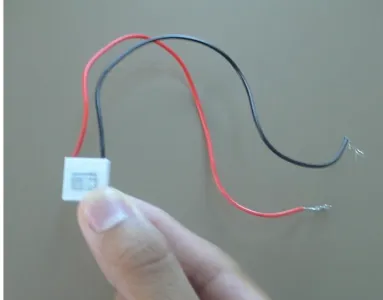
Fig. 1. Thermoelectric module with two wires.
3.
Construction
Here this system heat or cool the product using Thermo-electricmodule.the construction set up for this system require following parts
1. Solar panel 2.Charge controller 3. Battery 4.Fins, thermister 5. Exaust fan circuit kit 6. Thermoelectric module. 7. Metal (aluminium box, sheets)
A. Solar Panel
The direct conversion of solar energy is carried out into electrical energy by means of the photovoltaic effect i.e. the conversion of light or other electromagnetic radiation into electricity. Heat can be converted directly into electrical energy by solar cell, more generally a photovoltaic cell.
The solar panel use in this fabrication having an input capacity 16v and output capacity 21v.
B. Charge Controller
The charge controller is a simple,efficient and precise controller designed to operate with the charge source such as solar panels and wind generator to prevent overcharge.
Output drive current-1.0 Amps.
C. Battery
The battery is an electrochemical device for converting chemical energy into electrical energy. The main purpose of the battery is to provide a
supply of current for operating the cranking motor and other electrical units.
Capcity of battery-12v.
D. Thermoelectric Module
A typical thermoelectric module is composed of two ceramic substrates that serve as a foundation and electrical insulation for P-type and N-type Bismuth Telluride dice that are connected electrically in series and thermally in parallel between the ceramics. The ceramics also serve as insulation between the modules internal electrical elements and a heat sink that must be in contact with the hot side as well as an object against the cold side surface. Electrically conductive materials, usually copper pads attached to the ceramics, maintain the electrical connections inside the module. Solder is most commonly used at the connection joints to enhance the electrical connections and hold the module together [6]. Most modules have and even number of P-type and N-type dice and one of each sharing an electrical interconnection is known as, "a couple." [6]. While both P-type and N-type materials are alloys of Bismuth and Tellurium, both have different free electron densities at the same temperature. P-type dice are composed of material having a deficiency of electrons while N-type has an excess of electrons. As current (Amperage) flows up and down through the module it attempts to establish a new equilibrium within the materials. The current treats the P-type material as a hot junction needing to be cooled and the N-type as a cold junction needing to be heated. Since the material is actually at the same temperature, the result is that the hot side becomes hotter while the cold side becomes colder. The direction of the current will determine if a particular die will cool down or heat up. In short, reversing the polarity will switch the hot and cold sides [7].
Boulevard · Nashua, NH 03062 · USA)[6]
4.
How it works
When two conductors are placed in electric contact, electrons flow out of the one in which the electrons are less bound, into the one where the electrons are more bound. The reason for this is a difference in the so-called Fermi level between the two conductors. The Fermi level represents the demarcation in energy within the conduction band of a metal, between the energy levels occupied by electrons and those that are unoccupied.
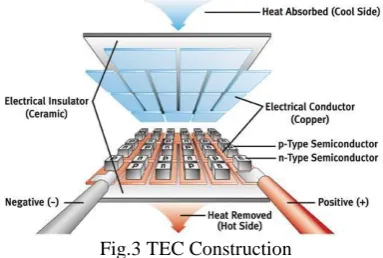
When two conductors with different Fermi levels make contact, electrons flow from the conductor with the higher level, until the change in electrostatic potential brings the two Fermi levels to the same value. (This electrostatic potential is called the contact potential.). Current passing across the junction results in either a forward or reverse bias, resulting in a temperature gradient. If the temperature of the hotter junction (heat sink) is kept low by removing the generated heat, the temperature of the cold plate can be cooled by tens of degrees (figure 2).
Fig.3 TEC Construction
Table 1
Specifications of the thermoelectric module used in our project
Sr.no. specification value 1 Maximum current (A) 5 2 Maximum voltage(V) 12 3 Maximum temperature(oc) 58 4 Dimension in (L×W×H)mm 40×40×3.4 5 Number of couples(N) 2
5.
Configuration of the thermoelectric
refrigerator
In this section, an experimental investigation and performance analysis on solar thermoelectric refrigerator was conducted.
Table 2
Example of results obtained from running one of the experiments Ambient temperature = 34.4oc
no Current (A)
Voltage (V)
Temp. cold side
(oC)
Temp. hot side(oC)
time (min)
Temp. diff (oC)
1 12 2.4 24.0 40.2 11 16.2 2 12 3.0 21.2 42.0 13 20.8 3 12 3.6 19.0 44.3 20 25.3 4 12 4.0 17.0 45.0 22 28.0 5 12 4.3 16.9 46.4 28 29.5 6 12 4.7 16.7 46.8 35 30.1 7 12 5.0 16.6 47.2 42 30.2
6.
Calculation
Calculation of the power consumed by the 10 modules used in the prototype
Each module takes a maximum of 2.5 A and 2 V. The power needed to give maximum cooling efficiency=2.5×2=5W
The total power consumed by the 2 module units= 2×5=10W.
Calculation of the power consumed by the fans Each fan consumed 0.5W.
Two fans consumed 1W.
Total power needed from solar cells
Total power= power consumed by the modules+power consumed by fans = 10+1=11W
6.1 Testing the performance of the solar
thermoelectric refrigerator
When the designed solar thermoelectric refrigerator was tested, it was found that the inner temperature of the refrigeration area was reduced from 34.4oC to
16.6oC in approximately 18 min, a difference of
17.8oC. Below is an example, which shows how the
coefficient of performance of the refrigerator (COPR) was calculated. water (density = 1 kg/L and C =4.18 kJ/kg).
V= 0.5 l canned drink. Calculation of copR
--Cop
R =Q
cooling / Wi/p m = v = 1(kg/l)×(0.5) = 0.5 kgQ
cooling =37202 / (60×42) = 14.76 W�W
in = IV =5× 12 = 60W
COP
R= 14.76 /
3-�
7.
Results and discussion
Table 3
Ambient temperature (T1) = 34.4oC
TDC= temperature difference cold TDH= temperature difference hot
n o
Wi/p = V×I
Temp. cold side (oC)T2
Temp. hotside
(oC)T3 Tim
e (min
) TDC (T1
-T2) (oC)
TDH
T1-T3 (oC)
COPR
1 28.8 24.0 40.2 11 10.4 5.8 1.2 2 36 21.2 42.0 13 13.2 7.6 0.9
8 3 43.2 19.0 44.3 20 15.4 9.9 0.6 2 4 48.0 17.0 45.0 22 17.2 10.
6 0.5
6 5 51.6 16.9 46.4 28 17.5 12 0.4 2
7.1.
Work input v
scop
RWe were doing experiments note down reading cop vs work input and draw this graph. In this graph we
use cop and work input . graph show COP decreases from 1.2 to 0.42 and work input increases from 28.8 to 51.6 within 60W. The efficiency of cooling chamber 0.78/22.8= 0.03
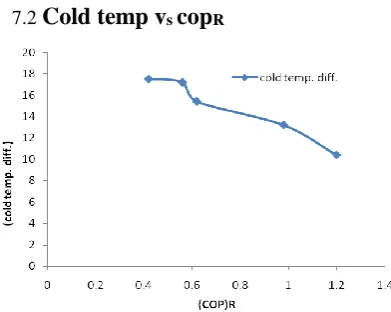
We were doing experiments note down reading cop vs cold temperature difference and draw this graph. In this graph we use cop and cold temperature difference. Graph show cop decreases from 1.2 to 0.42 and temperature increases from 10.4 to 17.5 .The efficiency of cooling chamber 0.78/7.1 = 0.10.
8.
Application
1. It can be uses as remote place where electric supply is not available.
2. In restaurants /hotels 3. At public places
4. Laboratory, scientific instruments, computers and video cameras.
5. Medical and pharmaceutical equipment. 6. Military applications.
8.1.
Advantages
Thermoelectric cooling devices and systems are believed to be as good as compressor- o absorber based refrigerators. However we believe that thermoelectric cooling offers a number of advantages over traditional refrigeration ,namely:
1. Solid state heat pumps have no moving parts, 2. No Freon’s or other liquid or gaseous refrigerants required,
3. Noiseless operation,
4. Compact size and light weight makes TEMs well suited for miniature coolers,
5. High reliability - We guarantee 200,000 hours of no failures,
6. Precise temperature control,
7. Relatively low cost and high effectiveness, 8. Operation in any orientation,
9. Easy to clean aluminum interior,
10. Eco-friendly C-pentane, CFC free insulation.
=.25
9.
Conclusion
In this work, a portable solar thermoelectric refrigerator unit was fabricated and tested for the cooling purpose. The refrigerator was designed based on the principle of a thermoelectric module to create a hot side and cold side. The cold side of the thermoelectric module was utilized for refrigeration purposes whereas the rejected heat from the hot side of the module was eliminated using heat sinks and fans. In order to utilize renewable energy, solar energy was integrated to power the thermoelectric module in order to drive the refrigerator. Furthermore, the solar thermoelectric refrigerator avoids any unnecessary electrical hazards and provides a very environmentally friendly product. In this regard, the solar thermoelectric refrigerator does not produce chlorofluorocarbon (CFC), which is believed to cause depletion of the atmospheric ozone layer. In addition, there will be no vibration or noise because of the difference in the mechanics of the system. In addition the rejected heat from the solar thermoelectric refrigerator is negligible when compared to the rejected heat from conventional refrigerators. Hence, the solar thermoelectric refrigerator would be less harmful to the environment. Several tests were carried out with the prototype to determine the minimum temperature that a refrigerated object could be reached. A canned drink with fixed volume was used as the refrigerated object in these tests. Experiment and analysis on the prototype were conducted mainly under sunny outdoor conditions. It was found that the system performance was strongly dependent on the intensity of solar insulation and the temperature difference of hot and cold sides between the thermoelectric modules. The maximum temperature difference under outdoor conditions was found to be 30oc. The energy efficiency
of solar thermoelectric refrigerators, based on currently available materials and technology, was still lower than its compressor counterparts. Nevertheless, a marketable solar thermoelectric refrigerator would be made with an acceptable performance through some improvements. For example, further improvement in the COP may be possible through improving module contact-resistance, thermal interfaces and heat sinks. In addition, this could be achieved by including more modules in order to cover a greater surface area of the refrigeration box.
10.
References
1. B.J. Huang, C.J. Chin and C.L. Duang:- A design method of thermoelectric cooler, International journal of Refrigeration, 23 (2000), pp.208-218
2. Sujin., Vora and Seetawan., Analyzing of Thermoelectric Refrigerator Performance. Proceedings of the 2ndInternational Science, Social-Science, Engineering and Energy Conference, 25,154-159,(2000) 3. Astrain D., Vian J.G., & Dominguez M.,
Increase of COP in the thermoelectric refrigeration by the optimization of heat dissipation. Applied Thermal Engineering, 23, 2183-2200,(2003)
4. Yadav and Nirves., Review on Thermoelectric materials and applications. International Journal for Scientific Research & Development, 1,413-417,(2013).
5. P.K. Bansal, A. Martin, Comparative study of vapor compression, thermoelectric and absorption refrigerators, International Journal of Energy Research 24 (2000) 93– 107.
6. Manoj Kumar., Chattopadhyay and Neogi., A review on developments of thermoelectric refrigeration and air conditioning systems: a novel potential green refrigeration and air conditioning technology. International Journal of Emerging Technology and Advanced Engineering, 38,362-367, (2013).
7. Min, G., Rowe, D. M. (2006). Experimental Evaluation of Prototype Thermoelectric Domestic-Refrigerators. Applied Energy, 83, 133–152
8. Dai, Y. J., Wang, R. Z., Ni, L. (2003). Experimental Investigation on a Thermoelectric Refrigerator Driven by Solar Cells. Renewable Energy, 28, 949– 959.
9. Manoj S., & Walke., Thermoelectric Air Cooling For Cars. International Journal of Engineering Science and Technology, 40(5), 2381-2394,(2011).
10. Z. Luo, A simple method to estimate the physical characteristics of a thermoelectric cooler from vendor datasheets, Electronics cooling, 14(3), 2008, 22-27.
11. Sabah A. Abdul-Wahab, Ali Elkamel, Ali M. Al- Damkhi, Is’haq A. Al-Habsi, Hilal S. Al Rubai’ey’, Abdulaziz K. Al-Battashi, Ali R. Al- Tamimi, Khamis H. Al-Mamari, Muhammad U. Chutani, “Design and experimental investigation of portable solar thermoelectric refrigerator”, Renewable Energy 34,pp. 30-34, 2009
12. www.marlow.com/resources/knowledgebas e/iii-tec-selection-procedure
13. www.wellentech.com
14. https://en.wikipedia.org/wiki/Thermal_cond uctivity