ASSESSING EFFECTIVE MANAGEMENT OF
DECENTRALIZATION OF TEACHING & LEARNING BY
TEACHERS SERVICE COMMISSION IN PUBLIC PRIMARY
SCHOOLS IN MOMBASA SUB- COUNTY, KENYA
EDWARD OTIENO OBUYA
E55/MSA/CE/24306/2013
A RESEARCH PROJECT SUBMITTED TO THE SCHOOL OF
EDUCATION IN PARTIAL FULFILMENT FOR THE AWARD
OF THE DEGREE OF MASTER OF EDUCATION KENYATTA
UNIVERSITY
ii
DECLARATION
I declare that this project is my original work and has not been presented in any other university/institution for consideration of any certification. This project has been complemented by referenced sources duly acknowledged. Where text, data (including spoken words), graphics, pictures or tables have been borrowed from other sources, including the internet, these are specifically accredited and references cited using APA system and in accordance with anti-plagiarism regulations.
EDWARD OTIENO OBUYA DATE E55/MSA/CE/24306/2013
Supervisors’ Declaration: We confirm that the work reported in this project was carried out by the candidate under our supervision as University supervisors
DR. DANIEL MANGE DATE Lecturer
Department of Educational Management, Policy and Curriculum Studies,
Kenyatta University
DR. MARY OTIENO DATE Lecturer
Department of Educational Management, Policy and Curriculum Studies,
iii
DEDICATION
iv
ACKNOWLEDGEMENTS
First and foremost, my gratitude goes to my academic supervisors Dr. Daniel Mange and Dr. Mary Otieno, both from the Department of Educational Management, Policy and Curriculum Studies, Kenyatta University, who worked tirelessly to constantly provide academic direction to the entire project. Their suggestions and insights led to this quality work.
I wish also to acknowledge the support I received from the Ministry of Education, notably the County director -Teachers Service Commission (TSC), and his staff, the County Education Department -Mombasa, District Education Officer (DEO)-Mombasa, Head teachers and Teachers who assisted me in my research work.
I also cannot forget the School Management Committees of the selected schools within Mombasa Sub-County for the assistance given by sharing the necessary information required without holding any back, no words can explain how sincerely grateful I am.
v
TABLE OF CONTENTS
DECLARATION... ii
DEDICATION... iii
ACKNOWLEDGEMENTS ... iv
TABLE OF CONTENTS ...v
LIST OF TABLES ... ix
LIST OF FIGURES ...x
ABBREVIATIONS AND ACRONYMS ... xi
ABSTRACT ... xiii
CHAPTER ONE:INTRODUCTION ...1
1.0 Introduction ...1
1.1 Background to the Study ...1
1.2 Statement of the Problem ...7
1.2.1 Purpose of the Study ...7
1.2.2 Objectives of the Study ...8
1.2.3 Research Questions ...8
1.3 Significance of the Study ...9
1.4 The Scope and Limitation of the Study ...9
1.4.1 Limitation ...10
1.4.2 Delimitation of the Study ...10
1.5 Assumptions of the Study ...11
1.6 Theoretical Framework ...11
1.7 Conceptual Framework ...14
1.8 Operational Definitions of Terms ...16
CHAPTER TWO ...20
REVIEW OF RELATED LITERATURE...20
2.1 Introduction ...20
2.2 Background to Decentralization of Education ...20
vi
2.3.1 Decentralization of education in Teaching & Learning in Developing
Countries ...25
2.3.2 Decentralization of Education in Teaching & Learning in Africa ....26
2.3.3 Decentralisation of Education Management in Teaching & Learning in Kenya ...30
2.4 Summary ...34
CHAPTER THREE:RESEARCH METHODOLOGY ...37
3.1 Introduction ...37
3.2 Research Design ...37
3.2.1 Locale of the Study ...38
3.3 Target Population ...38
3.4 Sampling Techniques and Sample Size ...39
3.4.1 Sampling Techniques ...39
3.5 Research Instruments ...40
3.6 Pilot Study ...40
3.7 Validity ...40
3.8 Reliability ...41
3.9 Data Collection Procedure ...41
3.10 Data Analysis and Presentation ...41
3.11 Logical and Ethical Consideration ...42
CHAPTER FOUR:PRESENTATION OF FINDINGS, INTERPRETATION AND DISCUSSION ...44
4.1 Introduction ...44
4.2 General and Demographic Information ...45
4.2.1 Instrument Return Rate ...45
4.3 Findings from the Objectives ...50
4.3.1 Findings on the Teachers’ Perception on Effectiveness of Managing Decentralization of Teaching and Learning by the TSC. ...51
vii
4.3.3 Operational Challenges Facing Teachers Service Commission (TSC) in Managing Decentralization of Teaching and Learning in Public
Primary Schools ...56
4.3.4 Benefits of Decentralization of Teaching and Learning by the Teachers Service Commission (TSC) in Public Primary Schools in Mombasa County ...61
CHAPTER FIVE:SUMMARY, CONCLUSIONS ANDRECOMMENDATIONS ...64
5.1 Introduction ...64
5.2 Summary of the Findings ...64
5.2.1 Teachers’ Perception on the Effectiveness of Managing Decentralization of Teaching and Learning by Teachers’ Service Commission (TSC) in Public Primary Schools ...64
5.2.2 Head Teachers’ view on Managing Decentralization of Teaching and Learning by the Teachers Services (TSC) ...65
5.2.3 Operational Challenges Facing Management of Decentralization of Teaching and Learning by TSC in Public Primary Schools in Mombasa Sub-County ...66
5.2.4 Benefits of Decentralization of Teaching and Learning by the Teachers Service Commission (TSC) in Public Primary Schools ...66
5.3 Conclusion ...67
5.4 Recommendations of the Study ...68
5.4.1 Policy Recommendations...70
5.4.2 Recommendations for Further Research ...70
REFERENCES ...71
APPENDICES ...75
APPENDIX I: COUTY DIRECTOR -TSC & EDUCATION OFFICIALS QUESTIONNAIRE ...75
APPENDIX II: HEAD TEACHER’S QUESTIONNAIRE ...79
viii
APENDIX IV: RESEARCH SCHEDULE/WORK SHEET ...84
APENDIX V: RESEARCH BUDGET ...85
APPENDIX VI: MAP OF MOMBASA COUNTY ...86
APPENDIX VII: APPROVAL OF RESEARCH PROPOSAL ...87
APPENDIX VIII: RESEARCH AUTHORIZATION ...88
ix
LIST OF TABLES
Table 3.1: Sample Size ... 39
Table 4.1: Instrument Return Rate ... 45
Table 4.2: Leadership Experience of Head Teachers ... 47
Table 4.3: Academic Qualification of Head Teachers ... 47
Table 4.4: Years of Experience for Teachers ... 48
Table 4.5: Academic Qualification of Teachers ... 49
Table 4.6: Presence of Non-Teaching Staff ... 49
Table 4.7: The Teachers’ Perception on Effectiveness of Managing Decentralization of Teaching and Learning by the TSC ... 51
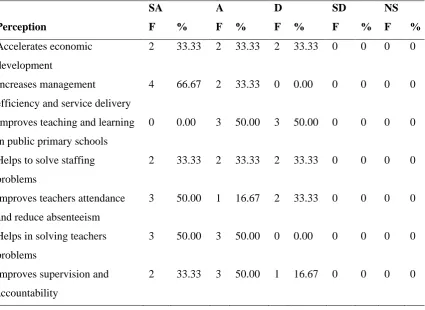
Table 4.8: Head teachers’ Perception of Managing Decentralization of Teaching and Learning by TSC ... 55
Table: 4.9: Response of Head Teachers on School Management Committees (SMC) Members Constrains ... 57
Table 4.10: Head Teachers’ Responses ... 58
x
LIST OF FIGURES
Figure 1.1: Correlates Effectiveness of Managing Decentralization of Teaching
& Learning by TSC ...14
Figure 2.1: Structure of the Ministry of Education ...32
Figure 4.1: Gender of Respondents ...45
Figure 4.2: Ages of the Respondents ...46
xi
ABBREVIATIONS AND ACRONYMS
BoG Board of GovernorsBQs Bills of Quantities
CEB County Education Board DEB District Education Board EFA Education for All
EU European Union
FDSE Free Day Secondary Education FPE Free Primary Education
IDA International Development Association IPAR Institute of Policy Analysis and Research JKF Jomo Kenyatta Foundation
KIE Kenya Institute of Education KLB Kenya Literature Bureau KENAO Kenya National Audit Office KESI Kenya Education Staff Institute
KESSP Kenya Education Sector Support Programme KNEC Kenya National Examination Council
KSSHA Kenya Secondary School Heads Association MEO Municipal Education Officer
MOE Ministry of Education
MTEF Medium Term Expenditure Framework
NCEOP National Commission on Education Objectives and Politics NCST National Council of Science and Technology
xii
OECD Organization of European Cooperation and Development PTA Parents Teacher Association
SAGAs School Development Plan
SIC School Infrastructure Committee SIMU School Infrastructure Management Unit SMC School Management Committee SWAP Sector Wide Approach to Planning TSC Teachers Service Commission
UNDP United Nations Development Programme
xiii
ABSTRACT
1
CHAPTER ONE
INTRODUCTION
1.0 IntroductionThe focus and key contents of this chapter covers the following areas: background of the study, statement of the problem, purpose of the study, objectives that the researcher aims to achieve, the research questions, significance of the study to the educational sector, scope and limitations of the study, assumptions of the study, the theoretical framework, conceptual and operational definition of terms used.
1.1 Background to the Study
Decentralization is a new undertaking in Africa Countries and Kenya in particular and its debate on the implementation has been on the public domain for a while. The promulgation of the Kenyan constitution in 2010 enabled the central government to cede some of its powers and responsibilities to the county levels with a view of bringing services closer to the electorate or rather the users of the services. Teachers Service Commission (TSC) a Semi-Autonomous Body was not left behind just like other state departments.
2
implement these laws. Every major attempt to decentralize basic education system throughout the world has involved changes in the law.
Decentralization does not just come with the passing of the law or signing decrees. Like most types of reforms, it is built rather than created. It happens slowly because the organizational culture (e.g. ‘the way we have always done things around here”) must be transformed, new roles transformed, new roles learnt, leadership styles altered (i.e. shifting from controlling to supportive behaviors), communication patterns revised ,planning procedures revised (e.g. bottom up and top down)and regional policies and programs developed.
Indeed, decentralization has sometimes taken place without any legislative action. In a number of African countries, Haiti in particular for example, the transfer of service provision has been more de facto than dejure as central governments have simply become unable to exercise their established financial and administrative responsibilities in various sectors, instead, passes them to a lower level by default. (Florestal and Cooper, 1997), this can indeed be used to inform educational policy makers, planers, and practitioners about the international experience in the legal aspects of decentralizing basic education. It also provides a basic understanding of how instruments such as laws and regulations can be used for education reforms and decentralization. Decentralization in this context basically means the transferring decision making power in basic education from the administrative centre of a country (such as central ministry of education) to authorities closer to the users.
3
responsibility to the most capable level of government and secondly to conform with a wider administrative reforms or with the general principle that administrative responsibilities should be vested in the lowest capable level of government to give users greater voice in decision making that affect them.( The Kenya Constitution, 2010).
The decentralization of services by the Teachers Service Commission is a very new undertaking in Kenya and its implementation comes with a number of both positive and negative challenges, the research therefore was intended to identify the effectiveness of managing decentralization of teaching and learning by TSC in Public Primary Schools within Mombasa County.
4
Decentralization in reality involves the devolution of responsibilities and resources to independent and autonomous sub-national authorities that are accountable to both the central government and their communities (Rosenbaum, 2000).
It would be necessary at this point to mention the confusion within many counties over the issue of decentralization, devolution and deconcentralization. Many efforts meant to encourage decentralization failed in many African countries because efforts were focused on deconcetralization rather than decentralization i.e. the central governments devolved power not to independent ,autonomous local governments ,rather they created administrative structures through which they maintained control at the local level. The study therefore sought to look in to the transfer of power by the Teachers Service Commission to the decentralized unit (Mombasa) and its effectiveness in managing teaching and learning in primary schools within Mombasa County.
5
of authority and responsibility to local units of government or agencies that are not always necessarily, branches or local offices of the delegating authority, with the bulk of accountability still vertical and to the delegating central unit) or of deconcentration (transfer of authority and responsibility from one level of the central government to another with the local unit accountable to the central government ministry or agency which has been decentralized) according to Rondinelli (1999).
6
The research therefore in a broader scope aimed at assessing the effective management of decentralization of teaching and learning in public primary schools in Mombasa Sub-County. Although decentralization can play a very vital role in broadening participation in political, economic and social activities in developing countries, it may not unless it entails a mixture of all the three: political, fiscal and administrative (Minor, 1999). If properly implemented, decentralization has the potential of reducing the bottlenecks in bureaucracy, enhancing public accountability and tailoring development plans to a particular needs.
This research intended to make a modest contribution to the literature of managing decentralization of teaching and learning by TSC in public primary schools in Mombasa County as well as present the current state of affairs in Mombasa County. The research crucially explored whether or not decentralization has been able to increase efficiency in terms of service with reference to teaching and learning in public primary schools in Mombasa County.
7 1.2 Statement of the Problem
Experiences from primary schools all over the world reveal little evidence on the extent to which decentralization of teacher management improves teaching quality and learning outcomes. In Kenya for instance, decentralization does not necessarily increase teacher morale neither does it improve the quality of teaching and learning. Although teacher recruitment and management in Kenya was decentralized since 2001, perception of teachers on decentralization has not been looked into, yet teachers are among the main stakeholders in education. Without proper and frequent evaluation of such issues as teachers' perceptions and feelings on effectiveness of teaching and learning by Teachers Service Commission, the government may be forced to follow the same path as countries like Colombia, Mexico, Nigeria and Zimbabwe, all of which saw policy swings back to centralization after it became clear that there was inefficiency in handling teacher management at the levels to which it had been devolved. Kenya has also enacted legislation which allows decentralization of Education and to which extent is it effective? There has been lack of clear guidelines and policies to regulate the effective operationalization of decentralization issues of funds which hinder the effectiveness of decentralization of teaching and learning in Public primary schools. To address this problem, this study sought to assess the effectiveness of managing decentralization of teaching and learning by TSC in Primary schools in Mombasa Sub-County.sa
1.2.1 Purpose of the Study
8 1.2.2 Objectives of the Study
The research was guided by the following objectives:
i. To describe the teachers perception on the effectiveness of managing decentralization of teaching and learning in Mombasa Sub-County,
ii. To find out Head teachers’ view on managing decentralization of teaching and learning by the Teachers Services (TSC) in public primary schools in Mombasa Sub-County,
iii. To identify operational challenges facing management of decentralization of teaching and learning by Teachers Service Commission (TSC) in Mombasa Sub-County.
iv. To analyze the benefits of decentralization of teaching and learning by the Teachers Service Commission (TSC) in public primary schools in Mombasa Sub-County.
1.2.3 Research Questions
The study was guided by the following research questions.
i. What are the teacher’s perceptions on the effectiveness of decentralization of Management by the Teachers Service Commission (TSC) on the teaching and learning in primary schools in Mombasa Sub-County?
ii. What are the Head Teachers’ view on the effectiveness of managing decentralization of teaching and learning by the Teachers Service Commission in primary schools in Mombasa Sub-County?
9
iv. What are the benefits of decentralizing teaching and learning by the Teachers Service Commission (TSC) in public primary schools in Mombasa Sub-County?
1.3 Significance of the Study
It was expected that the findings from the study may guide and inform policy makers including Teachers Service Commission (TSC) and other stakeholders on any gap which may exist on the effectiveness of managing decentralization of teaching and learning by the Teachers Service Commission (TSC) in public primary schools and how it influences the teaching and learning and to explore ways of addressing the challenges with a view to enhancing efficiency in the Teachers Service Commission in its effort towards service delivery. Thus the timing of this study was appropriate at this particular time in our history when decentralization is put into perspective more so by the Teachers Service Commission.
The findings of the study may therefore benefit policy makers in educational sectors in determining the effectiveness of managing decentralization of teaching and learning by TSC in Mombasa Sub-County. It may also provide education administrators and school managers with information regarding the structures of decentralization by the TSC and for scholars to raise issues for further exploration by researchers.
1.4 The Scope and Limitation of the Study
10
teacher proficiency and other mandates of the TSC at the County level, with the focus of teaching and learning in public primary schools in Mombasa sub-County.
1.4.1 Limitation
The research study faced the following problems: i. Finance
The financial constrain hindered the coverage of a wider scope considering that this was a self-sponsorship hence limited target sample. But the researcher tried to reach a wide range of target at a minimal cost.
ii. Uncooperative respondents
Some respondents were not cooperative and did not submit the questionnaires back hence the low return rate realized.
1.4.2 Delimitation of the Study
The study was only based on matters of decentralization of Management by the Teachers Service Commission (TSC) and its effectiveness on the teaching and learning in public primary schools in Mombasa sub-County.
The study was carried out in public primary schools and not private nor faith based primary schools which are not under the Teachers Service Commission (TSC).
11 1.5 Assumptions of the Study
The study assumed that the sample population co-operated and responded truthfully to the information and data capture instruments. It further assumed that the selected sample was representative enough and gave an indicative picture of the facts on the ground. This study also assumed that the decentralization of management by the Teachers Service Commission has been taking place in line with the other Government policies on decentralization. In addition, the study assumed that since the promulgation of the new constitution in 2010 and its effective, the County Education Office and the Schools’ Management Committees have been operating under the devolved system.
1.6 Theoretical Framework
According to Kerlinger (1973:9), theory is a set of interrelated concepts, definitions and proposition that present a systematic view of phenomena by specifying relations among variables with the purpose of explaining and predicting a phenomenon.
According to Oso and Onen (2008), theoretical framework refers to a set of interrelated variables and definitions that present a systematic view of a phenomenon by specifying the relationship among variables. Its main objective is to explain a phenomenon.
12
must function harmoniously and complement each other towards attainment of the organization objectives.
This theory was developed by Hegel in the 19th century to explain historical development as a dynamic process. It was later used by L. von Bertalanffy, a biologist, in1940’s as the basis for the field of study known as ‘general system theory’, a multidisciplinary field (1968) to react against reductionism and attempt to revive the unity of science. He emphasized that real systems are open to and interact with their environment. (Bertalanffy, 1968).
According to Mugenda and Mugenda (1999), should one of the sub-systems fail in their role, the organization’s performance is affected. For this study therefore the social system theory as an open system will be the focus of the study.
13
The education sector has the above characteristics at all levels from the national to the school levels. For instant, according to Owens (1981), a school is an open system which receives input from the environment and the processes them into outputs which are given back to the environment. The interactions between all the subsystems have to function harmoniously to attain the organizational goals and in this case, determine the factors that affect the effectiveness or ineffectiveness of decentralized management and the quality of the education services.
14 1.7 Conceptual Framework
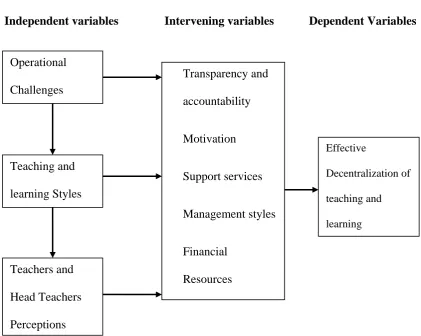
Effective decentralization by the Teachers Service Commission
Source: Researcher, (2015)
Figure 1.1: Correlates Effectiveness of Managing Decentralization of Teaching & Learning by TSC
A conceptual framework is a scheme of concepts or variables which the researcher will use in order to achieve set objectives (Oso and Onen 2008). Basically, it is a diagrammatic presentation of a theory. As shown in the fig 1.1 the independent variables which include operational challenges, teaching and learning styles and teachers and head teachers perceptions which are independent variables will affect the effectiveness of decentralization of teaching and learning which are dependent variables even if the intervening variables are present or not. The study argued that
Operational Challenges Teaching and learning Styles Teachers and Head Teachers Perceptions
- Transparency and accountability
- Motivation
- Support services
- Management styles
15
independent variables have strong correlation with dependent variables but presence of intervening variables will enable realization effective decentralization of teaching and learning.
The study also expected that where guidelines were available, clearly followed by the management of education institutions, there would be improved services especially in the posting and giving advice to teachers and personnel involved. The result would be improved service delivery and management.
The study further argued that where there was motivation and support among stakeholders who include the Ministry of Education, Teachers Service Commission (TSC) headquarters, County directorate, District Units and the School Management Committees, School Administration among others, would result in effective decentralization of teaching and learning.
Financial resources from the National government which formulates policy, provides resources and monitors and support lower level structures is important for effective service delivery.
16 1.8 Operational Definitions of Terms
Decentralization: The Webster’s Third New International Dictionary defines decentralization as “the dispersion or distribution of functions and powers from central authority to regional and local government bodies”. It is conceptualized in different ways by academicians and administrators. According to Fiske (1996), Decentralization is the process of re-assigning responsibility and corresponding decision making authority for specific functions from higher to lower levels of governments and organizations units”. The concept takes many forms from delegation, devolution and deconcentration.
According to Bray (1991), decentralization involves the authorization of lower level structures to take decisions regarding the utilization of resources. The central authority in this case, authorizes the lower levels to make certain decisions and undertake delegated functions.
The TSC has decentralized the managements of its services to the local level to enable teachers receive services with ease and to identify, solve issues affecting teachers and improve service delivery.
17
Administrative decentralization: This involves providing services to the public at different levels of government. It also implies the transfer of authority for planning, financing and management of some functions from central government to agencies and Semi-Autonomous Government Agencies (SAGAs).The major forms of administrative decentralization include: deconcentration, delegation and devolution. The TSC has devolved its administrative organs to County and the Sub-County level for effective management of teaching and learning at the local levels.
Deconcentration: This term denotes the transfer or delegation of responsibility for managing services/functions from the national level to a local level of a central organization such as the Ministry of Education.
In this case, decision making and policy direction are centralized by the TSC. But basically, the lower levels such as the County, sub-County and schools are allowed to implement policy, apply the regulations or guidelines but have nothing to do with their formulation. All the services that used to be offered at the National level are now decentralized at the local /district level to ease supervision and improve service delivery.
18
power such as that of maintaining the physical school plans, preparation and approval of School development Plan (SDP) and budgets.
From the above definitions, decentralization in education adopts many forms and aspects. All the above definitions have a common meaning, that is, the transfer of powers and functions from a central government to lower level structures.
For the purpose of this study, it was to identify the influence of decentralization by the TSC on the teaching and learning in schools. Administrative decentralization embraces concentration, which is the transfer of responsibility of managing services from the national level to lower level structures. It also means delegation whereby powers and responsibilities are delegated to lower level structures .It means the transfer of decision making from central government to an elected local government school committee. Funding for the lower level structures is by the central government although the structures can raise their own revenues with the approval of the central authority. This is done through the office of the County Director of Education –TSC.
Effectiveness: Effectiveness on the other hand means the quality or state of being effective, the capability of bringing out an effect or accomplishes a purpose (Webster Third International Dictionary, 1986).Simply put; it focuses on the goal and production of the desired results from the customer’s point of view. In this case how effective is the decentralization of teaching and learning at the sub-county level.
19
time, money or materials. “This implies achieving a purpose economically. It means the ability to choose and use most effective and least wasteful means of doing something or accomplishing a purpose or “efficient operation as measured by a comparison of actual results with those that could be achieved with the same expenditure of energy” (Webster’s Third International Dictionary, 1986).It means attaining a result at minimum wastage. Efficiency as regards this study refers to the best method that can lead to speedy decision making and implementation, and less wastage of time and resources.
20
CHAPTER TWO
REVIEW OF RELATED LITERATURE
2.1 IntroductionThe focus of this chapter is literature review related to the study. It covers the following areas: background of the decentralization of Education in developed countries, decentralisation of education in developing countries of Asia and South America, decentralisation of education in Africa and finally in Kenya focusing on the Teachers Service Commission and its influence of teaching and learning in primary schools.
2.2 Background to Decentralization of Education
The concept of education decentralization has been witnessed in both developed and developing countries with the belief that it can bring about reforms in service delivery. (Rondinelli et al., 1983). Western countries have used the strategy in the belief that it will bring about reforms in the education and other social sectors. Developing countries have been encouraged to decentralize education by the World Bank through projects. However, different countries understand the concept in various ways and therefore apply different practices (Siry, 2007).
21
It also envisages less bureaucratic, speedy decision making, strengthens democracy and ownership and therefore reduces transactional cost of administrative burden. In short, it is assumed that it will contribute to quick decision making and more effective utilization of resources. This implies that in education, school management should be given a freehand to manage and account for the resources granted to them. The study sought to find out if decentralization enhances the effectiveness of management of schools in terms of teaching and learning in primary schools in Mombasa County. By 1960, some countries in Europe had decentralized education management functions. For instance, In Norway communities had been given rights to participate in school decision making as shown in the curriculum guidelines of 1974 and 1987(Karlsen, 1999).
22
Protectorate of Kenya African Education in Kenya, Report (1949) recommended that primary and intermediate schools be placed under the DEBS.
This report was implemented through the Education Act which established governance structures such as the Provincial Education Board (PEDS), the District Education Boards (DEBS), and Boards of Governors (BOGs) for Secondary Schools and Tertiary Institutions and School Management Committees (SMCs) for Primary Schools (Republic of Kenya, 1968).
The legal notice No 50/1970, entrusted the education functions to local authorities order under section 5 of the education Act cap 211, the minister responsible for the education can entrust any of his functions with respect to education to a local authority. The evidence of this is found in Municipalities. However, finances come from the ministry of education since over time local authorities have been financially constrained for various reasons. A commission of inquiry into the education system of Kenya (Republic of Kenya, 1993), observed that growth and development of education had been impeded by centralization of decision making in formal education at the headquarters” coupled with poor coordination of education services by various ministries.
23
Education (KIE) to develop curriculum, Kenya Staff Education Institute (KESI) for sector capacity building, the Kenya national examination council (KNEC) for examination and certification, Jomo Kenyatta Foundation (JKF) and Kenya Literature bureau(KLB) to publish education books and Kenya Institute of Special Education (KISE) to focus on the capacity to teach learners with special needs among others.
Many countries, especially since 1990 have adopted some form of decentralization in the social sector such as education and health. In Kenya, there has been a clamour for devolution as ways of getting resources and services closer to the people. Decentralization would basically lower transactional costs; improve access, governance and accountability by eliminating bureaucratic processes.
The sessional paper that culminated as a result of the recommendations of the conference recognized the need to develop and improve infrastructure and fast track the attainment of education for all (EFA). One of the targets as set out in the sessional paper No. 1 (2005) is to construct/renovate physical facilities/equipment in public learning institutions in disadvantaged areas particularly in ASAL and urban slums by 2008’. The ministry will mobilize resources to develop infrastructure in regions of high poverty levels (pockets of poverty).
24
educational ministry retains the responsibilities of policy and curriculum development.
2.3 Decentralization of Education Management in Teaching & Learning in Developed Countries
In the United States of America (USA), which is administratively divided into federals states and counties, education management is by school councils run by School Boards and the local school district supported by finances from the state government. In the case of Canada, education is funded by municipal governments from taxes since the central government does not have an education ministry. The municipal governments which is elected, fund the school boards who manage education services including infrastructure development and maintenance in liaison with schools governance structures.
25
On the other hand, Cyprus has a decentralized education system and has decentralized some education services such as school infrastructure building and maintenance to the school board. However the state provides funds in the form of grants. Teachers’ management, curriculum and policy are the reserve of the central education ministry. In England, the administration of education service is devolved to local authorities ‘while in Switzerland education authority and functions are vested on the regional authorities and schools. However, policy formulation remains the preserve of the central government.
In the Wales, devolved governance was established by Wales National Assembly for Wales in 1999. Responsibilities for nearly all aspects of education and training have been decentralized. (Gareth, 2007).
Armenia has entrusted education to local schools committees with members elected by teachers and parents and with broad authority. The central government finances all recurrent cost through transfer of funds to the school boards.
2.3.1 Decentralization of education in Teaching & Learning in Developing Countries
26
efficiency. In Colombia, decentralization of education is focused on allocating resources, functions and responsibilities as at different levels of power.
Brazil has schools’ councils composed of parents, teachers and students. The councils are charged with the responsibility of selecting the school improvement plan as proposed by electoral candidates during election contests. Candidates propose what they would do once elected. They also select the school director. The states also provide each school council with capitation grants. Teachers continue to be employees of the state since their terms of service are negotiated with the state.
India and Bangladesh are federated countries and education management and schools construction is by communities while in Peru, it is by elected regional governments who have the responsibilities of planning and budgeting for school infrastructure and procurement of goods and services.
Lessons from Latin America suggest that for decentralization to be effective, it is necessary to undertake legal framework review to align education with the framework. Further, client demand through the roles and influence of the civil society and community is critical for enhanced accountability. Capacity of the decentralized structures is very important for effective implementation of education services (Verspoor, 2008).
2.3.2 Decentralization of Education in Teaching & Learning in Africa
27
In most of African countries, decentralization has been through donor funded projects championed by the World Bank (Winkler, 2003). This is evidenced in countries such as Mali, Tanzania, Uganda, Nigeria and Guinea among others through grants from the central governments. The objectives have been to enhance efficiency and effectiveness by holding service providers at whatever level accountable.
Uganda is divided into districts, elected councils and sub counties. Funds are transferred to the districts on per capita bases and the ministry of education provides guidelines to schools on the administration of the funds. Grants are then transferred to schools accounts who manage the funds. Teachers are recruited by the district but paid by central government since teacher salaries are set at the national level following pay negotiations.
In Morocco schools are managed by boards of management with representation of parents, teachers and local professionals. The central government defines the functions and the responsibilities such as supervision of schools, infrastructure and human resources.
28
Ethiopia has many levels of administration or governments. These are national, regional bureaus, schools district and Kebeles each with its own department of education and reporting to the next level. Regional bureaus are responsible for curriculum development, provision of instructional materials and teacher training (AED 1996). As such it has devolved system of government, in respect to education, teacher recruitment and management is by regional government using central government guidelines. Financing is however from central government.
With federal and local forms of governments which are responsible for provision of primary and secondary education. Nigeria has shared responsibilities between federal and local governments. The federal government provides policy directions and standards for both curriculum delivery and school infrastructure construction. PTAs and SMCs raise funds for operations and maintenance and sometimes PTAs hire teachers (world Bank. 1998).
Tanzania is administratively divided into regions, districts and locals authorities, sub districts (villages or wards). Education decentralization therefore corresponds to the general government decentralization. Primary education is managed by local government authorities and school committees with strong parental representation who oversee the running of schools by managing the funds and developing school development plans. Teacher salaries are nationally set (Maclean Keith, 1997).
29
The republic of South Africa has a strong regional government just like Nigeria and Ethiopia. Administratively, it is divided into provinces and municipalities. Education services are provided by provincial ministries of education. Financing is from central government mixed with community and regional contributions. Schools are funded through capitation grants. There are school council comprising of staff and parents established by the school Act of 1996(Sayed, 2002). They can make decisions on curriculum, personnel and budgeting using national and provincial guidelines. In Malawi, upon the introduction of Free Primary Education in 1994, the result as is the case everywhere, enrolment increased leading to insufficient classrooms. With the support of the development partners the education sector embarked on classrooms construction supported by the World Bank and used local constructors. Mali runs community schools where parents have a strong voice and authority on the management (Tiefjen, 1999).They select the governing body. The governing body selects the school head and other required personnel. They therefore hire and fire teachers. School infrastructure development and maintenance is undertaken by communities using locally available materials.
30
2.3.3 Decentralisation of Education Management in Teaching & Learning in Kenya
The Kenyan case in development of formal education commenced with the missionaries who established schools with a view to acculturate the people and provide them with rudimentary skills to read the bible. Upon the onset of colonial government, education continued along the same lines especially for Africans. The colonial government ran education along racial lines that is for Europeans, Indians, Arabs and Africans (Republic of Kenya, 1993).
Following the end of World War II, in 1945, the Africans who had participated in the war began clamoring for education and by the 1950’s the Africans established independent schools (community) especially in central Kenya (Wamagatta,2008).The central government would then support the schools with teachers.
31
32
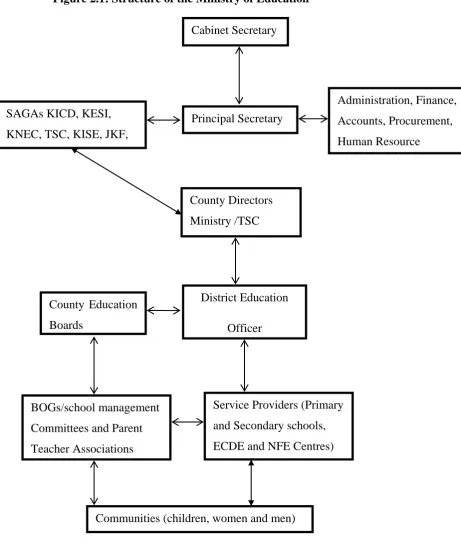
Figure 2.1: Structure of the Ministry of Education
Source: Ministry of Education 2010/11 Cabinet Secretary
Administration, Finance, Accounts, Procurement, Human Resource SAGAs KICD, KESI,
KNEC, TSC, KISE, JKF, KLB
Principal Secretary
County Directors Ministry /TSC
County Education Boards
District Education Officer
Service Providers (Primary and Secondary schools, ECDE and NFE Centres) BOGs/school management
Committees and Parent Teacher Associations
33
The Education Act Cap 211 (1968), Laws of Kenya, established specialized agencies of the Ministry known as Semi-Autonomous Government Agencies (SAGAs) to perform specialized supportive functions (Republic of Kenya,1968). These include the Kenya Institute of Education (KIE), Kenya Education Staff Institute (KESI), Jomo Kenyatta Foundation (JKF) and the Kenya Literature Bureau (KLB), Teachers Service Commission (TSC) among others. The same legal framework established governance structures such as the Provincial Education Boards (PEBs), the District Education Boards (DEBs), and Boards of Governors (BOGs) for Secondary Schools and Tertiary Institutions and School Management Committees (SMCs) for primary schools. These bodies are entrusted with certain functions which they perform at their level. The Education Act also entrusts local government authorities with the running of education especially primary school education at the Municipalities, hence the creation of Municipal Education Offices (MEOs) in their jurisdictions.
The County Education Boards are charged with the responsibility of co-ordination of all programmes activities of the districts, monitoring and evaluation of the implementation of education activities ,advising the District Education Officers, supervising District Education programmes and ensuring implementation of timely mitigation measures as recommended by Monitoring and Evaluation and audit reports.
34
level of decentralization depends on whether a country is in federal or centralized system.
The functions of the Teacher Service Commission (TSC) are devolved to the lower level structures and include recruitment of teachers’ assignment and transfer, teacher discipline and deployment (Olembo et.al., 1992).The function of recruitment of teachers has some time now been devolved to the County Education Board for Public Primary School teachers and that of post primary to the Boards of Governors (Republic of Kenya 2005).
The Sessional Paper No.1of 2005 on “A Policy Framework for Education, Training and Research” regards the implementation of Primary Education as the perfect vehicle for attainment of Universal Primary Education (UPE and Education for All (EFA) goals).In 2003, the Government introduced free Primary Education to stem the declining enrolments and increase access for the poor and marginalized populations. Under this programme, the decentralized educational components all geared towards enhancing access, retention, quality and equity education (Ministry of Education Science and Technology 2007).
2.4 Summary
35
argument that it enhances efficiency and client voice and good governance. Decentralization of education in Kenya is not backed by law as is clear from the current education Act cap 211 laws of Kenya. The current education Act entrusts education to local governments which has proved difficult in the face of scarce financial resources. International experience shows that: efficiency and effectiveness are likely to improve when service providers are held accountable; when there is clear delineation of authority and responsibility; increase potential for community and parental participation and school managers must acquire leadership and management skills (Winkler, D.R. and Alen, Ian Gershberg, 2003).
The logic on decentralization in Kenya has not been vigorously studied as in other countries such as those in Latin America and Europe .Hence, there is little data and information on the subject like in the cases of Ethiopia, South Africa and Nigeria in Africa and this presents a research gap. Studies by IPAR (2004), on District focus for rural development strategy highlighted challenges of decentralization of a general nature and not education in particular. The study lacked legal backing, relied on an institutional framework that did not facilitate local decision making and resource mobilization and lacked capacity in participatory planning and implementation among stakeholders. The review of the literature did not come across studies on decentralization of instructional materials and supervision except for infrastructure in decentralized schools in Nigeria which showed that the involvement of local community in the infrastructure leads to lower cost (Ikoya, 2008).
36
37
CHAPTER THREE
RESEARCH METHODOLOGY
3.1 IntroductionThis Chapter comprises of the following sections, research design, target population, sample sizes and sampling procedures, research instruments, validity and reliability of instruments, data collection procedures and analysis plan.
3.2 Research Design
The study used descriptive survey design. A survey design enabled the researcher to obtain information from responses from the selected sample. Survey of the County Education Offices, the County director- Teachers Service Commission (TSC) and its staff, the Head teachers of Public Primary Schools and selected sampled teachers through the administration of questionnaires to generate data.
According to Orodho (2008), descriptive designs are used to facilitate the collection of information, summarizes, present and interpret the information hence these components were instrumental in this study as data obtained were described in detail.
38 3.2.1 Locale of the Study
The study was conducted in Public Primary schools within Mombasa County specifically in Mvita Sub-County. The sub- County borders Likoni to the South, Changamwe to the West and Kisauni to the North. The sub-county acts as commercial and tourist town.
The choice of the location for research was influenced by the fact that it has a long history of underperformance in national examination with the centralized education system (KCPE 2000-2013 Result Analysis District Education Office Mombasa).
With the decentralized system of management by the TSC, the research sought to establish the effectiveness of managing decentralization of teaching and learning in these schools. Furthermore the familiarity and rapport with the community made it easier for researcher to receive cooperation.
3.3 Target Population
The target population of the study included the County Director of TSC, the District Education Officer (DEO), District Quality Assurance and Standards Officer, the staffing officer, the District Auditor and Teachers Advisory Center Tutors, the Head teachers and teachers from public primary schools in Mombasa Sub-County. The study targeted twelve (12) public primary schools.
39 3.4 Sampling Techniques and Sample Size 3.4.1 Sampling Techniques
A sample is a portion of the target group. According to Orodho (2000), a sample is a small part of a large population which is thought to be representative of the larger population.
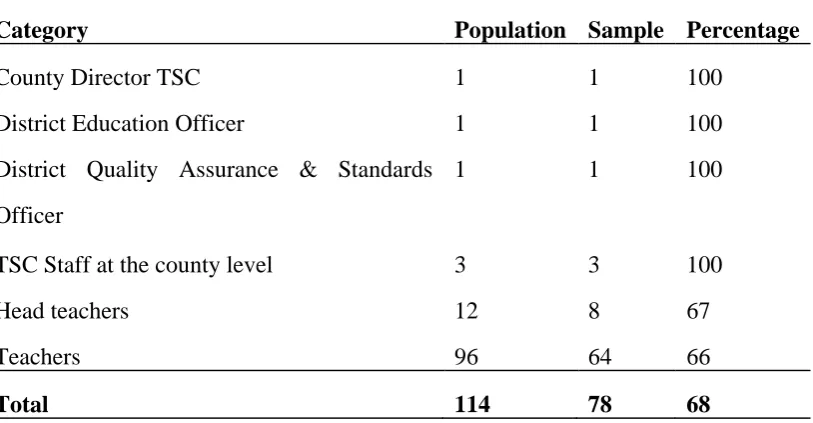
Gay (1992) opinionated that minimum sample of 20% of the target population can be adequate for a research work in social science. Sample random and non-probability (purposive) was used. Where there was one respondent as in the case of Director –Teachers Service Commission, District Education Officer and District Quality Assurance Standards Officer, purposeful sampling technique was applied. However, where there was more than one respondent as in the case of the Head Teachers and teachers, simple random sampling method was used. The sample was therefore 8 schools in the Sub-County and 6 educational officials in the County. The sample size was between 50% and 100% well above Gay’s recommendation.
Table 3.1: Sample Size
Category Population Sample Percentage
County Director TSC 1 1 100
District Education Officer 1 1 100
District Quality Assurance & Standards Officer
1 1 100
TSC Staff at the county level 3 3 100
Head teachers 12 8 67
Teachers 96 64 66
Total 114 78 68
40 3.5 Research Instruments
The study used a set of questionnaires. It was easier to administer as observed by (Kiess and Blooquist, 1985).The use of questionnaire was appropriate because it was easy to administer as78 respondents participated simultaneously. Questionnaires provided the respondents with latitude to give their views freely since they were anonymous as the respondents did not append their names or signatures on them .In this way we expected truthful responses.
The questionnaires comprised of open and closed ended items .Section A captured information on personal and contextual information from the respondents, Section B captured data on decentralization in use whereas section C collect data on the benefit of decentralization Section D captured on challenges on decentralization and how to improve on them from respondents.
3.6 Pilot Study
The questionnaires were pre- tested on small sample of three head teachers from the target sub-county. The procedure used was the same as the actual data collection .Piloting helped to identify unclear questionnaires items which needed to be changed or discarded altogether.
3.7 Validity
41
(1989), validity was enhanced through expert judgment. In this case, the researcher subjected the instruments to scrutiny from expert in order to enhance clarity.
3.8 Reliability
Reliability according to Mugenda (1999) is a measure of the degree to which a research instrument yields results after repeated trials. The researcher used the Test- pre-test technique to assess the reliability of the instrument. The spearman’s rank order correlation, a correlation coefficient helped to establish if the questionnaire were reliable. A correlation coefficient of 0.75 was deemed to be reliable of the questionnaires.
3.9 Data Collection Procedure
Approval and permission was sought from Kenyatta University Graduate School, then a letter of authority to conduct research obtained from the National Commission for Science, Technology and Innovation (NACOSTI).This letter was then be presented to the County Director Ministry , County Director -TSC and the District Education Officer for consent before data collection. The letter was then sent to the sampled population before data capture instruments with the assistance of the field officers. Contact persons were assigned to help distribute and collect the completed instrument back.
3.10 Data Analysis and Presentation
42
software. Cross tabulation was used to determine the variations in terms of age groups, gender, experience and academic qualifications of respondents.
This procedure involves identification of those areas were relevant to the research objectives and questions thereby classifying the themes covered and coding the data obtained. The data captured was both quantitative and qualitative. Descriptive statistics enabled the researcher to summarize and organize data in a meaningful way for interpretation and presentation. In words and presented using percentages, tables, pie-chart and graphs. Data was analyzed using the Descriptive statistics was used to analyze the data in order to facilitate generalization. Frequency distribution was used to show the number of respondents making similar responses. Descriptive statistics enabled the researcher to summarize and organize data to make some meaning. Descriptive statistics involved tabulation, graphing and describing data in an organized and simplified way.
3.11 Logical and Ethical Consideration
The researcher had pre-field work where the layout of the research instrument was done. This included the physical layout for example the questionnaires were neat, easy to use and easy to code and analyze.
43
Given that the researcher was familiar with the geographical location, the language barrier was not a problem and all the respondents are professionals so it was easier to communicate with them.
44
CHAPTER FOUR
PRESENTATION OF FINDINGS, INTERPRETATION AND
DISCUSSION
4.1 Introduction
This chapter presents data analysis, interpretations and discussion of the study findings. The general objective of the study was to establish the effectiveness of managing decentralization of teaching and learning by Teachers’ Service Commission (TSC) in public primary schools in Mombasa sub-County. The findings of the research are presented based on the following four research objectives:
i. To determine the effectiveness of managing decentralization of teaching and learning by Teachers’ Service Commission (TSC) in public primary schools in Mombasa sub-County
ii. To find out Head teachers’ view on managing decentralization of teaching and learning by the Teachers Services (TSC) in public primary schools in Mombasa sub-County.
iii. To identify the operational challenges facing management of decentralization of teaching and learning by TSC in public primary schools.
iv. To analyze the benefits of decentralization of teaching and learning by the Teachers Service Commission (TSC) in public primary schools in Mombasa sub-County
45 4.2 General and Demographic Information
The study participants comprised of County Director –TSC(1), District Education Officer(1), District Quality Assurance & Standards Officer(1), TSC Staff at the County level (3), Head teachers(6) and Teachers(30) making a total of 40 respondents.
4.2.1 Instrument Return Rate Table 4.1: Instrument Return Rate
Numbers administered Number returned Return Rate Field Officers 6 4 83.33% Head teachers 8 6 75%
Teachers 64 56 88%
Total 78 66 85%
A total of 78 instruments were administered to the education officers, head teachers and teachers and the number returned were 66 with the return rate indicated as 83.33% for the education officers, 75% for the head teachers and 88% for the teachers respectively showing a higher number of instruments returned.
46
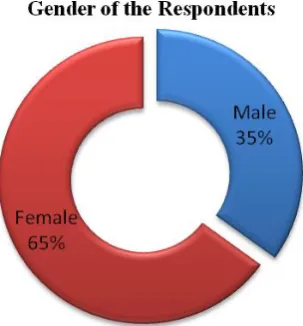
From the figure above, it is evident that there were more female 36 (65%) respondents than male 20 (35%) indicating that there were more female than male in the County Educational Management in Mombasa County. Majority of who comprised of the teaching staff.
Figure 4.2: Ages of the Respondents
47
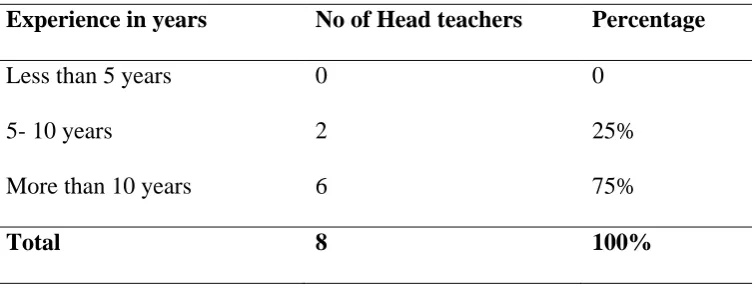
Table 4.2: Leadership Experience of Head Teachers
Experience in years No of Head teachers Percentage
Less than 5 years 0 0
5- 10 years 2 25%
More than 10 years 6 75%
Total 8 100%
Table 4.2 shows that none of the head teachers had less than 5 years of leadership , 2(25%) had 5-10 years of experience in the school management while 6 (75%) had indicated that they had over 10 years of experience. This implies that the head teachers had adequate experience in leadership, meaning that they were conversant with the issues and challenges related to education decentralization in primary schools. Waithaka (2010) demonstrated that work experience is related to school leadership effectiveness as well as readiness to change.
Table 4.3: Academic Qualification of Head Teachers
Education Level No. of Head teachers Percentage
MED 1 12.5%
BED 4 50%
Approved teacher Status (ATS)/Diploma 3 37.5%
Primary 1 (P1) 0 0
Total 100
48
Teachers Status (ATS), 4(50%) Bachelor degree holders and 1(12.5%) have MED qualifications. The findings from the table implies that although most of the head teachers had the required pre-service education for the primary school management, they had advanced much in their education to equip themselves with the new managerial techniques. Previous research by Njoka (2009), showed that the level of education achieved by education administrators and the in-service training influences their performance on various leadership tasks, such as implementation of TSC decentralization policies.
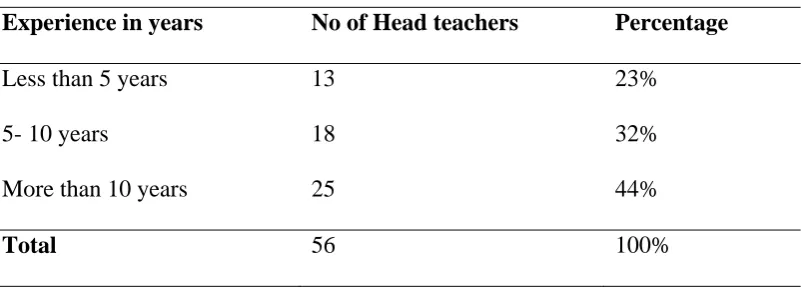
Table 4.4: Years of Experience for Teachers
Experience in years No of Head teachers Percentage
Less than 5 years 13 23%
5- 10 years 18 32%
More than 10 years 25 44%
Total 56 100%
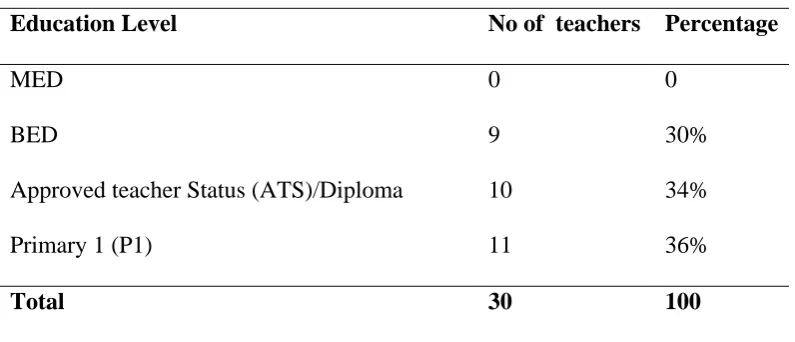
49 Table 4.5: Academic Qualification of Teachers
Education Level No of teachers Percentage
MED 0 0
BED 9 30%
Approved teacher Status (ATS)/Diploma 10 34%
Primary 1 (P1) 11 36%
Total 30 100
Table 4.5 illustrates that above 50% of the teachers in Mombasa sub-County have advanced they education either to Diploma or Degree level up from the P1 minimal entry level. The findings in the table implies that although most teachers had the requisite pre-service training for primary teaching education, they had advanced their level of education to enhance their knowledge which in turn improves their performance
Table 4.6: Presence of Non-Teaching Staff
Response Yes No
Frequency % Frequency %
Bursar/Accounts Clerk 5 83.33 1 16.67
Store Keeper 2 33.33 4 66.67
Security Officer 6 100.00 0 0.00
50
Since there is free primary education including supply of stationary to school through the government funding, most schools needed adequate security for the school properties including computers hence the need for security in all the schools.
4.3 Findings from the Objectives
The respondents were expected to give their views related to the objectives of the study. These objectives were divided into four:
The first objective of the study was to determine the effectiveness of managing decentralization of teaching and learning by Teachers’ Service Commission (TSC) in public primary schools in Mombasa County.
51
4.3.1 Findings on the Teachers’ Perception on Effectiveness of Managing Decentralization of Teaching and Learning by the TSC
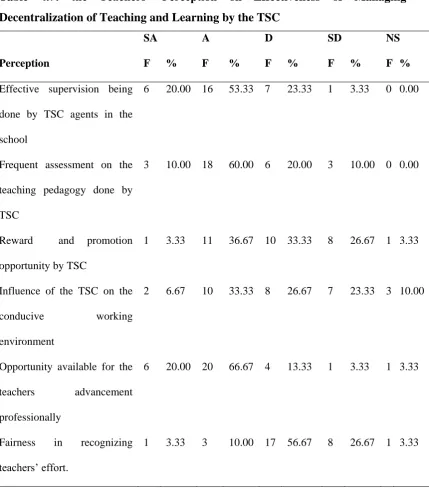
Table 4.7: the Teachers’ Perception on Effectiveness of Managing Decentralization of Teaching and Learning by the TSC
SA A D SD NS
Perception F % F % F % F % F %
Effective supervision being
done by TSC agents in the
school
6 20.00 16 53.33 7 23.33 1 3.33 0 0.00
Frequent assessment on the
teaching pedagogy done by
TSC
3 10.00 18 60.00 6 20.00 3 10.00 0 0.00
Reward and promotion
opportunity by TSC
1 3.33 11 36.67 10 33.33 8 26.67 1 3.33
Influence of the TSC on the
conducive working
environment
2 6.67 10 33.33 8 26.67 7 23.33 3 10.00
Opportunity available for the
teachers advancement
professionally
6 20.00 20 66.67 4 13.33 1 3.33 1 3.33
Fairness in recognizing
teachers’ effort.
1 3.33 3 10.00 17 56.67 8 26.67 1 3.33
52
Table 4.7 shows that over 53.33% of the teachers agreed with the statement that effective supervision by the TSC agents in schools lead effectiveness in managing decentralization of teaching and learning in public primary schools in Mombasa Sub-County, 60% agreed that there was frequent assessment on the teaching pedagogy done by the TSC and 66% agreed that they are opportunities available for the teachers to advance professionally. However, 56.67% left that they were no fairness in recognizing teachers’ effort by the TSC. This could be best explained by the fact that remuneration and reward of teachers are still centralized and the County Directors have no autonomy over the same.
Ikoya (2008), in his study of decentralization and infrastructure in Nigeria concluded that the level of maintenance and teachers motivation can easily be addressed in a decentralized system than in centralized system. The study concluded that decentralization of TSC services enhances effective supervision in schools hence improve quality of education.53.33% agreed that there was supervision being carried out by the TSC agents in their schools to facilitate teaching and learning. However, most teachers 56.67% felt that there was no fairness in recognizing teachers hence they felt demotivated.
53
Figure 4.3: Response of Teachers’ on the Effectiveness of Managing Decentralization by TSC
KEY: VS- Very Satisfied S- Satisfied M- Moderate NA- Not Sure.
As shown in Figure 4.3, the response of teachers’ on effectiveness of managing decentralization by TSC varied distinctly from one teacher to the other. Only 2(6.67%) of the respondents were very satisfied with the effectiveness of managing decentralization of teaching and learning by TSC in primary schools, 11( 36.67%) were satisfied , 10(33.33%) were for the opinion that TSC were moderate on their effectiveness in managing decentralization while 7(23.33%) were not sure.
54
4.3.2 Head Teachers’ View on Managing Decentralization of Teaching and Learning by TSC
The second objective of the study sought to find out Head teachers view on managing decentralization of teaching and learning by the Teachers Services (TSC) in public primary schools in Mombasa Sub-County.
To address this objective, first it was important to establish whether head teachers were aware of major policies that govern decentralization of education in Kenya.
It turned out that more than three quarters 5(83.33%) were aware of the policies that govern education while only 1(16.67%) was not very sure. The head teachers indicated that policies that govern decentralization include, Kenya Constitution (2010), The TSC Act 2012 and the Basic Education Act 2013. This implies that majority of the head teachers are aware of the policy documents governing decentralization of education in the country.
Head teachers were then given a list of items regarding their perception on a 5- point Likert scale to measure their level of agreement or disagreement on the extent to which managing decentralization on teaching and learning by TSC in their schools meet various targets. They were required to state their level of agreement ranging from strongly agree to strongly disagree.