Menstrual cup use, leakage, acceptability, safety, and
availability: a systematic review and meta-analysis
Anna Maria van Eijk, Garazi Zulaika, Madeline Lenchner, Linda Mason, Muthusamy Sivakami, Elizabeth Nyothach, Holger Unger, Kayla Laserson,
Penelope A Phillips-Howard
Summary
Background
Girls and women need effective, safe, and affordable menstrual products. Single-use products are
regularly selected by agencies for resource-poor settings; the menstrual cup is a less known alternative. We reviewed
international studies on menstrual cup leakage, acceptability, and safety and explored menstrual cup availability to
inform programmes.
Methods
In this systematic review and meta-analysis, we searched PubMed, Cochrane Library, Web of Science,
Popline, Cinahl, Global Health database, Emerald, Google Scholar, Science.gov, and WorldWideScience from database
inception to May 14, 2019, for quantitative or qualitative studies published in English on experiences and leakage
associated with menstrual cups, and adverse event reports. We also screened the Manufacturer and User Facility
Device Experience database from the US Food and Drug Administration for events related to menstrual cups. To be
eligible for inclusion, the material needed to have information on leakage, acceptability, or safety of menstrual cups.
The main outcome of interest was menstrual blood leakage when using a menstrual cup. Safety outcomes of interest
included serious adverse events; vaginal abrasions and effects on vaginal microflora; effects on the reproductive,
digestive, or urinary tract; and safety in poor sanitary conditions. Findings were tabulated
or combined by use of
forest plots (random-effects meta-analysis). We also did preliminary estimates on costs and environmental savings
potentially associated with cups. This systematic review is registered on PROSPERO, number CRD42016047845.
Findings
Of 436 records identified, 43 studies were eligible for analysis
(3319 participants). Most studies reported on
vaginal cups (27 [63%] vaginal cups, five [12%] cervical cups, and 11 [25%] mixed types of cups or unknown) and
15 were from low-income and middle-income countries. 22 studies were included in qualitative or quantitative
syntheses, of which only three were of moderate-to-high quality. Four studies made a direct comparison between
menstrual cups and usual products for the main outcome of leakage and reported leakage was similar or lower for
menstrual cups than for disposable pads or tampons (n=293). In all qualitative studies, the adoption of the menstrual
cup required a familiarisation phase over several menstrual cycles and peer support improved uptake (two studies in
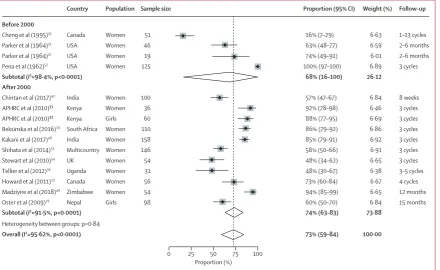
developing countries). In 13 studies, 73% (pooled estimate: n=1144; 95% CI 59–84, I²=96%) of participants wished to
continue use of the menstrual cup at study completion. Use of the menstrual cup showed no adverse effects on the
vaginal flora (four studies, 507 women). We identified five women who reported severe pain or vaginal wounds,
six reports of allergies or rashes, nine of urinary tract complaints (three with hydronephrosis), and five of toxic shock
syndrome after use of the menstrual cup. Dislodgement of an intrauterine device was reported in 13 women who
used the menstrual cup (eight in case reports, and five in one study) between 1 week and 13 months of insertion of the
intrauterine device. Professional assistance to aid removal of menstrual cup was reported among 47 cervical cup
users and two vaginal cup users. We identified 199 brands of menstrual cup, and availability in 99 countries with
prices ranging US$0·72–46·72 (median $23·3, 145 brands).
Interpretation
Our review indicates that menstrual cups are a safe option for menstruation management and are
being used internationally. Good quality studies in this field are needed. Further studies are needed on
cost-effectiveness and environmental effect comparing different menstrual products.
Funding
UK Medical Research Council, Department for International Development, and Wellcome Trust.
Copyright
© 2019 The Author(s). Published by Elsevier Ltd. This is an Open Access article under the CC BY 4.0 license.
Lancet Public Health 2019
Published Online
July 16, 2019
http://dx.doi.org/10.1016/ S2468-2667(19)30111-2 SeeOnline/Comment
http://dx.doi.org/10.1016/ S2468-2667(19)30126-4
Department of Clinical Sciences
(A M van Eijk PhD, G Zulaika MPH, L Mason PhD, Prof P A Phillips-Howard PhD)
and Centre for Maternal and Newborn Health (H Unger PhD), Liverpool School of Tropical Medicine, Liverpool, UK; Population Health Sciences, Institute of Epidemiology and Health Care, University College London, London, UK
(M Lenchner MSc); Centre for
Health and Social Sciences, School of Health Systems Studies, Tata Institute of Social Sciences, Mumbai, Maharashtra, India
(Prof M Sivakami PhD); Centre
for Global Health Research, Kenya Medical Research Institute (KEMRI), Kisumu, Kenya (E Nyothach MSc); Department of Obstetrics and Gynaecology, Edinburgh Royal Infirmary, Edinburgh, UK
(H Unger PhD); and Bill &
Melinda Gates Foundation, India Country Office, New Delhi, India
(K Laserson ScD) Correspondence to: Prof Penelope Phillips-Howard, Liverpool School of Tropical Medicine, Liverpool L3 5QA, UK
penelope.phillips-howard@ lstmed.ac.uk
Introduction
Girls and women need effective, safe, and affordable
menstrual products. Globally, an estimated 1·9 billion
women—around 26% of the population—were of
menstruating age in 2017, spending on average 65 days
in the year dealing with menstrual blood flow.
1Menstruation is a normal body function and a sign
has been shown to predispose women to an increased
risk of urogenital infections including bacterial
vaginosis.
4–6In some situations, mostly researched in
low-income and middle-income countries, menstruation
can affect girls’ schooling,
7make women and girls a
target of sexual violence or coercion,
8,9and affect
employment and work experiences of women.
10,11In
low-income and middle-low-income countries, a lack of water,
sanitation, and hygiene, inadequate education, and
poor disposal facilities, raise public health concerns,
particularly among schoolgirls.
7,12In several countries,
the number of policy-led initiatives and donations to
provide menstrual products have increased—eg, to keep
girls in school. To allow such organisations to make
informed decisions, information is needed on the full
range of menstrual products.
The menstrual cup is not commonly known, despite its
long history (appendix p 2).
13Like tampons, menstrual
cups are inserted into the vagina, but the blood is
collected in the receptacle, which can hold 10–38 mL of
blood. The menstrual cup should be emptied every
4–12 h, depending on menstrual flow and type of cup.
Two types of cup are available, a vaginal cup, which is
generally bell-shaped and placed in the vagina, and a
cervical cup, which, like a diaphragm for contraception,
is placed around the cervix high in the vagina. Menstrual
cups are made of medical-grade silicone, rubber, latex, or
elastomer and can last up to 10 years; disposable
single-use menstrual cups also exist.
We aimed to summarise current knowledge about
leakage, safety, and acceptability of menstrual cups
and compared, when available, with other menstrual
products. We compiled information on global availability
and costs of menstrual cups, did preliminary estimates
on costs and waste savings, and examined online
guidance materials on menarche in selected regions of
the world for reference to menstrual cup as a product
option.
Methods
Search strategy and selection criteria
In this systematic review and meta-analysis, we
searched
PubMed, Cochrane Library, Web of Science, Popline,
Cinahl, Global Health database, Emerald, Google Scholar,
Science.gov, and WorldWideScience for material in
English from the inception of the database until
May 14, 2019, using the keywords (“menstrual” AND “cup”)
OR (“menses” AND “cup”) OR (“menstruation” AND
Research in context
Evidence before this study
A lack of affordable and effective menstrual products can result
in leakage and chaffing in menstruating girls and women
and can affect their health and education. The number of
programmes that provide menstrual products to assist women
and girls has increased. The menstrual cup, a receptacle used to
collect menstrual blood flow, has received little attention,
which in part might reflect concerns about insertable products
as either culturally unacceptable or because of previous public
health alerts associated with highly absorbent tampons
(eg, toxic-shock syndrome). Information about leakage,
acceptability, and safety of menstrual cups is needed to support
organisations to make informed decisions and provide more
comprehensive menstrual health education for girls and
women. We searched PubMed, Cochrane Library, Web of
Science, Popline, Cinahl, Global Health database, Emerald,
Google Scholar, Science.gov, and WorldWideScience from
database inception on Nov 24, 2018, for publications in
English using the keywords (“Menstrual Cup”) AND “Review”
to determine if a review of menstrual cups was available with
information on leakage, acceptability, and safety. No review
was identified, but a literature review on menstrual
management in emergency contexts noted a lack of empirical
evidence examining the introduction and testing of menstrual
cups in humanitarian settings.
Added value of this study
To our knowledge, this is the first systematic review and
meta-analysis examining girls' and women’s experiences of
menstrual cups, aggregating outcomes from 43 studies
and 3319 participants who were asked about their use or
willingness to use menstrual cups. We provide information on
leakage compared with other products, a listing of known
adverse events, and quantitative and qualitative information
on acceptability in both high-income countries and
low-income and middle-income countries. We also assessed
availability and prices of menstrual cups. Serious adverse
events were not common, with five reported cases of
toxic-shock syndrome. However, the number of menstrual
cup users is unknown, so comparisons of risk of toxic-shock
syndrome between menstrual cups, tampons, or the
intravaginal diaphragm cannot be made. Although menstrual
cups are manufactured and available globally, they are not
commonly mentioned on websites offering educational
materials on puberty for girls.
Implications of all the available evidence
Menstrual cups seem to be an effective and safe alternative to
other menstrual products. Information on menstrual cups
should be provided in puberty education materials. Policy
makers and programmes can consider this product as an option
in menstrual health programmes. Further research globally can
provide more information on acceptability and is needed to
monitor adverse events and assess best practice to shorten
the familiarisation phase required for safe and effective use,
and on cost-effectiveness and environmental effects.
See Online for appendix For initiatives in Kenya see http://www.gender. go.ke/sanitary-towels-program/ For initiatives in
Scotland see https://
“cup”) OR (“vaginal” AND “cup”). We also screened the
Manufacturer and User Facility Device Experience
(MAUDE) database from the US Food and Drug
Administration (FDA) for events related to menstrual cups
(10-year limit, last search done on May 28, 2019).
14For
information on costs and availability, we screened websites
of menstrual cup manufacturers using different web
listings and web searches and consulted experts (full lists
are in the appendix [pp 35–39]).
To ensure we covered a broad range of the available
literature, we searched the reference lists of relevant
studies, websites of pertinent professional bodies (eg,
FDA), non-governmental organisations, and grey literature
(eg, reports or conference abstracts), and we contacted
experts in the field to recommend relevant reports. For
information on costs and availability, our search included
individually going through every list of menstrual cup
brands we could find and searching where they were being
sold (via web lists, Google searches, Pinterest boards,
Facebook pages, and experts working in countries where
cups appeared to be unavailable to confirm).
Study eligibility, data extraction, and risk-of-bias assess-
ment were done independently by two reviewers (AMvE
and ML for quantitative and LM and GZ for qualitative
studies), and conflicts were resolved via discussion until
an agreement was reached. To be eligible for inclusion,
the material needed to have information on leakage,
acceptability, or safety of menstrual cups. Quantitative,
qualitative, or mixed design studies were included.
Animal studies, and studies using menstrual cups to
collect vaginal fluids without participants’ reported
experiences during menstruation were ineligible.
The main outcome of interest was menstrual blood
leakage when using the menstrual cup. Additional
outcomes of interest were acceptability of use of
menstrual cups, difficulty with insertion or removal,
comfort of wearing, and intention to use in future. Safety
outcomes of interest
included serious adverse events,
such as toxic shock syndrome; vaginal abrasions and
effects on vaginal microflora (eg, vaginal discharge,
infections); effects on the reproductive, digestive, or
urinary tract; and safety in poor sanitary conditions.
Other safety issues we identified only during our review
were documented, and all material was re-reviewed to
ensure completeness of the safety assessment.
Data analysis
Data were manually extracted from studies using
spreadsheets. If the same results from the same study
were presented in several reports, we used data from the
report with the largest sample size. For quality and bias
assessments, we used the Cochrane tool for trials, an
adaptation of the Newcastle-Ottawa tool (appendix p 5)
for observational studies,
15,16and the Critical Appraisal
Skills Programme tool
17for qualitative studies.
We tabulated our findings as a narrative synthesis. If
trials or studies presented sufficiently homogeneous
data in terms of design, we pooled results as proportions
using meta-analyses and a random-effects model with
heterogeneity quantified using the I² statistic (appendix
p 3). We examined the following sources of heterogeneity
if sufficient data were available using subgroup analysis:
setting of the study (high-income vs low-income and
middle-income countries), study population (adult
women vs adolescents), year of study (study conducted
before or after 2000), type of menstrual cup used
(cervical vs vaginal cup), and duration of menstrual cup
use. We assessed publication and small-study bias by
visual inspection of funnel plots and Egger's test. We
integrated the quantitative and qualitative analyses for
the acceptability of use of menstrual cups.
For estimations on costs of disposable pads and tampons,
we explored prices for commonly used products in
six countries (the USA, the UK, India, Spain, China,
and Canada) and calculated average costs per product.
Extrapolating information on content and weight of
menstrual products,
18we estimated waste and costs for a
range of 9–25 units per product per month and compared
these with consistent use of one menstrual cup for
10 years.
Additional information on methods used to
assess menstrual cup information, availability and prices,
qualitative studies, and costs and waste, and additional
information on data extraction are in the appendix (pp 3–5).
We did a sensitivity analysis of low versus
moderate-to-good quality studies, as determined by the quality
assessment and assessed small-study effect using funnel
plots and the Egger's test. We used two-tailed p values of
less than 0·05 to indicate statistical significance. We did
statistical analyses using Metaprop, Stata version 14.2.2.
This systematic review is registered on PROSPERO,
number CRD42016047845.
Role of the funding source
The funders had no role in study design, data collection,
data analysis, data interpretation, or writing of the report.
The corresponding author had full access to all data in
the study and had final responsibility to submit for
publication.
Results
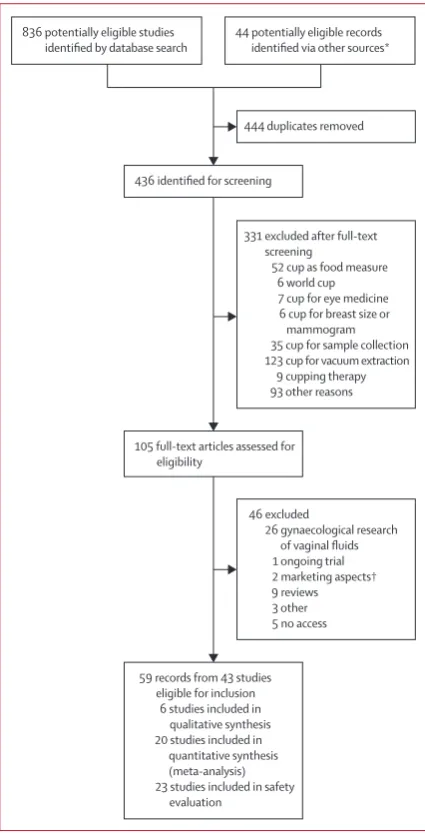
Of 436 unique records identified (appendix p 6), 59 were
identified as relevant (figure 1), and 43 studies were
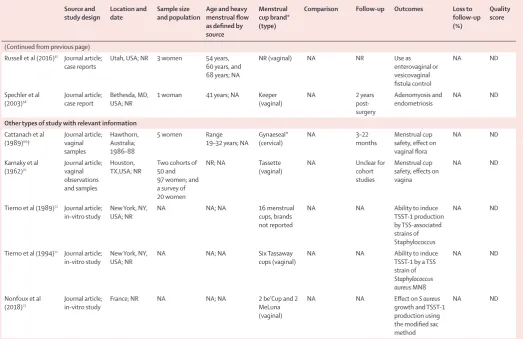
included in our analysis (table 1). In these 43 studies,
3319 participants used or were asked about the menstrual
cup.
5,13,14,19–73Seven studies were completed among
schoolgirls (ie, aged 12–19 years)
in low-income and
middle-income countries (647 [19·5%] participants).
5,27,33,43,58,59cup used, at least seven described menstrual cups that are
no longer available (Tassette, Tassaway, and Gynaeseal).
The quality of quantitative studies was low, with only two
that were of moderate-to-high quality (table 1; appendix
pp 7–8). Many studies did not clearly identify where
their participants were from, or participants were not
representative of the community. Only six studies, all from
low-income and middle-income countries, provided
qualitative information (appendix p 10).
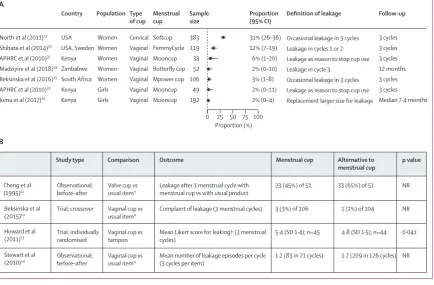
With regard to leakage, only four studies (n=293) made
direct comparisons between menstrual cups and usual
products. The outcomes in each of these studies were
different, but leakage between products was similar in
three studies and significantly less among
menstrual
cups for one study (figure 2).
23In studies that assessed
menstrual cups that are still available, the proportion of
leakage among the participants who reported use of the
menstrual cup was 2–31% for a wide range of definitions,
as shown in figure 2. Some factors mentioned in
association with leakage by study authors included
menorrhagia,
48unusual anatomy of the uterus,
53need for
a larger size of menstrual cup,
5and incorrect placement
of the menstrual cup, or that it had filled to capacity.
39,53When looking at safety, use of the menstrual cup was
not associated with abnormalities in the vagina or cervix
in three studies with vaginal examinations (n=370;
table 2).
13,52,70Three users reported vaginal wounds in case
reports, which could not be confirmed with medical
records. In one case report, severe pain on removal
was self-reported and in another case report severe pain
was self-reported when wearing the menstrual cup,
14and two participants in two different cohort studies
reported vaginal or cervical irritation without clinical
consequences.
39,41Three adverse events that were reported
in one cohort study and three case reports were possibly
related to an allergy; one case of silicone allergy
necessitated reconstructive vaginal surgery.
13,14,48Difficulty
with removal that required professional assistance—an
adverse event we did not anticipate—was reported
47 times for cervical cups (one participant from a cohort
study, and 46 case reports) and twice for vaginal cups
(both case reports).
13,14,46,63We found no increased infection risk (reproductive
tract or systemic infection) associated with use of a
menstrual cup among European,
54,55North American,
and African women and girls,
5,19compared with other
menstrual products (table 2). A decrease in candidiasis
was reported with use of the menstrual cup in two of four
studies that investigated this infection; one study found
no candidiasis infections at follow-up in 18 participants,
and the other, a randomised feasibility pilot among
schoolgirls (aged 14–16 years) in Kenya comparing
menstrual cups, sanitary pads, and usual practice (cloths,
pads, tissue, or other makeshift materials), showed no
difference in the prevalence of candidiasis by study group
(menstrual cup 11 [8%] of 143, pads 19 [10%] of 200, and
usual practice 13 [9%] of 156; menstrual cup vs pads
p=0·68 and menstrual cup vs usual practice p=0·87;
table 2).
5,13,56,70One study
70reported lower prevalence of
bacterial infections among users of the menstrual cup
than among users of tampons or pads (not further
specified), and a randomised pilot study
5in Kenya
reported lower prevalence of bacterial vaginosis among
users of the menstrual cup than users of pads and usual
practice enrolled for 9 months or longer (menstrual cup
13 [13%] of 101, pads 29 [20%] of 143, usual practice
20 [19%] of 104; menstrual cup vs pads p=0·018 and
menstrual cup vs usual practice p=0·074; table 2).
5,70Toxic
shock syndrome was identified in five case reports;
13,14,66microbiological confirmation was available with cultures
from menstrual cup and blood showing streptococcus
Figure 1: Study selection*Reference lists of relevant studies, websites of pertinent professional bodies (eg, US Food and Drug Administration), non-governmental organisations, grey literature (eg, reports or conference abstracts), and records recommended by experts. †For example, advertising approaches.
436 identified for screening
331 excluded after full-text screening
52 cup as food measure 6 world cup 7 cup for eye medicine 6 cup for breast size or
mammogram 35 cup for sample collection 123 cup for vacuum extraction
9 cupping therapy 93 other reasons
105 full-text articles assessed for eligibility
46 excluded
26 gynaecological research of vaginal fluids 1 ongoing trial 2 marketing aspects† 9 reviews 3 other 5 no access
59 records from 43 studies eligible for inclusion
6 studies included in qualitative synthesis 20 studies included in
quantitative synthesis (meta-analysis) 23 studies included in safety
evaluation
44 potentially eligible records identified via other sources*
444 duplicates removed 836 potentially eligible studies
for one case.
14In two participants from two case reports,
concomitant conditions were present (intrauterine device
[IUD] in situ; an immunodeficiency disease).
14,66A
potential additional case of toxic shock syndrome was
identified in a web blog (appendix pp 43–44): we could
not determine whether this case has separately been
reported in the MAUDE system or in a case report and
thus it has been left out of our analysis. The prevalence of
vaginal Staphylococcus aureus was examined among
Kenyan schoolgirls participating in a randomised pilot
study;
5,29no difference was seen between menstrual cup,
pads, and usual practice groups.
29No expression of toxic
shock syndrome toxin 1 (TSST-1) was found in S aureus
positive samples from menstrual cup users in this
study.
29In-vitro studies of production of TSST-1 in the
presence of menstrual cup material showed conflicting
results (table 2).
72,73An initial case report of a menstrual cup user about
dislodgement of her IUD during use of a menstrual cup
was followed by a case series of seven women who
reported dislodgement of an IUD during removal of the
menstrual cup between 1 week and 13 months of IUD
insertion.
14,64A retrospective chart survey did not find an
increased risk for IUD expulsion within 6–8 weeks after
insertion among menstrual cup users (five [4%] of 135),
compared with tampons users (11 [2%] of 469) or pad
users (seven [4%] of 169).
57One case-report
68suggested use of a menstrual cup
might have been associated with the development of
endometriosis;
68however, this hypothesis was not
considered plausible by the regulatory authority and
we did not identify any further reports
on this
possible association. We found three case reports
60–62of
hydronephrosis and one
14of incontinence when using
the menstrual cup; however, symptoms disappeared after
menstrual cup removal (table 2).
14,60,61Other uses of
menstrual cups—eg, as a contraceptive or temporary
fistula control—are in the appendix (p 9)
When assessing uptake and acceptability, all six relevant
qualitative studies were from low-income and
middle-income countries (appendix pp 10–13),
30,33,34,38,56,58,59whereas
20
studies with quantitative information on uptake
and acceptability were from low-income and
middle-income countries and high-middle-income countries (appendix
pp 14–22).
13,19,22–24,32,33,38,39,41–43,46,48,49,51–54,56In low-income
and middle-income countries, usual products for
menstruation included cloths, disposable pads, cotton
wool, tissue paper, or other items, and leakage and
chaffing is a common concern.
30,33,34,58,75All studies that
assessed use of menstrual cups
used some form of
education and training on the menstrual cup. Girls and
women expressed initial concerns in qualitative studies,
noting the size of the menstrual cup.
30Many were
concerned it could cause pain (and noted it often did so at
first) or worried about reproductive harms (eg, infertility).
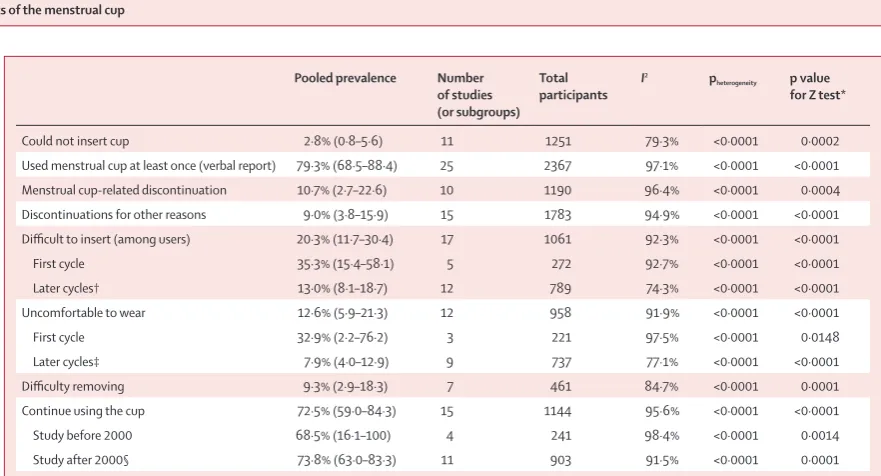
In quantitative studies, 3% (pooled estimate: n=1251,
Source and
study design Location and date Sample size and population Age and heavy menstrual flow as defined by source
Menstrual cup brand* (type)
Comparison Follow-up Outcomes Loss to follow-up (%)
Quality score
Trials Beksinska et al (2015)19–21
Africa; 2013 110 women 29 years (SD 6; range 18–45); heavy
Hoffmann et al (2014)22 assigned to cup group and 46
8 months Acceptability, demand for high-barrier menstrual cup and low-barrier sanitary pads
(vaginal) Tampons 4 cycles Use, use in future, costs, and waste 11·8% 3 Oster et al (2011),24
Oster et al (2012),25
Oster et al (2009)26,27
Journal article;
98 in cup group 14·2 years (SD 1·2); NR Mooncup (vaginal) Usual product (ie, cloths and disposable pads)
15 months School attendance,
peer effect 0·5% 3
Phillips-Howard et al (2016),5
Nyothach et al (2015),28
Juma et al (2017),29
Mason et al (2015),30
Oduor et al (2015),31
van Eijk et al (2018)32
(vaginal) Disposable pads and usual practice (ie,
Source and
study design Location and date Sample size and population Age and heavy menstrual flow as defined by source
Menstrual cup brand* (type)
Comparison Follow-up Outcomes Loss to follow-up (%)
Quality score
(Continued from previous page) Observational studies
APHRC (2010)33–35 Report; cohort
study Nairobi, Kenya; 2008 36 women and 60 schoolgirls NR; NR Mooncup (vaginal) Disposable pads, cloths, cotton wool, tampons
3 cycles Feasibility 6·3% 2
Averbach et al (2009)36
43 women Range
18–45 years Duet (cervical, re-usable) Cotton wool, cloths, disposable pads, tissue
NA Consideration of
menstrual cup use NA ND
Borowski et al (2011)37
Master's
thesis; survey USA; 2011 155 women Age NR ≥18 years; No particular brand NR NA Consideration of eco-friendly menstrual products
NA ND
Care International in Uganda (2018)38
Report; cohort Refugee settlement,
Ruby cup Disposable and re-usable pads, cloths
3 months Menstrual cup use 53·8% 2
Cattanach et al (1991),39Cattanach
et al (1990)40†
Journal article;
cohort Hawthorn, Australia; NR 80 women Range 17–42 years; NR Gynaeseal (cervical) NR 18 months Acceptability 69·1% 2
Cheng et al (1995)41 Journal article;
cohort NR, Canada; 1991–92 51 women 46 (90%) of 51 <40 years; moderate to heavy flow: 42 (82%) of 51
Menses cup‡
(vaginal) Tampons and disposable pads 2–13 cycles Acceptability of menstrual cup for measuring flow
NR 2
Chintan et al (2017)42
Journal article;
cohort India (several sites); NR 100 women Range 14–55 years; NR Flow care (vaginal) Disposable pads and tampons 8 weeks Menstrual cup use NR 2 Femme
International (2017)43§
Report; cohort Kilamanjaro region, Tanzania; 2016–17
184 adolescents
and 38 women Range 12–54 years; NR Ruby cup (vaginal) NR 6–12 months Menstrual cup use 37–88% 2
Ganyaglo et al (2018),44 Ryan et al
Ghana; 2016 11 women 43·6 years
(SD 12·3); NR Diva cup Pads 4 h Menstrual cup use for vesicovaginal fistula
0 5
Gleeson et al (1993)46
Journal article;
cohort Dublin, Ireland; NR 22 women NR; 12 (55%) women had menorrhagia
Gynaeseal
(cervical) Tampons 1 cycle Leakage, ease, use for measuring flow 0 3
Grose et al (2014)47 Journal article;
survey California, USA; NR 151 undergraduates Range 18–23 years; NR Brand not reported NR NA Consideration of menstrual cup NA ND Kakani et al (2017)48 Journal article;
cohort Dharpur, Gujarat, India; NR
3 cycles Acceptability and
efficacy 5·1% 3
Madziyire et al (2018)49,50§
Journal article;
cohort Epworth, Zimbabwe; 2016–17
54 women Range
18–45 years; no information on heavy flow
Butterfly
(vaginal) NR 3 cycles;year 1 Acceptability, leakage 3·7% 3
North et al (2011)13 Journal article;
cohort USA (7 centres); NR 406 women Range 18–55 years; no information on
3 cycles Safety, effectiveness, and acceptability
24·1% 3
Parker et al (1964)51 Journal article;
cohort Ann Arbor, USA; NR 65 women NR; 46 women with menorrhagia, 19 with normal flow
Tassette
(vaginal) Tampons and disposable pads 2–6 months Acceptability 15·2% 3
Source and
study design Location and date Sample size and population Age and heavy menstrual flow as defined by source
Menstrual cup brand* (type)
Comparison Follow-up Outcomes Loss to follow-up (%)
Quality score
(Continued from previous page) Pena et al (1962)52 Journal article;
cohort Florida, USA; NR 125 women (100 with normal flow and 25 with vaginal infections)
Range 20–45 years; all participants had normal flow
Tassette
(vaginal) Tampons and disposable pads 3 cycles Not clear NR 2
Shihata et al (2014)53
Journal article;
cohort Sweden, USA, Mexico, Brazil, Colombia; 2013
146 women Range
18–40 years; NR FemmyCycle (one size, vaginal)**
Disposable pads,
tampons 3 cycles Leakage, acceptability 28·1% 2
Stewart et al (2010)54
Journal article;
cohort Nottingham, UK; 2008–09 54 women Mean 22·5 (SD NR); NR Mooncup (vaginal) Tampons and disposable pads 6 cycles (3 with cup) Leakage, acceptability 61·1% 2 Stewart et al
(2009)55
Journal article;
survey Nottingham, UK; NR 69 clinic patients n=18 <30 years, n=21 30–40 years, n=30 >40 years; NR
Mooncup
(vaginal) Tampons and disposable pads NA Consideration of menstrual cup NA ND
Tellier et al (2012)56 Report; cohort
study Kitgum, Uganda; NR 31 women 24 years (SD NR); NR Ruby cup (vaginal) Cloths, gauze, disposable pads 3–5 cycles Acceptability, safety 51·6% 3 Wiebe et al (2012)57 Journal article;
retrospective chart survey
Vancouver,
Canada; 2009 930 women; 96 used menstrual cups
75 (59%) of
96 <30 years; NR No particular brand or type NA 6 weeks IUD expulsion within 6 weeks after placement, by menstrual product used
NA ND
Studies with only qualitative information Hyttel et al
(vaginal) NA 4 months after study start
Willingness and
ability to use NA Medium
Sundqvist et al (2015)59
Thesis; in-depth interviews
Msiriwa,
Tanzania; 2014 15 schoolgirls Range 14–15 years; NA Lady cup (vaginal) NA NR Effect of menstrual cup use on education and social interactions
NA Strong
Case reports Adedokun et al (2017)60
Abstract; case
report Brno, Czech Republic; NR 1 woman 30 years; NA NR NA NR Hydronephrosis NA ND
Nunes-Carneiro et al (2018)61
Journal article;
case report Porto, Portugal; NR 1 woman 26 years; NA NR NA 5 days Uretero-hydronephrosis NA ND
Stolz et al (2019)62 Journal article;
case report NR; NR 1 woman 47 years; NA NR NA A “couple of weeks” Hydronephrosis NA ND
Day et al (2012)63 Journal article;
case report London, UK; NR 1 woman 20 years; NA Mooncup (vaginal) NA NR Menstrual cup retention NA ND FDA MAUDE
12 women NR; NA Mooncup, Diva
cup, Femmy cycle, Softcup (vaginal and cervical)
NA Variable Adverse events
(in table 2) NA ND
Seale et al (2019)64 Journal article;
case series Denver, CO, USA; NR 7 women n=1 16 years: n=6 22–25 years; NA NR NA 2–12 months IUD expulsion NA ND Goldberg et al
(2016)65
Journal article;
case report New Brunswick, Canada; 2013
1 woman 39 years; NA NR (vaginal) NA NR Use as diagnostic
aid of vesicouterine fistula
NA ND
Mitchell et al (2015)66
Journal article;
case report Ontario, Canada; NR 1 woman 37 years; NA DivaCup (vaginal) NA 2 weeks post-admission
Possible TSS NA ND
95% CI 1–6%, 11 studies; I
2=79·3%) of participants
reported they could not insert the menstrual cup and 11%
(n=1190, 95% CI 3–23%, ten studies; I
2=96·4%) reported
discontinuation related to the menstrual cup (table 3).
Pain on insertion was reported for ten (9%) of
106 menstrual cup users versus none of 104 using their
usual method at 3 months of follow-up in a South African
crossover trial (p value not reported).
19Initial discomfort
on insertion was reported by 20% of participants (pooled
estimate: n=1061, 95% CI 12–30%, 17 studies; I
2=92·3%).
All qualitative studies described user familiarisation with
the menstrual cup over time, with practice, peer support,
and training being key to success.
30,33,34,38,58,59Longitudinal
quantitative studies in low-income and middle-income
countries showed a learning curve of 2–5 months
(appendix p 22); colour change of the menstrual cup as an
objective measure suggested use increased throughout
the first year among Kenyan schoolgirls.
32A Nepalese
study
25noted that self-reported increased use 2 months
after distribution was associated with the presence of
friends who successfully used the menstrual cup. In
India
22and Tanzania,
43the uptake of menstrual cups was
significantly slower than uptake of pads (appendix p 24).
22,43In 15 studies with relevant information, 73% (pooled
estimate: n=1144, 95% CI 59–84; I
2=96%) of participants
reported willingness to continue use of the menstrual cup
Source andstudy design Location and date Sample size and population Age and heavy menstrual flow as defined by source
Menstrual cup brand* (type)
Comparison Follow-up Outcomes Loss to follow-up (%)
Quality score
(Continued from previous page) Russell et al (2016)67 Journal article;
case reports Utah, USA; NR 3 women 54 years, 60 years, and 68 years; NA
NR (vaginal) NA NR Use as
enterovaginal or vesicovaginal fistula control
NA ND
Spechler et al (2003)68
Journal article;
case report Bethesda, MD, USA; NR 1 woman 41 years; NA Keeper (vaginal) NA 2 years post-surgery
Adenomyosis and
endometriosis NA ND
Other types of study with relevant information Cattanach et al
(1989)69†
Journal article; vaginal samples
Hawthorn, Australia; 1986–88
5 women Range
19–32 years; NA Gynaeseal* (cervical) NA 3–22 months Menstrual cup safety, effect on vaginal flora
NA ND
Karnaky et al (1962)70
Journal article; vaginal observations and samples
Houston,
TX,USA; NR Two cohorts of 50 and 97 women; and a survey of 20 women
NR; NA Tassette
(vaginal) NA Unclear for cohort studies
Menstrual cup safety, effects on vagina
NA ND
Tierno et al (1989)71 Journal article;
in-vitro study New York, NY, USA; NR NA NA; NA 16 menstrual cups, brands not reported
NA NA Ability to induce
TSST-1 production by TSS-associated strains of Staphylococcus
NA ND
Tierno et al (1994)72 Journal article;
in-vitro study New York, NY, USA; NR NA NA; NA Six Tassaway cups (vaginal) NA NA Ability to induce TSST-1 by a TSS strain of
Staphylococcus aureus MN8
NA ND
Nonfoux et al (2018)73
Journal article;
in-vitro study France; NR NA NA; NA 2 be’Cup and 2 MeLuna (vaginal)
NA NA Effect on S aureus
growth and TSST-1 production using the modified sac method
NA ND
Where data are missing, it was not provided in the source material. Cycles refer to menstrual cycles. A quality score of 5–6 indicates a moderate-to-high quality study, and a score of less than 5 indicates a medium-to-low quality study. For qualitative studies, levels of study quality were strong, medium, and weak. The quality score components of individual studies are in the appendix (pp 7, 8, 10).Cloths=pieces of material (clothing, blankets, socks) that are used for menstruation and can be reused after washing or disposed of after use. NR=not reported. STI=sexually transmitted infection. APHRC=African Population and Health Research Center. NA=not applicable. ND=not done (these studies were not assessed for quality). IUD=intrauterine device. FDA=US Food and Drug Administration. MAUDE=Manufacturer and User Facility Device Experience. TSS=toxic shock syndrome. TSST-1=toxic shock syndrome toxin 1. *Manufacturing company, city, country, and website where available, are listed in the appendix (p 8). †The study author was the developer of Gynaeseal (a disposable cup covering the cervix. that can also be worn during intercourse); we assumed the articles from 1990 and 1991 described the same study and used the publication with the larger sample size (1991). ‡This type of cup has a drainage tube that can be opened to let menstrual fluids pass. §Additional information obtained from internal report or author. ¶Description in article is like a cervix-covering cup (“The device- the menstrual cup we utilized for the study is an internally worn device with a pliable rim 44mm in diameter and a thin-walled reservoir to collect and hold the menstrual fluid. It was designed to minimize bulk in order to facilitate insertion and removal. Once inserted; it opens to an oval shape, positioned between the posterior fornix and the notch behind the pubic bone, covering the cervix. Removal is accomplished by hooking a finger over the rim behind the pubic bone. It is made up of health grade non-toxic non- allergic silicon”), but image is of a low vaginal cup. ||Instead Softcup (a rebrand of Softcup): disposable cup covering the cervix. This type of cup can also be worn during intercourse. **Author has patent on this menstrual cup. ††Part of a larger study (Gulu Schoolgirl Menstrual Cup Study, n=194), for which no other publication could be retrieved.
after the study (figure 3). All qualitative and some
quantitative studies reported a positive effect of use of the
menstrual cup on participants’ lives, decreased stress
concerning staining and leakage, and improvements in
mobility.
13,51,53Challenges described included difficulties
with cleaning and storage of the menstrual cup in
low-income and middle-income countries.
34,58Other
challenges were associated with emptying the menstrual
cup in school or public toilets,
28,34,58which was also reported
by participants in high-income countries.
37Menstrual
cups were associated with a decrease in the average
number of changes per cycle in a UK study compared
with tampons or sanitary pads.
54Three qualitative studies
implied that school attendance, concentration, and
performance improved after participants were given a
menstrual cup.
30,34,58No measured difference in school
absence or test results between products were reported
(appendix p 24).
5,27,34A study in Nepal noted a significant
decrease in time spent doing laundry for menstrual cup
users compared with those using usual practice.
27An economic advantage of a menstrual cup emerged in
qualitative studies, with participants (and families) citing
monthly cost savings from not needing to purchase pads
or soap for laundry. Two qualitative studies included
quotes from participants showing that menstrual cups
might decrease the need for transactional sex to purchase
pads.
34,38This finding might be corroborated by results
from a randomised controlled study among schoolgirls
(aged 14–16 years) in rural western Kenya that noted a
significantly lower prevalence of sexually transmitted
infections among participants who were provided by the
study with either menstrual cups or disposable pads
versus controls (ie, using usual practice), citing lower
exposure to transactional sex as a probable reason
(table 2; appendix p 24).
5A study in schoolgirls in Kenya (aged 14–16 years) in an
area with poor water and sanitation
76reported dropping
of menstrual products during changing of cloths or
disposable pads, or emptying of the cup.
31The frequency
was similar for menstrual cups and sanitary pads. Factors
involved included young age, and lack of time and
privacy. Dropping of the menstrual cup decreased with
increasing experience (approximately 23% in the first
3 months and 10% at or after 12 months). This dropping
was associated with Escherichia coli isolated in cultures
from swabs of menstrual cups, which was higher in new
users than in experienced users (table 2).
29The proportion
of girls who washed their hands before changing of the
menstrual cup, by verbal self-report, was 95% (204 of 215)
in a Kenyan report,
2870% (16 of 23) in a Ugandan report,
56and 94% (15 of 16) in a study in a refugee camp.
38When
toilets have a lack of water, some participants reported
carrying a bottle of water for when they emptied their
menstrual cup.
28Others said they had to empty the
Figure 2: Menstrual cup and leakage
(A) Proportion of participants who had menstrual leakage in seven studies using different types of menstrual cups and definitions. (B) Reports of leakage among menstrual cup users versus users of other menstrual products. APHRC=African Population and Health Research Center. NR=not reported. *Disposable pad or tampon. †Likert scale: 7-point score, in which 1=terrible and 7=great. ‡p value reported in article for Mann-Whitney test.
North et al (2011)13
Shihata et al (2014)53
APHRC et al (2010)33
Madziyire et al (2018)49
Beksinska et al (2016)19
APHRC et al (2010)33
Juma et al (2017)29
Occasional leakage in 3 cycles Leakage in cycles 1 or 2 Leakage as reason to stop cup use Leakage in cycle 3
Occasional leakage in 3 cycles Leakage as reason to stop cup use Replacement larger size for leakage
Definition of leakage
(1995)41 Observational; before–after
Trial; crossover
Vaginal cup vs usual item*
Vaginal cup vs tampon
Vaginal cup vs usual item*
Leakage after 1 menstrual cycle with menstrual cup vs with usual product
Complaint of leakage (3 menstrual cycles)
Mean Likert score for leaking† (3 menstrual cycles)
Mean number of leakage episodes per cycle (3 cycles per item)
Study type Comparison Outcome Menstrual cup Alternative to p value
n (%) or description Notes Data source Handling and positioning of menstrual cup
Vaginal wound Cup not clear
(Divacup or softcup) Event April, 2012; vaginal wound due to use of menstrual cup, needing treatment from physician for vaginal bleeding Complete medical records were not available for evaluation FDA database
14
Softcup (cervical) Reported April, 2012; long-term customer of softcup product
claimed vaginal scarring due to use Medical director did not find anything in medical records provided by customer related to vaginal health FDA database
14
Softcup (cervical) FDA database case report: “…cup wore through the vaginal wall,
damaging an artery that required surgical repair” Event could not be confirmed; no medical records were available North et al (2011)
13
Vaginal pain on removal
Divacup (vaginal) Event March, 2017; extreme pain on removal (first use),
individual stopped using the cup Self-report; no medical report available FDA database
14
Pelvic pain
Softcup (cervical) Event February, 2017; pain in lower pelvis and rectum and nausea about 1 h after insertion, no longer present approximately 30 min after removal
Self-report; no medical evaluation available; individual stopped use after
trying twice (possibly vascular compression) FDA database
14
Vaginal irritation
Gynaeseal (cervical) One (1%) of 73 Self-report by participant Cattanach et al
(1991)39
Cervix irritation
Menses cup (vaginal) One (2%) of 51 Cervical smear was normal Cheng et al
(1995)41
Allergy and rash
NR, vaginal cup Allergy: one (1%) of 150; and rash: two (1%) of 150 · · Kakani et al
(2017)48
Softcup (cervical) FDA database: two case reports NR North et al (2011)13
Mooncup (vaginal) Event 2010: silicone allergy in one individual Surgery was needed for vaginal repair; manufacturer noted that silicone
allergy is very rare FDA database
14
Difficulty with removal requiring professional assistance
Gynaeseal (cervical) One (5%) of 22 · · Gleeson et al
(1993)46
Softcup (cervical) FDA database: three case reportsreported by North 2011;
one event in 2018 · · North et al (2011),13 FDA
database14
Softcup (cervical) Reported complaints to company 2003–08: 42 individuals
underwent physician-assisted removal Other complaints reported to company included poor fit (n=102), leakage (n=168), messy (n=98) North et al (2011)
13
Mooncup (vaginal) Case report: menstrual cup lodged on cervix, difficult to remove,
requiring assistance Moderate cervical inflammation after retrieval Day et al (2012)
63
Divacup (vaginal) Event April, 2015: one case report required an emergency room
visit for removal · · FDA database
14
Reproductive tract observations with use of menstrual cup Vulva abnormalities
Softcup (cervical) Baseline: four (1%) of 393; cycle 1: eight (2%) of 365; cycle 2:
six (2%) of 326; cycle 3: five (2%) of 305 Vulva-vaginal inspection at baseline and monthly for 3 months; no p values reported North et al (2011)
13
Abnormalities of vaginal wall
Softcup (cervical) Zero of 44 Vulva-vaginal inspection at baseline and monthly for 3 months North et al (2011)13
Tassette (vaginal) Zero of 12 Vaginal inspection after 3 months Pena et al (1962)52
Tassette (vaginal) Zero of 50 Vaginal inspection done; timing of inspections not clear Karnaky et al
(1962)70
Abnormalities of cervix
Softcup (cervical) Baseline: 23 (6%) of 390; cycle 1: ten (3%) of 345; cycle 2: six (2%)
of 326; cycle 3: four (1%) of 300 Inspection of cervix; no p values reported for differences North et al (2011)
13
Softcup (cervical) Abnormal cervical smear test: baseline: one (<1%) of 406; cycle 1:
one (<1%) of 368; cycle 2: two (1%) of 329; cycle 3: zero of 308 Abnormal cervical smear test results were exclusion criteria at admission, and a reason for discontinuation of the study; no p values reported for differences North et al (2011)
13
Condition of vaginal and cervical epithelium
Softcup (cervical) 44 women examined at baseline, 37 at 2–3 months, and 25 at
5–6 months “The Softcup caused no alteration or disruption in vaginal or cervical epithelium, as assessed by colposcopy and cervical cytology” North et al (2011)
13
n (%) or description Notes Data source (Continued from previous page)
Vaginal flora and infections with use of menstrual cup pH changes of vagina
Tassette (vaginal) Zero of 50 No abnormalities, vaginal areas where menstrual cup was placed were
more acid Karnaky et al (1962)70
Softcup (cervical) Mean pH at baseline: 4·6 (n=400); cycle 1: 4·6 (n=368);
cycle 2: 4·6 (n=329); cycle 3: 4·5 (n=308) No p values reported North et al (2011)
13
Clue cells (vaginal smear) Lactobaccilus
Softcup (cervical) Number with clue cells: baseline n=6; cycle 1 n=6; cycle 2 n=2;
cycle 3 n=4 Sample sizes and p values were not reported North et al (2011)
13
Lactobaccilus
Softcup (cervical) “…before, during, and after use of the cup, vaginal Lactobacillus
(normal vaginal flora) was maintained at normal levels.” Data in figure 3 in publication cannot be extracted; no significant changes according to authors North et al (2011)
13
Gardnerella vaginalis
Softcup (cervical) No significant changes from baseline-cycle 3 according to authors Data in figure 3 in publication cannot be extracted North et al (2011)13
Bacterial vaginosis
Softcup (cervical) No significant changes from baseline to cycle 3 according to
authors Data in figure 3 in publication cannot be extracted North et al (2011)
13
Mooncup (vaginal) Study end survey: cup 21 (15%) of 144; pads 40 (20%) of 202, and usual practice (control) 32 (21%) of 156; cup vs control p=0·11 and cup vs pads p=0·13; among girls enrolled for ≥9 months: cup 13 (13%) of 101, pads 29 (20%) of 143, usual practice 20 (19%) of 104; cup vs control p=0·07, and cup vs pads p=0·018
Cluster randomised trial of schools; median follow-up 11 months
(range 3–15) Phillips-Howard et al (2016)5
Candidiasis
Softcup (cervical) Number with candidiasis: baseline n=6; cycle 1 n=6; cycle 2 n=3;
cycle 3 n=6 Sample sizes not reported; according to authors, yeast decreased significantly from month 1 to 2 North et al (2011)
13
Ruby cup (vaginal) Zero of 18 participants had vaginal candidiasis at follow-up
(3–5 months) NA Tellier et al (2012)
56
Tassette (vaginal) Candida albicans decreased with the use of the cup NR Karnaky et al
(1962)70
Mooncup (vaginal) Study end survey: cup 11 (8%) of 143, pads 19 (10%) of 200, usual practice (control) 13 (9%) of 156; cup vs control p=0·87, and cup
vs pads p=0·68
Cluster randomised trial of schools; median follow-up 11 months
(range 3–15) Phillips-Howard et al (2016)5
Group B Streptococcus
Softcup (cervical) No differences between baseline and cycle 1 to cycle 3 Data in figure 3 in publication cannot be extracted; no significant changes
according to authors North et al (2011)
13
Enterococcus
Softcup (cervical) Increase in Enterococcus from cycle 2 to cycle 3 (p=0·03 ) “… this increased frequency persisted for 3 months after discontinuing use of the cup, suggesting that factors or behavior other than cup use may have influenced colonization”; data in figure 3 in publication cannot be extracted
North et al (2011)13
E coli
Softcup (cervical) No significant changes from baseline to cycle 3 according to
authors Data in figure 3 in publication cannot be extracted North et al (2011)
13
Escherichia coli on menstrual cup
Mooncup (vaginal) Nine (53%) of 17 if used cup for <6 months; four (22%) of 18 if used for ≥6 months (p=0·12); association between E coli with heavy periods: 61·5% of girls reporting heavy periods had E coli on cups, compared with 22·7% of those stating they did not have heavy periods (p=0·022, no numbers presented)
Cluster randomised trial of schools; median follow-up 11 months (range
3–15) Juma et al (2017)
29
Chlamydia trachomatis
Mooncup (vaginal) Study end survey: cup three (2%) of 144, pads three (2%) of 201, usual practice (control) seven (5%) of 154; cup vs control p=0·20, and cup vs pads p=0·63
Cluster randomised trial of schools; median follow-up 11 months (range
3–15) Phillips-Howard et al (2016)5
Trichomonas vaginalis
Softcup (cervical) Zero cases at baseline, and cycles 1 to 3 Sample sizes not reported North et al (2011)13
Mooncup (vaginal) Study end survey: cup two (1%) of 143, pads five (3%) of 200, usual practice (control) seven (5%) of 154; cup vs control p=0·12, and cup vs pads p=0·36
Cluster randomised trial of schools; median follow-up 11 months
(range 3–15) Phillips-Howard et al (2016)5
n (%) or description Notes Data source (Continued from previous page)
Ruby cup (vaginal) Zero of 18 at baseline, and at 3–5 months of follow-up NA Tellier et al (2012)56
Neisseria gonorrhoea
Mooncup (vaginal) Study end survey: cup one (1%) of 144, pads one (1%) of 201, usual practice (control) one (1%) of 154; cup vs control p=0·96, and cup vs pads p=0·81
Cluster randomised trial of schools; median follow-up 11 months
(range 3–15) Phillips-Howard et al (2016)5
Ruby cup (vaginal) Zero of 18 at baseline, and at 3–5 months of follow-up NA Tellier et al (2012)56
Staphylococcus aureus
Softcup (cervical) No significant changes in cycles 1–3 compared with baseline Data in figure 3 of publication cannot be extracted North et al (2011)13
Mooncup (vaginal) Among menstrual cup users: four (11%) of 38 in first month of intervention, 13 (9%) of 139 after first month; p=0·83 (median follow-up 4 months, range 2–11 for this substudy); prevalence was 21 (11%) of 197 in sanitary pads group, and 16 (11%) of 153 in usual practice group
Cluster randomised trial in schools; median follow-up 11 months
(range 3–15); samples from vaginal swab (self-swabbing) Juma et al (2017)
29
be’Cup (vaginal) Silicone cup: potentially more S aureus after incubation for 8 h with shaking in a plastic bag with S aureus in one of two cups used, but not when no shaking
In-vitro study Nonfoux et al
(2018)73
Me Luna (vaginal) Thermoplastic isomer cup: no more S aureus after incubation for
8 h with shaking in plastic sac, and not when no shaking In-vitro study Nonfoux et al (2018)73
TSST-1
Mooncup (vaginal) 49 schoolgirls with vaginal S aureus had second swab: ten yielded
S aureus, two had TSST-1, both in sanitary pad group; the cases
were asymptomatic
Cluster randomised trial in schools; median follow-up 11 months
(range 3–15); sample from vaginal swab (self-swabbing) Juma et al (2017)
29
NR No TSST-1 in supernatant of S aureus cultivated for 24 h (incubated aerobically in a still growth environment) in the presence of elastic polymer menstrual cup (n=16 menstrual cups)
In-vitro study Tierno et al
(1989)71
Tassaway (vaginal) S aureus MN8 produced no TSST-1 when grown in the presence of
Tassaway (elastomeric polymer, n=6), washed or unwashed, no shaking, incubation overnight
In-vitro study Tierno at al
(1994)72
be’Cup (vaginal) Silicone cup: potentially more TSST-1 production after incubation for 8 h with shaking in plastic bag with S aureus compared with control, but not when not shaken or with pieces of cup
In-vitro study Nonfoux et al
(2018)73
Me Luna (vaginal) Thermoplastic isomer cup: potentially more TSST-1 production after incubation for 8 h with shaking in plastic bag with S aureus compared with control, but not when not shaken or with pieces of cup
In-vitro study Nonfoux et al
(2018)73
TSS
Mooncup (vaginal) Zero of 192 in trial in Kenya “Safety monitoring components comprised routine nurse-based screening, population-based monitoring (school and community) and clinical evaluation of infection with laboratory confirmation”
Juma et al (2017)29
Softcup (cervical) Two case reports in the FDA database Both unconfirmed cases of TSS North et al (2011)13
Divacup (vaginal) One case report: blood cultures and urine culture negative,
no culture of the menstrual cup was done Woman had history of Hashimoto’s thyroiditis and chronic menorrhagia Mitchell et al (2015)66
Mooncup (vaginal) Event February, 2012: TSS 2 days after using of first and new Mooncup resulting in 9 days of inpatient hospital stay; vaginal swab positive for S aureus
Had an IUD, Mooncup was not sent for bacteriological testing FDA database14
Divacup (vaginal) Event February, 2015: TSS from Streptococcus resulting in 5 days of i-patient hospital stay; culture of cup isolated group A and B streptococcus
Woman had used Divacup for menstrual period, which started 3 days before
illness; menstrual cup was in for 18 h on admission to hospital FDA database
14
UTI
Ruby cup (vaginal) Baseline: four (13%) of 31; at follow-up (after 3–5 months)
three (17%) of 18; p=0·65, McNemar test One participant with a UTI at enrolment and follow-up had her cup stolen and used toilet paper in vagina as a tampon Tellier et al (2012)
56
Gynaeseal (cervical) One (1%) of 73 had transient dysuria “The woman who developed dysuria did not seek treatment and the problem
subsided within 24–48 hours” Cattanach et al (1991)39
Softcup (cervical) Urine analysis done; detailed results not reported “Monthly monitoring of gynecological health via urinalysis, pelvic examination with visual evaluation of tissues, vaginal pH, and microscopic wet mount showed no adverse effects of cup use”
North et al (2011)13
Softcup (cervical) Event August, 2014: UTI confirmed by urine cultures twice after
use of softcup Medical records were not available for evaluation FDA database
14
n (%) or description Notes Data source (Continued from previous page)
Infections overall
Tassette (vaginal) “The amount of bacterial contamination was greatest with the
pad, next with the tampon and least with the rubber cup” No data provided; study reported to make cultures from vaginal wall samples and to examine fresh and stained smears for C albicans, Trichomonas vaginalis,
Haemophilus vaginalis, and for predominance of Gram-positive or
Gram-negative cocci, small rods or long-rod bacilli (Doederlein bacilli)
Karnaky et al (1962)70
Softcup (cervical) FDA database: one case report Vaginal infection not further specified; could not be confirmed at follow-up North et al (2011)13
Butterfly cup
(vaginal) “...none of the women sought treatment for a pelvic infection.There was no onset or worsening of dysmenorrhoea in 83%, dyspaurenia in 94%, pelvic pain in 92% and vaginal discharge in 92% of the participants during the 12 months of cup use"; n=52
NA Madziyire et al
(2018)49,50
Gynaeseal “There was no increased pathogenicity detected in vaginal flora. There was a trend towards smaller numbers of potentially pathogenic bacteria for 4 of the women, and the remaining woman showed no change. None of the women developed any significant medical problems"
Vaginal swabs before and after use, five women, median follow-up
14 months (range 3–22) Cattanach et al (1989)69
STIs
Mooncup (vaginal) Study end survey: menstrual cup six (4%) of 144, pads nine (5%) of 202, and usual practices (control) 12 (8%) of 156; cup vs control p=0·11, and cup vs pads p=0·87; whenfollow-up was ≥9 months: cup four (40%) of 101, pads seven (5%) of 143, and usual practice 11 (11%) of 104; cup vs control p=0·004, and cup vs pads p=0·60
Presence of either C trachomatis, T vaginalis or N gonorrhoea; cluster randomised trial of schools in Kenya; median follow-up 11 months (range 3–15)*
Phillips-Howard et al (2016)5
Reproductive tract infections
Mooncup (vaginal) Study end survey: cup 31 (22%) of 144, pads 58 (29%) of 202, and usual practice (control) 42 (27%) of 156; cup vs control p=0·36, and cup vs pads p=0·19
Presence of either B vaginosis or C albicans; cluster randomised trial of schools
in Kenya; median follow-up 11 months (range 3–15) Phillips-Howard et al (2016)5
Other adverse events Urinary incontinence
Femcap (first model of femmycycle, vaginal)
FDA database: one case report; event July, 2014; pelvic pain and urinary incontinence when wearing and removing menstrual cup; urine sample negative for infection
Self-report; stopped using menstrual cup FDA database14
Displacement of IUD when using menstrual cup
NR IUD expulsion 6–8 weeks after insertion: menstrual cup five (4%) of 135, tampon 11 (2%) of 469, pads: seven (4%) of 169; cup vs tampon p=0·57, and cup vs pads: p=0·92
Retrospective cohort; expulsion of an IUD occurs in approximately one in 20 women and is most common in the first 3 months after insertion; expulsion commonly occurs during menstruation; some recommend not to use internal sanitary protection for 3–6 weeks after insertion because of an increased infection risk
Wiebe et al (2012)57
Mooncup (vaginal) FDA database: one case report; event July, 2012; potential IUD dislodgment after Mooncup removal; patient had an ectopic pregnancy and needed surgery
Patient felt pain after removal of Mooncup and had the position of the IUD checked at a health centre where it was declared in position; 2 months later she was found to be pregnant
FDA database14
NR Case series of seven women with IUD expulsion when removing menstrual cup; expulsion occurred 1 week to 13 months after insertion of IUD and was recurrent in two women; of seven women, two choose to use different contraception; the five others had their IUD re-inserted
Two women opted for cutting the wires of the IUD close to the cervix to avoid the problem; authors also stress importance of releasing vacuum of menstrual cup before removal
Seale et al (2019)64
Endometriosis because of menstrual backflow via use of menstrual cup
Tassette (vaginal) Position of cup confirmed with X-ray imaging "Hence the free space available in the upper vagina plus the capacity of the cup itself are ample to accommodate several times the amount of blood passed in a complete menstrual cycle"
Pena et al (1962)52
Tassette (vaginal) No evidence for backflow “Thin watery solutions could not be introduced under high pressures during
the menstrual flow in 6 multiparous women” Karnaky et al (1962)70
Keeper (vaginal) Case report: dysmenorrhoea 2 years after start of menstrual cup use (10 years ago tubal ligation); laparoscopy showed adenomyosis and endometriosis, treated with laser; patient stopped use of menstrual cup; pain decreased after surgery; 2 years of follow-up
“The observations in our patient suggest that it may be useful to inquire about use of these devices in women with pelvic pain or endometriosis”; petition for revoking of market approval to US FDA rejected because of lack of evidence74
Spechler et al (2003)68
menstrual cup only twice a day, so they could avoid
emptying in public places.
38In two studies, women
reported that use of menstrual cups saved water because
of less leaking and washing of cloths.
33,38Privacy was
mainly mentioned as a problem when boiling (ie,
cleaning) or storing menstrual cups.
38,56We identified considerable heterogeneity in outcomes
of acceptability of menstrual cups in the pooled
meta-analyses (table 3). Subgroup meta-analyses by study quality
(low vs moderate-to-good) for outcomes examined did not
show significant differences for the outcomes examined,
but the sample size for moderate-to-good quality studies
was small (appendix p 23). Smaller studies sometimes
show different, often larger, treatment effects than large
studies (ie, small-study effect); except for the outcome of
"could not insert cup" (p=0·041), we did not find evidence
for the presence of small-study effects (appendix p 23).
In the assessment of visibility in three studies in
high-income countries, only 11–33% of the women
interviewed (n=375) were aware of menstrual cups
(appendix p 25).
37,47,55On 69 websites with educational
materials on puberty and menarche from 27 countries,
disposable pads were mentioned as an option by 53 (77%),
tampons by 45 (65%), menstrual cups by 21 (30%), and
reusable pads by 15 (22%; appendix pp 26–28). In the
assessment of costs and availability, we identified
199 brands of menstrual cups, and availability in
99 countries with prices ranging US$0·72–46·72
Pooled prevalence Numberof studies (or subgroups)
Total
participants I
2 pheterogeneity p value for Z test*
Could not insert cup 2·8% (0·8–5·6) 11 1251 79·3% <0·0001 0·0002
Used menstrual cup at least once (verbal report) 79·3% (68·5–88·4) 25 2367 97·1% <0·0001 <0·0001
Menstrual cup-related discontinuation 10·7% (2·7–22·6) 10 1190 96·4% <0·0001 0·0004
Discontinuations for other reasons 9·0% (3·8–15·9) 15 1783 94·9% <0·0001 <0·0001
Difficult to insert (among users) 20·3% (11·7–30·4) 17 1061 92·3% <0·0001 <0·0001
First cycle 35·3% (15·4–58·1) 5 272 92·7% <0·0001 <0·0001
Later cycles† 13·0% (8·1–18·7) 12 789 74·3% <0·0001 <0·0001
Uncomfortable to wear 12·6% (5·9–21·3) 12 958 91·9% <0·0001 <0·0001
First cycle 32·9% (2·2–76·2) 3 221 97·5% <0·0001 0·0148
Later cycles‡ 7·9% (4·0–12·9) 9 737 77·1% <0·0001 <0·0001
Difficulty removing 9·3% (2·9–18·3) 7 461 84·7% <0·0001 0·0001
Continue using the cup 72·5% (59·0–84·3) 15 1144 95·6% <0·0001 <0·0001
Study before 2000 68·5% (16·1–100) 4 241 98·4% <0·0001 0·0014
Study after 2000§ 73·8% (63·0–83·3) 11 903 91·5% <0·0001 0·0001
Data in parentheses are 95% CIs. No significant difference was found for any of the subgroup analyses (high-income vs low-income and middle-income countries, adult women vs adolescents, type of cup, duration of follow-up, or high vs low or moderate study quality).*A significant Z test indicates that the pooled prevalence is different from zero. †Difficult to insert: first vs later menstrualcycles: p=0·15. ‡Uncomfortable to wear: first vs later menstrualcycles: p=0·13. §Continue to use cup: before vs after 2000: p=0·29.
Table 3: Pooled estimates of meta-analyses for different outcomes of acceptability
n (%) or description Notes Data source
(Continued from previous page) Hydronephrosis (ie, renal colic)
NR Case report: severe colicky flank pain; CT scan showed menstrual
cup was slightly dislocated, pressing into left ureter “The extraction of the menstrual cup resulted in resolution of hydronephrosis and associated symptoms” Adedokun et al (2017)60
NR Case report: 3 h of back pain on the right side; low-dose unenhanced CT scan showed entrapment of left vaginal wall and part of interolateral bladder wall; improperly positioned menstrual cup
Symptoms and swelling disappeared after removal of menstrual cup, confirmed by another CT scan; patient had used a menstrual cup for a long time with no previous problems, and continued use of cup; no problems at follow-up after several weeks
Stolz et al (2019)62
NR Case report: 3 h of pain in the right flank, and nausea during menstruation; X-ray imaging showed menstrual cup orientated to the right
“The symptoms and the ureterohydronephrosis relieved completely after the
removal of the device”; patient had used a menstrual cup for 2 years Nunes-Carneiro et al (2018)61
Entries in FDA database14 for softcup not entered if before 2011, to avoid double reporting with North et al (2011).13 NR=not reported. NA=not applicable. TSST-1=toxic shock syndrome toxin-1. TSS=toxic shock
syndrome. FDA=US Food and Drug Administration. IUD=intrauterine device. UTI=urinary tract infection. STI=sexually transmitted infection. *The decrease in STIs in the trial in Kenya in the groups in which either menstrual cups or sanitary pads were provided is thought to be an indirect effect because of the decrease in risky sexual behaviour to obtain money to buy pads.
(median 23·3 [IQR 16·54–29·20], from 145 brands with
prices available; appendix pp 29–39).
When considering financial and environment costs,
using accumulated estimates over 10 years, purchase costs
and waste from consistent use of a menstrual cup (vaginal
cup) would be a small fraction of the purchase costs and
waste of pads or tampons—eg, if compared with using
12 pads per period, use of a menstrual cup would
comprise 5% of the purchase costs and 0·4% of the plastic
waste, and compared with 12 tampons per period, use of a
menstrual cup would comprise 7% of the purchase costs
and 6% of the plastic waste (appendix pp 40–42).
Discussion
Women, girls, and transgender people require hygienic
menstrual products monthly to live healthy and productive
lives. In this systematic review and meta-analysis, we
assessed the menstrual cup, combining information from
medical and grey literature to inform choice and
strengthen the evidence base for programmes supporting
menstrual health, such as for schoolgirls in low-income
and middle-income countries or among refugees. Leakage
was similar or less when using the menstrual cup than
when using disposable pads and tampons. The adoption
of a menstrual cup required a familiarisation phase and
peer support seemed to be important for uptake in
low-income and middle-low-income countries. Challenges in
resource constrained settings (eg, lack of sanitation,
hygiene, and privacy) did not stop women from using the
cup. Around 70% of participants in 13 studies declared
wanting to continue use. We identified several incidental
case reports of vaginal damage, toxic shock syndrome, or
urinary tract complaints after menstrual cup use, and
difficulty retrieving the menstrual cup was also reported.
Use of menstrual cups has been described as a factor for
<