ABSTRACT
R0BERTS, WILLIAM EDWARD. The Use of Cues in Multimedia Instructions in
Technology as a way to Reduce Cognitive Load. (Under the direction of Dr. Eric N. Wiebe.)
This study was designed to address cognitive overload issues through the use of visual cueing as a means to enhance learning.
While there has been significant research such as use of color for cueing to address many of the cited problems, there are missing elements in this research that could go a long way toward designing more effective solutions and teaching methods for Technology Education students. One aspect that is missing is a better understanding of how color cueing and narration interact with various aspects of information overload, split attention effect, and overall instructional difficulty.
When teaching technical topics to a technical or non-technical audience using multimedia instructions or tutorials, there is a problem of information overload when using these methods of delivery. Without the proper testing and methods for designing these types of presentation, the students or the audience the instructor plans to present this information to may likely experience cognitive overload, reducing the effectiveness of the instructions and tutorials. Cognitive overload is the result of excessive demands made on the cognitive processes, in memory particular.
The principal research uses two rating scale assessment techniques: the SSI and NASA-Task Load Index (TLX), to assess levels of cognitive load. Previous research demonstrated that the SSI and TLX had different sensitivities to cognitive load.
The research adds to the existing research base, address some of these missing elements, and gain a better understanding of how to address the problems that have been presented above specific to Technology Education students, but equally relevant to other subject matter.
The Use of Cues in Multimedia Instructions in Technology as a way to Reduce Cognitive Load
by
William Edward Roberts
A dissertation submitted to the Graduate Faculty of North Carolina State University
in partial fulfillment of the requirements for the Degree of
Doctor of Education
Technology Education Raleigh, NC
2009
APPROVED BY:
_________________________________ __________________________________ Eric N. Wiebe, Ph.D. William James Haynie III, Ph.D.
Chair
DEDICATION
This dissertation is dedicated to my parents Dorothy L. Crowell, and the late William R. Roberts, to my sister Michelle Roberts McCulloch, to my son Robert Clayton Roberts, and a very special thanks to my long time best friend and business/technology advisor who became my wife as of January 2009; Julie Levitt Roberts and her son Colin and daughter Tiara. My new bride, Julie provided me with her steadfast confidence and encouragement during my years away in college as well as recording the test modules, and providing writing and research advice. I additionally would like to thank my Chair, Dr. Eric Wiebe, and fellow members of my doctoral committee, Dr. William DeLuca, Dr. William J. Haynie III, and Dr. Brad Mehlenbacher as well as the departmental professors, and student colleagues for their support they have provided in this accomplishment in my professional development. And finally, I would like to offer much overdue appreciation to all my former colleagues and professors who encouraged and supported my pursuit of my doctoral studies from
BIOGRAPHY
William Edward Roberts was born in Asheville, North Carolina on May 27, 1955. Edward attended Asheville city schools until he moved to Spruce Pine, North Carolina in 1969. Edward graduated from Harris High School in 1974. In 1976 Edward enrolled at Gupton-Jones College of Mortuary Science in Atlanta, Georgia and graduated in 1977. Edward then worked at Webb Funeral Home as a licensed embalmer and funeral director until 1992, before beginning his Associates degree at Mayland Community College in Spruce Pine, North Carolina, graduating in 1994.
After graduation, Edward worked at Hampshire Hosiery until 2001, and in August 2001 Edward enrolled at Appalachian State University in Boone, North Carolina, where he graduated with a Bachelor of Science degree in Industrial Technology/Electronics with a minor in physics in 2003. He received his MA in Technology Education from Appalachian State University in Boone, North Carolina in 2004 with a concentration in Jr. College and technical college teaching, and a minor in physics. Edward earned his doctorate of education degree at North Carolina State University Technology Education program with a minor in training and development from NC State University in Raleigh, North Carolina in 2008. While at NC State University, Edward worked as a graduate assistant in the graphics
communication program teaching the Fundamentals of Graphic Communications. His special interests including but not limited to finding new cueing methods to reduce cognitive
ACKNOWLEDGMENTS
This research could not be accomplished without the opportunity that North Carolina State University, the College of Education, and the Department of Math Science, and
TABLE OF CONTENTS
Section Page
List of Figures………...…x
List of Tables………...………....xi
Chapter 1: Introduction ...………1
Multimedia in the classroom ...1
Multimedia Overload Problems ...1
Problem of Information ...2
Theories under Study... 2
How Cueing Interacts with Cognitive Load Theory ...3
Aspects of Missing Research... ...4
Research Questions being Addressed ...4
Assumptions/Hypothesis...4
Significance of the Study ...6
TABLE OF CONTENTS (Continued)
Section Page
Summary... 6
Definition of Key Terms... 7
Chapter 2: Literature Review ...9
Introduction………. ...9
Summary of Cueing and Cueing Foundations ...9
Basic Memory ...10
Basics of Cognitive Load Theory ...12
Summary ...20
Principles of Cueing Theory ...21
Introduction ...21
Goals of Cueing ...21
Types of Cueing. ...22
Visual and Color Cueing ...25
Auditory Cueing...28
Advantages of Cueing ...29
Disadvantages of Cueing ...33
Cueing and Interaction with Cognitive Load Theory ...37
Cueing and Modality Effect.. ...37
TABLE OF CONTENTS (Continued)
Section Page
Chapter 3: Research Methodology...41
Research Questions. ...………..…….………...41
Assumptions/Hypotheses ..…………..……….………..41
Participants Involved in the Study ...42
Materials ...43
SSI and NASA-TLX Instruments Methodology ...46
NASA-TLX Methodology. ...46
Short Subjective Instrument (SSI) Methodology. ...51
Procedures of the Study ...53
Data Analysis. ...54
Chapter 4: Presentation and Discussion of Data ...58
Preliminary Analysis ...58
Demographics ...……….………59
Main Analysis... ...…..……….………...60
Analysis of the SSI...……….………61
Analysis of the NASA TLX. ...63
Analysis of the Knowledge Test ...66
TABLE OF CONTENTS (Continued)
Section Page
Chapter 5: Conclusions and Recommendations ...70
Statement of the Problem. ...70
Significance of the Study ...71
Conclusions ...71
Limitations ...75
Recommendations for Further Research ...77
References ...80
Appendices ...88
Appendix A: Short Subjective Instrument (SSI) ...89
Appendix B: NASA Task Load index (TLX). ...91
Appendix C: Informed Consent, Regulatory Compliance Exempt, IRB Application. ...94
Appendix D: IRB Consent. ...102
Appendix E: Sample Screen captures of Design condition A (Non-Cued Split Attention Effect) Learning Modules 1-5 ...104
Appendix F: Sample Screen captures of Design condition B (Non-Cued Split Attention Effect) Learning Modules 1-5 ...106
TABLE OF CONTENTS (Continued)
Section Page Appendices (Continued)
Appendix H: Sample Screen captures of Design condition D (Non-Cued
LIST OF FIGURES
Figures Page
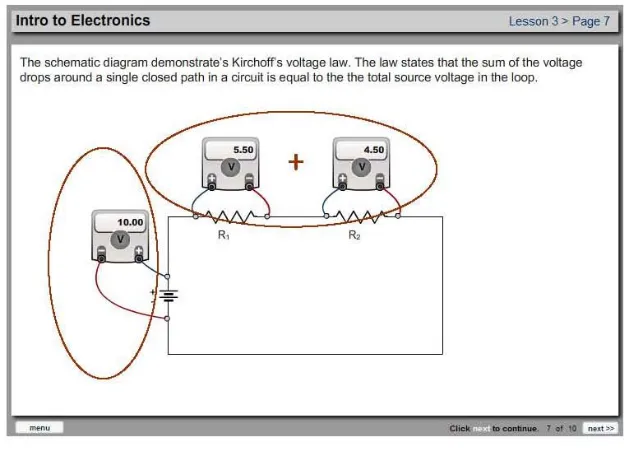
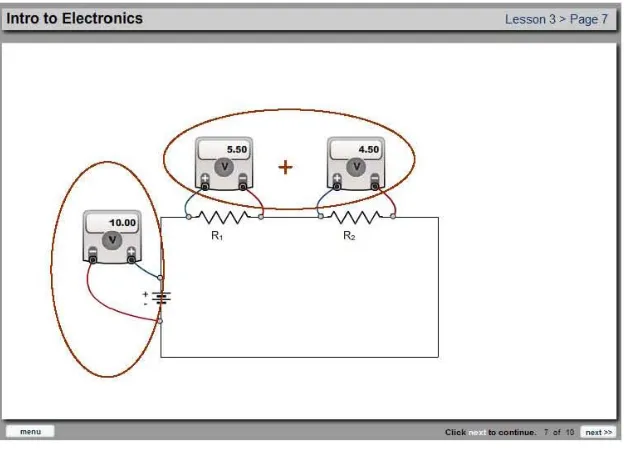
Figure 3.1: Example of a non-cued split attention effect condition ...44
Figure 3.2: Example of a cued split attention effect condition. ...44
Figure 3.3: Example of a non-cued modality effect condition. ...45
Figure 3.4: Example of a cued modality effect condition ...45
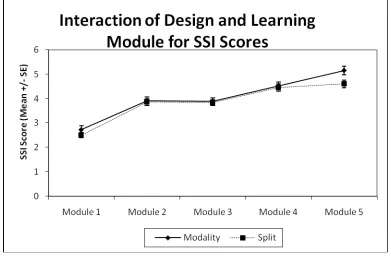
Figure 4.1: Comparing SSI Mean to Learning Module ...63
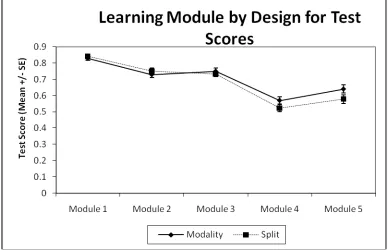
Figure 4.2: Comparing Test Mean to Learning module ...65
LIST OF TABLES
Tables Page
Table 3.1: Table of assigned conditions ...43
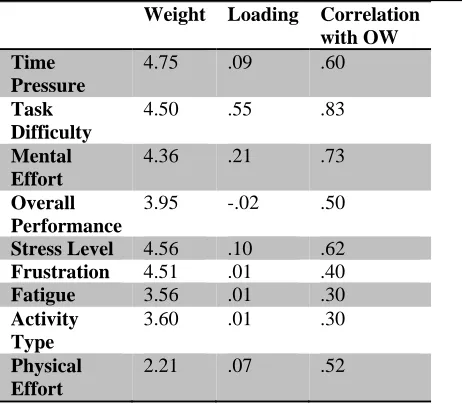
Table 3.2: Correlations and Rating between Ratings and Overall workload ...48
Table 4.1 Demographics ...59
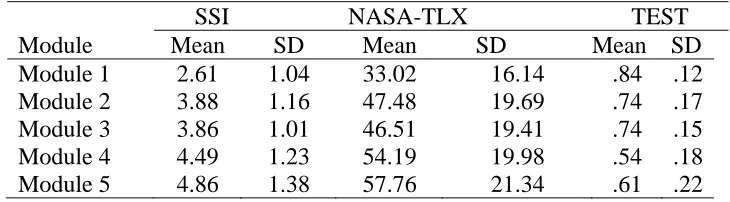
Table 4.2: Statistics for SSI, NASA TLX and TEST for Learning Modules ...60
Table 4.3: Results for Fixed Effects Short Subjective Instrument (SSI) ...61
Table 4.4: Orthogonal Contrasts for Learning Module on SSI ...62
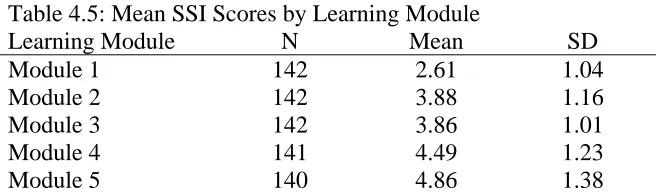
Table 4.5: Mean SSI Scores by Learning Module ...63
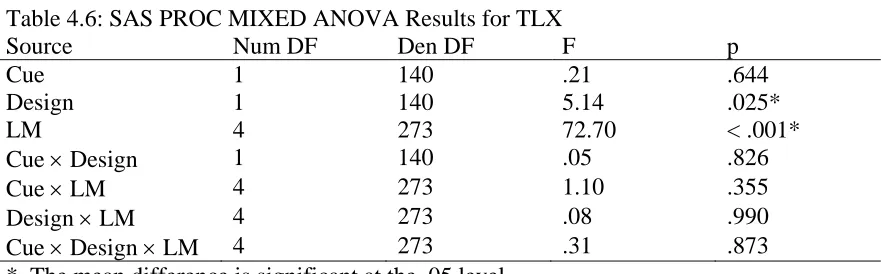
Table 4.6: SAS PROC MIXED ANOVA Results for TLX ...65
Table 4.7: Orthogonal Contrasts for Significant Main Effect of Learning Module on TLX ...66
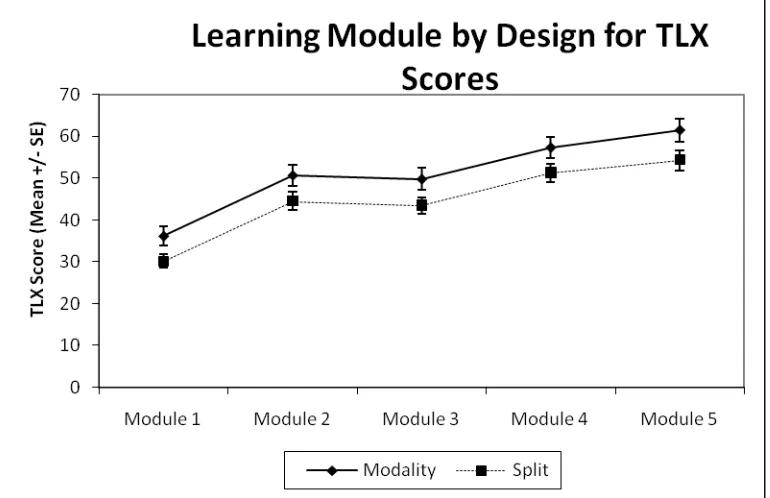
Table 4.8: Mean TLX Scores by Learning Module ...66
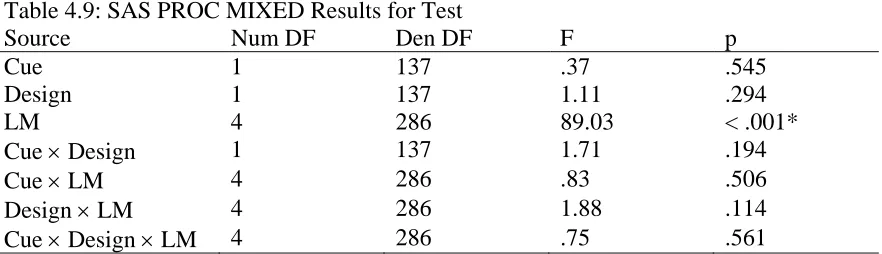
Table 4.9: SAS PROC MIXED Results for Test ...67
Table 4.10: Orthogonal Contrasts for Significant Main Effect of Learning Module on Test ...69
Table 4.11 Mean Test Scores by Module ...69
Chapter 1: Introduction
Multimedia in the Classroom
N
Numerous technologies provide multimedia integration and education in the
classroom (Mayer & Moreno, 2003). This includes a tremendous influx of technologies such as personal computers, PDAs, cell phones, integrated and interactive Power Point
presentation slides, integrated audio, iPod casting, instant Messaging, along with integrated multimedia applications and features inherent to these products. Almost 100% of the K-12 and college level classes use some form of multimedia instruction (Marrison & Frick, 1993; Johnson, Johnson, & Stanne, 1985). However, Mayer (2002) states that students seem to lack the ability to navigate multimedia lessons and directions such as those provided in the MTE (Modular Technology Education) program. This is important since a majority of the modular multimedia learning experience presentations are presented in a self-instructional format which was first coined by J.D. Russell. (Russell, 1974, p. 3).
Multimedia Overload Problems
The use of multiple types of delivery methods brings problems of multimedia
Problem of Information
This general problem of too much information (both text and graphics) creates real problems with information overload. This problem is enhanced when the information is spread out over multiple slides and pages of information compounding opportunity for overload.
Various techniques that designers commonly use to address information overload include narration, highlighting, and cueing. Narration is often utilized to reinforce the material; while highlighting or cueing (visually or auditory) key pieces of information can help guide the learner’s eyes to the relevant information and key points. Modality integration used in Technology Education instructional materials is generally useful for graphics and narration, but can lead to problems and information overload when graphics, narration and text are combined (Mayer, 2001). Adding multimedia without consideration has often meant that the information is not presented properly, or in a way that inundates the student
(Doolittle, 2002).
Researchers have been using new technologies and techniques to study these issues and develop better solutions to address these problems. To date, much of the work has been theory-driven research (Mayer & Moreno, 2000).
Theories under Study
cognitive load (Meij, 2000). The effect occurs when learners must split their attention
between and mentally integrate multiple sources of information. Vekiri (2002) separately in a review of graphical displays explained the role of graphical displays in learning and
synthesized relevant findings into principles for effective graphical design. Modality effect describes the advantages of using different modalities when two or more sources of
information are presented simultaneously (Sweller, Merrienboer & Paas, 1998). An example of modality effect is when words are presented as narration through the auditory modality and pictures are presented in the visual modality.
Two important classes of cues include audible and visual cues. Auditory cues can be verbal, as a person speaking or reading text, or simply a sound or tone. Visual cues use design techniques such as color, arrows, and highlighting to draw attention to certain information.
How Cueing Interacts with Cognitive Load Theory
Cueing interacts with cognitive load by reducing extraneous load. The use of cueing to minimize the split-attention effect can be achieved by guiding the learner between the two information sources (Merrienboer & Sweller, 2005). Chandler and Sweller (1991) have said that effective instructional material facilitates learning by directing cognitive resources toward activities that are relevant to learning rather than toward preliminaries to learning. Similarly, Perlman and Swan (1995) showed that color-coding improved search time compared to no coding situations.
spoken text (the modality effect), and adding visual cues relating elements of a picture to the text (the cueing effect) increase the effectiveness of multimedia instructions in terms of better learning results or less mental effort spent. From an earlier paper, Tabbers (1999) attests that visual cueing restored learning results that could have been expected from audio-visual instructions because of modality effect.
Aspects of Missing Research
While there has been significant research such as use of color for cueing to address many of the cited problems, some missing elements in this research could go a long way toward designing more effective solutions and teaching methods for Technology Education students. One aspect that is missing is a better understanding of how color cueing and narration interact with various aspects of information overload, split attention effect, and overall instructional difficulty. The proposed research is intended to add to the existing research base, address some of these missing elements, and gain a better understanding of how to address the problems that have been presented above specific to Technology Education students, but equally relevant to other subject matter.
Research Questions being addressed
Assumptions/Hypotheses
1. Cognitive load theory predicts that the split attention effect condition will have heightened cognitive load relative to the modality effect condition. 2. Cognitive load theory also predicts that the lowering of cognitive load will
only improve learning when load is initially high (i.e., at or near maximum capacity).
3. Design heuristics concerning the use of color as a cueing device leads us to believe that this technique should lower extraneous load due to the improved design’s ability to guide the learner to key pieces of information.
Therefore, the following hypotheses were predicted:
1a. The student’s total cognitive load should be lower in the modality effect conditions relative to the split attention effect condition.
1b. The student’s total cognitive load should be lower in the cued conditions relative to the non-cued conditions.
2a. The modality effect condition test scores will only be higher than the split attention effect condition for the more difficult instructional modules.
2b. The cued condition test scores will only be higher than the non-cued condition for the more difficult instructional modules.
3. The lowering of cognitive load due to cueing should be greater for the split attention effect condition than the modality effect condition.
Education classroom specifically. Some of the research seems to point to the possibility that cueing does reduce cognitive overload. Some of the research seems more ambiguous or theory based. This study offers insight into the design of Technology Education materials to better address cognitive overload. Lowering cognitive load is an important means of
improving the students’ learning experience.
This research into the effect of different combinations of cueing can be interpreted in ways that will improve the Technology Education student’s experience. The questions asked in this study offer a more complete understanding of whether or not we can lower cognitive load through specific cued conditions to help guide Technology Education learners to which information has been pre-determined to be important. The findings can be used to better design materials, to lower total cognitive load, and to improve student test scores all of which meet the needs of our students.
Significance of the Study
Limitations of the Study
This study was limited because it wasconducted using a small number of
undergraduate engineering majors, mainly sophomores from one university, North Carolina State University. There may be limitations as to how well this population generalized to all technology and technical education majors in other departments, other colleges or in other regions in the country. The study also only looked at a small number of lessons on the fundamentals of electronics. There may be limitations as to how well this subject matter generalized to other technical instructional areas.
Summary
When dealing with multimedia instructions or tutorials, there is a problem of
information overload when using these methods of delivery. Without the proper testing and methods for designing these types of presentation, the students or the audience presented this information may likely experience cognitive overload, reducing the effectiveness of the instructions and tutorials. Cognitive overload is the result of excessive demands made on the cognitive processes, especially memory. Visual cueing shows promise as a means to reduce cognitive overload and enhance learning.
Definition of Key Terms
1. Cognitive Load Theory
2. Modality Effect
Replacing visual text with audio will decrease working memory load and improve learning.
3. Split Attention Effect
Using information sources that are distributed over time and space (i.e., cannot be captured in a single view) causes higher cognitive load on working memory, and therefore impedes the learning process and leading to degraded learning performance.
4. Cueing Foundations
Chapter 2: Literature Review
Introduction
In this chapter, we will cover two primary areas of research, cognitive load theory, and research related to the managing of attention with cues. There really is no cueing theory per se but a group of literature that draws on a number of theories and empirical findings that are classified as cueing foundations.
Summary of Cueing and Cueing Foundations
The last research area we will look at is cueing foundations. Cueing foundations can be thought of as visual and auditory aids that guide students through multitudes of information (Mayer & Moreno, 2003). By guiding the learner, it reduces search time and reduces the load on working memory (Xing, 2006). The literature reviewed will define the different types of cues, and how cognitive load theory predicts how these cues interact with split-attention and modality effects.
Basic Memory
Working memory (Short-term memory) was defined by Baddeley (1992) initially in the 1980s as the ability to hold multiple facts or thoughts in memory temporarily while
to handle multitudes of information at any given time, this information decays very rapidly over a short period. Since this information is limited by capacity and decays over time, you only have temporary recall of this information while it is being processed (Cowan, 2000). While working memory focuses on a limited number of elements, long-term memory provides humans with the ability to vastly expand this processing ability (Paas, Renkl & Sweller, 2003; Paas, Tuovinen, Tabbers, & Gerven, 2003). Long-term memory is the permanent memory storage where we organize our general world knowledge for later recall and use.
Basics of Cognitive Load Theory
The basics of cognitive load theory (CLT) originated during the 1980s and underwent substantial development and expansion in the 1990s by researchers from around the globe (Paas, Tuovinen, Tabbers, & Gerven, 2003; Sweller, Merrienboer, & Paas, 1998).
In the articles by Paas, Tuovinen et al. (2003), and Sweller et al. (1998), they state that cognitive load theory is a major theory for providing a framework for investigations into cognitive processes and instructional design. Cognitive load theory deals with the design aspects of different instructional methods that work efficiently with students’ limited cognitive processing capacity by helping to apply acquired knowledge and skills in new situations. Cognitive load theory is based on the fact that the cognitive architecture only consists of a limited working memory with a separate processing space for visual and auditory information inputs that interact with an unlimited long-term memory (Paas, Tuovinen et al. 2003; Sweller et al. 1998). Exceeding the limited working memory
processing capacity in working memory causes cognitive overload. The most vital process used for learning, and problem solving of any kind, is the ability to transfer acquired knowledge and skills to long-term memory through schema construction and automation.
According to the literature on cognitive load theory, multiple elements of information can be chunked as single elements in cognitive schemas, which can be automated to a large extent. Then, they can bypass working memory during mental processing thereby
working memory. Schema acquisition and limited processing capacity contribute to cognitive overload (Paas, Tuovinen et al. 2003; Sweller et al. 1998).
Three types of cognitive load are differentiated including intrinsic cognitive load, extraneous cognitive load, and germane cognitive load.
Intrinsic cognitive load is an interaction of individual differences with the nature of the instructional materials. The primary individual differences of interest are the students’ past knowledge or experiences. As a rule, if a student is facing a complex and novel instructional content, intrinsic cognitive load will rise. Similarly, if a student encounters a situation or problem that they have experienced before or are familiar with, they will yield smaller levels of intrinsic load, which shows that they have to put forth less effort (Paas, Tuovinen et al. 2003; Sweller et al. 1998). The volume of essential information to be learned in part defines intrinsic cognitive load. However, almost as important to intrinsic cognitive load is how those elements of information interact with each other. Interactivity rises when the
information to be learned is dependent on other pieces of information and must be processed simultaneously to attain a good understanding of the information presented. An example of this would be the understanding of sentences in a paragraph (Sweller et al. 1998).
Germane Cognitive Load can be necessary in novel learning environments. The load is created in a construction of schemas and mental models. Schemas are stored in long-term memory. One of their obvious functions is to provide a mechanism for knowledge
input of new information to be learned. The effective automation of schemas is also a learned process, thus additionally contributing to germane load (Paas, Tuovinen et al. 2003; Sweller et al. 1998).
The manner in which information is presented to learners and the learning activities required of learners can also impose a cognitive load. When that load is unnecessary and interferes with schema acquisition and automation, it is referred to as an extraneous or ineffective cognitive load (Sweller et al. 1998). Extraneous load, or ineffective load, is that cognitive load which is not necessary for learning. Consider another common instructional design. Frequently, instruction includes multiple sources of information such as a
combination of mutually referring diagrams and texts. In order to understand the diagram or the text, it may be necessary to mentally integrate them. Such mental integration likely imposes a heavy, intrinsic load. The extraneous load comes from less than optimal formatting or layout of that information. The load is extraneous because it is caused entirely by the format of the instruction rather than by the intrinsic characteristics of the material (Sweller et al. 1998). In circumstances of poor design, increased amounts of extraneous load can lead to poor performance and lowered amounts of knowledge acquisition. When intrinsic and germane load are both low, the effects of high extraneous load may not be apparent because the overall load still does not reach an individual’s maximum capacity. Only under generally high load conditions will the effects of extraneous load be apparent (Sweller et al. 1998).
effect occurs when learners must split their attention between and mentally integrate multiple sources of information. In a split-attention situation, where the student is using a textbook with graphics and text, the student’s visual attentional resources are used to hold words and graphics in working memory so there is no extra space for the student to be able to build a connection between the graphic and text (Mayer & Moreno, 1998; Yeung et al. 1997). The split-attention effect is derived in part from the worked-example effect (Sweller et al. 1998). The design of good worked examples is also difficult. For instance, worked examples that require learners to integrate different sources of information (e.g., text and diagrams) are often not effective because they yield a high extraneous cognitive load. The same may be true for worked examples that convey redundant information or a low-variability sequence of worked examples that do not allow for an effective construction of schemas (Sweller et al. 1998). In split-attention situations, an overload in a visual working memory reduces the learner’s ability to build coherent mental models that can be used to answer questions (Mayer & Moreno, 1998). Sweller et al. (1998) state that high intrinsic load and high extraneous load from split-attention leads to cognitive overload.
the continuous stream of information. From a cognitive load perspective, this means that novices will often use cognitive resources inadequately, for instance, by attending to the most salient features of an animation that are not the most thematically relevant (Wouters, Paas & Van Merrienboer, 2005).
The research literature states that multimedia instructions consisting of verbal and pictorial information, for example a picture of a machine and a text about its functioning, place a high demand on working memory resources because the learner has to switch between text and picture in order to integrate them mentally. An interesting finding in the literature research is that this memory load can be reduced by presenting the verbal information auditorily (e.g., narration) instead of visually. They call this phenomenon the modality effect or modality principle. The results of both experiments in this study show that replacing onscreen texts with audio will only increase the effectiveness of multimedia
instructions, but only if the student has no control over the pacing of the instruction and the pace is set by the time of the narration (Tabbers, Martens, & Merrienboer, 2001).
The researchers concluded that learning is deeper when the limited capacity of working memory is maximized by coordinated inputs into the visual and auditory subsystems rather than just the visual subsystem, as is the case when text is used to describe visuals. From their research, they have developed examples in athletic training education to help illustrate when these methods are appropriate, and state that instructional methods can be incorporated into lesson design and improve learning by managing cognitive load in working memory, stimulating encoding into long-term memory, and supporting transfer of learning (Clark & Harrelson, 2002).
Tindall-Ford, Chandler, and Sweller (1997) state that instructional materials that use dual-mode presentation techniques (e.g., auditory text and visual diagrams) can result in superior learning to equivalent, single-modality formats (e.g., visual text and visual diagrams). This modality effect may be attributed to an effective expansion of working memory. Using a variety of instructional materials, the authors found in three experiments that participants studying materials incorporating audio text and visual diagrams or tables performed better than those studying a conventional, visual-only format (Tindall-Ford, Chandler, & Sweller, 1997).
representations of words. In their research, the first two studies revealed a split -attention effect in which students learned better when the instructional material did not require them to split their attention between multiple visual sources of information. The third study revealed a modality effect in which students learned better when verbal input was presented auditorily as speech rather than visually as text (Moreno & Mayer, 1999).
When students have to split their attention between multiple sources of information, Mousavi, Low, and Sweller (1995) suggests this can result in a heavy cognitive load. Their research with presentation-modality effects suggest working memory has partially
independent processors for handling visual and auditory material. Effective working
memory, therefore, may be increased by presenting material in a mixed rather than a unitary mode (Mousavi, Low, & Sweller, 1995).
Low and Sweller’s (2005) research brings us better understanding that under certain conditions, by presenting some information in visual mode and other information in auditory mode, we can expand effective working memory capacity and so reduce the effects of an excessive cognitive load. Low and Sweller (2005) state this is just one technique that can effectively expand working memory capacity. This effect is called the modality effect or the modality principle. It is an instructional principle that can substantially increase learning. Presenting some information in visual mode and other information in auditory mode can expand effective working memory capacity and so reduce the effects of an excessive cognitive load (Low & Sweller, 2005).
Reinforcing the information in this study by Low and Sweller (2005) that presenting some information in visual mode and other information in auditory mode can expand
effective working memory capacity, and so reduce the effects of an excessive cognitive load, we can look at the research of Mousavi, Low, and Sweller (1995) that tested for the modality effect using geometry instruction. The geometry diagram obviously must be presented in visual form, but the textual information could be presented in either written (or hence visual) versus auditory form. A visually presented diagram and auditorily presented text may
increase effective working memory over conditions where visual working memory alone must be used to process all of the information. As a consequence, learning may be enhanced.
Mousavi et al (1995) stated that audio/visual instructions were consistently superior to visual/visual instructions, demonstrating the modality effect. Tindall-Ford, Chandler, and Sweller (1997) replicated this finding in another series of experiments using electrical engineering instructional materials. The modality effect was obtained only when using high element interactivity materials. The researchers obtained strong evidence that the cognitive load was higher under visual/visual than under audio/visual conditions but only when the material was high in element interactivity (Sweller, Merrienboer, & Paas, 1998).
Summary
Cognitive load theory is based on the idea that the amount of activity that is imposed on working-memory at any given time during the manipulation of information will affect how we learn. This theory is based on what we know about the basic memory components of short-term and long-term memory. Short-term memory or working-memory is limited to the amount of information that can be held there, and this information decays over a short time span. Long-term memory is the permanent memory storage where we organize our general world knowledge for later recall and use. Working memory consists of two complimentary systems: verbal and non-verbal. We know from the research that when pictures and words are both presented visually and separated spatially or temporally, learners end up being able to integrate fewer pieces of relevant information because visual working memory is
cognitive load theory and dual coding theory leads to the hypotheses of two key influences multimedia instructions can have on learning: the split-attention and modality effects.
Principles of Cueing Theory
Introduction
Guiding attention through the use of cues--whether it be using arrows, colors, or highlighting--reduces the time it takes for a student to find the key information in
instructional materials. Cues can either be of the visual or auditory type. When you reduce the search for information, you reduce the time and amount of information that had to be held in working memory, thus reducing extraneous load. Since working memory decays over time, reducing search latency means that information that needs to be connected is more likely to still be in working memory. Cueing can also be used as a way to structure
information by guiding students to the most pertinent information. Since working memory is finite in size, cueing helps assure that working memory does not overflow with irrelevant information and allows the most relevant information to reside in working memory at the same time.
Goals of Cueing
includes a central area for current flight situations and one or several menu bars along the sides of the display. Controllers spend a great deal of time scanning the flight situation area. However, an alert message that appears in the left-top corner of the display may require immediate detection. Because a controller does not often look at the corners, that message may go unnoticed unless the message “pops out” and captures the controller’s attention (Xing, 2006). Another goal of cueing is to reduce search time and increase retention. Tabbers, Martens, & Merrienboer (2004) indicate cognitive load theory would predict that presenting text accompanying a picture as spoken text will decrease the extraneous load and increase the effectiveness of instruction (the modality effect). In addition, including visual cues to a picture that relates the relevant elements of the picture to the text will reduce visual search and also increase the effectiveness of the instructions (the cueing effect). This, in turn, reduces the latency in finding key information, allowing this information to stay in working memory longer and making it easier to integrate all of the information (Tabbers, Martens, & Merrienboer, 2004). Using cues helps the student select and organize relevant information by pointing to pertinent information. This in turn minimizes extraneous information that
working memory has to process (Mayer & Moreno, 2003).
Types of Cueing
research in motor learning and sports pedagogy has examined the effects of verbal cues in directing attention to critical task stimuli and information, recalling series of motor activities, and initiating movement sequences. In two experiments conducted by Loman and Mayer (1989), high school students read and listened to either a signaled or non-signaled expository passage. The signals consisted of preview sentences, underlined headings, and logical
connective phrases. The results indicated a pattern in which the signaled groups performed better on recall of conceptual information and on generating high quality problem solutions, whereas the non-signaled groups excelled on recall of information from the beginning and end of the passage and on generating low quality problem solutions. These results suggest that signaling was effective in modifying students' reading strategies (Loman, & Mayer, 1983).
Different techniques can be used to add either auditory or visual cueing to different types of instruction or tutorials. Tabbers, Martens, & Merrienboer, (2004) state that adding visual cues to illustrations results in higher retention scores of the students in that study. If we look at the context of visual cueing, we know that visual context effects have been studied in numerous eye movement studies, object and scene recognition studies, and
attention tasks (Chun, 2000). Contextual cueing is important because it may give insights on how we integrate and use information from many sources. Contextual cueing is driven by incidentally learned associations between spatial configurations (context) and target locations (Chun & Jiang, 1998; Chun, 2000).
both the presence of icons and the spatial grouping of icons speeded the search for a target file. The researchers concluded that icon or picture superiority over text has been well reported in research on recall and recognition and also in studies of information search and recognition based on their own results. A short review of previous comparisons of icon versus text concluded that the advantages of icons are not a result of the icons themselves but of their effective implementation (Niemela & Saarinen, 2000). Niemela and Saarinen (2000) expresses that icons may have other inherent properties that lead to improved user
performance in an interface.
This brings us to the use of color as a visual cue. Hughes & Creed (1994) infer that color is recognized faster than the icon shape in a visual search. Colors and simple shapes “pop-out” in search and can be used as a way to separate features as text segregation or figure ground groupings (Treisman & Gelade, 1980; Treisman & Paterson, 1984). Busse, Katzner, and Treue (2006) states that the use of color cues are more attentional orienting to the cued item than exogenous cues (or outside the cued item), symbolic (or iconic) cues, and arrows.
in different learning situations. Temporal reasoning is essential when time plays a crucial role in many aspects of everyday problem solving (Decortis, 1988).
Visual and Color Cueing
When we talk about color, we need to look at the color dimensions. The basic dimensions of color are hue, value, and chromaticity/saturation. Hue is the dimension of color that specifies a color’s position in the visible spectrum. Humans are able to interpret different combinations of red, green and blue and "see" the range of colors shown in the hue diagram. Tints and shades are variations of these pure hues; tinting occurs when white is added to a color. The value or brightness of a color is based on the amount of light being given off by the color. The easiest way to remember this dimension of color is to visualize the "grayscale" which runs from black to white and contains all of the possible grays. The brighter the color is, the higher its value. Saturation, also known as "intensity," describes the strength of a color with respect to its value or lightness. What that means is a color's saturation is the degree to which it is different than gray at a given lightness. For instance, colors near middle gray are
relatively unsaturated compared to brighter, more vibrant colors (Bertin, 1983). In the article by Christ (1975) he states that color aids both the identification and the searching of
information. The average reading group significantly outscored the low reading group on both the cued and non-cued information. The results support a visual cueing technique by which instructional designers can highlight critical information without sacrificing the noncritical information.
Two recent studies (Beck, 1987, 1990) demonstrated that the cued pictorial measure groups significantly outscored the no pictorial measure groups. The cues that were added to the pictorial measures in each study (i.e., arrows and labels in the first study and pointer-shaped labels in the second study) were designed to match the encoding cues in the
Auditory Cueing
The last type of cueing technique used in instructions is auditory cueing. Mayer and Moreno (2003) state in their research that students who received the signaled version of the narrated animation performed better on a subsequent test of problem-solving transfer than did students who received the un-signaled version. Mayer et al. (2003) acknowledge that
language or narration provides better transfer of information; also, narration is more
descriptive in describing how certain elevations on a map are displayed to the student as an example (Mayer & Anderson, 1991). Sound, on the other hand, gets your attention but
provides no positive influence on the information being relayed to the student (Dwyer, 1978). By using narration, you get the students attention and provide information at the same time. In the research by Jeung and Chandler (1997) they state that in accordance with current views of the structure of working memory, it was suggested that mixed sensory mode presentations (e.g. visual diagrams and auditory text) would result in effectively more
Advantages of Cueing
Two key advantages to cueing including first; it draws the attention of the individual, so a cue helps to reduce the search time when looking for information. Second, cueing can also be used in the identification of certain types of information and to segment this
information into different elements. Xing (2006) explains that air traffic controllers need to instantly detect critical information in ATC displays without serially searching complex scenes, so the target that represents critical information should immediately become obvious to capture attention. The use of pop-outs or cues is especially useful when targets need to be detected in large displays because targets located in the peripheral visual field can be quickly brought to the forefront for detailed inspection (Xing, 2006).
Another effective way to reduce cognitive workload is to organize information in complex visual scenes into categories and denote the categories with visual attributes that can be easily identified. Xing states that color is often used denotatively to identify an object. The task of using color for identification is essentially the task of color naming in which
observers can associate targets with specific color names (Xing, 2006). Another advantage to cueing is segmentation of elements. Segmentation is based on uniformity and consistency of elements. An area composed of uniform elements can be easily segmented from its
surroundings. Since the human visual system processes color separately from achromatic visual features, color is one of the ways to segment a display into separate regions (Xing, 2006). Johnson and Haggard (2003) state that attending to a cued location in space leads to faster reaction times when a stimulus is presented there, the reasons for this attentional effect,
state that the transmission of information in science texts is often accomplished through the use of graphs. Graphs are typically viewed as helpful adjuncts to information transmitted in prose form. However, research on the effectiveness of graphs in printed material has shown that graphs often add little to the understanding of textual materials, and may under certain conditions have a deleterious effect on learning from a text. Research in the area of
mathemagenic behaviors had demonstrated the effectiveness of certain types of questions and cues interspersed in textual materials. The function of cues in written text has been
learner in selecting, organizing, and integrating explanatory information (Mautone, & Mayer, 2001). In one of the studies reviewed by Schwier and Misanchuk (1995) one hundred and nine ninth grade students learned geometric concepts when a computer was used in
combination with the use of one of three conditions: monochrome, functional color (used as a Cue), and non-functional color (used indiscriminately). Immediate and delayed post test showed significantly better learning under the functional color (used as a cue), with low ability learners benefiting the most. High aptitude students showed the most positive attitude toward the treatment (Schwier, & Misanchuk, 1995). In the research by Tabbers, Martens, and Merrienboer (2000) they state that from their test results it seems that preventing visual search by adding visual cues to the diagrams has been effective. Students that have received the cues are scoring higher on the reproduction test than students that haven’t. However, this advantage disappears in the transfer test, except for a small effect in the audio conditions. The second strategy that they applied, replacing text with audio, has not produced the increase in effectiveness as was expected. The test results do show a modality effect, only it is exactly opposite to what Cognitive Load Theory would have predicted. The students in the visual condition have scored better on the reproduction test than the students in the audio conditions. However, the higher reproduction scores are coupled with a higher mental effort spent on the test, which could partly explain the difference (Tabbers, Martens, &
the additional advantage of organizing information presented in the animation. In conclusion, incorporating a visual cue in the design of an animation seems an interesting tool for
instructional designers to enhance learning from an animation (Koning, Tabbers, Rickers, & Paas, 2007). In the research by Lorch, and Lorch (1996) the results of the comparisons between the half-signal condition and the other two signaling conditions are easily
summarized. Signaled content was recalled well than un-signaled content in the half-signal condition. Signaled content in the half-signal condition was recalled at the same level as the corresponding content in the full-signals condition. However, un-signaled content in the half-signal condition was recalled more poorly than the corresponding content in the no-half-signals condition. Thus, the presence of signals interfered with memory for un-signaled content in the half-signal condition (Lorch, & Lorch, 1996). In the research by Lorch, Lorch, and Inman (1993) signaling produced better memory for the topics and their organization. In one
experiment, subjects recalled the content of the text they read, and recalls were scored for the number of accurately recalled ideas. Signals produced recalls that were better organized by text topics. Signals also influenced the distribution of recall of ideas: Subjects remembered more topics but recalled less about each accessed topic if the text they read contained signals than if it did not. The results are interpreted as supporting a model in which signals influence readers' representations of a text's topic structure, which, in turn, is used to guide the recall of text content (Lorch, Lorch, & Inman, 1993). In the research paper by Ayers, and Paas
(2007A) cueing was used as a strategy to direct the learner’s attention to a key aspect of the instructional animation. It was found that learners who received the cue performed better on
he cue. This finding supports the hypothesis that cueing by highlighting a key aspect and
darkening the other aspects, reduces the effects of extraneous cognitive load induced through
unnecessary searches. In addition, earners performed better on both the actual content that
was cued, and also non-cued content. The authors argued that this result was most likely
caused by the cued material freeing up cognitive resources, which could be spent on germane
load on the non-cued material. They also suggest that the cued material may have
underpinned the understanding of the non-cued material in a functional relationship (Ayers,
& Paas, 2007A).
Disadvantages of Cueing
Even though cueing offers many advantages, some disadvantages to cueing include distraction, uncertainty, loss of integration, coding interference, and lastly- readability. Distraction and inattentional blindness occurs when you focus a person’s attention to one piece of information to the detriment of their attention to other information. Since the human ability to attend to stimuli is limited, attending to a salient target in a complex scene acts as a distraction from other materials in the scene. Therefore, the perception of other stimuli is reduced. Hence, what facilitates attention is also the source of distraction (Xing, 2006; DiVita, Obermayer, Nugent, & Linville, 2004).
for decision-making, and color had no advantage over achromatic attributes (Xing, 2006; Jeffrey & Beck, 1972).
Loss of integration is another distraction in cueing. When using colors to categorize information, the brain tends to process different colors separately and is less likely to
associate the pieces of information displayed in different colors. This can pose a risk to tasks in which different types of information have to be considered together simultaneously (Xing, 2006).
Color-coding interference is also a disadvantage to cueing from a cognitive point of view. When people use color displays they build a mental model of the display in which colors are associated with certain categories of information. When several sets of color-coding are used in a display, users’ cognitive workload is significantly increased due to switches between the coding schemes. Moreover, multiple color schemes often lead to the following situations: one color has multiple meanings in a display, and several colors are assigned the same meaning (Xing, 2006; Yuditsky, Sollenberger, Rocco, Friedman-Berg, & Manning, 2002).
In a study by Blohm (1986) subjects in the study represented mature readers, evidently possessing their own successful internalized strategy for immediately
distinguishing the structural importance among ideas. For these readers, color cueing as an extension of signaling structural importance was unnecessary or helping them determine more important ideas from less important ones. It cannot be concluded, however, that developing readers would not benefit from this form of cueing. Younger and/or disabled readers, who are not aware of the relationships which exist among ideas in text, might well benefit from color cueing. Blohm stated that further research with younger populations seems in order before the conclusion can be made that color cueing is generally ineffective. Asking younger readers to respond to different types of decision statements might also reveal that its effectiveness is a function of reading maturity. Assimilation of encoding might, in fact, is a necessary prerequisite to distinctiveness of encoding for improving learning and
remembering among readers (Blohm, 1986).
In the research by Haynie (1978) states that cues work under many normal conditions but breaks down when cues are such that they cause interference. Haynie states that there is a limit to the channel capacity of the human receivers, and therefore the experimenter must be careful when flooding sensory inputs that the inputs are only flooded by meaningful
information. Only then will the researcher be able to make useful inferences about the capacity of the channel or the optimal number of cues to provide (Haynie, 1978). In the research by Lorch (1989) he also found some several failures to find benefits of
was affected by typographical cues. Thus selective effect of cuing may have been obscured by the global performance measures employed in those experiments. Second, most studies have at least produced trends in the direction of better memory for cued information, with two exceptions. Two studies have examined complex typographical cuing schemes in which four or five categories of text content have been signaled by different combinations of cues (color variation, typeface variation, and underlining). Although the trends were not always reliable, the studies found poorer memory for both signaled and un-signaled content if
typographical cues were present in the text. Thus, typographical cuing may be beneficial only if the nature of the cuing is simple enough for the reader to readily grasp the relationship between the cues and the text content. In the study by Moreno (2007) there was no parallel finding for the signaling (cueing) method. A potential explanation for the lack of a signaling
(cueing) effect is that the benefits of the signaling (cueing) method may have been offset by a
visual split-attention effect. A split-attention effect occurs when learning is impaired from
forcing a learner to mentally integrate separate sources of information. The signaling
(cueing) method used in the present study forced students to split their visual attention
between the video/animation and the side figure highlighting the essential skills that were
being illustrated. Had the signaling (cueing) consisted of a message integrated in the
video/animation itself, the results may have shown a positive signaling (cueing) effect
Cueing and Interaction with Cognitive Load Theory
Cueing interacts with instructional materials design by reducing extraneous load. Cueing can reduce extraneous cognitive load by minimizing search time between multiple pieces of information. Effective instructional material facilitates learning by directing cognitive resources toward activities that are relevant to learning, rather than just toward preliminaries to learning (Chandler & Sweller, 1991). One example of ineffective instruction occurs if learners unnecessarily are required to mentally integrate disparate sources of
mutually referring information, such as separate text and diagrams. Such split-source information may generate a heavy cognitive load because material must be mentally
integrated before learning can commence (Chandler & Sweller, 1991). In research of search times, errors, and subjective rankings of the coding methods that were recorded, the results showed that color coding improved search time compared to no coding situations (Perlman & Swan, 1995).
Cueing and Modality Effect
better when auditory narration was presented simultaneously with corresponding diagrams. The diagram was a geometry worked problem, the statement was a problem statement and a proof statement in auditory. Problem statement given O is the center of the circle; AB=CB all the letters are in the diagram. They were using narration to cue certain aspects of the problem (Mousavi, Low & Sweller, 1995). Merrienboer and Sweller (2005) explain that by replacing multiple sources of information (frequently pictures and accompanying text) with a single, integrated source of information we can reduce extraneous cognitive load because there is no need to mentally integrate the information sources (Merrienboer & Sweller, 2005). Two cases are described in Kalyuga (2000) where combining audio explanations with visual instructions has had negative rather than positive or neutral effects. The results were explained as a consequence of working memory overload. In the research by Kalyuga, Chandler, and Sweller (1999) they studied two experiments ran and the investigated
evidence in both experiments that alternatives to split-attention instructional designs were effective due to reductions in cognitive load (Kalyuga, Chandler, & Sweller, 1999).
Summary
In this chapter, we have covered two primary areas of research, cognitive load theory and research related to the managing of attention with cues. From the literature, we draw on a number of theories and empirical findings that we can classify as a foundation of cueing.
We know that cognitive load theory is the amount of activity that is imposed on working-memory at any given time during the manipulation of information, and that the basic memory components consist of short-term and long-term memory. Short-term memory or working-memory is limited to the amount of information that can be held there, and this information decays over a short time span. Long-term memory is the permanent memory storage where we organize our general world knowledge for later recall and use. We understand that working memory consists of two complimentary systems: verbal and non-verbal. Through the dual coding theory, these two parts of working memory are part of a dual cognitive subsystem, one dealing with just images, and the other specializing in dealing with just language (Paivio, 1991). Through the literature review, we have understood how the organization and functionality of memory is dependent on cognitive load theory, and dual coding theory. Through the research, we also learned that the two key influences on learning with multimedia instructions are the split-attention and modality effects.
Chapter 3: Research Methodology
Research Questions
The following research questions were addressed in this study:
1. How does the use of color cueing interact with the split attention effect? 2. How does the use of color cueing interact with the modality effect? 3. How does the use of color cueing interact with instructional difficulty?
Assumptions/Hypotheses
5. Cognitive load theory predicts that the split attention effect condition will have heightened cognitive load relative to the modality effect condition. 6. Cognitive load theory also predicts that the lowering of cognitive load will
only improve learning when load is initially high (i.e., at or near maximum capacity).
7. Design heuristics concerning the use of color as a cueing device leads us to believe that this technique should lower extraneous load due to the improved design’s ability to guide the learner to key pieces of information.
Therefore, it was predicted:
1a. The student’s total cognitive load should be lower in the modality effect conditions relative to the split attention effect condition.
1b. The student’s total cognitive load should be lower in the cued conditions relative to the non-cued conditions.
2b. The cued condition test scores will only be higher than the non-cued condition for the more difficult instructional modules.
3. The lowering of cognitive load due to cueing should be greater for the split attention effect condition than the modality effect condition.
Participants Involved in the Study
One hundred forty-two students enrolled in six sections of the GC-120 Foundations of Graphics laptop sections with approximately twenty-four plus students per class participated in this study. All students were entered in a raffle for a gift card from a department store worth one hundred dollars. Students withdrawing prior to completing the study were given participation credit and their data was not used for the final analyses.
The participants were known only by selected numbers generated at the time of the study. A list of the participants’ names and the identifying numbers generated for them were held in confidence by the investigator and no one else for the purpose of the gift card
Materials
The learning modules (LM) for this study were presented to each student on a CD. The number generated for each student determined the assigned condition the student received. The assigned conditions that were given to the participants of this study were broken down into four sections depicted in the Table 3.1 below.
Table 3.1. Assigned Conditions
Split Attention Modality
Non-Cueing A (Figure 3.1) B (Figure 3.3)
Cueing C (Figure 3.2) D (Figure 3.4)
As you can see from Table 3.1., the first condition “A” was a split-attention effect that was not cued; “B” is a modality effect that was not cued; condition “C”, which uses auditory narrations, is a split-attention effect that was cued; and the last condition is “D” which was a modality effect that was cued.
Each of these conditions contained five learning modules that lasted approximately ten minutes each. The CD program ran from the students own laptop disk drive; the students completed the lesson and recorded their answers on a paper test. Participants in modality conditions where auditory cueing and narration were used (condition “B” and condition “D”) used stereo headphones during the study.
Figure 3.1: Example of a non-cued split attention effect condition.
Figure 3.3: Example of a non-cued modality effect condition.
Figure 3.3 and 3.4 depict the modality effect although narration cannot be shown within this document.
SSI and NASA-TLX Instruments Methodology
The current research used two rating scale assessment techniques: the SSI and
NASA-Task Load Index (TLX), to assess levels of cognitive load. This research approach of using both SSI and NASA-TLX was used based on the research by Windell, 2006) which demonstrated that the SSI and TLX had different sensitivities to cognitive load. The reason for this is that the SSI rating scale is based on prior research that the assumption is a safe and reliable one in learning tasks. People can reliably provide accurate mental burden ratings (Gopher & Braune, 1984) presenting the individual with one or more dimensions, anchored at either end with an extreme descriptor of that dimension; and that these scales are sensitive to small changes in overall load (Gimino, 2002; Paas, van Merrienboer, & Adam, 1994). See Paas, et al. (2003) for a comprehensive list of studies.
Differences between the two assessment techniques are not trivial (1 question SSI versus 6 question NASA-TLX along with pair-wise comparisons), but should be noted that all participants in the current study completed five distinct learning modules as well as the multidimensional NASA-TLX, including the associated paired comparison, and the Short Subjective Instrument (SSI).
NASA-TLX Methodology
different experimental tasks. The experimental tasks included such aspects as simple cognitive and manual tasks as controls and complex laboratory and supervisory tasks and aircraft simulation. Based on this extensive research, the NASA-TLX multi-dimensional rating scale came into use based on the concept that the magnitude and sources of six
common workload factors are combined to come up with a reliable estimate of the perceived workload (Hart & Staveland, 1988). The goal was to be able to validate the methodology behind the NASA-TLX and to understand the relevancy of using a framework to relate imposed task and incidental subjective workload experiences and formal workload evaluation as a measure that could be used across a variety of activities to measure both human
performance and workload. The study was based on an understanding of how subjects perceive workload across a wide variety of simple cognitive and manual tasks. The results were able to provide sufficient data to formulate the reliability and validity data for using NASA-TLX using a multi-dimension rating scale and to derive the reliability and validity data for NASA-TLX.
Table 3.2 Correlational Data for the NASA TLX
Weight Loading Correlation
with OW Time
Pressure
4.75 .09 .60
Task Difficulty
4.50 .55 .83
Mental Effort
4.36 .21 .73
Overall Performance
3.95 -.02 .50
Stress Level 4.56 .10 .62 Frustration 4.51 .01 .40 Fatigue 3.56 .01 .30 Activity
Type
3.60 .01 .30
Physical Effort
2.21 .07 .52
From Hart & Staveland (1988)
Within the same overall study, the findings provided a reliability index of overall workload (test-retest correlation = .83) based on a scale from (0-100) (Hart & Staveland, 1988). A variety of other statistical analysis methods were used to demonstrate the
effectiveness, including analyses of variance and correlations among measures of workload and performance, multiple correlations among individual rating scales and coefficients of variation (SD/Mean) for overall weighted workload and sensitivity tests were conducted to compare the percentage of variance (SD/Mean) accounted for by overall workload.
When compared to other subjective assessment techniques (e.g. SWAT, Cooper-Harper scale), studies showed that the NASA TLX is favored by most participants, when compared to other subjective workload assessment techniques such as SWAT and Cooper-Harper scale) and was highly correlated with other measures of workload (Battiste & Bortoussi, 1988; Hill, et al., 1992; Byers, et al., 1988). NSA-TLX reliability for repeated measures of different types of workload has shown correlations of 0.77 (Battiste & Bortoussi 1998). Separately, the reliability and validity of subjective workload assessment technique and NASA-TLX using two mental workload assessments, (e.g. SWAT and NASA TLX) using randomized cluster sampling was conducted. Reliability retest coefficients for SWAT was more than 0.80 and as for NASA-TLX; the split-half reliability and alpha coefficient was more than 0.80 with both scales having good inner consistency. (Zhonghua,et al, 2005)
results from the NASA-TLX, and the researcher, was then able to calculate the NASA-TLX weighted work load index. While the NASA-Task Load Index (NASA-TLX) instead
incorporates six different dimensions of work load measurement and experimenters are given the ability to weight each dimension so that the overall workload measurement is task
specific. The weights are determined from a set of relevance ratings provided by the
participants. (Windell, 2006). The NASA-TLX mental demands subscale is well recognized as a standard for measuring mental workload (Xie & Salvendy, 2000). The NASA-TLX is a subjective multi-dimensional workload technique. An overall workload rating is determined from a weighted combination of scores on the six dimensions. The weights are determined from a set of relevance ratings provided by the participants. Use of the TLX requires two steps. First, participants rate each task performed on each of the six subscales: Mental demand, Physical demand, Temporal demand, Performance, Effort, Frustration level to derive an overall workload score based on a weighted average of the ratings. They are measured in scales of 0 to 100. Secondly, participants must perform 15 pair-wise
Short Subjective Instrument (SSI) Methodology
Short Subjective Instrument Methodology was first introduced by Paas and published in an article in 1992 which appeared in the publication Journal of Educational Psychology. SSI remains the most widespread measure of working memory load within cognitive load theory research. In Paas’ initial introduction of SSI methodology, he notes that the scale was based on a measure of perceived task difficulty modified but originally devised by Bratfisch, Borg, and Dornic’s scale (Paas, 1992) for measuring perceived task difficulty. In the Paas’ (1992) study, what was considered the golden standard, a Spearman rank order correlation of 0.9, was obtained between objective and subjective task difficulty. In the same study, the reliability of the scale was estimated with Cronbach’s coefficient alpha. For the condition-independent instructional problems, a coefficient of reliability of .90 was obtained.
In Paas, et al. (1994), they note that the SSI scale’s reliability and sensitivity and moreover its ease its ease of use have made this scale and variants of it, the most widespread measure of working memory load within Cognitive Load Theory research. Rating Scales, although introspective, rely on the idea that people are able to give accurate ratings on mental burden. Prior research has shown that this assumption is a safe and reliable one in learning tasks (Gopher & Braune, 1984) and that subject can introspect on their cognitive processes with no difficulty in assigning numerical values to the imposed mental load or the invested mental effort. Semantic differential scales present the individual with one or more