An Efficient ID-based Digital Signature with
Message Recovery Based on Pairing
Raylin Tso, Chunxiang Gu, Takeshi Okamoto†, and Eiji Okamoto‡
Department of Risk Engineering
Graduate School of Systems and Information Engineering University of Tsukuba, Japan
{raylin, ken†, okamoto‡}@risk.tsukuba.ac.jp
Network Engineering Department, Information Engineering University
Zhengzhou P.R. China
Abstract. Signature schemes with message recovery have been wildly investigated a decade ago in the literature, but the first ID-based signa-ture with message recovery goes out into the world until 2005. In this paper, we first point out and revise one little but important problem which occurs in the previous ID-based signature with message recov-ery scheme. Then, by completely different setting, we propose a new ID-based signature scheme with message recovery. Our scheme is much more efficient than the previous scheme. In our scheme (as well as other signature schemes with message recovery), the message itself is not re-quired to be transmitted together with the signature, it turns out to have the least data size of communication cost comparing with generic (not short) signature schemes. Although the communication overhead is still larger than Boneh et al. ’s short signature (which is not ID-based), the computational cost of our scheme is more efficient than Boneh et al. ’s scheme in the verification phase. We will also prove that the pro-posed scheme is provably secure in the random oracle model under CDH Assumption.
Key words: CDH problem, Identity-based signature, Message recov-ery, Pairing, Short signature.
1 Introduction
of signatures are to minimize the total length of the original message and the appended signature so are useful in an organization where bandwidth is one of the main concern or useful for the applications in which small messages should be signed.
It is obvious that an RSA signature [10] can be used with message recovery since it is unique in the sense that the signature and encryp-tion funcencryp-tions are inverse to each other. But, for small size messages, it yields much larger signatures. For example, to sign a 100-bit message, the signature will be the size of 1024-bit. In 1993, Nyberg and Ruep-ple [7] proposed the first digital signature with message recovery based on the discrete logarithm problem (DL problem). Schemes based on the DL problem produce relatively small signatures if they are implemented over a finite group over elliptic curve. For example, a 320-bit signature is enough for a 100-bit message. Due to this reason, DL problem based signature schemes with message recovery (as well as their variants) are appropriate for signing small messages so have been extensively investi-gated in the literature (e.g., [1, 6–8, 12]).
On the other hand, the concept of identity-based (ID-based) cryp-tosystem was firstly introduced by Shamir [11] in 1984 which can simplify key management procedures of traditional certificate-based cryptography. Many based cryptosystems have been proposed since that but no ID-based signature scheme with message recovery goes out into the world until the scheme proposed by Zhang et al. [13] in 2005. Zhang et al. pro-posed two schemes in the paper: an ID-based message recovery signature scheme for messages of fixed length, and an ID-based partial message re-covery signature scheme for messages of arbitrary length. Zhang et al. ’s idea gives a new concept to shorten ID-based signatures in contrast to proposing a short signature scheme.
other side. In addition, Barreto et al. give the security proof of [2] on a stronger assumption (i.e., the q-strong Diffie-Hellman problem) while we will prove that our scheme is secure against existential forgery under adaptively chosen message attack and ID attack in the random oracle model and under only a weaker assumption: the hardness assumption of computational Diffie-Hellman (CDH) problem. The essential idea of the security proofs of our scheme can also be used to prove the security of [2] so as to reduce their security assumption from a stronger one to a weaker one. This is another contribution of this paper.
The rest of this paper is organized as follows. in Section 2, we recall some preliminary works which will be used throughout this paper. Section 3 reviews and revises the first ID-based signature scheme with message recovery. In Section 4, we present our new scheme, its variation and the efficiency comparisons with other schemes. In Section 6, we give a concrete proof of our scheme in the random oracle model. Finally, we conclude this paper in Section 7.
2 Preliminaries
2.1 Bilinear Pairings and the Related Computational Assumption
Let (G1,+) and (G2,·) be two cyclic groups of the same prime order q. ˆ
e:G1×G1 →G2 be a map which satisfies the following properties.
1. Bilinear:∀P, Q∈G1,∀α, β ∈Zq,ˆe(αP, βQ) = ˆe(P, Q)αβ;
2. Non-degenerate: IfP is a generator ofG1, then ˆe(P, P) is a generator ofG2;
3. Computable: There is an efficient algorithm to compute ˆe(P, Q) for anyP, Q∈G1.
Such an bilinear map is called anadmissible bilinear pairing [3]. The Weil pairings and the Tate pairings of elliptic curves can be used to construct efficient admissible bilinear pairings.
Definition 1 (CDH Assumption). Let (G1,+), (G2,·) and ˆe be the same as those defined at Section 2.1. Let alsoP be a generator ofG1, the challenger choosesa, b∈Zpat random and outputs (P, A=aP, B =bP). The adversary then attempts to output abP ∈G1. An adversary, B, has at least anadvantage if
where the probability is over the randomly chosen a, b and the random bits consumed byB.
Definition 2. We say the CDH assumption is (t, )-secure if there is no
t-time adversary with at least advantage in solving the above game.
2.2 Scheme Model
An ID-based message recovery signature scheme is defined by four algo-rithms:
- Setup: A deterministic algorithm which takes as input a security parameterλ, outputs the Key generation Center KGC’s private key,
SKGC, and public key, Ppub, together with the system parameters,
para.
- Extract:A deterministic algorithm which takes as input an identity,
IDi, of a userUi, outputs the user’s private key,SID
i.
- Sign:A probabilistic algorithm which takes as inputs a signer’s pri-vate keySID and a messagem, outputs a signatureσ.
- Verify: A deterministic algorithm which takes as input the sender’s identity, ID, and the signature, σ, outputs 1 if σ is a valid signa-ture. In this case, the original message can be recovered successfully. Otherwise, outputs 0.
2.3 Security Definition
For digital signatures, the widely accepted notion of security was defined by Goldwasser et. al. in [5] asexistential forgery against adaptive chosen-message attack (EF-ACMA). It’s ID-based variation is described as the following form.
Definition 3. An ID-based digital signature scheme is said to be secure against EF-ACMA, if for any polynomial-time adversaryF, the advantage defined by
AdvEFF −ACMA =P r
⎡
⎣V erif y(ID, m, σ((m, σ)∈/S), IDlist,) = 1,
(ID, .)∈/Elist
(paraID, m, σ←Setup)← F(1Sλ().,),E(.)(para) ⎤ ⎦
is negligible, whereSlistand Elistare the query/answer lists coming from
2.4 Notations
The following notations will be used throughout this paper.
• a||b: a concatenation of two strings aand b. • ⊕: X-OR computation in the binary system. • [x]10 :the decimal notation of x∈ {0,1}∗. • [y]2 :the binary notation of y∈Z.
• l2|β| : the firstl2 bits ofβ from the left side. • |β|l1 : the firstl1 bits ofβ from the right side.
3 Zhang et al.’s Scheme Revisit
In this section, we review Zhang et al.’s ID-based message recovery sig-nature scheme [13] and show one problem of their scheme.
- Setup:P KGchooses a random number s∈Zq∗ and sets Ppub =sP.
P KGalso publishes system parameters{G1, G2,e, q, λ, P, Hˆ 0, H1, F1, F2, k1, k2}, and keepssas the master-key, which is known only by itself. Here
• |q|=k1+k2,
andH0, H1, F1, F2 are for cryptographic hash functions such that • H0:{0,1}∗ →G1∗,
• H1:{0,1}∗ →Zq∗, • F1 :{0,1}k2 → {0,1}k1 • F2 :{0,1}k1 → {0,1}k2.
- Extract: A user submits his/her identity information ID to P KG.
P KGcomputes the user’s public key as QID=H0(ID), and returns
SID=sQIDto the user as his /her private key. - Sign:Let the message be m∈ {0,1}k2.
S1: Compute v=e(P, P)k, where k∈RZq∗. S2: f =F1(m)||(F2(F1(m))⊕m).
S3: r=H1(v) +f modq. S4: U =kP−rSID
A The signature is (r, U)
- Verification:GivenIDA, a message m, and a signature (r, U), com-pute
r−H1(ˆe(U, P)ˆe(QID
A, Ppub)
r) =f, and m=
k2|f| ⊕F2(|f|k1).
3.1 Discussion
We found that in some undesirable cases, a correctly generated signature may be misjudged and rejected. Accordingly, in such cases, the message cannot be recovered correctly.
Since we have |q|= k1 +k2 and we know that any element a∈ Zq∗
of course has the size |a| ≤ |q|. On the contrary, any value b with size |b| = |q| cannot be concluded that b ∈ Zq∗. An toy example is that elements 16,17,18 ∈ Z19∗ all have the same size equal to |19| = 5, but elements 20,21,· · · ,31∈/ Z19∗also have the same size 5. These cases come more often whenq is large.
In S2 of the signing phase,f =F1(m)||(F2(F1(m))⊕m). |f|=k1+
k2=|q|, but it is very likely thatf > q even though they have the same size. Iff > q, sayf =f+q, then, in the verification phase,
r−H1(ˆe(U, P)ˆe(QID
A, Ppub)
r) =f, and m=
k2|f| ⊕F2(|f|k1).
With a large probability |f|k1 = F1(m), so the signature will be reject although it is generated correctly.
Their second scheme for partial message recovery also suffers this problem. To prevent this problem of misjudgement, we suggest r be
H1(v) +f instead of H1(v) +f modq. This small revision is very im-portant in order to make the verification correct.
4 New ID-based Message Recovery Scheme
In this section, we present our efficient ID-based message recovery signa-ture scheme with the restriction (for any message recovery scheme) that it can deal with only messages of some fixed length (ie., m∈ {0,1}l1 for some fixed integer l1).
- Setup:Takes as input a security parameterλ∈N, outputs a random numbers∈Zq∗ asKGC’s private key and setsPpub =sP. The system parameters made public are
para={G1, G2,e, q, P, Pˆ pub, µ, H, H1, F1, F2, l1, l2}, where
• G1, G2 are cyclic groups of the same orderq,|q|=l1+l2, • eˆ:G1×G1 ←G2 is the admissible bilinear pairing, • µ= ˆe(P, P),
• F1 :{0,1}l1 → {0,1}l2, a collision resistent one-way function, • F2 :{0,1}l2 → {0,1}l1 a collision resistent one-way function,. - Extract: Takes as input a user’s identity IDi ∈ {0,1}∗,KGC
com-putes the user’s private key SID
i ← (H(IDi) + s)
−1P. The user’s
ID-based public keyPID
i is (H(IDi) +s)P, which can be computed asH(IDi)P +Ppub.
- Sign: For input a user A’s private key SID
A and a message m ∈ {0,1}l1:
(1) Pick a random numberr1∈Zq∗, computeµr1 andα ←H1(µr1)∈ {0,1}|q|
(2) Compute β ←F1(m)||(F2(F1(m))⊕m) and r2 ←[α⊕β]10. (3) Compute U ←(r1+r2)SID
A. The signatureσ onm is (r2, U).
- Verify:Given the signature σ and IDA:
(1) Compute ˜α←H1(ˆe(U, PID
A)µ−r2). (2) Compute ˜β ←[r2]2⊕α˜.
(3) Recover the message ˜m← |β˜|l1⊕F2(l2|β˜|).
(4) Output 1 and acceptσ as a valid signature of the messagem←m˜ if and only if |l2β˜|=F1( ˜m).
CorrectnessThe correctness of this scheme can be proved as follows:
ˆ
e(U, PID
A)µ
−r2 = ˆe((r
1+r2)SID
A, PIDA)ˆe(P, P) −r2
= ˆe((H(IDA) +s)−1P,(H(IDA) +s)P)r1+r2ˆe(P, P)−r2 = ˆe(P, P)r1+r2ˆe(P, P)−r2
= ˆe(P, P)r1 =µr1
If σ is a valid signature, thenH1(µr1) =α and
F1(m)||(F2(F1(m))⊕m) =β= [r2]2⊕α.
Hence, we obtain
|β|l1 ⊕F2(l2|β|)
= (F2(F1(m))⊕m)⊕F2(F1(m))
=m.
4.1 Variation (A Partial Message Recovery Scheme for Long Messages)
In this section, we simply modify the previous scheme so that the modified scheme can be used for messages of arbitrarily length (i.e., m∈ {0,1}∗).
- Setup:The system setting is the same as the previous scheme with the only modification ofF1. In this scheme, F1 :{0,1}∗ → {0,1}l2. - Extract:The same as the previous scheme.
- Sign: For input a user As private key SID
A and a message m ∈ {0,1}∗:
(1) Pick a random number r1 ∈Zq∗, compute µr1 and α←H1(µr1) (2) Dividem intom2||m1 with m1 ∈ {0,1}l1
(3) Compute β ←F1(m)||(F2(F1(m))⊕m1) and r2 ←[α⊕β]10. (4) Compute U ←(r1+r2)SID
A. The signatureσ onm is (m2, r2, U).
- Verify:Given the signature σ and IDA: (1) Compute ˜α←H1(ˆe(U, PID
A)µ −r2)
(2) Compute ˜β ←[r2]2⊕α˜ where [x]2 is the binary representation of
x
(3) Recover ˜m1 ← |β˜|l1 ⊕F2(l2|β˜|).
(4) Output 1 and accept σ if and only if l2|β˜|= F1(m2||m˜1). Other-wise, output 0 and abort the next step.
(5) Recover m←m2||m˜1.
Correctness:The correctness of the scheme is straightforward according to that of the previous scheme.
5 Efficiency Comparison
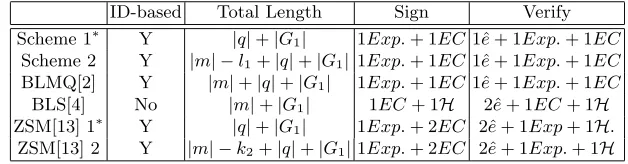
function called ”MaptoPoint”, which is still probabilistic and usually not efficient enough to be neglected. The computation of a ”MaptoPoint” hash is denoted byH in Table 1.
To compare at approximately the same security as a standard 1024-bit RSA signature,qshould be a 170-bit prime andG1 be a group where each element of G1 is 171-bit if we use any of the families of curves described in [4]. In addition,l1 =k2 = 91 according to [13] in order to obtain a 2−80 probability of the verification condition holding for an attempted forgery generated by an adversary.
Except Boneh et al. ’s short signature scheme [4], we see from these results that our schemes surpass other schemes in at least one aspect and be second to none in every aspect. Our schemes are faster than all known pairing-based IBS methods according to [2] since our schemes inherit the efficiency of [2] but surpass [2] in the aspect of total-length (i.e., |message|+|signature|). Also note that our schemes happens to be faster than [4] at verification and exceed [4] in the aspect of ID-based propoerty.
Table 1.Efficiency comparison
ID-based Total Length Sign Verify Scheme 1∗ Y |q|+|G1| 1Exp.+ 1EC1ˆe+ 1Exp.+ 1EC
Scheme 2 Y |m| −l1+|q|+|G1|1Exp.+ 1EC1ˆe+ 1Exp.+ 1EC BLMQ[2] Y |m|+|q|+|G1| 1Exp.+ 1EC1ˆe+ 1Exp.+ 1EC BLS[4] No |m|+|G1| 1EC+ 1H 2ˆe+ 1EC+ 1H ZSM[13] 1∗ Y |q|+|G1| 1Exp.+ 2EC 2ˆe+ 1Exp+ 1H.
ZSM[13] 2 Y |m| −k2+|q|+|G1|1Exp.+ 2EC 2ˆe+ 1Exp.+ 1H ∗Available for messages of fixed length only.
6 Security Proof
weaker hardness assumption while the scheme in [2] is proved under a stronger hardness assumption (i.e., theq-strong Diffie-Hellman problem).
The following definition will be used as a core of the proof.
Definition 4 (Forking Lemma [9]). Let (G, Σ, V) be a generic digital signature scheme with security parameter k. Let A be a probabilistic polynomial time Turing machine whose input only consists of public data. Assume that, within a time bound T, A can produce a valid signature (m, σ1, h, σ2) with probability ≥ 10(qs + 1)(qs+qh)/2k by making qs
signing queries and qh random oracle queries. If the triple (σ1, h, σ2) can be simulated without knowing the private key, with an indistinguishable distribution probability, then there exists another Turing machineAthat uses A to produce two valid signatures (m, σ1, h, σ2) and (m, σ1, h, σ2) such thath =h in expected timeT ≤120686qhT /.
For short, denote our scheme of Section 4 by IDM R, we first de-fine a related (non-ID-based) public key signature scheme with message recovery P KM R= (KGen, Sign, V erif y) as following:
- KGen:Takes as input a security parameter λ∈N,
• runs Setup(1λ) of IDM R to generate a master keysand system parameters para={G1, G2,e, q, P, Pˆ pub, µ, H, H1, F1, F2, l1, l2},
• selects randomlyID∈ {0,1}∗, computesPID=H1(ID)P+Ppub,
SID= (H1(ID) +s)−1P,
• returnsSID as private key and (para, PID) as public key.
- Sign’: Given a secret key SID and a message m ∈ {0,1}l1, do the same as that ofIDM R.
- Verify’: Given the signatureσ and the public key (para, PID), do the same as that ofIDM R
It is obviously that theP KM Ris ageneric signature scheme. Also, if we assume H :{0,1}∗ →Zq∗ to be a random function, then the function
H defined by
H :{0,1}∗→G1
IDi →H(IDi)P+Ppub
Lemma 1. In the random oracle mode, if there is an adversaryAwhose input only consists of public data, and can succeed in existential forgery on
IDM Rwithin a time boundT by un-negligible probabilityε, then there is another adversaryA who can succeed in existential forgery onP KM R, within expected time T with un-negligible probability ε/qh, where qh is the number of queries thatA can ask to the random oracleH(.).
Proof: We show how to build an A to forge a signature on P KM R if there is an adversary A who can forge a valid signature on IDM R via EF-ACMA.
Without loss of generality, we may assume that for anyID,Aqueries
H(.) with ID before ID is used as (part of) an input of any query to
Extract(.) andSign(.).
From A, we can construct adversaryA againstP KM R as follows:
1. A challenger C runs (SID,(para, PID = Q)) ← KGen(1λ), where
para={G1, G2,e, q, P, Pˆ pub, µ, H, H1, F1, F2, l1, l2}, and gives (para, Q) toA.
2. Asetsz= 1, picks randomlyt,1≤t≤qhandxi∈Zq∗, i= 1,2, ...qh. 3. A runs A with input para. During the execution, A simulates the
following oracles which can be accessed byA:
• H(.): For input ID, A checks if H(ID) is defined. If not, he defines
H(ID) =
Q z=t
xiP z=t, and setIDz ←ID, z←z+ 1.A returns H(ID) toA.A records and keeps the tuples (ID, H(ID)) in the
H−list.
• H1(.): If A makes a query µr to random oracle H1(.), A checks if H1(µr) is defined. If not, it picks a random α ∈ {0,1}|q|, and sets H1(µr) ← α. A returns α to A and records (µr, α) to the
H1−list.
• F1(.) and F2(.) queries: Acan also query the random oracleF1(.) and F2(.) at any time. A simulates the oracles F1(.) and F2(.) in the same way as theH1(.) oracle, keeping anF1−listandF2−list
of tuples, respectively.
• Extract(.): For input IDi, if i = t, then abort. Otherwise, A computes SID
i =x −1
i ·P and letsSIDi be the reply toA. • Sign(.): For input IDi and message m, if i= t, A uses SID
i =
x−1i P as the private key to sign on m. Otherwise, A simulates
4. IfAoutputs (IDi, m, r2, U) which satisfiesV erif y(IDi, m,(r2, U)) = 1, in addition, if i = t, then A can get a forgery (m,(r2, U)) on
P KM Rcorresponding to (para, Q).
IfAsucceed in his attack, thenAhas not query toExtract(.) with input
IDt. Hence the responses of A’s emulations are indistinguishable from A’s real oracles. Because t is chosen randomly, A can output a forgery corresponding to (para, Q) of P KM S within expected timeT and with probability ε/qh.
Let δ = µr1, in the following lemma, we prove that the signature triples (δ, r2, U) on P KM R can be simulated without the knowledge of the signer’s secret key, with an indistinguishable distribution probability.
Lemma 2. Givepara={G1, G2,ˆe, q, P, Ppub, µ, H, H1, F1, F2, l1, l2}and an identity ID, Q = PID = H(ID)P +Ppub, SID = (H(ID) +s)−1P, the following distributions are the same.
σ = ⎧ ⎪ ⎪ ⎨ ⎪ ⎪ ⎩
(δ, r2, U)
r1∈RZq∗ r2∈RZ,|r2| ≤ |q|
δ =µr1 U = (r1+r2)·SID
⎫ ⎪ ⎪ ⎬ ⎪ ⎪ ⎭ , σ= ⎧ ⎪ ⎪ ⎨ ⎪ ⎪ ⎩
(δ, r2, U)
U ∈RG1 r2∈RZ,|r2| ≤ |q| δ =µ−r2·eˆ(U, Q)
δ = 1
⎫ ⎪ ⎪ ⎬ ⎪ ⎪ ⎭
Proof: First we choose a triple (a, b, c) from the set of the signatures:
a∈G∗2,b∈Z with|b| ≤ |q|,c ∈G1 such that a=µ−b·eˆ(c, Q) = 1. We then compute the probability of appearance of this triple following each distribution of probabilities:
Prσ(δ, r2, U) = (a, b, c)= Prr=0 ⎡ ⎣µ
r
1 =a
r2=b
(r1+r2)·SID=c
⎤
⎦= 1
(q−1)2|q|.
Prσ(δ, r2, U) = (a, b, c)= Prα=1 ⎡
⎣a=α=µ
−r2 ·ˆe(U, Q)
r2 =b
U =c
⎤
⎦= 1
(q−1)2|q|.
That is, we can construct a simulator M, which produces triples (δ, r2, U) with an identical distribution from those produced by the signer, as follows.
• Simulator M: For input{G1, G2,e, q, P, Pˆ pub, µ, H, H1, F1, F2, l1, l2}
andQ=H(ID)P +Ppub and a messagem∈ {0,1}l1,
δ=µ−r2·eˆ(U, Q). In the (unlikely) situation whereδ= 1, we discard the results and restart the simulation.
2. returns the triple (δ, r2, U).
Theorem 1. In the random oracle model, if there is an adversary A who performs, within a time bound T, an existential forgery onIDM R
with probability ε ≥ 10qh(qs+ 1)(qh1 +qs)/q, where qh, qh1 and qs are the number of queries that A can ask to the oracles H(.), H1(.) and
Sign(.) respectively. Then there is a Turing machineM1 that can output
a−1P on input of any given P, aP ∈ G∗1 within expected time less than 120686·qh·qh2 ·T /ε.
Proof: With the Lemma 1, using adversary A, we can construct an-other adversary A, given (para, Q), who can produce a valid signature of P KM R, within expected time T and with un-negligible probability
ε =ε/qh.P KM Ris a generic signature scheme and the signature triples (δ, r2, U) can be simulated without the knowledge of the signer’s secret key and with an indistinguishable distribution probability (proved in Lemma 2). ε =ε/qh ≥10(qs+ 1)(qh2 +qs)/q. Hence, with the Forking Lemma, there is another machineB which has control over the machine obtained fromAreplacing the signing oracle by simulation and produces two valid signatures (m, δ, r2, U) and (m, δ, r2, U) such that r2 =r2 in expected time less than 120686·qh2 ·T /ε = 120686·qh·qh2 ·T /ε.
From the adversary B, we can construct a Turing machine M1 such that M1 can output a−1P on input of any given P, aP ∈G∗1 as follows:
1. A challengerC generates (G1, G2, q,eˆ) and selects randomly P, aP ∈ G1.C gives (G1, G2, q,e, P, aPˆ ) toM1 as inputs.
2. M1 selects randomly as∈Zq∗, sets Ppub =sP and selects four hash functionsH, H1, F1, F2.
3. M1runsF2with input (para= (G1, G2, q,e, P, Pˆ pub, µ, H, H1, F1, F2, l1, l2), aP) until F2 outputs two valid signatures (m, δ, r2, U) and (m, δ, r2, U)
such thatr2 =r2.
4. M1 can computes and outputs a−1P as follows:
a−1P = (r2−r2)−1(U−U)
Theorem 2. Suppose there is a Turing machine M1 that can output
a−1P on input of any given P, aP ∈G∗1 with probability ε, in expected time bound T. Then there is a Turing machine M2 which outputs abP
Proof.From M1, we can construct a Turing machine M∗2 as follows:
1. M2’s input is P, aP, bP ∈G∗1.
2. M2 runs M1 with input aP, P (P can be used as a−1aP). If M1 outputsY1 =aaP =a2P, then goto the next step.
3. M2 runs M1 with inputbP, P =b−1bP. If M1 outputsY2 =bbP =
b2P, then goto the next step.
4. M2 runs M1 with input (a+b)P, P = (a+b)−1(a+b)P. If M1 outputsY3 = (a+b)2P, then goto the next step.
5. M2 computes and outputsY = 2−1(Y3−Y1−Y2).
Obviously,Y = 2−1(Y3−Y1−Y2) = 2−1(2abP) =abP. Hence, in expected time 3T,M2 can outputabP with success probability ε3.
With Theorem 1 and Theorem 2, we can get the conclusion that the new ID-based signature scheme with message recovery is secure against EF-ACMA and ID-attack under the hardness assumption of CDH Prob-lem in the random oracle model.
7 conclusion
This paper first shows a little revision to Zhang et al.’s scheme [13] in or-der to make their scheme correct and then presents an efficient ID-based signature scheme with message recovery. Our scheme is much more ef-ficient than the previous scheme proposed by Zhang et al.. Our scheme can be regarded as an improvement of Barreto el al. ’s signature scheme [2] since our scheme not only inherits the efficiency of their scheme but also reduce the total length of a message and the corresponding signa-ture comparing to [2]. In addition, we prove that our scheme is secure against EF-ACMA and ID-attack in the random oracle under the CDH Assumption while [2] is proved secure under a stronger assumption.
References
1. M. Abe and T. Okamoto, A signature scheme with message recovery as secure as discrete logarithm, Advances in cryptology –ASIACRYPT’99, Lecture Notes in Computer Science1716, pp.378–389, 1999.
2. P. S. L. M. Barreto, B. Libert, N. McCullagh, and J. Quisquater, Efficient and provably-secure identity-based signatures and signcryption from bilinear maps, Ad-vances in cryptology –ASIACRYPT’05, Lecture Notes in Computer Science3778, pp.515–532, 2005.
4. D. Boneh, B. Lynn, and H. Shacham,Short signatures from the weil pairing, Ad-vances in cryptology –ASIACRYPT’01, Lecture Notes in Computer Science2248, pp.514–533, 2001.
5. S. Goldwasser, S. Micali and R. L. Rivest,A digital signature scheme secure against adaptive chosen-message attacks, SIAM Journal of Computing17(2), pp.281–308, 1988.
6. A. Miyaji, A message recovery signature scheme equivalent to DSA over elliptic curves, Advances in cryptology –ASIACRYPT’96, Lecture Notes in Computer Sci-ence1163, pp.1–14, 1996.
7. K. Nyberg and R. A. Tuepple,A new signature scheme based on the DSA giving message recovery, Proceedings of the 1st ACM conference on communication and Computer security, pp.58–61, 1993
8. K. Nyberg and R. A. Ruepple,Message recovery for signature schemes based on the discrete logarithm problem, Advances in cryptology –EUROCRYPT’94, Lecture Notes in Computer Science950, pp.182–193, 1995.
9. D. Pointcheval and J. Stern, Security arguments for digital signatures and blind signatures, Journal of Cryptology,13(3), pp.361–396, 2000.
10. R. L. Rivest, A. Shamir, and L. Adleman,A method for obtaining digital signatures and public key cryptosystems, Communications of the ACM,21, pp.120–126, 1978. 11. A. Shamir,Identity-based cryptosystems and signature schemes, Advances in cryp-tology –CRYPTO’84, Lecture Notes in Computer Science0196, pp.47–53, 1984. 12. C. Y. Yeun,Digital signature with message recovery and authenticated encryption
(signcryption)- a comparison, IMA - Crypto & Coding’99, Lecture Notes in Com-puter Science1746, pp.307–312, 1999.