Volume 2008, Article ID 710590,13pages doi:10.1155/2008/710590
Research Article
Improving 2D-Log-Number-System Representations
by Use of an Optimal Base
Roberto Muscedere
Electrical and Computer Engineering Department, University of Windsor, Windsor, ON, Canada N9B3P4
Correspondence should be addressed to Roberto Muscedere,[email protected]
Received 10 April 2008; Accepted 20 June 2008
Recommended by Ulrich Heute
The 2-dimensional logarithmic number system (2DLNS), a subset of the multi-DLNS (MDLNS), which has similar properties to the classical Logarithmic Number System (LNS), provides more degrees of freedom than the LNS by virtue of having two orthogonal bases and has the ability to use multiple 2DLNS components, or digits. The second base in 2DLNS can be adjusted to improve the representation space for particular applications; the difficulty is selecting such a base. This paper demonstrates how an optimal second base can considerably reduce the complexity of the system while significantly improving the representation space for application specific designs. The method presented here maps a specific set of numbers into the 2DLNS domain as efficiently as possible; a process that can be applied to any application. By moving from a two-bit sign to a one-bit sign, the computation time of the optimal base is halved, and the critical paths in existing architectures are reduced.
Copyright © 2008 Roberto Muscedere. This is an open access article distributed under the Creative Commons Attribution License, which permits unrestricted use, distribution, and reproduction in any medium, provided the original work is properly cited.
1. INTRODUCTION
The 2-dimensional logarithmic number system (2DLNS), a subset of the multi-DLNS (MDLNS) [1], a generalization of the index calculus introduced into the double-base number system (DBNS) [2, 3], uses 2 orthogonal bases (of which the first is 2) and has similar properties to the logarithmic number system (LNS) [4,5]. The 2DLNS has found initial applications in the implementation of special digital signal processing systems, where the operation on orthogonal bases greatly reduces both the hardware and the connectivity of the architecture. As with the LNS, some operations such as multiplication and division are relatively easy whereas operations of addition, subtraction, and conversion to stan-dard representations are difficult. Current 2DLNS systems utilize architectures which favor any multiplication [1,3,6] (or division) but try to minimize any use of addition or subtraction as they are considered costly functions since they traditionally require large lookup tables (LUTs). One of the most popular 2DLNS architectures is the inner product computational processor which performs multiplication in the 2DLNS domain, converts to the binary domain, and then
accumulates the result. This conversion requires LUTs whose size is dictated by the range of the second-base exponent.
This paper demonstrates how an optimal base can significantly reduce the range on the second-base exponent and therefore the hardware needed for this and potentially future 2DLNS architectures. This reduction makes these types of architectures more competitive with existing systems based on fixed-point and floating-point binary as well as those based on LNS. We also show that migrating from a two-bit sign system to a one-bit sign system can half the computation time of determining the optimal base as well as reduce the critical paths of an established architecture.
2. BACKGROUND
2.1. Multi-digit 2DLNS representation
simplified representation of a value,x, as ann-digit 2DLNS is shown as follows:
x=
n
i=1
si·2ai·Dbi+ε. (1)
A sign,si, is required as the exponents cannot influence the sign of the representation. si is typically −1 or 1 but the case si = 0 is required when either the number of digits required to representx is less than n, or the special case when x = 0. The second base, D, is our target for optimization. It should be chosen such that it is relatively prime to 2, but it does not necessarily need to be an integer especially in signal processing applications. This extension can vastly increase the chance to obtain an extremely good representation of a particular set of numbers with very small exponents especially with two or more digits. The exponents are integers with a constrained precision.Ris the bit-width of the second-base exponent, such thatbi= {−2R−1,. . ., 2R−1− 1}. This value directly affects the complexity of the MDLNS system. We will also defineBas the bit-width of the binary exponent, such that ai = {−2B−1,. . ., 2B−1 −1}. Later, when we look at a practical example, the resolution of these exponent ranges will be further refined as the full bit range will be rather excessive. UnlikeR,Bdoes not directly effect the complexity of the system. We define these values since our 2DLNS system is to be realized in hardware. We also considerε as the error between the 2DLNS representation and the intended value ofx.
2.2. Single-digit 2DLNS representation
We start our discussion by examining the single-digit 2DLNS case. Settingn = 1 in (1), we obtain the simplified single-digit 2DLNS representation as follows:
x=s·2a·Db. (2)
2.3. Single-digit 2DLNS inner product computational unit
Figure 1shows the structure of the single-digit 2DLNS inner product computation unit (CU) from [3]. The multiplica-tion is performed by small parallel adders for each of the operands base exponents (top of the figure). The output from the second-base adder is the address for an LUT or ROM which produces an equivalent floating point value for the product of the nonbinary bases (i.e.,Db1+b2 ≈ 2ξB·ξM). The base 2 exponents are added to that of the table to provide the appropriate correction to the subsequent barrel shifter (i.e., 2a1+a2Db1+b2 ≈ 2a1+a2+ξB·ξM). This result may then be converted to a 2’s complement representation, set to zero, or unmodified based on the product of the signs of the two inputs (−1, 0, or 1, resp.). The final result is then accumulated with a past result to form the total accumulation (i.e.,y(n+ 1)=y(n) + 2a1+a2+ξB·ξM).
This structure removes the difficult operation of addi-tion/subtraction in 2DLNS by converting the product into binary for simpler accumulation. It is best for feedforward
First-base
exponents Second-baseexponents Signs
a1 a2 b1 b2 s1,s2
+/− +/−
Look-up table Exponent Mantissa
+/−
ξB ξM
Barrel shifter Sign corrector Binary input
Binary output +/−
Figure1: One-digit 2DLNS inner product computational unit from [3].
architectures. We note that when the range of the second-base exponent,R, of the 2DLNS representation is small (e.g., less than 4 bits), then these LUTs will be very small as well.
The structure can be extended to handle more bases by concatenating the output of each corresponding exponent adder to generate the appropriate address for the LUT. The penalty however is that every extra address bit doubles the LUT entries. The structure itself will be replicated depending on the number of digits. If both operands have the same number of digits, we can expect to haven2such units in an
n-digit MDLNS. For a parallel system, these outputs could be summed at the end of the array using an adder tree for example. The biggest advantage of the use of more than one digit for the operands is that one can obtain extremely accurate representations with very small exponents on the second base. But the area cost increases as the number of computational channels required is increased to at least four.
3. SELECTING AN OPTIMAL BASE
3.1. The impact of the second base on hardware
complexity of the architecture; in fact, as we will see, such an optimization offers a great potential for further reductions of the hardware complexity. Therefore, any value ofDwill only change the contents of the LUT while the range of the second-base exponents is the only factor which influences the size of the LUT. The same can be said for the binary-to-MDLNS converters found in [7]; their complexity is limited by this range as well as the number of digits.
3.2. Defining a finite limit for the second base
We can limit the potential range of what could be considered to be an optimal value by analyzing the unsigned single-digit representation as shown in (3),
2aDb=2a−b(2D)b=2a+b
D
2
b
. (3)
This expression shows that we can multiply or divide the unknown base by any multiple of the first base there changing its exponent but not changing the computational result. This simple relationship implies a restriction on the range of values of an optimal base. For example, if our search was to begin at D = 3, then it would be pointless to go outside of the range 3 to 6 as the results of the representation would simply repeat.
The relationship in (3) also shows that as the value of
D is divided by a multiple of 2, the exponent of the first base will increase when b is positive but decrease when
b is negative. A similar conclusion can be made for the case when D is multiplied by a multiple of 2. Therefore, some representations may have large values for the first base exponent, and some may have smaller values. For a hardware implementation, the bit-width of the first base exponent should be minimized while maintaining the selected repre-sentation space. We can determine the bit-width for the first base exponent by limiting our representation with (4),
1≤2aDb<2. (4) There is a unique first base exponent for every second-base exponent. We continue by taking the logarithm of (4) as shown in (5),
0≤aln(2) +bln(D)<ln(2). (5) From (5), we obtain limits on the first base exponent, as shown in (6),
−bln(D)
ln(2) ≤a <1−b ln(D)
ln(2). (6) Since the range ofbis known, the value ofacan be found for all valid values ofb. From this, the integer range ofacan be found from the maximum and minimum values ofb. The binary word length of the usable 2DLNS range is added to the maximum integer range ofato find the total range ofa. For example, ifD=3 andbranges from−4 to 3 (4 bits), then the range for the first base exponent will be between−4 and 7 for numbers between 1 and 2. If we wish to represent at most a 9-bit integer, then we will require a range of [−4, (7 + 9=16)] for the first base exponent, or 6 bits.
Using these relationships, we can potentially reduce the number of bits required to representa. From (6), the range ofa depends on the factor ln(D)/ln(2), where minimizing ln(D) results in a smaller bit-width ona. Since the factor has a denominator of ln(2), any integer multiple of 2 onDwill produce the same 2DLNS results. The function ln(D) will be minimized whenDis closest to 1. The optimal range ofDcan thus be found by relating ln(y) (which is>1) with ln(y/2) (which is<1). Setting ln(y)= −ln(y/2), we obtainy=√2. Therefore, the optimal range ofDis between√2/2 (or 1/√2) and√2. We now have established an optimal range forDthat will provide a minimal bit-width to represent the first base exponent,aand eliminate base replication.
If we rework our previous example usingD = 0.75 (3 divided by 4) and set the range ofbto [−4, 3] (4 bits), the range for the first base exponent will be between−1 and 2. To represent a maximum of a 9-bit integer, we will require a range of [−1, (2 + 9 = 11)] for the first base exponent, or 5 bits. This is a saving of 1 bit from the previous example, whereD=3, but with no change in the representation.
3.3. Finding the optimal second base
We have developed two methods for determining the optimal base formnumbers in the setx. The first, an algorithmic approach, only applies to single-digit 2DLNS, and the second, a range search, applies to any number of digits.
3.3.1. Algorithmic search
Using the assumption that the optimal base represents one of the values in the given setxwith virtually no error (ε ∼=
0), then that optimal base can be found by solving the base from the single-digit unsigned 2DLNS expression as in the following:
D= b
x
2a or D=x
1/b2−a/b. (7)
This expression can be solved for every value in the set x given the range on b which depends onR (i.e.,b = {−2R−1,. . .,−1, 1,. . ., 2R−1−1}). Since any multiple of 2 on
D does not effect the 2DLNS representation, a is limited by b, such that a = {−b+ 1,. . .,b −1}. Although many solutions may exist depending on the value of R and the number of valuesx, only the bases with the smallest errors will be finely adjusted until the final optimal base is found (seeSection 3.3.3).
3.3.2. Range search
A second alternative is to perform a range search through all the possible real bases. We have already seen that the most efficient bases for hardware implementation lie in the range [1/√2, √2]. This limitation offers a practical start and end point for a range search. Given an arbitrary second base, the program measures the error of mapping the given set
[7] or a brute force approach. The program uses a dynamic step size which is continuously adjusted by analyzing the change in the mapping errors for a series of test points. This step size increases so long as the resulting errors are monotonically improving. If this is not the case, the program retraces and decreases this step size. When a better error is found it is added to a running list of optimal candidates. Using a dynamic step size is effective in finding optimal base candidates while also reducing the overall search time. Once the entire range has been processed, each element in this list is finely adjusted. Depending on the representation method selected and the range ofR, this approach can generate fewer bases than the algorithmic method and therefore produce results in a shorter amount of time.
3.3.3. Fine adjustment
A fine adjustment is performed with the list of optimal candidates by progressively adding and subtracting smaller and smaller values. The performance of the software is further increased by using direct floating point (IEEE 64-bit) manipulation as well as minimizing conditional branches and expensive function calls. This approach drastically improves search times by initially performing a coarse search, by one of the methods above, and then a finer search near the selected optimum points.
4. ONE-BIT SIGN ARCHITECTURE
The data path of the 2DLNS processor (in Figure 1) is affected significantly by the signs of the operands. The required sign correction operation comes at a cost of addi-tional logic and power. Thus far, a multidigit architecture would require additional processing to be performed after the 2DLNS processor, such as summing all the channels. It is possible to use the common one-bit sign binary representation for the intermediate results. We have therefore developed a new 2DLNS sign system to reduce the processing path of the 2DLNS inner product CU while producing a single sign-bit binary representation.
4.1. Representation efficiency
Our original 2DLNS notation uses two bits to represent the sign for each digit (−1, 0, and 1) however only three of four states are used, one of which (zero) only represents a single value. By using two bits for the sign, the efficiency of the representation is approximately 50 percent:
efficiencytwo-bit sign
=valid representations
total possibilities =
21+B+R+ 1 22+B+R ∼=0.5.
(8)
To improve this efficiency, we propose that only a single sign-bit is needed to represent the most common cases, that is, −1 and 1. We then choose to represent zero by setting the second-base exponents to their most negative values (i.e., if the range is [−4, 3], then −4 is used to represent zero). This allows us to reduce the circuitry of
the system while maintaining the independent processing paths of the exponents; this modification is easily integrated into the existing two-bit sign architecture. This special case for zero still leaves us with a significantly smaller unused representation space compared to the two-bit sign system. As
Rincreases, the valid representations ratio approaches 1:
efficiencyone-bit sign
=1−invalid representations total possibilities =1−
21+B 21+B+R=
2R−1 2R −→1.
(9)
With the one-bit sign system, the range of the second base changes tobi= {−2R−1+ 1,. . ., 2R−1−1}with a special case ofbi= −2R−1representing zero.
4.2. Effects on determining the optimal base
Since the upper and lower bounds of the second-base exponent are equal in magnitude, this eliminates the need for any reciprocal computations in determining the optimal base (i.e., Db = 1/D−b) thus approximately halving the search time for both algorithms. For the algorithmic search, the possible range ofbis changed, such thatb= {1,. . ., 2R−1−1}. For the range search approach the second base limits are now ([ 1/√2, 1.0 ] or [ 1.0,√2 ]).
4.3. Effects on hardware architecture
By using the one sign-bit architecture, the word length for any 2DLNS representation is reduced by 1 bit per digit. Compared to the original CU, we can remove the sign cor-rector component (essentially a conditional 2’s complement generator). The sign is calculated by simply XORing the two signs of the inputs. The output is now only an absolute binary representation which can easily be manipulated further with the sign bit depending on the number of digits (seeFigure 2). The special zero case only needs to be handled by modifying the very small adders in the multiplication component; the representation of zero is now inside the table and therefore eliminates the conditional path.
To accumulate this result with any other value, we can use the generated sign bit to determine the proper operation of an addition/subtraction component (see Figure 3). The inclusion of a one-bit sign allows us to reduce the hardware and computational path by removing the zero/two’s comple-ment generator. The final adder/subtractor component itself is slightly larger than an adder, but with regards to the whole system, this architecture will consume less area and time.
First-base
exponents Second-baseexponents Signs
a1 a2 b1 b2 s1,s2
+/− +/−
Look-up table Exponent Mantissa
Barrel shifter
Absolute output
Sign bit for accumulation +/−
Figure2: One-bit sign 2DLNS inner product computational unit.
Absolute input Sign bit
+/−
Binary output Binary input
Figure3: Single-digit one-bit sign accumulation component.
used in [6] and showed a 55% saving in power as well as other improvements compared to the original design in [8]. Further hardware reductions can be made by ordering each 2DLNS processor in order of product magnitude. The resulting binary representation will be the largest for the first channel but will be decreased for each of the subsequent channels. If the range of both operands is known, the mantissa in the LUTs can be sized correctly as well as the subsequent adders.
5. EXAMPLE FINITE IMPULSE RESPONSE FILTER
To demonstrate how important it is to choose an optimum base, D, we provide the following example of a 47-tap lowpass FIR filter. There are many methods for designing digital filters, each of which prioritizes different output characteristics. In our case, we will use a simple set of characteristics which generalizes the problem so that the proposed method can be applied to any other application. For this example, we will minimize the passband ripple (<0.01 dB), maximize the stop band attenuation, and main-tain linear phase (the coefficients will be mirrored in order to guarantee linear phase). To further reduce the complexity of this problem, we will first generate the filter coefficients by using classical design techniques. Ideally, using floating point values, we obtain a passband ripple of 0.0008 dB and a stop band attenuation of 81.1030 dB (seeFigure 5).
Sign
bits Absolute channels
Sign bits as1
as2
ach1 ach2 ach3 ach4
as3 as4 as1 as3
as1
+/− +/−
Binary input
+/−
Binary output +/−
Figure4: Two-digit one-bit sign accumulation component.
−150
−125
−100
−75
−50
−25 0
M
ag
nitude
(dB)
0 0.2 0.4 0.6 0.8 1
Normalized frequency (×πrad/sample)
Figure5: Magnitude response of the 47-tap FIR filter;ωp=0.4 and
ωs=0.6.
20 30 40 50 60 70
St
op
band
att
en
uation
(dB)
0.7 0.75 0.8 0.85 0.9 0.95 1 Base
Figure6: Stop band attenuation for bases 0.7071 to 1.0000 forrc=
63; worst case is 15.0285 dB, best case is 72.0858 dB.
0 50 100 150 200 250
N
u
mber
of
bases
(t
otal
=
2930)
20 30 40 50 60 70
Stop band attenuation (dB)
Figure7: Histogram of stop band attenuation for bases 0.7071 to 1.0000.
we are discussing the 2DLNS representations of the data, coefficient and product values in the same system, we will refer to their exponents as (ad,bd), (ac,bc), and (ao,bo), respectively. We will also compensate for a finer resolution on the multiplicands such thatbd = {−rd,. . .,rd}andbc =
{−rc,. . .,rc}resulting in a product where ro = rd+rc and
bo = {−ro,. . .,ro}. The range of the products second-base exponent,bo, will dictate the complexity of the system.
To demonstrate how any arbitrary base can affect the filters performance, we have mapped the coefficients into a single-digit 2DLNS using bases between 1/√2 and 1.0 (in increments of 0.0001) and plotted the resulting stop band attenuation inFigure 6forrc=63.
This figure clearly shows that there is no obvious correlation between the filter’s performance and the choice of the second base; in fact it appears random. The same can be said for the passband ripple. We can also examine these results in the form of a histogram as inFigure 7.
The low values of the stop band attenuation are a result of bases very close to 1.0 (where, as the exponent increases, the normalized representation approaches 1). The average is 54.6721 dB, but for a base of 3 (or 0.75) it is 61.0460 dB; which is better than the average results. Even though, our sample size for this test is small (2930 values), it is reasonable to assume that any arbitrary base will not give the best 2DLNS representational performance. The best base in this case is 0.8974 with a stop band attenuation of 72.0858 dB. This is a good result but it is possible to achieve better without testing the filter’s performance for every possible base.
5.1. Optimizing the base through analysis of the coefficients
Generally the signal samples or input “data” are large in magnitude and in order to accommodate for this, we will need to use two or more digits for their representation. If the input data was relatively small, we could use a one-digit representation, however we would expect some quantization. For our example, we will use a two-digit representation as the intended input range is larger (−32768 to 32767 or 16 bits).
5.1.1. Single-digit coefficients
In [9], the typical distribution of the coefficients of many different filters was found to be a Gaussian-like function centered on zero. Such a coefficient distribution is better represented by a logarithmic-like number system (such as the LNS or 2DLNS) rather than a linear number representation (such as binary). Therefore, we should be able to obtain very good single-digit approximations in the 2DLNS by making use of a carefully calculated second base. Since the data representation uses two digits, the resulting system will consist of only two computational channels. We will also consider a two-digit 2DLNS representation with four channels later.
A comparison of the frequency response for a wide range of exponent ranges (or various values ofrc) for the example filter is shown inTable 1. We compare the passband ripple and stop band attenuation within a system with the second base of 3 and an optimal base. The optimal base is truncated to 6 decimal digits for presentation, however, the number of decimal digits is computed up to 15 (IEEE 64-bit floating point) and may be very necessary when the exponents on the base are large.
Table1: Filter performance for ternary and optimal base (single-digit).
rc Base 3 Optimal base
Passband ripple (dB) Stop band attenuation (dB) Passband ripple (dB) Stop band attenuation (dB) Base
1 0.5147 24.2840 0.1498 35.3497 0.793123
3 0.2644 30.1926 0.0518 44.5401 0.889553
7 0.0526 44.3046 0.0202 52.5938 0.888477
15 0.0195 52.8771 0.0053 64.4114 0.897501
31 0.0131 56.5177 0.0031 68.5123 0.897504
63 0.0079 61.0460 0.0014 74.6231 0.788051
127 0.0034 68.7088 0.0010 77.6842 0.908324
255 0.0020 73.4312 0.0010 80.0042 0.876152
Table2: Filter performance for ternary and optimal base (two-digit).
rc Base 3 Optimal base
Passband ripple (dB) Stop band attenuation (dB) Passband ripple (dB) Stop band attenuation (dB) Base
1 0.0314 48.8313 0.0013 76.8648 0.757910
2 0.0042 66.4051 0.0010 78.6542 0.899757
3 0.0031 68.9081 0.0009 80.0583 0.957323
4 0.0020 73.0290 0.0008 80.3113 0.789982
5 0.0016 74.9437 0.0008 80.9408 0.814313
6 0.0016 74.7669 0.0008 81.0408 0.919486
7 0.0015 75.4867 0.0008 81.0342 0.885619
their dimensions. In this case a two-bit reduction translates to a 4X area saving per LUT or CU.
5.1.2. Two-digit coefficients
We will continue using a two-digit representation for the signal and now use a two-digit representation for the coefficients. This will result in 4 parallel computational units. The method for generating these representations is via a brute force approach where effectively all possible representations are generated and the one with the least error is chosen. This method is not applicable to hardware as it is assumed; the coefficients will be generated offline. This approach was taken in [8] to improve 8 separate FIR filters in a filter bank application. Another comparison of the frequency response for various values ofrcis shown for the two-digit coefficients inTable 2.
We stop atrc = 7 as the results are approaching near ideal. Again the use of an optimal second base offers the same stop band attenuation as with a second base of 3 but with two fewer bits. This saving is important as the CU in this case is duplicated four times.
5.1.3. Comparison of single and two-digit coefficients
In order for a one-digit 2DLNS to achieve 80 dB stop band attenuation, we need to use 9 bits (rc = 255) for the second-base exponents and, correspondingly, we require an LUT with 512 entries for each CU (two for a parallel implementation). For a two-digit 2DLNS, we only need 3 bits (rc = 3) to represent the second-base exponents therefore
requiring an LUT with 8 entries for each CU (four for a parallel implementation). The two-digit coefficient system appears to be favorable as the LUTs are smaller; however, there is some additional overhead in the accumulation circuit for all the channels. It is also very important to note that this entire 4-channel architecture is multiplier-free as it consists only of small adders and very small LUTs.
5.1.4. Effects on the two-digit data
Clearly the choice of the second base has a significant effect on the performance of the filter. However, in order to use this representation effectively, we have to apply the same second base to the data representation or input signal as well in order for the 2DLNS arithmetic to operate properly. In the case of filter design, our optimal base is selected by the filter’s performance which we can relate back to the quality of the mapping. In the case of data, specifically integers, we do not necessarily require perfect mapping but only error-free representations where, from (1),εis less than half a bit or 0.5 [1].Table 3shows the range ofrd for a 0%, 1%, 5%, and 10% nonerror-free representations with a base of 3 and the optimal bases from Tables1and2, respectively.
Table3: Data representation performance for various bases
Base Error free 1% nonerror-free 5% nonerror-free 10% nonerror-free
rd rd Worstε rd Worstε rd Worstε.
3.000000 93 51 0.898 28 1.272 24 2.533
0.793123 147 131 1.867 113 17.349 101 28.392
0.889553 71 36 1.213 32 4.452 30 5.976
0.888477 70 48 1.002 35 1.872 27 2.009
0.897501 59 44 1.290 34 2.435 28 2.438
0.897504 54 45 1.330 35 2.437 29 2.522
0.788051 105 74 1.189 55 1.858 42 2.308
0.908324 66 47 1.364 36 1.720 29 2.121
0.876152 74 59 1.511 46 2.763 39 4.009
0.757910 886 734 6.002 566 18.941 496 25.501
0.899757 52 40 0.994 28 1.605 24 2.476
0.957323 67 54 1.810 45 3.238 39 3.678
0.789982 70 45 1.235 29 1.414 23 2.565
0.814313 270 191 1.252 134 2.206 106 2.944
0.919486 95 70 1.106 50 1.707 39 2.636
0.885619 48 40 1.442 30 1.545 25 2.751
5.2. Optimizing the base through analysis of the data
We have seen how applying an optimal base to the coeffi -cients of a digital filter can significantly increase the accuracy of the 2DLNS representation. This same improvement can be seen when applied to the input data of the filter. For the case of a 16-bit signed input, from−32768 to 32767, we require
rd=39 in order to achieve a completely error-free mapping using the high/low method [7] (the only published real-time binary to MDLNS conversion circuit). For particular applications however, a complete error-free mapping may not be necessary.Table 4summarizes different choices ofrd for nonerror-free integer mappings.
The trend of the number of nonerror-free representa-tions follows an exponential decay asrdincreases. From the optimal base calculations of the coefficients (see Table 3), we have the smallest rd of 36 with 1% nonerror-free representation but with a worst case error of 4.452. The next smallest rd of 40 offers a worst case error of only 0.994. Both cases requirerd to be increased by more than 33% to achieve an error-free representation. When optimizing the base for the data representation, we can select rd = 32 to achieve less than 1% nonerror-free representation with a worst caseεof 0.772. This is comparable tord=40 inTable 3 but with a 25% reduction in the exponent range as well as the LUT entries. This approach was used in [6] so that the filter coefficients could be changed by mapping them into the optimal base selected for the data representation. This required a larger rc to improve the filter performance, but allowed the coefficients to be runtime loaded.
5.3. Optimizing the base through analysis of both the coefficients and data
We have so far seen that an optimal base can improve the coefficient or data representations of a 2DLNS filter
architecture without changing the range of the exponents. Again, the 2DLNS arithmetic will not operate correctly unless both bases are the same. In each case the selection of one base severely impacts the other’s representation. To remedy this, we have modified the optimal base software to target two separate scenarios. This is done by optimizing the two independent sets of values and minimizing the product of their errors.
5.3.1. Single-digit coefficients and two-digit data
For our example of an FIR filter, the data is represented with two-digit 2DLNS (using the high/low method) and the coefficients with a single-digit (later, two-digit brute-force method). Since the range ofrc must be large for the single-digit coefficients to obtain good filter performance, we will also target an error-free data mapping as we can expect that
rdwill be close to 39. Through experimenting with different variations of rd, it was found that rd would have to be 42 in order to produce an error-free data representation. To maximize the data path utilization forro, the remaining bits are used to specifyrc; this technique has been virtually used in every DBNS/MDLNS paper to date.Table 5shows the best results of the optimal base calculations for 8 (42 + 85=127) and 9 (42 + 213 = 255) bits. The resulting passband ripple is no longer presented on this or subsequent tables as it is always below the specification of 0.01 dB. The bolded values in the table indicate the best result for the selected attribute. A bolded base is the author’s choice for best stop band attenuation, nonerror-free representations, and the worst case error.
5.3.2. Comparison to the individual optimal base
Table4: Data representation performance for optimal bases.
Base rd Nonerror-free representations Worstε % Nonerror-free
0.810537 16 16472 2.933 25.13
0.853451 17 14296 2.857 21.81
0.844819 18 12406 2.362 18.93
0.867483 19 10926 2.156 16.67
0.776015 20 9238 1.991 14.10
0.797969 21 7836 1.717 11.96
0.769616 22 6630 1.598 10.12
0.915321 23 5566 1.540 8.49
0.855890 24 4594 1.333 7.01
0.838039 25 3746 1.343 5.72
0.987020 26 3020 1.231 4.61
0.797037 27 2398 1.104 3.66
0.843455 28 1854 1.061 2.83
0.719670 29 1394 1.001 2.13
0.815027 30 1082 0.906 1.65
0.785026 31 766 0.845 1.17
0.749814 32 558 0.772 0.85
0.710762 33 348 0.822 0.53
0.843007 34 216 0.712 0.33
0.990287 35 144 0.684 0.22
0.892307 36 74 0.636 0.11
0.854608 37 36 0.610 0.05
0.756487 38 16 0.569 0.02
0.735582 39 0 — 0.00
Table5: Combined optimal base (single-digit coefficient, two-digit data).
rd rc Base Stop band attenuation (dB) Nonerror-free representations Worstε % Nonerror-free
42 85 0.924440 75.5074 348 0.993 0.53
42 85 0.871988 68.7626 0 — 0.00
42 85 0.815959 75.1871 88 0.756 0.13
42 213 0.912396 78.2265 196 0.839 0.30
42 213 0.872018 77.2010 0 — 0.00
band attenuation. However, comparing the nonerror-free data mapping to Table 3, we can see a large improvement in the representation. This improvement seems to justify the sacrifice of 2 dB in the stop band.
When considering a hardware implementation, ro will never exceed ±255 for the 9-bit system. The 2DLNS-to-binary conversion tables will require 2ro+ 2 entries, one of which is for the zero representation. We will therefore have two inner product CUs each containing tables of 512 entries totaling 1024 entries for both CUs.
5.3.3. Two-digit coefficients and two-digit data
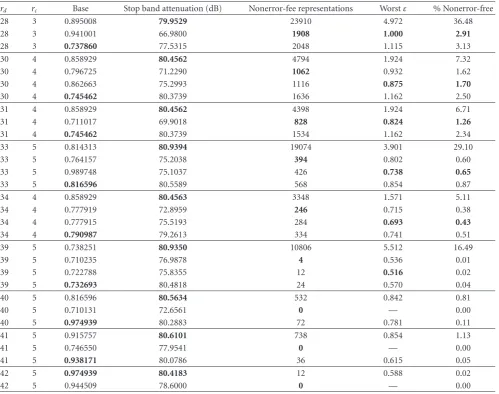
We can also apply the blended optimal base to the two-digit coefficient representation as well. Since the ranges onrcare much smaller, we will explore the possibility of having a
nonerror-free data representation. As we have seen before, obtaining an error-free data representation will require larger ranges of rd which in turn will require larger tables for the 4 parallel inner product CUs. Table 6 shows various possibilities forrdandrc.
Table6: Combined optimal base (two-digit coefficient, two-digit data).
rd rc Base Stop band attenuation (dB) Nonerror-fee representations Worstε % Nonerror-free
28 3 0.895008 79.9529 23910 4.972 36.48
28 3 0.941001 66.9800 1908 1.000 2.91
28 3 0.737860 77.5315 2048 1.115 3.13
30 4 0.858929 80.4562 4794 1.924 7.32
30 4 0.796725 71.2290 1062 0.932 1.62
30 4 0.862663 75.2993 1116 0.875 1.70
30 4 0.745462 80.3739 1636 1.162 2.50
31 4 0.858929 80.4562 4398 1.924 6.71
31 4 0.711017 69.9018 828 0.824 1.26
31 4 0.745462 80.3739 1534 1.162 2.34
33 5 0.814313 80.9394 19074 3.901 29.10
33 5 0.764157 75.2038 394 0.802 0.60
33 5 0.989748 75.1037 426 0.738 0.65
33 5 0.816596 80.5589 568 0.854 0.87
34 4 0.858929 80.4563 3348 1.571 5.11
34 4 0.777919 72.8959 246 0.715 0.38
34 4 0.777915 75.5193 284 0.693 0.43
34 4 0.790987 79.2613 334 0.741 0.51
39 5 0.738251 80.9350 10806 5.512 16.49
39 5 0.710235 76.9878 4 0.536 0.01
39 5 0.722788 75.8355 12 0.516 0.02
39 5 0.732693 80.4818 24 0.570 0.04
40 5 0.816596 80.5634 532 0.842 0.81
40 5 0.710131 72.6561 0 — 0.00
40 5 0.974939 80.2883 72 0.781 0.11
41 5 0.915757 80.6101 738 0.854 1.13
41 5 0.746550 77.9541 0 — 0.00
41 5 0.938171 80.0786 36 0.615 0.05
42 5 0.974939 80.4183 12 0.588 0.02
42 5 0.944509 78.6000 0 — 0.00
representation when rd = 40 and above. Depending on the application, a nonerror-free mapping may be acceptable considering the worst caseεis below 1.0.
5.3.4. Comparison to the individual optimal base
When we compare the above results with the previous individual optimal bases, we can see that we have not sacrificed much in terms of stop band attenuation (rc=5) or exponent ranges for error-free data mapping (rd=40). This approach seems to offer the best filter performance and data representation as compared to the single-digit coefficients.
For the purposes of implementation,rowill never exceed
±45. We can therefore expect to have four inner product CUs, each of which with 92 entries, totaling 368 entries for four CUs.
5.4. Comparison of base 3 to the optimal bases
There are many possibilities available for an optimal base depending on the accuracy required for the filter
per-formance and data representation. Table 7 compares the original base 3 and optimal base system’s performance to give at least 73 dB stop band attenuation and a 0% and 1% nonerror-free data mapping. For all cases, the optimal base offers saving in the CU LUTs as well as the range of the second-base exponent.
In the single-digit case, we can increase or decreaserd to decrease or increase the nonerror-free representations, respectively.
5.5. Comparison to general number systems
Table7: Comparison of standard and optimal base for a minimum 73 dB system.
Base Stop band attenuation (dB) % Nonerror-free rc rd LUT entries per CU Total LUT entries
Single-digit coefficients
3.000000 73.4312 1.00 255 51 614 1228
0.828348 73.7272 0.67 85 39 250 500
Saving 59.3%
3.000000 73.4312 0.00 255 93 698 1396
0.828348 73.7272 0.00 85 45 262 524
Saving 62.5%
Two-digit coefficients
3.000000 75.4867 1.00 7 51 118 472
0.777915 75.5193 0.43 4 34 78 312
Saving 33.9%
3.000000 75.4867 0.00 7 93 202 808
0.746550 77.9541 0.00 5 41 94 376
Saving 53.5%
Table8: Comparison of filter performance for general number systems.
Bits Fixed-point binary Floating-point binary LNS with fixed-point exponent
Passband ripple (dB)
Stop band attenuation
(dB)
Passband ripple (dB)
Stop band attenuation
(dB)
Passband ripple (dB)
Stop band attenuation
(dB)
1 6.0206 6.0206 1.4225 16.4174 2.2454 14.6224
2 3.6810 9.2326 1.2905 17.1989 1.3542 26.0100
3 3.6810 9.2326 0.1589 34.8402 0.5313 28.6544
4 1.9997 13.7377 0.1521 35.2187 0.3403 37.1995
5 0.5606 24.0824 0.0813 40.6289 0.1493 38.1408
6 0.2873 29.7543 0.0693 42.0232 0.0776 45.6083
7 0.2474 31.0320 0.0092 59.6780 0.0422 54.1982
8 0.0778 41.0001 0.0036 68.0561 0.0249 69.0545
9 0.0507 44.6930 0.0025 71.3190 0.0127 71.2978
10 0.0211 52.2642 0.0026 70.9529 0.0064 74.0112
11 0.0117 57.4244 0.0019 74.1708 0.0032 74.8158
12 0.0062 62.9227 0.0017 75.2752 0.0017 74.7228
13 0.0040 66.8129 0.0016 75.5764 0.0012 78.0202
14 0.0023 71.6093 0.0012 78.7328 0.0009 80.0245
15 0.0013 76.5792 0.0009 80.9136 0.0008 80.8327
16 0.0012 77.2776 0.0009 80.6924 0.0008 80.9733
17 0.0010 78.6727 0.0008 81.0919 0.0008 81.0450
18 0.0008 80.2013 0.0008 81.0246 0.0008 81.1399
19 0.0008 80.7061 0.0008 81.1587 0.0008 81.1113
20 0.0008 81.1363 0.0008 81.1301 0.0008 81.1117
bit limitation is applied to the fractional portion of the representations only. The integer portion (i.e., exponent for floating point, integer for LNS exponent) is not considered as it only affects the fixed-point binary representation for values greater than 1; all of the filter’s coefficients are however less than 1.
From Table 6, we achieved over 80 dB stop band attenuation with only 6.6 bits per digit using a two-digit data/coefficient system. In this case only 12 of the 65536
Table 7 shows that not more than 6.3 bits (per digit) are required when using a two-digit 2DLNS representation (ε≤
0.67). For each of these general number systems, additional bits in the multipliers (or adders for LNS) will be required to include the calculation of the input data. The presented 2DLNS approach does not need additional precision, but the two-digit system does require an accumulation stage to merge the results from the four separate processing channels. The aforementioned improvements to 2DLNS with an optimal base as well as a one-bit sign make the architecture more attractive in applications where traditional number systems such as fixed-point and floating-point binary as well as LNS are used. Unfortunately, we are unable to explore a 2DLNS in a wide variety of applications as the choice of the second base is a balance of accuracy and implementation hardware.
6. EXTENDING TO THREE BASES
Applying this software to find a set of optimal bases on a multiple base system would have serious scalability issues as we would be performing a linear search geometrically for each base. The complexity of this problem can be considered to beO(nk) where nis the number of scenarios tested for a single base, andkis the number of nonbinary bases. For the two-digit coefficient case ofrd = 40 and rc = 5, nis 20864199. The computational time for any scenario varies considerably with rd, rc, and the representation method selected, as they all effect the data generation and search times. We do believe that it is possible to reduce this massive search time for a single-digit 3DLNS system (two nonbinary bases) by merging both algorithmic and range searching methods. By assuming that one of the target representations will have a near zero error, the algorithmic search should provide a series of second bases with the range search supplying the third base. We have yet to attempt this process but we believe it can improve the single-digit representation by using multiple bases with smaller exponent ranges rather than a single base with a larger exponent range. The complexity should be reduced as we are effectively performing many two base optimizations (potentially in parallel) but with a much smaller limitation on the exponents. Using a 3DLNS system with smaller r’s could result in a more compact hardware implementation and better representation than a 2DLNS system.
7. CONCLUSION
Since the 2DLNS inner product computational unit requires an LUT for 2DLNS-to-binary conversions, it is important to try to minimize the size of this LUT as the overall system complexity is based on it. We have shown, by example, that selecting an optimal second base can reduce the size of these LUTs and more importantly the range ofbo, by a minimum of 33% in one case without impacting the quality of the 2DLNS representation compared to the standard second base of 3. These results should hold true for any other arbitrary second base. As the binary-to-2DLNS conversion hardware also depends on the range of the second-base
exponent, selecting an optimal base will offer reductions in this component and may potentially reduce the data paths and storage registers of the complete system. Reducing the range ofbocan also impact future architectures, one of which would be a native MDLNS addition/subtraction circuit [11]. By migrating from a two-bit sign to a one-bit sign, the computation time of the optimal base halves and the hardware area and critical paths of published architectures are further reduced as some processing steps are eliminated.
The software for finding an optimal base can be utilized in many different applications other than FIR filter design. The software accepts either a list of real numbers, a range of integers, or both in order to find the best representation with minimal error.
All software, source files, and detailed results can be found athttp://research.muscedere.com.
ACKNOWLEDGMENTS
This work was supported in part by the Natural Sciences and Engineering Council (NSERC) of Canada, and Gennum Corporation. The author would like to acknowledge the important contribution of the Canadian Microelectronics Corporation (CMC) for their equipment, and software loan.
REFERENCES
[1] V. S. Dimitrov, J. Eskritt, L. Imbert, G. A. Jullien, and W. C. Miller, “The use of the multi-dimensional logarithmic number system in DSP applications,” inProceedings of the 15th IEEE Symposium on Computer Arithmetic, pp. 247–254, Vail, Colo, USA, June 2001.
[2] V. S. Dimitrov and G. A. Jullien, “Loading the bases: a new number representation with applications,”IEEE Circuits and Systems Magazine, vol. 3, no. 2, pp. 6–23, 2003.
[3] V. S. Dimitrov, G. A. Jullien, and W. C. Miller, “Theory and applications of the double-base number system,” IEEE Transactions on Computers, vol. 48, no. 10, pp. 1098–1106, 1999.
[4] M. G. Arnold, T. A. Bailey, J. R. Cowles, and J. J. Cupal, “Redundant logarithmic arithmetic,” IEEE Transactions on Computers, vol. 39, no. 8, pp. 1077–1086, 1990.
[5] E. E. Swartzlander Jr. and A. G. Alexopoulos, “The sign/logarithm number system,”IEEE Transactions on Com-puters, vol. C-24, no. 12, pp. 1238–1242, 1975.
[6] R. Muscedere, V. Dimitrov, G. Jullien, and W. Miller, “A low-power two-digit multi-dimensional logarithmic number system filterbank architecture for a digital hearing aid,” EURASIP Journal on Applied Signal Processing, vol. 2005, no. 18, pp. 3015–3025, 2005.
[7] R. Muscedere, V. Dimitrov, G. A. Jullien, and W. C. Miller, “Efficient techniques for binary-to-multidigit multidimen-sional logarithmic number system conversion using range-addressable look-up tables,”IEEE Transactions on Computers, vol. 54, no. 3, pp. 257–271, 2005.
[9] J. Eskritt, R. Muscedere, G. A. Jullien, V. S. Dimitrov, and W. C. Miller, “A 2-digit DBNS filter architecture,” inProceedings of IEEE Workshop on Signal Processing Systems (SiPS ’00), pp. 447–456, Lafayette, La, USA, October 2000.
[10] D. M. Lewis, “An architecture for addition and subtraction of long word length numbers in the logarithmic number system,” IEEE Transactions on Computers, vol. 39, no. 11, pp. 1325– 1336, 1990.
![Figure 1: One-digit 2DLNS inner product computational unit from[3].](https://thumb-us.123doks.com/thumbv2/123dok_us/1162342.1146339/2.600.354.497.74.320/figure-digit-dlns-inner-product-computational-unit.webp)