Grammar Induction with Neural Language Models:
An Unusual Replication
Phu Mon Htut1 AdeptMind Scholar
Kyunghyun Cho1,2 CIFAR Global Scholar
Samuel R. Bowman1,2,3
1Center for Data Science
New York University 60 Fifth Avenue New York, NY 10011
2Dept. of Computer Science
New York University 60 Fifth Avenue New York, NY 10011
3Dept. of Linguistics New York University 10 Washington Place New York, NY 10003
Abstract
A substantial thread of recent work onlatent tree learninghas attempted to develop neural network models with parse-valued latent vari-ables and train them on non-parsing tasks, in the hope of having them discover interpretable tree structure. In a recent paper,Shen et al. (2018) introduce such a model and report near-state-of-the-art results on the target task of lan-guage modeling, and the first strong latent tree learning result on constituency parsing. In an attempt to reproduce these results, we discover issues that make the original results hard to trust, including tuning and even training on what is effectively the test set. Here, we at-tempt to reproduce these results in a fair exper-iment and to extend them to two new datasets. We find that the results of this work are robust: All variants of the model under study outform all latent tree learning baselines, and per-form competitively with symbolic grammar induction systems. We find that this model represents the first empirical success for la-tent tree learning, and that neural network lan-guage modeling warrants further study as a setting for grammar induction.
1 Introduction and Background
Work on grammar induction attempts to find methods for syntactic parsing that do not re-quire expensive and difficult-to-design expert-labeled treebanks for training (Charniak and Car-roll, 1992; Klein and Manning, 2002;Smith and Eisner,2005). Recent work onlatent tree learning
offers a new family of approaches to the problem (Yogatama et al.,2017;Maillard et al.,2017;Choi et al.,2018). Latent tree learning models attempt to induce syntactic structure using the supervision from a downstream NLP task such as textual en-tailment. Though these models tend to show good task performance, they are often not evaluated us-ing standard parsus-ing metrics, and Williams et al.
(2018a) report that the parses they produce tend to be no better than random trees in a standard evalu-ation on the full Wall Street Journal section of the Penn Treebank (WSJ;Marcus et al.,1993).
This paper addresses the Parsing-Reading-Predict Network (PRPN;Shen et al.,2018), which was recently published at ICLR, and which reports near-state-of-the-art results on language modeling and strong results on grammar induction, a first for latent tree models (though they do not use that term). PRPN is built around a substantially novel architecture, and uses convolutional networks with a form of structured attention (Kim et al., 2017) rather than recursive neural networks (Goller and Kuchler,1996;Socher et al.,2011) to evaluate and learn trees while performing straightforward back-propagation training on a language modeling ob-jective. In this work, we aim to understand what the PRPN model learns that allows it to succeed, and to identify the conditions under which this success is possible.
pars-There ’s nothing worth seeing in the tourist offices. There ’s nothing worth seeing in the tourist offices.
[image:2.595.83.519.59.151.2]The entire Minoan civilization was destroyed by a volcanic eruption. The entire Minoan civilization was destroyed by a volcanic eruption.
Figure 1: LeftParses from PRPN-LM trained on AllNLI.RightParses from PRPN-UP trained on AllNLI (stopping criterion: parsing). We can observe that both sets of parses tend to have roughly reasonable high-level structure and tend to identify noun phrases correctly.
ing decisions greedily and withno access to any words to the right of the point where each parsing decision must be made (Collins and Roark,2004); (2) As RNN language models are known to be in-sufficient for capturing syntax-sensitive dependen-cies (Linzen et al., 2016), language modeling as the downstream task may not be well-suited to la-tent tree learning.
In this replication we train PRPN on two cor-pora: The full WSJ, a staple in work on gram-mar induction, and AllNLI, the concatenation of the Stanford Natural Language Inference Corpus (SNLI; Bowman et al.,2015) and the Multi-Genre NLI Corpus (MultiNLI; Williams et al., 2018b), which is used in other latent tree learning work for its non-syntactic classification labels for the task of textual entailment, and which we include for comparison. We then evaluate the constituency trees produced by these models on the WSJ test set, full WSJ10,1 and the MultiNLI development set.
Our results indicate that PRPN-LM achieves better parsing performance than PRPN-UP on both WSJ and WSJ10 even though PRPN-UP was tuned—at least to some extent—for parsing. Sur-prisingly, a PRPN-LM model trained on the large out-of-domain AllNLI dataset achieves the best parsing performance on WSJ despite not being tuned for parsing. We also notice that vocabulary size affects the language modeling significantly— the perplexity gets higher as the vocabulary size increases.
Overall, despite the relatively uninformative ex-perimental design used in Shen et al.(2018), we find that PRPN is an effective model. It outper-forms all latent tree learning baselines by large
1A standard processed subset of WSJ used in grammar
induction in which the sentences contain no punctuation and no more than 10 words.
margins on both WSJ and MultiNLI, and performs competitively with symbolic grammar induction systems on WSJ10, suggesting that PRPN in par-ticular and language modeling in general are a vi-able setting for latent tree learning.
2 Methods
PRPN consists of three components: (i) aparsing network that uses a two-layer convolution kernel to calculate the syntactic distance between suc-cessive pairs of words, which can form an indi-rect representation of the constituency structure of the sentence, (ii) a recurrentreading networkthat summarizes the current memory state based on all previous memory states and the implicit con-stituent structure, and (iii) a predict network that uses the memory state to predict the next token. We refer readers to the appendix and the original work for details.
We do not re-implement or re-tune PRPN, but rather attempt to replicate and understand the re-sults of the work using the author’s publicly avail-able code.2 The experiments on language model-ing and parsmodel-ing are carried out usmodel-ing different con-figurations of the model, with substantially differ-ent hyperparameter values including the size of the word embeddings, the maximum sentence length, the vocabulary size, and the sizes of hidden layers. PRPN-LM is larger than PRPN-UP, with embed-ding layer that is 4 times larger and the number of units per layer that is 3 times larger. We use both versions of the model in all our experiments.
We use the 49k-sentence WSJ corpus in two set-tings. To replicate the original results, we re-run an experiment with no train/test split, and for a clearer picture of the model’s performance, we run it again with the train (Section 0-21 of WSJ), val-idation (Section 22 of WSJ), and test (Section 23
Training
Data StoppingCriterion VocabSize
Parsing F1 Depth
WSJ Accuracy on WSJ by Tag
Model WSJ10 WSJ ADJP NP PP INTJ
µ( ) max µ( ) max
PRPN-UP AllNLI Train UP 76k 67.5 (0.6) 68.6 36.9 (0.6) 38.0 5.8 29.3 62.0 31.6 0.0
PRPN-UP AllNLI Train LM 76k 66.3 (0.8) 68.5 38.3 (0.5) 39.8 5.8 28.7 65.5 32.7 0.0
PRPN-LM AllNLI Train LM 76k 52.4 (4.9) 58.1 35.0 (5.4) 42.8 6.1 37.8 59.7 61.5 100.0
PRPN-UP WSJ Full UP 15.8k 64.7 (3.2) 70.9 26.4 (1.7) 31.1 5.8 22.5 47.2 17.9 0.0
PRPN-UP WSJ Full LM 15.8k 64.3 (3.3) 70.8 26.3 (1.8) 30.8 5.8 22.7 46.6 17.8 0.0
PRPN-UP WSJ Train UP 15.8k 63.5 (3.5) 70.7 26.2 (2.3) 33.0 5.8 24.8 55.2 18.0 0.0
PRPN-UP WSJ Train LM 15.8k 62.2 (3.9) 70.3 26.0 (2.3) 32.8 5.8 24.8 54.4 17.8 0.0
PRPN-LM WSJ Train LM 10k 70.5 (0.4) 71.3 37.4 (0.3) 38.1 5.9 26.2 63.9 24.4 0.0
PRPN-LM WSJ Train UP 10k 66.1 (0.5) 67.2 33.4 (0.8) 35.6 5.9 33.0 57.1 18.3 0.0
300D ST-Gumbel AllNLI Train NLI – – – 19.0 (1.0) 20.1 – 15.6 18.8 9.9 59.4
w/o Leaf GRU AllNLI Train NLI – – – 22.8 (1.6) 25.0 – 18.9 24.1 14.2 51.8
300D RL-SPINN AllNLI Train NLI – – – 13.2 (0.0) 13.2 – 1.7 10.8 4.6 50.6
w/o Leaf GRU AllNLI Train NLI – – – 13.1 (0.1) 13.2 – 1.6 10.9 4.6 50.0
CCM WSJ10 Full – – – 71.9 – – – – – – –
DMV+CCM WSJ10 Full – – – 77.6 – – – – – – –
UML-DOP WSJ10 Full – – – 82.9 – – – – – – –
Random Trees – – – – 34.7 21.3 (0.0) 21.4 5.3 17.4 22.3 16.0 40.4
Balanced Trees – – – – – 21.3 (0.0) 21.3 4.6 22.1 20.2 9.3 55.9
Left Branching – – – 28.7 28.7 13.1 (0.0) 13.1 12.4 – – – –
[image:3.595.74.528.66.326.2]Right Branching – – – 61.7 61.7 16.5 (0.0) 16.5 12.4 – – – –
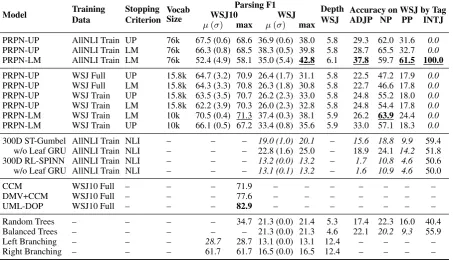
Table 1: Unlabeled parsing F1 results evaluated on full WSJ10 and WSJ test set broken down by train-ing data and by early stopptrain-ing criterion. TheAccuracycolumns represent the fraction of ground truth constituents of a given type that correspond to constituents in the model parses. Italics mark results that are worse than the random baseline. Underlining marks the best results from our runs. Results with RL-SPINN and ST-Gumbel are from Williams et al.(2018a), and are evaluated on the full WSJ. We run the model with 5 different random seeds to calculate the average F1. We use the model with the best F1 score to report ADJP, NP, PP, and INTJ. WSJ10 baselines are fromKlein and Manning(2002, CCM),Klein and Manning(2005, DMV+CCM), andBod(2006, UML-DOP). As the WSJ10 baselines are trained using additional information such as POS tags and dependency parser, they are not strictly comparable with the latent tree learning results.
of WSJ) splits. To compare PRPN to the models studied inWilliams et al.(2018a), we also retrain it on AllNLI. As the MultiNLI test set is not pub-licly available, we followWilliams et al. (2018a) and use the development set for testing. The pars-ing evaluation code in the original codebase does not support PRPN-LM, and we modify it in our experiments only to add this support.
For early stopping, we remove 10k random sen-tences from the MultiNLI training set and combine them with the SNLI development set to create a validation set. Our AllNLI training set contains 280.5K unique sentences (1.8M sentences in total including duplicate premise sentences), and cov-ers six distinct genres of spoken and written En-glish. We do not remove the duplicate sentences. We train the model for 100 epochs for WSJ and 15 epochs for AllNLI. We run the model five times with random initializations and average the results
from the five runs. The generated parses from the trained models with the best F1 scores and the pre-trained model that provides the highest F1 are available online.3
3 Experimental Results
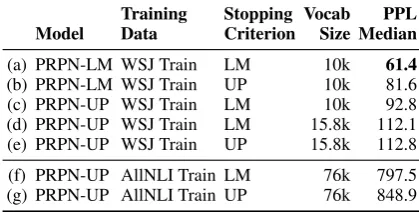
Table2shows our results for language modeling. PRPN-UP, configured as-is with parsing criterion and language modeling criterion, performs dra-matically worse than the standard PRPN-LM (a vs. d and e). However, this is not a fair comparison as the larger vocabulary gives PRPN-UP a harder task to solve. Adjusting the vocabulary of PRPN-UP down to 10k to make a fairer comparison pos-sible, the PPL of PRPN-UP improves significantly (c vs. d), but not enough to match PRPN-LM (a vs. c). We also observe that early stopping on
3https://github.com/nyu-mll/
Training Stopping Vocab PPL Model Data Criterion Size Median
(a) PRPN-LM WSJ Train LM 10k 61.4
(b) PRPN-LM WSJ Train UP 10k 81.6
(c) PRPN-UP WSJ Train LM 10k 92.8
(d) PRPN-UP WSJ Train LM 15.8k 112.1
(e) PRPN-UP WSJ Train UP 15.8k 112.8
(f) PRPN-UP AllNLI Train LM 76k 797.5
(g) PRPN-UP AllNLI Train UP 76k 848.9
Table 2: Language modeling performance (per-plexity) on the WSJ test set, broken down by train-ing data used and by whether early stopptrain-ing is done using the parsing objective (UP) or the lan-guage modeling objective (LM).
parsing leads to incomplete training and a substan-tial decrease in perplexity (a vs. b and d vs. e). The models stop training at around the 13th epoch when we early-stop on parsing objective, while they stop training around the 65th epoch when we early-stop on language modeling objective. Both PRPN models trained on AllNLI do even worse (f and g), though the mismatch in vocabulary and domain may explain this effect. In addition, since it takes much longer to train PRPN on the larger AllNLI dataset, we train PRPN on AllNLI for only 15 epochs while we train the PRPN on WSJ for 100 epochs. Although the parsing objective con-verges within 15 epochs, we notice that language modeling perplexity is still improving. We expect that the perplexity of the PRPN models trained on AllNLI could be lower if we increase the number of training epochs.
Turning toward parsing performance, Table 1
shows results with all the models under study, plus several baselines, on WSJ test set and full WSJ10. On full WSJ10, we reproduce the main parsing result of Shen et al. (2018) with their UP model trained on WSJ without a data split. We also find the choice of parse quality as an early stopping criterion does not have a substantial effect and that training on the (unlabeled) test set does not give a significant improvement in performance. In addition and unexpectedly, we observe that PRPN-LM models achievehigherparsing perfor-mance than PRPN-UP. This shows that any tuning done to separate PRPN-UP from PRPN-LM was not necessary, and more importantly, that the re-sults described in the paper can be largely repro-duced by a unified model in a fair setting. More-over, the PRPN models trained on WSJ achieves
Stopping F1 wrt.
Model Criterion LB RB SP Depth
300D SPINN NLI 19.3 36.9 70.2 6.2
w/o Leaf GRU NLI 21.2 39.0 63.5 6.4
300D SPINN-NC NLI 19.2 36.2 70.5 6.1
w/o Leaf GRU NLI 20.6 38.9 64.1 6.3
300D ST-Gumbel NLI 32.6 37.5 23.7 4.1
w/o Leaf GRU NLI 30.8 35.6 27.5 4.6
300D RL-SPINN NLI 95.0 13.5 18.8 8.6
w/o Leaf GRU NLI 99.1 10.7 18.1 8.6
PRPN-LM LM 25.6 26.9 45.7 4.9
PRPN-UP UP 19.4 41.0 46.3 4.9
PRPN-UP LM 19.9 37.4 48.6 4.9
Random Trees – 27.9 28.0 27.0 4.4
Balanced Trees – 21.7 36.8 21.3 3.9
Table 3: Unlabeled parsing F1 on the MultiNLI development set for models trained on AllNLI.F1 wrt. shows F1 with respect to strictly right- and left-branching (LB/RB) trees and with respect to the Stanford Parser (SP) trees supplied with the corpus; The evaluations of SPINN, RL-SPINN, and ST-Gumbel are fromWilliams et al.(2018a). SPINN is a supervised parsing model, and the oth-ers are latent tree models. Median F1 of each model trained with 5 different random seeds is re-ported.
comparable results with CCM (Klein and Man-ning,2002). The PRPN models are outperformed by DMV+CCM(Klein and Manning, 2005), and UML-DOP(Bod, 2006). However, these models use additional information such as POS and de-pendency parser so they are not strictly compara-ble with the PRPN models.
[image:4.595.75.285.64.170.2] [image:4.595.319.515.65.239.2]per-formance than the baselines fromYogatama et al.
(2017, called RL-SPINN) and Choi et al. (2018, called ST-Gumbel), despite the fact that the model was tuned exclusively for WSJ10 parsing. This suggests that PRPN is consistently effective at la-tent tree learning.
We also show detailed results for several spe-cific constituent types, following Williams et al.
(2018a). We observe that the accuracy for NP (noun phrases) on the WSJ test set is above 46% (Table1) for all PRPN models, much higher than any of the baseline models. These runs also per-form substantially better than the random baseline in the two other categoriesWilliams et al.(2018a) report: ADJP (adjective phrases) and PP (preposi-tional phrases). However, as WSJ test set contains only one INTJ (interjection phrases), the results on INTJ are either 0.0% or 100%.
In addition, Table 3 shows that the PRPN-UP models achieve the median parsing F1 scores of 46.3 and 48.6 respectively on the MultiNLI dev set while PRPN-LM performs the median F1 of 45.7; setting the state of the art in parsing perfor-mance on this dataset among latent tree models by a large margin. We conclude that PRPN does ac-quire some substantial knowledge of syntax, and that this knowledge agrees with Penn Treebank (PTB) grammar significantly better than chance.
Qualitatively, the parses produced by most of the best performing PRPN models are relatively balanced (F1 score of 36.5 w.r.t balanced trees) and tend toward right branching (F1 score of 42.0 with respect to balanced trees). They are also shal-lower than average ground truth PTB parsed trees. These models can parse short sentences relatively well, as shown by their high WSJ10 performance. For a large proportion of long sentences, most of the best performing models can produce rea-sonable constituents (Table 1). The best perform-ing model, PRPN-LM trained on AllNLI, achieves the best accuracy at identifying ADJP (adjective phrases), PP (prepositional phrases), and INTJ (in-terjection phrases) constituents, and a high accu-racy on NP (noun phrases). In a more informal inspection, we also observe that our best PRPN-LM and PRPN-UP runs are fairly good at pairing determiners with NPs as we can observe in Fig-ure1). Although lower level tree constituents ap-pear random in many cases for both PRPN-LM and PRPN-UP, the intermediate and higher-level constituents are generally reasonable. For
exam-ple, in Figure1, although the parse for lower level constituents likeThe entire Minoanseem random, the higher-level constituents, such as The entire Minoan civilization and nothing worth seeing in the tourist offices, are reasonable.
4 Conclusion
In our attempt to replicate the grammar induction results reported inShen et al.(2018), we find sev-eral experimental design problems that make the results difficult to interpret. However, in exper-iments and analyses going well beyond the scope of the original paper, we find that the PRPN model presented in that work is nonetheless robust. It represents a viable method for grammar induction and the first clear success for latent tree learning with neural networks, and we expect that it her-alds further work on language modeling as a tool for grammar induction research.
Acknowledgments
This project has benefited from financial support to SB by Google and Tencent Holdings, and was partly supported by Samsung Electronics (Improv-ing Deep Learn(Improv-ing us(Improv-ing Latent Structure). We thank Adina Williams, Katharina Kann, Ryan Cot-terell, and the anonymous reviewers for their help-ful comments and suggestions, and NVIDIA for their support.
References
Rens Bod. 2006. An All-Subtrees Approach to Un-supervised Parsing. Proceedings of the 21st Inter-national Conference on Computational Linguistics and the 44th annual meeting of the Association for Computational Linguistics, pages 865–872.
Samuel R. Bowman, Gabor Angeli, Christopher Potts, and Christopher D. Manning. 2015. A large an-notated corpus for learning natural language infer-ence. In Proceedings of the Conference on Em-pirical Methods in Natural Language Processing (EMNLP). Association for Computational Linguis-tics.
Eugene Charniak and Glen Carroll. 1992. Two exper-iments on learning probabilistic dependency gram-mars from corpora. In Proceedings of the AAAI Workshop on Statistically-Based NLP Techniques, page 113.
Michael Collins and Brian Roark. 2004. Incremen-tal parsing with the perceptron algorithm. In Pro-ceedings of the 42nd Annual Meeting of the Asso-ciation for Computational Linguistics, 21-26 July, 2004, Barcelona, Spain., pages 111–118.
Christoph Goller and Andreas Kuchler. 1996. Learn-ing task-dependent distributed representations by backpropagation through structure. InProceedings of International Conference on Neural Networks (ICNN’96).
Sepp Hochreiter and J¨urgen Schmidhuber. 1996. Long Short Term Memory. Memory, (1993):1–28.
Yoon Kim, Carl Denton, Luong Hoang, and Alexan-der M. Rush. 2017. Structured attention networks.
Dan Klein and Christopher D. Manning. 2002. A generative constituent-context model for improved grammar induction. InProceedings of the 40th An-nual Meeting on Association for Computational Lin-guistics - ACL ’02, page 128.
Dan Klein and Christopher D. Manning. 2005. Nat-ural language grammar induction with a genera-tive constituent-context model. Pattern Recognition, 38(9):1407–1419.
Tal Linzen, Emmanuel Dupoux, and Yoav Goldberg. 2016. Assessing the ability of lstms to learn syntax-sensitive dependencies.TACL, 4:521–535.
Jean Maillard, Stephen Clark, and Dani Yogatama. 2017. Jointly learning sentence embeddings and syntax with unsupervised Tree-LSTMs. arXiv preprint 1705.09189.
Mitchell P. Marcus, Beatrice Santorini, and Mary Ann Marcinkiewicz. 1993. Building a large annotated corpus of english: The penn treebank. Computa-tional Linguistics, 19(2):313–330.
Yikang Shen, Zhouhan Lin, Chin wei Huang, and Aaron Courville. 2018. Neural language modeling by jointly learning syntax and lexicon. In Interna-tional Conference on Learning Representations.
Noah A. Smith and Jason Eisner. 2005. Guiding un-supervised grammar induction using contrastive es-timation. In Proceedings of IJCAI Workshop on Grammatical Inference Applications, pages 73–82.
Richard Socher, Cliff Chiung-Yu Lin, Andrew Ng, and Chris Manning. 2011. Parsing Natural Scenes and Natural Language with Recursive Neural Networks. InProceedings of the 28th International Conference on Machine Learning, pages 129–136.
Adina Williams, Andrew Drozdov, and Samuel R. Bowman. 2018a. Do latent tree learning models identify meaningful structure in sentences? Trans-actions of the Association for Computational Lin-guistics (TACL).
Adina Williams, Nikita Nangia, and Samuel R. Bow-man. 2018b. A broad-coverage challenge corpus for sentence understanding through inference. In Pro-ceedings of the North American Chapter of the As-sociation for Computational Linguistics (NAACL). Dani Yogatama, Phil Blunsom, Chris Dyer, Edward