Volume 2009, Article ID 862618,6pages doi:10.1155/2009/862618
Research Article
Weak GPS Signal Acquisition Algorithm Based on
Chaotic Oscillator
Pengda Huang, Yiming Pi, and Zhiqin Zhao
701-4 Laboratory School of Electronic Engineering, Electronic Science and Technology University of China, Number 4 Section 2, Jianshe Road, Chengdu 611731, China
Correspondence should be addressed to Pengda Huang,[email protected]
Received 21 November 2008; Revised 21 March 2009; Accepted 16 September 2009
Recommended by Liang-Gee Chen
To detect weak Global Position System (GPS) signal indoors, various high-sensitivity detection algorithms have been proposed. However, a common tradeoffbetween high-sensitivity and computation burden impedes development of high sensitivity GPS receiver. As another strategy, chaotic oscillator, sensitive to periodic signal and inert to noise, possesses huge advantage in weak signal acquisition. In this paper chaotic oscillator is employed in weak GPS signal acquisition. With numerical indication of Lyapunov exponents (LEs), chaotic oscillator can achieve acquisition in extremely weak GPS signal. Compared with conventional algorithm, chaotic oscillator consumes less acquisition time and is capable of detecting weak GPS signal. In the final section of paper, results from computer simulation illustrate that chaotic oscillator algorithm can acquire GPS signal at−48 dB/2MHz SNR.
Copyright © 2009 Pengda Huang et al. This is an open access article distributed under the Creative Commons Attribution License, which permits unrestricted use, distribution, and reproduction in any medium, provided the original work is properly cited.
1. Introduction
GPS signal indoors become extremely weak because of fading, refraction, reflection, and multipath interference [1]. Normally line-of-sight GPS signal is at 44 dBHz [2], while signal strength will degrade larger than 25 dB in bad case [3,4]. However common commercial GPS receiver can only acquire GPS signal above 38 dBHz. To achieve successful position and navigation in such challenging environment, much work has been performed, which focused on prolong-ing integration duration to increase SNR.
Until now there are three typical solutions to weak GPS signal acquisition in high-sensitivity receiver, alternate half-bit accumulation [5], full-bit accumulation with estimation of bit transition time [5], and differentially coherent acquisi-tion algorithm [6]. Alternate half-bits algorithm [5] divided raw GPS signal data into equal cells by the length of 10 mil-liseconds, and all cells alternately belong to two groups. As the epoch of data bit is 20 milliseconds, such division by 10 milliseconds ensured that one of the two groups avoids data bit transition. Simulation in [5] illustrated well performance of alternate half-bit accumulation in detecting weak GPS signal. However alternate half-bit algorithm demanded huge computations. Full-bit accumulation divided processing data
into 20 groups, and any two adjacent groups started at 1-millisecond time difference, the epoch of code chip. As one of the 20 groups was assured to avoid data bit transition, integration duration could be theoretically prolonged with-out limits. In fact, hardware implementation did not allow such duration extension. Furthermore, computation burden caused by 20 groups is amazing. In differential coherent [6], perform received data correlation with replica signal at the length of 1 millisecond, multiply all the adjacent two correlation results, accumulate all products to get detection statistic, and compare the statistic with threshold to judge whether expected signal exist. As claimed in [6], differential coherent accumulation is insensitive to data bit transition and tolerates Doppler shift. However, it sacrifices square gain.
developed a practicable method in detecting weak periodic signal with indication of Lyapunov Exponent (LE). Further-more, Ding proposed an effective method of computing LE, which contributes a lot to signal detection based on chaotic oscillator.
Up to now (to our knowledge), chaotic oscillator has not been employed in weak GPS signal detection. In this paper, a GPS signal acquisition algorithm based on Duffing chaotic oscillator is presented. Without prolonging accumulation interval, this method is totally different from conven-tional acquisition algorithm. InSection 5, simulation results demonstrate that chaotic oscillator algorithm outperforms conventional ones.
2. Duffing Oscillator Acquisition Method
In this section, chaotic oscillator will be introduced. In the field of nonlinear dynamics, various chaotic oscillators have been brought up. Among the chaotic oscillators, Duffing oscillator has been extensively studied [8–10]. The application of Duffing oscillator will be exemplified in details below.
2.1. Physical Explanation of Duffing Oscillator Acquisition in Weak Signal. Duffing Oscillator was brought into nonlinear dynamics in 1918 by Duffing. D [7]. Its primal form is ¨
x(t) +x(t) +εx3(t) = 0. Holmes [11] modified the primal
equation and reached novel one which depicts forced double-well model, as follows:
¨
x(t) +kx˙(t)−ax(t) +bx3(t)= fcos(t). (1)
The equation represents a strengthened spring system with cubic restore force term. Constant k is a damping coefficient, constantsaandbare real coefficients, the term
ax(t) − bx3(t) is nonlinear restore force, and constant
f denotes amplitude of periodic disturbing force (PEDF)
f cos(t). State of oscillator system (1) changes obviously when the frequency of input signal is close to frequency of PEDF. Such characteristic is key in weak signal acquisition.
2.2. Principle of Duffing Oscillator in Acquisition GPS Signal.
From (1), the state equations of Duffing oscillator can be derived, as
˙
x=y, ˙
y= −k·y+x−x3+ fcos(t). (2)
States of Duffing oscillator can be mapped on phase plane. As (2) is a Poincar´e map, states of the oscillator can be indicated by fixed points of (2) [7]. Solution procedure of these fixed points is described as below.
Let ˙x=0, ˙y=0, (2) can be written as
y=0,
−k×y+x−x3+f cos(t)=0. (3)
Firstly, consider a simplified situation without PEDF, that is, f =0. State (3) can be rewritten as
y=0,
−k×y+x−x3=0. (4)
Three fixed points (0, 0), (1, 0), (−1, 0) are gotten by solving (4).
The Jacobian matrix of (4) is
J=
0 1 1−3x2 −k
. (5)
Here setkas a typical value,k= −0.5 [9].
At the fixed point (x,y)=(0, 0) in equationΔ= J = −1<0 holds, which means that (0, 0) is a saddle point [7].
At fixed points (x,y) =(±1, 0) in equationΔ= J =
2 > 0 holds, trace of J equals to −0.5, and in equation
τ2−4Δ<0 holds. Therefore partial conclusion can be drawn
that points (±1, 0) are two stable spirals. So the two points (±1, 0) form a strange attractor [7]. All the trajectories in phase plane are attracted by this strange attractor.
In fact, amplitude f of the PEDF is limited in the range from 0 to 1, which is small enough to be ignored in engineering application. Therefore the conclusion in the end of the former paragraph stands still, when f /=0. However the tiny disturbance fromf costwill change motion states of Duffing oscillator. It is the change which indicates whether expected signal exists in received data.
2.3. GPS Signal Model. Mark [5] proposed a typical received GPS signal model as
rk=Ad(tk)c
1+η(tk−ts)
cosωIFtk−
ωDtk+φ0
+δ(tk),
(6) whererk is output of RF front end at sample timetk, fD =
ωD/2π is Doppler shift, η = ωD/(2π × 1575.42 × 106)
accounts for Doppler shift caused chip length distortion,
fIF =ωIF/2πis carrier frequency,φ0is initial carrier phase,
δ(tk) is Gaussian band-limited white noise, constant A is
signal amplitude, andd(tk) stands for GPS data stream.
Front end output is at frequency fIF − fD. Sampling
frequency fSis 5 MHz. After sampling, output from lowpass
filter with 2 MHz bandwidth is at frequency fG= fIF−fD−
n fS, corresponding to angular frequencyωG.
2.4. Deduced Original Duffing Oscillator. For application of Duffing oscillator in GPS signal acquisition, (1) can be deduced to (7) atωG:
¨
x(t) +ωGkx˙(t)−ωG2
x(t)−x3(t)=ωG2fcos(ωGt).
(7) If the angular frequency ω of GPS signal is same to the inherent angular frequencyωG of oscillator system (7),
3. Judgment of System State Based on
Lyapunov Exponent
To judge existence of expected GPS signal, observing change on phase plane is concise and instinctive. However, this method is time consuming. Human eyes detect the change after many periods. Furthermore, human judgment is inac-curate and inefficient, which cannot be implemented in engineering. Fortunately, LE can be employed in GPS signal acquisition based on chaotic oscillator [11].
Trajectories on phase plane are sensitive to initial condi-tions of oscillator system [7]. Two trajectories, which start very close, will rapidly diverge from each other and have totally different futures ultimately. LE is numeric indicator that describes divergence situation and motion state of trajectories.
LE can be solved out from state equation of system. Two stage nonautonomous equation (7) of Duffing oscillator system has two LEs corresponding tox- andy- dimension. The signs of LEs can indicate system states as follows: if one of two LEs is positive and the other is negative, system is at chaotic state; if both are negative, system is at big dimension circle state; if one LE equals to zero and the other is negative, the system is at critic state, the transition state between big dimension circle and chaotic ones [12].
3.1. Computation of LE. The state equation of (7) is expressed as
˙
x=y, ˙
y= −ωGk y+ωG2
ax−bx3+ω
G2fcos(ωGt).
(8)
As both variablesxandyare time dependent, (8) belongs to nonautonomous equation [11]. Letz = t, the two stage nonautonomous equation can be transformed into three stage autonomous equation as
˙
x=y, ˙
y= −ωGk y+ωG2
ax−bx3+ω
G2fcos(ωGz),
˙
z=1.
(9)
Furthermore, (9) can be simplified as the expression ˙A= J×A, where
J= ⎡ ⎢ ⎢ ⎢ ⎣
0 1 0
ωG2
a−3bx2 −ω
Gk −ωG3f sin(ωGz)
0 0 0
⎤ ⎥ ⎥ ⎥
⎦. (10)
At fixed point (x,y)=(0, 0) in equationΔ= J(0,0)<0
holds, which means that point (0, 0) is a saddle point. At fixed points (x,y) = (±1, 0), in equation if Δ = J(±1,0)>0 holds, trace ofJequals to−0.5, and in equation
τ2−4Δ<0 holds. Therefore two points (±1, 0) also form a
strange attractor. LE can be gotten:
λi
pi
= lim
t→ ∞
1
tlogA(t)pi, (11)
wherepiis initial matrix. By Runge Kutta iterative method
[12], LE can be easily calculated in engineering.
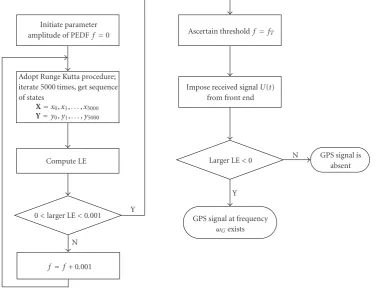
3.2. Flows of GPS Signal Detection Method with LE. Pro-cedure of GPS signal acquisition based on LE can be summarized as follows.
(1)Setting Threshold off. Modify amplitudefof PEDF from minute positive number to larger one smoothly and compute corresponding LEs. When the larger one of two LEs most approaches to zero from positive value, corresponding value of f is threshold fT.
(2) Detectting Signal. Impose received data on oscillator system. If the larger LE becomes negative, GPS signal at frequencyωGis assured to be comprised in received data.
Operation flows in Figure 1 illustrate succinctly the acquisition procedure.
4. Doppler and Code Phase Resolution
For implementation convenience in computer, (11) is rewrit-ten in form of discrete time:
λi
pi
= lim
N→ ∞
1
N
N
k
logA(k)pi. (12)
Time interval determines accuracy of LE. With fixed time step, increasingNinduces decrease in variance of calculated LEs by ratio 1/N2. In fact N cannot approach infinity;
therefore the numberN should selected at reasonable one. Also, length of iteration step h affects accuracy of LE. Ambiguity of LE increases when iteration step becomes larger, and vice versa. Unfortunately, the iteration step cannot be shortened arbitrarily considering convergence and computation burden. Doppler resolution is affected by accuracy of the LE number which is calculated at critical state. Code phase resolution is determined by sampling frequency [2]. Supposed that received data is sampled at 5 MHz in the front end, phase resolution of the oscillator system is 0.1 microsecond.
5. Simulations
In simulation, Monte Carlo method is adopted to test the performance of chaotic oscillator acquisition system. As contrast, conventional acquisition methods are used in simulation. GPS signal is based on signal model (6). Data length of conventional algorithm is 0.4 second. Referring to [2], GPS strength is at nominal level−130 dBm, and noise level is−174 dBm. From reference [4], GPS signal strength indoors would decrease in the range from 15 dB to 30 dB. Therefore, SNR of simulated indoor GPS signal ranges from
−49 dB to−34 dB, and CNR from 14 dBHz to 30 dBHz. Threshold is chosen to allow one false alarm happens among 106 times test on data without expected GPS signal.
Initiate parameter amplitude of PEDFf =0
Adopt Runge Kutta procedure; iterate 5000 times, get sequence of states
X=x0,x1,. . .,x5000
Y=y0,y1,. . .,y5000
Compute LE
0<larger LE<0.001
f =f+ 0.001
Ascertain thresholdf =fT
Impose received signalU(t) from front end
Larger LE<0
GPS signal at frequency ωGexists
GPS signal is absent
Y
N
Y
N
Figure1: Operation flows of Duffing oscillator acquisition system.
algorithm threshold is 50; for chaotic oscillator, threshold value of LE is−0.001 with 200 Hz Doppler resolution.
Damping coefficientk equals to 0.5. Initial state of (9) is at point (0, 0, 0); iteration time step is 1/(1.25×106×10)
second.Figure 2illustrates two LE curves versus amplitude of periodic disturbing force f, and iteration step isΔf =
0.001. A key point that should be mentioned is that three-stage autonomous system has three LE curves. The third LE curve corresponding to time dimension is always zero, which is neglected inFigure 2.
Figure 2 shows us that larger LE (upper curve)
approaches to zero when f equals to 0.829. So f = 0.829 is selected as threshold fT corresponding to critic state.
Figure 3intuitively demonstrates phase plane at critic state. With determined threshold fT, impose data, which contains
expected GPS signal, on chaotic oscillator-based acquisition system. The larger LE turns to be negative at the number -0.169, which indicates big dimension circle state, as shown in
Figure 4.
To illustrate performance of the three algorithms, acqui-sition probability curves are listed inFigure 5.
From Figure 5, chaotic oscillator system outperforms other two conventional algorithms. Chaotic oscillator acqui-sition algorithm approaches 1 detection ratio when CNR is 19 dBHz; detection ratio is close to 0.9 when CNR is 16 dBHz. However, to guarantee 0.9 detection ratio, alternate half-bit method and differential coherent algorithm demands for signal strength at 21 dBHz and 20 dBHz CNR, respectively.
L
yapuno
v
ex
ponents
−0.6 −0.5 −0.4 −0.3 −0.2 −0.1 0 0.1 0.2
Amplitude of periodic disturbing force
0.6 0.65 0.7 0.75 0.8 0.85 0.9 0.95 1
Figure2: Nonzero Lyapunov exponent curve via thef from 0.600 to 0.999.
6. Computation Burdern Considerasion
Computation burden is a key issue in GPS receiver design, which affects tracking and decoding message.
y
−2 −1.5 −1 −0.5 0 0.5 1 1.5 2
x
−2 −1.5 −1 −0.5 0 0.5 1 1.5 2
Figure3: Phase plane at critic state.
y
−2 −1.5 −1 −0.5 0 0.5 1 1.5 2
x
−2 −1.5 −1 −0.5 0 0.5 1 1.5 2
Figure4: Phase plane at big dimension circle state.
Det
ection
ratio
0 0.1 0.2 0.3 0.4 0.5 0.6 0.7 0.8 0.9 1
CNR (dBHz)
5 10 15 20 25 30 35
Chaotic oscillator Differential Alternate half-bit
Figure 5: Acquisition probability curve: CNR from 5 dBHz to 35 dBHz.
cell are 3.12 × 10⁶ and 0.781 × 10⁶, respectively. After
correlation, noncoherent calculation should be performed, which needs 0.221×10⁶real additions and 0.142×10⁶real
multiplications. Therefore, to process 400-millisecond data, 31.2×10⁶real multiplications and 125×106real additions
are needed.
In full-bit method, experimental data is divided into 20 groups. 20×169×106real addition and 20×43.9×106real
multiplications are needed to deal with the 400 milliseconds data. In fact, partial correlation can be used in accelerating calculation, which will divide each group into equal sections. If each section is at length 20 milliseconds, 20×135×106
real additions and 20×33.2×106 real multiplications are
needed totally.
As for differential coherent method, after correlation between 1 milliseconds received data and local signal, two adjacent correlation results perform conjugate multi-plication. For 400-millisecond data, computation burden is above 504 × 106 real additions and 186 × 106 real
multiplications.
As for Duffing oscillator, whole procedure is divided into two parts. In the former part, the LE values in critical state are computed. Afterwards, received data is taken as input to test existence of expected signal. Suppose that iteration step is 1/(1.25×106×10) in the whole acquisition procedure.
To determine threshold, state turns into critical one after 5000 times of iteration in simulation. After threshold deter-mination, 10-millisecond data is taken as input of Duffing oscillator system to test expected signal, which consumes 0.125×10⁶times iteration. In each iteration, 76 real additions
and 102 real multiplications are needed. Therefore 9.51×10⁶
real additions and 12.8×10⁶real multiplications are needed
totally. Computation burden is reduced to one fiftieth of conventional method.
7. Conclusions
In this paper chaotic oscillator is used to acquire weak GPS signal. The suggested acquisition method belongs to application of nonlinear dynamics which is different from conventional method. LE is employed to determine states of chaotic oscillator system. A procedure flow is given to illustrate the acquisition method. The simula-tion results demonstrate that chaotic oscillator acquisisimula-tion preponderates conventional ones. Chaotic oscillator can detect signal at 16 dBHz CNR at detection ratio 0.9, with false alarm ratio 10−6. Furthermore, oscillator acquisition
algorithm consumes much less acquisition time, which is important for tacking signal and decoding navigation message. The advantage derives from properties of nonlinear dynamics.
Acknowledgment
Research work in the paper is supported by the National High Technology Research and Development Program of China, no. 2007AA12Z159
References
[1] J. J. Spilker Jr.,Digital Communication by Satellite, Prentice-Hall, Englewood Cliffs, NJ, USA, 1977.
[2] J. B.-Y Tsui,Fundamental of Global Positioning System Receivers a Software Approach, John Wiley & Sons, New York, NY, USA, 2004.
[3] D. M. Akos, P. L. Normark, J. T. Lee, K. G. Gromov, J. B.-Y. Tsui, and J. Schamus, “Low power global navigation satellite system(GNSS) signal detection and processing,” inProceedings of the International Technical Meeting of the Satellite Division of the Institute of Navigation (ION GPS ’00), pp. 784–791, Salt Lake City, Utah, USA, 2000.
[4] G. Lachapell, H. Kuusniemi, D. T. H. Dao, G. Macgougan, and M. E. Cannon, “HSGPS signal analysis and performance under various indoor conditions,” in Proceedings of the International Technical Meeting of the Institute of Navigation (GPS/GNSS ’03), pp. 1–14, Portland, Ore, USA, 2003. [5] M. L. Psiaki, “Block acquisition of weak GPS signals in a
software receiver,” in Proceedings of the 14th International Technical Meeting of the Satellite Division of the Institute of Navigation (ION GPS ’01), pp. 2838–2850, Salt Lake City, Utah, USA, 2001.
[6] H. Elders-Boll and U. Dettmar, “Efficient differentially coher-ent code/doppler acquisition of weak GPS signals,” in Proceed-ings of the IEEE International Symposium on Spread Spectrum Techniques and Applications (ISSSTA ’98), pp. 731–735, 2004. [7] S. H. Strogatz, Nonlinear Dynamics and Chaos, Perseus
Publishing, LLC, Cambridge, Mass, USA, 2000.
[8] B. Le, Z. Liu, and T. Gu, “Chaotic oscillator and other techniques for detection of weak signals,”IEICE Transactions on Fundamentals of Electronics, Communications & Computer Sciences, vol. E88-A, no. 10, pp. 2699–2701, 2005.
[9] D. Liu, H. Ren, L. Song, and H. Li, “Weak signal detection based on chaotic oscillator,” inProceedings of the IEEE 40th Industry Applications Conference (IAS ’05), vol. 3, pp. 2054– 2058, Kowloon, Hong Kong, 2005.
[10] G. Wang, D. Chen, J. Lin, and X. Chen, “The application of chaotic oscillators to weak signal detection,”IEEE Transactions on Industrial Electronics, vol. 46, no. 2, pp. 440–444, 1999. [11] P. Holmes, “A nonlinear oscillator with strange attractor,”
Philosophical Transactions of the Royal Society A, vol. 292, p. 419, 1979.