R E S E A R C H
Open Access
New Smith predictive fuzzy immune PID
control algorithm for MIMO networked
control systems
Yinqing Tang, Feng Du
*, Yani Cui and Yu Zhang
Abstract
Aiming at the problem of network-induced delays for multi-input multi-output networked control systems (MIMO NCS), a new Smith predictive fuzzy immune PID algorithm is introduced to effectively reduce the adverse effect of network-induced delays about stability in MIMO NCS, firstly, by using the v-norm type to decouple the coupling plant. Based on the generalized plant after decoupling, the new Smith predictor is designed. Then, an modified fuzzy immune feedback control algorithm is used to tune PID controller parameters online. When there is a model mismatch or parameter perturbation, the set-point tracking performance and robustness of output response can be significantly optimized. The proposed algorithm does not contain the network delay prediction model and does not need to measure, estimate, or identify the network delay. It can be used in MIMO NCS where the network bandwidth is constrained and the network-induced delays are large. Numerical examples with Ethernet protocol are built to illustrate the correctness and effectiveness of this new algorithm.
Keywords:New Smith predictor, Improved fuzzy immune PID (proportion integration differentiation) algorithm, Multi-input multi-output networked control systems (MIMO NCS), Network-induced delays
1 Introduction
Sensor, controller, and actuator nodes transmit data via networks, which form a kind of complex network con-trol system (NCS). The rapid development of interdis-ciplinary research has made NCS successfully applied in modern industry [1, 2]. Multi-input multi-output networked control systems (MIMO NCS) is con-structed when the plant contains multiple input and multiple output variables [3]. MIMO NCS can not only achieve remote control, but also enable nodes to share information and resources. The practical challenges faced by MIMO NCS are more complicated when com-pared to single-input single-output (SISO) NCS. For example, each output is usually controlled and influ-enced by several inputs at the same time, that is, coup-ling or cross influence. Due to the insertion of the wired or wireless communication network, the intelli-gent nodes in the control system compete for network resources, which will cause some extended problems,
for instance, network-induced delays, packet losses, packet disorder, and network scheduling [4].
Considering the random delay and packet loss prob-lem caused by network bandwidth constraint, the clas-sical Smith predictor has strong advantages in compensating delay and has been successfully applied in SISO NCS [5]. In [6], an adaptive Smith predictor has been studied, where the predictive delay is adapted based on the delay information. In [7], a digital Smith pre-dictor based on delay compensator is proposed. Based on linear matrix inequalities, the uncertain system model is remodeled as Lyapunov equation for the stability ana-lysis. In [8], a controller is designed in terms of Smith predictor and incomplete differential proportion integra-tion differentiaintegra-tion (PID) method. The output has super-ior performance when there are large delays in network channels. In addition, a modified Smith predictor is proposed in [9] to reduce the negative effects of net-work-induced delays and disturbance. In [10], a Smith predictor is designed to compensate the delay and combined with proportion differentiation (PD) control * Correspondence:[email protected]
College of Information Science and Technology, Hainan University, Haikou, China
algorithm and neural network to diminish estimation error.
In [5–10], Smith predictor can only be applied to the case where the prediction models of the plant and the delays are determined. However, it is very hard to accur-ately predict both models of time delay and plant. In [11], two modified Smith predictors have been given to compensate for delay effects. They do not need to know the prediction model of network delay. Zhang et al. [12] introduce a modified Smith predictor and presents an adaptive PID control method to overcome the effect about model errors of the plant. The study in [5–12] considers the SISO NCS, rather than the Smith compen-sation of MIMO NCS. Garrido et al. and Giraldo et al. [13,14] have studied the Smith predictor of MIMO con-trol systems, but focused on the decoupling instead of network delays.
Recently, some other research methods on the network-induced delays of MIMO NCS are progressing steadily [15]. For the short delay issue of MIMO NCS less than one sampling period, the following references have been studied. Ma and Zhao [16] construct a modi-fied Lyapunov function and obtains the asymptotically stability conditions for MIMO NCS. The output con-troller design method is obtained based on stability analysis. In [17], based on dynamic matrix control (DMC) of the MIMO impulse response model, a MIMO network DMC algorithm for stochastic delay is established, and the problem of system stability is transformed into a class of LMI solvable problem. Zhao and Hua [18] propose a new discrete-time MIMO reset controller design method to handle the MIMO NCS network-induced delay problem. In the above studies, the network delays are considered to be short delays of less than one sampling period. It is assumed that both delays (sensor to controller, SC; controller to actuator, CA) are equal. In addition, there are no data packet losses between the channels. The main idea is to model the stochastic delays as determinate constant delays be-fore compensating. The conclusions reached are rather conservative and cannot be applied to MIMO NCS with long network delays.
Aiming at problems of the delays caused by model-ing error and communication constraints, [19] pro-poses an iterative algorithm for solving MIMO NCS stability criteria and static output feedback control laws with time-varying delays. Li et al. [20] model the MIMO NCS with bounded delays, packet loss, and packet timing disorder as a Markov chain jump linear system and raise a guaranteed performance control design algorithm. Du et al. [21] model the MIMO NCS as a switched system and obtain asymptotically stable conditions with bilinear matrix inequalities. In [22], for a kind of complex MIMO NCS with network
delay, packet loss, and interference, it gives the pro-portional term of the controller that satisfies the net-work transmission conditions to ensure the integrity of the system. Aim at the double-input double-output NCS with stochastic delays, reference [23] uses a re-cursive optimal control algorithm to improve system output performance. Garone et al. [24] design linear quadratic Gaussian (LQG) optimal controllers for MIMO NCS with time delays. Wu et al. [25] consider that CA delays are stochastic and variant at any mo-ment but upper bound.
Yang et al. [26] model the random delay as a Bernoulli distribution system that satisfies certain probability. In [27], the random delay is constructed as a Takagi-Sugeno fuzzy system. Then, it designs a controller to overcome the influence of delays. In [28], a virtual observer is set up for MIMO NCS with large network-induced delays. First, the input and output time delays are integrated and then assigned them to the output. Then, an observer is used in the virtual plant with time delays. In [29], for wired and wireless heterogeneous MIMO NCS between sensors and controllers, the communication topology of distributed sensor nodes is described by a direct graph. Then, the Markov chain and Bernoulli distribution are adopted to characterize the network-induced delays and packet drop-outs respectively. In [30], for a case of up-link and down-link channels with limited bandwidth and affected by Gaussian noise, the two-degree-of-freedom controller and the Youla parameter optimization method are used to achieve the optimal tracking response.
The above research on the network-induced delays of MIMO NCS usually needs to estimate the delays, build mathematical models, and add buffer compensa-tion delays. For multi-loop MIMO NCS, if buffers are added to each channel, the delays will be artificially in-creased, which will reduce the stability of the system. On the other hand, it is usually assumed that the con-straints such as time delays and packet losses are inde-pendent of each loop, which is not valid for MIMO NCS with couplings. In actual MIMO NCS, the net-work delays are usually random, time-varying, and un-certain and are usually longer than a few tens of sampling periods. It is hard to accurately predict the network delays [31]. These factors have caused more challenges compared to other control system without time delay.
by some illustrative simulations. Finally, Section 7 is the summary of the article.
2 Methods/experimental
With respect to the problems of delay compensation in MIMO NCS, a modified control method in terms of new Smith predictive and improved fuzzy immune PID method is proposed. This method first decouples the system using v-norm type. A new Smith predictor was applied to move the network delays out of the MIMO closed loop control system. Then, a robust controller adopts improved fuzzy immune PID control algorithm that uses fuzzy rules to adjust the three nonlinear func-tions of the proportional, integral, and differential pa-rameters, respectively. Finally, the illustrative instance is built under the Ethernet environment in MATLAB software. The simulation result indicates that this method can overcome large delays and packet losses and has stronger robustness.
3 Problem formulation
The common structure of the MIMO NCS, in which a network exists in forward and feedback paths simultan-eously, is illustrated in Fig.1[21,32].
As shown in Fig.1, the system includes the plant matrix
G(s), r sensors, m actuators, and controller matrix C(s). The SC delays are τ1
sc; τ2sc⋯τrsc, while the CA delays are τ1
ca; τ2ca⋯τmca.
For systematic analysis, we make assumptions as follows:
Assumption 1 Clock driven is adopted by all sensor nodes, and the same sampling period is T where T> 0;
event driven are used by controller nodes and actuator nodes
Assumption 2After every sensor samples the plant, the single is transmitted to the controller by single data packet
Assumption 3 Because the rapid development of hardware, the delays caused by sensor sampling are included in SC delays, while the delays caused by controller calculating are included in CA delays
For a class of MIMO NCS, simplified structure is shown in Fig.2, which containsnsensor nodes,n actu-ator nodes, and a centralized controller node.
In Fig. 2, G(s) represents the matrix of multivariable plant. Usually, the expression ofG(s) is as follows:
Gð Þ ¼s
the stable, proper, and delay-free transfer function, and
θijdenotes the corresponding dead time delays. The
sys-tem containsninput variables andnoutput variables. In Fig.2, D(s) = [D1(s)D2(s) ⋯Dn(s)] is the vector of load
disturbance. C(s) represents controller matrix, e−τscs are
the SC delays, ande−τcasare CA delays. The reference
in-put vector isR(s) = [R1(s)R2(s) ⋯Rn(s) ] and output
vec-tor isY(s) = [Y1(s) Y2(s)⋯Yn(s)].
According to the expression of G(s), there is an inter-related coupling effect in plant. That is, a change in one input signal in the system will cause the quantities of multiple outputs to change, and each output is also af-fected not only by one input. For the complex MIMO
NCS, the essence of control, first of all, needs to design a reasonable decoupling device to eliminate the coupling between the loops. That is, the plant is corrected to weaken or eliminate the correlation among the loops, and the multivariable system turns into several inde-pendent single loop systems. Therefore, G(s) needs to satisfy its determinant which is not equal to 0, that is, det[G(s)]≠0. Only when the plant is steady and nonsin-gular can decoupling control be realized.
From Figs.1and2, it can be seen that MIMO NCS dif-fers from conventional multivariable control systems in that signals between nodes are transmitted over the net-work. Due to the limited network bandwidth, data colli-sions and network congestion often occur when multiple nodes transmit data in the network, and network-induced delays are inevitable. The network-induced delays of MIMO NCS are random, time-varying, and uncertain. The set-point response transfer function matrix and dis-turbance response transfer function matrix of MIMO NCS available in Fig.2are shown below.
Hrð Þ ¼s Gð Þs ½IþCð Þse−τcasGð Þs e−τscs−1e−τcasCð Þs
Hdð Þ ¼s ½IþCð Þs e−τcasGð Þs e−τscs−1
ð2Þ
From Eq. (2), we can find that the characteristic equa-tion is jIþCðsÞe−τcasGðsÞe−τscsj ¼0. It contains the delay exponential terms e−τcas and e−τscs. Since the delay τca
occurs after the controller, it is impossible to predict its exact value. In addition, the network-induced delays make the internal coupling of the multivariate plant more complex, and the dynamic performance and stabil-ity analysis of MIMO NCS become more difficult. Therefore, designing an appropriate controller elimi-nates the network-induced delay index terms e−τcas and e−τscs from the transfer function matrix. Considering the compensation and control of network delays from the structure is the focus of this paper. At the same time, it is necessary to make the system output responses have the ability to overcome the uncertain disturbances.
4 The principle of new Smith predictor
4.1 V-norm decoupling control
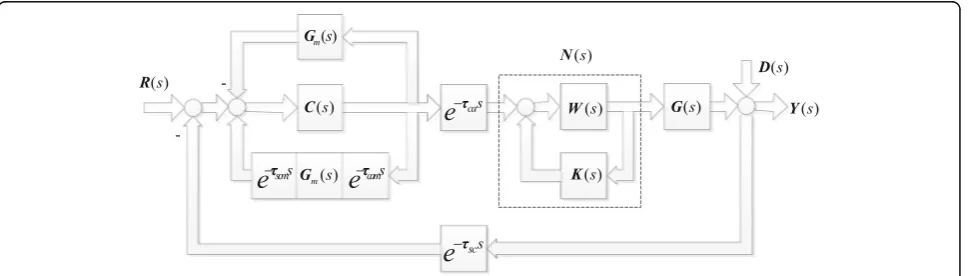
The classic Smith predictor and v-norm decoupling structure of MIMO NCS are depicted in Fig. 3. G(s) andC(s) denote the plant transfer function matrix and the centralized controller, respectively. N(s) is the decoupler that is decoupling the plant to single loops. The v-norm decoupling matrix is composed of the for-ward matrix W(s) and the feedback matrix K(s). Gm(s) denotes the transfer function matrix of generalized plant prediction model after decoupling. R(s) refers to reference input vector, andD(s) refers to input interfer-ence vector.Y(s) stands for the output vector. e−τscsand e−τcas are network delays; e−τscms and e−τcams are network delay prediction models.
Fig. 2The simplified structure of MIMO NCS
In Fig. 3, open loop decoupling control is first
SinceW(s) represents a diagonal matrix and the diag-onal elements of K(s) are all zero, they can be obtained as follows:
Wð Þ ¼s Niið Þ ¼s Gii−1ð Þs Gkð Þs ði¼1;2…nÞ ð5Þ
Kð Þ ¼s Nijð Þ ¼s −Gk−1ð Þs Gijð Þs ð6Þ
W(s) is chosen as the unit matrix to simplify the de-coupling process. Then,Nii(s) =Gii−1(s)Gk(s) =I, soGk(s) =Gii(s). But, in order to make the decoupling compensa-tion off-diagonal element K(s) available, let Gk(s) =Gii −(s) whereGii−(s) is the minimum phase part of the diag-onal elements of the plant. In addition, the off-diagdiag-onal elements of this decoupled matrix are Nij(s) = −Gii −−1(s)Gij(s) .
4.2 Classic Smith predictor for MIMO NCS
After decoupling control, the generalized plantGk(s) is a diagonal matrix. In Fig. 3, we first calculate the inner loop on the controller side.
Cð Þ ¼ ½s IþCð Þs
ðGmð Þs −e−τscmsGmð Þse−τcams−1Cð Þs ð7Þ
For the outer loop after decoupling, the transfer func-tion matrix of closed loop is shown below.
Yð Þ ¼s ½IþGkð Þs e−τcasCð Þs e−τscs−1
Gkð Þs e−τcasCð Þs Rð Þs
ð8Þ
Substituting (7) into (8), we can get
Yð Þ ¼s IþGkð Þs e−τcasΤ−1ð Þs Cð Þs e−τscs
It can be proved that the characteristic equation of the system is as follows:
IþCð Þs Gkð Þs
j j ¼0 ð11Þ
From Eq. (11), we can see that the characteristic equa-tion of the system no longer contains the network delay, and there is no dead time delay in both C(s) and Gk(s). Therefore, the Smith predictor can overcome the impact of the network delays on MIMO NCS stability. However, accurate predictions of network delays are difficult. And delayτcaoccurs in the process of data transmission from controller to actuator. Advance precise prediction in the controller node is impossible with the delay of subse-quent data transmission. Regardless of the prediction method used, there will be prediction errors between
τcamandτca.
4.3 New Smith predictor method for MIMO NCS
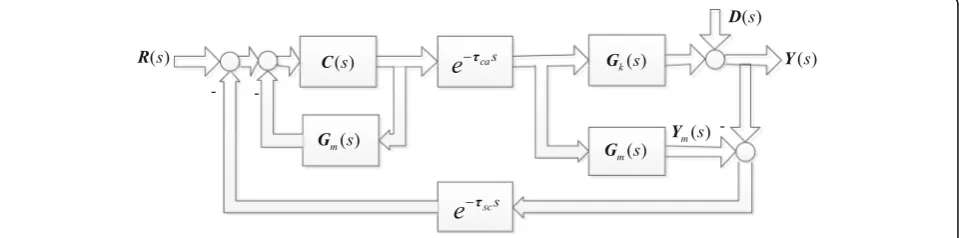
We address the deficiencies in Section 4.2, a new modi-fied dynamic Smith predictor is presented in Fig.4. The key to the modified Smith predictor for MIMO NCS is that the information flows via the network delays which are the real data packet transmission delays. Therefore, we do not need to measure, estimate, or identify the net-work-induced delays online. It realizes the compensation of the delay from the structure and avoids adding buffer to estimate delays and saves network bandwidth resources.
The transfer function matrix in Fig.4of the inner loop consisting ofC(s) andGm(s) is:
Cð Þ ¼s IþCð Þs G mð Þs
½ −1C
s
ð Þ ð12Þ
The transfer function matrix of the inner loop consist-ing ofC(s),e−τcas,Gm(s), ande−τscsis:
Bð Þ ¼s Iþe−τcasCð Þs e−τscsG mð Þs
½ −1
e−τcasCð Þs ð13Þ
Then, the outer loop is:
Yð Þ ¼s ½IþGkð Þs Bð Þs e−τcasCð Þse−τscs−1
The characteristic equation of the system is:
IþCð Þs Gkð Þs
j j ¼0 ð16Þ
Similarly, from Eq. (16), it can be seen that when the new Smith predictor is used, the characteristic equation no longer contains the estimated exponential terms of the network-induced delays. It effectively reduces the stability influence to the system. From Fig. 4 and Eq. (15), com-pared with the new Smith controller and the classic Smith controller, the superiority of this method is that the actual transmission delays of the network data replace the esti-mation models of the network-induced delays, thus elim-inating the need to measure, estimate, and identify the network delays. Therefore, the new Smith method can re-duce the output deviation due to inaccurate estimation models. Furthermore, during the process of the sensor sending data packet to the controller, the network-induced delay τsc is completely eliminated from the closed loop characteristic equation. The controller can be triggered by the sensor signal regular, but we do not have to worry
about the delay and packet loss in this process. When the system bandwidth resources are limited, the system can tolerate a certain amount of packet losses.
5 Improved fuzzy immune PID algorithm
Due to the model errors produced by mismatch or disturb-ance, Smith predictor cannot fully realize compensation. An improved fuzzy immune PID approach is used to strengthen the robustness of the MIMO NCS when there is a prediction error or network bandwidth constraint.
5.1 Immune system mechanism
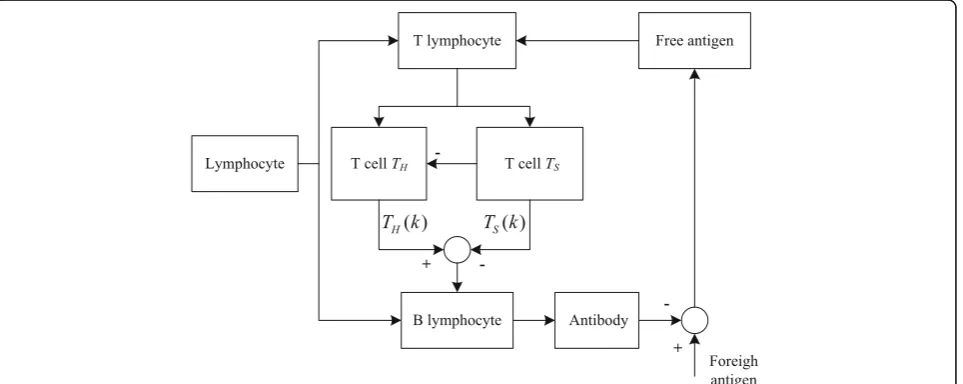
The immune feedback system is an important functional of the human body, and it is responsible for immune defense, immune surveillance, and immune self-stability. The im-mune system produces antibodies that are resistant to for-eign antigens. Lymph is composed of T cells and B cells. T cells are produced by the thymus including THand TS. B
cells are formed in the bone marrow. They are very import-ant for the body immunity. After the import-antigen invades the body, the T cells sense the invading antigen and then stimu-late B cells to excrete antibodies. After a period of immune response, the differentiation of suppressor cells TSis
accel-erated. It secretes inhibitory factors and inhibits the func-tion of TH cells and B cells to exert negative feedback
regulation. When there are more antigens, there are more THcells in the body, but there are fewer TScells, which will
produce more B cells. The number of antibodies is much more. Conversely, the antibody will decrease. After a while, the body tends to balance. A perfect and harmonious im-mune feedback system is that the body has a faster response speed to the invasion of antigen and can be stabi-lized quickly. The simplified immune system mechanism is shown in Fig.5[33].
Inspired by the biological immune feedback mechan-ism, similar immune feedback PID controllers are hot in control engineering field. The coefficients of propor-tional, integral, and differential are usually adjusted in terms of the changes of the control signal output vari-able u. The immune feedback controller will have a fast response time and a small overshoot when the PID pa-rameters and nonlinear functions f(·) are reasonable. And when the system is subject to external disturbance, it has strong robustness. It is assumed that the k-gener-ation antigens are σ(k), the cells produced by TH cells
after stimulation are TH(k), and the cells that suppress
the antibody secretion of TS cells areTS(k). After TH(k)
and TS(k) act on B cells, the antibody produced by all
the stimuli received by B cells isS(k), which has the fol-lowing formulation descriptions. of cell inhibition and excitation changes. If the antigen number σ(k) is regarded as the error e(k), the B cell receiving the stimulus is regarded as the control signal output u(k). We can get the feedback control rules in Eq. (18):
u kð Þ ¼K½ð1−ηf u kð ð Þ;Δu kð ÞÞe kð Þ ¼kPe kð Þ ð18Þ
where K=k1and η¼kk21. In the immune feedback
con-trol systems,Kandηare particularly important parame-ters. Increasing the value of K will promote response speed, while increasing the value of η will reduce the output response overshoot. If the parameters are chosen properly, the system output will have better output
performance. The output of the general fuzzy immune PID method is presented in (19).
u kð Þ ¼u kð −1Þ þkp½kp1ðe kð Þ−e kð −1ÞÞ
KP,KI, andKDare variable proportional gains, integral
gains, and differential gains, respectively [34]. Based on Eq. (20), the parameters of the PID controller simultan-eously enlarge or reduce the same multiple. However, the influence of parameters about proportional, integral, and differential on the system is different. The classic fuzzy immune PID control method is not the optimal to deal with the parameters. In the following, this paper turns the output of the modified fuzzy controller into three nonlinear functions corresponding to the PID parameters in order to realize an independent, online control of MIMO NCS.
5.2 Improved fuzzy immune PID algorithm
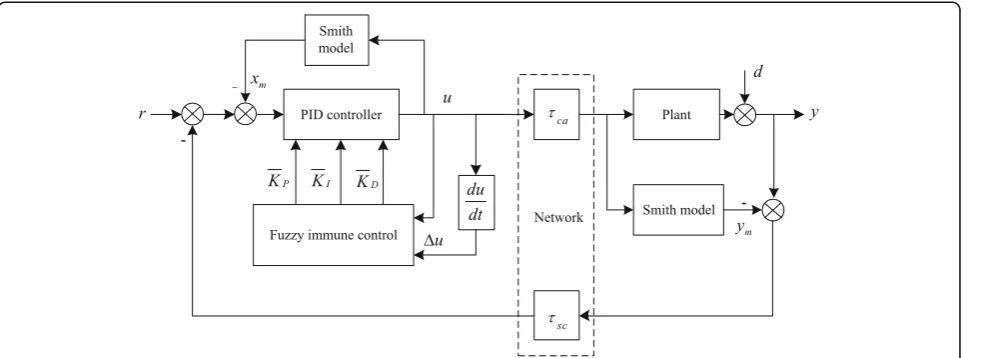
The nonlinear expressionf(u(k),Δu(k)) is difficult to obtain in immune feedback control structure. An improved fuzzy approach is proposed to describe the nonlinear function of PID. The rules are determined by the control variables of the system, which has better flexibility and adaptive per-formance. Fuzzy logic controller has two inputs and three outputs. The two inputs are the output signalu(k) and the change rate of outputΔu(k), respectively. The outputs are three nonlinear functionsfP(·),fI(·), andfD(·) that adjust the
PID parameters separately. The structure of new Smith pre-dictor combined with improved fuzzy immune PID con-troller is displayed in Fig.6.
Equation (21) gives the improved fuzzy immune PID
As described in Eq. (22), the modified fuzzy immune PID control parameters KP,KI, and KD are adaptively adjusted by different nonlinear functions. KP is mainly regulated by fP(·). KI is mainly regulated by fI(·). KD is mainly regulated byfD(·).fP(·),fI(·), andfD(·) are the
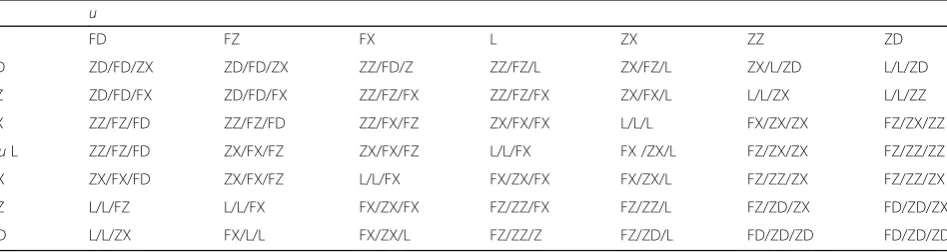
func-tions that control the signal u(k) and its rate of change Δu(k). The inputs and outputs use a set of Z member-ship function, triangle membermember-ship function, and S membership function. {FD,FZ,FX,L,ZX,ZZ,ZD} repre-sents the seven fuzzy set states of the input and output. The fuzzy logic uses “and,” and the defuzzification method is“centroid.” According to the dynamic balance rule of the immune feedback control system, the fuzzy control rules of nonlinear functions fP(·), fI(·), and fD(·)
can be obtained as Table1.
Combining the membership function and fuzzy theory in Table 1, the nonlinear functions fP(·), fI(·), and fD(·)
can be tuned online. Refer to the change of the output form of any loop of the MIMO NCS to optimize the output performance of the system.
6 Illustrative examples
In this section, simulation experiments are performed for a coupled NCS. Double-input double-output NCS model is built in MATLAB/TRUETIME, the sampling periodT= 0.010s. The network protocol selects Ethernet with stochastic, time-varying, and uncertain delays. The initial network bandwidth is set to 880 kb/s, no packet loss, the minimum frame length is 40 bit, and the inter-ference node is occupied 58% of the network bandwidth.
The output performance of the double-input double-output NCS can be analyzed in terms of plant matches, parameter perturbation, or network environ-ment changes. The reference signals are step signals. Their amplitudes are 10 triggered at t= 0.500s and 8 triggered att= 5.000s.
6.1 Simulation of model matches the generalized plant 6.1.1 Example design
The transfer function matrix of input double-output control plant is given by the following:
Gð Þ ¼s
We address the deficiencies in Section4.1, the decoup-ling segment W(s) is the unit matrix, and the deter-mined decoupler is as follows:
Kð Þ ¼s
The Smith model of initial generalized plant matrix
GmðsÞ ¼
. The domains of the control
single are {−3, 3} in both loops; the domains of devi-ation change ratio are {−2.25, 2.25}. The domains of the output functionsfP(·),fI(·),fD(·) are {−0.225, 0.225},
{−0.045, 0.045}, and {−2.25, 2.25} respectively. The ini-tial parameter of PID coefficient of loop 1 is Ka1= 0.003; Ka2= 0.040; Ka3= 0.100,ηa1= 0.010; ηa2= 0.010;
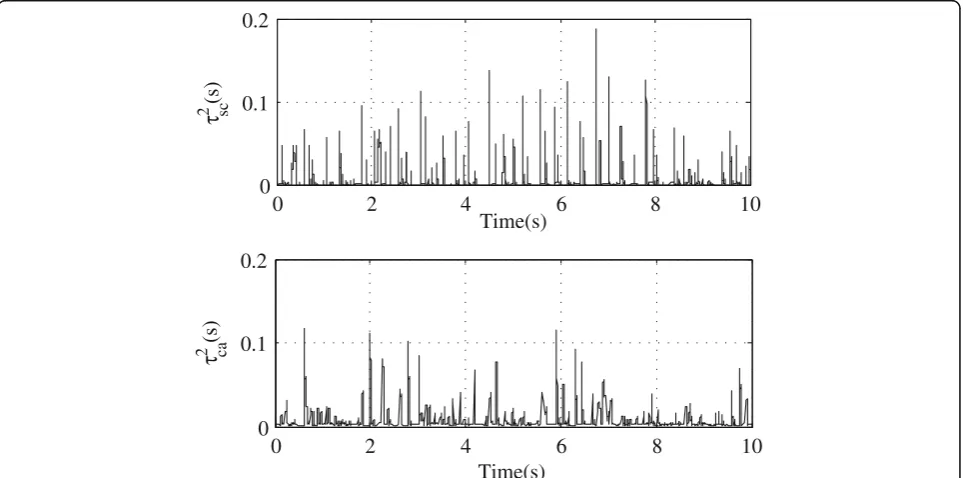
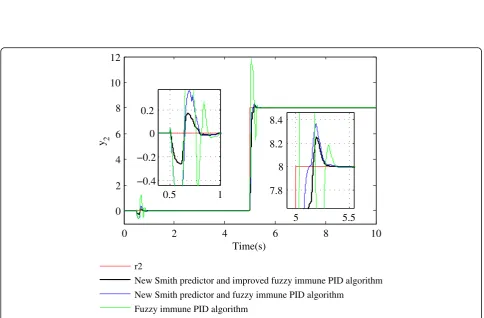
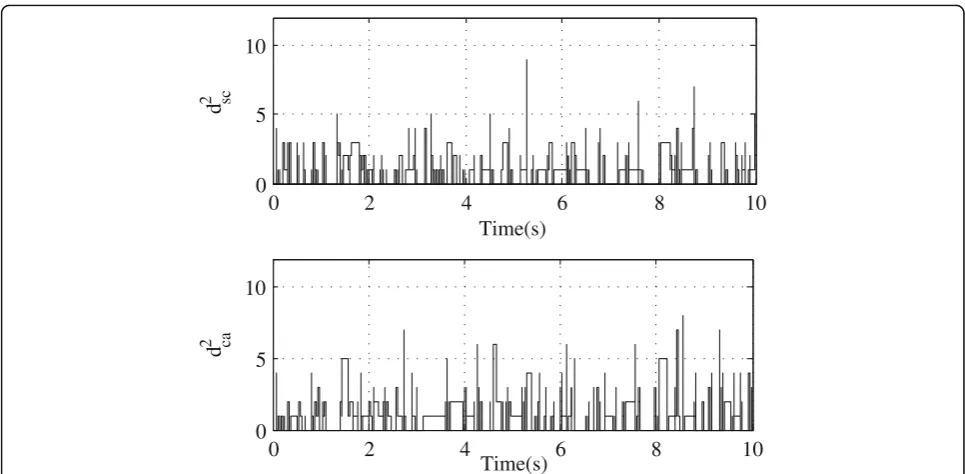
ηa3= 0.600. The initial defined value of PID coefficient of loop 2 isKb1= 0.004; Kb2= 0.090; Kb3= 0.100, ηb1= 0.010; ηb2= 0.010; ηb3= 0.600. The network delay dis-tributions between the nodes are presented in Figs. 7 and 8. The output responses are shown in Figs. 9 and 10, in which the figures contain partial enlarged de-tails for ease of comparison.
Table 1Fuzzy rules of the three nonlinear functionsfP(·),fI(·), andfD(·)
u
FD FZ FX L ZX ZZ ZD
FD ZD/FD/ZX ZD/FD/ZX ZZ/FD/Z ZZ/FZ/L ZX/FZ/L ZX/L/ZD L/L/ZD
FZ ZD/FD/FX ZD/FD/FX ZZ/FZ/FX ZZ/FZ/FX ZX/FX/L L/L/ZX L/L/ZZ
FX ZZ/FZ/FD ZZ/FZ/FD ZZ/FX/FZ ZX/FX/FX L/L/L FX/ZX/ZX FZ/ZX/ZZ
ΔuL ZZ/FZ/FD ZX/FX/FZ ZX/FX/FZ L/L/FX FX /ZX/L FZ/ZX/ZX FZ/ZZ/ZZ
ZX ZX/FX/FD ZX/FX/FZ L/L/FX FX/ZX/FX FX/ZX/L FZ/ZZ/ZX FZ/ZZ/ZX
ZZ L/L/FZ L/L/FX FX/ZX/FX FZ/ZZ/FX FZ/ZZ/L FZ/ZD/ZX FD/ZD/ZX
6.1.2 Results and discussion
From Figs.7and8, we can see that the network-induced delays are random, uncertain, and changing over time. When the sampling period T= 0.010s, in the first loop, the maximum of SC delays reaches 0.176 s and exceeds 17 sampling periods; the maximum value of CA delays reaches 0.115 s and exceeds 11 sampling periods. Simi-larly, in the second loop, the maximum of SC delays is 0.187 s, which reaches 18 sampling periods; the CA
delays are more than 11 sampling periods. From the out-put responses in Figs. 9 and 10, it can be noticed that under large network delay circumstances, both the pro-posed algorithm and the new Smith fuzzy with conven-tion immune PID method can quickly track the set-point step response and maintain the system stable in two loops. On the contrary, the output without new Smith compensation is unstable and has a large over-shoot whether in loop 1 (the green curve in y1) or loop
Fig. 7The SC and CA delay distributions of loop 1 when the model matches the generalized plant
Fig. 9The step responses of loop 1 when the model matches the generalized plant
2 (the green curve iny2). It indicates that the proposed new Smith and improved fuzzy immune PID algorithm has superior output performance compared with the other two algorithms.
6.2 Robust simulation of parameter perturbation and communication network changes
6.2.1 Example design
To illustrate the robustness of the new modified Smith pre-dictor and improved fuzzy immune PID approach, network
bandwidth is reduced to 700 kb/s. The network packet loss rate is set to 0.35, and the plant becomes as follows:
Gð Þ ¼s
1:02 0:03sþ1e
−0:02s −1:27
0:027sþ1e
−0:02s
0:27 0:0127sþ1e
−0:02s 1:02
0:04sþ1e
−0:02s
2 6 4
3 7 5
ð25Þ
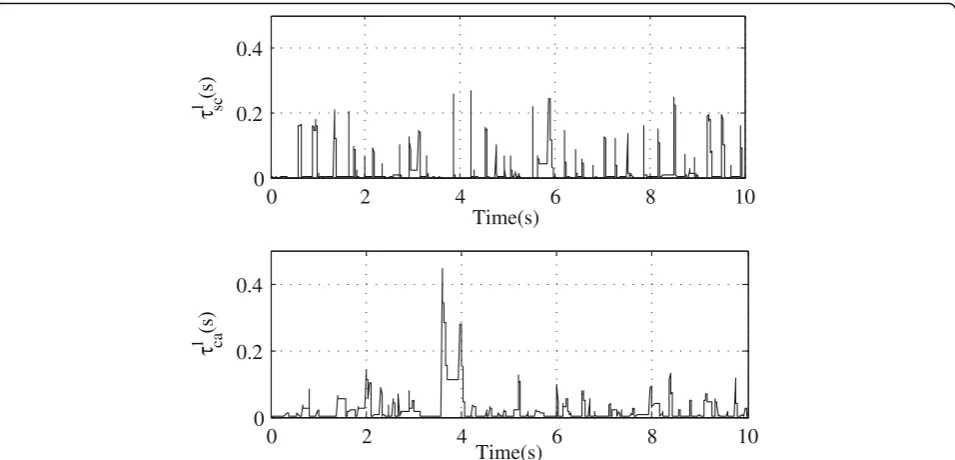
The network delay distributions between the nodes are shown in Figs.11and12. The packet dropout distributions
Fig. 11The SC and CA delay distributions of loop 1 when parameter perturbation and communication network change
between the nodes are indicated in Figs. 13 and 14. The output response curves are denoted in Figs. 15 and 16, where partial enlargements are included to facilitate com-parison results.
6.2.2 Results and discussion
From Figs. 11 and 12, we can notice that after the work bandwidth is reduced, the nodes compete for net-work resources. Congestion causes some packets in the
network channel to fail to reach the destination node in time. As a result, the data packet dropouts occur and the network delays also increase. In the first loop, the maximum of SC delays is up to 0.265 s, which are more than 26 sampling periods; the maximum of CA delays is up to 0.444 s, which exceeds 44 sampling periods. In the second loop, the maximum of SC delays rises to 0.294 s, which exceeds 29 sampling periods. The maximum of CA delays rises to 0.451 s, which exceeds 45 sampling
Fig. 13The SC and CA packet dropout distributions of loop 1 when parameter perturbation and communication network change
Fig. 15The step responses of loop 1 when parameter perturbation and communication network change
periods. Figures13and14show that there are data packet losses in the network channels. The distributions of packet losses are changing at any time. In the first loop, the max-imum values of SC and CA packet dropouts are 7 and 11 respectively. In the second loop, the maximum values of SC and CA packet dropouts are 9 and 8 respectively.
When there are large network delays and data packet dropouts, as can be noticed from Figs. 15 and 16, the new Smith predictor and improved fuzzy immune PID show better set-point responses with small overshoot and are much smoother. Compared with the other two algorithms, this proposed algorithm has strong robust-ness and anti-interference ability.
7 Conclusions
Focusing on the structure of MIMO NCS, a new Smith predictive fuzzy immune PID algorithm is applied to implement compensation for network-induced delays. It combines the advantages of Smith compensation method and artificial fuzzy immune algorithm. Under the assumption of perfect control, the network delay expo-nential term is eliminated. The proposed algorithm does not need to measure, estimate, and identify delays and is suitable for MIMO NCS where the network-induced delays are large and time-varying. The illustrative exam-ples indicate that the output responses of the proposed algorithm can meet the system control performance re-quirements in terms of rise time, overshoot, etc. When uncertainties such as plant parameter perturbation and network packet dropouts occur, the new Smith predictive fuzzy immune PID controller can also more quickly re-cover the system to a stable state with superior robustness and anti-interference capability.
Abbreviations
CA:Controller to actuator; DMC: Dynamic matrix control; LQG: Linear quadratic Gaussian; MIMO NCS: Multi-input multi-output networked control systems; NCS: Networked control system; PD: Proportion differentiation; PID: Proportion integration differentiation; SC: Sensor to controller; SISO: Single-input single-output
Acknowledgements
This work is partially supported by the State Key Laboratory of Marine Resource Utilization in South China Sea of Hainan University.
Funding
This paper is particularly supported by the National Natural Science Foundation of China (Grant No. 61263001), Natural Science Foundation of Hainan Province (No. 20166209), and International S& T Cooperation Projects of China (No. 2015DFR10510).
Authors’contributions
FD conceived and designed new Smith predictor; YT and FD performed the fuzzy immune PID algorithm and experiments; YT wrote the manuscript; YC analyzed the data; and YZ checked the language errors. All authors read and approved the final manuscript.
Competing interests
The authors declare that they have no competing interests.
Publisher’s Note
Springer Nature remains neutral with regard to jurisdictional claims in published maps and institutional affiliations.
Received: 10 July 2018 Accepted: 20 August 2018
References
1. Y. Kang, Y.B. Zhao, Dynamic data packing towards the optimization of QoC and QoS in networked control systems. SCIENCE CHINA Technol. Sci.59(1), 72–80 (2016)
2. Z.D. Tian, S.J. Li, Y.H. Wang, et al., Networked control system time-delay compensation based on time-delay prediction and improved implicit GPC. Algorithms.8(1), 3–18 (2015)
3. S.F. Cai, V.K.N. Lau, MIMO precoding for networked control systems with energy harvesting sensors. IEEE Trans. Signal Process.64(17), 4469–4478 (2016) 4. X.H. Ge, F.W. Yang, Q.L. Han, Distributed networked control systems: a brief
overview. Inf. Sci.380, 117–131 (2017)
5. C.H. Chen, C.L. Lin, T.S. Hwang, Stability of networked control systems with time-varying delays. Commun. Lett. IEEE.11(3), 270–272 (2007)
6. C.L. Lai, P.L. Hsu, Design the remote control system with the time-delay estimator and the adaptive Smith predictor. IEEE Trans. Ind. Inform.6(1), 73–80 (2010)
7. S. Bonala, B. Subudhi, S. Ghosh, On delay robustness improvement using digital Smith predictor for networked control systems. Eur. J. Control.34, 59–65 (2017)
8. Z.L. HT Zhang, Simulation of networked control system based on Smith compensator and single neuron incomplete differential forward PID. J. Netw.6(12), 1675–1681 (2011)
9. H.T. Zhang, M.M. Du, W.S. Bu, Research of networked control system based on improved Smith predictor and Kalman filter. ICIC Expr. Lett.7(10), 2765–2771 (2013)
10. L.L. Huang, J. Chen, PD control of networked control system based on Smith compensation and neural network. Syst. Eng. Electron.34(9), 1884–1888 (2012)
11. W.C. Du F Du,Compensation of Networked Control System Based on New Smith Predictor(Science press, Beijing, China, 2012)
12. H.T. Zhang, J.B. Hu, W.S. Bu, Research on fuzzy immune self-adaptive PID algorithm based on new Smith predictor for networked control system. Math. Probl. Eng.2015(10), 6. (2015). Article ID 343416
13. J. Garrido, F. Vázquez, F. Morilla, et al., Smith predictor with inverted decoupling for square multivariable time delay systems. Int. J. Syst. Sci.
47(2), 374–388 (2016)
14. S.A.C. Giraldo, R.C.C. Flesch, J.E. Normey-Rico, Multivariable greenhouse control using the filtered Smith predictor. J. Control Automation Electrical Syst.27(4), 349–358 (2016)
15. G. Yuan, X.X. Zhang, Q.G. Chen, et al., Initialization of the HMM-based delay model in networked control systems. Inf. Sci.364-365, 1–15 (2016) 16. F. Ma, L.Y. Zhao, The stability of MIMO networked control systems and
controller design. Comput. Technol. Automation.34(3), 6–10 (2015) 17. X. Zhao, Z.Z. DF He, Analyze on the stability of multivariable DMC algorithm
in networked control systems. J. Zhejiang Univ. Technol.40(2), 209–212 (2012)
18. G.L. Zhao, C.C. Hua, Discrete-Time MIMO reset controller and its application to networked control systems. IEEE Transactions on Systems, Man, and Cybernetics: Systems. 1-10, 99 (2017)
19. Y.Q. Xia, X.P. Liu, G.P. Liu, et al., Stabilization analysis and implementation for MIMO NCS with time-varying delays. Int. J. Adapt. Control Signal Process.
25(7), 639–652 (2011)
20. J.N. Li, Q.L. Zhang, Y. HB, et al., Real-time guaranteed cost control of MIMO networked control systems with packet disordering. J. Process Control21(6), 967–975 (2011)
21. D. DJ, T.G.J. MR Fei, Modeling and stability analysis of MIMO networked control systems with multi-channel random packet losses. Trans. Inst. Meas. Control.35(1), 66–74 (2013)
22. C. Zhang, H.Y. ZH Xiong, Informative conditions for the data set in an MIMO networked control system with delays, packet dropout and transmission scheduling. Int. J. Syst. Sci.45(7), 1346–1355 (2014)
24. E. Garone, B. Sinopoli, A. Goldsmith, et al., LQG control for MIMO systems over multiple erasure channels with perfect acknowledgment. IEEE Trans. Autom. Control57(2), 450–456 (2012)
25. W. D, X.M. Sun, C. Wen, et al., Redesigned predictive event-triggered controller for networked control system with delays. IEEE Trans. Cybern.
46(10), 2195–2206 (2017)
26. F.W. Yang, Z.D. Wang, Y.S. Hung, et al., H∞control for networked systems with random communication delays. IEEE Trans. Autom. Control51(3), 511–518 (2006)
27. E. Tian, G.D. Yue, T.C. Yang, et al., T-S fuzzy model-based robust stabilization for networked control systems with probabilistic sensor and actuator failure. IEEE Trans. Fuzzy Syst.19(3), 553–561 (2011)
28. X.X. Meng, Y. Zhang, J. Zhang, inMultiple Input/Output Delays Compensation for Networked MIMO Systems. The 25th Chinese Control and Decision Conference (CCDC) (2013), pp. 2545–2550
29. D.J. Du, B. Qi, M.R. Fei, Distributed H2/H∞filtering for hybrid wired-wireless networked systems with network-induced delays and packet losses constraints. Acta Automatic Sinica.42(2), 213–225 (2016)
30. C.Y. Chen, W.H. Gui, Z.H. Guan, et al., Optimal tracking performance of networked control systems under multi-constraints. Control Theory Appl.
34(9), 1195–1200 (2017)
31. M.S. Mahmoud, N.B. Almutairi, Feedback fuzzy control for quantized networked systems with random delays. Appl. Math. Comput.290, 80–97 (2016)
32. L. Sun, Z. Wan, G. Zhang, inLQG Control Design for a Class of MIMO Networked Control System. Proceedings of the 29th Chinese Control Conference (2010), pp. 3822–3826
33. X.H. Liu, X.H. Chen, X.H. Zheng, et al, Development of a GA-fuzzy-immune PID controller with incomplete derivation for robot dexterous hand. Sci. World J.2014(3), 10 (2014) Article ID 564137
![Fig. 2, D(s) = [D1(s) D2(s) ⋯Dn(s)] is the vector of load−τs](https://thumb-us.123doks.com/thumbv2/123dok_us/918042.1111157/3.595.58.540.494.712/fig-d-d-d-dn-vector-load-ts.webp)