R E S E A R C H
Open Access
TIHOO: An Enhanced Hybrid Routing
Protocol in Vehicular Ad-hoc Networks
Shirin Rahnamaei Yahiabadi
1, Behrang Barekatain
1,2*and Kaamran Raahemifar
3,4Abstract
Recently, vehicular ad hoc network (VANET) is greatly considered by many service providers in urban environments. These networks can not only improve road safety and prevent accidents, but also provide a means of
entertainment for passengers. However, according to recent studies, efficient routing has still remained as a big open issue in VANETs. In other words, broadcast storm can considerably degrade the routing performance. To address this problem, this research proposes TIHOO, an enhanced intelligent hybrid routing protocol based on improved fuzzy and cuckoo approaches to find the most stable path between a source and a destination node. In TIHOO, the route discovery phase is limited intelligently using the fuzzy logic system and, by limiting the route request messages, the imposed extra overhead can be efficiently controlled. Moreover, in figure of an intelligent hybrid approach, the improved cuckoo algorithm, which is one of the most effective meta-algorithms especially in the large search space, intelligently selects the most stable and optimal route among known routes by calculating an enhanced fitness function. The simulation results using NS2 tool demonstrate that TIHOO considerably improves network throughput, routing overhead, packet delivery ratio, packet loss ratio, and end-to-end delay compared to similar routing protocols.
Keywords:Hybrid routing protocol, Cuckoo-fuzzy approach, Stable path, Vehicular ad hoc network
1 Introduction
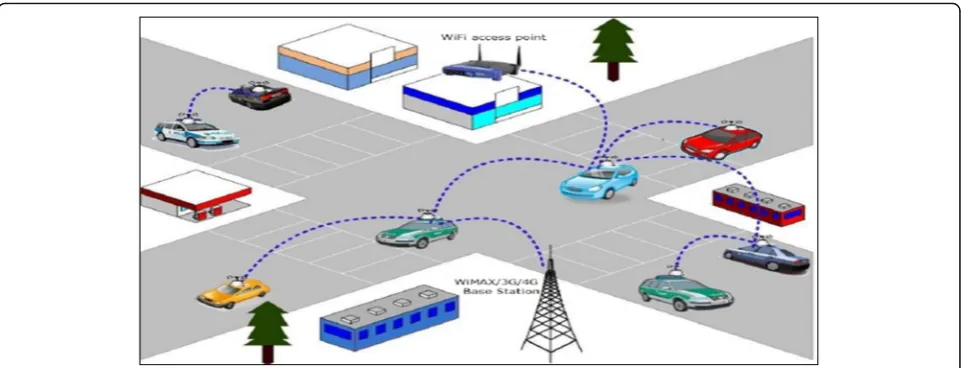
One group of ad hoc networks are mobile ad hoc net-works (MANET)—a collection of wireless mobile nodes which act independent of central management with no or little use of infrastructures. These networks are char-acterized by dynamic topologies, energy limitations, lim-ited bandwidth, etc. A special category of MANETs is the vehicular ad hoc network (VANET) (Fig.1) that has a number of unique characteristics such as predictable mobility, free of constraint energy, rapid changes in the network topology, etc. [1,2]. In contrast to wireless sen-sor networks [3, 4] or MANETs, long-life batteries of vehicles have prevented energy-induced constraints in these networks. In VANETs, communications occur be-tween adjacent vehicles and bebe-tween vehicles and fixed units placed at special locations such as intersections and parking lots. Accordingly, there are two types of
communication in these networks: vehicle-to-vehicle (V2V) and vehicle-to-infrastructure (V2I). In V2V com-munications, vehicles that are in adjacent to each other engage in data sharing via dedicated short-range com-munications (DSRC) and wireless access in vehicular
environment (WAVE) [5] among others while in V2I,
the vehicles are connected to roadside infrastructures to engage in information exchanges [6]. Inter-vehicular net-works improve the traffic efficiency and promote safe driving as well as welfare and comfort of the passengers. However, there are numerous challenges that impact the achievements of vehicular ad hoc networks. These chal-lenges include signal losses, limited bandwidth, security and privacy, connection, and routing. Timely delivery of warning messages at the time of collisions and accidents could prevent more accidents, an objective fulfilled through reliable data packets routing. Designing a rout-ing protocol which could deliver data packets in the shortest possible time and with the lowest number of packet loss is essential to improving the security of vehicles and winning the users’satisfaction. High mobil-ity of vehicles, limitations on wireless sources, and the
© The Author(s). 2019Open AccessThis article is distributed under the terms of the Creative Commons Attribution 4.0 International License (http://creativecommons.org/licenses/by/4.0/), which permits unrestricted use, distribution, and reproduction in any medium, provided you give appropriate credit to the original author(s) and the source, provide a link to the Creative Commons license, and indicate if changes were made.
* Correspondence:[email protected] 1
Faculty of Computer Engineering, Najafabad Branch, Islamic Azad University, Najafabad, Iran
2Big Data Research Center, Najafabad Branch, Islamic Azad University, Najafabad, Iran
characteristic wireless channel losses present a serious challenge to carve a route from the source node to the destination node through middle ones. An effective route depends on all the wireless links which make up the route [5,7,8].
Routing is faced with serious challenges in these
networks. The movement of vehicles constantly
changes network topology[9]. In addition, network ex-pansion on a large scale significantly increases routing overheads [2, 10, 11]. Another challenge is to prevent
VANET’s routing from being trapped in a local
optimum [12].
Like other networks such as wireless mesh net-works, peer to peer networks use a variety of tech-niques such as network coding for data sharing in order to enhance the routing effectiveness [13–15]. Various methods have been used to improve routing in VANETs. Some routing protocols draw on the top-ology of the middle links [16] (occurring between the source and destination nodes) to find the optimal route while some other use the geographical position of vehicles to design a routing protocol [17]. The lat-ter focuses on the location of connections and predicting the next locations of the vehicles to find the appropriate route [18–20]. Fuzzy logic is very ef-fective as well for the introduction of routing
proto-cols [21, 22]. A number of researches apply bio
methods for appropriate routing. These methods are very effective for large-scale VANETs and at the same time offer low-complex solutions to computation prob-lems [23–25]. However, and as it was mentioned in re-search [26], there is no routing protocol in VANET that can satisfactorily perform in every scenario and com-pletely fulfill all routing protocols objectives. Thus, a hy-brid method could prove very effective. In order to
address the existing problem in previous studies, this paper proposes TIHOO, an enhanced hybrid routing protocol. This protocol intelligently employed fuzzy [27,28] and cuckoo [29] approaches by introducing novel fitness functions in which many important parameters for finding the most stable path between the source and the destination node are considered in them.
In other words, the route discovery phase is limited using the fuzzy logic system and, by limiting the route request messages, it somewhat controls the created extra overhead. After identifying the routes in the source node, the cuckoo search algorithm selects the most stable and optimal route among known routes by calcu-lating the fitness function based on criteria such as route lifetime, route reliability, and average available buffer. Simulation results using NS2 (network simulator 2) simulator provides 55.52, 65.85, 79.27, 31.67, and 78.19% in the most important network parameters including packet delivery ratio, throughput, end-to-end delay, routing overhead, and packet loss ratio, respectively.
The rest of this paper is organized as follows. Section 2 is a review of the previous research in this area. In section 3, we provide a brief review over some basic is-sues. Section 4 explains the method and experimental approach. Section 5 summarizes existing open issues in the related works. Section 6 discusses the proposed routing protocol (TIHOO) in detail and how it addresses the open issues mentioned in Section 5. Per-formance evaluation parameters and simulation results are discussed in Section 7. Finally, the paper is con-cluded in Section 8.
2 Related work
the routing needs in these networks due to the dynamic na-ture of VANETs, which is a result of traffic conditions and limitations. This section provides a review of the most im-portant attempts in developing a routing algorithm for VANETs. Adaptive fuzzy multiple attribute decision routing in VANETs (AFMADR) [17] is a location-based protocol in which data packet carriers are employed for selection of the next step. In this protocol, every candid vehicle is specified through distance, direction, road density, and location where each characteristic receives a fuzzy point. The vehicle receiv-ing the highest points is selected for the transference of data packets. This protocol has a desirable profile in the rate of delivery of data packets, transfer delays. However, a more ac-curate selection of carriers could significantly improve the delivery rate of data packets in this protocol. For example, using city buses which are different locations based on a schedule is a way of selecting suitable carriers. In contrast to AFMADR, TIHOO draws on fuzzy logic for selection of ap-propriate route request (RREQ) reception links. Stable routes are determined through designing effective fitness functions based on the life of the links, etc. Choosing a stable route improves packet delivery rates and packets lost. Moridi and Barati [22] have proposed a multi-level routing protocol which is based on trust in forbidden search in MA-NET. In the first step, in order to improve the Ad hoc On-demand Distance Vector routing (AODV) routing protocol, fuzzy logic has been used among cluster members. At this level, the reliability and sustainability of a link are used as the input criterion of the fuzzy system; the ultimate goal is to choose the most reliable link. Afterwards, the best links of cluster heads are presented in a tabular list. The best links are selected based on distance, speed, and direction. This protocol is credited for decreased failures of links and lower losses of packets. However, the overhead has not been con-sidered in this protocol for the purpose of comparison with other protocols. Dharani Kumari and Shylaja [11] have pro-posed a multi-step geographical routing protocol for V2V communications which has improved Greedy Perimeter Stateless Routing (GPRS) protocol. AHP-based Multimetric Geographical Routing Protocol (AMGRP) improves the data transference mechanism of the geographical routing proto-col via four routing criteria of mobility, link life, node dens-ity, and node position. Routing criteria are hierarchically organized to be compared in the form of a general unit once similar parameters have been grouped and the sub-criteria of each group are tested and compared with each other. This protocol identifies the next step via computing the function unit weight in a predefined range which could guarantee the improved transfer process. Although AMGRP routing protocol has had some success in improving the rate of data packet delivery compared to other protocols, it has failed in controlling the overhead. F-ANT [2] has designed an improved, fuzzy logic-based framework for ant colony optimization (ACO) protocol. Devised for VANETs, ACO
draws on factors such as bandwidth, the power of received signals, and congestion criterion for recognizing the link credibility. Despite its high rate of packet delivery and low end-to-end delays, this protocol is challenged by high over-head due to employing ant colony algorithm along with fuzzy logic while the proposed metaheuristic algorithm pro-duces considerably lower overheads compared to ant colony algorithm. By combining the advantages of proactive and re-active routing, a reliable routing protocol (R2P) for VANETs was developed by [30]. R2P uses a route discovery mechan-ism to detect available routes to the destination. It then se-lects the safest route, which may not be necessarily the shortest one. This routing method is more efficient than previous methods and shortens the delays. However, it is not superior to other methods in term of overhead while its packet delivery is low in some of its default simulation speeds. PFQ-AODV which has been presented in [21] learns the optimal route using Q-learning algorithms and fuzzy constraints on AODV protocol. This protocol employs fuzzy logic and considers a number of criteria such as available bandwidth, the quality of the link, and the direction of the vehicle to assess the wireless link. It then learns the best route through Hello and RREQ messages. The flexible and practical routing that this protocol offers is due to its inpendence from lower layers. However, it does not have a de-sirable performance in term of overhead. The intelligent proposed protocol (TIHOO) in this article limits the route discovery through fuzzy logic and decreases the available control packets of the network to keep the overhead in check.
In the method introduced by [31], there is an area-based routing protocol that utilizes fuzzy logic and bac-terial foraging optimization algorithm (BFOA) to detect
unsafe situation associated with rapid topological
changes and the best possible route to the destination node. This protocol applies these three techniques to en-hance the sustainability of the selected route. First, the areas are created based on the mobility of vehicles and the characteristic of dispersion while nodes are assigned into different areas. Once a node generates the Hello message from the data transfer phase, it attempts to find the route between the source and the destination points. The fuzzy logic is implemented in the next stage to de-termine the status of the links based on the quality of the link as well as bandwidth and mobility. BFOA has been applied for finding the best route based on the re-sults of implementing fuzzy logic and the credit of the link. Although this method produces lower delays and faster delivery rates, the computations drastically in-crease in complexity as a result of inin-creases in popula-tion. This is in contrast to the low computation complexity offered by our metaheuristic method [31].
packets [33]. AODV comprises three phases of discovery, data transfer, and route maintenance. What primarily distinguishes AODV from other protocols is its use of sequence number. When there is a need for information transfer in this protocol, the source node broadcast RREQ control packet to all neighboring nodes. These nodes keep performing this process until the destination node is confirmed as the receiver node. In the next stage, the destination node unicasts the route reply (RREP) packet to the source node. Data transfer begins once the route has been established. If links are broken in this stage, the maintenance phase will be recalled to help find a new route. AODV suits the networks charac-terized with high mobility. However, this protocol con-sumes large amounts of bandwidth due to periodical baking. In [34], this method that attempts to improve the GPRS routing performance controls the network congestion via buffering the nodes and as a result dis-plays higher efficiency in terms of time delays and packet losses. Two factors of the distance between the transfer node and the destination node and the length of the buffers left from the transfer nodes are considered in the proposed method to calculate the possibility of transference by a given node. Those nodes which are assigned higher possibility will be selected as the trans-ference nodes. However, this protocol is a failure in re-solving the issue of local optimum and provision of recovery strategy [34]. In [35], the fuzzy control-based AODV routing (FCAR) protocol that takes place on the traditional platform of AODV employs both fuzzy logic and fuzzy control to decide the route. The length of the routes and the percent of vehicles taking the same direc-tion are the two criteria of route assessments. Regarding packet losses and end-to-end delays, the proposed protocol outperforms AODV. However, it produces in-creased extra overheads compared to AODV if there are few network nodes. In contrast, TIHOO has managed to control the overhead in a relatively satisfactory way via using fuzzy logic for selection of links receiving RREQ and limiting the phase of route discovery.
Using the transfer quality criteria, which is a combin-ation of connections and the rate of data delivery packets, the functionality of each route part is evaluated to be able to select each route part dynamically so that it contains the best path [36]. This method improves the data packet transfer and delivery rates; however, it will go through local maximization and the strategy to deal with it will lead to end-to-end delay as it uses greedy forwarding.
In [37], it is an algorithm predicting the variability of the receiver queue length, the intermediary signal rate, and the noise. The results of this prediction determine the usefulness of the relay vehicles in the candidate set. The results of the utility of the vehicles are based on the
weighting algorithm and weights are the variance of these two criteria. The relay priority of each relay device is determined by its usefulness. This algorithm did not consider the effects of parameters such as packet length and transfer steps in the results obtained.
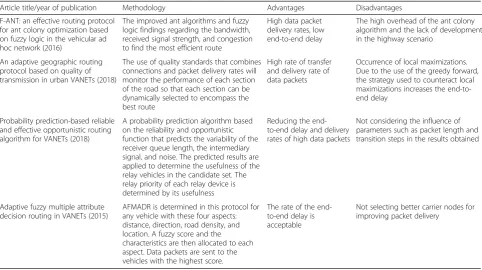
In [38], there is a unique protocol based on attractive se-lection, which is an opportunistic protocol and can adapt routing feedback packets to the dynamics and complexity of the environment. A multi-attribute decision-making strategy is applied to reduce the number of candidates to be chosen at the next step to improve the effectiveness of the attractive selection mechanism. When a route is de-tected, URAS either keeps the current path or finds an-other better route based on the current pathway efficiency; this self-evaluation is continued until finding the best route. Some of the latest research studies are summarized in Table1.
3 Preliminary
In this section, we provide a brief review over some basic issues such as the fuzzy logic system and cuckoo search algorithm.
3.1 The fuzzy logic system
The fuzzy logic variables have a true value that ranges from 0 (false) to 1 (true).
Fuzzy logic control is comprised of four main phases of fuzzifying, a base of rules, inferences, and defuzzify-ing. Linguistic variables and pre-defined membership functions that are used to indicate the digital value of the linguistic variables are converted into fuzzy values. The second phase presents a number of a limited set of rules which are applied in the decision-making process and are intended to guide the final fuzzy value.
In the third inference phase, fuzzy decisions are generated through the rules available in the rule base. The rules of this database are a set of if-then rules which relate fuzzy input variables to the output vari-ables. In the last phase, the membership output func-tions are defined in advance and non-fuzzifying methods are converted into digital values. This is a very useful method for sophisticated processes where there is no chance of defining simple mathematical methods as well as non-linear models. Since fuzzy logic can control inaccurate and variable information, it is used in solving the routing-associated problems without applying the mathematical models. Fuzzy logic could process approximate data through linguis-tic, non-digital variables to express the facts [8].
3.2 Cuckoo search algorithm
for many optimization algorithms. To raise its babies, the bird lays its eggs in the nest of other birds. Cuckoos push out one of the eggs of the host bird and lay eggs that better imitate the host eggs. The eggs with the high-est resemblance to the host have much more chances of being hatched into mature cuckoos while the eggs dis-covered by the host are destroyed [39]. In CS, every egg in the host’s nest indicates a solution to the effectiveness of which is computed through some parameters of the adaptation function. If the new solution is found to be superior to the old one, a replacement takes place [29].
Yang and Deb described the CS in three ideal rules [29]:
1. Each cuckoo lays one egg at a time and dumps its egg in a randomly chosen nest;
2. The best nests with high-quality eggs will be carried over to the next generation;
3. The number of available host nests is fixed, and the egg laid by a cuckoo is discovered by the host bird with a probability of [0..1].
4 Methods
Recent studies have tried to address the routing issue in VANETs by introducing enhanced methods. However, they have not carefully considered the problem of a large number of required exchanged messages in the routing process. Moreover, like other wireless networks, VANETs suffer from unwanted broadcast storm both in routing and data dissemination. In order to efficiently address
these challenges, in the first phase of TIHOO, contrary to previous methods where fuzzy logic was applied as a tool to find the best path, in this method, fuzzy logic is intelligently used to limit the route discovery phase. By limiting the RREQ control packet, the additional over-head created in the network is reduced and the network traffic is prevented from creating a storm.
On the other hand, by reducing the number of wan-dering packets in the network, the bandwidth usage of the network is also decreased. This not only consider-ably reduces the routing overhead, but also decreases the number of discovered routes. This can help the source to select the best path in less time. It is important to note that fuzzy logic is used in a way so that only the paths are removed where link failures are very likely to occur.
Another required step is to find the most stable path among the introduced paths by the first phase. An effi-cient new fitness function is also introduced and used in this phase. The cuckoo search (CS) algorithm selects the most stable route via intelligent configuration of the fit-ness function based on parameters such as the link life-time and the reliability of the route and its available buffer in the second phase.
Adjusting the link’s lifetime and reliability in the com-patibility function will lead to the selection of more stable paths, resulting in fewer failures in paths and higher deliv-ery rates for data packets. Selecting the buffer parameter available in the compatibility function causes the selection
Table 1Latest research studies
Article title/year of publication Methodology Advantages Disadvantages
F-ANT: an effective routing protocol for ant colony optimization based on fuzzy logic in the vehicular ad hoc network (2016)
The improved ant algorithms and fuzzy logic findings regarding the bandwidth, received signal strength, and congestion to find the most efficient route
High data packet delivery rates, low end-to-end delay
The high overhead of the ant colony algorithm and the lack of development in the highway scenario
An adaptive geographic routing protocol based on quality of transmission in urban VANETs (2018)
The use of quality standards that combines connections and packet delivery rates will monitor the performance of each section of the road so that each section can be dynamically selected to encompass the best route
High rate of transfer and delivery rate of data packets
Occurrence of local maximizations. Due to the use of the greedy forward, the strategy used to counteract local maximizations increases the end-to-end delay
Probability prediction-based reliable and effective opportunistic routing algorithm for VANETs (2018)
A probability prediction algorithm based on the reliability and opportunistic function that predicts the variability of the receiver queue length, the intermediary signal, and noise. The predicted results are applied to determine the usefulness of the relay vehicles in the candidate set. The relay priority of each relay device is determined by its usefulness
Reducing the end-to-end delay and delivery rates of high data packets
Not considering the influence of parameters such as packet length and transition steps in the results obtained
Adaptive fuzzy multiple attribute decision routing in VANETs (2015)
AFMADR is determined in this protocol for any vehicle with these four aspects: distance, direction, road density, and location. A fuzzy score and the characteristics are then allocated to each aspect. Data packets are sent to the vehicles with the highest score.
The rate of the end-to-end delay is acceptable
of paths with less traffic load. It is therefore effective in re-ducing the end-to-end delay.
This algorithm, as one of the most effective metaheur-istic algorithms, selects the most stable path with higher execution speed and convergence rate compared to other metaheuristic algorithms. The combination of these two phases introduces an enhanced routing proto-col named TIHOO for efficient routing in vehicular ad hoc networks.
Finally, TIHOO is evaluated in the NS2 simulation tool under various conditions and compared with similar works. The obtained results indicate that TIHOO pro-vides significant improvement in routing in VANETs and makes this process more effectively and efficiently especially in high network traffic.
5 Problem statement
VANETs are dynamic networks; the frequent changes in the environment caused by various factors such as traffic conditions, and changes in the topology of the road, ne-cessitate a sufficiently adaptive routing protocol. Multiple routing protocols have been proposed for this purpose, a number of which was presented in the previous section. Although these protocols make great efforts in fulfilling the routing objectives and improving the routing condi-tions, they are challenged by serious shortcomings.
5.0.0.1 Failures of link The life of the links which are affected by the motion of vehicles is an influential factor in identifying stable routes. Not paying attention to this factor by a number of routing protocols leads to con-secutive failures of the route which in turn result in lower rates of data packet deliveries and increased num-ber of packet losses.
The intelligent configuration of the parameters applied in the fitness function of the CS [29] metaheuristic algo-rithms in TIHOO leads to identification and selection of stable routes with a lower possibility of failure and nat-urally improved data packet delivery rate as well as fewer cases of packet loss.
5.0.0.2 High overhead Another serious shortcoming of some of routing protocols [21, 35] is their inability in controlling the number of control packets and the increased number of the packets over the network. These factors contribute to the development of higher overhead and increased bandwidth consumption which negatively affects the efficiency of the protocols. More-over, using some metaheuristic algorithms to improve the routing protocols and enhance the quality of the provided services [2,31] suffers from a number of issues such as high overhead and overly complex computa-tions. Since fuzzy logic system [27] can control inaccur-ate and variable information, it is used in solving the
routing-associated problems without applying the
mathematical models. Fuzzy logic uses linguistic non-digital variables and, thus, can process approximate data [8, 28].
Although fuzzy-based approach is employed in previ-ous researches for deciding this route, TIHOO attempts to use the fuzzy logic in a new manner in which it intel-ligently selects appropriate links for sending RREQ packets and at the same time limits broadcasting of the route discovery phase and decreases the number of con-trol packets to lower the overhead imposed on the sys-tem. Also, the lower overhead and easier computation demands of the metaheuristic algorithms of this research compared to other metaheuristic algorithms such as ACO and BFOA have made this bio algorithm a desir-able candidate for application in the improved protocol of the proposed one.
6 The proposed TIHOO protocol
TIHOO is an intelligent hybrid routing protocol as we mentioned in the previous section. This protocol is dis-cussed in detail in the following paragraphs.
6.1 General description of TIHOO
TIHOO is an optimized hybrid protocol developed for routing in VANETs. It is implemented based on the AODV routing protocol. In contrast to previous methods, this research uses fuzzy logic to limit the route discovery phase. Selection of effective input parameters contributes to the selection of more stable links to re-ceive route request control packets. In addition, CS algo-rithm selects the most stable route via intelligent configuration of the fitness function based on parame-ters such as the link life and the reliability of the route and its available buffer. CS algorithm is one of the most effective, metaheuristic algorithms with higher execution speed and convergence rate compared to other meta-heuristic algorithms. It also is able to discover the best route in a rational time [40]. TIHOO consists of two main phases.
6.1.1 Phase I: Broadcast limitation phase
VANETs. The first phase of this protocol, which focuses on the fuzzy logic system, sends packet requests to a number of selected neighboring nodes in a targeted way. This part of the neighboring nodes is selected based on having some features. These features are included as inputs of the fuzzy logic system. The neighbors that are the most appropriate receivers of the control packets are determined by the output of this system. By limiting the route requesting receiver nodes, the number of discov-ered routes is reduced and the system’s overhead is par-tially under control. This process is repeated in the nodes receiving the control packet so that the destin-ation node receives all route requesting control packets from different routes.
6.1.2 Phase II: Find the best route
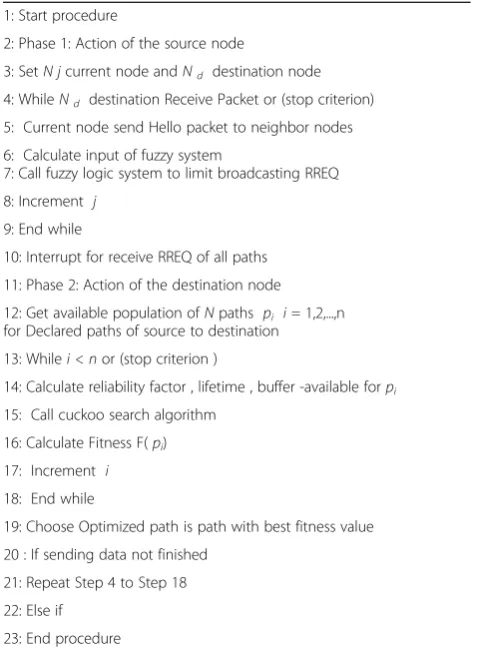
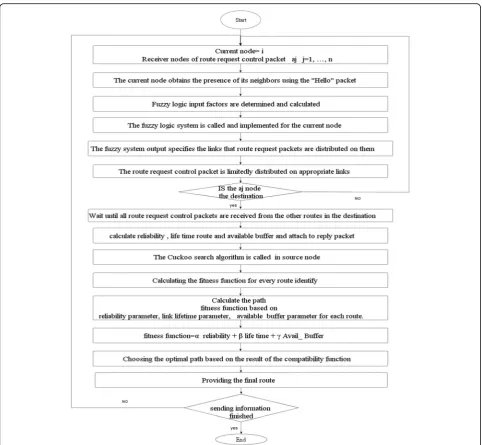
After identifying all routes, the second phase of the pro-posed protocol begins and the cuckoo search algorithm is called in the source node. Levy’s flight in this algo-rithm provides the possibility of random to randomly se-lect the routes. The length of the random steps gets use of Levy’s distribution in large steps. For each of the routes, the calculation of the proposed enhanced fitness function is performed based on a number of factors. These factors, which determine the path stability, are a criterion for measuring path optimality. Ultimately, the cuckoo algorithm selects the most optimal route by comparing the fitness function of various routes and converges toward it. Since this algorithm has a high per-formance and convergence speed, this routing protocol is expected to provide a fairly satisfactory result. Table2 shows the pseudo-code, and Fig. 2 shows the flowchart of the proposed protocol. The steps of the proposed protocol are shown in these figures in detail. In the fol-lowing section, we will deal with the careful review of the proposed protocol.
6.2 Details of TIHOO
This section discusses the proposed protocol in details. We will also examine each section of the flowchart separately.
AODV reactive protocol provides the platform for the implementation of this research. In the first step of Fig. 2, the current node which is considered as ai is the source node in the first run of the algorithm while other surrounding nodes which receive the con-trol packets of route requests are set aj.
In the second step of Fig. 2, the algorithm starts through sending Hello packets from the source node. Sending these packets to the surrounding nodes helps identify the neighboring nodes and learn their positions. Once the source node has identified its surrounding nodes and their positions using GPS (Global Positioning System), the time arrives for sending the packets of
route requests. Unlike the other protocols, in TIHOO, the source node does not send the packets of route requests to all neighboring nodes via broadcasting. In-stead, it sends them only to those neighboring nodes with more effective characteristics such as smaller motion speed difference with the source node (the current node), smaller divergence with the source node (the current node), and a shorter distance. Pla-cing limits on sending the packets of route requests implies limiting the route request phase and decreas-ing the number of control packets, in turn resultdecreas-ing in reduced control overheads. Since not every neigh-bor participates in sending the packets of route re-quests, fewer control packets are sent over the network.
Fuzzy logic is employed in this method for selection of RREQ reception nodes. The inputs of the fuzzy logic system are calculated and determined in the third step of Fig. 2. These inputs consist of the speed difference between the current node and the neigh-boring node, the direction taken by the current node and the neighboring node, and the distance between the destination node and the neighboring node. The
Table 2Pseudo of TIHOO. The pseudo-code of the proposed protocol. The steps of the proposed protocol are shown in this figure in detail
1: Start procedure
2: Phase 1: Action of the source node
3: SetN jcurrent node andNd destination node
4: WhileNd destination Receive Packet or (stop criterion)
5: Current node send Hello packet to neighbor nodes
6: Calculate input of fuzzy system
7: Call fuzzy logic system to limit broadcasting RREQ
8: Increment j
9: End while
10: Interrupt for receive RREQ of all paths
11: Phase 2: Action of the destination node
12: Get available population ofNpaths pi i =1,2,...,n for Declared paths of source to destination
13: Whilei < nor (stop criterion )
14: Calculate reliability factor , lifetime , buffer -available forpi
15: Call cuckoo search algorithm
16: Calculate Fitness F(pi)
17: Increment i
18: End while
19: Choose Optimized path is path with best fitness value
20 : If sending data not finished
21: Repeat Step 4 to Step 18
22: Else if
smaller the speed difference of these nodes, the higher the duration of being in mutual communica-tion range which boosts the possibility of successful exchange of data packets. However, large differences between the nodes in term of their speed quickly push these nodes out of their mutual ranges and con-sequently they have fewer chances of sharing their in-formation. Fast movements of vehicles prevent the development of stable connection in the network. The second input factor is using the fuzzy logic for move-ments of vehicles. The angle of the movement direc-tion of the receiving node and the previous node is calculated and then is set as the second factor of the
fuzzy logic input. α is the angle of two vehicles is cal-culated via Eq 1.
arccosα¼ ffiffiffiffiffiffiffiffiffiffiffiffiffiffiffiffiffiffiffiffiffiffiffiffiffiffiffiffiffiffidx1:dx2þdy1:dy2 dx1þdy1
p
þpffiffiffiffiffiffiffiffiffiffiffiffiffiffiffiffiffiffiffiffiffiffiffiffiffiffiffiffiffiffiffiffidx2þdy2 ð1Þ
In this equation, the movement direction of the ve-hicle 1 is (dy1and dx1) while (dy2and dx2) is assigned to
the movement direction of the vehicle 2. The direction
vector on x- and y-axes is denoted by dx and dy,
respectively.
In general, the movement direction of the vehicles is limited by the road, and according to the conducted re-searches, it has been proved that the route is more con-sistent with a greater number of vehicles with the same direction[35]. Therefore, the movement direction in this research has been used as one of the inputs of fuzzy cri-terion to select routes for sending route request packets that have a higher potential.
The distance is the third factor used to limit the route discovery phase. At this stage, we use the information on the location of the neighboring node obtained by the Hello message and then we calculate the distance be-tween the neighboring node and the destination. It is clear that neighboring nodes that are in a far less dis-tance to the destination node are in a better position and are better candidates for sending RREQ packets. The distance between the neighboring node and the destination is calculated using Eq. (2)—the Euclidean distance equation [22].
D¼ pffiffiffiffiffiffiffiffiffiffiffiffiffiffiffiffiffiffiffiffiffiffiffiffiffiffiffiffiffiffiffiffiffiffiffiffiffiffiffiffiffiffiffiffiffiðx1−x2Þ þ ðy1−y2Þ ð2Þ
In the equation above (x1,y1) indicates the neighboring
node’s location and (x2, y2) represents the spatial
loca-tion of the destinaloca-tion node.
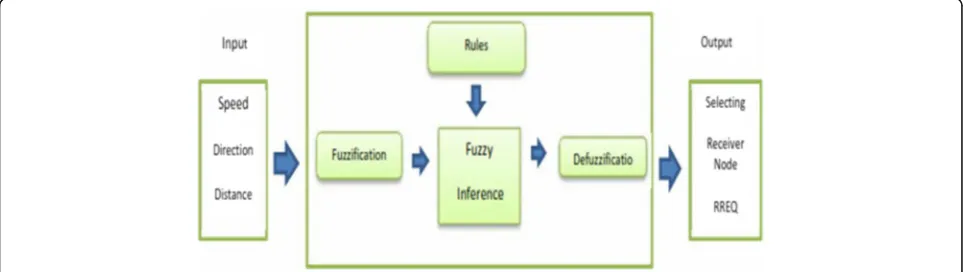
In the fourth step of Fig.2, after determining the input parameters of the fuzzy logic and calculating the dis-tance of the neighboring node to the destination and an-gular displacement, these three criteria are used as the input of this system so that a proper conclusion is pro-vided using the fuzzy logic based on this uncertain and inaccurate information. Figure 3indicates the fuzzy sys-tem used in this paper.
The main processes of fuzzy logic include fuzzification, fuzzy inference, and defuzzification. Fuzzification takes place in this section whereby numerical values are con-verted into fuzzy values via fuzzy member function.
For each of the mentioned criteria, the membership function is defined in the linguistic set. The words large, medium, and low are used to determine the rate of input criteria.
The linguistic set of the member function of the fuzzy
logic input parameters covers three values (low,
medium, and high). The diagram of member functions of the speed difference, direction difference, and distance is presented in Fig.4. Although we could use other com-plex member functions as well, this triangular member function suits the proposed protocol, since it only needs to identify the best links.
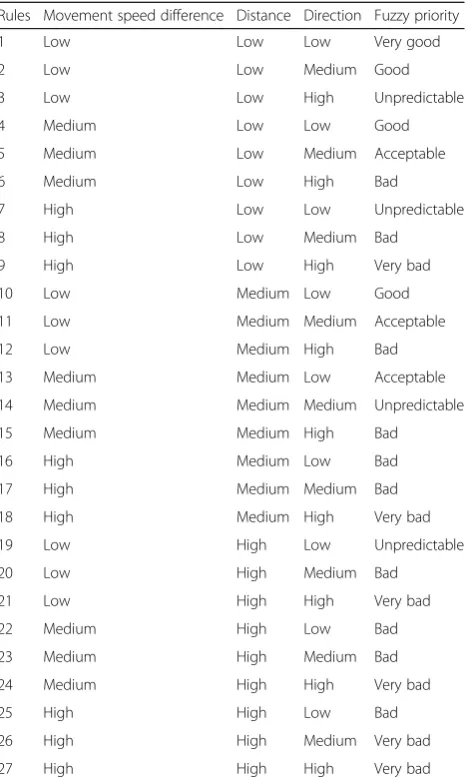
In the fifth step of Fig. 2, once input parameters had been determined, we embarked upon fuzzy inference and developed a set of rules informed by expert know-ledge. Fuzzy-based knowledge has been designed to inte-grate input and output variables which are in turn informed by accurate perceptions of traffic patterns of urban vehicular ad hoc networks. Fuzzy rules are based on the IF-THEN rule [41].
Every fuzzy rule consists of an IF component, a logical
relation, and a THEN component. The “IF” part has
been formed by predictions and logical relation connects the input logic to the result while “THEN” defines the degree of member function and the usefulness. These rules have been presented in Table3. The linguistic vari-ables for determining the desirability of the candidate node for receiving RREQ are very bad, bad, unpredict-able, acceptunpredict-able, good, and very good.
For example, a small speed difference between the current vehicle and the neighboring vehicle indicates a short distance between the neighboring vehicles and the destination vehicle and a small angular divergence be-tween the current vehicle and the neighboring vehicle; we then can say that the neighboring vehicle is a very good candidate for receiving RREQ packets.
Since several rules are implemented simultaneously, we apply the Min-Max methodology to combine the assessment
Fig. 3Fuzzy control system of the proposed protocol. The fuzzy system used in this paper. The main processes of fuzzy logic include
results. In this method [42], the minimum prior value is used as the final degree. When different rules are combined, the maximum results are used.
Defuzzification is the process of generating numerical data based on the output member function. The outputs of this system are shown in Fig. 5. In TIHOO, unlike previous protocols, the fuzzy logic system is not used to determine the optimal path but determines the proper neighboring nodes for reception RREQ.
In the sixth step of Fig. 2, after obtaining the output from the fuzzy logic, among the neighboring nodes, the nodes that have a better situation and more stable links between them and the source node (considered in the next iterations of the link between each node and its neighbors) are selected, and the control packets of the
route request are only sent in a limited way on these links.
Sending a limited number of control packets in this part of the algorithm affects the overhead and decreases it in practice.
The seventh step of Fig.2shows the control condition. Every neighboring node receiving the route request packet iterates this process and sends the route request packet over a group of neighboring links. This controlled process is repeated for each node until the destination node receives the packets.
this stage to ensure that all route request packets are de-livered on time from all available routes.
In the ninth step of Fig.2, a route reply packet is sent by the destination node to the source node for each identified route. Factors such as reliability, lifetime, and available buffer are calculated for each route. These fac-tors are attached to the reply packet to other usual
infor-mation. Table 4 presents the structure of the RREP
packet.
The reliability of communication links of two vehicles is the ability of transference of information packets with the minimum possibility of the link failure which is a very important parameter for assessing the system stabil-ity and effectiveness. The reliabilstabil-ity is defined based on Eq.3in [22].
Applying this parameter to fitness function helps select a more stable route, resulting in an enhanced data packet delivery rate. More stable routes had the added advantage of decreased losses of data packets.
r lð Þ ¼P to continue to be available untiltþTpjavailablet
ð3Þ
Tp is the predicted time for the availability of link
be-tween vehicles ci, cj. The reliability will be defined as below:
In case of the availability of the link in timet, this link will be available at time t + Tp. Therefore,Lij is the dis-tance between the two vehicles which is obtained through Eq.4[22].
Lij¼
ffiffiffiffiffiffiffiffiffiffiffiffiffiffiffiffiffiffiffiffiffiffiffiffiffiffiffiffiffiffiffiffiffiffiffiffiffiffiffiffiffiffiffiffiffiffiffiffiffiffi X1−X2
ð Þ2þ
Y1−Y2
ð Þ2
q
ð4Þ
Tp can be calculated as follows by Eq. (5) and Eq. (6) [22];Ris radio range in VANET:
Table 3Fuzzy rule used in TIHOO
Rules Movement speed difference Distance Direction Fuzzy priority
1 Low Low Low Very good
2 Low Low Medium Good
3 Low Low High Unpredictable
4 Medium Low Low Good
5 Medium Low Medium Acceptable
6 Medium Low High Bad
7 High Low Low Unpredictable
8 High Low Medium Bad
9 High Low High Very bad
10 Low Medium Low Good
11 Low Medium Medium Acceptable
12 Low Medium High Bad
13 Medium Medium Low Acceptable
14 Medium Medium Medium Unpredictable
15 Medium Medium High Bad
16 High Medium Low Bad
17 High Medium Medium Bad
18 High Medium High Very bad
19 Low High Low Unpredictable
20 Low High Medium Bad
21 Low High High Very bad
22 Medium High Low Bad
23 Medium High Medium Bad
24 Medium High High Very bad
25 High High Low Bad
26 High High Medium Very bad
27 High High High Very bad
1. If two vehicles have the same direction.
2. If two vehicles have opposite directions:
T¼
The reliability of the link is determined through Eq. (7):\
σ and μ are mean and standard deviation which are
included in this equation to figure out the speed differ-ences of vehicles. These parameters could be easily cal-culated using the maximum and minimum speed limits in urban settings. The speed differences and Erf function are calculated through Eq. 8 [22] and Eq. 9 [22], respectively:
ΔV ¼jV2−V1j ð8Þ
The Erf function is obtained using the following equation:
The link lifetime is the shortest time for two vehicles to start communication over a route. Including this par-ameter in the fitness function helps in finding the most stable route. Selection of the most stable route contrib-utes to the more effective delivery of the packets and lowers the loss rates of data packets during transfers. Suppose that (x1,y1) is the last hop position of a given
vehicle,Vx1 and Vy1 are the components of the speed
vector of the last hop vehicle, (x2,y2) is the position of
the current vehicle, andVx2andVy2are the components
of its speed vector. Therefore, the position of the last hop will be (y1+t.vy1,x1+t.vx1)‘(y2+t.vy2;x2+t.vx2).
Where:
a¼x1−x2;b¼y1−y2;c¼Vx1−Vx2;d¼Vy1−Vy2
Based on Pythagoras’theory, the ror the distance be-tween two vehicles will be calculated using Eq.10[35].
r2¼ðaþc:tÞ2þðbþd:tÞ2 ð10Þ
r is the effective communication range between the
two vehicles and thus the communication time (t) is es-timated using Eq.11[35].
Equation12[43] shows the available buffer. Consider-ing available buffer for each node is intended to prevent losses of effective data packets. The application of this parameter helps in the selection of less congested route and prevention of losses of effective data packets. End-to-end delays will be decreased while sending data packets. The qibiindicates the available buffer in whichqi is the length of the data packet queue inNi node, while bidisplays the buffer capacity of the node.
Avail Buffer¼ 1−qi bi
ð12Þ
The tenth step of Fig.2 takes the form of call cuckoo search algorithm. The initial cuckoo population and the number of the nests are 30 in this research. CS algo-rithm demands accurate adjustment of a smaller number of parameters compared to other algorithms such as genetics and optimization of congestion of particles. Three components are included in the cuckoo search al-gorithm: selection of the best, random discovery through general Levy flight and discovery through local random walks. Selection of the best nest (solution) is done through the protection of the best nest (solution) which guarantees finding the best solution via the next repeti-tion. The best solution has been discovered by random walks. Using levy flights in local random walks causes bigger and effective steps [39] in CS while in F-ANT algorithm, random walks are in a standard format as a result of the application of Gaussian distribution.
Table 4Structure of the RREP packet
Moreover, applying Levy flight to cuckoo algorithm makes it possible to sample the entire search space and find the best solution. Using Levy flight is more effective than random discovery for conducting searches in large spaces [39].
The occurrence of these components in the cuckoo search algorithm makes it one of the best metaheuristic al-gorithms and gives the edge to our method over its counterparts.
The fast convergence of the algorithm combined with the possibility of searching in a bigger space provides for the optimal route in a shorter time. It also decreases end-to-end delays during sending data packets.
In the 11th to 13th steps of Fig.2, the source node re-ceives RREPs from different routes and then calculates the fitness function of each route. The fitness function has been configured based on Eq.13in TIHOO. In this equa-tion,rt(l) denotes reliability,trepresents the link lifetime, Avail_ Buffer is the length of the available buffer, andα,β, andγare weighted factors for reliability, link lifetime, and the available buffer, all of which have been set based on experience and repeated tests (α+β+γ= 1).
Fitness Function¼αrtð Þ þl βt
þγAvail Buffer ð13Þ
Since the factors used for calculation of the fitness function are not measured with the same scales, it is neither possible to compare them nor to include them in this function. Thus, it is necessary to normalize or descale these factors to allow for the ap-plication of a single measurement tool. We have used linear descaling in this research. Considering the fact that the indicators are positive and equal, each of the values of data matrices are divided equally to the maximum of the related column.
In the 14th and 15th steps of Fig. 2, once the fitness function of each route has been calculated, the route with the best fitness function is selected as the optimal route for data transfer.
7 Performance evaluation
The performance of TIHOO, F-ANT, and AODV in the challenge of routing is evaluated in this section. TIHOO is compared with two methods, why these protocols?
The F-ANT algorithm is a combination of fuzzy logic and one of the biological algorithms called ant colony. Since our proposed method is also a combin-ation of bio-algorithms and the fuzzy logic, the F-ANT algorithm is an appropriate alternative to our proposed protocol. Based on the articles presented below, the cuckoo search algorithm and the ant col-ony are also used in combination with other routing
research. Therefore, we have considered an article for comparison which applied an ant colony biology algo-rithm in order to evaluate the efficiency and effective-ness of the use of the ant colony algorithm in comparison with the use of cuckoo’s algorithm.
7.1 Performance metrics
To evaluate the effectiveness and performance of TIHOO, we conduct extensive simulations and compare the results with those of F-ANT and AODV. We evalu-ate end-to-end delay, packet delivery ratio, packet loss ratio, throughput, and routing overhead.
7.1.1 Packet delivery rate (PDR)
PDR is the number of data packets successfully delivered to destination nodes to the total number of data packets sent from the source node. Accordingly, PDR is calcu-lated via Eq. (14).
The average delay between the moments a packet is sent by the source to the moment it is received in the destination is called end-to-end delay. EED is measured in milliseconds and includes all possible de-lays that occur on the way, including route discovery,
Table 5Simulation parameters
Parameter Value
Simulator version NS-2.29
Antenna type Omni Antenna
Simulation time 400 s
Propagation model Two ray ground
Traffic type CBR
Network area 700 × 700 m2
Mobility model Random waypoint
Transmission range 200 m
Data packet size 512 B
Scenario type Urban
Mobility generator SUMO
Number of nodes 30, 40, 50, 80, and 120
Speed range 0–30 m/s
MAC layer IEEE-802.11p
data acquisition, and queuing delays, delay caused by processing at intermediate nodes, propagation time, retransmission delays at the MAC, etc. The lower the value of EED, the better the performance of the protocol. EED is calculated using Eq. (15) below:
EED¼XðPAi−PSiÞ ð15Þ
where PAi= packet arrival, PSi = packet start, and ith packet
7.1.3 Throughput
This parameter denotes the number of data packets delivered to the destination node per unit of time. Throughput is calculated as received throughput in
bit per second at the traffic destination. Throughput is calculated via Eq. (16) as follows:
Throughput¼
Xn
j¼1
Packets received
t ð16Þ
7.1.4 Routing overhead
The number of generated control packets is denoted by control overheads. Lower overhead positively affects the assessment of protocol efficiency. The overhead is calcu-lated via Eq. (17) where Nc is the number of control
packets andNtis the total number of packets.
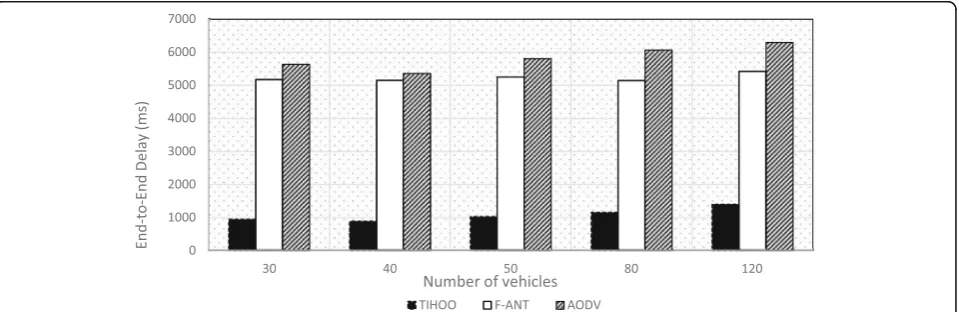
Fig. 7End-to-end delay based on the number of vehicles. When the number of vehicles increases, end-to-end delay also increases. Applying the cuckoo metaheuristic algorithm to TIHOO has helped in the selection of the best route in a shorter time than the other two protocols. In contrast to F-ANT which is very slow to converge as a result of the ant colony optimizationalgorithm(ACO), TIHOO has a fast convergence rate and could identify the optimal route in a shorter time. Moreover, the intelligent configuration of the fitness function of this protocol and considering parameters such as available buffer have proved to be very useful in the deselection of congested routes. The selection of less busy routes has decreased end-to-end delays
Routing Overhead¼Nc
Nt ð17Þ
7.1.5 Packet loss rate (PLR)
PLR is the fraction of the total transmitted packets that were not received at the destination. The packet loss rate is calculated in Eq. (18) as follows:
PLR¼ Xn
j¼1
Number of sent packets−Xn j¼1
Number of recieved packets !
100
ð18Þ
7.2 Simulation results and analysis
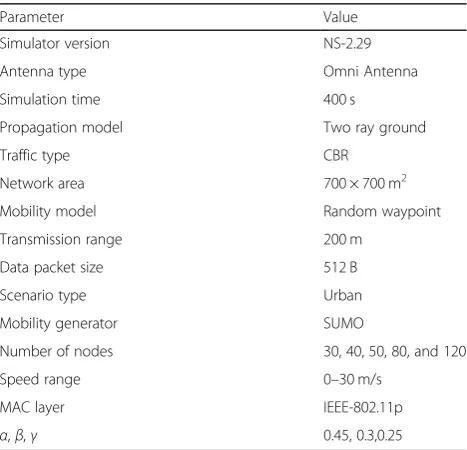
We have implemented TIHOO, F-ANT, and AODV ap-proaches in the NS-2 [7] on Fedora 10. Table 5 shows the simulation parameters.
7.2.1 An assessment of the simulation parameters based on the number of vehicles
This section assesses the parameters of end-to-end de-lays, throughput, packet delivery rate, routing overhead, and the loss rate of packets as a function of the number of vehicles. The results of this test and comparisons have been satisfactory in this protocol between 30, 40, 50, 80, and 120 nodes. Figures 6, 7,8, 9, and 10show that the proposed protocol is a scalable one as the desired results are still produced in face of the growing number of vehicles.
Figure 6 compares the performance of TIHOO with
that of F-ANT and AODV for packet delivery ratio. This improvement is due to the cuckoo search algo-rithm in the proposed protocol and the intelligent con-figuration of the fitness function parameters such as the reliability and the link lifetime which positively affect the
Fig. 9Routing overhead based on number of vehicles. The routing overhead values of TIHOO, F-ANT, and AODV for various numbers of vehicles. In TIHOO, broadcasting of route request control packets are prevented and the discovery is conducted in a controlled manner while running this phase in AODV algorithm causes increased system overhead. Also, F-ANT protocol imposes increased overhead on the system as a result of employing the ACO metaheuristic algorithm and storing the whole information of the entire colony. Therefore, TIHOO outperforms other protocols in terms of overhead produced
data packet delivery rate via the selection of more stable routes as the optimal route. Simulation results show that TIHOO performs better than F-ANT and AODV in terms of PDR (as shown in Fig.6).
Figure 7 shows the end-to-end delay based on the
number of vehicles. In Fig.7, when the number of vehi-cles increases, the end-to-end delay also increases. Ap-plying the cuckoo metaheuristic algorithm to TIHOO has helped in the selection of the best route in a shorter time than the other two protocols. In contrast to F-ANT which is very slow to converge as a result of the ant colony optimizationalgorithm(ACO), TIHOO has a fast convergence rate and could identify the optimal route in a shorter time. Moreover, the intelligent configuration of the fitness function of this protocol and considering pa-rameters such as available buffer have proved to be very useful in the deselection of congested routes. The selec-tion of less busy routes has decreased end-to-end delays.
Figure 8 compares the performance of TIHOO with
that of F-ANT and AODV for throughput.
Based on simulation figures, TIHOO has outper-formed the other two protocols. Selecting the best route takes more time in F-ANT as it employs ACO and is slow to converge while the application of CS algorithm to TIHOO has brought about faster convergence and less parametric configuration demands during the imple-mentation phase compared to other metaheuristic algo-rithms which have accelerated the selection of the optimal route and improved the throughput of the pro-posed protocol.
Figure 9 shows the routing overhead values of
TIHOO, F-ANT, and AODV for various numbers of vehicles. In TIHOO, broadcasting of route request control packets are prevented and the discovery is conducted in a controlled manner while running this phase in AODV algorithm causes increased system
Fig. 11Packet delivery ratio based on simulation time. The simulation results for packet delivery rate are assessed in this section based on the simulation time. The bigger rate of packet delivery in TIHOO is associated with the movement of packets in the most stable route which in turn is determined thanks to the application of stability factors in the fitness function of TIHOO. In addition, accounting for the available buffer for the selection of a less congested route is very effective in enhancing the number of delivered data packets
overhead. Also, F-ANT protocol imposes increased overhead on the system as a result of employing the ACO metaheuristic algorithm and storing the whole information of the entire colony. Therefore, TIHOO outperforms other protocols in terms of overhead produced.
Figure10 depicts the packet loss rate values of TIHOO, F-ANT, and AODV protocols for various numbers of vehi-cles. Loss of data packets was partly due to packet collision, link failure, insufficient bandwidth, overhead of buffer, etc. In TIHOO, the fitness function of the CS algorithm is con-figured based on such parameters as route lifetime and its reliability. Employing these factors contributes to the selec-tion of more stable with fewer cases of link failures which affect the packet losses as well. Moreover, accounting for the available buffer for selection of a less congested route is very effective. Less congestion is synonymous with fewer packet losses.
7.2.2 Assessment of simulation parameters based on simulation duration
In this section, the packet delivery rate and end-to-end de-lays are assessed based on the simulation time. Figures11 and12display the simulation results for the packet delivery rate and end-to-end delays which are assessed in this sec-tion based on the simulasec-tion time. These figures show that TIHOO is superior over the other two protocols. The big-ger rate of packet delivery in TIHOO is associated with the movement of packets in the most stable route which in turn is determined thanks to the application of stability factors in the fitness function of TIHOO. In addition, ac-counting for the available buffer for the selection of a less congested route is very effective in enhancing the number of delivered data packets. CS algorithm which has a fast convergence rate has improved end-to-end delays.
8 Conclusion
VANETs are a special type of ad hoc networks that con-sist of nodes connected via wireless links without any
fixed infrastructure. This and the lack of a centralized administration have made efficient routing a significant challenge in these networks. In this study, we proposed a new routing protocol called TIHOO for VANETs. This protocol intelligently employed fuzzy and cuckoo ap-proaches. In TIHOO, the fuzzy logic system is used to limit the route discovery phase and, by limiting the route request messages, it somewhat controls the created extra overhead. The inputs in the fuzzy logic system include three factors of vehicle speed, direction of movement, and neighbor node-to-destination distance. After identi-fying the routes in the source node, the cuckoo search algorithm is called. This algorithm is one of the most ef-fective metaheuristic algorithms, especially in the large search space. It selects the most stable and optimal route among known routes by calculating the fitness function based on criteria such as route lifetime, route reliability, and available buffer.
Simulation results show that TIHOO outperformed F-ANT and AODV in terms of throughput, routing over-head, packet delivery ratio, packet loss ratio, and end-to-end delay. The reliability parameter and the link lifetime in the compatibility function make it possible to select a path that is more stable. These parameters are effective along with the buffers available to increase the delivery rate of data packets. TIHOO is proposed to be better than the F-ANT protocol used by the ant colony algo-rithm, because it uses the cuckoo algorithm and its unique features, such as the run-rate and convergence resulting from the use of Levy’s distribution in this algorithm.
Abbreviations
start; R2P: Reliable routing protocol; RREP: Route reply; RREQ: Route request; V2I: Vehicle-to-infrastructure; V2V: Vehicle-to-vehicle; VANETs: Vehicular ad hoc networks; WAVE: Wireless access in vehicular environment
Authors’contributions
SRY and BB carried out all research steps including finding the problem, analyzing the related works, and finding, implementing, and simulating the proposed method as well as writing the manuscript. KR has contributed in analyzing the data and editing the paper. All authors read and approved the final manuscript.
Authors’information
Shirin Rahnamaei Yahiabadi received her bachelor in computer science from the University of Yazd, Yazd, Iran, in 2013 and now is a master student in Najafabad Branch, Islamic Azad University, Iran. Her research interest encompasses the fuzzy logic system and metaheuristic base on bio-inspired algorithm, as well as wireless communication.
Behrang Barekatain earned his BSC and MSC in computer software engineering in 1996 and 2001, respectively. He has more than 22 years of experience in computer networking and security. He is as a faculty member in Najafabad Branch, Islamic Azad University, Iran, for 18 years. He received his PhD and post-doc in computer networks from Ryerson University, Canada. His research interests encompass wire and wireless systems, VANETs, FANETs, SDN, NDN, IoT, peer-to-peer networking, network coding, video streaming, network security, and wireless mesh networks using network coding.
Kaamran Raahemifar received his B.Sc. degree (1985-1988) in Electrical Engineering from Sharif University of Technology, Tehran, Iran, his MASc. degree (1991-1993) from Electrical and Computer Engineering Dept., Waterloo University, Waterloo, Ontario, Canada, and his PhD degree (1996–1999) from Windsor University, Ontario, Canada. He was Chief Scientist (1999–2000), in Electronic Workbench, Toronto, Ontario, Canada. He joined Ryerson University in September 1999 and was tenured in 2001. Since 2011, he has been a Professor with the Department of Electrical and Computer Engineering, Ryerson
University. He is the recipient of ELCE-GSA Professor of the Year Award (Elected by Graduate Student’s body, 2010), Faculty of Engineering, Architecture, and Science Best Teaching Award (April 2011), and Department of Electrical and Computer Engineering Best Teaching Award (December 2011), and Research Award (December 2014). He has been awarded more than $6 M external research fund during his time at Ryerson. His research interests include (1) Optimization in Engineering: Theory and Application, which includes grid optimization and net-zero communities, as well as biomedical signal and image processing techniques, (2) Big Data Analysis (Dictionary/Sparse Representations, Interpolation, Predictions), (3) Modelling, Simulation, Design, and Testing, and (4) Time-Based Operational Circuit designs.
Funding
The authors received no financial support for the research, authorship, and/ or publication of this article.
Availability of data and materials
Data sharing not applicable to this article as no datasets were generated or analyzed during the current study.
Competing interests
The authors declare that they have no competing interests.
Author details
1Faculty of Computer Engineering, Najafabad Branch, Islamic Azad University, Najafabad, Iran.2Big Data Research Center, Najafabad Branch, Islamic Azad University, Najafabad, Iran.3Electrical and Computer Engineering, Sultan Qaboos University, P.O. Box: 31, Al-Khoud 123, Sultanate of Oman.4Chemical Engineering Department, University of Waterloo, 200 University Avenue West, Waterloo, Toronto, Ontario N2L 3G1, Canada.
Received: 3 June 2018 Accepted: 3 July 2019
References
1. Singh, S. and S. Agrawal, VANET routing protocols: Issues and challenges, 2014 Recent Advances in Engineering and Computational Sciences (RAECS), 1-5,6-8 March 2014,1-5.
2. H. Fatemidokht, M. Kuchaki Rafsanjani, F-Ant: an effective routing protocol for ant colony optimization based on fuzzy logic in vehicular ad hoc networks. Neural Computing and Applications, 1–11 (2016)
3. S. Dehghani, M. Pourzaferani, B. Barekatain, Comparison on energy-efficient cluster based routing algorithms in wireless sensor network. Procedia Computer Science72, 535–542 (2015)
4. S. Dehghani, B. Barekatain, M. Pourzaferani,An enhanced energy-aware cluster-based routing algorithm in wireless sensor networks(Wireless Personal Communications, 2017), pp. 1605–1635
5. S. Bitam, A. Mellouk, S. Zeadally, Bio-inspired routing algorithms survey for vehicular ad hoc networks. IEEE Communications Surveys & Tutorials17, 843–867 (2015)
6. H. Rana, P. Thulasiraman, R.K. Thulasiram,MAZACORNET: mobility aware zone based ant colony optimization routing for VANET(2013 IEEE Congress on Evolutionary Computation, 2013), pp. 2948–2955
7. S. Al-Sultan et al., A comprehensive survey on vehicular ad hoc network. Journal of Network and Computer Applications37, 380–392 (2014) 8. C. Wu, S. Ohzahata, T. Kato,Routing in VANETs: a fuzzy constraint Q-learning
approach(2012 IEEE Global Communications Conference (GLOBECOM), 2012), pp. 195–200
9. K.N. Qureshi, A.H. Abdullah, A. Altameem, Road aware geographical routing protocol coupled with distance, direction and traffic density metrics for urban vehicular ad hoc networks. Wireless Personal Communications92, 1251–1270 (2017)
10. B. Barekatain et al., GAZELLE: An enhanced random network coding based framework for efficient P2P live video streaming over hybrid WMNs. Wireless Personal Communications95, 2485–2505 (2017) 11. N.V. Dharani Kumari, B.S. Shylaja, AMGRP: AHP-based multimetric
geographical routing protocol for urban environment of VANETs. Journal of King Saud University - Computer and Information Sciences, 849–857 (2017) 12. T.-Y. Wu, Y.-B. Wang, W.-T. Lee, Mixing greedy and predictive approaches to
improve geographic routing for VANET. Wireless Communications, and Mobile Computing12, 367–378 (2012)
13. B. Barekatain et al., efficient P2P live video streaming over hybrid WMNs using random network coding. Wireless Personal Communications80, 1761–1789 (2015)
14. Barekatain, B., et al., MATIN: A Random network coding based framework for high quality peer-to-peer live video streaming, PLOS ONE, 8, e69844 (2013), 165-172.
15. B. Barekatain et al., Performance evaluation of routing protocols in live video streaming over wireless mesh networks. Jurnal Teknologi 10, 85–94 (2013)
16. B. Barekatain et al., GREENIE: a novel hybrid routing protocol for efficient video streaming over wireless mesh networks. EURASIP Journal on Wireless Communications and Networking168(2013), 1–22 (2013)
17. G. Li et al., Adaptive fuzzy multiple attribute decision routing in VANETs. International Journal of Communication Systems30, 1543–1563 (2017) 18. P. Sermpezis, G. Koltsidas, F.N. Pavlidou, Investigating a junction-based multipath source routing algorithm for VANETs. IEEE Communications Letters17, 600–603 (2013)
19. L.N. Balico et al.,A prediction-based routing algorithm for vehicular ad hoc networks(2015 IEEE Symposium on Computers and Communication (ISCC), 2015), pp. 365–370
20. J.-M. Chang et al., An energy-efficient geographic routing protocol design in vehicular ad-hoc network. Computing96, 119–131 (2014)
21. C. Wu, S. Ohzahata, T. Kato, Flexible, portable, and practicable solution for routing in VANETs: a fuzzy constraint Q-learning approach. IEEE Transactions on Vehicular Technology62, 4251–4263 (2013)
22. E. Moridi, H. Barati, RMRPTS: a reliable multi-level routing protocol with tabu search in VANET. Telecommunication Systems, 1–11 (2016)
24. H. Dong et al., Multi-hop routing optimization method based on improved ant algorithm for vehicle to roadside network. Journal of Bionic Engineering 11, 490–496 (2014)
25. B. Barekatain, S. Dehghani, M. Pourzaferani, An energy-aware routing protocol for wireless sensor networks based on new combination of genetic algorithm & k-means. Procedia Computer Science72, 552–560 (2015)
26. M. Al-Rabayah, R. Malaney, A new scalable hybrid routing protocol for VANETs. IEEE Transactions on Vehicular Technology61, 2625–2635 (2012) 27. L.A. Zadeh, Fuzzy sets. Information and Control8, 338–353 (1965) 28. L. Altoaimy, I. Mahgoub,Fuzzy logic based localization for vehicular ad hoc
networks, 2014 IEEE Symposium on Computational Intelligence in Vehicles and Transportation Systems (CIVTS)(2014), pp. 121–128
29. X.S. Yang, D. Suash,Cuckoo Search via Levy flights, 2009 World Congress on Nature & Biologically Inspired Computing (NaBIC)(2009), pp. 210–214 30. A.I. Saleh, S.A. Gamel, K.M. Abo-Al-Ez, A reliable routing protocol for
vehicular ad hoc networks. Computers & Electrical Engineering, 473– 495 (2016)
31. K. Mehta, P.R. Bajaj, L.G. Malik,Fuzzy bacterial foraging optimization zone based routing (FBFOZBR) protocol for VANET, 2016 International Conference on ICT in Business Industry & Government (ICTBIG)(2016), pp. 1–10
32. C.E. Perkins, E.M. Royer,Ad-hoc on-demand distance vector routing, Mobile Computing Systems and Applications(Proceedings. WMCSA '99. Second IEEE Workshop on, New Orleans, 1999), pp. 90–100
33. A. Feyzi, V. Sattari-Naeini, Application of fuzzy logic for selecting the route in AODV routing protocol for vehicular ad hoc networks,2015 23rd Iranian Conference on. Electrical Engineering684-687, 684–687 (2015)
34. T. Hu et al.,An enhanced GPSR routing protocol based on the buffer length of nodes for the congestion problem in VANETs, 2015 10th International Conference on Computer Science & Education (ICCSE)(2015), pp. 416–419 35. X.B. Wang, Y.L. Yang, J.W. An,An, Multi-metric routing decisions in VANET, 2009 Eighth IEEE International Conference on Dependable, Autonomic and Secure Computing(2009), pp. 551–556
36. Li, X., et al., An adaptive geographic routing protocol based on quality of transmission in urban VANETs, 2018 IEEE International Conference on Smart Internet of Things (SmartIoT), 17-19 2018, 52-57.
37. N. Li et al., Probability prediction-based reliable and efficient opportunistic routing algorithm for VANETs %J. IEEE/ACM Trans. Netw 26, 1933–1947 (2018)
38. D. Tian et al., A microbial inspired routing protocol for VANETs. IEEE Internet of Things Journal5, 2293–2303 (2018)
39. A.H. Gandomi, X.-S. Yang, A.H. Alavi, Cuckoo search algorithm: a metaheuristic approach to solve structural optimization problems. Engineering with Computers29, 17–35 (2013)
40. A. Kout et al., AODVCS, a new bio-inspired routing protocol based on cuckoo search algorithm for mobile ad hoc networks. Wireless Networks, 2509–2519 (2017)
41. Z. Qin, M. Bai, D. Ralescu, A fuzzy control system with application to production planning problems. Information Sciences181, 1018–1027 (2011) 42. C. Wu, S. Ohzahata, T. Kato,VANET broadcast protocol based on fuzzy logic
and lightweight retransmission mechanism(IEICE Transactions on Communications, E95.B, 2012), pp. 415–425
43. Hui, L., et al., An adaptive genetic fuzzy multi-path routing protocol for wireless ad hoc networks, Sixth International Conference on Software Engineering, Artificial Intelligence, Networking, and Parallel/Distributed Computing and First ACIS International Workshop on Self-Assembling Wireless Network,468-475, 2005,468-475.
Publisher’s Note