Yu Lei. Reachability Analysis and Testing of Asynchronous Message-Passing Programs. (Under the direction of Professor Kuo-Chung Tai.)
An asynchronous message-passing program consists of concurrent processes that inter-act with each other by the exchange of messages. Many network protocols and distributed applications are asynchronous message-passing programs. This dissertation investigates techniques to ensure correctness of asynchronous message-passing programs.
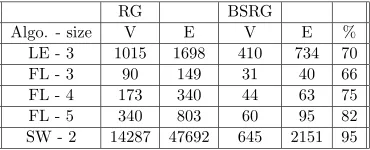
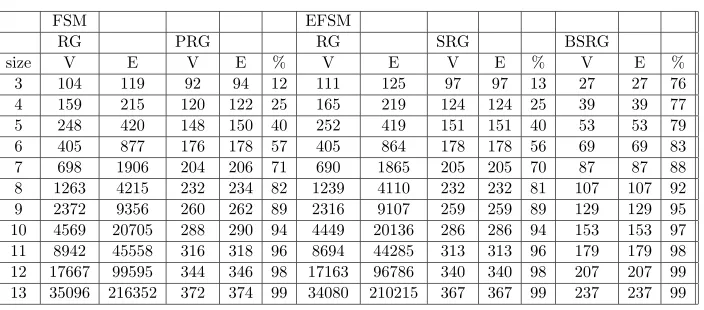
Reachability analysis has been a successful approach to verifying concurrent programs. Existing reachability analysis techniques for asynchronous message-passing programs as-sume causal communication, which means that messages sent to a destination are received in the order they are sent. In the first part of this dissertation, we propose a new reachabil-ity analysis approach, called blocking-based simultaneous reachabilreachabil-ity analysis (BSRA), for asynchronous message-passing programs based on any communication scheme. We describe an algorithm for generating BSRA-based reachability graphs and show that this algorithm guarantees the detection of deadlocks. Empirical results indicate that BSRA significantly reduces the number of states in reachability graphs.
The second part of this dissertation deals with a new concept of testing concurrent programs, namely reachability testing. LetPbe an asynchronous message-passing program, and X an input of P. Assume that every execution ofP with X terminates. Reachability testing of P with X is to execute, in a systematic manner, all possible synchronization sequences (or SYN-sequences) of P withX such that the correctness of P with X can be determined. The main challenge of reachability testing is to derive race variants of SYN-sequences. We develop a formal approach to computing race variants of SYN-sequences consisting of send and receive events. We describe an efficient reachability testing algorithm for asynchronous message-passing programs.
Message-Passing Programs
by
Yu Lei
A thesis submitted to the Graduate Faculty of North Carolina State University
in partial fulfillment of the requirements for the Degree of
Doctor of Philosophy
Computer Science
Raleigh
2002
APPROVED BY:
Prof. S. Purush Iyer Prof. Arne A. Nilsson
Prof. Mladen A. Vouk Prof. Kuo-Chung Tai
BIOGRAPHY
ACKNOWLEDGEMENTS
I am deeply indebted to my advisor, Dr. Kuo-Chung Tai, for his guidance and support. A majority of this work is finished when Dr. Tai is on medical leave. Without his tremendous effort and personal sacrifice would this work never come into existence. His view, principles, and methods of research are bound to shape my academic pursuit for years to come.
I would like to extend my sincere gratitude to Dr. Munindar Singh for his support in the first year of my study in this country. It has been a great pleasure to work with him.
I want to thank Dr. S. Purush Iyer, Dr. Arne Nilsson, and Dr. Mladen Vouk for their service on my advisory committee. I have always enjoyed occasional discussions with Dr. Iyer. His advice and encouragement is very much appreciated.
I owe everything to my parents. Their struggle to provide me with the best education is not to be forgotten. I am confident that this work would make them proud.
Contents
List of Figures vii
List of Tables viii
1 Introduction 1
1.1 Overview . . . 1
1.1.1 Reachability analysis . . . 1
1.1.2 Reachability testing . . . 2
1.1.3 Pairwise testing . . . 3
1.2 Contributions . . . 4
1.3 Organization . . . 5
2 Blocking-based Simultaneous Reachability Analysis 7 2.1 Background . . . 7
2.2 Related work . . . 8
2.2.1 Fair reachability analysis . . . 8
2.2.2 Maximal progress state exploration . . . 10
2.2.3 Partial-order reduction . . . 10
2.2.4 Simultaneous reachability analysis . . . 11
2.3 Preliminaries . . . 13
2.3.1 The multi-port EFSM model . . . 13
2.3.2 Reachability analysis of asynchronous message-passing programs . . 15
2.4 Blocking-based simultaneous reachability analysis . . . 17
2.4.1 Basic concepts . . . 19
2.4.2 Algorithm Generate BSRGEdges . . . 20
2.4.3 Correctness of BSRA . . . 29
2.5 Empirical results . . . 32
2.6 Summary . . . 36
3 Reachability Testing 38 3.1 Background . . . 38
3.2 Related work . . . 40
3.3 Preliminaries . . . 42
3.3.2 Race variant . . . 43
3.4 An approach to computing race variants . . . 46
3.4.1 Basic definitions and theorems . . . 46
3.4.2 A race variant computation algorithm . . . 50
3.5 An algorithm for reachability testing . . . 53
3.6 Summary . . . 58
4 A Test Generation Strategy for Pairwise Testing 60 4.1 Background . . . 60
4.2 Related work . . . 61
4.3 In-Parameter-Order (IPO) strategy for generating pairwise test sets . . . . 63
4.3.1 Framework of the IPO Strategy . . . 63
4.3.2 An optimal algorithm for vertical growth . . . 64
4.4 Two algorithms for horizontal growth . . . 67
4.4.1 Algorithm IPO H EC . . . 68
4.4.2 Algorithm IPO H IV . . . 73
4.5 Test generation with relations and constraints . . . 78
4.6 PairTest: An IPO-based test generation tool . . . 81
4.7 Summary . . . 84
5 Conclusions and Future Work 86 5.1 Conclusions . . . 86
5.2 Future work . . . 88
5.2.1 Model checking using BSRA . . . 88
5.2.2 Further improvement on reachability testing . . . 89
List of Figures
2.1 An example EFSM system . . . 15
2.2 Algorithm Generate RG . . . 17
2.3 Algorithm Generate BSRG . . . 18
2.4 Algorithm Generate BSRGEdges . . . 24
2.5 Functions gen next bpand gen trans sets . . . 25
2.6 BSRG for the example system . . . 26
2.7 The first snapshot of T3’s happen-before graph . . . 28
2.8 The second snapshot of T3’s happen-before graph . . . 29
3.1 An example time-space diagram . . . 44
3.2 Algorithm Generate-Variants . . . 51
3.3 All possible SR-sequences of program M . . . 53
3.4 SR-sequences of programM generated during race variant computation . . 54
3.5 Race variants of SR-sequenceQ1 . . . 55
3.6 Algorithm Reachability-Test . . . 56
3.7 SR Tree for the example system . . . 58
4.1 The IPO strategy . . . 64
4.2 Algorithm IPO V . . . 66
4.3 Algorithm IPO H EC . . . 74
4.4 Algorithm IPO H IV . . . 76
4.5 Function mark . . . 77
4.6 Function eval . . . 77
List of Tables
2.1 Empirical results for fully asynchronous communication . . . 34
2.2 Empirical results for FIFO communication . . . 34
2.3 Empirical results for causal communication - LE . . . 35
2.4 Empirical results for causal communication - TP . . . 35
2.5 Empirical results for causal communication - FL . . . 35
2.6 Empirical results for causal communication - ME . . . 35
2.7 Empirical results for causal communication - SW . . . 36
2.8 Empirical results for causal communication - RW . . . 36
4.1 An example relation . . . 78
4.2 A constraint for the example relation . . . 78
4.3 Sizes of pairwise test sets generated by AETG and PairTest . . . 82
4.4 Results of PairTest for systems withn 4-value parameters . . . 84
Chapter 1
Introduction
1.1
Overview
An asynchronous message-passing program consists of concurrent processes that inter-act with each other by the exchange of messages. It uses non-blocking send and blocking receive operations to send and receive message. Non-blocking send means that a process performs a send operation, and then immediately proceeds without waiting for the message to arrive at the destination; blocking receive means that a process performs a receive op-eration, and then blocks until a message arrives. Many network protocols and distributed applications are asynchronous message-passing programs.
One important aspect of asynchronous message-passing programs is that their behavior is nondeterministic [62]. Given the same input, multiple executions of an asynchronous message-passing program may exercise different synchronization sequences, and may even produce different results. Such nondeterminacy makes it difficult to ensure the correctness of asynchronous message-passing programs. This dissertation investigates techniques to ensure the correctness of asynchronous message-passing programs.
1.1.1 Reachability analysis
is an exponential function of the number of processes in the program [58]. A number of reachability analysis approaches have been proposed to reduce the global state space during reachability analysis while preserving certain fault detection capabilities [20] [6].
Existing reachability analysis approaches for asynchronous message-passing programs assume causal communication, which means that messages sent to the same destination be received in the same order as they are sent. However, in a fully asynchronous environment, messages may be received out of order [62]. In the first part of this dissertation, we propose a new reachability analysis approach, called blocking-based simultaneous reachability analysis (or BSRA). BSRA can be applied to asynchronous message-passing programs based on any communication scheme. The main idea of BSRA is described as follows. From a global stateg, processes are allowed to proceed simultaneously until each of them terminates or is ready to execute a receive operation. Global states reached by such executions from g are called next blocking points ofg. For each next blocking point ofg, possible matches between waiting messages and receive operations are performed to produce immediate BSRA-based successor states ofg. The intermediate global states fromgto each ofg’s immediate BSRA-based successors are not saved. We describe an algorithm for generating BSRA-based reachability graphs and show that this algorithm guarantees the detection of deadlocks. Our empirical results indicate that BSRA significantly reduces the number of states in reachability graphs.
1.1.2 Reachability testing
Reachability testing is a new concept of testing concurrent programs [33] [64]. LetP be a concurrent program andXan input ofP. An execution ofP withXcan be characterized by a sequence of synchronization events, referred to as a synchronization sequence (or SYN-sequence). Reachability testing of P with X is to execute, in a systematic manner, all possible synchronization sequences ofP with X. By doing so, the correctness of P withX can be determined.
1. Perform nondeterministic testing ofP with X to collect one SYN-sequence.
2. For a collected SYN-sequence, derive its race variants by changing the outcomes of race conditions in this sequence. (These race variants are prefixes of other SYN-sequences of P withX).
3. For each new race variant derived in Step 2, force a deterministic execution ofP withX according to this race variant and then letP continue execution nondeterministically to collect one SYN-sequence. (This process is referred to as prefix-based testing.)
4. For each new SYN-sequence collected in Step 3, repeat Steps 2, 3, and 4.
The main challenge of reachability testing ofP withXis how to derive the race variants of an SYN-sequence. LetQbe an SYN-sequence exercised by one execution ofP withX. A race variant ofQcan be obtained by modifying the outcome of one or more race conditions inQ and is guaranteed to be exercised by at least one execution of P regardless of how P is implemented.
Because the details of the above steps depend uponP’s concurrent programming con-structs, the above description of reachability testing is abstract. In the second part of this dissertation, we present an efficient algorithm for reachability testing of asynchronous message-passing programs. An execution of an asynchronous message-passing program can be characterized by a sequence of send and receive events, which is referred to as an SR-sequence. We formally define an SR-sequence and its race variants. We develop an approach to systematically deriving the race variants of an SR-sequence.
1.1.3 Pairwise testing
Many system faults are caused by unexpected interactions between system parameters [9] [74]. For the purpose of fault discovery, it is desirable to test as many parameter interactions as possible. However, the number of possible parameter interactions grows exponentially in the number of parameters. It is often the case that due to limited resources, we cannot test all possible parameter interactions. Much research has been devoted to reduce test cost while maintaining a well-defined level of test coverage.
practical and effective for various types of software systems [9] [13] [10]. In the third part of this dissertation, we propose a new test generation strategy, called In-Parameter-Order (or IPO), for pairwise testing. For a system with two or more input parameters, the IPO strategy generates a pairwise test set for the first two parameters, extends the test set to generate a pairwise test set for the first three parameters, and continues to do so for each additional parameter. The IPO strategy allows the use of local optimization techniques for test generation and the reuse of existing tests when a system is extended with new parame-ters or new values of existing parameparame-ters. We present practical, IPO-based test generation algorithms. We describe the implementation of an IPO-based test generation tool and show some empirical results.
1.2
Contributions
The first contribution is that we have proposed a new reachability analysis approach, that is the BSRA approach. Existing reachability analysis approaches for asynchronous message-passing programs assume causal communication, which means that messages sent to a destination are received in the order they are sent. In contrast, BSRA can be applied to asynchronous message-passing programs based on any communication scheme. We have developed an algorithm for generating BSRA-based reachability graphs and have formally established that this algorithm guarantees the detection of deadlocks. In order to evaluate the effectiveness of the BSRA approach, we have developed a reachability analysis tool based on BSRA, and have carried out an empirical study on a number of commonly used distributed algorithms. Our empirical results indicate that BSRA can significantly reduce the number of states in reachability graphs.
(that needs to be changed), performs prefix-based testing according to v (i.e. forces a deterministic execution ofP according tovand then letP proceed nondeterministically) to collect a new SR-sequenceQ’, and derives a race variantv’ ofQ’ by changing the outcome of the second race condition (that needs to be changed), and continues to do so until the outcomes of all the race conditions (that needs to be changed) are changed. In contrast, our approach allows the outcomes of multiple race conditions to change simultaneously. By doing so, a large number of program executions can be saved. In addition, our reachability testing algorithm organizes collected SR-sequences, as well as their race variants, into a special tree structure such that they can be searched efficiently. Such a tree structure does not take much space, and can be used for regression testing, analysis of synchronization patterns, checking of assertions on sequencing of events, and other purposes.
The third contribution is that we have proposed a new test generation strategy, that is, the IPO strategy, for pairwise testing. The IPO strategy allows the use of local optimization techniques for test generation and the reuse of existing tests when a system is extended with new parameters or new values. Based on the IPO strategy, we have developed optimal and heuristic test generation algorithms. The optimal algorithms carry more theoretical significance, and the heuristic algorithms are easy to be implemented for practical use. In order to evaluate the effectiveness of the IPO strategy, we have built a test generation tool, called PairTest, which implements the heuristic algorithms. We have carried out an empirical study by generating pairwise test sets for a number of system configurations using PairTest. In comparison with a commercial (and costly) pairwise test generation tool, namely AETG [9], PairTest produces competitive results with the core algorithm having a lower asymptotic time complexity.
1.3
Organization
Chapter 2
Blocking-based Simultaneous
Reachability Analysis
2.1
Background
An asynchronous message-passing program consists of concurrent processes that inter-act with each other by the exchange of messages. It uses non-blocking send and blocking receive operations to send and receive messages. A non-blocking send operation allows the executing process to continue execution, and a blocking receive operation blocks the execut-ing process until it receives a message. Many network protocols and distributed algorithms are asynchronous message-passing programs.
The communication scheme of an asynchronous message-passing program may impose certain restrictions on the relationship between the order in which messages are sent and the order in which messages are received. In [62], the following three communication schemes are identified:
• Asynchronous communication, which does not impose any restriction on the relation-ship between the order in which messages are sent and the order in which messages are received.
• Causal communication, which requires that messages sent to the same destination be received in the same order as they are sent. Causal communication is a special type of FIFO communication.
Various properties of asynchronous message-passing programs can be verified using reachability analysis. Let P be an asynchronous message-passing program. Reachability analysis of P involves systematically generating global states ofP and verifying the satis-faction of specified properties by each global state. Since the number of global states of a concurrent program is an exponential function of the number of processes in the program [58], how to reduce the state space in reachability analysis while preserving some fault detection capabilities has been investigated for a long time [60] [25] [44] [20] [55] [6] [35].
Existing reachability analysis techniques for asynchronous message-passing programs assume causal communication. In this chapter, we propose a new reachability analysis approach, called blocking-based simultaneous reachability analysis (BSRA). BSRA can be applied to asynchronous message-passing programs based on any communication scheme. The next section discusses related work. Section 2.3 introduces the multi-port EFSM model, and discusses how to construct full reachability graphs of asynchronous message-passing programs. Section 2.4 presents the synchronization-based simultaneous reachability analysis (BSRA) approach, and proves that BSRA is capable of detecting every deadlock of an asynchronous message-passing program. Section 2.5 shows empirical results of applying BSRA to a number of commonly used distributed algorithms. Section 2.6 summaries this chapter.
2.2
Related work
2.2.1 Fair reachability analysis
process is chosen first. Two execution sequences are canonically equivalent if they have the same canonical form. It is shown that the canonical equivalent of any executable sequence is an executable sequence. In order to incorporate the concept of canonical sequences into global state exploration algorithms, it is necessary to divide the protocol execution into a series of basic interactions. An interaction is a sequence of execution steps that leads the protocol from one stable state to the next, where a stable state is defined as one in which all message queues are empty. A basic interaction is an interaction that can not be divided into simpler interactions without changing the sequence of execution steps of the two processes. Their state exploration algorithm determines the basic interactions by coupling pairs of transitions in the two processes, executes each basic interaction in its canonical form, and considers intermediate states with a non-empty transmission medium when necessary. Executing only canonical sequences reduces the number of states analyzed, since only those states in which equal number of messages underway in both directions are generated. Rubin and West argued that their algorithm is capable of detecting every deadlock and unspecified receptions in two-process protocols.
The above work is extended by Gouda and Han to determine whether a two-process protocol is bounded [25]. They observed that the execution of a canonical sequence forces the two processes to progress at the same speed, and therefore, they used the name of fair reachability analysis for the state exploration technique in [60]. The reachability graph constructed by fair reachability analysis is referred to as fair reachability graph. In order to determine if a two-process protocol is bounded, the fair reachability graph is constructed and then augmented such that the augmented graph can be used to determine the node reachability of the protocol. Note that the processes are modeled as CFSMs, and a node is a local state of a finite state machine. They proved that a two-process protocol is unbounded if and only if there exists a reachable node that is in a directed cycle of all sending edges.
2.2.2 Maximal progress state exploration
Gouda and Yu developed another technique of state exploration, called maximal progress state exploration, to detect every non-progress state of protocols consisting of two commu-nicating finite state machines (or CFSMs) in [26] [27]. LetP be a protocol consisting of two CFSMs M1 and M2. In order to detect every non-progress state of P, maximal progress state exploration constructs two reachability graphs: one for M1 and the other for M2. When it constructs the reachability graph for M1 (or M2), M1 (or M2) is forced to make maximal progress in the sense that it always tries to execute transitions ofM1 if possible. Transitions ofM2 (or M1) are executed only whenM1 can no longer make progress on its own. P has a non-progress state if and only if a non-progress state is reached during the construction of the reachability graph for M1 and/or for M2. Gouda and Yu proved that maximal progress state exploration is capable of detecting every deadlock state.
As mentioned earlier, Rubin and West [60] developed a technique to improve reachabil-ity analysis by forcing two machines to progress in equal speeds. However, their technique can not be used to detect overflows, and therefore can not detect non-progress states [26]. This has been the original motivation behind the development of maximal progress state exploration. It is worth to note that the work in [25] is indeed the outcome of applying the idea of maximal progress to the technique in [60].
2.2.3 Partial-order reduction
Partial-order reduction is based on the idea that exploring all the interleavings of con-current events is nota priorinecessary for verification [20]. LetP be a concurrent program consisting of processes P1, P2, . . ., and Pn, where n > 1. Let G be a global state of P
containing local states l1, l2, . . ., and ln, where li is the local state of Pi. Assume that
there arentransitionst1,t2,. . ., andtn enabled atG, where ti is a transition enabled atli.
If all the interleavings (n!) of thesen transitions reach the same state s, then considering only one of these n! interleavings is sufficient to determine if s is reachable. Partial-order reduction avoids the part of combinatorial explosion due to the modeling of concurrency by interleaving.
reached during the search, it computes a subsetT of the set of transitions that are enabled ins, and explores only the transitions inT [20]. The first technique of computing the set of transitions to explore in a selective search is called the persistent set technique [17] [20] [24]. A persistent set T is a set of transitions enabled in a statesif all transitions not inT that are enabled ins, or in a state reachable fromsthrough transitions not inT, are independent with all transitions in T. In order to compute persistent sets, it is desirable to be able to detect independence between transitions [17]. Informally, two transitions are independent if their execution does not interact with or affect each other. In [17], it was shown that refining dependencies among transitions improves effectiveness of partial-order reduction. Note that the persistent set technique actually corresponds to a family of algorithms that were proposed independently by several researchers [18] [23] [70] .
The second technique of computing the set of transitions to consider in a selective search is called the sleep set technique [24] [20]. A sleep set associated with a statescontains a set of transitions that are enabled insbut will not be explored in sin a selective search. Used in conjunction with the persistent set technique, the use of sleep sets can further reduce the number of states explored by avoiding unnecessary exploration of multiple interleavings of independent transitions. Note that a sleep set is computed based on information about the past of the search, which is in contrast with the fact that a persistent set is inferred from the static structure of a program.
2.2.4 Simultaneous reachability analysis
edge is associated with a simultaneously executable set, and each node is a simultaneously reachable global state. The edge generation for a simultaneously reachable stateGconsists of two steps. The first step is to select maximal simultaneously executable sets at G. A simultaneously executable set is maximal if it is not a proper subset of another simulta-neously executable set. The second step has something to do with potentially executable transitions. A transition t is a potentially executable transition at Gift is not executable at G but may become executable at a success state reachable from G. For every selected maximal simultaneously executable setM, SRA checks if M contains any executable tran-sition from a process which also has a potentially executable trantran-sition atG. If so, lettingt0 be such an executable transition, SRA selects another simultaneously executable set which includes the same set of transitions in M except t0. Ozdemir and Ural proved that SRA identifies every deadlock, every non-executable transition, every missing receiving transition causing an unspecified reception, and every channel at which a buffer overflow occurs.
Schoot and Ural developed a technique, called leaping reachability analysis (LRA), to improve the efficiency of SRA [71] [72]. The main idea of LRA is to refrain the processes that have both executable and potentially executable transitions from progressing. In case that every process has either no executable transitions or at least one potentially executable transitions, a separate edge is generated for every executable transition atG. By doing so, LRA yields extra reduction over SRA in terms of the space and time requirement. It is proved that LRA maintains the power of SRA to detect all deadlocks, all non-executable transitions, all unspecified receptions, and all buffer flows in a protocol.
Bengi and Tai further generalized the SRA approach to the multi-port extended finite state machine (EFSM) model [35] [36] [38]. The EFSM model is more expressive than the CFSM model in that the former allows that each process may contain a number of ports to receive different types of messages. SRA is first generalized for deadlock detection of a system of multi-port EFSMs [35]. The use of ports in the multi-port EFSM model gives rise to the following two problems. First, two process-independent transitions enabled at a global stateGcan not be executed simultaneously if they send messages to the same port. The notion of dependency needs to be modified such that two enabled transitions at a global stateGare independent if and only if they are process-independent and port-independent. Second, an enabled transitiontof processPi at a global stateGis said to have a race with
a transition t0 of process Pj (j 6=i) at a global stateG0, where G0 is reachable from G, ift
sent bytandt0 may impact the system behavior, it is necessary to generate paths in which t occurs before t0 and vice versa. However, t0 is not enabled at G. Therefore, in order to generate paths in which t0 occurs before t, the execution of t needs to be delayed until t0 gets a chance to be executed. In another word, one edge needs to be generated at G such that t is not executed at G. Bengi and Tai proved that SRA with the above extension is capable of detecting every deadlock of a system of EFSMs.
SRA is later generalized for model checking of a system of EFSMs [38]. Model checking involves systematically generating all reachable states and checking them against properties specified in temporal logic formulae. Generally speaking, the simultaneous reachability graph (SRG) constructed for deadlock detection is insufficient for model checking. The notion of visible transitions is used to ensure the construction of an SRG that retains sufficient information for model checking. A transition is visible with respect to a temporal logic formula if its execution changes the values of some variables in the formula, and otherwise invisible. In order to generate all possible interleavings of visible transitions, the edge generation of SRA is modified such that each edge contains at most one visible transition.
2.3
Preliminaries
2.3.1 The multi-port EFSM model
An extended finite state machine (or EFSM) is a finite state machine in which each transition is associated with a predicate defined over a set of variables [35] [38]. A multi-port EFSM contains a set of multi-ports for receiving different types of messages. Each multi-port can receive messages sent from any process. It is assumed that the capacity of a port is large enough to prevent the buffer overflow problem.
A multi-port EFSMM can be formally defined as a tuple M = (Q, q0, V, T, I, O, F, δ) (adapted from the definition of EFSM in [36]):
• Q: Set of states of M.
• q0: Initial state of M,q0 ∈Q.
• V: Set of local variables of M.
• I: Set of input messages for all ports of M.
• O: Set of output messages ofM.
• F: Set of final states ofM,F ⊆Q.
• δ: Set of transitions ofM.
The implementation of a port depends on the communication scheme used byM. For asynchronous communication, a port contains a pool in which messages are unordered. For FIFO communication, a port contains a separate message queue for each EFSM that communicates withM. For causal communication, a port maintains a single message queue for all the EFSMs that communicate withM.
A transitiont∈δ contains the following information:
• head(t): the start state of t,head(t)∈Q.
• tail(t): the end state oft,tail(t)∈Q.
• pred(t): a boolean expression involving variables in V, constants, and arithmetic, relational and boolean operations.
• comp(t): a computation block, which is a sequence of computational statements (as-signment, loop, etc) involving the received message, variables in V, and constants. The execution ofcomp(t) terminates in a finite amount of time.
• A send operation (!Ti.m) or a receive operation (?Ti.m). In the former case, Ti is a
port name of another EFSM, andman output message inO. In the latter case,Ti is
a port name ofM, and m an input message in I. We also refer to Ti asport(t) and
m asmsg(t).
At most two of the following three components can be missing from a transitiont: the predicate pred(t), the computation block comp(t), and the send/receive operation. M is also referred to as proc(t).
tis a send or internal transition,tis enabled athead(t) provided thatpred(t) is not present orpred(t) is true. If t is a receive transition, tis open at head(t) provided thatpred(t) is not present orpred(t) istrue, andtis enabled athead(t) provided thattis open athead(t) and port(t) is not empty.
The semantics of the execution of transition t can be described as follows. If t is an internal transition, the execution oftconsists of the following actions in the given order: (1) comp(t) is executed; and (2)tail(t) becomes the current state ofM. Iftis a send transition, the execution of t consists of the following actions in the given order: (1)msg(t) is saved atport(t); (2)comp(t) is executed; and (3) tail(t) becomes the current state of M. Ift is a receive transition, the execution of t consists of the following actions in the given order: (1) a messagem is removed from port(t); (2) comp(t) is executed; and (3) tail(t) becomes the current state of M.
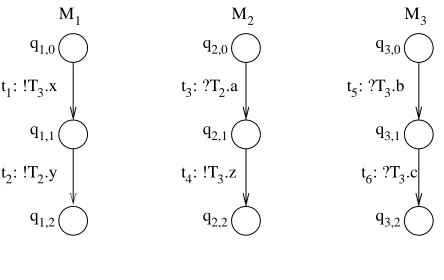
We comment that our EFSM model is different from that in [35] [38]. In the latter model, a port contains a single message queue and a single transition may contain both send and receive operations. Figure 2.1 shows an example EFSM system.
Figure 2.1: An example EFSM system
t1: !T3.x
t2: !T2.y
t5: ?T3.b
t6: ?T3.c t3: ?T2.a
t4: !T3.z
M1 M2 M3
q1,0
q1,1
q1,2
q2,0
q2,1
q2,2
q3,0
q3,1
q3,2
2.3.2 Reachability analysis of asynchronous message-passing programs
Reachability analysis of a concurrent program produces a reachability graph that con-sists of reachable states of the program. In this section, we discuss how to construct the full reachability graph of an asynchronous message-passing programs.
global state ofP contains the initial local state, the initial values of local variables and empty ports for each EFSM in P. A final global state of P contains a final local state and empty ports for each EFSM in P.
Definition 2 Let g be a global state of a system P of EFSMs. g is said to be a deadlock state if g is not a final global state and g has no enabled transitions.
Definition 3 Let P be a system of EFSMs M1, M2, . . ., and Mn. Let g be a global state of P. LetT be a port of an EFSM Mi, where1≤i≤n. The frontier of T at g, denoted as
f rontier(T, g), is the set of messages inT that can be received by an open receive transition
r atg withport(r) =T according to P’s communication scheme.
The computation off rontier(T, g) can be described as follows. For asynchronous com-munication, f rontier(T, g) contains all messages in T at g. For FIFO communication, f rontier(T, g) contains the first message of each non-empty queue of T at g. For causal communication, f rontier(T, g) contains the first message of the only queue ofT atg.
A transition between two local states is referred to as a local transition. A transition between two global states is referred to as a global transition. In our EFSM model, a local transition may involve the use of variables. A global transition can be considered as an instance of a local transition whose variables are bound according to a global state.
If necessary, we distinguish a global transition from a local transition as follows. Let t be a local transition. Let g be a global state. If t is a send transition, [t]g, or [t] if
g is implied, denotes a global send transition at g that is an instance of t whose vari-ables are bound according to g. If t is a receive transition, [t]g,m, or [t]m if g is implied,
where m ∈ f rontier(port(r), g), denotes a global receive transition at g that is an in-stance oft whose variables are bound according tog and whose execution removesm from f rontier(port(r), g).
Definition 4 Let P be a system of EF SMs. Let g be a global state of P, and t a global transition at g. The global stateg0 reached by the execution oft is said to be an immediate successor state ofg, denoted asg→t P g0, or g→t g0 if P is implied.
Definition 5 Let P be a system of EFSMs andg a global state of P. Let ω=t1t2. . . tn be a sequence of global transitions. ω is an enabled (or executable) transition sequence from g
if there exists a sequence of states g =g0, g1, . . ., and gn =g0 such that gi−1 ti
→gi, where
Figure 2.2: Algorithm Generate RG
AlgorithmGenerate RG(P: A set of multi-port EFSMs) RG: Reachability graph,RG= (V, E),V: nodes,E: edges
open: Set of nodes to be explored
V ← ∅,E← ∅
generate the initial global stateg0
putg0inopen
whileopen6=∅do
g←the most recently added global state inopen
removegfromopen
ifgis a deadlock state, report deadlock else
determine the set of global transitions atg
foreach global transitiontatgdo
executetatg, and letg0be the successor state ifg06∈V
open←open∪ {g0} V ←V∪ {g0} E←E∪ {t}
returnRG;
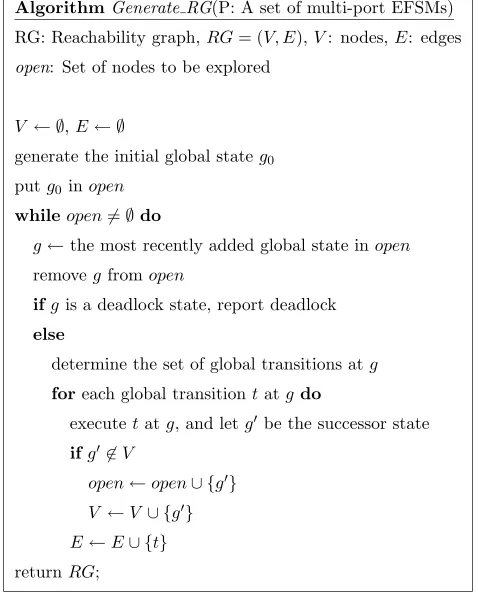
Figure 2.2 shows an algorithm to construct the full reachability graph of an asyn-chronous message-passing program. The set of global transitions at g is determined as follows. Lettbe a local transition atg. Iftis an enabled send transition atg, we generate a global transition [t]g according tot. Ift is an enabled receive transition atg, we generate
a global transition [t]g,m for each message m inf rontier(port(t), g).
2.4
Blocking-based simultaneous reachability analysis
In this section, we describe a new reachability analysis approach, called blocking-based simultaneous reachability analysis (or BSRA), for detecting deadlocks of asynchronous message-passing programs.
Figure 2.3: Algorithm Generate BSRG
AlgorithmGenerate BSRG(P: A set of multi-port EFSMs) RG: Reachability graph,RG= (V, E),V: nodes,E: edges
open: Set of nodes to be explored
V ← ∅,E← ∅
generate the initial global stateg0
putg0inopen
whileopen6=∅do
g←the most recently added global state inopen
removegfromopen
ifgis a deadlock state, report deadlock else
gedges←Generate BSRGEdges(g)
foreach edgee= (b, γ)∈gedges
restorebas the current global state ofP
ifγis not empty
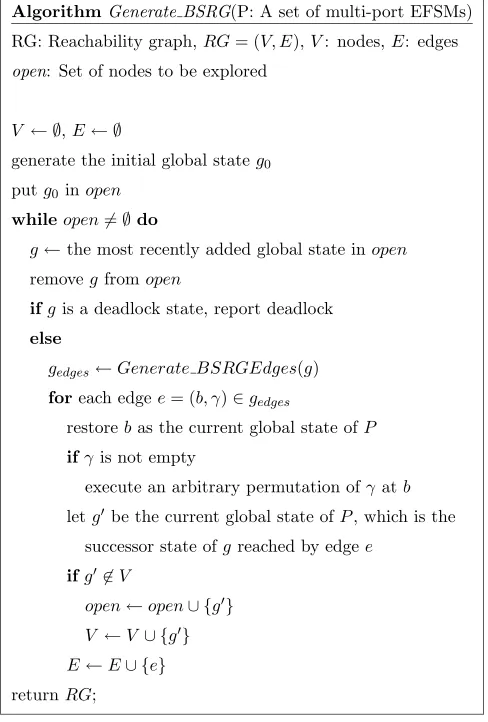
execute an arbitrary permutation ofγatb
letg0be the current global state ofP, which is the successor state ofg reached by edgee
ifg06∈V
open←open∪ {g0} V ←V ∪ {g0} E←E∪ {e}
returnRG;
2.4.1 Basic concepts
Definition 6 Let P be a system of EFSMs. A global stateg of P is a blocking point of P
if each EFSM either has at least one open receive transition or has no enabled transitions
at g.
Definition 7 Let P be a system of EFSMs. Let g be a global state of P. A blocking point
b of P is a next blocking point of g if g → ∗ω b, where ω is an enabled transition sequence from g, |ω| ≥0, andω consists of send and/or internal transitions only.
Ifgis a blocking point, thengis a next blocking point of its own. In this case, |ω|= 0. (The reason for considering a blocking point as a next blocking point of its own is to make algorithm Generate BSRGEdges in Section 2.4.2 concise.) A global stateg may have a set of next blocking points, which is referred to asnext bp(g). A transition sequence consisting of send and/or internal transitions only is referred to as a send/internal transition sequence. Let us consider the example system in Figure 2.1. A global stategcontainingq1,2,q2,0,
and q3,0 is a blocking point, becauseM1 has no enabled transitions atg, and M2 and M3
both have an open receive transition at g. Let g0 be the initial global state. g is a next blocking point of g0 because g0 t→ ∗1t2 g, where t1t2 is an enabled send transition sequence from g0.
Definition 8 Let g be a global state of a system P of EFSMs. Two global transitions t1
and t2 of P are said to be independent wrt g if (1) t1 and t2 are enabled global transitions at g; and (2) proc(t1)6=proc(t2).
LetL be a set of enabled global transitions at a global state g of a system of EFSMs. If transitions in L are pairwise independent wrt g, then L is said to be an independent transition set atg.
Assume that transitionst1 and t2 are independent wrt global stateg. Ifgt→ ∗1t2 g0, then g t→ ∗2t1 g0. Thus, the state reached from g after the execution of t1 and t2 is independent of the execution order of t1 and t2. This property can be generalized to three or more independent transitions wrt a global state, as shown below.
2.4.2 Algorithm Generate BSRGEdges
LetP be a system of EFSMsM1,M2,. . ., and Mn. Let g be a global state ofP. The
edge generation for g consists of the following two steps. The first step is to determine next bp(g), the set of next blocking points ofg. The second step is to generate independent global receive transition sets at each blocking point in next bp(g). An outgoing edgeeof g is a tuple (b, γ), wherebis a next global blocking point ofg, andγ is an independent global receive transition set at g.
In Section 2.3.1, it is mentioned that a port maintains a single message queue for causal communication. This is sufficient for algorithm Generate RG in Figure 2.2. However, we point out that a single message queue per port for causal communication cannot support BSRA. Rather, a port needs to maintain a special type of data structure, called happen-before graph, such that messages in the port can be received correctly according to causal communication. We will discuss such happen-before graphs in details in the end of this section.
Before we elaborate algorithm Generate BSRGEdges, we define the cross product, de-noted as S1 ⊗S2⊗. . .⊗Sn, of sets S1, S2, . . ., and Sn as follows: S1⊗S2⊗. . .⊗Sn =
{{e1, e2, . . . , en}|ei ∈ Si, where 1 ≤ i ≤n}. Note that unlike a Cartesian product, which
contains a set of (ordered) tuples, a cross product contains a set of (unordered) sets.
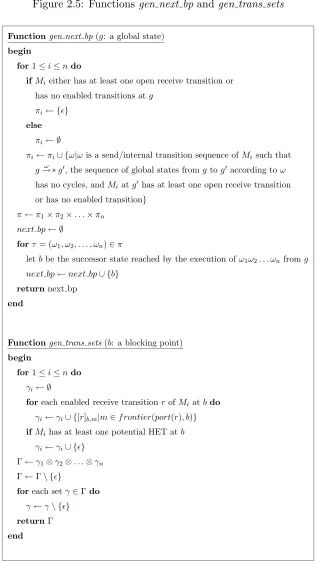
Step 1 of algorithm Generate BSRGEdges(g)
This step is to determine next bp(g), the set of next blocking points of g. First, we find a set πi of enabled send/internal transition sequences of each EFSM Mi, 1 ≤ i ≤ n,
at g. Let ω be an enabled send/internal transition sequence of Mi from g. Let g0 be a
successor state of g such that g → ∗ω g0. Let H be the sequence of global states from g to g0 according to ω. If H has no cycles, and Mi has at least one open receive transition or
has no enabled transitions at g0, then ω is added into πi. (If H has a cycle, then P may
repeat the cycle forever. As a result,P either makes no progress, if all transitions inω are internal transitions, or creates the buffer overflow problem, if one or more transitions in the cycle are send transitions.) In case that Mi has at least one open receive transition or has
no enabled transitions atg, an empty transition sequence ²is also added intoπi. Next, we
compute the cross product of these transition sequence sets, lettingπ =π1⊗π2⊗. . .⊗πn.
to reach a next blocking point ofg.
Let us consider how to computenext bp(g0) for the example system in Figure 2.1. Let πi, 1 ≤ i ≤ 3, denote the set of enabled send/internal transition sequences of Mi at g0.
Note that π1 ={t1t2}, π2 = {²}, and π3 = {²}. Thus, π = {{t1t2, ², ²}}. So, next bp(g0) contains a single blocking pointb0 = (q1,2, q2,0, q3,0, T1={}, T2={y}, T3 ={x}).
Step 2 of algorithm Generate BSRGEdges(g)
This step is to generate independent global receive transition sets for each blocking point in next bp(g). In order to maximize the state reduction in the resulting graph, it is desirable to generate maximal independent global receive transition sets at each blocking point. Let b ∈ next bp(g). Let γ be an independent global receive transition set at b. γ is a maximal independent global receive transition set at b if there does not exist a global receive transition r at g such that γ∪ {r} is also an independent global receive transition set at g.
Maximal independent global receive transition sets at b can be computed as follows. First, we determine the set of global receive transitionsγi for each EFSMMi, where 1≤i≤
n. This is accomplished by adding intoγi a global receive transition, denoted as [r]b,m, for
each open local receive transitionr of Mi at band each message m∈f rontier(port(r), b).
Next, we compute the cross product Γ of those non-empty global receive transition sets. Each set in Γ is a maximal independent receive transition set at b.
However, generating only maximal independent global receive transition sets is insuffi-cient. This is due to the existence of hereafter executable receive transitions.
Definition 9 Let P be a system of EFSMs and g a global state of P. An open local receive transition r at g is a hereafter executable transition (HET) at g if there exists an executable transition sequencet1t2. . . tm,m≥1, fromg such that for1≤i≤m,proc(ti)6=
proc(r), tm is a send transition with port(tm) = port(r), g t1t2→ ∗...tm g0, and msg(tm) ∈
f rontier(port(r), g0).
Letran HET atb. Lett1t2. . . tmbe an executable transition sequence frombaccording
of Mi needs to be delayed until g0 is reached. Therefore, given an independent global
receive transition set γ atb, ifγ contains a global receive transitionr0 ofMi, then another
independent global receive transition set γ0 needs to be generated such that γ0 does not includer0.
To determine whether an open local receive transition is an HET at a global state, the entire system needs to be considered. In what follows, we identify a necessary condition for an open local receive transition to be an HET at a global state, and use this condition to handle HETs.
Definition 10 Let P be a system of EFSMs and M an EFSM of P. Let l be a local state of M. Let T be a port ofP. reachable(l, T) is a boolean function defined as follows:
reachable(l, T) is true if and only if within M, l can reach a local send transition s such thatport(s) =T.
Note that the computation of functionreachabledoes not require system-wide analysis, and solely depends on the syntactic structure of an EFSM.
Lemma 2.4.2 Let P be a system of EFSMsM1, M2, . . ., andMn. Let g be a global state of P. Let r be an open local receive transition of Mi, 1 ≤i ≤n, at g. r is an HET at g only if there exists an EFSM Mj, where1≤j ≤nand i6=j, such that lettingl be the local state of Mj at g, reachable(l, port(r)) =true.
Proof
Assume thatris an HET atg. Let ω=t1t2. . . tmbe an executable transition sequence
from g according to Definition 9. Let l be the local state of proc(tm) at g. Let σ be the
transition sequence obtained by removing from ω all the transitions that do not belong to proc(tm). Then, lreaches tm via σ within proc(tm). Note that tm is a send transition with
port(tm) =port(r). Therefore, reachable(l, port(r)) =true. This concludes our proof. 2
Let g be a global state. Lemma 2.4.2 states a necessary condition for an open local receive transition at g to be an HET atg. An open local receive transition satisfying this necessary condition atg is referred to as a potential HET at g.
Mi has at least one potential HET at b, we add into γi a special transition ². Then, we
compute the cross product Γ of those non-empty global receive transition sets. Given an independent global receive transition set γ ∈ Γ, if γ contains only ², then we ignore γ; otherwise, we delete ² from γ. By doing so, we implement that if an independent global receive transition setγ ∈Γ contains a global receive transitionr from a process that has at least one potential HET atb, thenγ\ {r} ∈Γ.
For illustration, let us consider the example system in Figure 2.1 again. In Section 2.4.2, we have shown thatg0has a next blocking pointb0 = (q1,2, q2,0, q3,0, T1={}, T2 ={y}, T3=
{x}). Note that f rontier(T1, b) = {}, f rontier(T2, b) = {y}, and f rontier(T3, b) = {x}. Thus, γ1 = ∅, γ2 = {[t3]b,y}, and γ3 = {[t5]b,x}. Since q2,0 can reach t4, which is a send
transition with port(t4) = T3, reachable(q2,0, T3) = true. This derives that [t5]b,x is a
potential HET at b. Thus, we add a special transition ² into γ3, that is, γ3 ={[t5]b,x, ²}.
Therefore, γ2⊗γ3={{[t3]b,y},{[t3]b,y,[t5]b,x}}.
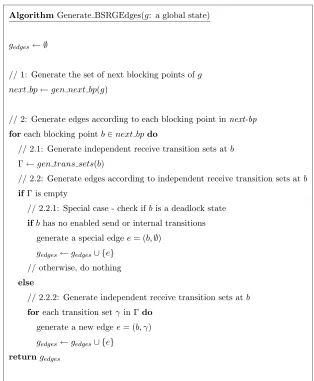
Figure 2.4 shows the complete algorithm to generate BSRG edges. Figure 2.5 shows two functions used by algorithm Generate BSRGEdges: gen next bpand gen trans sets.
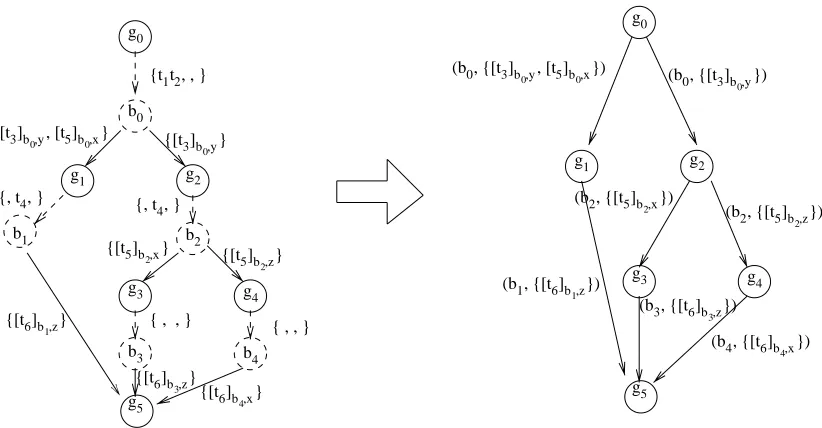
Figure 2.6 shows the application of algorithm Generate BSRG to the example system in Figure 2.1, assuming that asynchronous communication is used. The left graph in Figure 2.6 contains blocking points (dashed nodes) generated during reachability analysis and the send/internal transition sequences (dashed edges) that reach those blocking points. The right graph in Figure 2.6 is the resulting BSRG graph, which does not contain dashed nodes and edges. Note that in these graphs, the path (g0g2g4g5) does not exist if causal communication is assumed.
Happen-before graph
Figure 2.4: Algorithm Generate BSRGEdges
AlgorithmGenerate BSRGEdges(g: a global state)
gedges← ∅
// 1: Generate the set of next blocking points ofg next bp←gen next bp(g)
// 2: Generate edges according to each blocking point innext-bp
foreach blocking pointb∈next bpdo
// 2.1: Generate independent receive transition sets atb
Γ←gen trans sets(b)
// 2.2: Generate edges according to independent receive transition sets atb
ifΓ is empty
// 2.2.1: Special case - check ifbis a deadlock state
ifbhas no enabled send or internal transitions generate a special edgee= (b,∅)
gedges←gedges∪ {e}
// otherwise, do nothing
else
// 2.2.2: Generate independent receive transition sets atb
foreach transition setγin Γdo generate a new edgee= (b, γ)
gedges←gedges∪ {e}
Figure 2.5: Functionsgen next bpand gen trans sets
Functiongen next bp(g: a global state) begin
for1≤i≤ndo
ifMieither has at least one open receive transition or
has no enabled transitions atg
πi← {²}
else
πi← ∅
πi←πi∪ {ω|ωis a send/internal transition sequence ofMisuch that
g→∗ω g0, the sequence of global states fromgtog0according toω
has no cycles, andMiatg0has at least one open receive transition
or has no enabled transition}
π←π1×π2×. . .×πn next bp← ∅
forτ= (ω1, ω2, . . . , ωn)∈π
letbbe the successor state reached by the execution ofω1ω2. . . ωnfromg next bp←next bp∪ {b}
returnnext bp end
Functiongen trans sets(b: a blocking point) begin
for1≤i≤ndo
γi← ∅
foreach enabled receive transitionrofMiatbdo γi←γi∪ {[r]b,m|m∈f rontier(port(r), b)}
ifMihas at least one potential HET atb γi←γi∪ {²}
Γ←γ1⊗γ2⊗. . .⊗γn
Γ←Γ\ {²}
foreach setγ∈Γdo
γ←γ\ {²}
returnΓ
Figure 2.6: BSRG for the example system
{t1t2, , }
0
g
g1 g2
g3
g5
g4
b1 b2
b3 b4
b0 {[t3]b
0,y, [t5]b0,x} {[t3]b0,y}
{[t6]b
1,z}
{[t5]b
2,x} {[t5]b 2,z}
{[t6]b
4,x}
{[t6]b
3,z}
{, t4, } {, t
4, }
{ , , } { , , }
0
g
g1 g2
g3
g5
g4 (b0, {[t3]b
0,y})
(b2, {[t5]b
2,z})
(b4, {[t6]b
4,x})
(b1, {[t6]b
1,z})
(b2, {[t5]b
2,x})
(b3, {[t6]b
3,z})
(b0, {[t3]b
0,y, [t5]b0,x})
b0: (q1,2, q2,0, q3,0, T1={}, T2={y}, T3={x}) g0: (q1,0, q2,0, q3,0, T1={}, T2={}, T3={})
g1: (q1,2, q2,1, q3,1, T1={}, T2={}, T3={})
b1: (q1,2, q2,2, q3,1, T1={}, T2={}, T3={z})
g2: (q1,2, q2,1, q3,0, T ={}, T ={}, T ={x})1 2 3
b2: (q1,2, q2,2, q3,0, T1={}, T2={}, T3={x,z})
g3: (q1,2, q2,2, q3,1, T1={}, T2={}, T3={z})
: (q
4 1,2, q2,2, q3,1 1 2 3
b , T ={}, T ={}, T ={x})
g5: (q1,2, q2,2, q3,2, T1={}, T2={}, T3={}) g4: (q1,2, q2,2, q3,1, T1={}, T2={}, T3={x}) b3: (q1,2, q2,2, q3,1, T1={}, T2={}, T3={z})
m0, which would be inconsistent with causal communication.) Hence, in order to compute f rontier(T, g), we need to determine the happen-before relation among the messages in T. In what follows, we describe a special type of data structure, called happen-before graph, in which messages in a port are stored according to their happen-before relation, and show how to compute the frontier of a port at a global state based on the happen-before graph maintained by the port.
Let P be an asynchronous message-passing program containing processes P1, P2, . . ., andPn. LetT be a port ofPi, and lethb graph(T) the happen-before graph maintained by
T. hb graph(T) contains (n−1) queuesQ1,. . .,Qi−1,Qi+1,. . .,Qnsuch thatQj, 1≤j≤n
andj6=i, contains the messages sent fromPj toPi. Each queueQj is further divided into a
is a portion of Qj such that Qj = qj1·qj2·. . .·qjkj. Each sub-queue maintains a parent
list and a child list. Every message in a parent sub-queue happens before any message in a child sub-queue.
In order to compute the frontier of T at a global state g, or f rontier(T, g), we check each queue Qj, 1 ≤ j ≤n and j 6= i, in hb graph(T). If Qj is not empty, and if the first
sub-queue ofQj (i.e. qj1) has an empty parent list (i.e. qj1 has no parent sub-queues), then
we add the first message ofQj into f rontier(T, g).
The construction and maintenance ofhb graph(T) is described as follows. Initially, we createhb graph(T) with all its queues being empty. It is natural to consider that an empty queue contains a single sub-queue which is also empty and has an empty parent and child list. Whenever a message m from Pj, 1 ≤j ≤n and j 6=i, arrives at T, m is added into
Qj. This also implies thatm is added into the last sub-queue inQj. WheneverPi receives
(or removes) a message m from T at a global state (m must be in the frontier ofT at the global state), we perform the following two tasks.
First, we check if qj1 becomes empty due to the removal of m (m must be in qj1). If
so, we find all the child sub-queues ofqj1 based on the child list ofqj1 and removeqj1 from
the parent list of each child sub-queue. After that, we deleteqj1 from Qj.
Secondly, we need to update the happen-before graph of every port of any process other thanPi and Pj as follows. LetT0 be a port of Pl, where 1≤l≤n,l6=iand l6=j. LetQ0i
be the queue inT0that contains messages sent fromPi andQ0j the queue inT0 that contains
messages sent from Pj. Let qik0 i be the last sub-queue in Q0i and q0jkj the last sub-queue in
Q0j. We updatehb graph(T0) as follows.
1. We divide qjk0 j into two sub-queues, denoted asq0u and qv0, such that all the messages inqu0 are sent before mand all the messages in q0v are sent afterm.
2. If qu0 is empty, then we terminate. Otherwise, we replace q0jkj inQ0j with qu0 and qv0. Note that we allowq0v to be empty.
3. Let qw0 be q0iki if qik0 i is empty. Otherwise, we create an empty sub-queue in the end of Q0j (i.e. a new sub-queue is added next toqik0 i), and let q0w be the new sub-queue.
4. We add qu0 into the parent list of q0w and q0w the child list of qu0.
Figure 2.7: The first snapshot of T3’s happen-before graph
m1,1
m1,2
m1,3
m1,4
m2,1
m2,2
m2,3
Q1 Q
2
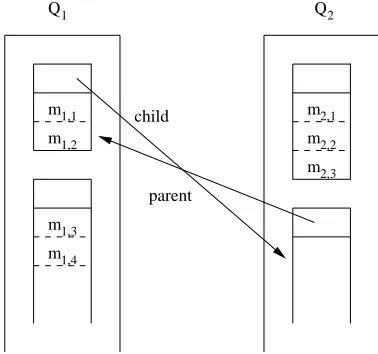
first sends messagesm1,1 andm1,2 toP3, which is followed by a message mtoP2, and then
messagesm1,3 and m1,4 toP3. Also assume that in the same execution,P2 sends messages
m2,1, m2,2, and m2,3 to P3, and then receives m from P1. Figures 2.7 and 2.8 show two
snapshots of the happen-before graph of T3. The first snapshot, as shown in Figure 2.7, is captured before m is received by P2; the second snapshot, as shown in Figure 2.8, is captured afterm is received byP2. Note thatm is not shown in both figures, becausemis not a message sent to T3.
It is very important to note that two global states of a program are equal if and only if the two states contain (1) the same local state for each process; (2) the same values for all the variables of each process; and (3) each port contains the same happen-before graph. Two happen-before graphs are the same if and only if they contain the same set of messages which are organized into the same graph structure (i.e. these messages have the same happen-before graph).
Figure 2.8: The second snapshot ofT3’s happen-before graph
m1,1
m1,2
m1,3
m1,4
m2,1
m2,2
m2,3
parent child
Q1 Q2
2.4.3 Correctness of BSRA
In this section, we prove that BSRA is capable of detecting every deadlock of an asyn-chronous message-passing program.
Definition 11 Let g be a global state of a system P of EFSMs. Let t be a transition ofP
and let ω=t1t2. . . tn be a transition sequence of P, where g=g1 →t1 g2 →t2 . . . tn−1
→ gn→tn g0.
t and ω are said to be independent wrt g if t and ti, 1≤i≤n, are independent wrtgi.
Lemma 2.4.3 Let g be a global state of a system P of EFSMs. Let t be a transition of
P and ω a transition sequence of P. if g → ∗ωt g0 and t and ω are independent wrt g, then
g→∗tω g0.
Definition 12 Let P be a system of EFSMs M1, M2, . . ., and Mn. Let σ =t1t2. . . tm be a transition sequence of P. The projection σ↓i of σ onto Mi, 1≤i≤n, is the transition sequence obtained by removing from σ all transitions not defined inMi.
Theorem 2.4.1 LetP be a system of EFSMsM1,M2, . . ., andMn. Letg be a global state of P. Let ω1, ω2, . . ., and ωn be a set of enabled send/internal transition sequences from
g, where ωi, 1 ≤i≤ n, is a transition sequence of Mi. Let α and β be two send/internal transition sequences such that α↓i =β↓i =ωi (1≤i≤n). Ifg→∗α g0, then g
β