Internal Curing of Concrete Using Prewetted
Light Weight Aggregates
Dayalan J*, Buellah. M**
*Assistant Professor, Department of Civil Engineering, Christ University Faculty of Engineering, Bangalore, Karanataka,India
** Assistant Professor,Department of Civil Engineering, Christ University Faculty of Engineering, Bangalore, Karanataka,India
ABSTRACT:This project deals with objective of gaining knowledge in the field of material science / concrete
technology which includes the study of internal curing of concrete. Applying water externally to the concrete is the conventional approach for curing. In practise conventional type of curing is difficult to perform as it shall need curing membrane and also large amount of water is wasted due to evaporation and runoff. Internal curing refers to the use of prewettedlight weight aggregate to provide sufficient moisture to the hydrating cement throughout the cross section of the concrete. These prewettedlight weight aggregates stores water in it and act as reservoirs which will be able to release the water whenever the concrete requires. Light weight aggregates such as expanded shale or clay is used for internal curing of concrete. The major advantages in internally cured concrete are, the concrete is light weight, free from shrinkage cracks, 3-dimensional curing, and limited use of water.In this study, expanded shale has been used in replacement for coarse aggregates in 10%, 15%, 20% and 25 %..This study also deals with testing of internally cured concrete to meet standards that it would ever need to face.
Keywords – Intrenal curing, Light weight aggregates, Expanded shale
I. INTRODUCTION
Internal curing provides a set of water-filled reservoirs within the concrete that supply water on demand to the hydrating cement paste from the time of mixing (i.e., for reducing plastic shrinkage and maintaining workability) until the time when moisture equilibrium is achieved between the reservoirs and the surrounding cement paste for reducing dry shrinkage. Internal curing is achieved by replacing a percentage of coarse aggregate with light weight aggregate such as expanded shale.The light weight aggregate i.e., the shale is been heated at a temperature of 2000°F after which it is soaked in water for 24 hours and mixed with cement and fine aggregate. This mixture is been poured into the mould and external vibration was used to consolidate the specimen after casting immediately. The water stored in the lightweight aggregates is typically stored in pores that are larger than those in a hydrating cement paste. As a result the water moves from the light weight aggregate to the surrounding cement paste keeping the small pores saturated. The internal curing process utilizes cement more efficiently during the hydration process. Internal curing improves the workability and reduces the cracks due to plastic, drying and thermal shrinkage. The strength of the concrete is increased as the bond between the light weight aggregate and the hydrated cement becomes continuous due to decrease in permeability.
II. LITERATURE SURVEY
expanded in rotary kilns to produce structural grade LWA for use in concrete and masonry units. Millions of tons of structural grade LWA produced annually are used in structural concrete applications.Khokrin, N.K, discussed the unique physical characteristics of rotary kiln expanded slate lightweight aggregate for producing high performance and high strength lightweight concrete. The compressive strength, elastic modulus, splitting tensile strength, specific creep, and other properties of lightweight concrete are significantly affected by the structural properties of the lightweight aggregate used. Concrete production, transportation, pumping and placing are also affected.Hoff. G.C. described the use of near-saturated lightweight aggregate (LWA) as a replacement for a portion of the normal weight aggregate (NWA) in high-strength/high-performance concrete in order to mitigate or eliminate the self-desiccation and autogenous shrinkage that can occur which can further lead to early age cracking and long-term durability problems. The amount of LWA used to achieve beneficial internal curing is a function of the type of LWA, its size and amount, the degree of moisture preconditioning the LWA receives, the amount and type of binder(s) in the mixture, the water-binder ratio at mixing, and the amount and duration of external moist curing provided to the concrete element.ArnonBentura et.al.studied that the concrete with saturated lightweight aggregate exhibited no autogenous shrinkage, whereas the normal-weight concrete with the same matrix exhibited large shrinkage. The study shows that the partial replacement of normal-weight aggregate by 25% by volume of saturated lightweight aggregate was very effective in eliminating the autogenous shrinkage and restrained stresses of the normal-weight concrete. It is noted that the internal supply of water from the saturated lightweight aggregate to the high-strength cement matrix caused continuous expansion, which may be related to continuous hydration. Ryan Henkensiefkenet. al has indicated that while internal curing may have been originally developed to reduce autogenous shrinkage and mitigate early-age cracking in high performance concretes, its application has far-reaching consequences for the performance of concrete throughout its lifetime By providing an on-demand source of extra water, internal curing can improve the slump retention, workability and finishability of fresh concrete and reduce deformations and cracking due to plastic, autogenous and drying shrinkage.
III.MATERIALS
A. Cement
The Ordinary Portland Cement of 53 grade conforming to IS: 12269-1987 is used. Thevariuos tests performed for the cement. The specific gravity of cement was found to be 3.157. The initial and final setting time for cements are found to be 29 minutes and 340 minutes.
B. Coarse Aggregate
The fractions from 20 mm to 4.75 mm are used as coarse aggregate, conforming to IS: 383 is use. The properties of coarse aggregates such as specific gravity and water absorption are found to be 2.67 and 05.1% respectively. these values are within the range as given in IS 383-1970.
C. Fine aggregate
The river sand conforming to the requirements of IS: 383 – 1970 is used as fine aggregate. The river sand is washed and screened to eliminate deleterious materials and over size particles. The properties of sand such as specific gravity and water absorption are found to be 2.52 and 1.14 % respectively.
D. Expanded shale
Table No.1 Properties of Expanded Shale
Fig.1. Expanded shale
IV. PREPERATION OF SPECIMENS
The grade of concrete adopted for investigation is M 25. The free water-cement ratio required for the target mean strength of 33.75 N/mm is 0.43. This is lower than the maximum value of 0.65 prescribed for Mild exposure in IS: 456-1978.The mix design for the concrete blocks is prepared as per IS 10262-2009. The expanded shale is mixed in proportions of 10%, 15% , 20% and 25% by replacing the coarse aggregates. Stationary mixer is used to blend the raw materials together. As the dry raw materials are mixed well, water is added to the mixer.
Table.2. Mix designation Replacement of Expanded Shale in Coarse aggregates
Mix designation % of replacement
of Expanded shale
M0 0 %
M1 10 %
M2 15%
M3 20 %
M4 25 %
V. RESULTS AND DISCUSSIONS
A.Workability Test
The concrete was tested for workability by slump Cone test by varying the percentage of expanded shale in coarse aggregates and values obtainted are within the permissible limit as per IS 456-2000 as shown below in Table.3
Sl.No Property Value
1 Specific Gravity 1.64
2 Water Absorption 10.03 %
Table.3 Slump Cone Test Values
Mix designation Slump value (mm)
M0 33
M1 32
M2 36
M3 37
M4 43
B.Compression Test
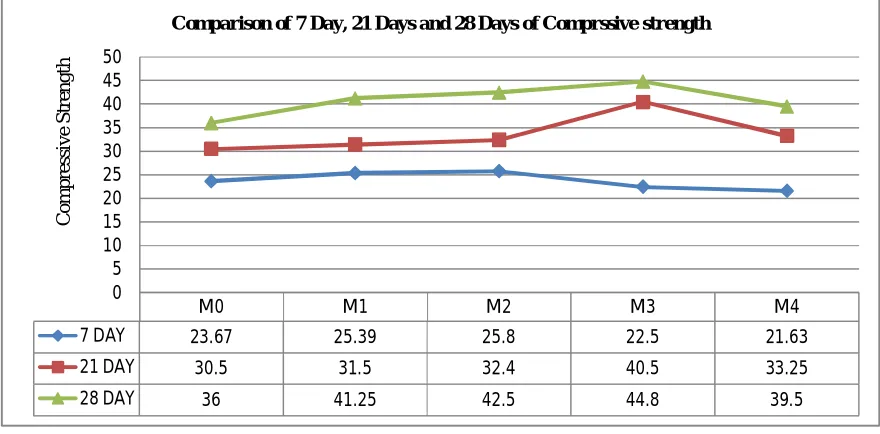
The compressive strength of the cylinders was measured at 7, 21, 28 days and calculated as an average of three cylinders for each age as given in Table 4. Initially the internally cured concrete showed a lower compressive strength, but after 2 weeks, the strength of the concrete increased and exceeded the plain concrete. The compressive strength of the internally cured concrete was about 20% higher than the plain concrete because of the continuous hydration of the mixture at later ages, promoted by the extra water stored in the light weight aggregate. Though lightweight aggregate can be considered the weakest component in concrete the compressive strength of the internally cured concrete is higher than the plain concrete.The comparative study on the compressive strength of the concrete with respect to early strength and strength after 2 weeks (14 day and 28th day) compressive value is performed. From the experiment it is known that 10 % mix shows higher early strength. However, when compared to the control specimen all other the mixes with expanded shale doesn’t show any significant reduction or increase in strength.Thereby by designing the concrete for a compression for 20% of expanded shale help in reducing the cost for a certain value with increased performance and obtaining light weight concrete.
Figure 2 Comparison of Average Compressive Strength after 7 days, 21 days and 28 Days for different mix.
M0 M1 M2 M3 M4
7 DAY 23.67 25.39 25.8 22.5 21.63
21 DAY 30.5 31.5 32.4 40.5 33.25
28 DAY 36 41.25 42.5 44.8 39.5
0 5 10 15 20 25 30 35 40 45 50
C
o
m
p
re
ss
iv
e
S
tr
en
g
th
Table.4 Average Compressive Strength at 7 days, 21 days and 28 days.
Mix Designation Compressive Strenthg (N/mm
2 )
7 days 21 days 28 days
M0 23.67 30.5 36
M1 25.39 31.5 41.25
M2 25.8 32.4 42.5
M3 22.5 40.5 44.8
M4 21.63 33.25 39.5
C.Durability test
1.Rapid Chloride Penetration Test
The rapid chloride penetration test (RCPT) was performed in accordance with ASTM C 1202-12. A cylindrical specimen was prepared. Before testing the sample was vacuum saturated. During testing one surface of the sample was exposed to a sodium chloride solution (3% NaCl) and the other surface was exposed to a sodium hydroxide solution (0.3 M NaOH). A 60V external potential was applied and the resulting current at 15 minute intervals was recorded for a six hour period. The results from the rapid chloride penetrability and the temperature at the end of the 6 hours testing period, shows that internally cured mixture is passing lower charge than the plain concrete.
Figure 3. Rapid Chlorine Penetration Test arrangement
Table.4. Rapid Chlorine Penetration Test
Mix designation Amount of Charge passed
(Columbs)
M0 1725
M1 1625
M2 1525
M3 1425
Figure4. Rapid Chlorine Penetration test values
2.Acid Attack on Control Cube:
The weight of the Control mix cube initially before immersing in acid was found to be 8.23kg.It is then immersed in sulphuric acid for a period of 3 days after which it is taken out dried and then the weight of the cube after drying was found to be 7.05kg.
3. Acid Attack on Cube with 10% Expanded Shale:
The weight of the cube with 10% Expanded Shale initially before immersing in acid was found to be 8.24kg.It is then immersed in sulphuric acid for a period of 3 days after which it is taken out dried and then weighed. The weight of the cube after acid attack was found to be 7.12kg.It is observed that the aggregates were exposed which is seen clearly in the figure.
Fig.3 Acid Attack on Cube(10% Expanded shale) Fig4. Acid Attack on cube(20% Expanded Shale) 4.Acid Attack on Cube with 15% Expanded Shale:
The weight of the cube with 15% Expanded Shale initially before immersing in acid was found to be 8.19kg. The weight of the acid attacked cube was found to be 7.15 kg. It is observed that the resistance of the cube was comparatively better than the previously tested cubes.
5.Acid Attack on Cube with 20% Expanded Shale:
The weight of the cube with 20% Expanded Shale initially before immersing in acid was found to be 8.17kg. The weight of the cube after acid attack was found to be 7.34kg.It is found that only few aggregates were exposed on the surface.
6.Acid Attack on Cube with 25% Expanded Shale: 1200
1250 1300 1350 1400 1450 1500 1550 1600 1650 1700 1750 1800
M0 M1 M2 M3 M4
A
m
o
u
n
t
o
f
C
h
a
r
g
e
p
a
ss
ed
(C
o
lu
m
b
s)
exposed aggregate is also very less. This is because of the increase in the amount of Expanded Shale added to the concrete mix.
VI. CONCLUSION
Based on the results it has been concluded that,
• The internally cured concrete is proved to be better than conventionally cured concrete by all means.
• The addition of Expanded Shale increases the degree of hydration, producing a denser microstructure leading to better curing.
• Compressive strength results reveal that strength of internal cured specimens at 21 days and 28 days are greater but at the age of 7 days the strength is lower than conventionally cured specimens.
• The compressive strength for the internally cured concrete resulted in values 20% higher when compared to the plain concrete.
• The improved hydration also reduce micro cracking as a result of the lower shrinkage tendency of concrete with lightweight aggregate (Expanded Shale) used for internal curing.
• The rapid chloride migration test showed that the internally cured concrete had a lower diffusion coefficient than the plain concrete (15% and 50%, respectively).
• The rapid chloride penetrability of the internally cured concrete is lower than the plain concrete at all of the ages tested (approximately 55% at 180 days).
• The RCPT value for the control mix was found to be greater than the internal cured specimens.
• From the test results it is very clear that the use of lightweight aggregate in concrete as internal curing agent is beneficial for all the aspects investigated in this study.
The use of lightweight aggregate for internal curing of concrete is particularly beneficial as it reduces various shrinkage cracks. The compressive strength for the internally cured concrete resulted in values 20% higher when compared to the plain concrete. Enables a high relative humidity within the pore structure of the concrete which reduces internal drying and extends hydration process which thereby increases strength and durability of the concrete.
REFERENCES
[1.] Khokrin, N. K. (1973). “The durability of lightweight concrete structural members,” Kuibyshev, USSR (in Russian)
[2.] Hoff. G.C. (2006), “Internal Curing of Concrete Using Lightweight Aggregates”, American Concrete Instiute, Volume 234, March 2006, P621-640. [3.] Briatka P.(2010), “Internal Curing of Concrete Using Lightweight Aggregate”, Proceedings of Conference on Design,Preparation and Execution of
Constructions, Bratislava, March 2010.
[4.] ACI Committee 213. (2003). Guide for structural lightweight aggregate concrete. Farmington Hills, MI: American Concrete Institute.
[5.] P. Briatka, P. Makys,(2011) “Desorption and use of Saturated lightweight Aggregate in internal Curing” Slovak Journal of Civil Engineering, 2011, Vol XIX, No.3,31-38.
[6.] SemionZhutovsky, Konstantin Kovler.(2012), “Effect of internal curing on durability-related properties of high performance concrete”, Cement and Concrete Research, Volume 42, Issue 1, January 2012, Pages 20–26.
[7.] Ryan Henkensiefken, Javier Castro, Haejin Kim, Dale Bentz, and Jason Weiss “Internal Curing Improves Concrete Performance throughout its Life” Concrete In Focus, September-October 2009.
[8.] ArnonBentura, Shin-ichiIgarashib, Konstantin Kovlera, “Prevention of autogenous shrinkage in high-strength concrete by internal curing using wet lightweight aggregates”, Cement and Concrete Research, Volume 31, Issue 11, November 2001, Pages 1587–91.
[9.] A Internal Curing: A 2010 State-of-the-Art Review , NIST IR 7765,nist.gov/manuscript-publication-search.cfm/pub_id=907729
[10.]Villarreal, V.H., and Crocker, D.A., “Development of Internally Cured Concrete for Increased Service Life” Publication FHWA/IN/JTRP-2010/10. Joint Transportation Research Program, Indiana Department of Transportation and Purdue University, West Lafayette, Indiana, 2010.
[11.]Castro, J. (2011). Moisture transport in cement-based materials: Application to transport tests and internal curing. Retrieved through Purdue University. [12.]Roberts, J., “High Performance Concrete: Enhancement Th rough Internal Curing”, Concrete InFocus, Vol. Winter 2006, pp.55-59, (2006).
[13.]Henkensiefken, R., “Internal Curing in Cementitious Systems Made Using Saturated Lightweight Aggregate,” Purdue University, 2008.
[14.]Henkensiefken, R., Castro, J., Bentz, D.P., Nantung, T., and Weiss, J., “Water Absorption in Internally Cured Mortar Made with Water-Filled Lightweight Aggregate”, Cement and Concrete Research, Vol. submitted, pp. (2008).
[15.]Bentz, D.P., “Influence of Internal Curing Using Lightweight Aggregates on Interfacial Transition Zone Percolation and Chloride Ingress in Mortars”, Cement and Concrete Composites, Vol. accepted, pp. (2008).
[16.]Internal Curing of Concrete, RILEM Publications S.A.R.L., Paris, (2007).