ISSN: 2319-8753
I
nternational
J
ournal of
I
nnovative
R
esearch in
S
cience,
E
ngineering and
T
echnology
(An ISO 3297: 2007 Certified Organization) Vol. 3, Issue 1, January 2014
Optimization of Surface Topography for Hard
Material Machining With CNC End Milling
Anmol Kumar
1, M.K. Paswan
2Assistant Professor, Dept. of Mechanical Engg., B. A. College of engg. & technology, Jamshedpur, Jharkhand, India 1
Professor, Dept. of Mechanical Engg, N.I.T Jamshedpur, Jharkhand, India 2
Abstract: In the present research, an attempt has been made to experimentally investigate the effects of cutting parameters on surface roughness in hard milling of AISI H13 steel with coated carbide tools. Based on face centered cubic method, three-factor (spindle speed, feed rate and depth of cut) and three-level experiments were employed using Commercial statistical software. The surface roughness of machined surface was measured using Surface roughness profilometer (MARSURF PS 1) and then using RSM and analysis of variance (ANOVA) are performed. It is found that the spindle speed and the feed are the two dominant factors affecting the surface roughness. The optimal cutting parameters for minimal surface roughness in the range of this experiment under these experimental conditions are searched. Empirical models for surface roughness are established, a quadratic model best describes the variation of surface roughness.
Keywords: Response Surface Methodology, CNC vertical Milling Machine
I. INTRODUCTION
The advancement of modern technology and a new generation of manufacturing equipment, particularly computer numerical control (CNC) machine, have brought enormous changes to the manufacturing sector. Generally, the handbook or human experience is used to select convenient machine parameters in manufacturing industry. In process planning of conventional milling, selecting reasonable milling parameters is necessary to satisfy requirements involving machining economics, quality and safety. The machining parameters in milling operations consists of cutting speed, depth of cut, feed rate and number of passes. These machining parameters significantly impact on the cost, productivity and quality of machining parts. The effective optimizations of these parameters affect dramatically the cost and production time of machined components as well as the quality of final products. In order to get specified surface roughness, selection of controlling parameters is necessary. There has been a great many research developments in modeling surface roughness and optimization of the controlling parameters to obtain a surface finish of desired level since only proper selection of cutting parameters can produce a better surface finish. But such studies are far from complete since it is very difficult to consider all the parameters that control the surface roughness for a particular manufacturing process. In CNC milling there are several parameters which control the surface quality. The analysis of surface roughness on CNC end milling process is a big challenge for research development. Several factors involved in machining process have to be optimized to obtain a desired surface quality. In this study, three machining parameters are considered viz. spindle speed, feed rate and depth of cut. Computer Numerical Control (CNC) is one in which the functions and motions of a machine tool are controlled by means of a prepared program containing coded alphanumeric data.
ISSN: 2319-8753
I
nternational
J
ournal of
I
nnovative
R
esearch in
S
cience,
E
ngineering and
T
echnology
(An ISO 3297: 2007 Certified Organization) Vol. 3, Issue 1, January 2014
turning, boring, and milling. Hard turning was early recognized and pioneered by the automotive industry as a means of improving the manufacturing of transmission components. Gear-wheel bearing surfaces are a typical example of early applications converted from grinding to hard machining using inserts in polycrystalline cubic boron nitride (PCBN). Case-hardened steel components are typical, often having a hardness-depth of just over 1 mm, giving it a wear resistant case and a tough core. Components that make use of this combination of material properties include gears, axles, arbors, camshafts, cardan joints, driving pinions, and link components for transportation and energy products, as well as many applications in general mechanical engineering. Kang et al. [1] carried out a comparative study, evaluating the characteristics of machined steel with a hardness of 28 HRc in a workpiece of planar geometry, varying the angle of inclination to 15, 30, and 45 degrees, using four possible cutting strategies. They used a solid carbide ball nose end mill coated with TiAlN, having a diameter of 10 mm and two cutting edges. They presented a qualitative and quantitative analysis of the surfaces obtained, showing images of the surface texture and graphs of roughness for each condition. The texture obtained for each condition shows the influence of the cutting strategy employed. These authors reported that the strategies employing an ascending cut, with the tool executing the cut from the base of the inclined plane and going up, presented lower values of surface roughness and a more homogeneous texture when compared with the descending strategies.
Although the machining of hardened steels presents difficulties during machining, Junz Wang and Zheng [2] showed that it offers advantages in the process and the final machined product, providing improvement in surface quality and dimensional control. A final machining after the thermal treatment, with the material already at the final work hardness, prevents recurrent problems related to the hardness, such as possible workpiece distortion and dimensional variation. One of the more basic and predominant geometric forms in the manufacture of molds and die cavities is the inclined plane. To simulate a finishing condition, geometry of low complexity was adopted, defined as an inclined surface, in one workpiece of definite and reduced dimensions. The main doubt in the machining of this geometry is to know what the best strategy is, defined as the tool trajectory. This includes the workpiece inclination, defined as the angle formed between the tool and a plane normal to the axis of the tool. We consider the ball-nose end mill, which is the type of tool most appropriate for finishing processes on surfaces with complex forms. In the literature, studies of the machining of inclined planes are restricted mainly to evaluating the life of the tool and varying the cutting conditions (feeds and speeds). A smaller number of papers go beyond this and consider the cutting strategies, comparing them with the surface quality obtained. The strategies are defined by the feed and cutting directions, being vertical or horizontal with respect to the plane, and with a direction that can be ascending (upward) or descending (downward).
Toh [3] carried out an analysis of the topography of surfaces machined on AISI H13 with hardness 52 HRc. The analysis evaluated different cutting strategies and cutting path orientations, using a planar geometry, inclined at 75°, simulating a finishing process. They used a solid tungsten carbide ball nose end mill, with TiAlN coating, with a diameter of 10 mm and six cutting edges. The objective was to understand the surface texture generated by certain cutting path orientations in a material of difficult machinability. An analysis of the topography resulted in three dimensional graphs of the roughness profile and allowed a determination of the best orientation for obtaining texture of better quality. In conclusion, Toh reported that the strategy involving an ascending vertical cut provided the best results.
According to Tabenkin [4], the finishing or texture can be described in terms of the number and direction of the valleys and peaks that compose a surface. The analysis of the surface, in practical terms, can be made in terms of three basic components: roughness, undulation, and form. Generally, the three exist simultaneously, overlapping, although in many situations, it is desirable to examine each condition independently
Aman Aggarwal and Hari Singh [5] reviewed various linear and non linear optimization techniques were studied in detail and relative advantages are also discussed and inferred for the non linear optimization methods are the most suited for the optimization of machining processes. The suggestion of the authors is to follow appropriate set of optimization methods based on the problem on hand and also to use a base statistical method to get the initial basic feasible solution and a non linear like genetic algorithm according to the respective problem and solution requirements.
II
DESIGNOF EXPERIMENTSISSN: 2319-8753
I
nternational
J
ournal of
I
nnovative
R
esearch in
S
cience,
E
ngineering and
T
echnology
(An ISO 3297: 2007 Certified Organization) Vol. 3, Issue 1, January 2014
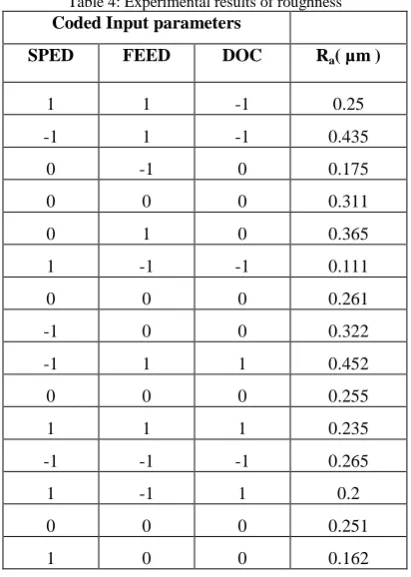
roughness values a total of 20 experiments are conducted at 3 levels for the three input variables speed, feed and depth of cut. Table 1shows the actual Design data and Table 4 shows the measured Ra with coded parameters.
Table 1: Recommended value of input parameters
Factors Unit Level -1
Level 0
Level 1
A. Speed rpm 3500 4000 4500 B. Feed rate mm/t 0.01 0.03 0.05 C. Depth Of Cut mm 0.20 0.35 0.5
III EQUIPMENTS AND MATERIAL
The machine used for the milling tests was a „Surya VF30CNC VS‟ CNC end milling machine having the control system „ FANUC- Oi mate model C‟ with a vertical milling head. For generating the milled surfaces, CNC part programs for tool paths were created.
A. Work Piece Material
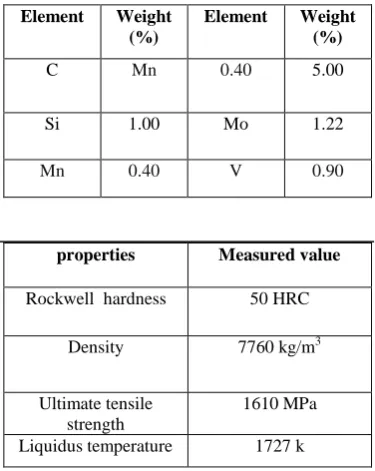
The work piece material used for present work was AISI H13 alloy steel. The chemical composition of AISI H13 is given in Table-2. The hardness of the material is found around 50 HRC using SAROJ Hardness Testers (Model – RAB-250) before start of machining.
Table 2: Chemical composition (wt %) of AISI H13
Element Weight (%)
Element Weight (%)
C Mn 0.40 5.00
Si 1.00 Mo 1.22
Mn 0.40 V 0.90
properties Measured value
Rockwell hardness 50 HRC Density 7760 kg/m3
Ultimate tensile strength
1610 MPa Liquidus temperature 1727 k
Table3: Mechanical properties of H13
ISSN: 2319-8753
I
nternational
J
ournal of
I
nnovative
R
esearch in
S
cience,
E
ngineering and
T
echnology
(An ISO 3297: 2007 Certified Organization) Vol. 3, Issue 1, January 2014
B. Tool
Commercially available CVD coated carbide tools have been used for the present investigation. The tools used are flat end mill cutters and the tools are coated with TiAlN coating.
Details of the inserts are given bellow: Manufacturer : Mitsubishi material cop. Code : A0MT123608PEER-M Grade : VP15 TF
Rake angle (αn) = 11o
The insert were fitted to a compatible cutter of diameter 20 mm from the same manufacture i.e. Mitsubishi material cop. Details of the high performance cutter used during the experiments are given bellow:
Cutter code : APX3000 R202SA20SA No. of teeth : 2 Nos
Maximum ramping angle: 9o
C. Surface Profilometer
Surface roughness was measured using the “MarSurf PS1” surface profilometer manufactured by Mahr GmbH Gottingen. The arithmetic average roughness values (Ra) was measured by this instrument. The surface finish of the
machined H13 steel block was measured after every machining using the profilometer.
IV MEASUREMENT OF SURFACE ROUGHNESS
Surface roughness is measured after each run of experiment. Details of measurement techniques for the measuring surface roughness are given individually in next article. Surface finish values (Ra- arithmetic average) was measured
using a stylus profilometer (Mar Surf PS1). Calibration of the instrument automatic of the roughness width cut off based on the roughness values expected. A total of 60 readings were taken to determine the average surface roughness of cut i.e. one reading in the centre of the block and other two readings at a distance of 5 mm from the right side.
Table 4: Experimental results of roughness Coded Input parameters
SPED FEED DOC Ra( µm )
1 1 -1 0.25 -1 1 -1 0.435
ISSN: 2319-8753
I
nternational
J
ournal of
I
nnovative
R
esearch in
S
cience,
E
ngineering and
T
echnology
(An ISO 3297: 2007 Certified Organization) Vol. 3, Issue 1, January 2014
0 0 1 0.241 0 0 0 0.253 0 0 -1 0.26 -1 -1 1 0.237
0 0 0 0.175
V STATISTICAL ANALYSIS
A response surface model was designed and analyzed using design expert software table 5 shows the Analysis of Variance ANOVA was carried out to determine the effect of cutting parameters on the surface roughness.
Table5: Analysis of variance (ANOVA) for surface roughness (Ra)
Source DF Seq SS Adj SS Adj MS F P
Regression 9 0.162415 0.018046 0.018046 18.37 0.000
Linear 3 0.159699 0.053233 0.053233 54.18 0.000
Speed 1 0.079745 0.079745 0.079745 81.16 0.000
Feed 1 0.079032 0.079032 0.079032 80.43 0.000
Doc 1 0.000922 0.000922 0.000922 0.94 0.356
Square 3 0.000888 0.0008 0.000296 0.30 0.824
S = 0.0313461 PRESS = 0.0148926
R-Sq = 94.30% R-Sq (pred) = 91.35% R-Sq (adj) = 89.16%
The mathematical relationship for correlating the surface roughness using uncoded data and the considered process variables has been obtained as follows,
Ra=0.251709-0.089300*SPEED+0.088900*FEED-0.009600*DOC 0.0107727*SPEED*SPEED
+0.0172273*FEED*FEED-0.00227273*DOC*DOC-0.008875*SPEED*FEED-0.006875*SPEED*DOC+0.01012*FEED*DOC
…….. Eqn1
VI RESULT AND DISCUSSION
ISSN: 2319-8753
I
nternational
J
ournal of
I
nnovative
R
esearch in
S
cience,
E
ngineering and
T
echnology
(An ISO 3297: 2007 Certified Organization) Vol. 3, Issue 1, January 2014
A. Effect of Process Parameters on Ra
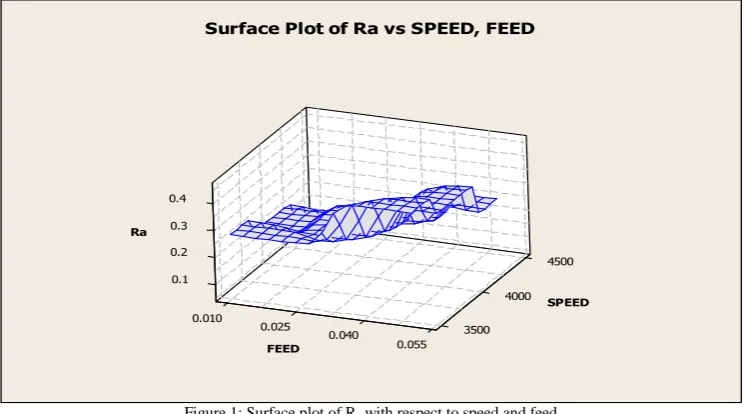
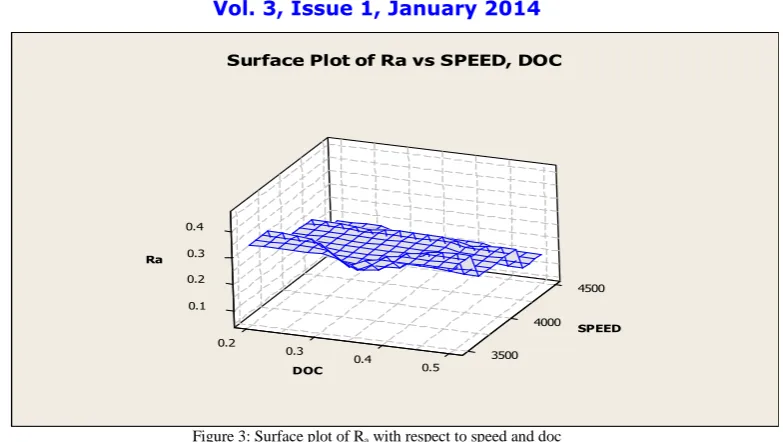
The surface plots physically represent the variation of the roughness parameters with respect to cutting parameters. In each of the surface plots, two cutting parameters are varied simultaneously along X and Y axes while the response parameters are recorded along Z axis.
4 4500 0.1
000 0.2
0.3 0.4
0.010
0.025 3500
0.040
0.055
Ra
SPEED
FEED
Surface Plot of Ra vs SPEED, FEED
Figure 1: Surface plot of Ra with respect to speed and feed
Surface roughness is shown in Z- axis with respect to feed (X-axis) and speed (Y-axis). In the plot, value of surface roughness is increased with increase in feed rate and it is decreased with increased in spindle speed.
0 0.055
.040
2 0.1 0.2 0.3
0.025 0.4
0.
0.3 0.010
0.4 0.5
Ra
FEED
DOC
Surface Plot of Ra vs FEED, DOC
Figure 2: Surface plot of Ra with respect to feed and doc
The surface plot graph shows the surface roughness parameters (Ra) in Z-axis corresponding to depth of cut (X-axis)
ISSN: 2319-8753
I
nternational
J
ournal of
I
nnovative
R
esearch in
S
cience,
E
ngineering and
T
echnology
(An ISO 3297: 2007 Certified Organization) Vol. 3, Issue 1, January 2014
4 4500 0.1
000 0.2
0.3 0.4
0.2
0.3 3500
0.4
0.5
Ra
SPEED
DOC
Surface Plot of Ra vs SPEED, DOC
Figure 3: Surface plot of Ra with respect to speed and doc
From fig.3 it is clear that at high spindle speed, the value of surface roughness is very small. For the constant spindle speed, if depth of cut is increased, we observe that value of surface roughness is increased. But at higher spindle speed and minimum depth of cut the value of surface roughness is minimum.
B. Optimal Process Parameters
Here we consider only the surface roughness is the output response for our selected input parameters, for this case we find the optimal cutting parameters and minimum surface roughness after analyzing the process parameters in RSM. We find the optimal solution for speed, feed & depth of cut is shown in table 6.
Table 6: Optimal value for surface roughness Speed
( rpm)
Feed (mm/tooth)
Depth of cut (mm)
Surface roughness (μm)
4500 0.01 0.5 0.0599659
REFERENCES
[1] Kang MC, Kim KK, Lee DW, Kim JS, Kim NK (2001) Characteristics of inclined planes according to the variations of cutting direction in high-speed ball-end milling. Int J AdvManuf Technol 17:323–329
[2] Junz Wang JJ, Zheng MY (2003) on the machining characteristics of H13 tool steel in different hardness states in ball end milling. Int J Adv Manuf Technol 22:855–863
[3] Toh CK (2004) Surface topography analysis in high speed finish milling inclined hardened steel. Precis Eng 28:386–398
[4]Tabenkin A (2005) Surface finish: a machinist‟s tool, a design necessity. Mod Mach Shop. Nº 3. 30 May .
[5] Aman Aggarwal and Hari Singh (December 2005): Optimization of machining techniques–A retrospective and literature review Optimization on machining techniques Vol. 30, Part 6, , pp.
699–711
ISSN: 2319-8753
I
nternational
J
ournal of
I
nnovative
R
esearch in
S
cience,
E
ngineering and
T
echnology
(An ISO 3297: 2007 Certified Organization) Vol. 3, Issue 1, January 2014
BIOGRAPHY
Anmol Kumar received his M.Tech degree from NITTTR KOLKATA in the year 2012. He is Currently Assistant Professor at the Department of Mechanical Engineering, B.A. College of Engg,& technology, Jamshedpur , Jharkhand India. His area of interest is CNC Machines, Automated Manufacturing System and FMS.
Dr. M K Paswan