Design and Analysis of Channel Assignment
Algorithm for IEEE 802.11 WLAN Network
Performance Enhancements
Ram Krishan
1, Dr. Vijay Laxmi
2Research Scholar, Guru Kashi University, Talwandi Sabo (Bathinda), Punjab, India1
Dean, University College of Computer Applications, Guru Kashi University, Talwandi Sabo (Bathinda), Punjab, India2
ABSTRACT: Wireless local area network (WLAN’s) using single channel have limited bandwidth. Channel
interference between Access Points (APs) of WLAN also decreases the network throughput. The solution of this problem is to transmit data simultaneously on multiple channels is considered as an alternative. In this paper, we propose a channel assignment algorithm for wireless local area network (WLAN) to analyse and enhance the network performance. The proposed algorithm finds the best suitable channel assignment option in order to attain desired performance. We use the RIVERBED MODELER simulator to simulate the WLAN environment with different channel assignment schemes. Simulation results with fixed and mobile (STA) stations demonstrate that our proposed channel assignment algorithm improve the network throughput 2 times higher as compare to other channel assignment schemes.
KEYWORDS: Channel Interference, WLAN, Throughput, Network Performance, Riverbed Modeler.
I. INTRODUCTION
In this paper we study the problem of how to assign the available channels [1] to among access points in WLAN environment. Frequency (or channel) allocation [2] is a well-studied subject in cellular wireless telephony [3, 6], where it has been guided by two design principles: frequency reuse based on a cellular architecture consisting of hexagonal cells and permanent allocation of channels to different cells.
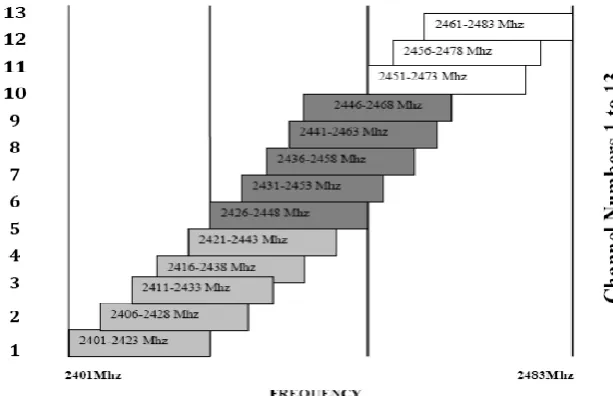
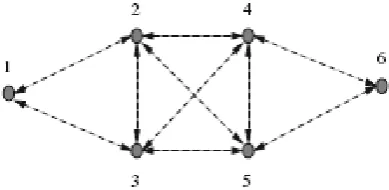
In IEEE 802.11 Wireless Local Area Network (WLAN) only 14 channels are used out of which three channels 1, 6 and 11 are non-overlapping [3, 13], as shown in Fig. 1. The frequency gap between two adjacent channels is 5 MHz. For instance, channel 1 range is from 2.401GHz to 2.423 GHz and its center frequency is 2.412 GHz [5]. The increase in access point (APs) deployment directs the researchers to develop new channel assignment algorithms [9] to reduce co-channel and adjacent co-channel interferences [10, 13]. Such co-channel interferences degrades the overall network performance. For example, consider the WLAN consisting of 6 APs shown in Fig. 2 [2]. In this figure the presence of an arrow between each pair of APs indicates that they interfere with each other.
Fig. 2 Channel Assignment Difficulty
In other words, concurrent transmissions (using the same channel) by each pair of APs connected by an arrow interfere with one another. Clearly, with only three channels, there is no way to assign channels to APs without at least one pair of connected (and hence interfering) APs being assigned the same channel. A channel that is available at a given time and in a given segment of the network may be unusable later due to external interference.
II.RELATEDWORK
In [13] the authors proposed a WLAN channel management algorithm to maximize the network efficiency by managing users on different channels so that the network throughput is maximized. This algorithm is uses a software agent to manage and communicate with the network APs. This algorithm shows the efficient management of users and increases the WLAN channel utilization. The work in [2] presents frame-based channel allocation architecture for WLANs. Authors proved that the system throughput can be optimized by scheduling APs and allocating channels in each frame such that a weighted queue sizes at the activated APs is maximized. The authors of [15] proposed a channel scanning technique to minimize the disconnection of the wireless stations. They introduced a channel scanning method in which wireless station scans the channels selected by the Neighbor Graph. In [16] an algorithm for Channel assignment is presented to maximize the (SIR) at user level for appropriate channel assignment at each AP. This algorithm minimizes the interference between APs and assigns channel to each AP after calculating SIR for each user. Work in [14] presents an un-administrated wireless local area network (WLAN) channel assignment to enhance the quality of WLAN by using the capacity of the IEEE 802.11 frequency spectrum.
III.PARAMETERSAFFECTINGTHEWLANPERFORMANCE
The following are various parameters affecting the WLAN performance [3, 10].
1. Number of Users
The number of users associated with network affects the performance as the medium is shared. The increase of users associated with an AP causes the higher interference in the neighbouring cells.
2. Channel Interference
The channel allocation becomes very difficult when deploying WLAN. There are two types of channel interference. Adjacent channel interferencebetween two access points is caused due to the fact that APs may share the same frequency bandwidth.
3. Communication load
The communication load [4] is the amount of traffic that an AP is forward to its associated clients. As the load on AP is increased it affects the network throughput.
4. Power Signal
There is a minimum threshold power value for receiver that the received signal must have to reach at this bit rate. If the received signal power is lower than the threshold the maximum bit rate [12] could be decreased, impacting performance.
IV.MATHEMATICALREPRESENTATIONOFOURALGORITHM
The following variables are used in our algorithm to evaluate the network performance.
t is the total number of channels. aM is the channel assigned to APM.
n is the total number of APs. tM is the total interference at APM.
rMN is the relative interference that APN cause on APM.
αMN is the co-channel interference factor between APM and APN.
βMN is the distance between APM and APN.
p is path-loss exponent (impact of overlap due to adjacent channel).
f is the overlapping channel factor.
Min Max {t1, t2- - - - tn} (a1, a2, a3, - - - - an)
Subject to conditions
𝑡₁ =𝛼₁₁ 𝛽11𝑝 +
𝛼₁₂ 𝛽12𝑝 +
𝛼₁₃
𝛽13𝑝 + − − − − 𝛼1𝑛
𝛽1𝑛𝑝
𝑡₂ =𝛼₂₁ 𝛽21𝑝 +
𝛼₂₂ 𝛽22𝑝 +
𝛼₂₃
𝛽23𝑝 + − − − − 𝛼2𝑛
𝛽2𝑛𝑝
∙ ∙ ∙ ∙ ∙ ∙ − − (∗)
∙ ∙ ∙
𝑡𝑛 =
𝛼𝑛1
𝛽𝑛1𝑝 + 𝛼𝑛2
𝛽𝑛2𝑝 + 𝛼𝑛3
𝛽𝑛3𝑝 + − − − − 𝛼𝑛𝑛
𝛽𝑛𝑛𝑝
Let 𝑟𝑀𝑁 = 𝛼𝑀𝑁
𝛽𝑀𝑁𝑝
(∗) Becomes
𝑡1= 𝑟11+ 𝑟12+ − − −𝑟1𝑛 = r1N 𝑛
𝑡2= 𝑟21+ 𝑟22+ − − −𝑟2𝑛 = r2N 𝑛
𝑁=1
∙ ∙ ∙
∙ ∙ ∙ − − (∗ ∗)
∙ ∙ ∙
𝑡𝑛 = 𝑟𝑛1+ 𝑟𝑛2+ − − −𝑟𝑛𝑛 = rnN 𝑛
𝑁=1
Rewriting ∗ ∗ as
𝑡𝑀= rMN 𝑛
𝑁=1
(M = 1, 2, − − −n)
𝛼MN = 1 − aM – aN × f if 𝛼MN > 0
0 otherwise
for M, N = 1, 2, - - - - n, aM , aN belong to {1, 2 - - - -, t}
V. EVALUATIONOFCHANNELASSIGNMENTALGORITHM
Our channel assignment algorithm is evaluated through extensive RIVERBED MODELER [7, 11] simulations. We compare our channel assignment algorithm with three other channel assignment schemes. Simulation results with fixed and mobile (STA) stations demonstrate that our proposed algorithm enhances the WLAN network performance in terms of delay, data dropped, retransmission attempts and throughput. The number of users associated with network affects the performance as the medium is shared. The increase of users associated with
1. Common Channel Assignment (CCA)
In this type of channel assignment only one common channel is assigned to all the APs. This is a very common approach where all APs use a default selected channel (like channel 6). The manufacturers of network devices designed their products which work on a default channel and this condition is generally applied in the wireless local area network.
2. Random Channel Assignment (RCA)
In this type of assignment the owner of the APs select any random channel without knowing the channel interference constraints of the network.
3. Non- overlapped Channel Assignment (NCA)
In this type of assignment only non-overlapped channels are assigned to the APs. In case of 802.11g mode of LAN channel 1, 6 and 11 are non-overlapped channels. We evaluate the efficiency of proposed algorithm with best suitable channel assignment option in order to attain desired performance.
VI.NETWORKSETUPDETAILS
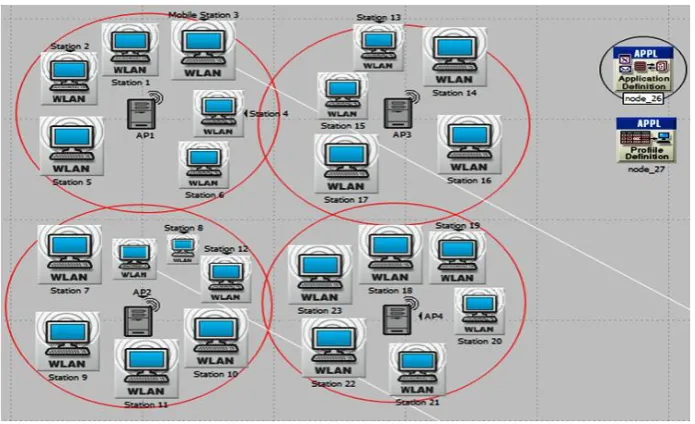
In NCA (Non-overlapping Channel Assignment) Scheme, channel 1, 6, 6 and 11 were assigned based on minimizing interference among neighboring APs to AP1 to AP4 respectively. In RCA (Random Channel Assignment) Scheme channel 3, 6, 7, and 11 assigned to AP1 to AP4 respectively. Finally, in proposed algorithm scheme channel 1, 6, 5 and 10 were assigned to AP1 to AP4 for optimal channel assignment. Only one scenario is created and other was duplicated while modifying the channels at each AP.
Fig. 3 Wireless LAN Riverbed Scenario
VII. SIMULATIONRESULTS
To analyse the performance of proposed channel assignment algorithm we simulate the wireless LAN environment described in figure 3 using the Riverbed Modeler 17.5 [11]. The simulated network contains 4 fixed APs, 22 workstation nodes, 2 mobile stations, an application definition and profile definition. This wireless network is simulated four times with common, non-overlapped, random and proposed channel scenarios.
Figure 6 shows the global delay (sec.) statistics. It represents the delay of packets received by all WLAN nodes in wireless LAN and forwarded to higher layer. We observe that the average delay for our proposed algorithm is reduced by 10 to 20 percent. The mean value for data dropped in all schemes is above 0.00100 seconds.
Fig. 7 Global Data Dropped Statistics
Figure 7 plots the total higher layer data traffic (bits/sec) dropped by WLAN nodes because of inconsistent retransmissions. The amount of global data dropped in case of our proposed algorithm is equal to the NCA and lesser than the CCA, RCA schemes. So global data dropped in our proposed algorithm is comparable to all other schemes.
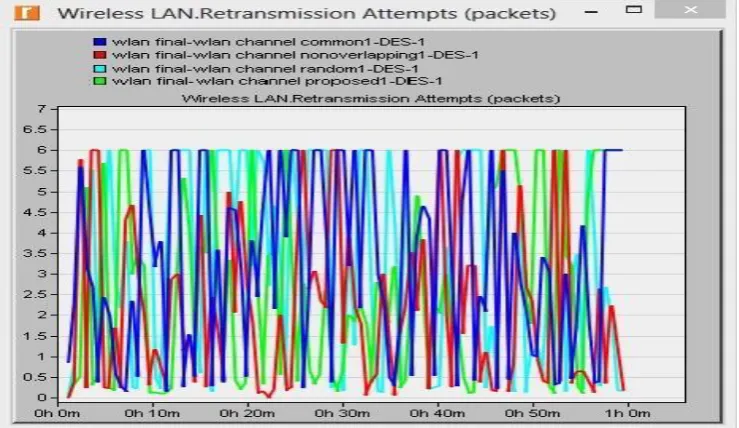
Figure 8 represents the number of retransmission attempts by WLAN nodes in the network waiting for packets to be transmitted successfully or discarded due to short or long retry limit. Result shows that the minimum and maximum values of retransmission attempt for proposed algorithm are 0.056 and 2.56 respectively which is lesser than among all other algorithms.
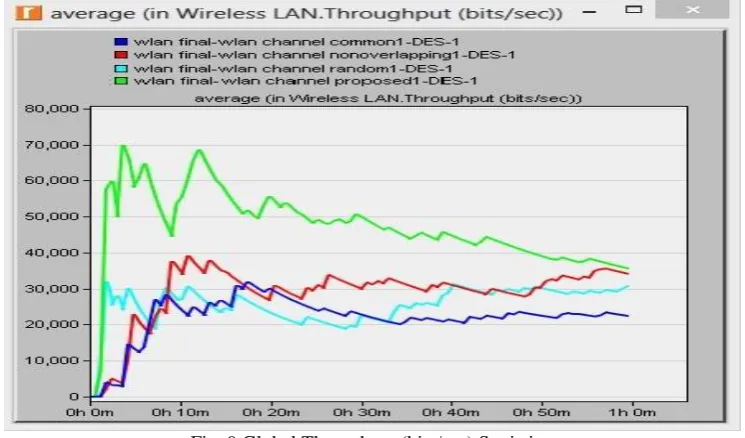
Fig. 9 Global Throughput (bits/sec) Statistics
Figure 9 represents the number of bits/second forwarded to higher layers by all wireless nodes of the WLAN layer in
the network. We observe that our proposed algorithm shows maximum throughput among all the other algorithms. With proposed algorithm the amount of throughput is 2 times higher as compare to all CCA and RCA. In case of NCA our proposed algorithm gives much better throughput result. The maximum value and mean value of throughput for all the schemes is given in table I suggests that our proposed algorithm performs better with compare to other scheme.
TABLE I Throughput Results
Channel Assignment Scheme Throughput
Maximum Value Mean Value
CCA 31,943 21,854
NCA 57,759 32,236
RCA 32,085 25,381
Proposed Scheme 69,990 46,818
We can conclude that our proposed algorithm provides better network performances in the wireless LAN. With proposed algorithm it is possible to manage the available channels and enhance the global WLAN performance.
VIII. CONCLUSIONANDFUTUREWORK
REFERENCES
[1] Andreas Konsgen, “Design and Simulation of Spectrum Management Methods for Wireless Local Area Networks”, Publisher Vieweg Teubner Verlag, pp. 49-51, 2010.
[2] S. Jamaloddin Golestani, Rajeev Rastogi and Mark A. Smith, “Optimal scheduling for dynamic channel allocation in wireless LANs”, Wireless Network, Vol. 16, pp. 1569-1586, 2010.
[3] T. Rappaport, “Wireless Communications: Principle and Practice, Prentice Hall”, pp. 19-23, 2006.
[4] George Athanasiou, Ioannis Broustis, and Leandros Tassiulas, “Efficient Load-Aware Channel Allocation in Wireless Access Networks”
Journal of Computer Networks and Communications, Vol. 2011, pp. 13, 2011.
[5] William Stallings, Wireless Communications & Networks, Prentice Hall, pp 430, 2005.
[6] Katzela, I., & Naghsineh, M., “Channel assignment schemes for cellular mobile telecommunication systems: A comprehensive survey”, IEEE Personal Communications, Vol. 3, pp. 10–30, 1996.
[7] Zheng Lu and Hongji Yang, “Unlocking the power of OPNET Modeller”, Cambridge University Press, 2012.
[8] K. K. Leung and B. J. Kim, “Frequency Assignment for IEEE 802.11 Wireless Networks”, 58th IEEE Vehicular Technology Conference, Vol. 3, pp. 1422–1426, 2003.
[9] Ryoichi Sato and Hiroshi Shirai, “Simplified Analysis for Indoor Propagation of a WLAN Channel”, IEEE International Symposium Digest, Vol. 3, pp. 248-249, 2001.
[10] E. Rozner, Y. Mehta, A. Akella, and L. Qiu, “Traffic aware channel assignment in enterprise wireless LANs”, 15th IEEE International Conference on Network Protocols (ICNP ’07), pp. 133-143, 2007.
[11] http://www.scribd.com/doc/245143573/Riverbed-Modeler-Tutorial.
[12] Cheng Kuan, and Ng ZhengYong, “Providing Quality of Service (QoS) in IEEE 802.11 Hot Spots”, First International Conference on Distributed Frameworks for Multimedia Applications (DFMA’05), pp. 2-7, 2005.
[13] Ram Krishan and Sukhwinder Singh, “A Noval Approach for Managing Channels in Wireless Network”, International Journal of Computer Applications, Vol. 1, pp. 43-48, 2010.
[14] Michael Finsterbusch and Patrick Schmidt, “Study of algorithms to optimize frequency assignment for autonomous IEEE 802.11 access points” International Journal of Computer Science Issues, Vol. 7, Issue 5, pp. 64-72, 2010.
[15] Sang-Hee Park, Hye-Soo Kim, Chun-Su Park, Jae-Won Kim, and Sung-Jea Ko, “Selective Channel Scanning for Fast Handoff in Wireless LAN Using Neighbor Graph” IFIP International Federation for Information Processing, pp. 194-203, 2004.