Performance of Concrete by partially replacement
of Cement with Glass powder and Rice husk ash
Mayur Mandloi
1,Vinay Deulkar
21 PG Student ,JITBorawan ; 2 Asst. Prof. ,JIT Borawan
Jawaharlal Institute of Technology, Borawan
EmailAdress :
[email protected]
; [email protected]
Abstract -
Concrete is a basic construction material. Being at the core of construction conventional concrete attracts many researchers toward itself. The main objective of researchers now a day is to increase the strength of conventional concrete and decrease the cost of conventional concrete by replacing cement with various industrial waste materials such as waste glass powder ,fly ash ,ceramic waste , blast furnace slag , Polymers and rice husk ash etc .This study is mainly concentrated on the use of Glass waste and Rice husk ash in concrete and observe effect of it. The purpose of using the Glass powder to reduce cost and rice husk ash to increase binding property because its an pozzolanic material.Keywords
-
Glass powder ,Rice Husk ash ,Workability ,Strength1. INTRODUCTION
As we know now a day developing as well as developed countries facing of lack availability of land and methodology for efficient disposal of waste .We need efficient alternative methods to dispose off this waste conveniently or Regenerating and reusing this waste for beneficial purpose. In this research, considering the used of post consume waste glass, there is effort to recover and use waste glass or otherwise its end up at disposal landfill as well as the rice husk ash that’s generated as by product from the furnace . Currently most of recovered waste glass is used by glass manufactured company in the production of new glasses used to manufacture many objects . But only a limited amount of waste glass is used for making new glass. These is because, manufactures only can use waste glass that’s has been pre-sorted by color and type and this is exclude waste glass that mixed with color were it is very expensive to produce new glass and even all the black and green glass bottles, car windshield, glass for cathode-ray tubes, glass for liquid crystal panels, glass building materials such as windowpane, and the like other than the colorless and brown bottles have come to be increasingly recycled, but are mostly discarded now and this wastes color mixed glass still it end up at landfill site.On other hand Rice husk is used as full for furnace but after burning the by product ash is useless and have to dispose of as ground
filling .Glass powder has approximately same chemical composition as the cement :
Glass powder
Glass powder collected from post-consumer source in Indore city. The main sources of waste glasses are waste crockery, broken glass window glasses, window screen, medicinal bottles, liquor bottles, Tube light and bulbs, electronic equipment’s etc. Only pre sorted by color and type waste glass can be used in recycling. The waste glass when powderised to a very fine powder shows some pozzolanic properties. Therefore, the glass powder can be ingredient that can mix with the cement and contribute to development of strength. The typical glass contains 70% silica approximately. Past study shows pozzoloonic properties of glass are noticeable on particle sizes below approximately 100µm. Size of glass powder less than 75µm possessed cementitious capability and improves compressive strength, resistance to sulphate attack and chloride ion penetration. The presents of alkali in glass may cause alkali-silica reaction and change the volume but it has been found that finely ground glass does not contribute to alkali-silica reaction. Less than 90-micron size of glass powder was use in this study.
Application of glass powder –
Glass powder use in paint and lining in chemical
plants, marine construction & harbor facilities and petroleum tanks.
Glass powder use in pollution control facilities,
fishery concerns.
Glass can be used as blasting media as dry of
slurry form mixed with water.
It has excellent anticorrosion characteristics in the
fields of paint and lining.
Rice husk ash
Rice husk is a byproduct of agriculture, which is produced annually worldwide around 300 million metric tons . Approximately, 10 Kg of rice husk are obtained from 50 Kg of rice. Rice husks contain natural substances and 20% of inorganic material. Rice husk powder (RHA) is gotten by the ignition of rice husk. The burning temperature must be within
the range of 600 to 800 0C. The ash obtained has to be
powdered in a ball mill for Half an hour and its appearance in color will be grey. The property of RHA that causes pozzolanic activity is the amorphous phase content. RHA contains a high amount of silicon dioxide, and its reactivity related to lime depends on a combination of two factors, namely the non-crystalline silica content and its specific surface.
Application of Rich Husk Ash -
RHA is a carbon neutral green product. There are a lots of ways are under consideration of Commercialize RHA. RHA is a good super-pozzolan. This super-pozzolan can be used in a big way to make special concrete mixes. There is high demand for fine amorphous silica in the manufacturing of special cement and concrete mixes, high performance concrete, high strength, low permeability concrete, for use in bridges, marine environments, nuclear power plants etc. Some other uses of RHA are given below :
Green Concrete
High performance of concrete
Refractory
Ceramic glaze&Insulator
Water proofing chemicals&Roofing Shingles
2. LITTERATURE REVIEW
1. Dr. Patagundi B.R. et. al. (oct-2012) presented “Effect of temperature on the properties of concrete containing glass powder as pozzolana” studied an attempt were made to find out the effect of temperature on the properties of concrete containing waste glass powder as pozzolana. The cement is replaced by glass powder in different percentages like 0%, 5%, 10%, 15%,20%, 25%, 30%, 35% and 40%. And carried out physical test like compressive strength, flexural strength, split tensile strength and impact test when cement is replaced by glass powder in different proportion and when subjected to high temperature of 200°C and 500°C for 12 hrs. 20% replacement of cement by glass powder is found to be
beneficial when concrete is subjected to temperature.
2. Patel et al. (2014) investigated the properties of pervious concrete by replacing the cement content with 20% of fly ash and 10% of silica fume. He can used A/C ratio 4:1 and various W/C ratio 0.30, 0.35 and 0.40. He investigated that when W/C ratio is increased from 0.30 to 0.40 the compressive strength, flexural strength and split tensile strength is increased, but permeability is decrease for both pervious concrete, which contain 20% fly ash and 10% silica fume.
3. Yukari et al. (2009) investigate the properties of pervious concrete by replacing the cement with 20% and 50% of fly ash. He concluded that compressive strength decreases with increase of the fly ash content. When fly ash content is increased up to 20% in concrete permeability is decreasing, but after that when fly ash content reach to 50% in concrete permeability is increased which is nearly similar to no fly ash pervious concrete.
4. DaoVan&PhamDuy presented several key properties of high strength concrete using RHA. RHAs obtained from two sources: India and Vietnam. RHA sample from India was much better than that of Vietnam. The optimum content is 10% to replace for cement with RHA to get maximum strength. Investigations in manufacturing high quality RHA in Vietnam is necessary.
5. Marthongn investigated the ―Effect of Rice Husk Ash (RHA) as Partial Replacement of Cement on Concrete Properties‖. Three grades of ordinary Portland cement (OPC) namely; 33, 43 and 53 are used. Percentage replacement of OPC with RHA was 0, 10, 20, 30 and 40% respectively. When test conducted on all grade of OPC it has been observe that setting time increase on addition of RHA. It is concluded from the paper that, Workability decreased upon the inclusion of RHA. Shrinkage of RHA concrete is similar to the pure cement concrete in all grades of OPC. Inclusion of RHA as partial replacement of cement slightly improves the durability.
6. Maurice & Godwin investigated the effects of partially replacing OPC with RHA . It is observed that replacement of cement with RHA in concrete resulted in increased demand of water , increase in workability and improve strength compared to the control concrete. This results show that an addition of RHA from 5-10% will increase the strength.
commercially available RHA as supplementary cementitious material for cement. There was a significant improvement in Compressive strength of the Concrete with RHA content of 10% for M30 and M60 at 7 days and 28 days i.e. 4.23% to 10.93%. It is observed that using 10% RHA in cement can be beneficial without any ill effect.
8. Malleswara&Patnaikuni studied the ―Performance of RHA concrete exposed to sea water‖. It can be concluded that for Mix of grade 20 ; RHA concrete subjected to seawater exposure for 28 days & 90 days. Better result observed on replacement by 7.5%. Seawater exposure to 90 days is shown better compressive strength than normal concrete.
9. zemke& woods recommended to use rice husk ash substitution for Ordinary Portland Cement up to 30%. This will decrease the weight of the finished project, decrease the cost, and dispose of the rice husk ash waste product.
10. Ramezanianpour&khani investigated ―The effect of rice husk ash on mechanical properties and durability of sustainable concretes‖. RHA replaced with cement by weight are 7%, 10% and 15%. Results conclude that concrete mixed prepare be replaced cement by RHA had higher compressive, splitting tensile strength and elastic modulii at various ages compared with that of the control concrete. In addition, results show that RHA as an artificial pozzolanic material has enhanced the durability of RHA concretes and reduced the chloride diffusion.
11. Harunur&Keramat investigated the durability Rice husk ash mortar (RHA)‖. The strength and durability of mortar with different replacement level (0%, 10%, 15%, 20%, 25% and 30%) of Ordinary Portland Cement (OPC) by RHA is investigated. In durability test all sample passed till 20 % replacement. It is concluded from the paper that the mortar incorporating rice husk ash is more durable than OPC mortar up to 20% replacement level.
3. METHODOLOGY
3.1 Concrete Mix Design
The concrete mix design is done by systematic analysis and
knowledge to choose and proportion the
ingredient used in a concrete mix produce economical concrete which will have the desired properties both when fresh and when hardened. The variables which can be
controlled are water cement ratio, maximum
aggregate size, aggregate grading, and use of admixtures.
Interactions between the effects of variables
complicate mix design and successive adjustments following
trial mixes are usually necessary. Experiences
built up by ready mix concrete producers should enable them to produce suitable mix design more quickly than this
3.2 DETAIL OF SAMPLES
In this research, the concrete will mixed using concrete mixer
and for each mixes, total of six of
150x150x150mm cubes will cast. The sample will be cured until the day of testing. The cubes will be tested at ages of 7 day and 28 day to study the development of the compressive strength.
3.3TEST RESULTS
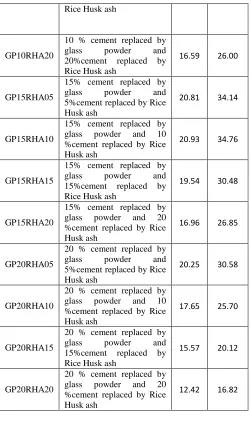
After Prepare cubes of various proportion combination and test after 7days and 28 days following results observed .
Material
Mixture Nature of Concrete M-30
Compressive Strength of Concrete Cube
(N/mm2 )
7 Days
28 Days
GP00RHA00 Conventional Concrete 22.63 33.06
GP05RHA05
5% cement replaced by glass powder and 5%cement replaced by Rice Husk ash
21.60 31.06
GP05RHA10
5% cement replaced by glass powder and 10%cement replaced by Rice Husk ash
19.51 31.45
GP05RHA15
5% cement replaced by glass powder and 15%cement replaced by Rice Husk ash
17.11 30.11
GP05RHA20
5% cement replaced by glass powder and 20%cement replaced by Rice Husk ash
14.46 28.69
GP10RHA05
10% cement replaced by glass powder and 5%cement replaced by Rice Husk ash
21.15 32.04
GP10RHA10
10% cement replaced by glass powder and 10%cement replaced by Rice Husk ash
18.35 31.67
GP10RHA15
10% cement replaced by glass powder and 15%cement replaced by
Rice Husk ash
GP10RHA20
10 % cement replaced by glass powder and 20%cement replaced by Rice Husk ash
16.59 26.00
GP15RHA05
15% cement replaced by glass powder and 5%cement replaced by Rice Husk ash
20.81 34.14
GP15RHA10
15% cement replaced by glass powder and 10 %cement replaced by Rice Husk ash
20.93 34.76
GP15RHA15
15% cement replaced by glass powder and 15%cement replaced by Rice Husk ash
19.54 30.48
GP15RHA20
15% cement replaced by glass powder and 20 %cement replaced by Rice Husk ash
16.96 26.85
GP20RHA05
20 % cement replaced by glass powder and 5%cement replaced by Rice Husk ash
20.25 30.58
GP20RHA10
20 % cement replaced by glass powder and 10 %cement replaced by Rice Husk ash
17.65 25.70
GP20RHA15
20 % cement replaced by glass powder and 15%cement replaced by Rice Husk ash
15.57 20.12
GP20RHA20
20 % cement replaced by glass powder and 20 %cement replaced by Rice Husk ash
12.42 16.82
The combined compressive strength of concrete of various combinations is shown in bar chart for 7 days and 28 days curing of concrete
Fig. -7 days Compressive Strength of concrete for keeping Glass Powder constant & RHA varying
Fig.- 28 days Compressive Strength of concrete for keeping Glass Powder constant & RHA varying
COST ANALYSIS
This study found GP15RHA10 combination is shows good strength as compared to other combination and conventional concrete mix. Cement quantity was reduced by using the other pozzolonic material in this study so cost is decrease. Table shows cost analysis for 1cubic meter concrete .
Study shows that replacement of cement with Glass powder and Rice husk ash decrease in cast about 16% .
Cost Analysis for 1 m³ Concrete
Conventional
Concrete
modified concrete
Ingredient
Quantity (KG)
Rate (Rs)
Cost (Rs)
Quantity (KG)
Rate (Rs)
Cost (Rs)
Cement 390 6 2340 253.5 6 1521
Rice husk
ash 0 0 0 58.5 2.5 117
Glass
Powder 0 0 0 39 4 156
Sand 507 0.43 218.1 507 0.43 218.1
Aggregate 1014 0.45 456.3 1014 0.45 456.3
water 148.2 0.3 44.46 148.2 0.3 44.46
Admix. 2.64 115 303.6 2.68 115 308.2
Total Rs.= 3362.3 Rs.= 2820.9
0 20 40
RHA05 RHA10 RHA15 RHA20
Co
m
p
ress
iv
e
S
treng
th
N/m
m
2
Compressive Strength
Variation
GP 5
GP 10
GP 15
GP 20
0 10 20 30
RHA05 RHA10 RHA15 RHA20
Co
m
p
ress
iv
e
S
treng
th
N/m
m
2
Compressive Strength
Variation
GP 5
GP 10
GP 15
CONCLUSION
1. Addition of Glass Powder and Rice husk ash in
cement concrete for replacement of cement solve the problem of disposal of waste material.
2. When 25 % of cement is replaced by 15% Glass
Powder and 10% Rice husk ash compressive strength of modified concrete is more than the conventional concrete.
3. On addition of Glass powder and Rice husk ash
initially the rate of gain of strength is slightly low but at 28 days it meets required design strength.
4.
Use of the modified concrete will reduce the cementconsumption hence saving of energy will take place.
5.
Till date research on effect of cement replacementwith rice husk ash and glass powder is carried out separately but in this result when combination of those is used .
6.
If we replace cement by rice husk ash and glasspowder in concrete it help in saving of cost by 16% .
7. The modified concrete is eco-friendly as cement
consumption is low.
FUTURE SCOPE OF STUDY
1. To check the durability and permeability of modified
concrete.
2. To study the properties of modified reinforce
concrete.
REFERENCE
1. Coutinho, S. J., 2003 “The combined benefits of
CPF and RHA in improving thedurability of concrete structures”, Cement and concrete composites: 25(1): 2003, pp. 51– 59.
2. MemonShazim Ali, Shaikh Muhammad Ali, Akbar
Hassan (2008) “Production oflow cost self-compacting concrete using rice husk ash” (ICCIDC– I).
3. CelsoYojiKawahata, HolmerSavastano Junior, Joana
Sousa-Coutinho(2012) “Ricehusk derived waste materials as partial cement replacement in light weight concrete”
4. Dr. Patagundi B.R., Dr. Prakash K.B. (2012) “Effect
of temperature on the propertiesof concrete containing glass powder as pozzolana” IJERT,ISSN 2278-0181, Volume1
5. Dr. Kumar G. Vijay, MsVishaliny H., Dr.
Govindarajulu (2013)“Studies on GlassPowder as
Partial Replacement of Cement in Concrete Production” (IJETAE,ISSN2250-
2459, vol. 3).
6. Vandhiyan R., Ramkumar K. and Ramya R. (2013)
“Experimental study onreplacement of cement by glass powder” (IJERT, ISSN:2278-0181,vol. 2 issue 5.
7. Godwin A. Akeke, Maurice E. Ephraim, Akobo,
I.Z.S. and Joseph O. Ukpata(2013) “Structural properties of Rice husk ash concrete” (IJEAS, ISSN 2305-8269, vol. 3, No.3)
8. Gambhir M L Concrete Technology (fourth edition).
9. Dr. ShubhaKhatri,”Impact Of Admixture And Rice
Husk Ash In Concrete Mix Design”, IOSR Journal of Mechanical and Civil Engineering E-ISSN: 2278-1684, P-ISSN: 2320-334X, Volume 11, Issue 1 Ver. 4 , Feb 2014, PP 13-17.
10. J.M. Khatib, E.M. Negim, H.S. Sohl and N.
Chileshe,” Glass Powder Utilisation in Concrete Production”, European Journal of Applied Sciences 4 (4): 173-176, ISSN 2079-2077, 2012.
11. Kartini,Mahmud, Hamidah,”Strength Properties Of
Grade 30 Rice Husk Ash Concrete”, 31st Conference on Our World In Concrete & Structures: 16 – 17 August 2006, Singapore.
12. P.PadmaRao, Pradhan Kumar, Bhaskar Singh,” A
Study on Use of Rice Husk Ash in Concrete”, IJEAR , ISSN: 2348-0033,Volume 4, Issue Spl-2, Jan-June 2014.
13. Dao V et al. (2008) ―Effect of rice husk ash on
properties of high strength concrete‖ The 3rd ACF International Conference- ACF/VCA 2008.
14. Zemke N and Woods E (2009) ―Rice Husk Ash‖
California Polytechnic State University.
15. Harunur k et al. (2010) ―Durability of Mortar in