
ISSN 2286-4822 www.euacademic.org
Impact Factor: 3.1 (UIF) DRJI Value: 5.9 (B+)
Improving Scientific Attitude among
Students at Primary Level
HARMINDER KAUR SURI
Headmaster Kendriya Vidyalaya No 4 Ambala
India
Abstract:
The present investigation examined the impact of various teaching strategies wherein, it was proposed that teaching same subjects through different methods would improve the scientific attitude among primary level students. The invisible thread of scientific attitude was explored by drawing data from two different primary classes (viz. IV to V), two sections for each. Final sample of the present study comprised of 95 participants within the age range of 9 to 12 years. The scores were obtained on academic performance which includes formative and summative assessment (FA1, FA2, FA3, & SA1) and a test on environment conducted by ICWSSAR (Indian council of wildlife studies in South Asian Regions, an NGO). Obtained scores on various occasions of the present investigation were analyzed by using higher statistical techniques including t-test and 3-way ANOVA. Results were discussed in the light of Indian socio cultural context which reveals that performance of the participants improved on treatment 5 (T5) i.e., FA3 over treatment 1 (T1) i.e., FA1. In addition, the analysis also showed that one can enhance the scientific attitude by using different teaching strategies which could also be promoted to be used in daily life settings. Thereby, students can grow personal aptitude towards science and related fields.
Key words: scientific attitude; environmental studies; formative
Introduction
“He who knows others is learned, but the wise one is the one who
knows himself. Learning without wisdom is of no use” (Kalam &
Tiwari 2005, 17). These opening words of the present work indicates that attitude towards science is a set of emotionally toned ideas about science and scientific method related directly or indirectly to a course of action in the literature of science education. Thus, scientific attitude is a broad concept consisting of many components. Therefore, according to C. V. Good Dictionary of education (1973), the term implies such qualities of mind as intellectual curiosity, passion for truth, respect for evidence and an appreciation of the necessity for free commutation of science. In sum, the scientific attitude could be understood as a package of beliefs, curiosity, objectivity, critical thinking, open mindedness, risk bearing, inventive, intellectual honesty, and responsibility.
Moreover, attitudes are mental predispositions toward people, objects, subjects, events, and so on. But in relation to science, attitudes are important because of three primary factors (Martin 1984, 13–14). First, a child’s attitude carries a mental state of readiness with it. Therefore, with a positive attitude, a child would be able to perceive science objects, topics, activities, and people positively. A child, who is unready or hesitant, for whatever reason, would be less willing to interact with people and things associated with science. This readiness factor occurs unconsciously in a child, without prior thought or overt consent.
directive factors when a child enters into new experiences. As a result, attitudes carry an emotional and an intellectual tone, both of which lead to making decisions and forming evaluations. These decisions and evaluations can cause a child to set priorities and hold different preferences.
Environmental Studies: At primary level
The word environment is derived from the French verb ‘environner’ which means to ‘encircle or surround’. Thus our environment can be defined as the physical, chemical and biological world that surrounds us as well as the complex of social and cultural conditions affecting an individual or community. This broad definition includes the natural world and the technological environment as well as the cultural and social contexts that shape human lives. It includes all factors living and nonliving that affect an individual organism or population at any point in the life cycle; set of circumstances surrounding a particular occurrence and all the things that surrounds us.
In the same line of work ‘Star Girl’ project in EVS (The Girl Star Project by UNICEF India) and alike programs are all pointing at creating awareness and sensitizing people around. Thus a systematic approach is needed to foster scientific process in students. Environmental studies are the interdisciplinary academic field which systematically studies human interaction with the environment in the interests of solving complex problems. It is a broad field of study that includes also the natural environment, built environment, and the sets of relationships between them. In sum, need of the hour is to built an environment for the students to improve their SCIENTIFIC ATTITUDE right at primary stage which is the most crucial element, too.
Rationale
As per the studies in National Curriculum Frame Work NCF(2005) & Teaching of Science –National Focus Group position paper by National council of Education Research and Training NCERT ,it is learnt that students need to cultivate the scientific attitude. Working on National level Project assigned to our Region on e –content development in January 2012 it was observed that all academic areas need to have a scientific approach in order to strengthen learning and application of knowledge ( as stated in Blooms Taxonomy).
Similarly, Pitafi & Farooq (2012) conducted a study on secondary school students in Pakistan and concluded that emphasis should be laid on science teaching along with experimentation and students should be allowed to construct new equipment for experiments. Additionally, the discovery approach should replace the conventional method of Science teaching.
'pupil should adopt the scientific attitude in making statements, accepting information & forming beliefs. Almost all the commissions & committees on School education which were formed after independence have stated the importance of development of scientific attitude in the students. Students in the 8th, 9th and 10th standard are in the age between 13 to 15 years. This age is important as for as curiosity, critical thinking decision making etc. are concerned.
However, it has been observed more recently that as the exposure to latest technology has reached to the students of primary level (4th and 5th standards) who are in the age between 9 to 11 are found to be high on curiosity, objectivity, critical thinking, open mindedness, risk bearing, inventive, intellectual honesty, and responsibility. They want to learn by doing, ask as many questions as many they may ask, they keep on trying to explore their environment, observe others and want to act in the similar manner for example, sometimes they act like a teacher and interact with their fellow students as if they are teacher in real, sometimes they act like a doctor and use to perform the role of a doctor, and so on.
Therefore, objective of this course is to develop concern for one’s own environment which would lead him to act at his own level to protect the environment all live in. The first, is the need for information that clarifies modern environmental concepts like equitable use of natural resources, more sustainable life styles etc. Second, there is a need to change the way in which one view his environment, using practical approach based on observation and self learning. Third, there is a need to create a concern for one’s environment that would trigger pro-environmental action; including simple activities one could do in his daily life to protect it. Therefore it was thought to cultivate scientific attitude in students of primary classes. This paper aims at –
2. To check if classroom teaching contributes over any task on scientific attitude.
3. To study the impact of methodology used by the subject teachers on scientific attitude.
Hypothesis
The hypotheses are listed below-
1. Academic subjects would be positively correlated with ICWESSAR (an NGO Tests).
2. There would be significant difference between the performances of both the classes.
3. There would be significant difference between performance on two different occasions/treatments i.e., T1 & T5.
4. There would be significant interaction effect between A x B & B x C.
Methodology
Sample
Tools used
1. Academic Performance: Scores of all four Academic subjects i.e., English, Hindi, Maths and Environmental studies were taken into account. The present sample was routed through number of activities while working in routine setup and scores of each student were obtained at the end of each treatment condition in the form of Formative assessments (i.e., FA1, FA2, & FA3) and Summative assessment (i.e., SA1). Scoring pattern for FA’s & SA’s were taken on the basis of 5 point rating scale as suggested by KVS for primary CCE. The rating is as under –
9-10 A+ outstanding
7-8 A Very good
5-6 B Good
3-4 C Average
0-2 D Needs Improvement
2. SEP Scores: The scoring pattern for test by ICWESSAR an NGO ranges from — score range 0 to 100 (<36 = Fail). This test was designed by ICWESSAR and has Study material based on SAVE EARTH .It was administered among the students whose purpose was to test curiosity and open mindedness towards science. Indirectly the scale is designed to test Scientific attitude through Environmental Awareness. A Test by ICWESSAR an NGO was conducted in November 2012.It consist of short question to be answered in one word to 10 words and were based on Saving the Planet Earth. The individuals who will score Top three position at National level will be awarded Gold, Sliver and Bronze medal along with Certificate.
Procedure:
Treatment 3 (T3) = SA1, Treatment 4 (T4) =NGO, Treatment 5 (T5) = FA3. During a particular treatment conditions different methods were used.
a. March 2012: Class teachers were made to conduct the result and error analysis of SA2 examination of the previous session 2011-12 for the students who have been promoted to classes IV and V which have been used as a base line to measure the scientific attitude. The error analysis was performed on the basis of competencies and it was reported that:
most of the students did not perform well in competencies like creative writing in case of both languages;
most of the students did not perform well in questions related to discovering facts (reasoning) in case of EVS;
most of the students did not perform well in problem solving competency in case of mathematics.
Thus it was decided to modify the strategies of class room interactions in all the scholastic subjects. Hence, all primary teacher were made to brainstorm and hands on in the workshops for national level e-content development (April, 2012) where a team of principals, vice principal, headmasters, PGTs, TGTs, and PRTs of the 47 school of Chandigarh region was coordinated. In the workshop teachers were provided with an opportunity to explore the concepts which were difficult to comprehend not only from their perspective rather from the student’s outlook, too. Thereby inclining workshop participants to work on teaching modules based on science. They were passionate enough to share their work with students of next session. b. April 2012 to January 2013: After result analysis it was
remedial teaching. Providing students an opportunity to evolve themselves in process of scientific attitude.
Teaching strategies based on self-created teaching material were used which includes -
videos by using graphic pen and free software
Audio was recorded using open source software Audacity. Most of the recordings were carried out from home at night owing to which the silence of studio was found in the audio material.
The strategies also demanded outdoor location shoot which was performed by using digital camera.
Thinking is natural as singing but it can be improved significantly if exposure to experience is given to do certain exercises and strategies are developed by using scientific methods or models for the same. Therefore students were provided with planned instructions and the certain exercises which were expected to help students to engage their meta-cognitive domain in a better way. Critical thinking strategies which were made part of all academic content are presented in the table form in Annexure I.
The remedial teaching was done as per their curriculum so the scores of FA1 to FA3 were taken into account for result and discussions. Purposive sampling was done to meet the rationale of the study. Initially, incidental sampling was done to select 200 students randomly for the NGO test out of which 95 were further randomly selected (purposive sampling) for the present investigation. At the end of each treatment condition score of all student participants were collected to compare effect of each treatment.
Statistical Analysis
after each treatment (T) condition (i.e., T1 v/s T2, T2 v/s T5, and T1 v/s T5) t-test was applied. Whereas, to the collected data was analyzed with the help of computer software package SPSS- 17. All the obtained results are represented in the form of tables.
Result:
Table 1: Showing Mean and S.D.’s of all the scores on academic subjects and NGO
Test at the end of each treatment condition for the present sample (N=95).
ACADEMIC SUBJECTS
Treatment
(T)
English
Mean,(S.D.)
Hindi
Mean,(S.D.)
Math
Mean,(S.D.) EVS
Mean,(S.D.) NGO
Mean,(S.D.)
T-1 (FA1) 5.99,(1.47) 6.34,(1.45) 6.65,(1.33) 6.27,(1.98) 0.00,(0.00)
T-2 (FA2) 7.02,(1.12) 7.57,(1.12) 7.48,(1.31) 6.85,(1.23) 0.00,(0.00)
T-3 (SA1) 20.93,(4.45) 22.33,(3.75) 22.28,(3.98) 22.48,(4.20) 0.00,(0.00)
T-4
(SEPT) 0.00,(0.00) 0.00,(0.00)
0.00,(0.00)
0.00,(0.00) 50.89,(7.80)
T-5 (FA3) 6.95,(1.90) 7.16,(1.69) 7.45,(1.77) 7.10,(1.93) 0.00,(0.00)
Table 1 show Mean & SD for 95 students & depicts that in T1 (FA1) maximum students are falling within the category of Grade “B” in all their respective subjects. Whereas the performance of EVS remains the same as it was in T1.
In T3 (SA1) most of the students have given average performance of grade “A” and in T4 (ICWESSAR test) average performance of students is “B”. In T5 (SA1) the performance in English language has shown slight decline whereas in Hindi ,Mathematics & EVS students have performed better with an average increase form “B” to “’A” grades.
Correlation:
that scientific attitude is not limited to the Mathematics & EVS teaching rather, teaching methods adopted for languages are also contributing factor towards scientific attitude.
Table 2: Showing correlation coefficient of all the scores on academic subjects at the
end treatment 1 and NGO test for the present sample (N=95).
Treatment 1 (FA1) Treatment 4
English Hindi Math EVS NGO
English - 0.61** 0.64** 0.50** 0.40**
Hindi - - 0.69** 0.50** 0.38**
Math - - - 0.50** 0.46**
EVS - - - - 0.40**
NGO - - - - -
p< 0.05 = 0.203 (by interpolation; df = 93) p< 0.01 = 0.264 (by interpolation; df = 93)
t-test:
Table 3 (a): Showing t-values of all the scores on academic subjects at the end of
treatment 1 and treatment 2 for the present sample (N=95).
Treatment 1 Treatment 2
Subjects Mean S.D. Mean S.D. t Sig. @
English 5.99 1.47 7.02 1.12 -7.70** .000
Hindi 6.34 1.45 7.57 1.12 -11.40** .000
Math 6.65 1.33 7.48 1.31 -6.91** .000
EVS 6.27 1.98 6.85 1.23 -3.33** .001
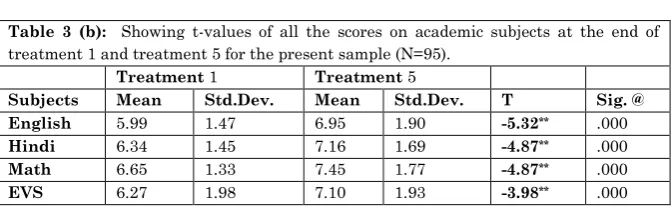
Table 3 (b): Showing t-values of all the scores on academic subjects at the end of treatment 1 and treatment 5 for the present sample (N=95).
Treatment 1 Treatment 5
Subjects Mean Std.Dev. Mean Std.Dev. T Sig. @
English 5.99 1.47 6.95 1.90 -5.32** .000
Hindi 6.34 1.45 7.16 1.69 -4.87** .000
Math 6.65 1.33 7.45 1.77 -4.87** .000
EVS 6.27 1.98 7.10 1.93 -3.98** .000
Table 3 (b) shows the comparison between T1 (FA1) & T5 (FA3). Students have shown equal performance in Hindi and Mathematics (t= -4.87)
Table 3 (c): Showing t-values of all the scores on academic subjects at the end of
treatment 2 and treatment 5 for the present sample (N=95).
Treatment 2 Treatment 5
Mean Std.Dev. Mean Std.Dev. T Sig. @
English 7.02 1.12 6.95 1.90 0.40 Ns
Hindi 7.57 1.12 7.16 1.69 2.37** .02
Math 7.48 1.31 7.45 1.77 0.15 Ns
EVS 6.85 1.23 7.10 1.93 -1.37 Ns
Table 3 (c) shows comparison between T2 & T5. None of the academic subjects show significant difference except Hindi which reported decline (t- 2.37; p< .02)
3-way ANOVA:
For the present study interest was to find out the effect of various Treatments on the performance of particular subject by the students of classes IV & V. For this purpose three way ANOVA has been used in which
Classes IV & V were symbolized with help of alphabet ‘a’, a1 = IV, a2 = V.
Treatment groups were symbolized with help of alphabet ‘b’, b1=FA1, b2= FA3.
Subject were denoted with ‘c’, c1= English, c2= Hindi, c3= Mathematics, c4= Environmental studies.
Therefore Total sample ‘N’ = 38+38 = 76 in case of Three way ANOVA.
Table 4: Showing summary of 3-way ANOVA for the present sample [N=76; i.e.
participants (n=38) in each group (a=2) were assigned to different treatment conditions (b=2) to unravel the academic performance of all the four academic subjects (c=4)].
Sources SS df MS F Sig.
@
Groups (a1 & a2)
A 30.95 1 (a-1) 30.95 13.23** .001
Treatments (b1 & b2)
B 110.52 1 (b-1) 110.52 47.23** .001
Subjects (c1, c2, c3, &
ca4)
C 44.48 3 (c-1) 14.83 6.34** .01
A x B 4.71 1 (a-1)(b-1) 4.71 2.01 Ns
B x C 4.34 3 (b-1)(c-1) 1.45 0.62 Ns
A x C 18.59 3 (a-1)(c-1) 6.20 2.65* .05
A x B x C
22.33 3 (a-1)(b-1)(c-1)
7.44 3.18* .05
With in 1382.38 592 [abc(n-1)] 2.34 -
Table value for df (1, 592) Table value for df (3, 592)
.05 3.84 .05 2.60
.01 6.64 .01 3.78
Table 4 It is observed that the F value of variable’ A’ (groups ie IV & V standards) comes out to be 13.23 which is highly significant at p<0.01 level. It means that the alternative Hypothesis H1 is being retained & can conclude that the two groups differ in their academic performance on all four academic subjects.
test condition (FA1).
Moreover, results from Table 4 also reveals that “F” value for groups “A” shows significant difference between the performances, which shows that class IV students differently perform on each academic subject as compared to class V students which could be the result of their exposure to the environment or subjects and the kind of activates they perform throughout the day in the school.
It is expected that there would be a significant difference between two treatment conditions as a result of different teaching and environment or exposure provided to the student of each class and the same are reported by the results.
There is significant interaction between classes and subjects which state that some students of class IV have an understanding of class V but at the same time some student s of class V have understanding of class IV. Thus the strategies of high order and for low achievers are to be adopted in a same set of students.
Conclusion
4.1 The correlation table reveals that academic performance of all the students on each Test under various treatment conditions comes to be co related significantly which has been supported by previous studies.
4.2 Further, results of t –test are in line with the facts revealed by the previous studies and reveals that performance of the students improved significantly on two different treatments. However, performance of students were compared on T1 (FA1) & T5 (FA3) I obtained t values significantly
T1 (FA1) & T2 (FA2) T2 (FA2) & T5 (FA3)
C), (A x C). All three variables show near about significant effect.
There is significant difference between performance of classes IV & V
Treatments show significant difference which was also the area of Interest
Similarly, performance on different subjects on both Treatment ie FA1, FA3 differs significantly for both the classes IV & V
Thereby, one can enhance the scientific attitude among students of Primary by promoting strategies which could be used in daily life settings.
Educational Implications
1. The present study reveals that the Scientific attitude can be developed in Secondary school students.
2. The strategies used can cater the need of Bright & slow achievers.
3. The similar study can be carried out in all types of school government, semi aided, Private, across the globe immaterial of CBSE, ICSE, International boards.
4. The similar study can be carried out in all age groups above 8 years to adults.
5. Thus a project with greatest potential to change the attitude towards life in a small style.
6. Teachers can teach have analytical approach while teaching, this will help in re designing the curriculum.
7. Parents and families can help meet children different need better.
8. Students will have a better attitude towards peer, parents and society.
9. Students become emotionally stable people.
Limitations
I could have opted for random sampling instead of Purposive one.
Demographic factors could have been variables for study.
The study could have been conducted on Teachers also.
The socio economic conditions could have been taken into account.
Gender differences could be studied.
At times copy right issues prevent us to use their material for references.
Suggestions
A cross cultural study could have conducted to find the growth of scientific attitude in different races in various part of the globe.
A comparative qualitative study involving JNVs , State Government, Private Aided , and International Schools could be conducted .This will help us to analyze out Text books critically and re frame the contents is desired.
Cost effectiveness
The practices involved are related to routine teaching learning process hence can be carried out in academic session conveniently.
The resources required are most of the time locally available.
BIBLIOGRAPHY:
Anjail, R. ICWESSAR (Indian Council of Wildlife Study in South Asian Region) Jaipur (Save Earth Programme) Good, C. V. (Ed.) 1973. Dictionary of Education. New York:
McGraw-Hill Book Company.
Haney, Richard E. 1984. “Development of Scientific Attitude.”
TheScience Teacher 31 (December): 33 - 35.
Movahedzadeh, F. 2011. “Improving student’s attitude towards science through blended learning.” Science Education &
Civic Engagement: An International Journal 3(2): 13-19.
NCERT Text books all academic subjects for classes IV & V National Curriculum Framework. 2005. National Council for
Education, Research and Training, New Delhi (INDIA). Piaget, Jean. “Cognitive development”.
Pitafi, A. I., & Farooq, M. 2012. “Measurement of scientific attitude of secondary school students in Pakistan.”
Academic Research International 2(2).
Science projects - http://www.sciencebuddies.org/science-fair-projects/project_display_ board fonts.shtml
Annexure – I
Period No. of
Days in a
week for
each IV & V
Level of
application
Strategies
April 2012
4/
section/class
use of podcast/audio material (pre recoded or by students )
Creating awareness of importance of reading in daily life
Newspaper reading PSQ(Purpose, Survey what to read, Question how to approach the subject)
Key word grid to promote reinforcement
Concept of place value
Concept of time line
Science experiments in Assembly
Postage stamp designing(save wild animals)
Dog show in School
Critical thinking July 4/
section/class
FA1 Write Book review( Bulleted format)
Film Review ( bulleted format)
Sentence making using grid of commonly used W’s , prepositions, Question tags , words form lesson
Podcasting
Compare and contrast
Key word grid to promote reinforcement
Extempore in all subjects
Science & Maths experiments in assembly
Critical thinking August 4/
section/class
FA2 Comprehending a story /Poem (SWBS)ie Somebody, wanted ,but, solution
Mind maps
Line diagrams
Mapping skill
©ICWESSAR an NGO ( study material – Annexure 2)
Key word grid to promote reinforcement
Science & Maths experiment in assembly
Hum aise kyon hein ? ( curiosity element)
Critical thinking
Sep 4/
section/class
SA1 Word webs
Use of dictionary, Thesaurus
Mapping skill
NGO study material discussed ( Group discussions , ppt )
Key word grid to promote reinforcement
Science & maths experiments n assembly
Critical thinking
Oct 4/
section/class
Finding a book in library by using e granthalaya (cataloging system )
Punctuation (with missing clues)
Flow chart
Mapping skill
Book reviews
Discussion NGO study material
& Test conducted by ICWESSAR Jaipur
Key word grid to promote reinforcement
Film reviews – Jamunia & Akad bakad—
Extempore
Critical thinking Nov 4/
section/class
Venn diagrams for comparison /contrast
Videos form net
Key word grid to promote reinforcement
Science & maths experiments in assembly
Reading a news paper
A day out with Orphan children at Mother Teresa Shishu Bhawan
Dec 4/
section/class
FA3 Character sketch (Traits v/s evidences)
National level Junior Editor Contest by Dainik Bhaskar
Key word grid to promote reinforcement
Science & maths experiments in assembly
Model making
Critical thinking January
2013 4/
section/class
Key word grid to promote reinforcement
Science & maths experiments in assembly (Annexure 3)
Mapping skill
Interscholastic activity ( on Swami Vivekananda ) ie collecting data/ write ups/map work
Annexure 4)
Critical thinking
Annexure – II
Area of
Improvement
Type of activities
Mental organization
Observing properties, similarities, differences, categorizing , comparing, sorting into groups, generalizing
Analytical thinking
Relationships, patterns, properties
Critical thinking Facts and opinions, relevant & irrelevant information, decision making, consider others point of view, ask me
Creative thinking Consequences, problem solving , analyzing a design Transfer of
thinking
Transfer your think to new content like animals , plants, weather , birds, etc.
5.99 6.34 6.65 6.27 7.02 7.57 7.48 6.85 0 1 2 3 4 5 6 7 8
english hindi math evs
ACADEMIC SUBJECTS M E A N O F S C O R E S
Treatment 1 Treatment 2
Graphical presentation of the table 3(a).
5.99 6.34
6.65
6.27
6.95 7.16 7.45 7.1
0 1 2 3 4 5 6 7 8
english hindi math evs
ACADEMIC SUBJECTS M E A N O F S C O R E S
Treatment 1 Treatment 5
7.02 7.57 7.48 6.85 6.95 7.16 7.45 7.1 6.4 6.6 6.8 7 7.2 7.4 7.6 7.8
english hindi math evs
ACADEMIC SUBJECTS M E A N O F S C O R E S
Treatment 2 Treatment 5
Graphical presentation of the table 3(c).
c1, a2 c3, a2 c4, a2 c1, a1
c2, a1 c2, a2
c3, a1 c4, a1 5.00 5.50 6.00 6.50 7.00 7.50 8.00 a1 a2 STANDARDS M E A N S C O R E S O N D IFF E R E N T S U B J E C TS
c1 c2 c3 c4
Index –a1 =IV; a2 =V ; c1=English ; c2=Hindi ; c3=Math ; c4= EVS
c1, b2 c2, b2 c1, b1 c2, b1 c3, b2 c3, b1 c4, b2 c4, b1 5.00 5.50 6.00 6.50 7.00 7.50 8.00 b1 b2 TREATMENT CONDITIONS M E A N S C O R E S O N D IFF E R E N T S U B J E C TS
c1 c2 c3 c4
a1, b1
a1, b2
a2, b1
a2, b2
5.00 5.50 6.00 6.50 7.00 7.50 8.00
b1 b2
TREATMENTS
M
E
A
N
S
C
O
R
E
S
O
N
D
IFF
E
R
E
N
T
S
U
B
J
E
C
TS
a1 a2
Index – a1=IV; a2=V; b1=T1 (FA1); b2= T5 (FA5)

![Table 4: Showing summary of 3-way ANOVA for the present sample [N=76; i.e. participants (n=38) in each group (a=2) were assigned to different treatment conditions (b=2) to unravel the academic performance of all the four academic subjects (c=4)]](https://thumb-us.123doks.com/thumbv2/123dok_us/7746804.1269397/13.439.52.390.143.405/participants-different-treatment-conditions-academic-performance-academic-subjects.webp)
