APl?LICATION OF CANOOICAL CDRHELATION ANALYSIS '{ "A Comparative Study on AcademicPerfonnance"
BY
'Iuis dissertatiun is submitted in partial fu LfiIrrerrt for the degree of Master
or
Science in Mathematical Statistics in the Department of Mathemati.cs,Makambi, Kepher Application of canonical
1111111I
90 192324KCNYATrA UNIVERSITY, JUNE, 1990.
,DECI J\P.J\TIClN
'Ibis c1issertation is myown work and has not been presented [0r a degree in any other Universi ty.
Signature
.~:
.
KEPEER lillNRY MAKAMBI .
'Illis d.is~3c;rtation has been submitted for examination with my approva.l as University ~)upervisor.
Signature
'l'iLl(~ DeclaraLion
LisL of Contents
i ii iii v ix xi List\of TalJles
Surrrnary 01 Contents AcknowledgerrBnt
OIAI'TER I: INTRODUCITON 1.1 Introduction
1.2 \'.hat is Canonical Correlation Analysis? I.3 Lr-ief Li te ra ture Review
1.4 Aims and Significance of the Study
1
2 5 7
CllAPTER II: SAHPlli CANONICAL CDRRELATION AND CM-DNICAL VAIUA'I'ES.
2.1 2.2
Introduction 9
9 f:8Illple EstimaLes
2.3 Deri vaLion 01 Fundament.al. Equations for
Omonical Correlations and Variates 12
CIIA1YI'ERI II : TI~ST8 OF SIGNIFICANCE AND INTERPRETIVE DEVICES
3.1 Tests of Gignificance Interpretiye Devices
21
26 3.2
Ulwmn IV: APPLICATIONS 4.1 Introduction
4.2 Pesults
37
1.2. L
4,2.2.
4.2. :3
4.2.4
4.2. C)
4.3 4.4
Canonical Correlation Analysis on the
J'elat.Lonsh ip Between Pure Mathematics' "lncl ~"a1..ltematicalStatistics Units (Variables). Cumparative Remarks
Canoui.ca.I Correlation Analysis on the P.elationsbips Between Pure and Applied Mathematics
Coruparative Remarks
Canonical Correlation Analysis on the Relationships Le(;ween Mathematical Statistics and Applied
Mathematics
Comparative Remarks
Ljmitations of the Technique Conclusions
LIST OF REf"ERENCES
38
59
74
76 90 92
93
LIST OF TABLER
TnhIr' J: ~nn~ll.el1'Y2at1sStandard d, eviations and the correlation matrix, R, for scores in Pure
Mathematicsand Mathematical Statistics for
£il~t year, 1984/85
'Iab,le 2: Canoui.ca.lCorrelation Coefficients, weights and loadings for scores in Pure Mathematics
and Mathematical 3Jtatistics for first year,
lU84/85
'IabIe 3: Test Statistics for scores in Pure Mathematics and Mathematical Statistics for first year,
1984/85
Table 4: Cross Loadings for scores in Pure Mathematics
and Mathematical Statistics for first year,
1984/85.
TabJe 5: Samplemeans, standard deviations and the
correlation matrix, H, Jar scores in Pure
Mat.hema t ics and Mathema.ticalStatistics
for first jear, 1985/86
TaJJlc6: Canonical Correlation Coefficients, Weights
ancl Loadi.ngsfor scores in Pure Mathematics and r.lathematical Statistics for first year,
1985/86
39
40
41
44
48
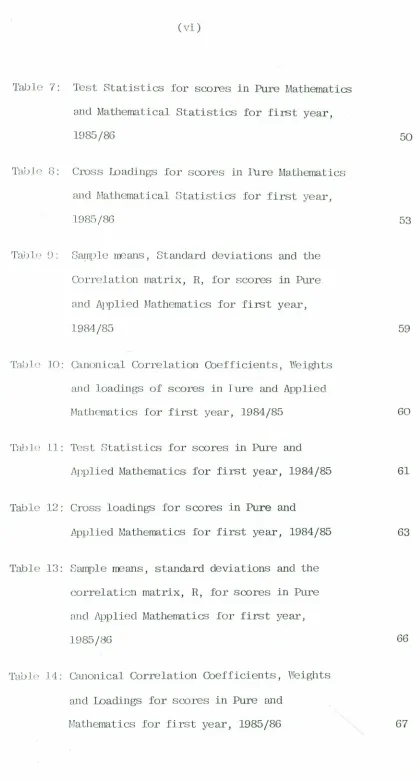
Table 7: Test Statistics for scores in Pure Mathematics and Mathematical Statistics for first year, 1985/86
Tablo 8: Cross Loadi.ngs for scores in lure Mathematics and Mathematical StatisticS for first year, 1985/86
Table D: S~ple rreans, Standard deviations and the Correlation matrix, R, for scores in Pure and Applied Mathematics for first year, 1984/85
Toole 10: Canonical Correlation Coefficients, Weights and loadings of scores in lure and Applied Mathematics for first year, 1984/85
TWJlc 11: Test Statistics for scores in Pure and Applied Mathematics for first year, 1984/85
Table 12: Cross loadings for scores in Pure and
Applied Mathematics for first year, 1984/85
Tabl.e 13: Sample means , standard deviations and the correlaticn matrix, R, for scores in Pure and Applied Mathematics for first year, 1985/H6
TaiJJe 11:l: Canonical Correlation Coefficients, Weights and Loadings for scores in Pure and
Mathematics for first year, 1985/86
50
53
59
60
61
63
66
Tab.lo 15: Test Statistics for scores in Pure and
Applied Mathematicsfor first year, 1985/86 68
Taole 16: Cross Loadings for scores in Pure and
Applied Mathematicsfor first year, 1985/86 71
Table 17: SampLemeans, standard deviations and the correlaU.on matrix, R, for scores in
r:aU1CTTlr':l.tiScatatlistics and Applied
Mathematics for first year, 1984/85 76
Tab1(> U3: Canonical Correlation Coefficients, Weights
and loadings of scores in Mathematical
Statistics and Applied Mathematics for first year
1984/85 77
Table 19: Test Statistics for scores in Mathematical
Statistics and Applied Mathematicsfor
first year, 1984/85 78
TabLo20: Interset Correlations for scores in Mathematical
Statistics and Applied Mathematics for first
year, 1984/85 80
Table 21: Srum)lemeans, standard deviations and the correlation matrix,R, for scores in
Mathematical statistics and Applied Mathenatics
for first year, 1985/86 84
Table 22: Canonical Correlation Coefficients, Weights and .Loadingsof scores in Mathematical Statistics
TabLe 23: Test Statistics for scores in Mathematical
Statistics and Applied Mathematics for first
year, 1985/86 86
Table 24: Cross Loadi.ngs for scores in Mathematical
Statistics and Applied Mathematics for
SUMMARY OF·mN'IENTS
The technique of Canonical Correlation Analysis is useful in
investigating the interrelationships between two or rroresets of
variables. In this dissertation, some interpretive devices in
canonical correlation analysis are used to study the interrelat
ion-ships among different courses offered by the Depar-tment of Mathe
-mati cs, Kenyatta Universi ty.
In section 1.1 of Chapte r I; we give a brief introduction of
Cilllonicalcorrelation analysis. Section 1.2 gives an overview of canoni.cal.correlation analysis whereby the data is assumed to be
from a known population. Section 1.3 outlines some of the work done early on the application of canonical correlation analysis.
TIle aims and significance of the study are given in section 1.4
Nonnally the population parameters are not known and therefore
their sample counterparts are used. Section 2.1 of O1apter II defines the data matrix based on a sample of size N. In section
L.2 the sample estimates of the population parameters are defined.
A rigorous derivation of fundamental equations for canonical
correlations and variates is given in section 2.3.
01apter III outlines the significance tests and
Interpreta-tion of canonical correlations. In section 3.1 the tests of
Si~li£icance of canonical correlations, individual canonical
correlation coefficients and those of particular variables are
discussed. Section 3.2 outlines the interpretive devices used
in canonical correlation analysis.
cor-relat.Lon analysis in studying the interrelationships arrongthe COUl'c;CS ofIered by the Dspartrrerrt of Mathematics, Kenyatta University. SecLlon 4.1 gives the descriptions of the courses which were offered in Erst year 1984/85 and 1985/86 academic years and these courses act as the variables in our current study. Sub-section 4.2.1 of section 4.2 deals with canonical correlation
analysis on the relationship between Pure Mathematics andM athe-matical Statistics and the results for 1984/85 and 1985/86 are both given here. Sub-section 4.2. 2 gives the comparative remarks
on the results of subsection 4.2.1. Canonical Cbrrelation analysis on the relationships between Pure and Applied Mathemat.i.csis dealt with in sub-section 4.2.3 and subsection 4.2.4 gives the comparative
remarks011 t.he results of subsection 4.2.3. 'I11ecanoni.cal.corre la-tion analysis on the relationships betweenMathematical Statistics and Appli.ed Hathematics is given in subsection 4.2.5 andsubsection
11.2.G giyes the comparati ve remarks on the resu1ts of subsection 4.2,:5. Even though this technique (canonical correlation analysis)
ACKNONLEffiEMENT
It gives megreat pleasure to express my gratitude to those
wlto in one wayor tbe other assisted mein the preparation of
t.li is dissertation.
I wish to acknowledgemySupervisor Prof. J.W. Odhiarrbofor
his delLgenceand excellent supervision which he showed by sac
ri-ficiug a lot of his tirre to scrutinise mywork and guide me in the
besL way possible.
I run especially indebted to Mr. L.B.X. Odongoand Mr. Githu
of Kenyatta Universi ty for improving my interest and knowledge in 8LaUstics. Mythanks to Prof. J. Hutio and Dr. E.M. Kukuni
10r providing mewith the data for the present study. I wouId.,
also like to express myappreciation to my lecturers Dr. M.Manene
and Dr. F. Njui for their encouragement during the preparation
01 t.h.i.s work.
I am thankful to Irene Karimi for typing mywork speedily
and wit.li a lot of care.
Finally, thanks to my dear wife, Pamela, for her patience
811(1 cooperation while I workedthrough this project. I also do
apprcc.i.at.e the active suppor-t and encouragement shown by my parents,
CHAPTER I
INTRODUCTION
1.1 Introduction.
In most statistical data analyses, it is usual
to examine linear interdependencies by multiple
regression, which measures the relationship between a
set of predictor (independent) variables and one dependent
(criterion) variable. When observations are taken on a
large number of correlated variables it is natural to
look at various ways in which the number of variables
m i gh t b ere d u c e d w i.tho u t sac rifi.ci n g too m u chi. n for mat ion .
When the variables are regarded as belonging to a single
set then principal components analysis is often
informative.
However, in many research settings, a scientist
encounters a phenomeno~ that is best described not in
terms of a single criterion but, because of its
complexity, in terms of a number of response variables.
In such cases, interest may centre on the relationship
bet wee nth e set 0f criterion v a ria b 1 e san d the set 0f
explanatory factors. In the business or economic fields,
we might be interested in the relationship between a
set of price indices and a set of production indices,
with a view towards, say, predicting one from the other.
In psychological investigations, we might be concerned
with the relationship between a set of personality
on the other. In educational performance investigations,
for example, we might be interested in the relationship
between a group of science subjects and arts subjects.
At university level., one can assess the degree of
relation-ship between a group of Pure Mathematics units on the
one hand, and Statistics or Applied Mathematics units
on the other. Broadly, one is faced with the problem
of investigating and explaining the relationships
between two or more sets of variables. The study of
the relationship between a set of predictor variables
and a set of response variables is known as Canonical
Correlation Analysis
1.2 What is Canonical Correlation Analysis?
In the most general of settings, Canonical Correlation
Analysis describes a multivariate statistical technique
that investigates the degree of relationship between two
sets of variables. It is used in analysing predictor
and criterion variables simultaneOusly. It is particularly
appropriate when the criterion variables are themselves
correlated. When one crtterion variable is available,
Canonical Correlation Analysis reduces to multiple
regression analysis. The use of canonical correlation
analysi's for descriptive purposes requires .no distributional
assumptions. In such cases, the predicto~ and criterion
variables can be measured at the nominal or ordinal level.
To test the significance of the relationships between
canonical variates, however, the data should meet the
of variance.
The Population Model of Canonical Correlation Analysis
Let
r
be the number of predictors and q thenumber of criterion variables and assume p > q. Denote
by ~I= (xl,x2, ... ,xp) the p dimensional vector of
predictor variables, and by YI, = (Yl'Y2?.,yq) the
q dimensional vector of criterion variables. Suppose
that X 'V Np
C
l::
x'LXX) and Y 'V Nq
Cl
::
y' Lyy) where ~xand JI denote the respective mean vectors and LXX -y
and L are "within-set" variance-covariance yy
matrices defined by
(I.t)
L = E{(Y-~ ) (Y-~ )I}, L > O.
yy - -y - -y yy
We shall use L to denote the "between-set" xy
matrix which is defined by
covariance
= E{(X-~ ) (Y-~ )I}
- -x --y ( 1 . 2 )
If we define a (p+q) dimensional vector, Z, by
then we can view the problem in terms of the partitioned
variance-covariance matrix Lzz given by
r
xxL
-zz L
LYx
The objective of canonical correlation analysis is to
find a linear combination of the p predictors that
maximally correlates with a linear combination of the
criterion variables. Let the respective linear combinations
be denoted by
a I. X = ( 1 . 4 )
and
(1 . 5 )
The correlation between nand ¢.is given by
a'l: b
xy-( 1 . 6 )
Then out of the infinite number of linear- combinations
between X-variables and the V-variables, we find that
set of linear combinations which maximises the
correlation,
p(!,~).
Sincep(!,~)
is invariant toscale transformations we choose a and b so that a'l: b - xy
-is maximum subject to the conditions
(i) a'l: a =
xx
-and ( 1. 7)
(ii ) b'l: b = yy
-The value of
p
(!,~)
obtained in this way is called thecanonical correlation between X and Y. The corresp
1.3 Grief Literature Review
The theory of canonical correlation analysis was
developed by Hotelling (1935, 1936) as a means of
identifying the most predictable p~variate criterion,
given the availability of several predtctor and
criterion variables.
In fiAance, W~ugh (1942) used canonical correlation
method to measure the changes in prices relative to a
stable value of currency. He did this by taking for
each of the years 1921 to 1940 inclusive, the prices
of beef steers and ~ogs and the per capita consumption of
beef and pork (excluding lard) for the U.S,A.
Shephard and Tanner (1962) used canonical correlation
to study proximities and growth of adolescence, respectively.
In the area of ~ducational ~~rformance, Barnett and
Lewis (1963) used the procedure to analyse qualitative
and quantitative data. Their study was on the academic
prediction. They managed to predict the students'
average grade at the university from the grades on
their GeE A-levels taken (a secondary school examination
required for university entrance), and the student's
average grade at the university was predicted.
In the field of marketing , Perry and Hamm (1969)
used canonical correlation analysis to relate the
degree of social risk and economic risk of 25 consumer
products. They found out that the higher the risk,
importance of personal influence on brand choice.
Psychology is another discipline which has really
utilized the technique of canonical correlation analysis.
For example, Cooley and Lohnes (1971) examined the
association between a set ,of eleven ability-type factors
(for example, verbal knowledge, ~athematics, visual
reasoning) and a set of eleven factors dealing with
career motives (for example, interest in science,
interest in business).
In Ecology, Thornton (1971) applied the method
of canonical correlation to study the effect of complete
rem 0val 0f hip pop 0tam u son g r ass 1 and i nth e Queen Elizabeth
National Park in Uganda. In the study of g"rowth and
development in animals, Tanner, Whitehouse, Marshall,
Healy and Goldstein (1975) applied the method of canonical
correlation analysis in the assessment of skeletal
Illaturity and prediction of adult height.
Further, in psychology, Wingard, Huba, and Bentler
(1979) report a canonical correlation analysis of
relationships between personality variables and use of
various licit and illicit drugs among junior high
school students in a metropolitan area.
Cohen, Gaughran, and Cohen (1979) examined the
relationships between patterns of fertility across 6
different age groups (as dependent variables) and 5
different sets of demographic characteristics as
independent variables (education and occupation;
housing and occupancy) in 5 separate canonical analyses. The units of analysis were 338 New York City health
areas.
Gittins (1979) used canonical correlation analysis
to investigate the relationships between variables of
two distinct but associated kinds in Ecology. He applied
the method to study the connections between the
occurence of plant or animal communities (and their
component speties) and soil or other environmental variables of several areas.
1.4 Aims and Significance of the study
Canonical correlation analysis is a technique
which has not been so widely used in an'alysing
educational performance. In contributing to the few
applications of the technique available, the present
study aims at:
(a) studying the interrelationships among different educational variables, in -particul ar courses
offered by the Mathematics department of Kenyatta
University;
(b) showing how the results of canonical correlation
analysis may be interpreted and the kind of
information provided;
(c) illustrating the kind of opportunities offered by canonical correlation ,analysis in the analysis
of academic data and so contribute towards an improved definition of the role of the method
(d) assessing the ability of canonical correlation
analysis to recover known relationships between
mathematics units of statisti~al interest;
-(e) comparing the results of the analysis for two
consecutive academic years that is, 1984/85
and 1985/86.
Consequently the entire study will
(a) raise many questions on interpretation of results
and thus make more statisticians to venture
into the technique and thus improving its
a pp 1 i cab i 1 i ty ;
(b) act as a reference material for those involved
in studying relationships between educational
variables;
(c) help postgraduate students in statistics to
develop their insight on the usefulness of the
technique;
(d) provide guidance on how.t o make use of existing information (data) to arrive at useful
C1IAPTER II
SAMPLE CANONICAL CORRELATION AND CANONICAL VARIATES
2.1 Introduction
Let ~ be a Cp+q) - component random vector. Let ~1'~2""""
~ be a sRmple of size N from X.
be partitioned into two subvectors
Further, let X , r=1,2, ,N
-r
X(1) of p variables of X and -r
X(2) of q variables of Y; where p+q = n. -r
Thcll
X
-r
[
~
;l)J;
r =X(2) -r
1,2, ... ,N
where
[Xl,X2, •••.•• , X
J
r r rp
~rp+l'
,
Xm
J
For convenience we will assume p>q.
The observed sample values on the variates may be written
collectively in matrix form as
The Nxn matrix X is called the data matrix of the sample.
2.2 Sample Estimates
X. 1
1 N
-NLX.;
r=l rl i=1,2, ... ,n.
This is the sample mean of the N observations on the ith variable
of X. The vector
represents the n-samp1e means of the n-variables of X. It is
called the sample mean vector. We can write X in the form
x -1 NL X,
N -r r=l
=
lx
\
N
-where 1 is an (Nx1) vector of ones.
Tile sample variance of the ith variable is given by
s
..
111 N - 2
=-NL:(X. -X.) . T'L 1 r=1
;\Ild tile sample covariance between the ith and jth variable; (ifj) is givcu by:
s ..
IJ1 N
-N L (X . - X.)(X . - Xj)
r=l r1 1 rJ
The matrix
s
= (s,··IJ); i,j 1,2, ... ,nmatrix. Its diagonal elements S.. are sample variances and the 11
off diagonal elements are the covariances. Let the diagonal
matrix of sample variances be given by
then the r-th vector of Standardised variables denoted by Z is
-1'
_1
Z S 2(X - X) -r 6 -1' -'
The varranee covariance matrix of Z is the nxn matrix R, given
-1'
by
R
wncrc
COV(Z(l) Z(2)) -1', -1'
are matrices of orders pxp, qxq and pxq respectively. Note that
the matrix R is the sample correlation matrix.
TIleint.er+rel ationsh.ips within and between the variables
COlllPOSjllg Z(l)
-1' anu -1'Z(2) are specified by the correlation matrix
Usually the variables making up the data matrix are first
standardised to have unit variance so that the variance-covariance
matrix is the correlation matrix.
2.3 Derivation of FWldamental Equations for Canonical Correlations
and Variates.
We now seek linear transformations of each set of variables to
new variates nk and <Pk'the canonical variates, for which the
corroLation matrix has a particular simple and appealing form.
Thus, IvC require that:
(;\) all the nk be wlCorrelated with one another;
lll) all the <Pk be uncorrelated with one another; and
(c) t.hat the pairs of canonical variates nk, <Pm for k,m ==1,2, ... ,q; be maximally correlated for k==m
and zero otherwi.se,
Let the linear combinations of Z(l)
-r and
Z (2)
-r be
n a1zrl + ......•.... + a z
p rp ==- -ralz(l)
b z +
p+l rp+I + bnmz b- -r' z(2)
where the coefficient vectors
and
bl
...
,
b )n
The Correlation r, between nand cjJexpressed as a function of
a and b IS
{Var(~'~(1)) .Var(E.'~(2)}~
(2.1)
We rcquire that a and b be such that n and cjJhave unit variances.
That is
Var(n) == aIR a == 1
- 1
1-(2.2)
Var(cjJ)== b'R b == 1 -
22-From equations (2.1)and (2.2)we have
r == aIR b
- 12- (2.3)
Thus the problem is to find a and b which maxirnise (2.3) subject
to (2.2).
Using Lagranges multipliers, we define the Lagrange filllction:
\VhCl'C )" and u are Lagrange multipliers.
To maximise F(~,~,A,]J) we differentiate F(~,E.,A,]J)first
with respect to the elements of a and then those of b. On
setting the results equal to zero we have
ClF
PreJllultLplying(2.4) by (1' and (2.5) by b' gIves
b'R a - ~b'R b = 0
- 21- - 22-
-NO\\I, because'
aIR a = b'R b = 1,
- 11- -
22-equations (2.6) reduce to
From (2.5) we obtain
substi tuting for b In (2.4) we get
III;I( IS
or equivalently
There wil l be a non-zero solution for a in (2.9) if and only
if
o
(2.5)
(2.6)
(2.7)
(2.8)
That is if and only if
IR-1R R-1R - ,2rl
11 12 22 21 /\
°
(2.10)Therefore 2 ° ° 1 f tJ t ° I'-'I) R-1J'
A lS an eigen va ue a 1e ma rix \" '12 22 '2' .
Let ...... > £2 be the eigen vCllllesof the OILitrix,
ct
then,
The first canonical correlation is rl = £1. Let (1' be the eigen
do .2
vector carrespan lng to £ •
1 Then
n = a'Z(l). 1 -l-r
Similarly, eliminating a from (2.4) and sul.s tiurtiug in (2.5)
gives
0,
that is
IR-IR R-1R - ,2rl
22 21 11 12 /\
o
.
(2.11)2
Therefore, A is a charasteristic root of the Il1Cltrjx
-1 -1
The number of non-zero characteristic roots of R,,'<'2'(22'<21 and
is tlle same. So again is the maximum characterl
-stic root of Let Q.lbe the corresponding eigen
Thus, the first pair of canonical variables is
= a"Z(l)
"i -:l-r and <PI -1-rb' Z(2)
and the corresponding canonical correlation is rl = 9-1, where
Max. characteristic root of
Max. characteristic root of
and .§l-l and .\2.1 are the eigen vectors corresponding to
9-
i
in-1 -1 -1-1
lZll'Z12H22R21and R22R21RnR12' respectively.
The second pair of canonical variables is given by
= a'Z(l)
Tl2 --r and <P2 = b'Z(2)--r
where a and b are such that [~~Rl2E.is a maximum subject to
In general the (k+l)-th pair of canonical variates is given
= aIZ(I)
Tlk+l - -r and <Pk+l = b'Z(2)- -r '
where a and b are such that ~'Rl2E. 1S a maximwn subject
to
(i)
(iii) (nk+l' ~k+l) are uncorrelated with
(ni'~i) for all i 1,2, ... ,k;
n, = a' .z(1)
1 - 1-r llild ~.
= b~Z(Z)
1 -l-r
Note that the pan (n·, ~.) of canonical variates will satisfy 1 1
cquations (Z.4) and (Z.5) . That is
(Z.lZ)
RZla.-1 - ~RZZb.-1-= 0 (Z .l3)
where a. and b.
-1. -1 are the eigen vectors at the i-th step.
NOIv, nk+l w1correlated with n· implies that 1
It ("011.0I1SFrom (Z.1Z) that
~1'R_2b. O. - --1 -1
Tllrlt is nk+l is uncor'rel ated with ~i as well. Next ~k+l
uncorrclat.ed with <p.
1 implies that
It 101101\'5from (Z.13) that
That is <Pk+l lS uncorrelated with 11. as well, for all 1
J == 1,2, ,k.
Therefore, the condition that (llk+l'<l>k+l)be uncorrelated
with (lli,<I>i)can be replaced with
~'Rll~i = 0 and Q'R22Qi = 0; for all i = 1,2, ... ,k.
The rroblem can be restated now as
Maximise ~'R12Q
~,Q
subject to
(i)
(ii) b'R b = 1
- 22
-(iii) a'Rlla. == 0; i == 1,2, .•..•,k
- -1
(iv) 1,2, ... .k,
UsillgLagranges multipliers, let us difine
F(i.~,~,A,lJ,~,i=D= ~'R12E. - A/2(~'Rll~ - 1)
k
- \J/2(Q'R22
Q
-
1) -.I:()',i(~'Rll~i)1"=1 k
- L 8. (b'R22b.)
i=l 1- -1
(2.14)
Differentiating (2.14) with respect to a;b,A,\J,()',.and 8. respecti
-- - 1 1
vely and equating the results to zero we obtain
aF
-= 0
o
_dF __ :=
dA 0 ~'Rll~ := 1
o
=
-b'R 22-b:= 1aF
I"~. I
0, i
o
1,2, ....•. ,k.()F
----;)f) .c= () ~ ,R2 2)21'.
.L
0, i 1,Z, .•.••• ,k.
Pr-emul tipJying (2.15) by a'.; for fixed J
- J we get
which implies that
O:j = 0, Vj = 1,Z, •...•• ,k.
SimiJarly, premultip1ying (2.16) by b., for fixed j we get
-J
b'.;R21a - ub ' .RZZb - e.b ' .R2Zb. := 0
- J - - J - J- J -J
wliich implies that
G.
J 0, V.J = 1,Z, ••••• ,k.
TllUS, the system of equations reduces to
a'R a:= 1
- 11
-b'R b:= 1
-
ZZ-(2.16)
(2.17)
which are the same as equations given originally, Therefore, the
(k+l)-th pair of canonical variates 1S
= at Z(l)
nk+l - k+l-r and ¢k+l = -b'k+l-z(Z)r
wherc ~k+ 1
-1 -]
HJ \ HlzRnRn and ~k+1
Z -]-1
.Q 1\-1\ ill RZZRZlRliRlZ'
1S the eigen vector corresponding to !I.Zk+l 1n
is the eigen vector corresponding to
CHAPTEH III
TESTS OF SIGNIFICANCE AND INTERPHETIVE DEVICES
3.1 Tests of Significance
For purposes of testing hypotheses we shall
assume that the observations are obtained from a normal population.
(a) Joint Nullity of all the q Canonical Correlations
We know that -1
2
rk ~ 1, where rk is the kthcanonical correlation coefficient. It is often necessary to test the simultaneous departure of the canonical
correlation coefficients from zero. Joint nullity of
all the q canonical correlations would indicate the
absence of any linear relationship between the two or more sets of variables. Suppose that we wish to test
the null hypothesis that, say, the X-variables set is uncolrelated with the V-variables sets that is,
where
Hl: Pk
t-
0 for some k , k = 1,2, ... ,q, is the kth population canonical correlation;01' equivalently
H L12 = 0
0
a qainst
H 1 : L12 t 0
where L12 is the matrix of intercorrelations. Then
=
wltere A is the Wilks' Lambda statistic. The range of
A is 0 to 1. It is apparent that A may be regarded
as tile product of the proportion of variance left
unexplained by the q canonical correlations. We see that if there is little correlation between the two
sets of varables, A will be close to unity, while if
they are closely correlated A will approach zero. 8ortlelt's chi-square approximation for the
disLribution of A is
X2 -~-HP+q+3D10geA.
Under the null hypothesis x2 is distributed approximately as a chi-squared variable with pq degrees of freedom
asymptotically as N -+ 00 The hypothesis is rejected if
where a is the size of the test. If the null hypothesis
(no relationship) can be rejected, the contribution of
the first pair of canonical variates can be removed
fro III A and the stat istic a 1 s i 9 n i f i can ceo f ,the rem a i n i n g
pairs of canonical variates assessed. It is generally of interest to remove the contribution of the largest
roo t , the fir st two roo t s, and soon? from .A and the n
to assess the significance of the remaining canonical
(b) Joint Nullity of the Smallest q~k Canonical
Correlations
A general criterion for testing the joint nullity of
the canonical correlations is given
by
q 2
II (l-r.)
. k 1
1=
The significance of Ak may be assessed by the chi~square
appro x iIIIation gi ven by
where x2 is distributed approximately as a chi-squared
variable with (p-k+l )(q-k+l) degrees of freedom. Ak
provides a test of the residuals after the effects of
the preceding correlations have been removed.
This test will eventually give us the number of
useful and interpretable canonical variates. It is
generally accepted that if the overall test is significant
then rl at least must be significant. The significance
itself is usually never directly tested,
of
(c) The Significance of Individual Canonical Correlation
Coeffi ci ents.
An alternative to the likelihood ratio tests of the
hypotheses considered above is arrived at through the
arplication of Roy's union intersection procedure. In
this context we write the multivariate hypothesis.
= p =
a
q
against
as an intersection of composite univariate hypotheses
and as a union of corresponding alternative hypotheses
respectively, that is
H :
o (\a, b(p(a-,-b) = 0)
against
L
J
a, b
wh ere fJ(~,~) is the simple correlation between nand
q) (tile linear composites a'z(l) and b'z(2)
-r r
respectively).
The test criterion for the hypothesis above is
the square of the maximum attainable correlation between
the linear composites a'z(l)
- -r and -b'z-r(2) for all
choices of a and b subject to the normalisation
~'Rll~
I
b 1 . This quantity is the
condition = E.R22 =
largest root, r 1 '2 of
- 1 R21
-1
R12
A
2y~
O.(R22 R 1 1
-
=The significance of rl2 may be tested by referring
it Lo critical points of the greatest characteristic
roaL (gcr) distribution defined as follows:
Let
Le two independent Wishart matrices. Then the cIa r q e st
- 1
eigenvalue
e
of (V,+V2) V2 is called the greatest rootNote that e can also be defined as the largest root of
the determinantal equation
Iv
2-
e
(v
l+v
2)I
=a .
If A is an eigenvalue of
v
1
l V2' then V(l+.\) is an-1
eigenvalue of (Vl+V2) V2. Since this is a monotonic function
of A, 0 is given by
where
Al
1+Al
is the largest eigenvalue of
e
Clearly, since
Al > 0, we see that
a
< e < 1.rherefore, the null hypothesis is accepted at the
level a if
and rejected otherwise. Here ea(q,ml ,m2) is the upper
lOOa percentage point of the qcr distribution with
parameters q , ml = (lp-ql-l)/Z and mZ = (N-p-q-2)/Z'
If the overall hypothesis of independence given above
is rejected, the signific~nce of the kth root may be
tested (k=Z, ... ,q). The procedure is identical to the
overall test using r~, but an adjustment to the first
degree-of-freedom parameter however is r equir e d . The
parameter qk is given by qk = min(p-k+l, q-k+l).
(d) The Contribution of Particular Variables
The significance of the contribution of particular
variables to the can o nic al relationship can be tested by a
modification of the likelihood ratio test procedure
described above. The test is accomplished by comparing
interest are first included and then omjtted. The value
of A is first calculated from
A =
q 2
II (l-rk)
k=l
with all the variables included. Now, suppose K X''s and
1
K2 Y's are omitted. The value of A is then reca
lcu-lated for the remaining (p-kl) plus (q-k2) variables. Denoting this second value by A*, the quantity
X2 = -
~-
!
(
p+q+3iJ
log eA*
is distributed approximately as a chi-squared variate with {p-kl )(q-k2) degrees of freedom. The test statistic is then given by
which has an approximate chi-square distribution with
3.2 INTERPRETIVE DEVICES
(a) Canonical Correlation Coefficients (rk)
These are product-moment correlation coefficients
between the kth pair of canonical variates, nk and ~k'
They can also be interpreted a~ multiple correlation
coefficients between a particular canonical variate of
one set and the complete set of variables of the other. The magnitude of rk expresses the degree of linear
correlation between nk and ~k' They are dimensionless
or both sets.
A squared canonical correlation coefficient,
represents the ratio of two determinants or generalized
variances - namely the ratio of the generalized total
variance. The sq~are of a canonical correlation is also
interpretable as the overlapping variance between the kth
pair of canonical variates. It should be noted that
canonical correlation coefficients calculated from the
sums of squares and product matrix, the variance-covariance
matrix and the correlation matrix for a particular set of
data are the same.
rhe magnitude of the sample correlation? does
depend to a large extent on the relative number of
variables and sample involved. As the number of variables,
(p+q), approaches the sample size N, the value of rl
(the first canonical correlation) tends rapidly to unity.
When (p+q) ~ N one or more canonical correlations of
unity will inevitably arise.
Apart from measuring the relationship between
canonical variates, canonical correlations have two other
r-irstthey provide an indication of the dimensionality
of linear relationship between the measurement domains.
uses.
That is,they help in determining the number of useful and
interpretable canonical variates. Secondly, they are used
(b) Canonical Weights
These are elements of the vectors ~k and E.k .
They serve to transform the original variables so that
the correlation between the two sets of variables i s
maximal. The magnitude of the weight tells us the
imp 0r tan ceo f a va ria b1e fro m 0n e set with regard to the
other set in obtaining a maximum correlation between
the sets.
'1:1enumerical va 1ues of canonical wei ghts depend on
the selection of variables as well as on their scale.
Addition or deletion of variables in either set is likely
to produce major alterations in the remaining coefficients.
Standardising the observed variables to zero mean and unit
variance will remove the scaling effects but the inter
-dependencies still remain.
As in multiple regression, the canonical weight
coefficients may be highly unstable due to multicolli~
nearity. Thus, some variable may have a small or even
negative weight because the variance in the variable has
already been accounted for by some other variable(s).
The adverse effects of collinearity on the algebraic
sign .ind ma qn itude of the canonical weight coefficient
give a rather warped view of the relevance of the
variables.
(c) Canonical Loadings (Intraset Correlation Coefficients)
A canonical loading (an intraset correlation
of the original variable and its respective canonical
variate. Thus, it reflects the degree to which a variate
is represented by a canonical variate. More precisely,
a cllnonical loading gives the correlation between a
can 0nic a1 va ria tea n d a n 0b s e r v e d va ria b1e of the same set.
There are two sets of intraset correlations cor
re-sponding tq the two measurement domains. The vector of
canonical loadings associated with the kth canonical
variate can be obtained by premultiplying the vector of
canonical weights by the appropriate matrix of within=set
correlations. For the variables and canonical variates
of z(l) the canonical loadings are given by
-r
corr(~~l), nk) = corr(~~l), ~Ik ~~l))
l
~
z (1 ) ~z (1)
J
'
I
aN -r -r -k
r=l
Rll ~k
=
=
= ~~l) (say), (3. 1 )
wher-e ,(1) is the
-k
k-th canonical
pxl vector of correlations between
the va riate 0f z( 1 )
-r and the observed variables of z ( 1 )
-r
Similarly, for the V-variables set we have
Corr(z(2) ,¢ ) = R b = £(2)
-r k 22 -k -k (say) ( 3 .2)
(d) Cross Loadings (Interset Correlation Coefficients)
A cross-loading gives the relationship between an
obseNed variable from one set with a canonical variate
There are two sets of cross-loadings corresponding
to the two measurement domains. For the correlations of"
the variables of
z(2) we have
( 1 )
z with the canonical variates of
= Corr(z(l), b' z(2)) -r " -k-r
I
-,-~1)~~2l~k
1 N
L: N r=l
(say) ( 3 .3)
where is the pxl vector of interset correlations
bet wee nth e k - t h can 0n i c a 1 va riate, '~'k'0f z (2 ) and
the observed variables of z(l)
From equation (2.4) it is easily seen that
( 3 .4)
Thus, cross-loadings can be obtained by taking the
product of the canonical correlation coefficient and
the canonical loading.
In a similar way,
E(yn) (say)
-k ( 3.5 }
where E(yn) is the qxl vector of correlations between -k
the k-th canonical variate, nk' of z(l) and the
observed variables in ~(2).
The attractive feature of cross-loadings is that
separately with the canonical variate from the other set.
The cross-loadings are more conservative, less inflated
than within-set ·loadings.
(e) Proportion of Explained Variance (Variance Extracted by a Canonical Variate)
The proportion of the total variance of a measurement domain which is associated with a canonical variate is referred to as the variance extracted or accounted for by
the variate. It is an index of the extent to which a
canonical variate explains the total variance of the
domain of which it is a linear composite.
The variance extracted by a canonical variate is
assessed as the sum of squared loadings on a variate'
divided by the number of variables in the set.
The proportion of explained variance in the X-set
variables that is accounted for by a particular
canonical variate is given by
= PE E'k/2
i=1 1 P
(3 .6 )
2
R(k)x denotes the proportion of variance in the
x-set variables accounted for by a particular canonical variate Efk is the ith squared intraset correlation with nk,
that is, the kth canonical variate. Similarly, the proportion of variance in the V-set accounted for by a particular canonical
2
variate, denoted by R(k)y' can be computed by
2 R(k)Y =
q 2
E Ehk h=1
1\ pair of canoni ca1 vari ates may extract very di fferent amounts
of variance from their respective sets of variates.
Because canonical variates are independent of one another
(orthogonal), percentages of variance can be summed across
variates to arrive at the total variance extracted from
the variables by all significant canonical yariates.
(f) Red u n dancy
Hedundancy is the proportion of the total variance
of a l1Ieasurement domain predictable from a linear
composite of the other domain, given tHe availability
of the second domain.
The redundancy, R2 of z (1 ) with respect to
(k)x/y'
the k-th canonical variate ¢k = b' z(2 ) of ( 2 )
-k - z ,
given the availability of ~ (2)
,
i s given by the' meanof the squared interset correlations (cross-loadings)
between the elements of z(l) and ¢k' That is
R2
(k)x/y =
P 2
L: Eik/p
i=1
( 3.8)
where Eik
of z (1 )
is the correlation between the ith variable
and the k-th canonical variate of z(2 ).
Similary, the redundancy, R~k)Y/X' of z(2).
given the availability of z( 1 ) , is given by
2
R(k)Y/x =
q 2
L: Ehk/q
h=l
( 3 . 9 )
where E..hk
of z(2)
is the correlation between the h-th variable
Alternatively, redundancy may be regarded as the
product of the within-set variance times the between-set
variance accounted for by a canonical variate. In other
words, redundancy is the product of the variance extracted
by a canonical variate from its own domain times the
the variance which the canonical variate shares with its
counterpart of the domain. Thus, we write
R2 = 2 2
R(k)x rk
(k)x/y
for the redundancy of z( 1 ) , given the availability of
the set z( 2 ) , and
2 R(k)y/x
ror the redundancy of z(2)
=
given the availability of
( 1)
z .
In more general terms, redundancy answers the
question~ If I knew the score on a canonical variate
fr o m one set, how much would my uncertainty regarding the
other set be reduced? It is possible, for instance, for
a can ani ca1 va ria te fro man e set tab e ani m par tan t
dimension in its own set of variables, but correlated
with an unimportant di.mension among the other set (and
vice versa). Therefore the redundancies for a pair of
canonical variates are not usually equal. That is
R2 :f
(k)x/y
2
R(k)y/x
Because canonical variates are orthogonal,
across canonical variates to get a total for the
variables and, thus, a total redundancy measure for
one set relative to the other, and vice versa.
For the total redundancy in the set z( 1 ) , given
the canonical variates <Pl,<P2' '" '<Pm
2
R(T)x/y
m
=
L k=lR2
(k)x/y (3.10)
where m is the number of retained canonical variates.
Similarly, the total redundancy in !(2), given
the canonical variates nl' n2' ... , nm of z(l) is
given by
R2
(T)y/x =
m q
L (L Ehk/q)
k=l h=l
m
= L
k=l R2
(k)y/x (3.11)
T his inde x pro v ide san 0ve r all measure of the variance
explained in one vari~ble set by the variables of the
other. Total redundancy is asymmetric between domains,
to that in general
R2
J
2(T)xjy R(T)y/x
(g) Variable Communalities
(i) Intmset Variable Communalities
These are the proportions of variance accounted
own set.
These are obtained as the sum of squared intraset
correlations (loadings) between a variable and the
retained canonical variates. For the i-th variable of
(1)
z , the intraset or within-set communality, h2 . ,
Wl
is therefore
(3.12)
where €ik is the intraset correlation of the i-th variable
with the k-th canonical variate of z(l).
Similarly, for the within-set communality of the h-th variable
of z(2), we have
= (3.13)
(ii) Interset Variable Communalities
These are the proportions of variance accounted for
". by the retained' canonical variates of the other set.
They are obtained as the sum of squared cross
loadings (interset correlations) between a variable and
the retained canonical variates. The interset or
between-set communa 1 ity, of the i-th variable of z( 1 )
with the retained canonical variates of z(2) is therefore
given by
= (3.14)
where is the interset correlation of the i-th
variable of z(l) with the k-th canonical variate
Similarly~ the interset communality of the h-th
variable of
ofz(l) is
(2)
z with the retained canonical variates
= (3.15)
CHAPTER IV
APPLICATIONS
r4.1 INTRODUCTION
This chapt.cr is aimed at applying the teclmique of Canonical
Correlation AnaIysis to data on scores of students in Mathematics
]Jl first ycar for two consecutive academic years, that is, 1984/85
allc1 1985/86 academic years. Six cases on the applications are
discussed. The various fields of Mathematics, namely: Pure
Mat.hcmatics, Statistics and Applied Mathematics, provided the three sets of variables for the analysis, whereas the units within each
field formed the specific variables. The three sets are each
characterized by N observations, where N is the same for each
academic year (for 1984/85 academic year, N = 66 and for 1985/86,
N == 44). The number N represents the actual number of students
\\lJIO sat for the examinations in a particular academic year. The
tlrrcc sets of variables are denoted by X,Y and Z, where the
X-variables set represents scores in Pure Mathematics, the
Y-variables set represents scores in Mathematical Statistics and
t1le Z-variables set represents scores in Applied Mathematics. The
variable sets are as given below:
(a) X-Variables
Xl - Calculus I
X - Calculus II
2
X3 - Linear Algebra I
(b) Y-Variab1es
Y1 - Probability wId Statistics I
Y2 - Prababi1ity mid Statistics II
(c) Z-V'8.riah1es
Zl - vector Analysis
Z2 - Classical Mechanics.
4.2. R[SULTS.
4.2.I• CANONICAL CORRELATION ANALYSIS ON THE RELATIONSHIP BETWEEN
PURE MATllEMATIC AND MATHEMATICAL STATISTICS UNITS (VARIABLES) .
This will be split into two analyses:
(I) 1984/85 academic year
(II) 1985/86 academic year
(I) 1984/85
'I'abl c 1 below gives the sample means, standard deviations and
the correlation matrix,R, for scores in Pure Mathematics and
Mathcmatical Statistics for first year, 1984/85 academic year.
Tahle 1: Sample meWIS, standard deviations and the correlation
matrix, R, for scores in Pure Mathematics and Mathe
Variable Mean Standard deviation
Xl 58.3 11.6
X2 65.3 10.3
X3 68.5 13.9
X4 67.0 8.0
Yl 62.4 12.7
Y 62.3 8.6
2
1.0000 0.4222 0.5652 0.3148 0.6047 0.3102
R = 0.4222 1.0000 0.5589 0.3022 0.3291 0.3534 0.5652 0.5589 1.0000 0.3914 0.5798 0.3429
0.3148 0.3022 0.3914 1.0000 0.4922 0.4143
0.6047 0.3291 0.5798 0.4922 1.0000 0.4005
0.3102 0.3534 0.3429 0.4143 0.4005 1.סס00
Canonical Correlations
Table 2 below shows the canonical correlation coefficients (rk)
and.other indices, for first year 1984/85. The first canonical correlation, rl, is 0.737 representing about 54% (r/
=
0.543) ovcrlappillgvariance between the first pair of canonical variates.The second.canonical correlation, r2, is 0~260 which represents
about
n
(r22 = 0.068) overlapping variance between the secondTabJe 2: Canonical Correlation Coefficients, weights and
loadings for scores in Pure Mathematics and
Mathematical Statistics for first year, 1984/85.
eigen- Canonical Canonical Weights and Loadings
K value, correlation,
Pure Mathematics Statistics
2 (X-Variables) (Y-Variables)
r rk
k
Weights Loadings Weights Loadings
1 0.543 0.737 0.485 0.821 0.866 0.971
-0.036 0.512 0.261 0.608
0.379 0.803
0.436 0.726
2 0.068 0.260 -0.564 -0.279 -0.664 -0.239
0.964 0.600 1.060 0.794
-0.504 70.082
0.515 0.432
Number of Significant Canonical Variates (Dimensionality)
III order to fi1ld the number of significant canonical variates,
we test the overall null hypothesis
against
The cOJilputedchi-square,
x~
,
and the table chi-square, X;, valuesfor various degrees of freedom appear in table (3) below.
Table 3: Test Statistics for scores in Pure Mathematics and
Mathematical Statistics for first year, 1984/85~
K X2 2 2 d.£.
c \0.01) \0.05)
I
1 53.306 1.65 2.73 8I
2 4.378 0.115 0.352 3
13art1cttIS X2 statistic given in the table provides tests of the
joint nullity of the residuals after the larger roots are succes
-sively removed. From the table we see that
for all rk(K = 1,2).
Thus, the null hypothesis of independence is rejected (for a= 0.01
awl O, OS) . Consequently, the two canonical variates are required
to [ulJ)' account, for the relationships which are present between
the X- and Y-variables. Therefore, a dimensionality of 2 is
required to study this relationship.
Canonical Weights.
These are also given in Table 2 above. From the table we see
that the first canonical variate is associated with ~ and X4
implies that Xl and Yl contribute more towards the first canonical
co rrclation than all the other variables.
The sccond canonical variate is associated with X2 in the
X-Vel riabIes set and Y2 in the Y-variables set. Thus, X2 and Y2
contribute more significantly towards the second canonical corre
-lation.
Canonical LoacLings (lntraset Correkat ions )
----
--The canonical loadings also appear in Table 2 above and are
hclpful in establishing the nature of the canonical variates
defined on each set of variables.
The correlation of the X-variables with n1
=
~i'
:
~
(1) arealike in sign. The variable Xl shows the strongest correlation
(0.821) with
n
,
closely followed by X3 (0.803). The canonicalvariate nl shows that the performance in all the X-variables is
correlated though to varying extents. Thus, it is possible to
Eet a Linear combination of these variables.
The lorresponding correlations of the Y-variables with
cf>= Ij"z(2) have the same sign, indicating also that the per
-l -1.
-fOl'lllancin thc e two variables comprising the Y-variables set is
corrclated. The variate cf>lis mainly represented by Yl with a
correlation of 0.971.
The first pair of canonical variates, (nl'cf>l)'indicate that
.xland Yl contribute most significantly to the first canonical
correlation. This implies that the performance in Xl and Yl should
be most highly interrelated, a fact that is established from
as 0.605 whidl is the highest correlation between the variables.
Further, these units (variables) account for most of the variance
in their respective variates.
Turning to the second pair of canonical variates we see that
the correlations tend to be smaller than those of the variables
with .'11 and <Pl' The loadings of the X-variables with '1Z vary in
Slgll. The canonical variate I1Z appears to represent XZ(0.600)
wh irh is least correlated with 111, However, we notice that Xl
and X3 (the variables which are highly correlated with '\) have
negative correlations with nZ' Similarly, the loadings of the
r-var Iablcs with <PZvary in sign. jvbreso, <PZis largely repre
-sentcd by YZ(O.794) wh ich has the least correlation with <PZ'
It should be clear that the first canonical variates, n1 and
cjll' telldto represent those variables whose performance is most
lughly correlated.
The fact that Xl and Yl contribute more to the first canonical
correlation is consistent with the interpretation given by the
canonical weights above. Further, X
z
and YZ contribute more tothe second canonical correlation as also given by the canonical
weights. Therefore, we can assume that the canonical weights
given in this analysis are quite stable (their interpretation
is valicl).
Cross Loadings (Interset Correlations)
These appear in Table 4 below. These loadings are helpful
of variables. From the table we notice that all the X-variables
are directly related to <Pl' However, Xl seems to be more corre
-lated with <Pl' Further, Y 1 is more correlated with nl (0.7l5) than
Y2(0.448) .
Table 4: Cross Loadings for scores in Pure Mathematics and
Na therna.itcal Statistics for first year, 1984/85.
!
,.-<P2 <P2 Tll nZ
--
-Xl 0.605 -0.073 Yl 0.7l5 -0.062
X2 0.377 0.156 Y2 0.448 0.206
X3 0.592 -0.02l
X4 0.535 0.112
Thus, it is clear that Xl and Yl contribute highly to the
first canonical correlation (composed with the other variables) .
This confinns the fact that the perfonnance in Xl .in more
related to that of Yl' That is, students who performed well in
Xl tended to do the same in Y1 .
Two of the X-variables vary inversely with <P2' Nonetheless,
cP2 and n2 tend to identify the interrelationship between X
z
and Y2'Variance Extracted oy Canonical Variates
The proportion of explained variance in the X-set variables
that is accowlted for by the first canonical variate,
n
l, is'"0.527
Thus, the first canonical variate, nl, explains about 53% of .
tlletotal variance of the X-variables set.
Next, the proportion of variance extracted by the second
canonical variate, n2, in the X-variables set is
'"0.158
which is about 16% of the total variance. Therefore, the two
canonical variates accowlt for about 69% of the total variance
in Lite X-variables set.
Considering the Y-variables set, the proportion of variance
accounted for by the canonical variate, cjJl'is
~ 0.344.
Thus, the two variates account for almost 100% of the variance
ill thc Y-variables set.
Redwlu3ncy:
The redwldancy in the X-variables set generated by each of
R2 (l)x/y
and
R2 (2)x/y
respectively.
2 2
R(l)x r1
0.527 x 0.543
0.286
0.158 x 0.068
'"0.011
}\lsothe redundancy in the Y-variable set attributable to the
canonical variates nk (k = 1,2) 1S
R2 (l)y/x
and
R2 (2)y/x
respectively.
= 0.656 x 0.543
'"0.356
0.344 x 0.068
'"0.023
From the above calculations, we notice that a higher proportion
of variance in the Y-variables set is predictable from the X-variables
set than that of X-variables set predictable from Y-variables set.
given the Y-variables.
From the redundancies given above, it is clear that <PI (which
mainly represent Yl) accow1ts for a greater part of the e2q1lained
variance of the X-variables. Also nl (represented mainly by \)
accowlts for a higher proportion of the explained variance of the
Y-va.riablcs.
TJlC two canonical variates illand T12 account collectively for about 29% of the variance in the Y -variables set, whereas
1']cl" :::1,2) account for about 38% of the variance in the X-variables
set; that is
R2
'" 0.29
(T)y/x
and
R2
'" 0.38 (T)x/y
respectively.
(11) 1985/86
Table 5 below shows the sample means, standard deviations
and the correlation matrix, R, for scores in Pure Mathematics
Table 5: Sample means, standard deviations and the correlation
matrix, R, for scores in Pure Mathematics and
Mathematical Statistics for first year, 1985/86.
Variable Mean Standard deviation
Xl 58.8 9.9
X2 53.6 14.0
X3 69.8 11.7
X4 77.4 13.7
Y 60.8 8.9
1
Y2 64.3 6.9
1.0000 0.4554 0.4467 0.5603 0.5133 0.3044
R = 0.4554 1.0000 0.2862 0.6244 0.5569 0.4755
0.4467 0.2862 1.0000 0.4131 0.3163 0.3756
0.5603 0.6244 0.4131 1.0000 0.4870 0.6988
0.5133 0.5569 0.3163 0.4870 1.0000 0.4559
l
__
0.3044 0.4755 0.3756 0.6988 0.4559 1.סס00CanonicJ.lCorrelations
TJ.ble6 below gives the canonical correlation coefficients
(lk' k = 1,2), the canonical weights and loadings for scores in
J\llC Mathematics and Mathematical statistics for first year, 1985/86.
The first canollica1correlation, rl, is given as 0.749 which
2
palf of canonical variates. The second canonical correlation, r2,
2
is 0.4(18 representing about 22% (r2 = 0.219) overlapping variance
beth"cen the second pair of canonical variates.
TabJ(' (I: Canonical Correlation Coefficients, Weights and Loadings for scores D1 Pure Mathematics and Mathematical Statistics
for first year, 1985/86.
--- - .
Ligell- Canonical Canonical Weights and Loadings
value, Correla
-K Pure Mathematics Statistics (Y-variables)
2 tion, (X-variables) r
k rIc
Weights Loadings Weights .Loadings
1 00561 0.749 -0.051 0.573 0.383 0.732
0.278 0.771 0.766 0.940
0.182 0.546
0.743 0.963
2 0.219 0.468 -0.957 -0.624 -1.056 -0.682
-0.664 -0.422 0.822 0.341
0.142 -0.055
1.020 0.128
-
-Uuncus 1.0Jtal ity
To determine the number of significant canonical variates, we test
jstile i.nt ercor relat i.on matrix between the X- and Y-varia
-12
blos. Tahle 7 LeLow repotts the computed chi-square,
x~
,
and thet.ab Ie ("iJ i-square, x~, values for various degrees of freedom. These
,1)'(' 11(_'C(~:-;s;lry for t.c st.ing the above hypo the si.s,
1:)'0111 the table we see that
X2 > X2. for all k = 1,2
c a'
Test Statistics for scores in Pure Mathematics and
Mathematical Statistics for first year, 1985/86.
I, X2 2 2 d.f.
X(O.Ol) X(0.05)
c -- ---"
I 42.29 1.65 2.73 8
2 fJ.77 O.llS 0.352 3
--_.. '
-Till' Il'
r(
\]"C. the nulI hypot.hesis of independence 1S rej ected, at the["'"0 lcvrl s of si.gn iLicance , a = 0.01 and 0.05. This suggests that
liJr' two canonical variates are required to account for the rela
-r i(III';iIjI'S which are present between the two variable sets.
Canouical WeigHts
The canollical weights are given in Table 6 above. We notice
tklt .the first canonical variate, n1, is associated with X4 which
n~p)"I'S('II L 1'1 more than YI' Therefore, X4 and Y2 contribute more
t.ownrds obtaining t he first canonical correlation than all the
0111('1' vnriabl cs makiug up the two sets.
'Ihl' second canou i.ca.l variate, ~n2'1S associated with X4with
,
I \
\"
jglJ ,. 0[ 1.020, and closely followed by Xl which has a weight(,r
.(I.<l:)7. The variate 4)2 is associated with YI• This impliesth.: f Xtj' Xj and YI contribute most significantly towards the
5C((1l1dcanon icul, correlation.
Canoi1i.cal loadings
All the X-variables contribute in the same direction to the
fil'sL ca1lonical variate,nl, (see Table 6 above) and all have
sizeable correlations with this variate. Above all, .nl seems
to he an expression of X4(O.963).
The correlations of the variables wi.th 112 are noticeably weaker
t.hnn thci r correlations with n1; the strongest correlations being
01' X1l-O.624) and X2(-O.422). Accordingly, n2 may be
It can also be seen from the tahl.e rC)',::ll't.ktl as an expression of Xl'
Lhnl t.hroo varl ahles , Xl' 1\2 and X3 are inversely related with
"
a
COIISj clering the canonical variates (~k= ~~ ~ (2) (k=L, 2) of
Y-v:lri(ll>les, we see that t.he two variables making up this set
con tribute in the same direction to <PIand the correlations are
quite high. The strongest correlation with <PI is that of
l'2(O.940). The second canonical variate, <P2' is largely
The first pair of canonical variates, (nl,4>l)'indicate
that X4 and Y2 contribute most heavily to the first canonical
correlation and accordingly the performance of students in the
two va riablcs is more correlated than to the rest of the variables.
We uot.c , from the correlation matrix, R, that X4 and Y2 have the
highcst correlation of about 0.699.
Tllc second canonical variates,
"
z
and 4>2'indicate ~ and YlCOil tributc more to the second canonical correlation. From the
correlation matrix, R, Ie notice that the correlation of Xl with
Yl is 0,513 \\'11i.ch.is the second largest after that of X2 with
)"1(0,557), However, the difference between the two correlations
is not very significant.
Whereas the interpretation that X4 and Y2 contribute more
significantly to thefirst canonical correlation is consistent in
bot.h the canonical weights and loadings, the canonical weights and
loadillgsdo not tally in their interpretation of the second pair
canolliculvariates. That is, according to the canonical weights,
X4 alldYl contribute more to the second canonical correlation
whereas the canonical loadings identify ~ and Y1 as the most
important variables. However, we nonnally tend to prefer the
jnterpretation given by the canonical loadings.
Cross Loadings
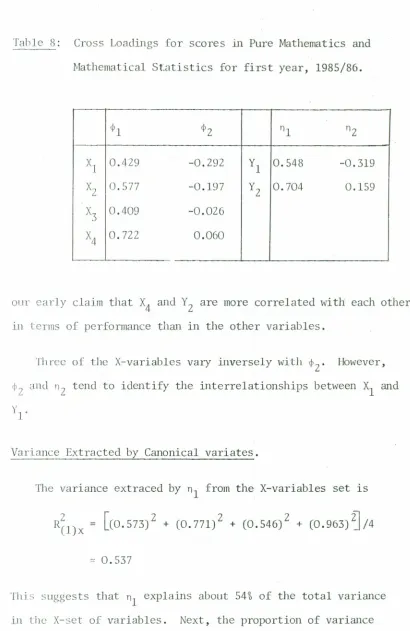
FrolllTable 8 below, we see that all the X-variables are directly
related to 4>1' The strength of the relationships does not vary so
much ; that of X4 is highest (0.722) and X3 the lowest (0.409).
Table 8: Cross Loadings for scores in Pure Mathematics and
Mathematical Statistics for first year, 1985/86.
<PI <PZ nl nZ
Xl 0.4Z9 -0.Z9Z Yl 0.548 -0.319
X
z
0.577 -0.197 YZ 0.704 0.159X3 0.409 -0.OZ6
X4 0.722 0.060
our early claim that X4 and YZ are more correlated with each other
illterms of performance than in the other variables.
Th rcc of the X-variables vary inversely with <PZ' However,
(1)2 and n2 tend to identify the interrelationships between Xl and
y]"
Variance Extracted by Canonical variates.
The variance extraced by nl from the X-variables set is
[(0.573)2 + (0.771)2 + (0.546)2 + (0.963)~/4
'" 0.537
Tltis suggests that nl explains about 54%of the total variance
in Lhe X-set of variables. Next, the proportion of variance
ex! r.rct.c.l by the second canonical variate, n2' in the X-variables is
'"0.147
which is about 15% of the total variance. Therefore, the two
canonical variates account for about 69%, (54+15)%, of the total
vrui aJlCC in the X-variables set.
COllsiclerillthg e Y-variab1es set, the proportion of variance
accouut.ed for by the first canonical variate, ¢1' is
~ 0.710,
\1'1lid} js 71~ 0 I the total variance. Further, the second canonical
the seconclcanonical variate accounts for about 29% of the total
vari;lJlCC, that is
[(-0.682) 2 + (0.341) 2J/2
'"0.290
Thus, the two variates account;for about 100% of the variance in
the Y-variables set.
n.edunclancy:
The redunclllncyin the X-variables set generated by each of the
GIIIOIl ica I var iates <11] and ¢2 is
n.2
(1)x/y
= 0.537 x 0.561
R2
(2)x/y
= 0.147 x 0.219
~ 0.032,
respectively.
Further, the redw1dancy in the Y-variables set attributable to
the canonical variates nk(k = 1,2) is
R2
(l)y/x
= O.710 x 0.561
'"0.398,
R2
(2)y
I
x
= O.290 x O.219
'"0.064
respectively.
This shows that a slightly higher proportion of variance in
the Y-variables set is predictable from the X-variables set than
that of the X-variables set predictable from Y-variables set.
From these redundancies it is clear that </>1(which represents YZ)
accounts for much the greater part of the explained variance of