243 | P a g e
SECURE DRIVING SYSTEM BASED ON
FINGERPRINT DETECTION
G Santhosha
1, B Santosh Kumar
21
Pursuing M.Tech, ES, Visvesvaraya College of Engineering and Technology (VCET),
M.P.Patelguda, Ibrahimpatnam, RangaReddy, Telangana, (India)
2
Working as Assistant Professor & HOD, ECE Department,
Visvesvaraya College of Engineering and Technology (VCET), M.P.Patelguda, Ibrahimpatnam ,
RangaReddy, Telangana, (India)
ABSTRACT
In this paper, we proposed a system prevent non-licensees from driving and therefore causing accidents. The
Fingerprint authentication method will give the highest level security for the authentication applications. The
Bio-metric technology is an ultimate security method due to their uniqueness. The proposed system consists of a
smart card capable of storing licensing details of a particular person. While issuing the license, we maintain the
database of a specific person. In this system we can process the verification in two categories one with
SMART-CARD and other with Fingerprint module. The system consists of SMART SMART-CARD which can check whether
authorized person or not. The somebody who desire to start the motor vehicle they must show the SMART
CARD and After checking the card, then again verify the fingerprint module if the vehicle is matched with
database then ignition will on or else off.
Keywords: Microcontroller, SMARTCARD, Fingerprint Module and Reed Sensor
I. INTRODUCTION
Driving without a license is the cause of many accidents. Many who bring vehicles onto the road may not have
perfect training how to ride the vehicle and don‟t even know the road traffic rules. But the misdeeds don‟t even
care for the penalties and the punishment.
A) Person who drives the automobile has not ever received any license from the government
B) Persons who had license a long back, but has been cancelled due to any of his inefficiency and
C) Person who has received only learning license are not eligible to drive the vehicle with any guidance or
co-driver.
This shows the incapability of the system in checking the valid documents of the driver who as performed the
accident. The survey performed by the AA Foundation for Road Safety Research estimated that in Sweden
nearly half of the drivers don‟t possess a valid license which is the cause for the accident occurrences. Those
who are the cause for the accident are mostly drunken people (Goldberg, 1997). Also in Sweden, the cause of
100 deaths and 2500 injuries per year at a cost of more than one billion US dollars is due to unlicensed driving
244 | P a g e
accidents (approximately a quarter of all road deaths in that year). The equivalent figure would be therefore over900 deaths if this rate prevailed, in Great Britain. So to prevent those accidents we are providing in-built system
in an automobile has therefore became vital. Here we produce a system where it works on bio-metric
application(finger print module), by receiving inputs from the user and process that, check whether it is valid or
not. If it is a valid then according to that vehicle ignition will be ON.
II. PROPOSED SYSTEM
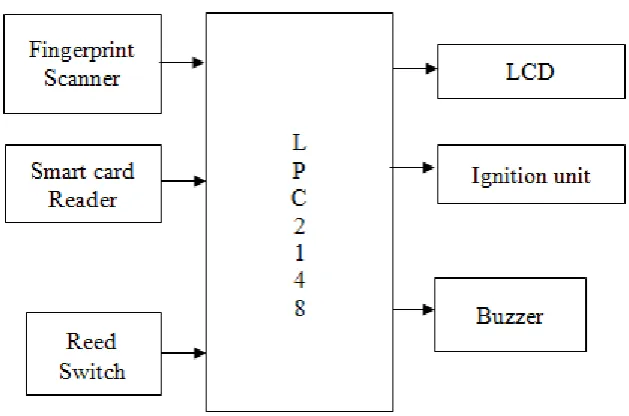
The proposed system consists of a smart card reader and fingerprint scanner placed in the vehicle itself, the
entire system will be processed by a micro-controller. While the user want to drive the vehicle, he/she has to
insert the smart card and then fingerprint, when both the details are matched with the existed database, and when
the system identified the person is licensed, then the system will check for the seat belt, it checks for the side
stand if the vehicle is a two wheeler.The ignition unit of the vehicle is also controlled by the micro-controller,
when only all the conditions are satisfied with the user. These methods will improve the security scope and
avoids the accident's occurrence due to non-licensees driving.
2.1 Block Diagram
Fig 1: Block Diagram of System Design
2.2 Description
The system entails of a micro-controller, smart card reader, fingerprint device, reed sensor, LCD and buzzer. The
controller plays an important role to execute the several tasks. The controller, which we used in this system i.e.
LPC2148. It has several inbuilt features such as
1) It is a 16/32 bit micro-controller.
2) It has 512kb of program memory and 8kb to 40kb of data memory.
3) It has 2 UART‟s which is used to communicate with several devices like SMARTCARD and FINGERPRINT. 4) It also consists of 2 I2C protocols.
245 | P a g e
6) It has 64 GPIO port pins.7) It has a real time clock to measure the time, date and day in real time manner.
8) It provides ADC, PWM and watchdog timer etc.
9) It also provides two 32 bit timers.
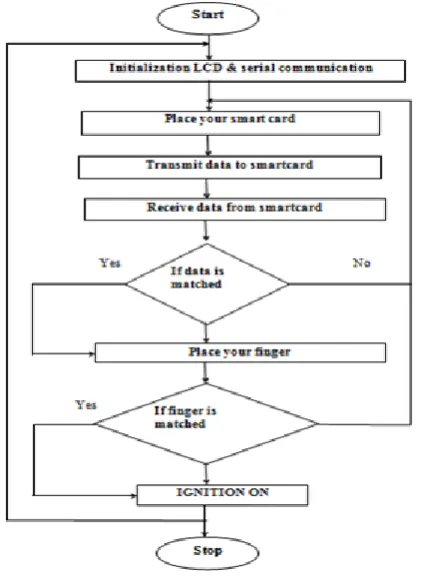
Firstly, we should check the condition, whether the seat belt is wearied or not and after next process
authentication verification i.e. Smart Card and Fingerprint. The smart card is used to identify whether the person
is licensed or not. If the card is licensed then again check the fingerprint for authentication. If it matches them
automatically ignition on or else off.
III. WORKING
The System can provide security for driving peoples by using fingerprint and smart-card. The components
utilized in the system are SMART-CARD, micro-controller module, Reed Switch, bio-metric module
(fingerprint), ignition system module and the SMART-CARD card which is used to insert into the system by the
user. We have to Enrol the fingerprint of specific people in the database. By maintaining a corresponding
database, we should compare whether fingerprint is matched or not. if fingerprint match with the inbuilt data,
the data pins on the controller would be producing a high logic level as „1‟ and ideally output about 5volts, when
a fingerprint mismatch would be producing the data on the data pins to be at a low logic level and ideally output
0volts..Firstly, we should check the reed sensor is detected or not. It is used to check whether the seat belt is
wearied or not. If sensor detected, then again verify the smart card and fingerprint, if matches, then automatic
ignition ON or else OFF.
The following flowchart represents the overall programming steps to execute the predefined task.
246 | P a g e
IV. SOFTWARE IMPLEMENTATION
In order to communicate with the hardware we require a predefined software. An embedded system we require
both hardware and software, it is mandatory to perform a specific application. The hardware components will run
according to the instruction given to the program. The software, tools should be selected based on
micro-controller using in this application. The following some of software tools are used in this project.
1) MDK Keil µVision
2) Flash Magic
4.1 Keil µVision
The Keil µVision is an IDE which will consist of complete programming environment for various
micro-controllers. Keil is having a C editor, ANSI C cross compiler, debugger, and a hex file generator in it. It
supports programming for various 8-bit, 16-bit and 32-bit micro-controllers.
4.2 Flash Magic
It is simply a programming dumping software. Micro-controllers can only understand machine language.
Whatsoever we are text in the program, we need to convert into machine level language. That machine level
language format of the program, we call it as Hex file. After completion of writing all the code, the programmer
needs to write the hex file into the micro-controller.
247 | P a g e
VI.
CONCLUSION
Thus observed above input and output analysis of the proposed system, it proves that the vehicle is surely driven
only by the authorized persons. This system also provides facilities and safety for the learner‟s licensees to drive
the vehicle by keeping a licensed person beside. It also provides time for the system to repair if any malfunction
exists. In cars, a special feature that it ensures that the seat belt is worn by the driver or not, so that it adds the
safety feature two carsThough in implementation of this proposed system, it may take time to perform all the
actions, but it would be of a great use for the safety of drivers and irregularities caused unknowingly can be
guarded without any loopholes in the system.This prototype module can be interfaced with a GPS / GSM
module which would be of great use in future. This data will be used to monitor about the individual who is
driving the vehicle, by this way, theft of the vehicles can be minimized so that it would detect the person who is
driving the vehicle along with location details with the help of GPS. Further, we can assure the safety of the
person with the seat belt detector can be interfaced with the controller as an additional input for ignition control.
REFERENCES
[1] R. C. Simpson, “Smart wheelchairs: A literature review,” J. Rehabil. Res. Develop., vol. 42, no. 4, pp.
423–436, 2005.
[2] R. C. Simpson, E. F. LoPresti, and R. A. Cooper, “How many people would benefit from a
smartwheelchair?” J. Rehabil. Res. Develop., vol. 45,no. 1, pp. 53–72, 2008.
[3] L. Fehr,W. E. Langbein, and S. B. Skaar, “Adequacy of power wheelchair control interfaces for persons
with severe disabilities: A clinical survey,”Development, vol. 37, no. 3, pp. 353–360, 2000.
[4] J.Connell and P.Viola, “Cooperative control of a semi-autonomous mobilerobot,” in Proc. IEEE Int.
Conf. Robot. Autom., 1990, pp. 1118–1121.
[5] A. Pruski and G. Bourhis, “The VAHM project: A cooperation betweenan autonomous mobile platform
and a disabled person,” in Proc. IEEEInt. Conf. Robot. Autom., 1992, pp. 268–273.
[6] S. P. Levine, D. A. Bell, L. A. Jaros, R. C. Simpson, Y. Koren, and J. Borenstein, “The NavChair
assistive wheelchair navigation system,” IEEE Trans. Rehabil. Eng., vol. 7, no. 4, pp. 443–451, 1999.
[7] R. C. Simpson, E. LoPresti, S. Hayashi, I. Nourbakhsh, and D. Miller, “The smart wheelchair component
system,” J. Rehabil. Res. Develop.,vol. 41, no. 3B, pp. 429–442, 2004.
[8] P. D. Nisbet, “Who‟s intelligent? Wheelchair, driver or both?” in Proc. IEEE Int. Conf. Control Appl.,
2002, pp. 760–765.
[9] G. Bourhis and Y. Agostini, “Man–machine cooperation for the control of an intelligent powered
248 | P a g e
AUTHOR DETAILS
G SANTHOSHA,Pursuing Mtech (ES) from Visvesvaraya College of Engineering and
Technology (VCET), M.P.Patelguda, Ibrahimpatnam, RangaReddy, Telangana,
INDIA. Her area of interest includes embedded systems interrelated with different
types of microcontrollers.
B.SANTHOSH KUMAR,working as Assistant Professor & HOD (ECE Department)
from Visvesvaraya College of Engineering and Technology (VCET),
M.P.Patelguda,Ibrahimpatna m, RangaReddy. Heis pursuing Ph.D in Wireless