Available Online atwww.ijcsmc.com
International Journal of Computer Science and Mobile Computing
A Monthly Journal of Computer Science and Information Technology
ISSN 2320–088X
IJCSMC, Vol. 4, Issue. 5, May 2015, pg.375 – 381
RESEARCH ARTICLE
An Improved Stable Clustering Mechanism
for Heterogeneous WSN Optimization
Ojasvee Gulia
Student, M.Tech, ECE Department, ITM University, Gurgaon, Haryana
Abstract: The optimized communication in a sensor network is always a challenging task. A clustered architecture divides the network in sub-segments and performs the cluster head adaptive communication. In this work, an improvement to the clustered architecture is provided by reducing the cluster switching. The stability here is achieved in terms of energy estimation and the time vector for cluster formation. This stable approach has reduced the energy consumption for cluster formation so that the network communication and network life is improved. The work defined here is for energy unbalanced heterogeneous network to optimize the clustering. The work has also provided the multihop communication with in clusters to deliver the packets to cluster heads. As the cluster heads will get the packets, the aggregative communication path will be generated to deliver the packets to base station. The comparative experimentation results show that network is optimized.
Keywords – Clustered, Stable, LEACH, Communication
1.
Introduction
As the sensor network is basically defined for specialized applications and environment the network is also defined along with specification of architectural constraints. One of such common architecture is zone adaptive architecture. In this architectural form, the network is divided in smaller segments called zone. Each node of the zone is controlled by a controller node that accepts the data from the zone nodes and takes the selective decision. After applying some aggregative operation, the collected data is passed to next base station using a multi hop path. There are number of existing protocols that work on this zone adaptive architecture. The main aim of zone adaptive architecture is to provide the optimize network communication under energy vector. The work is here defined as an improved clustered architecture so that the network restrictions will be utilized and the performance of the network in terms of communication and network life will be improved.
A) Clustered Architecture
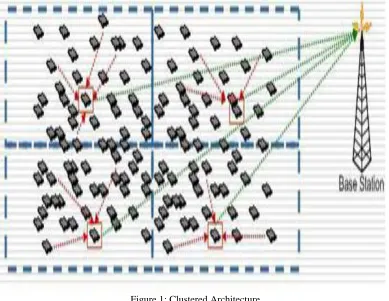
form is also adaptive to provide the reliable and accurate information transmission when the available resources are restricted. This network form has reduced the network communication and energy consumption so that the network transmission is improved. The network model for this work is given here under.
Figure 1: Clustered Architecture
The main application area of sensor network is to work on real time data that is generally obtained by the sensor node by observing the environment or the specific component. To provide the environment effective communication, it is required to configure the network and the nodes respective to the relative constraints. The examples of such kind of information collection include the temperature analysis, humidity analysis etc. Once the data is collected, the next work is to perform data distribution among nodes and to perform the final transmission to the main base station so that the outer world can get and use this information.
In this present work, a node stability analysis approach is defined to improve the clustered architecture. In this section, an exploration to the clustered architecture and its requirement in sensor network is described. In section II, the work defined by earlier researchers is described. In section III, the proposed research methodology is explained. In section IV, the results obtained from the work are explained. In section V, the conclusion obtained from the presented work.
2.
EXISTING WORK
defined the cooperative communication based on the operational analysis and transmission control analysis so that the clustering mechanism would be improved.
Mohamed Elhawary[4] defined a work on energy optimization based on the cooperative nature of the network. Author improved the cluster formation under recruit neighboring model based on the network assistance. Author defined the improvement to the clustering mechanism so that the network communication is be improved and end-to-end delay would be reduced. Author defined the model under energy adaption and error rate so that the improved network communication would be achieved. Zhu Yong[5] defined an energy adaptive clustering so that the algorithmic improvement to the network would be defined. Author defined the energy adaptive cluster formation. The process modeling here is defined based on cluster head election and process modeling and data transmission. Hanady M. Abdulsalam[6] has defined a work on LEACH protocol to improve the connectivity under weight analysis and formation so that the network handling to the network would be improved.
Feda’ Al-Maaqbeh[7] presented a fuzzy adaptive clustering with rule specification so that the network density based clusters will be formed. Author provided the uniform distribution of network nodes so that the communication stability would be achieved. Xiaohua(Edward) Li[8] presented a work on node level synchronization so that the adaptive cooperative communication would be formed. Author defined the improvement to the energy optimization so that the critical vector analysis based communication would be performed. Geoffrey Werner Challen[9] defined a work distributed architecture based on energy adaptation. Author applied the decision making under node sensing. Author also achieved the component level evaluation to improve the network life. D A Vidhate[10] presented a work on adaptive network clustering with hierarchical protocol generation and formation. Author defined the random selection of nodes so that the cluster switching is be optimized. Hania Aoudia[11] defined an energy adaptive LEACH so that the network formation under memory adaption would be achieved. Author achieved the clustering under energy and distance optimization.
3.
PROPOSED WORK
The presented work is here defined as an improvement to the existing work to improve the network stability so that the clustered architecture will be improved. In the traditional architecture, the clustering is based on the probability vector. In this kind of probability based clustering, the cluster formation is modified with each communicating round. In this work, an adaptive clustering mechanism is proposed. According to this presented work model, the analysis on the network nodes will be done to perform the cluster formation or cluster selection. The work will reduce the cluster switch and track the existing clusters. Till the cluster node strength is high it will not recall the clustering process. This presented approach will improve the clustering mechanism by enhancing the cluster strength. As the clustering time and energy is saved overall network life will improved. As the network life is improved, the alive nodes can perform the communication for larger time interval so that the network communication will be improved itself. The algorithmic approach for cluster formation is given in this section in figure 2.
Figure 2 : Clustering Model
In this network form, all the cluster members deliver the data to the adaptive cluster head. To perform this intra cluster communication, the inner sensing range is defined. The nodes present in the range can perform the direct communication with cluster head whereas the nodes outside the inner range will perform the multihop communication. The selection of the
Define WSN Network under Random Node Placement
Network Feature Specification under Energy and Communication Parameters
Divide the network in N clusters initially based on the geographical division
Separate the network nodes in each allocated geographical region
Apply Clustering in Each Region for cluster head formation and selection under specification of
energy adaptively, distance analysis and probability vector
Identify the region criticality based on the network density and the node type criticality based on these vector decide the decision vectors
dynamically
Obtain the sensitive cluster heads based on the region and the node criticality analysis
Perform the cluster nodes communication with cluster head
Apply the aggregative operator and perform the cluster communication to base station
path to the cluster head is done under distance and energy parameters. Based on these parameters the packets will be delivered to the base station.
Figure 3 : Multihop Aggregative Communication
As the cluster head accepted the packets from all the cluster members it combine these packets under some aggregative operation and deliver it to the base station. The base station is also defined with specific sensing range. The cluster heads that are in range of base station can perform direct communication with base station but the nodes that are not in range will have to generate a multihop path to communicate with base station. Each participating node will give some amount of energy loss based on its role such as the aggregator, communicator or the forwarder. The aggregator gives the maximum energy loss whereas the forwarder gives the minimum energy loss. The multihop communication architecture is shown in figure 3. The constraint specific experimentation results are described in next section.
4.
RESULTS
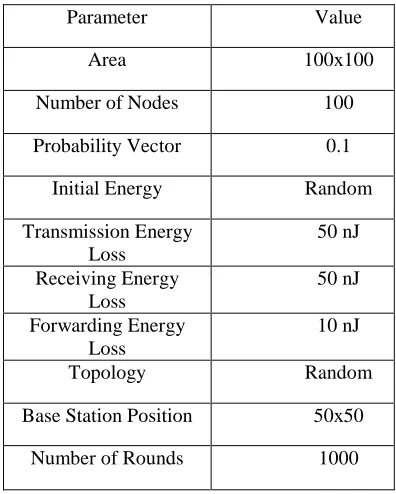
The work experimentation is here applied on clustered network architecture to achieve the energy adaptive optimization. The simulation parameters considered in this work are given here in table 1
Table 2 : Network Parameters
Parameter Value
Area 100x100
Number of Nodes 100
Probability Vector 0.1
Initial Energy Random
Transmission Energy Loss
50 nJ
Receiving Energy Loss
50 nJ
Forwarding Energy Loss
10 nJ
Topology Random
Base Station Position 50x50
The work is here implied to perform the effective network communication under the limitations of sensor network. The analysis of the work is here done in terms of dead node analysis, alive node analysis, energy consumption and packet communication. These results are described in this section
Figure 1 : Dead Node Analysis
Here figure 1 is showing the network life analysis in terms of dead node identification respective to communication rounds. The figure shows that the presented work has improved the network life.
Figure 2 : Network Energy Analysis
Here figure 2 is showing the analysis on the network in terms of energy vector. Here x axis represents the communication rounds and y axis represents the network energy. The figure shows that the proposed work has reduced the energy consumption over the network.
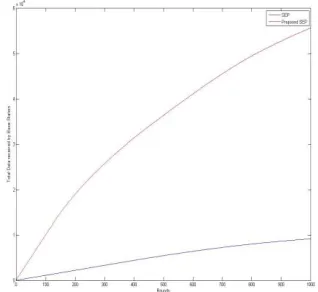
Here figure 3 is showing the packet communication analysis in case of proposed work. Here x axis represents the communication rounds and y axis represents the packet communication. The results show that the presented work has improved the packet communication in the network.
behaviour is improved in this work,
5.
CONCLUSION
In this present work, an improved network architecture is defined not stability analysis. The stability is here achieved in terms of network life and network communication scenario. The comparative experimentation shows that the work has improve the network life and network communication.
References
[1] Marcelo P. Sousa," Low-Energy Selective Cooperative Diversity with ARQ for Wireless Image Sensor
Networks", 978-1-4244-3574-6/10©2010 IEEE
[2] Marcelo Portela Sousa," Ant Colony Optimization with Fuzzy Heuristic Information Designed for Cooperative
Wireless Sensor Networks", MSWiM’11, October 31–November 4, 2011, Miami, Florida, USA. ACM 978-1-4503-0898-4/11/10
[3] Neetesh Purohit," A New Scheme for Cooperative Communication in LEACH based Wireless Sensor Network",
2011 International Conference on Computational Intelligence and Communication Systems 978-0-7695-4587-5/11 © 2011 IEEE
[4] Mohamed Elhawary," Energy-Efficient Protocol for Cooperative Networks", IEEE/ACM TRANSACTIONS ON
NETWORKING, VOL. 19, NO. 2, APRIL 2011 1063-6692 © 2011 IEEE
[5] Zhu Yong," A Energy-Efficient Clustering Routing Algorithm Based on Distance and Residual Energy for
Wireless Sensor Networks", 2012 International Workshop on Information and Electronics Engineering (IWIEE) 1877-7058 © 2011
[6] Hanady M. Abdulsalam," Data Aggregation for Evolving Wireless Sensor Networks
Using W-LEACH", Second Kuwait Conf. on E-Services and E-Systems April 5-7, 2011 ACM 978-1-4503-0793-2
[7] Feda’ Al-Maaqbeh," Fuzzy Logic Based Energy Efficient Adaptive Clustering Protocol", ICICS’12, April 3–5,
2012, Irbid, Jordan. ACM 978-14503-1327-8/04/2012
[8] Xiaohua(Edward) Li," Cooperative Transmissions in Wireless Sensor Networks with Imperfect Synchronization".
[9] Geoffrey Werner Challen," IDEA: Integrated Distributed Energy Awareness for Wireless Sensor Networks",
MobiSys’10, June 15–18, 2010, San Francisco, California, USA. ACM 978-1-60558-985-5/10/06
[10] D A Vidhate," Performance Evaluation of Low Energy Adaptive Clustering Hierarchy Protocol for Wireless
Sensor Networks", International Conference and Workshop on Emerging Trends in Technology (ICWET 2010) – TCET, Mumbai, India ICWET’10, February 26–27, 2010, Mumbai, Maharashtra, India. ACM 978-1-60558-812-4
[11] Hania Aoudia," Hierarchical Routing Approach-Based Energy Optimization in Wireless Sensor Networks",