Λ
◦
λ
:
Functional Lattice Cryptography
Eric Crockett* Chris Peikert† August 17, 2016
Abstract
This work describes the design, implementation, and evaluation ofΛ◦λ, a general-purpose software framework for lattice-based cryptography. TheΛ◦λframework has several novel properties that distinguish it from prior implementations of lattice cryptosystems, including the following.
Generality, modularity, concision:Λ◦λdefines a collection of general, highly composable interfaces for mathematical operations used across lattice cryptography, allowing for a wide variety of schemes to be expressed very naturally and at a high level of abstraction. For example, we implement an advanced fully homomorphic encryption (FHE) scheme in as few as 2–5 lines of code per feature, via code that very closely matches the scheme’s mathematical definition.
Theory affinity: Λ◦λis designed from the ground-up around the specialized ring representations, fast algorithms, and worst-case hardness proofs that have been developed for the Ring-LWE problem and its cryptographic applications. In particular, it implements fast algorithms for sampling from theory-recommendederror distributions overarbitrarycyclotomic rings, and provides tools for maintaining tight control of error growth in cryptographic schemes.
Safety: Λ◦λhas several facilities for reducing code complexity and programming errors, thereby aiding thecorrectimplementation of lattice cryptosystems. In particular, it uses strong typing tostatically enforce—i.e., at compile time—a wide variety of constraints among the various parameters.
Advanced features:Λ◦λexposes the richhierarchyof cyclotomic rings to cryptographic applications. We use this to give the first-ever implementation of a collection of FHE operations known as “ring switching,” and also define and analyze a more efficient variant that we call “ring tunneling.”
Lastly, this work defines and analyzes a variety of mathematical objects and algorithms for the recommended usage of Ring-LWE in cyclotomic rings, which we believe will serve as a useful knowledge base for future implementations.
*School of Computer Science, Georgia Institute of Technology, and Department of Computer Science and Engineering, University of Michigan.
Contents
1 Introduction 4
1.1 Contributions . . . 4
1.1.1 Novel Attributes ofΛ◦λ . . . 4
1.1.2 Other Technical Contributions . . . 6
1.2 Example: FHE inΛ◦λ . . . 7
1.3 Limitations and Future Work . . . 9
1.4 Comparison to Related Work . . . 10
1.5 Architecture and Paper Organization . . . 10
2 Integer and Modular Arithmetic 11 2.1 RepresentingZandZq . . . 12
2.2 ReduceandLift . . . 12
2.3 Rescale . . . 13
2.4 Gadget,Decompose, andCorrect . . . 13
2.5 CRTrans . . . 15
2.6 Type-Level Cyclotomic Indices . . . 15
3 Cyclotomic Rings 16 3.1 Mathematical Background . . . 17
3.1.1 Cyclotomic Rings . . . 17
3.1.2 Ring-LWE and (Tweaked) Error Distributions . . . 17
3.1.3 Error Invariant . . . 18
3.2 Cyclotomic Types:CycandUCyc . . . 19
3.2.1 Instances . . . 19
3.2.2 Functions . . . 20
3.3 Implementation . . . 22
3.3.1 Representations . . . 22
3.3.2 Operations . . . 22
3.3.3 Promoting Base-Ring Operations . . . 23
4 Fully Homomorphic Encryption inΛ◦λ 24 4.1 Keys, Plaintexts, and Ciphertexts . . . 25
4.2 Encryption and Decryption . . . 26
4.3 Homomorphic Addition and Multiplication . . . 27
4.4 Modulus Switching . . . 27
4.5 Key Switching and Linearization . . . 28
4.6 Ring Tunneling . . . 30
A More on Type-Level Cyclotomic Indices 36 A.1 Promoting Factored Naturals . . . 37
B Sparse Decompositions and Haskell Framework 38
B.1 Sparse Decompositions . . . 38
B.2 Haskell Framework . . . 39
C TensorInterface and Sparse Decompositions 41 C.1 Mathematical Background . . . 41
C.1.1 Cyclotomic Rings and Powerful Bases . . . 41
C.1.2 (Tweaked) Trace, Dual Ideal, and Decoding Bases . . . 43
C.1.3 Chinese Remainder Bases . . . 45
C.2 Single-Index Transforms . . . 46
C.2.1 Prime-Power Factorization . . . 46
C.2.2 Embedding Scalars . . . 46
C.2.3 Converting Between Powerful and Decoding Bases . . . 46
C.2.4 Multiplication bygm . . . 47
C.2.5 Chinese Remainder and Discrete Fourier Transforms . . . 48
C.2.6 Generating (Tweaked) Gaussians in the Decoding Basis . . . 49
C.2.7 Gram Matrix of Decoding Basis . . . 50
C.3 Two-Index Transforms and Values . . . 50
C.3.1 Prime-Power Factorization . . . 50
C.3.2 Coefficients in Relative Bases . . . 51
C.3.3 Embed Transforms . . . 51
C.3.4 Twace Transforms . . . 52
C.4 CRT Sets . . . 53
C.4.1 Mathematical Background . . . 53
C.4.2 Computing CRT Sets . . . 54
D Tensor Product of Rings 55 E Evaluation 56 E.1 Source Code Analysis . . . 57
E.1.1 Source Lines of Code . . . 57
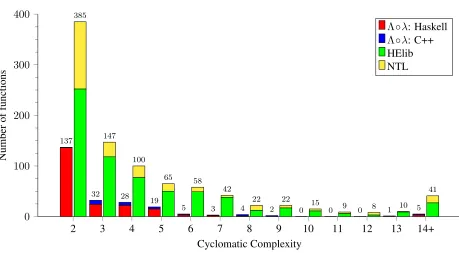
E.1.2 Cyclomatic Complexity and Function Count . . . 58
E.2 Performance . . . 58
E.2.1 Cyclotomic Ring Operations . . . 59
E.2.2 SHE Scheme . . . 61
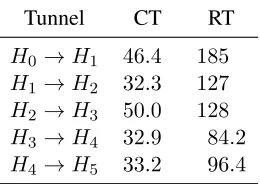
E.2.3 Ring Tunneling . . . 62
F Haskell Background 63 F.1 Types . . . 63
1
Introduction
Lattice-based cryptography has seen enormous growth over the past decade, and has attractive features like apparent resistance toquantumattacks; security underworst-casehardness assumptions (e.g., [Ajt96, Reg05]); efficiency and parallelism, especially via the use of algebraically structured lattices over polynomialrings (e.g., [HPS98, Mic02, LPR10]); and powerful cryptographic constructions like identity/attribute-based and fully homomorphic encryption (e.g., [GPV08, Gen09, BGV12, GSW13, GVW13]).
The past few years have seen a broad movement toward thepractical implementationof lattice/ring-based schemes, with an impressive array of results. To date, each such implementation has been specialized to a particular cryptographic primitive (and sometimes even to a specific computational platform), e.g., collision-resistant hashing (using SIMD instruction sets) [LMPR08], digital signatures [GLP12, DDLL13], key-establishment protocols [BCNS15, ADPS16, BCD+16], and fully homomorphic encryption (FHE) [NLV11, HS] (using GPUs and FPGAs [WHC+12, CGRS14]), to name a few.
However, the state of lattice cryptography implementations is also highlyfragmented: they are usually focused on a single cryptosystem for fixed parameter sets, and have few reusable interfaces, making them hard to implement other primitives upon. Those interfaces that do exist are quitelow-level; e.g., they require the programmer to explicitly convert between various representations of ring elements, which calls for specialized expertise and can be error prone. Finally, prior implementations either do not support, or use suboptimal algorithms for, the important class ofarbitrary cyclotomicrings, and thereby lack related classes of FHE functionality. (See Section 1.4 for a more detailed review of related work.)
With all this in mind, we contend that there is a need for ageneral-purpose,high-level, andfeature-rich frameworkthat will allow researchers to more easily implement and experiment with the wide variety of lattice-based cryptographic schemes, particularly more complex ones like FHE.
1.1 Contributions
This work describes the design, implementation, and evaluation ofΛ◦λ, a general-purpose framework for lattice-based cryptography in the compiled, functional, strongly typed programming language Haskell.1,2Our primary goals forΛ◦λinclude: (1) the ability to implement both basic and advanced lattice cryptosystems correctly, concisely, and at a high level of abstraction; (2) alignment with the current best theory concerning security and algorithmic efficiency; and (3) acceptable performance on commodity CPUs, along with the capacity to integrate specialized backends (e.g., GPUs) without affecting application code.
1.1.1 Novel Attributes ofΛ◦λ
TheΛ◦λframework has several novel properties that distinguish it from prior lattice-crypto implementations.
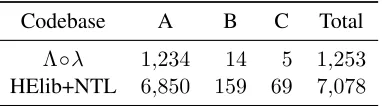
Generality, modularity, and concision: Λ◦λdefines a collection of simple, modular interfaces and implementations for the lattice cryptography “toolbox,” i.e., the collection of operations that are used across a wide variety of modern cryptographic constructions. This generality allows cryptographic schemes to be expressed very naturally and concisely, via code that closely mirrors their mathematical definitions. For example, we implement a full-featured FHE scheme (which includes never-before-implemented functionality) in as few as 2–5 lines of code per feature. (See Sections 1.2 and 4 for details.)
1
The nameΛ◦λrefers to the combination of lattices and functional programming, which are often signified byΛandλ, respectively. The recommended pronunciation is “L O L.”
2
WhileΛ◦λ’s interfaces are general enough to support most modern lattice-based cryptosystems, our main focus (as with most prior implementations) is on systems defined overcyclotomic rings, because they lie at the heart of practically efficient lattice-based cryptography (see, e.g., [HPS98, Mic02, LPR10, LPR13]). However, while almost all prior implementations are limited to the narrow subclass ofpower-of-twocyclotomics (which are the algorithmically simplest case),Λ◦λsupportsarbitrarycyclotomic rings. Such support is essential in a general framework, because many advanced techniques in ring-based cryptography, such as “plaintext packing” and homomorphic SIMD operations [SV10, SV11], inherently require non-power-of-two cyclotomics when using characteristic-two plaintext spaces (e.g.,F2k).
Theory affinity: Λ◦λis designed from the ground-up around the specialized ring representations, fast algorithms, and worst-case hardness proofs developed in [LPR10, LPR13] for the design and analysis of ring-based cryptosystems (over arbitrary cyclotomic rings), particularly those relying on Ring-LWE. To our knowledge,Λ◦λis the first-ever implementation of these techniques, which include:
• fast and modular algorithms for converting among the three most useful representations of ring elements, corresponding to thepowerful,decoding, andChinese Remainder Theorem (CRT)bases;
• fast algorithms for sampling from “theory-recommended” error distributions—i.e., those for which the Ring-LWE problem has provable worst-case hardness—for use in encryption and related operations;
• proper use of the powerful- and decoding-basis representations to maintain tight control of error growth under cryptographic operations, and for the best error tolerance in decryption.
We especially emphasize the importance of using appropriate error distributions for Ring-LWE, because ad-hoc instantiations with narrow error can be completely broken by certain attacks [ELOS15, CLS15, CIV16], whereas theory-recommended distributions are provably immune to the same class of attacks [Pei16].
In addition,Λ◦λis the first lattice cryptography implementation to expose the richhierarchyof cyclotomic rings, making subring and extension-ring relationships accessible to applications. In particular,Λ◦λsupports a set of homomorphic operations known asring-switching[BGV12, GHPS12, AP13], which enables efficient homomorphic evaluation of certain structured linear transforms. Ring-switching has multiple applications, such as ciphertext compression [BGV12, GHPS12] and asymptotically efficient “bootstrapping” algorithms for FHE [AP13].
Safety: Building on its host language Haskell,Λ◦λhas several facilities for reducing programming errors and code complexity, thereby aiding thecorrectimplementation of lattice cryptosystems. This is particularly important for advanced constructions like FHE, which involve a host of parameters, mathematical objects, and algebraic operations that must satisfy a variety of constraints for the scheme to work as intended.
More specifically, Λ◦λuses advanced features of Haskell’s type system tostatically enforce(i.e., at compile time) a variety of mathematical constraints. This catches many common programming errors early on, and guarantees that any execution will perform only legal operations.3 For example,Λ◦λrepresents integer moduli and cyclotomic indices as specializedtypes, which allows it to statically enforce that all inputs to modular arithmetic operations have the same modulus, and that to embed from one cyclotomic ring to another, the former must be a subring of the latter. We emphasize that representing moduli and indices as types does not require fixing their values at compile time; instead, one can (and we often do)reifyruntime values into types, checking any necessary constraints just once at reification.
Additionally,Λ◦λaids safety by defininghigh-level abstractionsandnarrow interfacesfor algebraic ob-jects and cryptographic operations. For example, it provides an abstract data type for cyclotomic rings, which
3
hides its choice of internal representation (powerful or CRT basis, subring element, etc.), and automatically performs any necessary conversions. Moreover, it exposes only high-level operations like ring addition and multiplication, bit decomposition, sampling uniform or Gaussian ring elements, etc.
Finally, Haskell itself also greatly aids safety because computations are by defaultpure: they cannot mutate state or otherwise modify their environment. This makes code easier to reason about, test, or even formally verify, and is a natural fit for algebra-intensive applications like lattice cryptography. We stress that “effectful” computations like input/output or random number generation are still possible, but must be embedded in a structure that precisely delineates what effects are allowed.
Multiple backends: Λ◦λ’s architecture sharply separates its interface of cyclotomic ring operations from the implementations of their corresponding linear transforms. This allows for multiple “backends,” e.g., based on specialized hardware like GPUs or FPGAs via tools like [CKL+11], without requiring any changes to cryptographic application code. (By contrast, prior implementations exhibit rather tight coupling between their application and backend code.) We have implemented two interchangeable backends, one in the pure-Haskell Repa array library [KCL+10, LCKJ12], and one in C++.
1.1.2 Other Technical Contributions
Our work onΛ◦λhas also led to several technical novelties of broader interest and applicability.
Abstractions for lattice cryptography. As already mentioned, Λ◦λ defines composableabstractions and algorithms for widely used lattice operations, such asrounding(or rescaling)Zq to another modulus,
(bit) decomposition, and other operations associated with “gadgets” (including in “Chinese remainder” representations). Prior works have documented and/or implemented subsets of these operations, but at lower levels of generality and composability. For example, we derive generic algorithms for all the above operations onproduct rings, using any corresponding algorithms for the component rings. And we show how to generically “promote” these operations onZorZqto arbitrary cyclotomic rings. Such modularity makes
our code easier to understand and verify, and is also pedagogically helpful to newcomers to the area.
DSL for sparse decompositions. As shown in [LPR13] and further in this work, most cryptographically relevant operations on cyclotomic rings correspond to linear transforms havingsparse decompositions, i.e., factorizations into relatively sparse matrices, or tensor products thereof. Such factorizations directly yield fast and highly parallel algorithms; e.g., the Cooley-Tukey FFT algorithm arises from a sparse decomposition of the Discrete Fourier Transform.
To concisely and systematically implement the wide variety of linear transforms associated with general cyclotomics,Λ◦λincludes an embeddeddomain-specific language(DSL) for expressing sparse decom-positions using natural matrix notation, and a “compiler” that produces corresponding fast and parallel implementations. This compiler includes generic combinators that “lift” any class of transform from the primitive case of prime cyclotomics, to the prime-power case, and then to arbitrary cyclotomics. (See Appendix B for details.)
almost all of this material is new. (For comparison, the Ring-LWE “toolkit” [LPR13] deals almost entirely with transforms and algorithms for asinglecyclotomic ring, not inter-ring operations.)
FHE with ring tunneling. In Section 4, we define and implement an FHE scheme which refines a variety of techniques and features from a long series of works on Ring-LWE and FHE [LPR10, BV11a, BV11b, BGV12, GHPS12, LPR13, AP13]. For example, it allows the plaintext and ciphertext spaces to be defined over different cyclotomic rings, which permits certain optimizations.
UsingΛ◦λ’s support for the cyclotomic hierarchy, we also devise and implement a more efficient variant of ring-switching for FHE, which we callring tunneling. While a prior technique [AP13] homomorphically evaluates a linear function by “hopping” from one ring to another through a commonextensionring, our new approach “tunnels” through a commonsubring, which makes it more efficient. Moreover, we show that the linear function can be integrated into the accompanying key-switching step, thus unifying two operations into a simpler and even more efficient one. (See Section 4.6 for details.)
1.2 Example: FHE inΛ◦λ
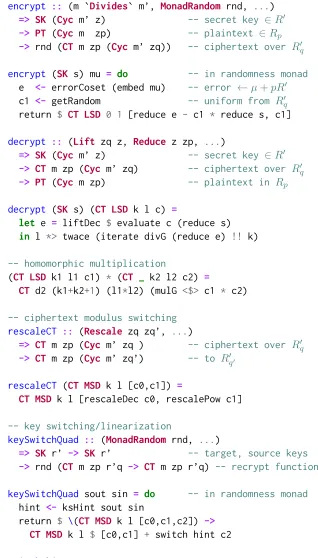
For illustration, here we briefly give a flavor of our FHE implementation inΛ◦λ; see Figure 1 for representative code, and Section 4 for many more details of the scheme’s mathematical definition and implementation. While we do not expect the reader (especially one who is not conversant with Haskell) to understand all the details of the code, it should be clear that even complex operations like modulus-switching and key-switching/relinearization have very concise and natural implementations in terms ofΛ◦λ’s interfaces (which include the functionserrorCoset,reduce,embed,twace,liftDec, etc.). Indeed, the implementations of the FHE functions are often shorter than their type declarations! (For the reader who is new to Haskell, Appendix F gives a brief tutorial that provides sufficient background to understand the code fragments appearing in this paper.)
As a reader’s guide to the code from Figure 1, by convention the type variablesz,zp,zqalways represent (respectively) the integer ringZand quotient ringsZp =Z/pZ,Zq=Z/qZ, wherepqare respectively
the plaintext and ciphertext moduli. The typesm,m’respectively represent the indicesm, m0of the cyclotomic ringsR, R0, where we needm|m0so thatRcan be seen as a subring ofR0. Combining all this, the types
Cyc m’ z, Cyc m zp, andCyc m’ zqrespectively representR0, the plaintext ringRp = R/pR, and the
ciphertext ringR0q =R0/qR0.
The declarationencrypt :: (m `Divides` m’, ...) => ...defines thetypeof the functionencrypt (and similarly fordecrypt,rescaleCT, etc.). Preceding the arrow=>, the text(m `Divides` m’, ...)
lists theconstraintsthat the types must satisfy at compile time; here the first constraint enforces thatm|m0. The text following the arrow=>defines the types of the inputs and output. Forencrypt, the inputs are a secret key inR0 and a plaintext inR0p, and the output is a random ciphertext overR0q. Notice that the full ciphertext type also includes the typesmandzp, which indicate that the plaintext is fromRp. This aids
safety: thanks to the type ofdecrypt, the type system prevents the programmer from incorrectly attempting to decrypt the ciphertext into a ring other thanRp.
encrypt :: (m `Divides` m’, MonadRandom rnd, ...)
=> SK (Cyc m’ z) -- secret key ∈R0
-> PT (Cyc m zp) -- plaintext ∈Rp
-> rnd (CT m zp (Cyc m’ zq)) -- ciphertext over R0q
encrypt (SK s) mu = do -- in randomness monad e <- errorCoset (embed mu) -- error ←µ+pR0
c1 <- getRandom -- uniform from R0q
return $ CT LSD 0 1 [reduce e - c1 * reduce s, c1]
decrypt :: (Lift zq z, Reduce z zp, ...)
=> SK (Cyc m’ z) -- secret key ∈R0
-> CT m zp (Cyc m’ zq) -- ciphertext over R0q
-> PT (Cyc m zp) -- plaintext in Rp
decrypt (SK s) (CT LSD k l c) =
let e = liftDec $ evaluate c (reduce s)
in l *> twace (iterate divG (reduce e) !! k)
-- homomorphic multiplication
(CT LSD k1 l1 c1) * (CT _ k2 l2 c2) =
CT d2 (k1+k2+1) (l1*l2) (mulG <$> c1 * c2)
-- ciphertext modulus switching
rescaleCT :: (Rescale zq zq’, ...)
=> CT m zp (Cyc m’ zq ) -- ciphertext over R0q
-> CT m zp (Cyc m’ zq’) -- to R0q0
rescaleCT (CT MSD k l [c0,c1]) =
CT MSD k l [rescaleDec c0, rescalePow c1]
-- key switching/linearization
keySwitchQuad :: (MonadRandom rnd, ...)
=> SK r’ -> SK r’ -- target, source keys
-> rnd (CT m zp r’q -> CT m zp r’q) -- recrypt function
keySwitchQuad sout sin = do -- in randomness monad hint <- ksHint sout sin
return $ \(CT MSD k l [c0,c1,c2]) ->
CT MSD k l $ [c0,c1] + switch hint c2
switch hint c =
sum $ zipWith (*>) (reduce <$> decompose c) hint
1.3 Limitations and Future Work
Security. While Λ◦λhas many attractive functionality and safety features, we stress that it is still an early-stage research prototype, and is not yet recommended for production purposes—especially in scenarios requiring high security assurances. Potential issues include, but may not be limited to:
• Most functions inΛ◦λare not constant time, and may therefore leak secret information via timing or other side channels. (Systematically protecting lattice cryptography from side-channel attacks is an important area of research.)
• WhileΛ◦λimplements a fast algorithm for sampling from theory-recommended error distributions, the current implementation is somewhat na¨ıve in terms of precision. By default, someΛ◦λfunctions use double-precision floating-point arithmetic to approximate a sample from a continuous Gaussian, before rounding. (But one can specify an alternative data type having more precision.) We have not yet analyzed the associated security implications, if any. We do note, however, that Ring-LWE is robust to small variations in the error distribution (see, e.g., [LPR10, Section 5]).
Discrete Gaussian sampling. Many lattice-based cryptosytems, such as digital signatures and identity-based or attribute-identity-based encryption schemes following [GPV08], require sampling from adiscrete Gaussian probability distribution over a given lattice coset, using an appropriate kind of “trapdoor.” Supporting this operation inΛ◦λis left to future work, for the following reasons. While it is straightforward to give a clean interfacefor discrete Gaussian sampling (similar to theDecomposeclassdescribed in Section 2.4), providing a secure and practicalimplementationis very subtle, especially for arbitrary cyclotomic rings: one needs to account for the non-orthogonality of the standard bases, use practically efficient algorithms, and ensure high statistical fidelity to the desired distribution using finite precision. Although there has been good progress in addressing these issues at the theoretical level (see, e.g., [DN12, LPR13, DP15b, DP15a]), a complete practical solution still requires further research.
Applications. As our focus here is mainly on theΛ◦λframework itself, we leave the implementation of additional lattice-based cryptosystems to future work. While digital signatures and identity/attribute-based encryption use discrete Gaussian sampling, many other primitives should be straightforward to implement usingΛ◦λ’s existing functionality. These include standard Ring-LWE-based [LPR10, LPR13] and NTRU-style encryption [HPS98, SS11], public-key encryption with security under chosen-ciphertext attacks [MP12], and pseudorandom functions (PRFs) [BPR12, BLMR13, BP14]. It should also be possible to implement the homomorphic evaluationof a lattice-based PRF under our FHE scheme, in the same spirit as homomorphic evaluations of the AES block cipher [GHS12, CLT14]; we have promising preliminary work in this direction.
1.4 Comparison to Related Work
As mentioned above, there are many implementations of various lattice- and ring-based cryptographic schemes, such as NTRU (Prime) encryption [HPS98, BCLvV16], the SWIFFT hash function [LMPR08], digital signature schemes like [GLP12] and BLISS [DDLL13], key-exchange protocols [BCNS15, ADPS16, BCD+16], and FHE libraries like HElib [HS]. In addition, there are some high-performance backends for power-of-two cyclotomics, like NFLlib [MBG+16] and [WHC+12], which can potentially be plugged into these other systems. Also, in a Masters thesis developed concurrently with this work, Mayer [May16] implemented the “toolkit” algorithms from [LPR13] for arbitrary cyclotomic rings (though not the inter-ring operations thatΛ◦λsupports).
On the whole, the prior works each implement just one cryptographic primitive (sometimes even on a specific computational platform), and typically opt for performance over generality and modularity. In particular, none of them provide any abstract data types for cyclotomic rings, but instead require the programmer to explicitly manage the representations of ring elements (e.g., as polynomials) and ensure that operations on them are mathematically meaningful. Moreover, with the exception of [May16], they do not support general cyclotomic rings using the current best theory for cryptographic purposes.
HElib. Our work compares most closely to HElib [HS], which is an “assembly language” for BGV-style FHE over cyclotomic rings [BGV12]. It holds speed records for a variety of FHE benchmarks (e.g., homomorphic AES computation [GHS12]), and appears to be the sole public implementation of many advanced FHE features, like bootstrapping for “packed” ciphertexts [HS15].
On the downside, HElib does not use the best known algorithms for cryptographic operations in general (non-power-of-two) cyclotomics. Most significantly, it uses theunivariaterepresentation modulo cyclotomic polynomials, rather than the multivariate/tensored representations from [LPR13], which results in more complex and less efficient algorithms, and suboptimal noise growth in cryptographic schemes. The practical effects of this can be seen in our performance evaluation (Appendix E.2), which shows thatΛ◦λ’s C++ backend is about nine times slower than HElib for power-of-two cyclotomics, but is significantlyfaster(by factors of two or more) for indices involving two or more small primes. Finally, HELib is targeted toward just one class of cryptographic construction (FHE), so it lacks functionality necessary to implement a broader selection of lattice schemes (e.g., CCA-secure encryption).
Computational algebra systems. Algebra packages like Sage and Magma provide very general-purpose support for computational number theory. While these systems do offer higher-level abstractions and operations for cyclotomic rings, they are not a suitable platform for attaining our goals. First, their existing implementations of cyclotomic rings do not use the “tensored” representations (i.e., powerful and decoding bases, and CRT bases overZq) and associated fast algorithms that are preferred for cryptographic purposes.
Nor do they include support for special lattice operations like bit decomposition and other “gadget” operations, so to use such systems we would have to reimplement essentially all the mathematical algorithms from scratch. Perhaps more significantly, the programming languages of these systems are relatively weakly and dynamically(not statically) typed, so all type-checking is deferred to runtime, where errors can be much harder to debug.
1.5 Architecture and Paper Organization
Integer layer (Section 2and Appendix A): This layer contains abstract interfaces and implementations for domains like the integers Zand its quotient ringsZq = Z/qZ, including specialized operations like
rescaling and “(bit) decomposition.” It also contains tools for working with moduli and cyclotomic indices at thetype level, which enables static enforcement of mathematical constraints.
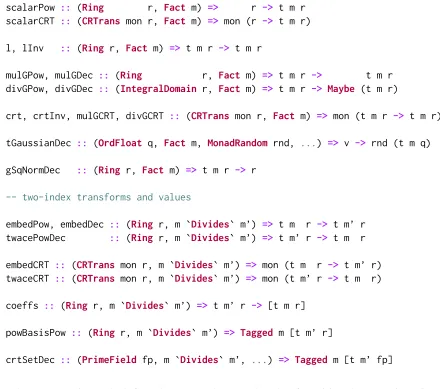
Tensor layer (Appendix B and C): This layer’s main abstract interface, calledTensor, defines all the linear transformations and special values needed for working efficiently in cyclotomic rings (building on the framework developed in [LPR13]), and permits multiple implementations. Because the tensor layer is completely hidden from typical cryptographic applications, we defer to Appendix C the details of its design and our implementations. This material includes the definitions and analysis of several linear transforms and algorithms that, to our knowledge, have not previously appeared in the literature. Additionally, Appendix B describes the “sparse decomposition” DSL and compiler that underlie our pure-HaskellTensor
implementation.
Cyclotomic layer (Section 3): This layer defines data types and high-level interfaces for cyclotomic rings and their cryptographically relevant operations. Our implementations are relatively thin wrappers which modularly combine the integer and tensor layers, and automatically manage the internal representations of ring elements for more efficient operations.
Cryptography layer (Section 4): This layer consists of implementations of cryptographic schemes. As a detailed example, we define an advanced FHE scheme that incorporates and refines a wide collection of features from a long series of works [LPR10, BV11a, BV11b, BGV12, GHS12, GHPS12, LPR13, AP13]. We also show how its implementation inΛ◦λvery closely and concisely matches its mathematical definition.
Finally, in Appendix E we evaluateΛ◦λin terms of code quality and runtime performance, and give a comparison to HElib [HS].
Acknowledgments. We thank Tancr`ede Lepoint for providing HElib benchmark code, Victor Shoup for helpful discussions regarding HElib performance, and the anonymous CCS’16 reviewers for many useful comments.
2
Integer and Modular Arithmetic
At its core, lattice-based cryptography is built around arithmetic in the ring of integersZand quotient rings Zq=Z/qZof integers moduloq, i.e., the cosetsx+qZwith the usual addition and multiplication operations.
In addition, a variety of specialized operations are also widely used, e.g.,liftinga coset inZqto its smallest
representative inZ,rescaling(orrounding) one quotient ringZqto another, anddecomposingaZq-element
as a vector of smallZ-elements with respect to a “gadget” vector.
Here we recall the relevant mathematical background for all these domains and operations, and describe how they are represented and implemented inΛ◦λ. This will provide a foundation for the next section, where we show how all these operations are very easily “promoted” from base rings like Zand Zq to
2.1 RepresentingZandZq
We exclusively use fixed-precision primitive Haskell types likeIntandInt64to represent the integersZ, and
define our own specialized types likeZqBasic q zto representZq. Here theqparameter is a “phantom” type
that represents the value of the modulusq, whilezis an integer type (likeInt64) specifying the underlying representation of the integer residues moduloq.
This approach has many advantages: by definingZqBasic q zas an instance ofRing, we can use the(+) and(*)operators without any explicit modular reductions. More importantly, at compile time the type system disallows operations on incompatible types—e.g., attempting to add aZqBasic q1 zto aZqBasic q2 zfor distinctq1,q2—with no runtime overhead. Finally, we implementZqBasic q zas anewtypeforz, which means that they have identical runtime representations, with no additional overhead.
CRT/RNS representation. Some applications, like homomorphic encryption, can require moduliqthat are too large for standard fixed-precision integer types. Many languages have support for unbounded integers (e.g., Haskell’sIntegertype), but the operations are relatively slow. Moreover, the values have varying sizes, which means they cannot be stored efficiently in “unboxed” form in arrays. A standard solution is to use the Chinese Remainder Theorem (CRT), also known as Residue Number System (RNS), representation: chooseqto be the product of several pairwise coprime and sufficiently smallq1, . . . , qt, and use the natural
ring isomorphism fromZqto the product ringZq1 × · · · ×Zqt, where addition and multiplication are both
component-wise.
In Haskell, using the CRT representation—and more generally, working in product rings—is very natural using the generic pair type(,): whenever typesaandbrespectively represent ringsAandB, the pair type (a,b)represents the product ringA×B. This just requires defining the obvious instances ofAdditiveand
Ringfor(a,b)—which in fact has already been done for us by the numeric prelude. Products of more than two rings are immediately supported by nesting pairs, e.g.,((a,b),c), or by using higher-arity tuples like (a,b,c). A final nice feature is that a pair (or tuple) has fixed representation size if all its components do, so arrays of pairs can be stored directly in “unboxed” form, without requiring any layer of indirection.
2.2 ReduceandLift
Two basic, widely used operations are reducingaZ-element to its residue class inZq, andlifting aZq
-element to its smallest integer representative, i.e., inZ∩[−q2,q2). These operations are examples of the
natural homomorphism, and canonical representative map, for arbitrary quotient groups. Therefore, we defineclass (Additive a, Additive b) => Reduce a bto represent thatbis a quotient group of a, andclass Reduce a b => Lift b afor computing canonical representatives.4 These classes respectively introduce the functions
reduce :: Reduce a b => a -> b lift :: Lift b a => b -> a
wherereduce◦liftshould be the identity function.
Instances of these classes are straightforward. We define an instanceReduce z (ZqBasic q z)for any suitable integer typezandqrepresenting a modulus that fits within the precision ofz, and a corresponding instance forLift. For product groups (pairs) used for CRT representation, we define the natural instance
Reduce a (b1,b2)whenever we have instancesReduce a b1andReduce a b2. However, we do not have
4
(nor do we need) a correspondingLiftinstance, because there is no sufficiently generic algorithm to combine canonical representatives from two quotient groups.
2.3 Rescale
Another operation commonly used in lattice cryptography isrescaling(sometimes also calledrounding)Zq
to a different modulus. Mathematically, the rescaling operationb·eq0:Zq →Zq0 is defined as
bx+qZeq0 := j
q0
q ·(x+qZ) m
= j
q0 q ·x
m
+q0Z∈Zq0, (2.1)
whereb·edenotes rounding to the nearest integer. (Notice that the choice of representativex ∈Zhas no effect on the result.) In terms of the additive groups, this operation is at least an “approximate” homo-morphism: bx+yeq0 ≈ bxeq0+byeq0, with equality whenq|q0. We represent the rescaling operation via class (Additive a, Additive b) => Rescale a b, which introduces the function
rescale :: Rescale a b => a -> b
Instances. A straightforward instance, whose implementation just follows the mathematical definition, is
Rescale (ZqBasic q1 z) (ZqBasic q2 z)for any integer typezand typesq1,q2representing moduli that fit within the precision ofz.
More interesting are the instances involving product groups (pairs) used for CRT representation. A na¨ıve implementation would apply Equation (2.1) to the canonical representative ofx+qZ, but for largeq
this would require unbounded-integer arithmetic. Instead, following ideas from [GHS12], here we describe algorithms that avoid this drawback.
To “scale up”x∈Zq1 toZq1q2 ∼=Zq1×Zq2 whereq1andq2are coprime, i.e., to multiply byq2, simply
output(x·q2modq1,0). This translates easily into code that implements the instanceRescale a (a,b). Notice, though, that the algorithm uses the value of the modulusq2associated withb. We therefore requireb to be an instance ofclass Mod, which exposes the modulus value associated with the instance type. The instanceRescale b (a,b)works symmetrically.
To “scale down”x= (x1, x2)∈Zq1×Zq2 ∼=Zq1q2 toZq1, we essentially need to divide byq2, discarding
the (signed) remainder. To do this,
1. Compute the canonical representativex¯2 ∈Zofx2.
(Observe that(x01 =x1−(¯x2 modq1),0)∈Zq1 ×Zq2 is the multiple ofq2closest tox= (x1, x2).)
2. Divide byq2, outputtingq−12 ·x01∈Zq1.
The above easily translates into code that implements the instanceRescale (a,b) a, using theLiftand
Reduceclasses described above. The instanceRescale (a,b) bworks symmetrically.
2.4 Gadget,Decompose, andCorrect
Many advanced lattice cryptosystems use special objects called gadgets[MP12], which support certain operations as described below. For the purposes of this work, a gadget is a tuple over a quotient ring
Rq =R/qR, whereRis a ring that admits a meaningful “geometry.” For concreteness, one can think ofR
as merely being the integersZ, but later on we generalize to cyclotomic rings.
Perhaps the simplest gadget is the powers-of-two vector g = (1,2,4,8, . . . ,2`−1) over
Zq, where
gadgets. For example, one may use powers of integers other than two, mixed products, the Chinese Remainder Theorem, etc. The salient property of a gadgetgis that it admits efficient algorithms for the following tasks:
1. Decomposition: givenu∈Rq, output ashortvectorxoverRsuch thathg,xi=gt·x=u(modq).
2. Error correction: given a “noisy encoding” of the gadgetbt=s·gt+etmodq, wheres∈Rqande
is a sufficiently short error vector overR, outputsande.
A key property is that decomposition and error-tolerant encoding relate in the following way (where the notation is as above, and≈hides a short error vector overR):
s·u= (s·gt)·x≈bt·x(mod q).
We represent gadget vectors and their associated operations via the following classes:
class Ring u => Gadget gad u where gadget :: Tagged gad [u]
encode :: u -> Tagged gad [u]
class (Gadget gad u, Reduce r u) => Decompose gad u r where decompose :: u -> Tagged gad [r]
class Gadget gad u => Correct gad u where
correct :: Tagged gad [u] -> (u, [LiftOf u])
The classGadget gad usays that the ringusupports a gadget vector indexed by the typegad; the gadget vector itself is given by the termgadget. Note that its type is actuallyTagged gad [u]: this is anewtype for[u], with the additional type-level contextTagged gadindicating which gadget the vector represents (recall that there are many possible gadgets over a given ring). This tagging aids safety, by preventing the nonsensical mixing of values associated with different kinds of gadgets. In addition, Haskell provides generic ways of “promoting” ordinary operations to work within this extra context. (Formally, this is because
Tagged gadis an instance of theFunctorclass.)
The classDecompose gad u rsays that au-element can be decomposed into a vector ofr-elements (with respect to the gadget index bygad), via thedecomposemethod.5The classCorrect gad usays that a noisy encoding of au-element (with respect to the gadget) can be error-corrected, via thecorrectmethod. Note that we split the above functionality into three separate classes, both because their arguments are slightly different (e.g.,Correcthas no need for thertype), and because in some cases we have meaningful instances for some classes but not others.
Instances. For our typeZqBasic q zrepresentingZq, we give a straightforward instantiation of the
“base-b” gadgetg= (1, b, b2, . . .)and error correction and decomposition algorithms, for any positive integerb (which is represented as a parameter to the gadget type). In addition, we implement the trivial gadget
g = (1) ∈ Z1
q, where the decomposition algorithm merely outputs the canonicalZ-representative of its
Zq-input. This gadget turns out to be useful for building nontrivial gadgets and algorithms for product rings,
as described next.
5
For the pair type (which, to recall, we use to represent product rings in CRT representation), we give instances ofGadgetand Decomposethat work as follows. Suppose we have gadget vectorsg1,g2 over
Rq1, Rq2, respectively. Then the gadget for the product ring Rq1 ×Rq2 is essentially the concatenation
ofg1 andg2, where we first attach 0 ∈ Rq2 components to the entries ofg1, and similarly forg2. The
decomposition of(u1, u2)∈Rq1×Rq2with respect to this gadget is the concatenation of the decompositions
ofu1, u2. All this translates easily to the implementations
gadget = (++) <$> (map (,zero) <$> gadget) <*> (map (zero,) <$> gadget) decompose (a,b) = (++) <$> decompose a <*> decompose b
In the definition ofgadget, the two calls tomapattach zero components to the entries ofg1,g2, and(++) appends the two lists. (The syntax<$>,<*>is standard applicative notation, which promotes normal functions into theTagged gadcontext.)
2.5 CRTrans
Fast multiplication in cyclotomic rings is made possible by converting ring elements to theChinese remainder representation, using the Chinese Remainder Transform (CRT) over the base ring. This is an invertible linear transform akin to the Discrete Fourier Transform (overC) or the Number Theoretic Transform (over
appropriateZq), which has a fast algorithm corresponding to its “sparse decomposition” (see Appendix C.2.5
and [LPR13, Section 3] for further details).
Applying the CRT and its inverse requires knowledge of certain roots of unity, and the inverse of a certain integer, in the base ring. So we define the synonymtype CRTInfo r = (Int -> r, r), where the two components are (1) a function that takes an integerito theith power of a certain principal6 mth root of unityωminr, and (2) the multiplicative inverse ofmˆ inr, wheremˆ =m/2ifmis even, elsemˆ =m. We
also define the classCRTrans, which exposes the CRT information:
class (Monad mon, Ring r) => CRTrans mon r where crtInfo :: Int -> mon (CRTInfo r)
Note that the output ofcrtInfois embedded in aMonad mon, the choice of which can reflect the fact that the CRT might not exist for certainm. For example, the CRTrans instance for the complex numbersC
uses the trivialIdentitymonad, because the complex CRT exists for everym, whereas the instance for
ZqBasic q zuses theMaybemonad to reflect the fact that the CRT may not exist for certain combinations ofmand moduliq.
We give nontrivial instances of CRTrans for ZqBasic q z (representing Zq) for prime q, and for Complex Double(representingC). In addition, because we use tensors and cyclotomic rings over base
rings likeZandQ, we must also define trivial instances ofCRTransforInt,Int64,Double, etc., for which
crtInfoalways returnsNothing.
2.6 Type-Level Cyclotomic Indices
As discussed in Section 3 below, there is one cyclotomic ring for every positive integerm, which we call the index. (It is also sometimes called theconductor.) The indexm, and in particular its factorization, plays a major role in the definitions of the ring operations. For example, the index-m“Chinese remainder transform”
6
A principalmth root of unity inris an elementωmsuch thatωmm= 1, andω m/t
m −1is not a zero divisor for every primet
is similar to a mixed-radix FFT, where the radices are the prime divisors ofm. In addition, cyclotomic rings can sometimes be related to each other based on their indices. For example, themth cyclotomic can be seen as a subring of them0th cyclotomic if and only ifm|m0; the largest common subring of them1th andm2th cyclotomics is thegcd(m1, m2)th cyclotomic, etc.
InΛ◦λ, a cyclotomic index mis specified by an appropriate typem, and the data types representing cyclotomic rings (and their underlying coefficient tensors) are parameterized by such anm. Based on this parameter,Λ◦λgenerically derivesalgorithms for all the relevant operations in the corresponding cyclotomic. In addition, for operations that involve more than one cyclotomic,Λ◦λexpresses andstatically enforces(at compile time) the laws governing when these operations are well defined.
We achieve the above properties using Haskell’s type system, with the help of the powerfuldata kinds extension [YWC+12] and thesingletonslibrary [EW12, ES14]. Essentially, these tools enable the “promotion” of ordinary values and functions from the data level to the type level. More specifically, they promote every value to a corresponding type, and promote every function to a correspondingtype family, i.e., a function on the promoted types. We stress that all type-level computations are performed at compile time, yielding the dual benefits of static safety guarantees and no runtime overhead.
Implementation. Concretely,Λ◦λdefines a special data typeFactoredthat represents positive integers by their factorizations, along with several functions on such values. Singletons then promotes all of this to the type level. This yields concrete “factored types”Fmfor various useful values ofm, e.g.,F1, . . . ,F100,F128,
F256,F512, etc. In addition, it yields the following type families, wherem1,m2are variables representing any factored types:
• FMul m1 m2 (synonym: m1 * m2) and FDiv m1 m2(synonym: m1 / m2) respectively yield the factored types representingm1·m2 andm1/m2(if it is an integer; else it yields a compile-time error);
• FGCD m1 m2and FLCM m1 m2respectively yield the factored types representing gcd(m1, m2) and
lcm(m1, m2);
• FDivides m1 m2yields the (promoted) boolean typeTrueorFalse, depending on whetherm1|m2. In addition, m1 `Divides` m2is a convenient synonym for the constraintTrue ˜ Divides m1 m2. (This constraint is used Section 3 below.)
Finally,Λ◦λalso provides severalentailmentsrepresenting number-theoretic laws that the compiler itself cannot derive from our data-level code. For example, transitivity of the “divides” relation is represented by the entailment
(k `Divides` l, l `Divides` m) :- (k `Divides` m)
which allows the programmer to satisfy the constraintk|min any context where the constraintsk|`and`|m
are satisfied.
Further details on type-level indices and arithmetic, and how they are used to derive algorithms for cyclotomic ring operations, may be found in Appendix A.
3
Cyclotomic Rings
In this section we summarizeΛ◦λ’s interfaces and implementations for cyclotomic rings. In Section 3.1 we review the relevant mathematical background. In Section 3.2 we describe the interfaces of the two data types,
representation of ring elements (i.e., the choice of basis in which they are represented), whereasUCycis a lower-level type that safely exposes and allows explicit control over the choice of representation. Lastly, in Section 3.3 we describe key aspects of the implementations, such asCyc’s subring optimizations, and how we generically “promote” base-ring operations to cyclotomic rings.
3.1 Mathematical Background
To appreciate the material in this section, one only needs the following high-level background; see Ap-pendix C.1 and [LPR10, LPR13] for many more mathematical and computational details.
3.1.1 Cyclotomic Rings
For a positive integerm, themthcyclotomic ringisR=Z[ζm], the ring extension of the integersZobtained
by adjoining an elementζmhaving multiplicative orderm. The ringRis contained in themthcyclotomic
number field K = Q(ζm). The minimal polynomial (over the rationals) ofζm has degreen=ϕ(m), so deg(K/Q) = deg(R/Z) =n. We endowK, and therebyR, with a geometry via a functionσ:K → Cn
called thecanonical embedding. E.g., we define the`2 norm on K askxk2 = kσ(x)k2, and use this to define Gaussian-like distributions overRand (discretizations of)K. The complex coordinates ofσcome in conjugate pairs, and addition and multiplication are coordinate-wise underσ.
For cryptographic purposes, there are two particularly importantZ-bases ofR: thepowerfulbasis~pm∈
Rnand thedecodingbasisd~m ∈Rn. That is, everyr ∈Rcan be uniquely represented asr =~ptm·rfor
some integral vectorr∈Zn, and similarly ford~
m. In particular, there are invertibleZ-linear transformations
that switch from one of these representations to the other. For geometric reasons, certain cryptographic operations are best defined in terms of a particular one of these bases, e.g., decryption uses the decoding basis, whereas decomposition uses the powerful basis.
There are special ring elementsgm, tm∈Rwhose product isgm·tm = ˆm, which is defined asmˆ :=m/2
whenmis even, andmˆ :=motherwise. The elementsgm, tmare used in the generation and management of
error terms in cryptographic applications, as described below.
Themth cyclotomic ringR=Z[ζm]can be seen as asubringof them0th cyclotomic ringR0 =Z[ζm0]if
and only ifm|m0, and in such a case we canembedRintoR0 by identifyingζmwithζm 0/m
m0 . In the reverse
direction, we cantwacefromR0toR, which is a certainR-linear function that fixesRpointwise. (The name is short for “tweaked trace,” because the function is a variant of the truetracefunction to our “tweaked” setting, described next.) Therelativepowerful basis~pm0,mis anR-basis ofR0that is obtained by “factoring
out” (in a formal sense) the powerful basis ofR from that ofR0, and similarly for the relative decoding basisd~m0,m.
3.1.2 Ring-LWE and (Tweaked) Error Distributions
Ring-LWE is a family of computational problems that was defined and analyzed in [LPR10, LPR13]. Those works deal with a form of Ring-LWE that involves a special (fractional) idealR∨, which is in a formal sense dual toR. More specifically, the Ring-LWE problem relates to “noisy” products
bi=ai·s+eimodqR∨,
whereai ∈ R/qR,s ∈ R∨/qR∨ (so ai·s ∈ R∨/qR∨), andei is drawn from some error distributionψ.
GaussianDrof parameterr =αq≈n1/4 in the canonical embedding.7 Such spherical distributions also
behave very well in cryptographic applications, as described in further detail below.
For cryptographic purposes, it is convenient to use a form of Ring-LWE that does not involveR∨. As first suggested in [AP13], this can be done with no loss in security or efficiency by working with an equivalent “tweaked” form of the problem, which is obtained by multiplying the noisy productsbiby a “tweak” factor
t=tm= ˆm/gm∈R, which satisfiest·R∨ =R. Doing so yields new noisy products
b0i :=t·bi =ai·(t·s) + (t·ei) =ai·s0+e0imodqR,
where both ai and s0 = t·sreside in R/qR, and the error terms e0i = t·ei come from the “tweaked”
distributiont·ψ. Note that whenψcorresponds to a spherical Gaussian (in the canonical embedding), its tweaked formt·ψmay behighly non-spherical, but this is not a problem: the tweaked form of Ring-LWE is entirely equivalent to the above one involvingR∨, because the tweak is reversible.
We remark that the decoding basisd~m ofRmentioned above is merely the “tweaked”—i.e., multiplied
bytm—decoding basis ofR∨, as defined in [LPR13]. Therefore, all the efficient algorithms from [LPR13]
involvingR∨ and its decoding basis—e.g., for sampling from spherical Gaussians, converting between bases ofR∨, etc.—carry over to the tweaked setting without any modification.
3.1.3 Error Invariant
In cryptographic applications, error terms are combined in various ways, and thereby grow in size. To obtain the best concrete parameters and security levels, the accumulated error should be kept as small as possible. More precisely, its coefficients with respect to some choice ofZ-basis should have magnitudes that are as
small as possible.
As shown in [LPR13, Section 6], errorsewhose coordinatesσi(e)in the canonical embedding are small
and (nearly) independent have correspondingly small coefficients with respect to thedecodingbasis ofR∨. In the tweaked setting, where errorse0 and the decoding basis both carry an extratm = ˆm/gmfactor, an
equivalent hypothesis is the following, which we codify as an invariant that applications should maintain:
Invariant 3.1 (Error Invariant). For an errore0 ∈R, every coordinate
σi(e0/tm) = ˆm−1·σi(e0·gm)∈C
should be nearly independent (up to conjugate symmetry) and have relatively “light” (e.g., subgaussian or subexponential) tails.
As already mentioned, the invariant is satisfied for fresh errors drawn from tweaked Gaussians, as well as for small linear combinations of such terms. In general, the invariant isnotpreserved under multiplication, because the product of two tweaked error termse0i =tm·eicarries at2m factor. Fortunately, this is easily
fixed by introducing an extragm factor:
gm·e01·e02 =tm·( ˆm·e1·e2)
satisfies the invariant, because multiplication is coordinate-wise underσ. We use this technique in our FHE scheme of Section 4.
3.2 Cyclotomic Types: CycandUCyc
In this subsection we describe the interfaces of the two data types,CycandUCyc, that represent cyclotomic rings.
• Cyc t m rrepresents themth cyclotomic ring over a base ringr—typically, one ofQ,Z, or Zq—
backed by an underlyingTensortypet(see Appendix C for details onTensor). The interface forCyc
completely hides the internal representations of ring elements (e.g., the choice of basis) from the client, and automatically manages the choice of representation so that the various ring operations are usually as efficient as possible. Therefore, most cryptographic applications can and should useCyc.
• UCyc t m rep r represents the same cyclotomic ring as Cyc t m r, but as a coefficient vector relative to the basis indicated byrep. This argument is one of the four valueless types P, D, C, E, which respectively denote the powerful basis, decoding basis, CRT r-basis (if it exists), and CRT basis over an appropriate extension ring ofr. Exposing the representation at the type level in this way allows—indeed, requires—the client to manage the choice of representation. (Cycis one such client.) This can lead to more efficient computations in certain cases whereCyc’s management may be suboptimal. More importantly, it safely enables a wide class of operations on the underlying coefficient vector, via category-theoretic classes likeFunctor; see Sections 3.2.1 and 3.3.3 for further details.
Clients can easily switch betweenCycandUCycas needed. Indeed,Cycis just a relatively thin wrapper aroundUCyc, which mainly just manages the choice of representation, and provides some other optimizations related to subrings (see Section 3.3 for details).
3.2.1 Instances
TheCycandUCyctypes are instances of many classes, which comprise a large portion of their interfaces.
Algebraic classes. As one might expect,Cyc t m randUCyc t m rep rare instances ofEq,Additive,
Ring, and various other algebraic classes for any appropriate choices oft,m,rep, and r. Therefore, the standard operators(==),(+),(*), etc. are well-defined forCycandUCycvalues, with semantics matching the mathematical definitions.
We remark thatUCyc t m rep ris an instance ofRingonly for the CRT representationsrep=C,E, where multiplication is coefficient-wise. In the other representations, multiplication is algorithmically more complicated and less efficient, so we simply do not implement it. This means that clients ofUCycmust explicitly convert values to a CRT representation before multiplying them, whereasCyc performs such conversions automatically.
Category-theoretic classes. BecauseUCyc t m rep rforrep=P,D,C(but notrep=E) is represented as a vector ofr-coefficients with respect to the basis indicated by rep, we define the partially applied typesUCyc t m rep(note the missing base typer) to be instances of the classesFunctor,Applicative,
Foldable, and Traversable. For example, our instantiation ofFunctorforf = UCyc t m repdefines fmap :: (r -> r’) -> f r -> f r’to apply the givenr -> r’function independently on each of the r-coefficients.
By contrast,Cyc t misnotan instance of any category-theoretic classes. This is because by design,Cyc
Lattice cryptography classes. Lastly, we “promote” instances of our specialized lattice cryptography classes likeReduce,Lift,Rescale,Gadget, etc. from base types toUCycand/orCyc, as appropriate. For example, the instanceReduce z zq, which represents modular reduction fromZtoZq, induces the instance Reduce (Cyc t m z) (Cyc t m zq), which represents reduction fromRtoRq. All these instances have
very concise and generic implementations using the just-described category-theoretic instances forUCyc; see Section 3.3.3 for further details.
3.2.2 Functions
scalarCyc :: (Fact m, CElt t r) => r -> Cyc t m r
mulG :: (Fact m, CElt t r) => Cyc t m r -> Cyc t m r
divG :: (Fact m, CElt t r) => Cyc t m r -> Maybe (Cyc t m r)
liftPow, liftDec
:: (Fact m, Lift b a, ...) => Cyc t m b -> Cyc t m a
advisePow, adviseDec, adviseCRT
:: (Fact m, CElt t r) => Cyc t m r -> Cyc t m r
-- error sampling
tGaussian :: (OrdFloat q, ToRational v, MonadRandom rnd, CElt t q, ...)
=> v -> rnd (Cyc t m q)
errorRounded :: (ToInteger z, ...) => v -> rnd (Cyc t m z)
errorCoset :: (ToInteger z, ...) => v -> Cyc t m zp -> rnd (Cyc t m z)
-- inter-ring operations
embed :: (m `Divides` m’, CElt t r) => Cyc t m r -> Cyc t m’ r
twace :: (m `Divides` m’, CElt t r) => Cyc t m’ r -> Cyc t m r
coeffsPow, coeffsDec
:: (m `Divides` m’, CElt t r) => Cyc t m’ r -> [Cyc t m r]
powBasis :: (m `Divides` m’, CElt t r) => Tagged m [Cyc t m’ r]
crtSet :: (m `Divides` m’, CElt t r, ...) => Tagged m [Cyc t m’ r]
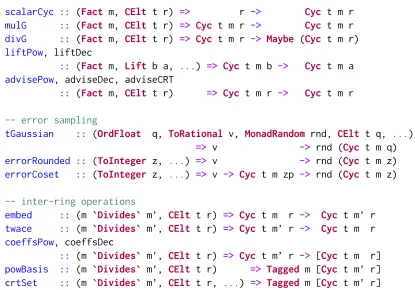
Figure 2: Representative functions for theCycdata type. (The CElt t rconstraint is a synonym for a collection of constraints that includeTensor t, along with various constraints on the base typer.)
We now describe the remaining functions that define the interface forCyc; see Figure 2 for their type signatures. (UCycadmits a very similar collection of functions, which we omit from the discussion.) We start with functions that involve a single cyclotomic indexm.
scalarCyc embeds a scalar element from the base ringrinto themth cyclotomic ring overr.
mulG,divG respectively multiply and divide by the special elementgmin themth cyclotomic ring. These
liftB forB=Pow,Declifts a cyclotomic ring element coordinate-wise with respect to the specified basis (powerful or decoding).
adviseB forB=Pow,Dec,CRTreturns an equivalent ring element whose internal representationmightbe
with respect to (respectively) the powerful, decoding, or a Chinese Remainder Theorem basis. These functions have no externally visible effect on the results of any computations, but they can serve as useful optimization hints. E.g., if one needs to computev * w1,v * w2, etc., then advising thatvbe in CRT representation can speed up these operations by avoiding duplicate CRT conversions across the operations.
The following functions relate to sampling error terms from cryptographically relevant distributions:
tGaussian samples an element of the number fieldKfrom the “tweaked” continuous Gaussian distribution
t·Dr, given v = r2. (See Section 3.1 above for background on, and the relevance of, tweaked
Gaussians. The input isv =r2 because that is more convenient for implementation.) Because the output is random, its type must be monadic: rnd (Cyc t m r)forMonadRandom rnd.
errorRounded is a discretized version oftGaussian, which samples from the tweaked Gaussian and rounds
each decoding-basis coefficient to the nearest integer, thereby producing an output inR.
errorCoset samples an error term from a (discretized) tweaked Gaussian of parameterp·rover a given
coset ofRp =R/pR. This operation is often used in encryption schemes when encrypting a desired
message from the plaintext spaceRp.8
Finally, the following functions involveCycdata types for two indicesm|m’; recall that this means themth cyclotomic ring can be viewed as a subring of them’th one. Notice that in the type signatures, the divisibility constraint is expressed as m `Divides` m’, and recall from Section 2.6 that this constraint is statically checked by the compiler and carries no runtime overhead.
embed,twace are respectively the embedding and “tweaked trace” functions between the mth and m’th
cyclotomic rings.
coeffsB for B=Pow,Decexpresses an element of them’th cyclotomic ring with respect to the relative
powerful or decoding basis (~pm0,m andd~m0,m, respectively), as a list of coefficients from the mth
cyclotomic.
powBasis is the relative powerful basis~pm0,m of them’th cyclotomic over the mth one.9 Note that the
Tagged mtype annotation is needed to specify which subring the basis is relative to.
crtSet is the relative CRT set~cm0,mof them’th cyclotomic ring over themth one, modulo a prime power.
(See Appendix C.4 for its formal definition and a novel algorithm for computing it.) We have elided some constraints which say that the base typermust representZpe for a primep.
8
The extra factor ofpin the Gaussian parameter reflects the connection between coset sampling as used in cryptosystems, and the underlying Ring-LWE error distribution actually used in their security proofs. This scaling gives the inputva consistent meaning across all the error-sampling functions.
We emphasize that both powBasis and crtSet are values (of type Tagged m [Cyc t m’ r]), not functions. Due to Haskell’s laziness, only those values that are actually used in a computation are ever computed; moreover, the compiler usually ensures that they are computed only once each and then memoized.
In addition to the above, we also could have included functions that applyautomorphismsof cyclotomic rings, which would be straightforward to implement in our framework. We leave this for future work, merely because we have not yet needed automorphisms in any of our applications.
3.3 Implementation
We now describe some notable aspects of theCycandUCycimplementations. As previously mentioned,Cyc
is mainly a thin wrapper aroundUCycthat automatically manages the choice of representationrep, and also includes some important optimizations for ring elements that are known to reside in cyclotomic subrings. In turn,UCycis a thin wrapper around an instance of theTensorclass. (Recall thatTensorencapsulates the cryptographically relevant linear transforms on coefficient vectors for cyclotomic rings; see Appendix C for details.)
3.3.1 Representations
Cyc t m rcan represent an element of themth cyclotomic ring over base ringrin a few possible ways:
• as aUCyc t m rep rfor somerep=P,D,C,E;
• when applicable, as ascalarfrom the base ringr, or more generally, as an element of thekth cyclotomic subringfor somek|m, i.e., as aCyc t k r.
The latter subring representations enable some very useful optimizations in memory and running time: while cryptographic applications often need to treat scalars and subring elements as residing in some larger cyclotomic ring,Cyccan exploit knowledge of their “true” domains to operate more efficiently, as described in Section 3.3.2 below.
UCycrepresents a cyclotomic ring element by its coefficients tensor with respect to the basis indicated byrep. That is, forrep=P,D,C, a value of typeUCyc t m rep ris simply a value of type(t m r). How-ever, a CRT basis overrdoes not always exist, e.g., ifrrepresents the integersZ, orZqfor a modulusqthat
does not meet certain criteria. To handle such cases we userep=E, which indicates that the representation is relative to a CRT basis over a certainextensionringCRTExt rthatalwaysadmits such a basis, e.g., the complex numbersC. That is, aUCyc t m E ris a value of type(t m (CRTExt r)).
We emphasize that the extension ringCRTExt ris determined byritself, andUCycis entirely agnostic to it. For example,ZqBasicuses the complex numbers, whereas the pair type(a,b)(which, to recall, represents a product ring) uses the product ring(CRTExt a, CRTExt b).
3.3.2 Operations
Most of the Cycfunctions shown in Figure 2 (e.g., mulG, divG, the error-sampling functions, coeffsB, powBasis,crtSet) simply call theirUCyccounterparts for an appropriate representationrep(after converting any subring inputs to the full ring). Similarly, most of theUCycoperations for a given representation just call the appropriateTensormethod. In what follows we describe some operations that depart from these patterns.
• For two scalars from the base ringr, the result is just computed and stored as a scalar, thus making the operation very fast.
• Inputs from (possibly different) subrings of indicesk1,k2|mare converted to thecompositumof the two subrings, i.e., the cyclotomic of indexk= lcm(k1,k2)(which dividesm), then the result is computed there and stored as a subring element.
• For(+), the inputs are converted to a common representation and added entry-wise.
• For(*), if one of the inputs is a scalar from the base ringr, it is simply multiplied by the coefficients of the other input (this works for anyr-basis representation). Otherwise, the two inputs are converted to the same CRT representation and multiplied entry-wise.
The implementation of the inter-ring operationsembedandtwaceforCycis as follows:embedis “lazy,” merely storing its input as a subring element and returning instantly. Fortwacefrom indexm’tom, there are two cases: if the input is represented as aUCycvalue (i.e., not as a subring element), then we just invoke the appropriate representation-specifictwacefunction on that value (which in turn just invokes a method from
Tensor). Otherwise, the input is represented as an element of thek’th cyclotomic for somek’|m’, in which case we applytwacefrom indexk’to indexk= gcd(m,k’), which is the smallest index where the result is guaranteed to reside, and store the result as a subring element.
3.3.3 Promoting Base-Ring Operations
Many cryptographic operations on cyclotomic rings are defined as working entry-wise on the ring element’s coefficient vector with respect to some basis (either a particular or arbitrary one). For example, reducing fromRtoRqis equivalent to reducing the coefficients fromZtoZqinanybasis, while “decoding”RqtoR
(as used in decryption) is defined as lifting theZq-coefficients, relative to thedecodingbasis, to their smallest
representatives inZ. To implement these and many other operations, we generically “promote” operations
on the base ring to corresponding operations on cyclotomic rings, using the fact thatUCyc t m repis an instance of the category-theoretic classesFunctor,Applicative,Traversable, etc.
As a first example, consider theFunctorclass, which introduces the method
fmap :: Functor f => (a -> b) -> f a -> f b
OurFunctorinstance forUCyc t m repdefinesfmap g cto applygto each ofc’s coefficients (in the basis indicated byrep). This lets us easily promote our specialized lattice operations from Section 2. For example, an instance Reduce z zq can be promoted to an instance Reduce (UCyc t m P z) (UCyc t m P zq)
simply by definingreduce = fmap reduce. We similarly promote other base-ring operations, including lifting fromZqtoZ, rescaling fromZqtoZq0, discretization ofQto eitherZor to a desired coset ofZp, and
more.
As a richer example, consider gadgets and decomposition (Section 2.4) for a cyclotomic ringRqover
base ringZq. For any gadget vector overZq, there is a corresponding gadget vector overRq, obtained simply
by embeddingZqintoRq. This lets us promote aGadgetinstance forzqto one forUCyc t m rep zq:10,11
10The double calls to fmap are needed because there are two Functor layers around the zq-entries of
gadget :: Tagged gad [zq]: the list[], and theTagged gadcontext. 11
gadget = fmap (fmap scalarCyc) gadget
Mathematically, decomposing anRq-element into a short vector overR is defined coefficient-wise with
respect to the powerful basis. That is, we decompose eachZq-coefficient into a short vector overZ, then
collect the corresponding entries of these vectors to yield a vector of shortR-elements. To implement this strategy, one might try to promote the function (here with slightly simplified signature)
decompose :: Decompose zq z => zq -> [z]
toCyc t m zqusingfmap, as we did withreduceandliftabove. However, a moment’s thought reveals that this does not work: it yields output of typeCyc t m [z], whereas we want[Cyc t m z]. The solution is to use theTraversableclass, which introduces the method
traverse :: (Traversable v, Applicative f) => (a -> f b) -> v a -> f (v b)
In our setting,visUCyc t m P, andfis the list type[], which is indeed an instance ofApplicative.12 We can therefore easily promote an instance ofDecomposefromzqtoUCyc t m P zq, essentially via:
decompose v = traverse decompose v
We similarly promote the error-correction operationcorrect :: Correct zq z => [zq] -> (zq, [z]).
Rescaling. Mathematically, rescalingRqtoRq0is defined as applyingb·e
q0:Zq→Zq0 (represented by the
functionrescale :: Rescale a b => a -> b; see Section 2.3) coefficient-wise in either the powerful or decoding basis (for geometrical reasons). However, there are at least two distinct algorithms that implement this operation, depending on the representation of the ring element and ofZqandZq0. The generic algorithm
simply converts the input to the required basis and then rescales coefficient-wise. But there is also a more efficient, specialized algorithm [GHS12] for rescaling a product ringRq =Rq1×Rq2 toRq1. For the typical
case of rescaling an input in the CRT representation to an output in the CRT representation, the algorithm requires only one CRT transformation for each ofRq1 andRq2, as opposed to two and one (respectively) for
the generic algorithm. In applications like FHE whereRq1 itself can be a product of multiple component
rings, this reduces the work by nearly a factor of two.
In more detail, the specialized algorithm is analogous to the one for product ringsZq1 ×Zq2 described at
the end of Section 2.3. To rescalea= (a1, a2)∈Rq1 ×Rq2 toRq1, we lifta2 ∈Rq2 to a relatively short
representativea¯2 ∈Rusing the powerful or decoding basis, which involves an inverse-CRT forRq2. We
then compute¯a02 = ¯a2 modq1Rand outputq2−1·(a1−¯a02)∈Rq1, which involves a CRT forRq1 on¯a
0 2. To capture the polymorphism represented by the above algorithms, we define a class calledRescaleCyc, which introduces the methodrescaleCyc. We give two distinct instances ofRescaleCycfor the generic and specialized algorithms, and the compiler automatically chooses the appropriate one based on the concrete types representing the base ring.
4
Fully Homomorphic Encryption in
Λ
◦λ
In this section we describe a full-featured fully homomorphic encryption and its implementation inΛ◦λ, using the interfaces described in the previous sections. At the mathematical level, the system refines a variety of techniques and features from a long series of works [LPR10, BV11a, BV11b, BGV12, GHPS12, LPR13,
12