Available Online atwww.ijcsmc.com
International Journal of Computer Science and Mobile Computing
A Monthly Journal of Computer Science and Information Technology
ISSN 2320–088X
IMPACT FACTOR: 6.017
IJCSMC, Vol. 7, Issue. 6, June 2018, pg.49 – 58
AN EFFICIENT WAY FOR SHAPE
RECOGNITION BY USING SPEEDED-UP
ROBUST FEATURE (SURF)
Ningappa Uppal
#1
, Prof. Mrs. Mangala C N
*2
#1M.Tech Scholar, Department of CSE, EWIT, Bangalore, Karnataka, India
#2
Associate Prof, Department of CSE, EWIT, Bangalore, Karnataka, India
1
[email protected]
,
2[email protected]
Abstract: In this paper, we present a novel scale- and rotation-invariant interest point detector and descriptor,
coined CONTOUR SURF (Speeded Up Robust Features). It approximates or even outperforms previously
proposed schemes with respect to repeatability, distinctiveness, and robustness, yet can be computed and
compared much faster. The paper presents experimental results on a standard evaluation set, as well as on
imagery obtained in the context of a real-life object recognition application. Both show SURF’s strong
performance. The calculation has properties of picture scaling-, interpretation, and revolution invariants.
Contour-SURF feature extraction and matching technique all along with a matching practice are given for the
contour based shape detection. The algorithm automatically extracts local features in the certain entity outline
with no any limitation of definite neighborhood location. A Contour recognition experiment was done with
different datasets. All images were taken as a target and resultant to the further model. The detection correctness
reaches 100% for images having distinctive contour feature, and lesser for images having common shapes.
Index Terms -- Rotation-Invariant, Contour-Surf, Robustness, Interpretation
I.
INTRODUCTION
Questions around us make our condition; in everyday life we have a tendency to group every one of the items
unmistakable to us. We have a tendency to group each question like a ball is circular, a note pad is rectangular et cetera ut ilizing
our faculties. A machine like PC does not have faculties to perceive or even recognize a protest. The state of the articles can be
utilized to extricate data from procured pictures. It is a substantial field that incorporates human face acknowledgment,
penmanship acknowledgment, finger – prints acknowledgment, and so on. In a picture, shape assumes a critical part. State of a
picture is one of the key data when an eye perceives a protest.
Various ongoing ways to deal with protest acknowledgment speak to the question by an arrangement of shading or dim level
finished nearby fixes. They get fantastic outcomes for objects which are locally planar and have an unmistakable surface.
Anyway there are numerous regular articles where surface or shading can't be utilized as a prompt for acknowledgment. The
unmistakable highlights of such questions are shape.
Fit as a fiddle is one of the noteworthy research territories. Principle focal point of the example acknowledgment is the grouping
between objects. In a PC framework, state of a question can be translated as an area enclosed by a blueprint of the protest. The
vital activity fit as a fiddle acknowledgment is to discover and speak to the correct shape data. Numerous calculations for shape
portrayal have been proposed up until this point.
State of a picture does not change when shade of picture is changed. Shape acknowledgment discovers its applications in
mechanical technology, unique finger impression examination, penmanship mapping, confront acknowledgment, remote sensors
and so on . Fit as a fiddle is one of the noteworthy research zones. In a PC framework, state of a protest can be translated as a
district encompassed by a layout of the question. The vital activity fit as a fiddle acknowledgment is to discover and speak to the
correct shape data
For orientation assignment, SURF uses wavelet responses in horizontal and vertical direction for a neighborhood of size 6s.
Adequate Gaussian weights are also applied to it. Then they are plotted in a space as given in below image. The dominant
orientation is estimated by calculating the sum of all responses within a sliding orientation window of angle 60 degrees.
Interesting thing is that, wavelet response can be found out using integral images very easily at any scale. For many applicat ions,
rotation invariance is not required, so no need of finding this orientation, which speeds up the process. SURF provides such a
functionality called Upright-SURF or U-SURF. It improves speed and is robust upto \pm 15^{\circ}. OpenCV supports both,
depending upon the flag, upright. If it is 0, orientation is calculated. If it is 1, orientation is not calculated and it is faster.
For feature description, SURF uses Wavelet responses in horizontal and vertical direction (again, use of integral images
. This when represented as a vector gives SURF feature descriptor with total
64 dimensions. Lower the dimension, higher the speed of computation and matching, but provide better distinctiveness of
features.
II.
METHOD
Those suggested Contour-SURF is differentiated under segments of key-point identification What's more characteristic
descriptor which complete those primary and the second errands about shape distinguishment. With respect to the third task, i t is
took care of Eventually Tom's perusing a matching algorithm that computes comparability between two sets about descriptors.
Notably, those suggested algorithm may be connected then afterward picture preprocessing methods that change over a enter
state picture under a shape.
Keypoint identification in this work, An Keypoint around a shape may be characterized Similarly as an remarkable purpose the
place its signature indicator altogether transforms. So as should extricate at Keypoints, two forms must make executed s o as.
Those initial transform will be finished to recognize Keypoints and the second methodology may be carried on refine Keypoints .
Advantages of Proposed System are both global and local points are extracted and proper identification is done, SURF is faster
than SIFT and SURF is better than SIFT in rotation invariant, blur and warp transform. Even though SURF provides same or
2.1 System Architecture
The processes can be divided in to 3 overall steps.
Detection automatically identifies interesting features, interest points this must be done robustly. The same feature should always be detected regardless of viewpoint.
Description Each interest point should have a unique description that does not depend on the features scale and rotation.
Matching Given and input image, determine which objects it contains, and possibly a transformation of the object, based on predetermined interest points. This report will focus on the details of the first two steps with the SURF algorithm.
2.1 DETECTION
In order to detect feature points in a scale invariant manner SIFT uses a cascading filtering approach. Where the
Difference of Gaussians, DoG, is calculated on progressively downscaled images. In general the technique to achieve scale
invariance is to examine the image at different scales, scale space, using Gaussian kernels. Both SIFT and SURF divides the scale
space into levels and octaves. An octave corresponds to a doubling of σ, and the the octave is divided into uniformly spaced
levels.
Fig. 2. 2 octaves with 3 levels, the neighborhood for the 3×3×3 non-maximum suppression used to detect features is highlighted
III.
HESSIAN MATRIX INTEREST POINTS
SURF uses a hessian based blob detector to find interest points. The determinant of a hessian matrix expresses the
Where, Lxx(x, σ) in equation 2 is the convolution of the image with the second derivative of the Gaussian. The heart of the SURF
detection is non-maximal-suppression of the determinants of the hessian matrices. The convolutions is very costly to calculate
and it is approximated and speeded-up with the use of integral images and approximated kernels.
An Integral image2 I(x) is an image where each point x = (x, y) T stores the sum of all pixels in a rectangular area between origo
and x (See equation 4).
The second order Gaussian kernels ∂2 ∂y2 g(σ) used for the hessian matrix must be discredited and cropped before we can apply
them, a 9×9 kernel is illustrated in Figure 4. The SURF algorithm approximates these kernels with rectangular boxes, box filt ers.
In the illustration grey areas correspond to 0 in the kernel where as white are positive and black are negative. This way it is
possible to calculate the approximated convolution effectively for arbitrarily sized kernel utilizing the integral image.
The approximated and discrete kernels are referred to as Dyy for Lyy(x, σ) and Dxy for Lxy(x, σ).
The illustrated kernels correspond to a σ of 1.2 and are the lowest scale that the SURF algorithm can handle. When
using the approximated kernels to calculate the determinant of the Hessian matrix - we have to weight it with w in equation 5,
this is to assure the energy conservation for the Gaussians. The w term is theoretically sensitive to scale but it can be kept
constant at 0.9.
3.1
DESCRIPTION
The purpose of a descriptor is to provide a unique and robust description of a feature, a descriptor can be generated
based on the area surrounding a interest point. The SURF descriptor is based on Haar wavelet responses and can be calculated
efficiently with integral images. SIFT uses another scheme for descriptors based on the Hough transforms. Common to both
schemes is the need to determine the orientation. By determining a unique orientation for a interest point, it is possible to achieve
rotational invariance. Before the descriptor is calculated the interest area surrounding the interest point are rotated to it s direction.
IV.
FURTHER WORK
Focus and time has been put at getting a good quality of the results by using multiple feature extraction techniques. There is a still
thing that could be optimized in this regard, just as there are some optimizations that could be implemented that would incre ase
performance. In the future this can be extended by applying various other feature descriptor like FAST,ORB and matching
method for contour based shape recognition
V.
Results and Discussion
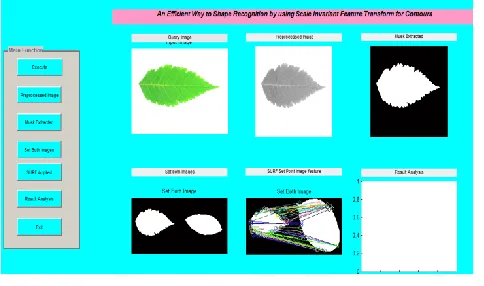
In this section, the results of our experiments are presented and discussed. We start with the Contour-SURF matching, here each
image Keypoints are compared with other image as shown in the Figure. Keypoints present in each image contour is detected
from candidate Keypoints and select the Keypoints
Fig 5.1 Main GUI with Input leaf image
Fig: Values Obtained for Contour-SURF when each image is compared with other
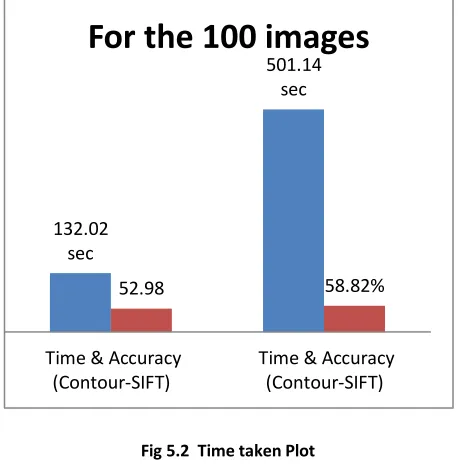
Fig 5.2 Time taken Plot
Here the experiment is conducted on 100 images where the time taken to match images by using Contour-SURF and
SIFT is 132.02 seconds and 501.14 seconds and the accuracy is52.98% and 58.82% respectively.
132.02
sec
501.14
sec
52.98
58.82%
Time & Accuracy
(Contour-SIFT)
Time & Accuracy
(Contour-SIFT)
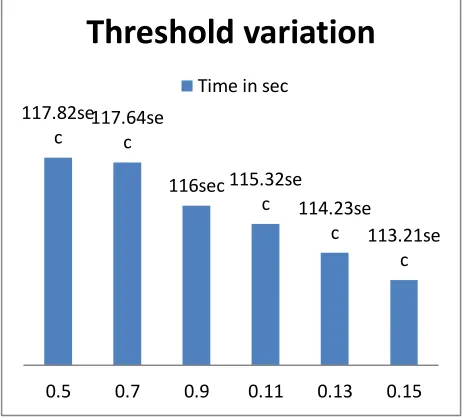
Fig 5.3 Graphical Representation of
threshold variation for detecting key pointsExamination is done by varying different threshold value, as we increase the threshold value the amount of time taken
to match will decrease. In our experiments we have conducted the experiment for threshold 0.5 for detecting the key points from
the candidate key points. Time has been taken down for the threshold value of 0.7,0.9,0.11,0.13 and 0.15.By increasing these
values the time taken to detect key points are decreased because the number of key points it should consider will became less
.
Fig 5.4 . Detection Accuracy
In above figure experiment was conducted under different input species for obtaining detection accuracy, by looking In
to the figure it has been concluded that detection accuracy of SURF has better than SIFT.
117.82se
c
117.64se
c
116sec 115.32se
c
114.23se
c
113.21se
c
0.5
0.7
0.9
0.11
0.13
0.15
Threshold variation
CONCLUSION
Contour-SURF feature extraction and matching technique all along with a matching practice are given for the contour
based shape detection . The algorithm automatically extracts local features in the certain entity outline with no any limitation of
definite neighborhood location. A Contour recognition experiment was done with different datasets. All images were taken as a
target and resultant to the further model. The detection correctness reaches 100% for images having distinctive contour feature,
and lesser for images having common shapes. The above shown results shows that by Contour-SURF Feature Extraction gives
matching the features is very fast when compared with Contour-SIFT. The Accuracy of Contour-SIFT is nearly same as
compared to Contour-SURF. But Contour Based SIFT method takes more repeated Keypoints in the matching process, whereas
Contour Based SURF considers all distinct Keypoints in matching.