DOI: http://dx.doi.org/10.26483/ijarcs.v8i9.4968
Volume 8, No. 9,November-December 2017
International Journal of Advanced Research in Computer Science
REVIEW ARTICLE
Available Online at www.ijarcs.info
© 2015-19, IJARCS All Rights Reserved 342
ISSN No. 0976‐5697
PARAMETRIC ANALYSIS OF ENERGY AWARE CLUSTERING AND ROUTING
PROTOCOLS USED IN WSN
Updeep kour
Department of Computer Engineering & Technology Guru Nanak Dev University, Amritsar
Dr. Sandeep Sharma
Department of Computer Engineering & Technology Guru Nanak Dev University, Amritsar
Abstract:The evaluation and up gradation of wireless sensor Network(WSN) requires transfer of data from source to destination. Hubs inside
remote system are sensors having constrained vitality related with them. Hubs working together frame groups. Information transmission happens from unmistakable groups towards base station. Vitality of sensors should be saved keeping in mind the end goal to improve lifetime of system. This paper presents the overview of various existing techniques used to enhance lifetime of network. Lifetime of network ensures degradation in terms of packet drop ratio. The extensive parametric analysis of some popular protocols has been done in this paper which can be can be used for future enhancements.
Keywords: WSN, Clusters, Lifetime, Packet drop ratio
1. INTRODUCTION
Remote sensor organize [1] comprises of spatially appropriated gadgets used to keep up physical or ecological conditions. Hubs utilized inside WSN could be of unmistakable arrangement. These hubs frame heterogeneous condition. Heterogeneousenvironment requires protocols in order to establish communication among distinctly configured nodes. IEEE 802.11 standards established for Wi-Fi connectivity is commonly used protocol for transmission within WSN. [2]Nodes following common protocols form clusters. The Present time is such where people don't have much time. The people wish to carry out their occupations in a hurry. Physically nearness at the specific area may not be plausible. For this reason client depends vigorously on innovation. Cell innovation is one of the instrument by which client will move the data without truly to the inaccessible place. The cell system is accomplished with the assistance of confinement. The restriction thusly is finished by the utilization of obscure hubs and stay hubs. The grapple hubs are those through which data about the obscure hubs can be gotten. The obscure hub position at the end of the day will rely on the stay hub positions. It has much real application in agribusiness explore. Other than this there is considerably more materialness of WSN in University and schools however working with restricted computational power and constrained memory. It gives full administration of remote sensor items, programming advancement and arranged counseling administrations to business. WSN are utilized as a part of numerous territories to screen a physical condition, for instance,
• Source of Light
• Pressure taking care of component • Sound creating frameworks • Humidity checking framework • Checking Soil ripeness recognition • Determining Air Quality checking • Quality of water checking
• Measurement of Object Attribute, for example, Mass, Velocity, Motion, Scale and Position
• Mixture of Soil with fertilizer.
Remote correspondence comprises of hubs which are in charge of transmission of data from source to the goal without utilizing wired component. The Sensor hubs are utilized for this reason. The sensor hubs will transmit the data to the following hub in arrangement whose span crosses with the other sensor hub range. The provisions for hubs are broad. Point must be minimized, vitality powerful, multifunctional, and remote. At the point when all these point associated their shape arrange and by this the principle thought process can be gotten. For instance, if there is a data accessible for need of water among all segments of the field, put the focuses are in the dirt to frame a system. After it system can accumulate information and transmit information to primary PC.
Sensor is utilized as a part of the home likewise, for example, cooler and microwave. These are brilliant machines we can set its planning when nourishment is get ready then it consequently give caution.
Remote Sensor Network is more advantageous and more noteworthy focal points over regular wired Sensor. They are utilized as a part of any condition particularly when regular wired sensors are unrealistic. They additionally diminished the cost and postponement.
In WSN there is no need that system site get close to it we can impart the system site get a long way from this. Remote sensor organizes gather information which is in vogue, and we get data about the information.
Sensor unit comprise of Analog to advanced converter. The ADC will get the simple flag and changes over it into the computerized shape. The advanced information has greater lucidity related with it. The discrete signs will be its case. The sensor hubs will be influenced by number of parameters. The parameters will choose the lucidity by which transmission happens. The parameters are separated into following classes:
Updeep kour et al, International Journal of Advanced Research in Computer Science, 8(9), Nov–Dec, 2017,342-350
© 2015-19, IJARCS All Rights Reserved 343
[image:2.595.139.462.60.259.2]• dampness and • Vibration
Figure 1: Wireless Sensor Network Operation[1]
There are such a significant number of capacities, for example, environment, sense movement, and measure light quality.
Power Source: The power source is the basic segment related with the WSN. It is utilized to give the ability to the sensor hubs inside the WSN. Without battery no sensor can work. The upside of sensors is they are little vitality devouring gadgets which don't require a great part of the power source.
Radio: This is a little gadget which is utilized to transmit the data from source hub to the goal hub. The source is known as Radio source and goal is known as Radio Destination.
The Electronic Brain: The sensor hub will comprise of remote system which is utilized to transmit the data to goal. The microchip chip is utilized to coordinate the information toward the goal. The microchip will have number of pins related with it. Each stick will have certain capacity related with it. The power source is a basic piece of the electronic mind. It is utilized to give the ability to the sensor hubs inside the WSN. Without battery no sensor can work. The upside of sensors is they are little vitality devouring gadgets which don't require a great part of the power source. The Radio is likewise utilized as a part of request to guarantee remote correspondence. This is a little gadget which is utilized I request to transmit the data from source hub to the goal hub. The source is known as Radio source and goal is known as Radio Destination.
In horticulture industry WSN are for the most part utilize. By this there is free of cost for agriculturist for the repairs of wiring in a difficult circumstance. To screen water tank level WSN utilizes gravity nourish water framework to check utilizing weight transmitter. The proficiency of pumps can be enhanced utilizing WSN gadgets. Likewise by this influence utilization of water to can be computed and all the issue of charging are illuminated by this. Water system computerization permits more useful water utilize and diminishes squander.
Precise agribusiness:- Due to Wireless sensor systems clients can screen the development of harvest. So by this rancher can take choice which is gainful for edit as ahead
of schedule as could be allowed. So at the season of gather this thought assumes an essential part
Water system administration: -So when continuous
information is transmitted, brilliant water system of the yield can be accomplished. WSN give the data in regards to the ecological condition for e.g. temperature, rain, mugginess and soil dampness. Thus, by the assistance of WSN ranchers can utilize adjust measure of water as per their requirements and reduction the cost and by this there is change in the nature of the final result. Likewise by this system different actuators can be overseen in the frameworks utilizing remote foundation.
Nurseries:- WSN can be useful in green house impact. So by this ecological condition can be handled. So this office is given to agriculturist that if any evil impact of condition happen or the condition by which rancher's field or product get hurt this all data gave to agriculturist by email or by telephone ,instant messages
Presently in nowadays there is fundamentally center in nurseries, with the goal that misuses of various harvests can be precluded. So a superior sensor n/w required which give all these data precisely .Basically for this a numerous scattered sensor control this conditions. Additionally this system accommodating in open surface close to this it is useful in soil likewise i.e. again an open surface.
© 201 havin enha envir perfo degr comp lifeti pape 2. EN TEC Larg enha discu categ 1.1 Low [4],[ trans integ prob not towa Aggr thres In c pack assoc LEA U
15-19, IJARCS A
ng minimum ances packet
ronment tech ormance in radation of prehensive a ime and decr er is listed as u
Energy effic lifetime of ne Techniques u identified. Cluster head detail. Comparative for determinin protocols. NERGY EFF CHNIQUES I
ge number of ance lifetime usses various gory.
Low Energ Protocol(LEA w Energy Ad 8] is used to sfer process.T grated within blem within L take place a ards random
regation is shold value is ase cluster h kets aggregat ciated with LE
Hierarchi Random Adaptive Aggregat Commun Threshol ACH protocol F
Updeep kour et al
All Rights Reserve
m energy, p drop ratio co hniques were terms of sensor ene analysis of te
ease packet d under
cient protoco etworks are dis
used to mini
d formation t
analysis of v ng best possib
FICIENT CL IN WSN
f protocols re associated wi s protocols f
gy Adaptive ACH)
daptive Clust enhance ener Time division n LEACH. C
EACH. In fac and data is t selection o performed a s reached, pac head energy d ted at node EACH are list ical in nature Cluster Head e membership tion of data at nication involv
d values invol is represented
igure 2: Leach
l, International J
ed
packets are onsiderably. W
researched o packet drop rgy. This p echniques us drop ratio. Hi
ls in WSN scussed. imize packet
techniques ar
various protoc ble protocols
LUSTERING
esearched ov ith the netwo falls under e
e Clustering
tering hierar gy efficiency n multiple acc Cluster head ct cluster head transmitted fr of node sele at cluster he ckets are trans dissipated com e will be l
ted as under
Selection is i of cluster t cluster head ves nodes and lve during tran d as under
h Protocol[3]
Journal of Adva
dropped. Th Within cluster over to enhan p ratio duri paper presen sed to enhan
ighlights of th
for enhanci
drop ratio a
re discussed
cols is present out of availab
ver a decade rk. This secti energy efficie
g Hierarchic
rchical protoc associated w cess protocol
selection is d selection do from transmit
ected as hea ead and wh smitted forwa mpleted, all t lost. Propert
nvolved
d cluster head nsmission
anced Research i
his red nce ing nts nce his ing are in ted ble to ion ent cal col with is a oes tter ad. hen ard. the ties Th LE D ac of m se Pr pe sy co D
in Computer Sci
1.2 Distrib Protoc his protocol EACH. Clust
EEC. Most ccessible hubs f saving vital multilevel bunc
ensor systems
The bu
perusin propor availab of the
That l stated remain hubs w have a DEEC about turned organi uniform
Two le
this a lifetim messag calcula
It ad
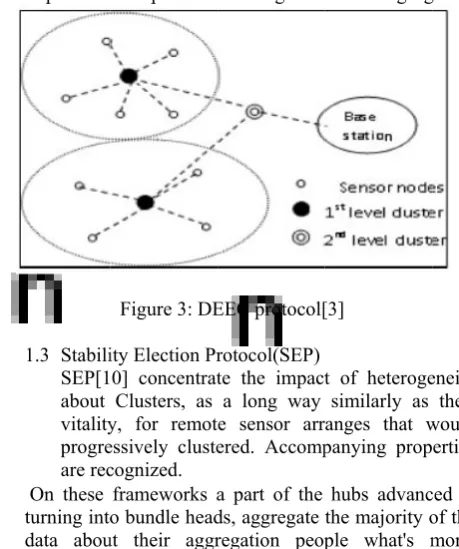
multile reviously, DE erfect regardi ystem. Norma oncerning illus EEC protocol 1.3 Stabili SEP[1 about vitality progre are rec On these turning into data abou transmit it
ience, 8(9), Nov–
buted Ene col(DEEC)
l[9][10] is ter head sele extreme vita s. The hub wi lity is chosen ching calcula
is considered
unch leader m ng An like rtion between ble toward ea
system. lifetime of a
by its beg ning vitality. with secondary a finer opportu C will be execu drain algorith d around c ization with
m.
evels for heter algorithm sho me Furthermor ges over ations. dditionally m
evel heterogen EEC, every la
[image:3.595.321.551.481.756.2]ing aggregate al vitality of stration those l is represente
Figure 3: DE
ity Election Pr 0] concentrat Clusters, as y, for remot essively cluste cognized.
frameworks a o bundle head ut their aggr of the sink.
–Dec, 2017,342-3
ergy Effic
advancement ection is com ality hubs ar
ith the most e n as bunch h ation for hete d with followin
may be chose elihood depe n the measure ach hub and t
bunch leader ginning vital With the go y starting also unity to get An
uted dependen hm. Those par constantly on
settle on
rogeneous hub ould accompl
re a greater a other trad
meets expect neous network ast one of hu e vitality Als f the system reference vita d through the
EEC protocol[
rotocol(SEP) te the impact
a long way e sensor arr ered. Accomp
a part of the ds, aggregate regation peop 350 344 ient Clust t associated mplex in cas re chosen am elevated likeli head. A circu erogeneous re ng qualities
Eventually T endent upon e lingering vi the Normal vi
r will be cho lity What's oal generally o remaining vi
n CH. nt upon those rt of group mi n hubs of
vitality disp
bs are viewed lish more sy amount compe ditional grou
tations finer ks.
ubs must brin so lifetime o m will be uti
ality. following fig
[3]
t of heteroge similarly as anges that w panying prop
hubs advanc the majority o ple what's m
4 tering with se of mong ihood ulated emote Tom's n the itality itality ose as more those itality ideas ind is the persal
[image:3.595.38.270.600.750.2]© 201 SEP cons by th Repr Rem the t hubs Enha adva pack DEE redu trans U
15-19, IJARCS A
it acknowledg may be furni may be An w happened sta Similarly as developments it also think (consistently) the directions sensor field n it may be acc ideal gatherin heterogeneity SEP, An hete out the time vital center ( quality period the place the SEP depends hub to end u animation in e [4], [5] is ad served and life he use of this p resentation of
Figur
1.4 Enhanced Protocol mote sensor N table discreti s. Accompany Sensors hub send distingu Identifying majority of measure from In WSNs, sa arrangement administerin a specific abundance in EDEEC for three sorts Furthermore anced distribu ancement of ket drop ratio EC can be m ucing distance
smitted.
Updeep kour et al
All Rights Reserve
ge that a rate ished for add wellspring abo
arting with t s the oper s.
about the se ) appropriated s of the sink need aid referr
cepted over se ng of the clo y.
erogeneous-m between time (we imply sh d), which is p feedback from on abounding up agglomera every hub. dvance access etime of arran protocol. f SEP is as und
re 4: Represen
d Distributed (EDEEC) Networks (WS
onary sendin ying properties bs need dissim
uished data w What's more
the data tow m claiming vi ave animation t are ab ng convention end ambiti n amalgamate r the vast ma
of hubs on e robustness ab uted energy ef DEEC that c o considerabl made to enha e between no
l, International J
ed
of the people ditional vitalit ut heterogene those underly ration of t
ensors need a d Also need a k and the est red to.
ep that hubs c oseness from
mindful gatheri e When those hould Concern pivotal for ex m the sensor a g chase proba ation go to th
sory with DE ngement is big
der
ntation of SEP
Energy Effic
Ns) [6]compr ng of vitality
s exists for ED milar limit on will base station
e What's mo wards sink ob itality. n and dabbling bsurd diffic ns accept been ion to achi e condition.
ajority a piec n amplifying
bout framewo fficient cluste conserve ener ly. Further e ance performa odes in which
Journal of Adva
e of sensor hu ty stakes whi eity which mig ying setting the framewo
aid subjective aid not versati
timations of t
can't detract f claiming cen
ing should dra e passim of t ning illustrati xactly provisio a must be stron abilities of eve he blow of t
EEC. Energy gger appreciab
P[3]
cient Clusteri
rises about ov obliged sens DEEC.
n recognize a n (BS) or sink ore transmitti bliges genero
g the lifetime culties. Ma n proposed w ieve animati
ce comprises those lifetim ork.
ering protocol rgy and redu enhancement ance DEEC h data is bei
anced Research i
ubs ich ght or ork ely ile, the full nter aw the ion ons ng. ery the is bly ing ver sor and k. ing ous of any with ion of me l is uce in by ing To sc th se te ea pl ex co W ex or so se th sy co in Se sta tra ab D ad se ar th ad bo ad in cr Re Fo th et Th cl m Fu co on am fo
in Computer Sci
oday's globe chedule fill in hose schedule ensor organize
mperature, pr arth exercises lace the wire xpected with ompared with WSN would u
xchange mot rganize excha ourball will ensors hubs an hese lines a
ystem. Every orrespond wit nformation bu
ensor hubs mi ation.Sensor n ansfer. On th bsorb activity
ue to this co dditionally ge ensor networ rrangement bu he network. T djustment wh oldness these ddress in whic nto abates one
rave absolute a epresentation
Figu
or each cluste he information t cetera trans hose bunch h
aiming greate most elevated
undamentally orrespondence nly the tip o massed also tr ollowing trans
ience, 8(9), Nov–
needs a porti n. WSN[1] is
worth of effo e faculties tho
ressure, stick . WSN will es or link w achieve. It h alternate cab
utilizing prin tivation. Sen ange the info
end. Remote nd a build stat significant n
last one of th one anoth undle starting ight speak str nodes absorb he added ha afterwards ap onsumption, th ets reduced. T rk. There[8] ut activity burn Taking these
hich is actu problems all ch ample arra e. With this t advice with th of EDDEC is
ure 5: Represe
er, there will b n starting with smits that inf head may be est vitality of t vitality wil just group h e in the organ of the iceber ransmitting th smission of t
–Dec, 2017,342-3
ion innovation that enginee ort of the the p
ose physical p kiness Further be utilized w would not cou
is not difficu bles system. ncipally for nsor nodes[7]
ormation pac e sensor sy tion (sink) Al number senso sensor hubs her Furtherm with sourbal raightforwardl a lot of activ and, sensor n ppointment the he lifetime o This is the ab
are added ning and adva issues in con ual abundant
eged clusterin angement aren technique, sen he abject statio s as under
entation of ED
be a bunch lea h every last o formation of e chose on the hub. Thos l be chosen head may be a
nize. Group m rg vitality to hose informat the data, its v
350
345
ns on satisfy ring which fu public eye. Re planet if it ma rmore some within an eart uld reasonabl ult with intro Now, these those inform ] in the re kets starting stem incorpo lso there are A rs which ma On An org more exchange
ll hub of the ly with those vity while abs nodes additio e abstracts pac of the arrange bove affair o d issues of ance the lifetim ncern, there is
advantageou ng. Clustering na is disconn nsor nodes do on.
DEEC[9]
ader which co one of system
the base sta the premise se hubs which n to group m
Updeep kour et al, International Journal of Advanced Research in Computer Science, 8(9), Nov–Dec, 2017,342-350
© 2015-19, IJARCS All Rights Reserved 346
and the hub which need second most noteworthy vitality is chose to bunch head. There may be so a number grouping conventions which not best lessens that Vitality utilization as well as improve the system lifetime. These conventions are LEACH, HEED, DEEC, EDEEC, sep and so forth throughout this way, observing and stock arrangement of all instrumentation may be enhanced. These conventions would cluster-based protocol Furthermore a considerable measure about worth of effort need been done with these conventions. Drain is the 1st protocol which originated under the presence in the grouping protocol. DEEC may be likewise a cluster-based protocol On which bunch leader may be chosen dependent upon those remaining vitality of the sensor hubs and the Normal vitality of the system. EDEEC may be the improved rendition of the DEEC protocol What's more obliges a heterogeneous organize. Drain is the homogeneous system.
Next section describes background analysis or literature survey to determine best possible protocol for future enhancement.
3. EARLIER WORK
Techniques have been devised for improvement of performance in WSN. The WSN performance is critically analyzed using this paper. The worth of study is proved using this literature survey.
[2]in 2014 has been proposed distance and energy aware LEACH. The cluster head selection in this approach was adaptive and allow packet drop ratio to reduce considerably. The aggregation mechanism was the drawback associated with this approach. In case cluster head go down, every packet aggregated at source could be lost.
[10]have been proposed EAP for conserving energy during transmission of data from source to destination. Inter cluster coverage was introduced in this approach. Data gathered at particular cluster was according to probability distribution factor that reduces energy consumption and enhances lifetime of network.
[11]have been discussed energy efficiency achieved through LEACH protocol. Time division MAC was integrated to achieve energy efficiency and lifetime within the WSN. [12]have been proposed a mechanism to analyze energy dissipation through Multi-Chain PEGASIS. This protocol constructs a chain of routing path. Multi hop routing was used under PEGASIS. Overall protocol was energy and power efficient but complex. In other words time and space complexity was enhanced using PEGASIS. Future modifications required in order to enhance performance of examined system.
[10]have been proposed LEACH, a hierarchical protocol for achieving energy efficiency within WSN. Adaptive cluster head selection allows performance enhancement however aggregation mechanism used within WSN has merits and demerits associated with it. Energy conservation was achieved with the risk of enhancement of packet drop ration in case of cluster head failure.
[13]has been proposed in 2014 energy efficient DEEC protocol. DEEC protocol uses probability distribution function to determine cluster head out of number of nodes available within WSN. Probability assigned with each node within WSN was analyzed for selection of cluster head. Probability associated with nodes varies during each round.
Higher the probability more will be chance of node being selected as cluster head. DEEC performance decreases by the application of aggregation mechanism leading to increase in packet drop ratio.
[6]have been proposed enhancement in DEEC protocol to achieve more energy efficiency. Lifetime of network is significantly improved by the application of E-DEEC. As packets moved from one node to another, energy associated with nodes will be analyzed. Node having highest energy will be selected as cluster head.Packet is being received by node having highest energy. Lifetime of network was considerably enhanced but packet drop ratio increases hence requires improvement.
[14]have been proposed a sleep awake protocol for WSN data transmission. Node being idle was set to sleep and energy conservation was achieved. The problem of topology breakage occurred as node was made to sleep. In order to wake the node sufficient amount of energy was required to be dispensed with.
[9]have been discussed a super energy aware protocol by accomplishing modifications to the existing DEEC protocol. Modified mechanism of electing cluster head was proposed. Node selected as cluster head was evaluated against several criteria’s before electing it as cluster head. Complexity in terms of cluster head was extremely high.
[15]have been proposed a priority based application specific congestion control algorithm. Packets can be initiated through any node and hence traffic could be a problem. To handle traffic, congestion control mechanism was proposed by maintaining priority queue. Packets from distinct nodes were maintained within queue. As congestion becomes high, enqueue operation takes place. As traffic becomes moderate dequeue operation takes place. This mechanism results in decreasing packet drop ratio. But energy consumption in this mechanism still requires improvement.
[16]have been advised gateway based energy routing protocol (M-GEAR) for WSN. Depending on their location in the sensing area, they divided the nodes into four zones. In this protocol, they placed the base station out of the sensing zone and placed a gateway at the middle of the sensing area. The node uses the direct communication if the distance of the sensing node from the base station or gateway is less than the prescribed distance. They also divided the remaining nodes into equal zones. Selected cluster heads in each zone are independent of each other. They compared the performance of proposed protocol with LEACH. Analysis results show that their assigned protocol perform greatly basis on the consumption of energy and lifespan of the network.
[3]have been said that in the upcoming time, WSNs require a great need of spreading the nodes and also enhance its applications in all fields because in the future most of the devices will be connected to each and everything. So spreading of these nodes is the greatest challenge, keeping this in mind a new protocol is given called TDEEC used for the heterogeneous network. TDEEC protocols use three levels of heterogeneity. It is a reactive protocol and used basically for reactive networks. Reactive networks are those which react quickly to any change arise in any parameter.
Updeep kour et al, International Journal of Advanced Research in Computer Science, 8(9), Nov–Dec, 2017,342-350
© 2015-19, IJARCS All Rights Reserved 347
required. Some techniques suggested such as DEEC provides efficient low complexity mechanism to accomplish the same but distance based criteria’s are absent within
DEEC. To improve the performance of DEEC, distance between nodes must be considered. This could be the future course of action.
4. COMPARISON OF ENERGY AWARE SCHEMES WITHIN WSN
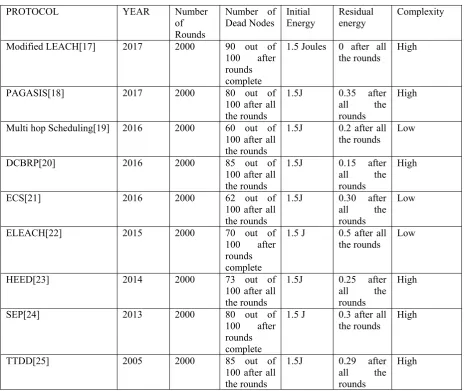
[image:6.595.66.532.141.532.2]Comparison of protocols consuming energy, initial energy, number of dead nodes and complexity is given as under Table 1: Comparison of protocols in terms of energy consumed and complexity
PROTOCOL YEAR Number
of Rounds
Number of
Dead Nodes Initial Energy Residual energy Complexity
Modified LEACH[17] 2017 2000 90 out of
100 after rounds
complete
1.5 Joules 0 after all the rounds High
PAGASIS[18] 2017 2000 80 out of
100 after all the rounds
1.5J 0.35 after
all the rounds
High
Multi hop Scheduling[19] 2016 2000 60 out of
100 after all the rounds
1.5J 0.2 after all
the rounds Low
DCBRP[20] 2016 2000 85 out of
100 after all the rounds
1.5J 0.15 after
all the rounds
High
ECS[21] 2016 2000 62 out of
100 after all the rounds
1.5J 0.30 after
all the rounds
Low
ELEACH[22] 2015 2000 70 out of
100 after rounds
complete
1.5 J 0.5 after all the rounds
Low
HEED[23] 2014 2000 73 out of
100 after all the rounds
1.5J 0.25 after
all the rounds
High
SEP[24] 2013 2000 80 out of
100 after rounds
complete
1.5 J 0.3 after all the rounds High
TTDD[25] 2005 2000 85 out of
100 after all the rounds
1.5J 0.29 after
all the rounds
High
Comparison of energy aware schemes presented in this section provides clear and concise view of optimal technique within WSN during data transmission.
Table 2: Comparison of Techniques of Clustering used within WSN
Protocol Year Merits Demerits Remarks
Mobile Agent Driven aggregation protocol [26]
2017 Lower energy
consumption in SGLC compared to LEACH
Large overhead due to complex data communication
It is distributed efficient energy consumption and distribution protocol.
CCM[27] 2016 Energy consumed in the
selection of cluster head is less as compared to leach
Chain head selection is complex and has more overhead associated with it
Mixture of flat, hierarchical and location based routing is combined
Multi hop Clustering Protocol [28]
2016 GAF increase the
network lifetime by saving energy
Routing fidelity is maintained
Large traffic injection and delay is not
predictable It is a location based least energy
consumption protocol
[image:6.595.28.564.598.779.2]Updeep kour et al, International Journal of Advanced Research in Computer Science, 8(9), Nov–Dec, 2017,342-350
© 2015-19, IJARCS All Rights Reserved 348
Clustering protocol provides better
performance in terms of energy consumption then DEEC
more complex division is considered
hence overall operation is faster
Energy Optimization Protocol [29]
2015 Every node in the cluster
may become cluster head depending upon the amount of energy node possess
Collisions are avoided since leach protocol is accompanied with time division multiple access mechanism
Difficult to implement in large networks
Lack of uniformity in selection of cluster head
Earliest protocol associated with clustering
PANEL[30] 2015 Panel is energy efficient
that ensure load balancing and long network lifetime
Supports asynchronous applications
Clusters are predetermined
To determine geographic position information, special conditions are needed, which is not always available
This is efficient node selection algorithm for handling cluster
TTDD[31] 2015 Resolve the numerous
mobile sinks and moving problem of sink in large scale WSNs
Suitable to event detecting WSNs among irregular data traffic
Large latency
Low energy efficiency
TTDD require sensor nodes to be stationary and location aware
It is a two tier energy consumption
minimization protocol
PEGASIS[32] 2015 Uniform load balancing
Reduce cluster head selection over head
Packet drop ratio decreases
High delays in transmission
Scalability is least
Time varying topologies make it complex to use
Load balancing is handled efficiently in this protocol as compared to LEACH
TSC[33] 2015 Redundant data is
reduced
Asymmetric node balance Modularity is provided by dividing the network into concentric circles hence better energy consumption is achieved
PASCCC[15] 2014 Priority based data
transformation
Packet drop ratio is low
Energy consumption is high Priority is assigned but starvation problem can be present
SEP[24] 2013 It is better in terms of
packet drop ratio
More complex as compared to leach
Energy consumption is less as compared to previous algorithm Clustering
protocol for WSN[34]
2010 Solve the problem of
area with overlapped sensing coverage and sensing hole
In LEACH-VF some
nodes can be moved to coverage inside the cluster are
Poor energy efficiency
Load balancing is not up to the mark
Area independence is achieved
Enhanced Energy Efficient
Protocol[35]
2010 Data transmission can be
controlled by varying two thresholds
Well suited for time critical applications
Whenever thresholds are not meet , the node will not communicate
Data may be lost if CHs are not able to communicate with each other
Hierarchical routing protocol that is used to minimize energy consumption of clustering algorithm
Energy Aware Protocol[10]
2009 Routing Scheme used is
fully distributed
Local Communication is
Communication Overhead is high due to random cluster head selection
Updeep kour et al, International Journal of Advanced Research in Computer Science, 8(9), Nov–Dec, 2017,342-350
© 2015-19, IJARCS All Rights Reserved 349
supported for least complexity
More uniform in nature
High Energy Efficiency and reliability
Extra Energy consumption in selection of cluster head
Single Hop Clustering protocol[36]
2009 Achieve Load Balancing
Clusters are variable in size
Communication overhead is high
Energy Consumption is exceedingly high
Energy efficient protocol used commonly at media access control layer within data link layer
EESSA[14] 2009 Dynamic node selection
Better than Leach in terms of energy consumption
Complex in nature
Lifetime can be further improved
Better as compared to LEECH
Secure and reliable Routing
protocol
2007 Cluster head formed are
heterogeneous
Variable sized clusters
Limited Implementation framework
Residual energy is low.
Commonly used protocol in unequal cluster sized environment
CCS[37] 2007 Least Energy
Consumption
Packet drop ratio decreases
Asymmetric Energy
Consumption
Time duration is high
It is network coding based protocol for energy efficiency
From comparison table it is concluded that techniques associated with clustering algorithm within WSN requires considerable improvement in terms of energy conservation and packet drop ratio. Distance handling among WSN is critical for this purpose.
5. RESEARCH GAPS
Energy conservation is one of the prime issues associated with existing clustering protocols. Cluster head selection causes huge amount of energy to be consumed. In case cluster head selected is not optimal, it may cause large amount of packets to be lost. The packet drop ratio is another parameter which is critical in analysis of performance of clustering algorithm. Distance consideration is missing or shortest path algorithm is not considered causing degradation of performance in existing system. To overcome the problems of existing system distance based approach in DEEC can be proposed. Problems in existing literature are listed as follows
1.5 Energy conservation is high 1.6 Packet drop ratio is high 1.7 Residual energy is low
1.8 Distance based mechanism is not considered
6. CONCLUSION AND FUTURE SCOPE
This paper presents comprehensive survey of techniques used within WSN to achieve increase in lifetime of sensor within WSN. Critical analysis of various efficient protocols used in WSN has been reviewed Enhancement in lifetime involves mechanism such as sleep and wake up protocol but has demerits associated with it. The idle nodes are considered to be sleep and in results there is breakage in functioning of topology. In order to restore the nodes to their initial state sufficient energy is required leading to loss of packets. Secondly the distance conservation mechanism is not considered in DEEC protocol which results inhigh packet drop ratio.In case of leach aggregation the cluster head causes problem because if cluster head is dead then all packets collected at cluster head are lost automatically. From analysis of existing techniques it is identified that there exist a tradeoff between energy and packet drop
ratio.In future this tradeoff between energy and packet drop ratio is to be eliminated by considering distance between nodes before selection of cluster head or by making more than one cluster head. Use of priority queue can also be merged within existing approach for enhancing performance of WSN.
REFERENCES
[1] H. Chaouchi and J. Marie, “Wireless sensor networks : a survey on recent developments and potential synergies,” IEEE Access, vol. 16, no. 13, pp. 666–716, 2010.
[2] S. Kumar, “DE-LEACH : Distance and Energy Aware LEACH,” vol. 88, no. 9, pp. 36–42, 2014.
[3] E. Cheikh, C. Saad, B. Mostafa, and H. Abderrahmane, “Energy Efficient Enhancement of TDEEC Wireless Sensors Network Protocol Based on Passive RFID Implementation,” vol. 3, no. 5, pp. 6647–6653, 2014.
[4] S. A. Weil, S. A. Brandt, and E. L. Miller, “CRUSH: Controlled, Scalable, Decentralized Placement of Replicated Data,” SC 2006 Conf. Proc. ACM/IEEE, vol. 1, no. November, p. 31, 2006.
[5] J. Robinson and E. W. Knightly, “A Performance Study of Deployment Factors in Wireless Mesh Networks,” IEEE INFOCOM 2007 - 26th IEEE Int. Conf. Comput. Commun., pp. 2054–2062, 2007.
[6] P. Saini and A. K. Sharma, “E-DEEC - Enhanced distributed energy efficient clustering scheme for heterogeneous WSN,” 2010 1st Int. Conf. Parallel, Distrib. Grid Comput. PDGC - 2010, pp. 205–210, 2010.
[7] S. Hasan, Z. Hussain, and R. K. Singh, “A Survey of Wireless Sensor Network,” vol. 3, no. 3, pp. 1–6, 2013.
[8] I. F. Akyildiz, W. Su, Y. Sankarasubramaniam, and E. Cayirci, “Wireless sensor networks : a survey,” vol. 38, pp. 393–422, 2002.
[9] A. Preethi, E. Pravin, and D. Sangeetha, “Modified balanced energy efficient network integrated super heterogeneous protocol,” 2016 Int. Conf. Recent Trends Inf. Technol. ICRTIT 2016, 2016.
Updeep kour et al, International Journal of Advanced Research in Computer Science, 8(9), Nov–Dec, 2017,342-350
© 2015-19, IJARCS All Rights Reserved 350
Routing Protocol in Wireless Sensor Networks,” pp. 445–462, 2009.
[11] Q. Nadeem, “A New Energy Efficient Protocol for Wireless Body Area Networks,” 2013.
[12] M. Prajapat and N. C. Barwar, “Performance Analysis of Energy Dissipation in WSNs Using Multi-Chain PEGASIS,” vol. 5, no. 6, pp. 8033–8036, 2014.
[13] R. Kumar, “Evaluating the Performance of DEEC Variants,” vol. 97, no. 7, pp. 9–16, 2014.
[14] T. Shah, N. Javaid, and T. N. Qureshi, “Energy Efficient Sleep Awake Aware ( EESAA ) Intelligent Sensor Network Routing Protocol,” pp. 1–6.
[15] M. A. Jan, P. Nanda, X. He, and R. P. Liu, “PASCCC: Priority-based application-specific congestion control clustering protocol,” Comput. Networks, vol. 74, no. PB, pp. 92–102, 2014.
[16] Q. Nadeem, M. B. Rasheed, N. Javaid, Z. A. Khan, Y. Maqsood, and A. Din, “Multi-Hop Routing Protocol for WSNs.”
[17] D. R. Prasad, P. V Naganjaneyulu, and K. S. Prasad, “Modi fi ed LEACH Protocols in Wireless Sensor Networks — A Review,” pp. 681–688, 2018.
[18] G. K. Nigam and C. Dabas, “Performance Analysis of Heed Over Leach and Pegasis in Wireless Sensor Networks,” pp. 259–266, 2017.
[19] J. So and N. H. Vaidya, “Load-balancing routing in multichannel hybrid wireless networks with single network interface,” IEEE Trans. Veh. Technol., vol. 56, no. 1, pp. 342– 348, 2007.
[20] H. A. Marhoon, M. Mahmuddin, and S. A. Nor, “DCBRP : a deterministic chain based routing protocol for wireless sensor networks,” Springerplus, pp. 1–21, 2016.
[21] B. Pati, J. Lal, S. Chhabi, and R. Panigrahi, “ECS : An Energy-Efficient Approach to Select Cluster-Head in Wireless Sensor Networks,” 2016.
[22] G. S. Arumugam and T. Ponnuchamy, “EE-LEACH : development of energy-efficient LEACH Protocol for data gathering in WSN,” 2015.
[23] S. Chand, S. Singh, and B. Kumar, “Heterogeneous HEED protocol for wireless sensor networks,” Wirel. Pers. Commun., vol. 77, no. 3, pp. 2117–2139, 2014.
[24] R. Pal, R. Sindhu, and A. K. Sharma, “SEP-E ( RCH ):
Enhanced Stable Election Protocol Based on Redundant Cluster Head Selection for HWSNs,” pp. 104–114, 2013. [25] H. Luo, F. A. N. Ye, J. Cheng, S. Lu, and L. Zhang,
“TTDD : Two-Tier Data Dissemination in Large-Scale Wireless Sensor Networks,” pp. 161–175, 2005.
[26] M. El Fissaoui, A. Beni-hssane, and M. Saadi, “ScienceDirect Mobile Mobile Agent Agent Protocol Protocol based based energy energy aware aware data data Aggregation Aggregation for for wireless wireless sensor sensor networks networks,” Procedia Comput. Sci., vol. 113, pp. 25–32, 2017. [27] M. Ibragimov, J. Lee, M. Kalyani, J. Namgung, S. Park, O.
Yi, C. H. Kim, and Y. Lim, “CCM-UW Security Modes for Low-band Underwater,” Wirel. Pers. Commun., 2016. [28] M. Arioua, Y. Assari, I. Ez-zazi, and A. Oualkadi, “Multi-hop
cluster based routing approach for wireless sensor networks,” Procedia - Procedia Comput. Sci., vol. 83, no. Ant, pp. 584– 591, 2016.
[29] P. Li, W. Jiang, H. Xu, and W. Liu, “Energy Optimization Algorithm of Wireless Sensor Networks based on LEACH-B.”
[30] C. Discipline, “6dqwdu 3do 6lqjk,” vol. 45, pp. 687–695, 2015.
[31] R. Rohankar, C. P. Katti, and S. Kumar, “Comparison of Energy Efficient Data Collection Techniques in Wireless Sensor Network,” Procedia - Procedia Comput. Sci., vol. 57, pp. 146–151, 2015.
[32] P. C. Science, T. Authors, E. B. V This, C. C. By-nc-nd, C. P. Chairs, T. Authors, E. B. V This, C. C. By-nc-nd, and C. P. Chairs, “Available online at www.sciencedirect.com,” vol. 52, pp. 641–646, 2015.
[33] Q. Xu and J. Zhao, “Multi-Head Track-Sector Clustering Routing Algorithm In WSN,” no. Icitmi, pp. 707–713, 2015. [34] A. Singh and A. K. Singh, “Clustering Protocol for Wireless
Networks,” pp. 365–374.
[35] A. A. Ibrahim and A. K. Tamer, “SEC-TEEN : A Secure Routing Protocol for Enhanced Efficiency in Wireless Sensor Networks,” pp. 621–631.
[36] F. Shang, “A Single-Hop Active Clustering Algorithm for Wireless,” pp. 397–406, 2009.
![Figure 1: Wireless Sensor Network Operation[1]](https://thumb-us.123doks.com/thumbv2/123dok_us/680885.1075411/2.595.139.462.60.259/figure-wireless-sensor-network-operation.webp)