IJIRT 142520
INTERNATIONAL JOURNAL OF INNOVATIVE RESEARCH IN TECHNOLOGY260
QoS and Energy Aware Geographic Routing Protocol
for WSN
K.Sindhuja
1, P. Punnam Chander Reddy
2 1Department of Computer Science and Engineering,
2,Department of Computer Science and Engineering,
Ganapathy Engineering College, warangal, India
Abstract— Due to the approved content nature, mostly collected of images and/or video streams with high throughput and delay restrictions, Quality of Service in the framework of WSN is a critical issue. In this paper, we propose a QoS and energy aware geographic routing protocol for WSN. To advance the efficiency of QoS routing in WSNs, we sketch the problem of efficient GOR for multiconstrained QoS provisioning in WSNs, which can be expressed as a multiobjective multiconstraint optimization problem. Based on the investigation and interpretations of different routing metrics in GOR, we then suggest an Efficient QoS-aware GOR (EQGOR) protocol for QoS provisioning in WSNs. EQGOR selects and orders the advancing candidate set in well-organizedmethod, which is suitable for WSNs in respect of energy efficiency, latency, and time difficulty.
Index Terms— Wireless sensor networks; Multiconstrained QoS, Geographic opportunistic routing.
I. INTRODUCTION
Wireless Sensor Networks (WSNs) have fascinated the care of many researchers. Wireless Sensor Networks (WSNs) are used for various applications
such as surroundings monitor, automation,
cultivation, and security measures. While recurrent sensors are usually organized on distant and remote spaces the intake and maintenance should be easy and accessible. Wireless sensor network comprise of large number of miniature nodes. The nodeafter that sense environmental alteration and report them to other nodes over flexible network architecture. Sensor nodes aregreat for misuse in hostile
environments or over large geographical
areas.Wireless sensor networks have recently come into importancesince they grip the possible to transformmany sections of our financial system and
life, beginning environmental monitor and
conservation to industrial and business dominance organization to automation in the transportation
and health care industry The project, execution, and deed of a sensor network requires the meeting of a lot of authority, other than signal processing, network and protocol embed system information management and distributed algorithm. Such network is again and again organizedinto resource-constrained environment, for example through battery operate nodes running undeterred.
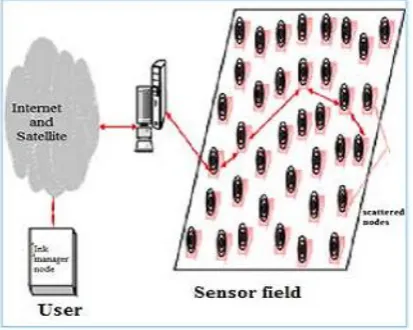
Fig 1 Wireless Sensor Networks
This restraintmandate that sensor network
determination are best method in a hostile technique by prearranged considering the physical, network and application layer and making chief design modifications across the layer. The Wireless Sensor Network achieve function simultaneously where nodes are self-governing bodies integrated in the field spatially for the correct result; the information transmits over proper channel taking the information gathering it in the form of data and send to the base. Sensor networks spread the present Internet bottomless into the bodily atmosphere the resulting state-of-the-art network is orders of flagrancy more extensive and active than
the current TCP/IP networks and is
makingcompletelynew kinds of traffic that are fairlydissimilar from what one treasures on the Internet at present.
IJIRT 142520
INTERNATIONAL JOURNAL OF INNOVATIVE RESEARCH IN TECHNOLOGY261
for example, temperature, wetness orshaking andrequires advanced inquiryboundaries and search engines to meritoriously support User-level functions. Sensornetworks may inter-network with an IP core network via a number of gateways. A gateway path user inquiry orcommands to suitable nodes in a sensor network. It also paths sensor data, at times collective and brief to userwho hasappeal it or are acknowledged to use the information. A data artillery or storage space facility may be presentat the gateway, in addition to data logging at each sensor.
II. RELATED WORK
The problem of using multi-path routing in wirelesssensor networks and suggested the Energy-constrainedMulti-Path routing (ECMP), an advance to the MCMPmodel. The chiefawareness driving the ECMP model is that inthe framework of
wireless sensor networks, effective
resourcepractice should reproduce not only efficient bandwidth operationbut also a negligible usage of energy in its firm term. Thestrong point of the ECMP model lies in the detail that it craftsbetween minimum number of hops and minimum energy bypicking out a path with minimum number of hops only whenit is the path with slightest energy or a longer path withslightest energy satisfying the restrictions.
Fig 2Sensor Nodes Scattered in a Sensor Field Anoriginal packet delivery mechanism called Multipath and Multi-SPEED Routing Protocol (MMSPEED) forprobabilistic QoS guarantee in wireless sensor networks.The QoS provisioning is achieved in two quality fields,namely, timeliness and reliability. Multiple QoS levels areproviding in the timeliness field by assuringseveralpacket delivery speed choices.
These devices for theQoS provisioning are comprehended in a contained way lackingglobal network material by using localizedgeographic packet forwarding greater than before with dynamicreward, which recompenses for local decisioninexactness as a packet travels towards its destination.MMSPEED can promise end-to-end necessities in alocalized way, which is required for scalability andflexibility to great scale dynamic sensor networks.
Fig 3 Virtual overlay of multiple speed layers. In current years, there has been a risingattention
inWireless Sensor Networks (WSN).
Currentimprovements in the field of sensing, computing andcommunications have fascinated researchers in the direction ofthe field of WSNs. Jianwei et al., [4] have presented R3E, which cansupplement most prevailing reactive routing protocols inWSNs to deliverdependable and energy-efficientpacket delivery contrary to the
untrustworthy wireless links.It can
efficientlyadvance robustness, end-to-endenergy efficiency and latency.
Cheng et al., [5] havedemoralized the Geographic Opportunistic Routing(GOR) for multi constrained
QoS provisioning inWSNs, which is
extraappropriate than the multipathrouting
approach.
Ravindra et al., [6] have suggested atechnique in
which defective sensor node is noticed
bymeasuring the round trip delay (RTD) time ofdistinct round trip paths and linking them withthreshold value.
Yuli et al., [7] have suggestedfractionalquality-of-service (QoS)-oriented relay selectionscheme with a decode-and-forward (DF) relayingprotocol, to decrease the feedback quantityessential forrelay selection.
Samina et al., [8] have developed cross layer
techniquesappropriate for Wireless Sensor
IJIRT 142520
INTERNATIONAL JOURNAL OF INNOVATIVE RESEARCH IN TECHNOLOGY262
access.Additionalin detail, energy and cross-layerawarerouting patterns are proposed for
multichannelaccess WSNs that interpretation for radio, MAC contentionand network constraints. Yunbo et al., [9] havedeveloped ainclusive cross-layer investigationframework, which pays a stochastic queueingmodel in accurate channel surroundings. Thisframework is nonspecific and can be parameterized for awide change of MAC
protocols and routing protocolswhich
affectsnumerous network parameters like endto-end delay.
Fenye et al., [10] have suggested a rankeddynamic
trust management protocol for
cluster-basedWireless Sensor Networks, as two featuresof honesty, specifically, social trust and QoStrust. A
probabilistic model is established for
usingstochastic Petri nets techniques to investigate theprotocol performance and authorizedpersonal trustagainst objective trust attained based on ground truthnode position.
III. PROPOSED SYSTEM MODEL
We deliberate have a multi-hop WSN in a two-dimensional planar area. We assume the network is thicklyorganized, i.e., each node has adequately of neighbors.We also assume that the MAC layer offers theconnection quality assessment service, e.g., the packet reception ratio(PRR) information on each link can be gained by countingof the lost inquiry messages or data packets.
Presumptuous node i is sending a data packet to thesink node (denoted as Dest), and j is one of i’s neighborswhich is closer to the sink than i. Define aij in Eq. 1 as thesingle-hop packet progress (SPP)
to the Dest when a packetis advanced by neighbor j. Ci is well-defined as the obtainablenext-hop
forwarder set of node i, where all nodes in Ci
havepositive SPPs.
aij = Dist (i, Dest) − Dist(j,Dest)………….. (1)
where Dist (i, Dest) is the Euclidian distance between node i and the Dest. Let pijrepresent the
PRR between node i and j. For any neighbor j, node i preserves the pair information (aij, pij) in its
neighbor table.
Geographic opportunistic routing Procedure 1) When node i has a data packet to send to
the sink node via multi-hop
communication, it pick out the advancing
candidate set Fidepends on its
nativeinformation of available next-hop forwarder set Ci.
2) Then node i transmit the data packet
wherever the list of candidates and their significances are included in packet header.
3) Now candidates track the
allocatedprecedence to relay the packet resourcefully.
4) For each candidate, if having
acknowledged the packet appropriately, it will start a timer whose value depends on its precedence.
5) The higher the precedence is, the shorter the timer will be. The forwarding
candidate whose timer
perisheswillsresponse an ACK, to inform the sender as well as all other candidates to abandon their timers.
6) Consequently, this forwarding candidate
converts the actual next-hop sender in
resourceful manner. The forwarding
process duplicates until the packet extents the sink node.
7) Now if no forwarding candidate has
successfully acknowledged the packet, the sender will resends the packet if the retransmission is permitted.
EQGOR DESIGN
The pareto principle (also known as the 80-20 rule in the field of economics) shapes that, for severalproceedings, roughly 80% of the things come from 20% of the causes.Thatis, utmost forwarding tasks for each hop are taken by the firsttwo or three candidates in the well-ordered forwarding candidateset. This specifies that it may only want to order a same smallnumber of candidates to achieve a close optimum solution inour proposal, by which the algorithm’s time difficulty can bemeritoriouslycondensed.Table 2 exemplifies thenumber of forwarding candidates involved in the proposedcandidate selection and ordering algorithm in [3].
IJIRT 142520
INTERNATIONAL JOURNAL OF INNOVATIVE RESEARCH IN TECHNOLOGY263
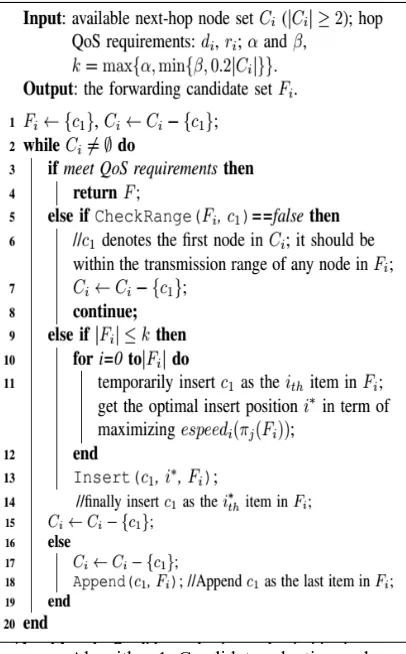
Algorithm 1: Candidate selection andprioritization atforwarding node i in EQGOR
The above hypotheticalinvestigation and
observations inspireus to propose a custom-made candidate selection and rankingalgorithm in EQGOR for QoS provisioning in WSNs. Oncenode i is sending a data packet to the sink node, it choosesand arranges forwarding candidates based on the scheme asproposed in Algorithm 1. Then it forwards the data packetfollowing the GOR procedure for further analysis.
Evaluation metrics
We pick out six main assessment metrics to assess the usefulness of EQGOR for QoS provisioning in WSNs.
• End-to-end Delay: the time occupied for a packet to be conveyed from the source node to the sink node. Given theend-to-end delay QoS requirement, this metric measuresthe on-time packet delivery ratio.
• Packet Delivery Ratio: It is the ratio of the amount of packetsacknowledged by the destination to the total amount of packetssent by the source.
• Data Transmission Cost: It is measured as the total numberof data transmissions for a fruitful end-to-end datadelivery.
• Control Message Cost: It is well-defined as
the total number ofcontrol message
transmissions for sending a single packetto the destination, such as RTS, CTS and ACK. • Single-hop Packet Progress: It is the ratio of the sum of singlehop packet headway in each hop to the number of hopsin a simulation run. • Link Quality per Hop: It is the average link quality for fruitful data transmission at each hop.
IV. RESULTS
Fig 4 Here we compare the average delay probabilities with transmission services
Fig 5 Here we compare single hop packet progress with node density
V. CONCLUSON
In this paper, we proposed to feat the geographic opportunistic routing (GOR) for multiconstrained
QoS provisioningin WSNs, which is
supplementarysuitable than the multipath
routingmethod.Based on our investigation and interpretations,we then proposed an Efficient
QoS-aware GOR (EQGOR)algorithm for QoS
provisioning in WSNs. EQGOR attainsa good equilibriumamong these multiple objectives, and
IJIRT 142520
INTERNATIONAL JOURNAL OF INNOVATIVE RESEARCH IN TECHNOLOGY264
exactlyadapted forWSNs allowing for the resourceconstraint of sensor devices.
REFERENCES
[1] J. Yick, B. Mukherjee, and D. Ghosal, “Wireless sensor network survey,” Comput. Netw, vol. 52, no. 12, pp. 2292–2330, Aug. 2008.
[2] J. Niu, L. Cheng, Y. Gu, L. Shu, and S. K. Das, “R3E: Reliable reactive routing enhancement for wireless sensor networks,” IEEE Transaction on Industrial Informatics, 2013.
[3] K. Zeng, W. Lou, J. Yang, and D. R. Brown, III, “On throughput efficiency of geographic
opportunistic routing in multihop wireless
networks,” Mobile Networks and Applications, vol. 12, no. 5, pp. 347– 357, 2007.
[4] Jianwei Niu, Long Cheng, Yu Gu, Lei Shu,and Sajal K. Das, “ R3E: Reliable ReactiveRouting Enhancement for Wireless SensorNetworks” in IEEE Transactions on IndustrialInformatics, vol. 10, no. 1, pp. 784 – 794,February 2014.
[5] Long Cheng, Jianwei Niu, Jiannong Cao,Sajal K. Das, “QoS Aware GeographicOpportunistic Routing in Wireless SensorNetworks” in IEEE Transactions on Paralleland Distributed Systems, vol. 25, no. 7, pp.1864 – 1875, 2014.
[6] Ravindra Navanath Duche and Nisha PSensor,“ Node Failure Detection Based onRound Trip Delay and Paths in WSNs” inIEEE Sensors Journal, vol. 14, no. 2, pp. 455– 464, February 2014.
[7] Yuli Yang, Hao Ma and Soni, “A Partial
QoSAware Opportunistic Relay Selection
OverTwo-Hop Channels: End-to-End
PerformanceUnder Spectrum-Sharing
Requirements” inIEEE Transactions on Vehicular Technology,vol. 63, no. 8, pp. 3829 – 384, 2014. [8] Samina Ehsan and B Hamdaoui , “A Surveyon Energy-Efficient Routing Techniques withQoS
Assurances for Wireless MultimediaSensor
Networks, in IEEE Tutorials onCommunications Surveys, vol. 14, no. 2, pp.265 - 278, 2012.
[9] Yunbo Wang, Mehmet C. Vuran, and SteveGoddard, “Cross-Layer Analysis of the
End-toEnd Delay Distribution in Wireless
SensorNetworks” in IEEE Symposium on Real-TimeSystems, pp. 138 – 147, 2009.
[10] Fenye Bao, Ing-Ray Chen, MoonJeong
Changand Jin-Hee Cho, “Hierarchical
TrustManagement for Wireless Sensor
Networksand its Applications to Trust-Based
Routingand Intrusion Detection” in
IEEETransactions on Network and