DOI:
Q
Abstr secre comp based Quan and G the d existi comp Keyw glob inter throu our r perfo unre unau Conf A. main Cryp and Cryp facto intru way make with one-Cryp B. quan parti enco by t theor detec chan: http://dx.doi.
QUANTU
ract: Cryptogra
et key also. But puting power an d on the values ntum Cryptogra Gilles Brassard drawbacks of the ing BB84 algor parative study o
words: Quantum
I.
Internet has ally. Day by rnet is increas ugh internet a requirements. orm these task Cryptography adable form uthorized pers fidentiality, In Classical Cry Classical Cry nly the two ty ptography is o Asymmetric ptography is m or to make uder[2].Classic functions wit e the things h the help of way function ptography less
Quantum Cry
Quantum Cr ntum mechani icles called p odes by the po the law of ph rem that supp cts an eavesdr nnel [4]. It de
.org/10.26483/
Inter
UM KEY
K
Departm
aphy is being i t classical cryp nd time. Thus, s of quantum m aphy is called Q in 1984. After e existing algor rithm along wi of both the exist
m Cryptography
. INTROD
become a day amount ing. We shou along with its Thus, cryptog ks.
y is a system t so that it be son. The three ntegrity and A
yptography
yptography an ypes of Crypto of two types: S Key Cryptogr mathematics. I e the com cal Cryptogra
th the help of complex to t sufficient com n can be reve
s secure.
yptography
ryptography i cs and on the photons and
olarization of hysics that d ports uncondit ropper while c
epends on tw
/ijarcs.v9i2.56 V rnational Jo A
DISTRIB
Kausik Sahament of Compu
introduced to s ptography is ba Quantum Cryp mechanics and Quantum Key D
r that several Q rithm towards d th the modified ting and the imp
y, Quantum Key
DUCTION
means of t of data tran uld secure the s transmission graphy is bein
to turn norma ecomes uninte
e pillars of cr Availability (C
d Quantum C ographic Tech Symmetric Ke raphy. The ba It uses large i mputation dif aphy generall f mathematica the unauthoriz mputing powe ersed which m
is based on concept of us
the value o f photon [3]. demonstrates
tionally to sec communicatin wo important
673
Volume 9, N ournal of Ad RES Available O
BUTION
BB84
a, Sirshendu uter Applicatio Jamshedpursecure data. Th sed on mathem ptography is intr photon. Scienti Distribution (QK QKD protocols h
disclosing large d one is describ proved one bas
y Distribution,
communicati nsferred throu data transferr n channel as p
ng introduced
al record into elligible to a ryptography a CIA) [1].
Cryptography a hnique. Classic ey Cryptograp
ase of Classic integer or prim fficult to t
ly creates on al techniques zed person. B er and time, t makes Classic
the values sing light weig of classical b
It is guarante by non-cloni cure the key a ng over quantu
components
No. 2, March dvanced Re SEARCH PA Online at ww
SCHEME
4 PROTO
Sekhar Ghos ons, National r-831014, Jhar hrough Classica matical techniqu roduced to over ists and researc KD) Protocol. T have been creatportion of secr bed in detail wi ed on their secu
QKD Protocols ion ugh red per d to an any are are cal phy cal me the ne-to But the cal of ght bits eed ing and um of qu an C. St di D w cr se be Q th A se Cr Se ex BB Pr V an ba im of m pr tra h-April 2018 esearch in Co APER
ww.ijarcs.inf
E: AN IM
OCOL
sh and Dilip
Institute of Te rkhand, India
al Cryptographi ues where rever rcome those dr chers have brou The first QKD p ted. In this pap ret key or Eaves
ith example an urity has been m
s, BB84 Protoco
uantum mech nd Photon Pol
C. Quantum K
The idea o tephen Wiesn istribution pr
istribution (Q way to exchang ryptography. ecurity. QKD
etween at leas The first Q KD protocol hem E91, BB AK15 are most This paper ection present ryptography. ection III pro xample. Sectio
B84 Protocol rotocol. This VI and Referen
The BB84 nd Gilles Bra asic QKD pro mplemented w f all the QKD much research rotocol. Photo ansmit bits. 8 omputer Sc fo
MPROVEM
Kumar Shaw echnology Jamic technique, w rsing one-way awbacks of trad ught up a new protocol BB84 er we have imp s dropping whic d pseudo code. made and descr
ol, Improved B
hanics [5]: He larization.
Key Distribut
f Quantum cr ner in 1970 rotocol is int QKD) Protoco ge secret key i It is a tech is used to ge st two parties. QKD protoco ls have been B92, SARG04
t popular. r is structured ts a brief idea Section II dea ovides pseudo on IV states t . Section V d paper conclu nces in section
II. BB84
Protocol was ssard in 1984 otocol of quan with basic setu D protocols a and impleme on polarization
ience
ISSN No
MENT BA
w
mshedpur
we can encrypt function is pos ditional classica key distributio was introduced proved BB84 P ch may not be d . Limitations of ibed in this curr
B84 Protocol.
eisenberg Un
tion
ryptography w . Based on troduced call
l. QKD will b in the near fut hnology that enerate and ex
ol is BB84. n created seq 4, KMB09, S
d in the follow a about Class als with BB84 o code of BB the loopholes describes impr udes with Con n VII.
PROTOCOL
s developed b 4 [6]. This pr ntum cryptogr up available in
are based on entation has b n state is used
o. 0976‐5697
ASED ON
our data and s ssible with suff al cryptography on protocol bas d by Charles B Protocol by rem detected. Steps f BB84 Protoco rent work.
certainty Prin
was first devise this a new ed Quantum be the most s ture of the wor
provides ulti xchange secre
After that se quentially. Am
09, COW12,
wing manner: sical and Qua 4 Protocol in d B84 Protocol
and limitatio rovement on B nclusion in se
L
by Charles Be rotocol is the raphy and it c
n the market. this protoco been done on
by this protoc 7
N
Steps of the BB84 protocol[7]to exchange the secret key has been described here. Alice and Bob both perform these steps as below:
A. Step-1 Communication over quantum channel
1) Alice generate a random string of (0,1) and prepares
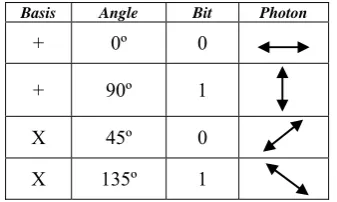
photons accordingly by polarizing them with either rectilinear (+) or diagonal (×)polarization basis as per the
[image:2.595.74.243.205.306.2]four polarization states (0º (0), 45º (0), 90º (1), 135º(1)) as shown in Table I.
Table I. Bit corresponding to basis and angle used in BB84
Basis Angle Bit Photon + 0º 0
+ 90º 1
X 45º 0
X 135º 1
2) Alice now transmit those photons to Bob and stores
the polarization of each photon.
3) By receiving a photon, Bob randomly chooses the
polarization of each photon among rectilinear or diagonal basis. Then Bob measures that photon according to the basis he guessed and records resultant bit. Bob does not know that his measurements are correct or not i.e. he measured as the same basis of Alice or not.
4) At the end of this step, Bob will get a string of
sequence (0,1).
5) Now they will start communicating over the public
channel.
B. Step 2- Communication over a public channel
1) Phase 1. Raw Key Extraction:
a) Bob sends his recorded basis publicly to Alice i.e.
the basis he used for each photon.
b) Alice compare those basis with him and tells Bob
about the correct measurements made by him through the public channel.
c) Alice and Bob both then delete all the bits for
which basis have not matched in both side.
d) After deleting all the mismatched bit, this will be
the raw key. Now, if there is any Eavesdropping, then in both side the key will not be same. Otherwise this will be same in both side and will be their final key.
2) Phase 2. Error Estimation:
Now Alice and Bob take a small portion of their raw key and compare that to check the presence of Eavesdropper and find the error-rate.
In this comparison, if Alice and Bob find no errors means no mismatch, then they will be sure that there was no eavesdropping.
If at least one error or mismatch found, then there must be an eavesdropping. In this case, they start the entire process again by discarding all the bits.
At the successful end of this phase they discard those bits they used for comparison to generate the final key, as they disclosed those bits in public.
III. PSEUDOCODEOFBB84
The pseudo code [8-9]of BB84 protocol is written below. After this, one small example is taken for better understanding of this entire algorithm and to map it with the Pseudo Code.
A. Step 1- Communication over quantum channel
Sender:
generate string r randomly from (0,1) FOR each bit from r
pick randomly from (“R”,“D”) resulting base b[i] END FOR
FOR each bit from r generate a photon
IF r[i]=0 and b[i]=R polarize the photon in state (0º) IF r[i]=1 and b[i]=R polarize the photon in state (90º) IF r[i]=0 and b[i]=D polarize the photon in state (45º) IF r[i]=1 and b[i]=D polarize the photon in state (135º) send q bit p[i] to Receiver
END FOR
Receiver:
FOR each q bit p’[i] received
generate RANDOM (“R”,“D”) results b’[i] measure q bit p’[i] in respect to base b’[i] result bit r’[i]
END FOR
B. Step 2- Communication over classical channel
1) Communication:
Receiver:
FOR each bit r’[i]
send base b’[i] to Sender END FOR
Sender:
FOR each bit r[i]
send base b[i] to Receiver END FOR
2) Raw Key Extraction:
Sender:
FOR each bit r[i] IF base b[i] ≠b’[i]
eliminate bit r[i] from string r END IF
END FOR
Receiver:
FOR each bit r’[i] IF base b’[i] ≠b[i]
eliminate bit r’[i] from string r’ END IF
3) Error Estimation: Sender and Receiver:
FOR a subset of bites randomly chosen from string r IF r’[i] = r[i] and b[i] = b’[i]
NO eavesdropping eliminate r’[i] and r[i] END IF
ELSE
Eaves dropper is present
discard all bits and start over again END ELSE
END FOR
4) Final Key:
Remaining bits in string r and r’ after successful execution of ‘IF’ block of Error Estimation is final key
C. Example
[image:3.595.37.282.333.595.2]We have taken a small example below in Fig. 1 which maps the steps of the algorithm and pseudo code as well for better understanding of this BB84 protocol.
Figure 1.Example of BB84 Protocol
IV. LIMITATIONS OF BB84PROTOCOL
BB84 Protocol has certain limitations. This protocol uses and can be applicable only with single photon sources. In photon preparation stage of this protocol, it is often established in weakening coherent states which gives a reasonable chance to Photon-Number-Splitting attack (PNS).The main loophole of this algorithm is present in the last step, The Error Estimation method, where eavesdropper cannot be detected if the number of comparing bits become small or the eavesdropper become so lucky also. If the number of bit compared in the method is small then the probability of detection of the Eavesdropper presence will be less. To provide more security, we may compare more number of bits. But it is also not a wise decision, as
Eavesdropper can easily acquire a large portion of the secret key. It may break the security of the key as Eavesdropper may guess some portion of the key with the help of that acquired information. In the proposed algorithm, these limitations are removed so that secret key can be generated and exchanged in a safer way.
V. PROPOSED ALGORITHM
In this proposed algorithm, limitations have been removed by providing two phase securities. All the initial steps of this algorithm like starting from Communication Over Quantum Channel and Photon Distribution up to Error Estimation phase are same as BB84 Protocol. This new algorithm starts after the final key generation of BB84 Protocol. All the steps should be done in both sender and receiver side. Steps of the proposed algorithm are described below:
A. Steps of Proposed Algorithm
1) Step 1- Set a value for Block Division:
We treat the finally generated key of BB84 as a Tentative Final Key in this algorithm. A tentative final key is generated at the end of Error Estimation phase. This key should be divided into blocks. At first Alice and Bob both must have to agree with a number ‘n’. Here ‘n’ defines number of bits in each block.
2) Step 2- Padding:
If the tentative final key is not completely divisible by ‘n’, then Padding is required for equally division of blocks. This padding is done starting by One (1) and then required number of Zeros (0) followed by that ‘1’. Now the updated key is divided into blocks with ‘n’ number of bits in each block.
3) Step 3- Invert the last bit of each block:
Now we will invert the last bit of each block. Inverting means, if the last bit is 0, then change that to 1 and if that is 1 then changed that to 0. This is done to create confusion to Eavesdropper. This will give the key one more level of security in the intermediate steps of key generation.
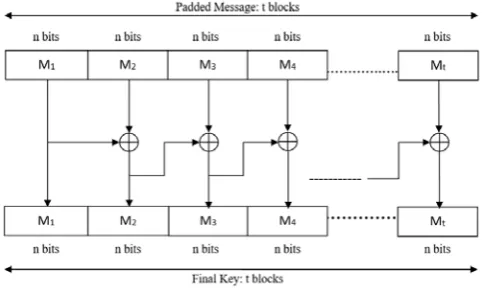
4) Step 4- XORing:
Figure 2.XORing Process
5) Step 5- Final Key generation:
Final key will be generated by sequentially put each block where the result of XORing is stored from the first one. This should be considered as a Final Key for this entire process.
B. Example
Here we are taking a short example to explain the new proposed algorithm. Suppose, tentative final key is generated at the end of Error Estimation step is:
1 0 0 1 1 1 1 0 0 0 1 0
Let the value of ‘n’ is 5.Number of bit in the tentative final key is 12. So, padding is required for the last three bits. So, after padding it will be like this:
1 0 0 1 1 1 1 0 0 0 1 0 1 0 0
Now splitting this into block. We will get 3 blocks here:
1 0 0 1 1 1 1 0 0 0 1 0 1 0 0
Now in the next step we invert the last bit of each block. Here is the result after inverting:
1 0 0 1 0 1 1 0 0 1 1 0 1 0 1
In the next step XORing is performed. First block remains same and stored into the resultant array. And We XOR the next block with the first block:
1 0 0 1 0 1 1 0 1 1 1 1 1 0 1 1 0 0 1 0
Andstore the result:
1 0 0 1 0 0 1 0 0 1
Next, we will XOR the third block with the XORing result of the second block:
1 0 0 1 0 1 1 0 1 1 1 1 1 0 1 0 1 0 0 1
Andstore the result:
1 0 0 1 0 0 1 0 0 1 1 0 1 0 0
Thus, the finally generated secret key will be:
1 0 0 1 0 0 1 0 0 1 1 0 1 0 0
C. Pseudo Code of Modified BB84 Protocol
Starting from Communication over quantum channel upto Final Key generation after Error Estimation phase, all
the steps are same as BB84 protocol. We treat the final key generated at the last step of BB84 algorithm as a Tentative Final key.
The entire process should be done in both sender and receiver side.
1) Step 1- Set a value for Block Division:
set ‘n’ as number of bit in each block let length of tentative final key is ‘i’
2) Step 2- Padding:
IF i completely divisible by n do nothing
END IF ELSE
remainder=i mod n set r[i+1] = ‘1’
set all the remaining bit as ‘0’ END ELSE
divide entire key into equal block of n bits
3) Step 3- Invert the last bit of each block:
FOR block M1 to Mt
IF Mi[last bit]= ‘0’
Mi [last bit] = ‘1’
END IF ELSE
Mi [last bit] = ‘0’
END ELSE END FOR
4) Step 4- XORing:
store M1 block directly in final key string k
FOR block M2 to Mt
XOR Mi with Mi-1
store block sequentially in string k END FOR
5) Step 5- Final Key generation:
string k will be the Final Key
D. Advantage of this modified BB84 algorithm over the existing one:
The modification is done after the last step of BB84 i.e. after Error Estimation. This means it gives guarantees against Eavesdropping as in that step the presence of Eavesdropper has already been checked and proceeds further only after there is no Eavesdropping. But there is a chance of not detecting Eavesdropper if the number of bit compared is small. So, this proposed algorithm provides securities regarding this as it changes the entire key in the last step. Even if there is an Eavesdropper who may know some portion of the key due to the discloser of bits at the time of comparisons or during the public discussion, but at last the Eavesdropper cannot be able to know the key. Thus, the modified algorithm is also providing securities against Photon-Number-Splitting attack (PNS) as at last the entire key is being modified.
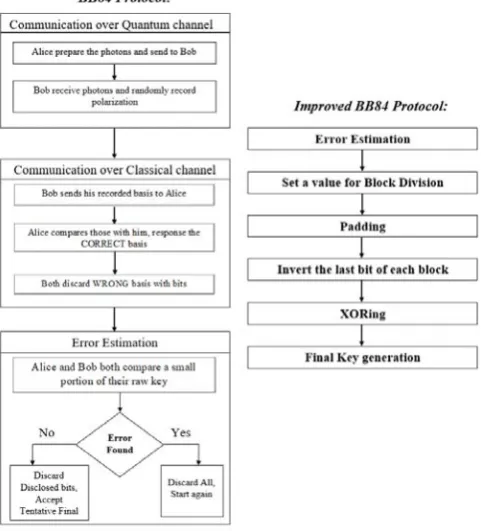
E. Flow chart
Figure 3. Flow chart of BB84 Protocol and the Improved One
VI. CONCLUSION
This paper gives a detailed analysis of BB84 protocol which is most basic and easy to implement QKD protocol. That is why we have improved this protocol. QKD is based on the quantum physics and can be thoroughly proven by generating secret keys. The modified BB84 Protocol which is described in this paper removes the limitations of the existing algorithms by adding an extra phase of security and helps to generate key securely. By this even if Eavesdropper’s presence is not detected or it may acquire a
good portion of secret key, then also the shared secret key will be secure enough to use in secret communication.
VII. REFERENCES
[1] W. Stallings, “Cryptography and Network Security: Principles and Practice”, 6th ed., Pearson Education
Inc.,2014, pp.9-12.
[2] Behrouz A Forouzan, Debdeep Mukhopadhyay, “Cryptography and Network Security”, 3rd ed., Tata
McGraw Hill Education(India) Pvt. Ltd., New Delhi, 2016. [3] N. Kaur, “Enhancement of Network Security Techniques
using Quantum Cryptography”, International Journal on Computer Science and Engineering (IJCSE), 2011.
[4] Zhao Sheng-Mei, Li Fei, and Zheng Bao-yu, “A Proof of Security of Quantum Key Distribution in Probabilistic Clone Scheme”, Communication Technology Proceedings (ICCT), vol. 2, 2003, pp. 1507-09.
[5] Miss. Payal P. Kilor, Mr. Pravin. D. Soni, “Quantum Cryptography: Realizing next generation information security”, International Journal of Application or Innovation in Engineering & Management (IJAIEM), vol.3, no. 2, February 2014.
[6] C. H. Bennett and G. Brassard, “Quantum cryptography: public key distribution and coin tossing”, Proceeding of the IEEE International Conference on Computers, Systems and Signal Processing, Bangalore, India, 1984, pp. 175-179. [7] Hitesh Singh, D.L. Gupta, A.K Singh, “Quantum Key
Distribution Protocols: A Review”, IOSR Journal of Computer Engineering (IOSR-JCE), vol. 16, no. 2, ver. XI (Mar-Apr. 2014), pp. 01-09.
[8] C. H. Bennett, F. Bassett, G. Brassard, L. Salvia, and J. Smiling, “Experimental quantum cryptography”, J. Cryptal. vol. 5, no. 1, 1992, pp. 3–28.