2016 International Conference on Mathematical, Computational and Statistical Sciences and Engineering (MCSSE 2016) ISBN: 978-1-60595-396-0
QISLSQb: A Quantum Image Steganography Scheme
Based on Least Significant Qubit
Tie-jun ZHANG
1, Bassem Abd-El-Atty
2, Mohamed Amin
2and Ahmed A. Abd El-Latif
2,*1
School of software, Harbin University of Science and Technology, Harbin, China
2
Department of Mathematics, Faculty of Science Menoufia University Shebin El-Koom 32511, Egypt
*Corresponding author
Keywords: Quantum steganography, Quantum image processing, LSQb, Image scrambling.
Abstract. In this paper, a new quantum image steganography scheme to embed quantum secrete gray image into quantum cover image is proposed. In the proposed scheme, the quantum secret image scrambled utilizing Arnold cat map and embedding the result into quantum cover image using two least significant qubit (LSQb).The extracting process need only stego image to extract the embedded secret image. The simulation results demonstrate that the proposed scheme has good invisibility and high capacity.
Introduction
Quantum steganography utilizes the effects of quantum mechanics such as quantum computation and quantum communication to achieve tasks of information hiding. Quantum steganography, can be defined as the classical steganography in the viewpoint of quantum mechanics, has become important researching area of quantum cryptography.
Quantum image steganography based on quantum image processing techniques to improve many tasks in classical image steganography. The first step is to represent and store the classical images on quantum computers. There are many representations for classical images on quantum computers, such as flexible representation of quantum images (FRQI) [1], which uses 2X + 1 number of qubits to represent a gray image with size 2x × 2x and the NEQR model for represent quantum images [2]. In spite of the used qubits of NEQR increases from 2x + 1 qubits used in FRQI to 2X + q qubits, it is excellent for processing quantum image because the quantum representation is very similar to the representation of a classical image.
In the earlier works, there is no quantum image steganography scheme to embed quantum gray image into quantum image. The quantum image steganography algorithms [3, 4] embed binary image or message as binary image with maximum capacity one bit per pixel. However, quantum image steganography algorithms [3, 4] broken to embed quantum gray image into quantum image. In [5], Wang et al. proposed an LSQb information hiding algorithm for quantum image, which embeds the secret information without scrambling into the first qubit of the cover image. Sang et al. In [6] proposed LSQb information hiding algorithm to embed quantum information into quantum color image. In [7], AL-Salhi et al. Presented a quantum image steganography algorithm based on the least significant Qu-block (LSQB). Heidari et al. In [8] proposed a Quantum watermarking technique based on least significant bit (LSB) to embed quantum binary image into cover image. In this paper, we propose a quantum image steganography scheme to embed quantum gray image instead of binary image into the quantum cover image. It utilizes NEQR for quantum representation, two LSQb and quantum image scrambling to increase the capacity and security of the proposed scheme. Experimental results demonstrate that, the maximum capacity increases from 1-bit per pixel in [3, 4, 5, 6 , 8] to 2-bit per pixel in the proposed scheme and the invisibility is good.
steganography approach. Section 4 is devoted to analysis and results in terms of visual quality and payload capacity. In section 5, we present a comparison with related algorithms. Finally, conclusions drown in section 6.
Preliminaries
NEQR for Quantum Images. The NEQR model has information about the pixels color and its related position of each pixel in the image. The mathematical representation of a quantum image for an 2n 2nimage can be expressed as follows.
2 2 1
0
1 1 0 2
1
| | |
2
| | .... , {0,1}, 1,....,1, 0, 0,1,...., 2 1
n
i n
i
q k n
i i i i
I c i
ci c c c c k q i
(1)where the binary sequence ciq 1....c ci1 0i
encodes the color value, and the color range is 2q, |i for
2
0, 1, , 2 n 1
i , are 22n
dimension computational basis quantum states.
Arnold Image Scrambling. The basic idea of image scrambling is to transform a meaningful image into a meaningless image by permutation the positions of pixels into new positions. Arnold image scrambling matrix is defined as
' ' 1 1 mod 1 2 x x y y N (2)
where N is the size of image.
The input is the position information x and y of original image, and the output is the position information x' and y' of Arnold scrambled image. The inverse of Arnold image scrambling is
defined as follows
' ' 2 1 mod 1 1 x xy y N
(3)
Zhou et al. [9] gives a quantum Arnold image scrambling that can be defined as
2 2 1 0 1 | (| | (| ) 2 n
S n i
i
I S I c S i
(4) (| )
S i can be defined according to Eq. 2 as
(| ) (| | ) (| ) (| )
S( ) =|x + y mod
S( ) =|x + 2y m |
| od
S i S y x S y S x
where
x N
y N
(5)
2 2 1 1 0, n q q i
j j i
U I X i i I j j
(6)2 2 1 0, n q j
j j i
U I j j
(7)Where 0 1
1 0
X
and
1 0
0 1
I
Proposed Quantum Image Steganography Scheme
Here, we propose a quantum image steganography scheme based on NEQR for quantum images by utilizing quantum Arnold image and two least significant qubits. We assume that the cover image
with size n n and secret image with size
2 2
n n
. The embedding procedures of the proposed
quantum image steganography consist of three phases, which are given by the following steps.
Phase 1: Preprocessing Images. Preprocessing images is given by the following steps.
Step 1: The secret image with size 2 2
n n
and 8-bit is expanded to image with size nnand 2-bit.
Step 2: The NEQR representations of the cover image and the secret image after expanding is |I
and |J, respectively are shown as follows:
2 2 1
1 1 0
0 1
| | | ,| | .... , ,
2 {0 1}
n
q k
i i i i i i
n i
I c i c c c c c
(8)2 2 1
1 0
0
1
| | | ,| | , 0,1}
2 {
n
k
j j j j j
n j
J c j c c c c
(9)Phase 2: Scrambling for Quantum Secret Image |J. The quantum secrete image |J
scrambled using Arnold transformation as follows
2 2 1 0 1 | (| | (| ) 2 n
S n j
j
J S J c S j
(10)Phase 3: Embedding Scrambled Image |JS into Cover Image |I. The quantum scrambled
image |JS embedded into quantum cover image |I utilizing two least significant qubits. The two qubits of scrambled secret image |JS color encoding information c1 and c0 in Eq. 10
compared with the two last qubits of cover image |I color encoding information c1 and c0 in
Eq. 8. If the output of comparison for c1 is the same apply Uj to I otherwise apply U1ito I
and if the output of comparison for c0 is the same apply Uj to I otherwise apply U0ito I .
2 2 1 2 0, 1 n q q i
j j i
U I X I i i I j j
(11)2 2 1 1 0, 0 n q q i
j j i
U I X i i I j j
2
2 1 0,
n
q j
j j i
U I j j
(13)Analysis and Results on Classical Computer
Visual Quality. Visual quality is the amount of difference between the stego image and the original cover image in pixels values. There are many quantities to measure the difference of pixels between the stego image and the original cover image; one of the most used quantities is PSNR (peak signal to noise ratio). It is defined as the MSE (mean squared error) for two images X and Y with size i × j.
1 1
2
0 0
1
MSE [ ( , ) ( , )]
j i
x y
X x y Y x y
ij
(14)PSNR is defined as follows.
10
MAX
PSNR 20 (
E
log )
MS X
(15)
Where, MAXX is the maximum value of pixels in the cover image X. In this scheme, Y related to the stego image and X related to the original cover image. In our experiments, we use images of size 128×128 as cover image and 64×64 as secret image to simulate the proposed scheme.
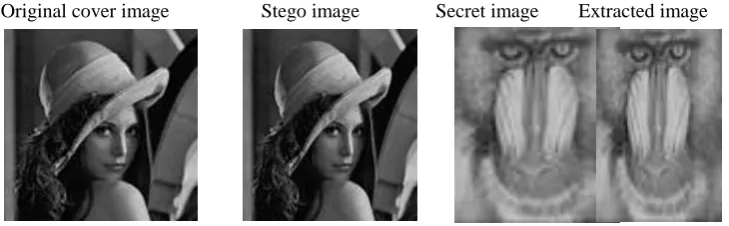
[image:4.595.124.489.639.752.2]The following Figure 1 describes experimental results of our scheme and Table 1 gives the PSNR value between the original image and the stego image for different images.
Table 1. PSNR (in dB) values for different text messages.
Cover image
Secret image Lena Baboon Barbara
Lena - 42.39 43.75
Baboon 43.33 - 44.13
Barbara 43.16 42.69 -
Obviously, from Figure 1, human eyes cannot detect the difference between stego image and original image. From Table 1, we can see that the PSNR values are high enough. So we can conclude that our scheme has a good visual effect.
Payload Capacity. The steganography capacity can be stated as the ratio between the number of embedded bits of the text message and the number of pixels for cover image. The proposed scheme's capacity is given as follows:
0.5 0.5 1
/ 4
number of embedded image pixels n n pixel
C pixel pixel
number of cover image pixels n n pixel
(16)
The capacity of the proposed scheme is 2-bit per pixel, which is higher than of most of quantum image steganography algorithms. So we can conclude that our scheme has high capacity.
Original cover image Stego image Secret image Extracted image
Comparison with Related Algorithms
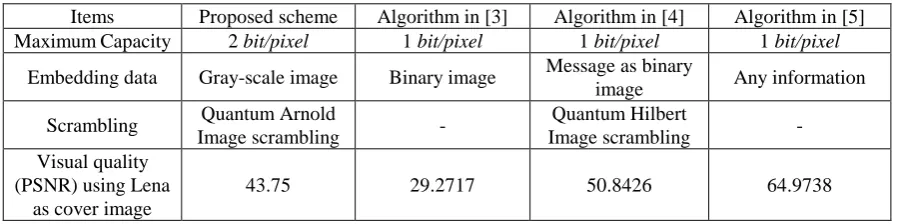
[image:5.595.74.523.184.296.2]From the above section, the simulation results demonstrate that the proposed scheme has high capacity compared to the algorithms of [3-5]. The capacity of the proposed algorithm is 2-bit per pixel, while the capacity of algorithms in [3-5] is 1-bit per pixel. From Table 2, we can conclude that the proposed algorithm has high capacity, good visual effect and embedding quantum gray image instead of binary image.
Table 2. Comparison with related algorithms.
Items Proposed scheme Algorithm in [3] Algorithm in [4] Algorithm in [5]
Maximum Capacity 2 bit/pixel 1 bit/pixel 1 bit/pixel 1 bit/pixel
Embedding data Gray-scale image Binary image Message as binary
image Any information
Scrambling Quantum Arnold
Image scrambling -
Quantum Hilbert
Image scrambling -
Visual quality (PSNR) using Lena
as cover image
43.75 29.2717 50.8426 64.9738
Conclusion
In this paper, a quantum image steganography scheme based on the novel enhanced quantum representation (NEQR) for quantum images, quantum Arnold image scrambling and two least significant qubits have been proposed. The advantages of the proposed scheme are the extracting operation does not need the original cover image or the original secret image, good visibility and high capacity. Simulation results show the efficiency of the proposed quantum image steganography scheme.
Acknowledgement
This work is supported by Menoufia University under the project number: A-WSN2016, Guangdong Natural Science Foundation: 2015A030310172 and Natural Science Foundation of Heilongjiang Province, China: QC2014C076, JJ2016ZR1068.
References
[1]P.Q. Le, F. Dong, K. Hirota, A flexible representation of quantum images for polynomial preparation, image compression and processing operations, Quantum Inf Process, 10 (2011) 63-84.
[2]Y. Zhang, K. Lu,Y.H. Gao, M. Wang, NEQR: a novel enhanced quantum representation of digital images, Quantum Inf Process, 12 (2013) 2833-2860.
[3]Nan Jiang, LuoWang, A Novel Strategy for Quantum Image Steganography Based on Moir´ePattern, Int J TheorPhys, 54 (2015) 1021-1032.
[4]Nan Jiang, Na Zhao, LuoWang, LSB Based Quantum Image Steganography Algorithm, Int J TheorPhys. 55 (2016)107-123.
[5]S. Wang, J. Sang, X. song, X. Niu, Least Significant Qubit (LSQb) Information Hiding Algorithm for Quantum Image, Measurement, 73 (2015) 352-359.
[6]J. Sang, S. Wang, Q. Li, Least significant qubit algorithm for quantum images, Quantum Inf Process. 15 (2016) 1-20.
[8]S. Heidari, M. Naseri, A Novel LSB Based Quantum Watermarking, Int J TheorPhys. 55 (2016) 4205-4218.