Journal of Computing and Security
A Weak Blind Signature Based on Quantum Key Distribution
Siavash Khodambashi
a,∗
Ali Zakerolhosseini
aaElectrical and Computer Engineering Department, Shahid Beheshti University; G.C., Tehran, Iran
A R T I C L E I N F O.
Article history:
Received:3 July 2014 Revised:1 December 2014 Accepted:17 February 2015 Published Online:28 February 2015
Keywords:
Quantum Weak Blind Signature, Quantum Key Distribution, Quantum Cryptography, Quantum Payment
A B S T R A C T
Recently, the laws of quantum physics have amazed classical cryptography and aided researchers to provide secure communications in presence of adversaries. In this paper we present a novel weak blind signature scheme whose security is guaranteed by fundamental principles of quantum physics. Despite previous schemes which are taking advantage of quantum entangled states, our proposed quantum blind signature relies only on Quantum Key Distribution (QKD) protocol. We show throughout this paper that our proposed quantum weak blind signature achieves a good position in security and reliability. In addition, it is feasible for the proposed scheme to become commercialized with current technology. Hence, it can be widely used for e-payment, e-government, e-business and etc.
c
2014 JComSec. All rights reserved.
1
Introduction
A considerable issue in cryptography is to authenticate a message the same way as a handwritten signature on a paper document would certify the originality of the document. Digital signatures are widely used to guar-antee the authenticity, integrity and non-disavowal of transmitted messages. However, standard digital sig-natures may harm the owner’s privacy due to the fact that they are not capable of protecting the anonymity of message owners.
A fundamentally new kind of signature was intro-duced by Chaum in 1983 which provided an automated payment system with some properties that were not existed with the previous digital signatures including the inability of third parties to determine payee, the ability of individuals to provide the proof of payment and the ability to stop use of the stolen payments [1]. Blind signature is a form of digital signature in which
∗ Corresponding author.
Email addresses:[email protected](S. Khodambashi),
[email protected](A. Zakerolhosseini)
ISSN: 2322-4460 c2014 JComSec. All rights reserved.
the content of a message is disguised prior to getting signed. Therefore, the signatory learns nothing about the message he signs while the user can not compute any additional signature without the help of the sig-natory. However, the produced blind signature can be publicly verified with respect to the originality of the message the same way as a regular digital signature. Blind signatures are typically employed in protocols where the signer and the message author are differ-ent parties and the anonymity of the message owner is important, such as cryptographic election systems and digital cash schemes.
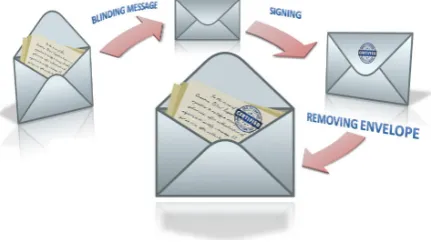
As an analogy, consider that Alice has a letter which ought to be signed by her boss,i.e. Bob. However, due to her privacy, the content of her letter should not be revealed to Bob. So, she puts the letter in an envelope lined with carbon paper and hands it to Bob. Later, Bob will sign the outside of the carbon envelope without opening it and then return it back to Alice. Alice can then open the envelope to find her signed letter, whose content is not seen by Bob.
large integers. Recently, some other blind signatures based on elliptic curves have also been proposed in [2] and [3]. In fact, all of the classical blind signatures are based on the computational complexities and their security is guaranteed mathematically and by con-sidering the limited computational power of classical computers. Hence, they are safe with the classical processors. But unfortunately, they are vulnerable to quantum computers. Quantum parallelism can solve some complex problems, e.g. the factoring problem and the discrete logarithm problem, much faster than the classical computers [4–6]. Hence, researchers have shown great interest in quantum methods which are secure even against quantum processors.
For the first time, a quantum signature was intro-duced by Zeng et al. in 2001 [7]. Zeng’s quantum signature was taking advantage of the correlation of quantum entangled states. In that year, Gottesman and Chuang [8] proposed a quantum one-way function and introduced their quantum digital signature. Al-though the early mentioned quantum signatures fulfill unconditional security and message authenticity, they can not achieve message blindness.
The idea of quantum blind signature was originally proposed by Wen et al. [9] in 2009. There would not be a unique blind signature for a blind message in Wen’s quantum weak blind signature and so the ver-ifier would not be able to authenticate the message half of the times as criticized by Naseri [10] and Su et. al. [11]. Hence, Wen’s scheme does not adequately complete the task of blind signature. Subsequently, Su proposed a quantum blind signature based on the two-state vector formalism to overcome the deficiency of Wen’s signature. Their protocol seemed practical because the signatory and the message owner have to perform only measurement operations to complete the signature’s process [11]. Nevertheless, Yang et. al. pointed out that a dishonest signatory in Su’s scheme can reveal both the message owner’s secret key and the message without being detected using Trojan horse attack or the fake photon attack [12]. A modified scheme was then proposed by Yang et. al. to avoid these kinds of attacks [12]. But Yang’s protocol also had a loophole that Alice could utilize an entangle-ment swapping attack to obtain Bob’s secret key and forge Bob’s valid signature at will [13]. Later, a ses-sional blind signature based on quantum entangled states was proposed by Khodambashi and Zakerolhos-seini in 2014 [14]. Their proposed scheme is reliable and secure against quantum attacks including Trojan horse attacks and so on. It also fulfills the ideal blind signature requirements, e.g., blindness, non-disavowal and no-counterfeiting. All mentioned schemes employ Einstain-Podolskey-Rosen (EPR) entangled pairs in the signing process. Although it is feasible to
imple-ment entangled pairs with current technology, there exist some limitations in their usage for real applica-tions. Hence, a quantum blind signature which does not rely on quantum entanglement is of interest.
In this paper we present a quantum blind signature based on Quantum Key Distribution (QKD) protocol. Our proposed scheme uses QKD for safe transfer of classical data and unlike classical methods it does not rely on computational complexities. Since the security of QKD has been proved in [15], therefore our proposed scheme is unconditionally secure and efficient. Furthermore, QKD has been commercialized in recent years by several corporations around the world [16, 17]. Hence, it is possible to easily realize our proposed quantum weak blind signature.
The rest of the paper is organized as follows: in Section2, blind signature types and their properties are addressed. Section 3 reviews QKD protocol in brief. The proposed quantum blind signature scheme is presented in Section4. In Section5, the security of the proposed quantum blind signature is analyzed. At last, Section6concludes the paper.
2
Blind signature requirements
There are three parties in a blind signature protocol: the message owner Alice, who requests for an endorse-ment, the signatory Bob, who confirms the message by signing it and the verifier Charlie, who checks the authenticity of the message. In a classical blind signa-ture, a message needs to pass a three-step procedure in order to be effective as illustrated in Figure1. At first, Alice blinds her message and gives it to Bob who is the signatory. Bob confirms Alice’s message by signing it blindly. Thus, he knows nothing about the message and returns the signed message back to Alice. Subsequently, Alice removes the blinding factor from the signed message while preserving the signa-ture. Later, she can deliver her message to the verifier Charlie who checks the validity of the signed message.
Figure 1. Classic blind signature process
ini-tially proposed by David Chaum in 1983, there have been many efforts to construct blind signature schemes. They lend themselves to electronic commerce, elec-tronic cash, elecelec-tronic voting and anonymous access control systems. In some cases, the security of the blind signatures is considered at the moment when the signatory signs the message. So it does not matter whether a blind signature remains anonymous later, when it is presented to the signatory since he can store the signature parameters of all signed messages. On the other side, it is required for some applications that the generated blind signature remains anonymous at the time of verification by the signatory. This new aspect leads to a classification of blind signatures.
It is possible to distinguish two classes of blind signatures depending on the strength of anonymity given by the signature:
(a) Weak blind signatures in which there exists a relation between the blind signature parameters and the message. Therefore, the signatory can store the signature parameters to identify the owner of the message at a later time. This fact can be beneficial in some applications e.g. e-payment and e-commerce in order to prevent yeggmen and launderers.
(b) Strong blind signatures in which the signatory will not recognize the owner of the message even if he stores the signature parameters while he signs the message, so that the signature is totally anonymous. Many applications take advantage of this ultimate anonymity e.g. electronic voting where the identity of voters has to be unknown. Generally speaking, there are four main character-istics for blind signatures listed as follows:
(a) Blindness, the scheme should be blindi.e.the signatory should not be able to read the message as he signs it.
(b) Anonymity, the owner of the message must re-main anonymous in strong blind signatures, so that the signatory can not trace the message owner.
(c) Originality, no one can counterfeit a legitimate signature generated by a certified signatory. (d) Non-refusal, the signatory can not disavow his
signature.
In weak blind signatures, it is possible for a signa-tory to trace the owner of the message when disagree-ment happens. Hence, the second characteristic is only limited to strong blind signatures. Like classical cryp-tography, quantum blind signatures are also required to have above characteristics.
3
Quantum key distribution overview
A secret key establishment between two spatially sep-arated parties is of immediate interest for practical cryptographic applications such as secure message transmission. We consider a setting where two distant parties, traditionally called Alice and Bob, want to establish a common secret keyi.e.a string of random bits which is unknown to an adversary, Eve. We as-sume that Alice and Bob already have some means to exchange classical messages authenticallyi.e., upon receiving a message, Bob can verify whether the mes-sage was indeed sent by Alice, and vice-versa. In fact, only relatively weak resources are needed to turn a completely insecure communication channel into an authentic channel. For instance, Alice and Bob might invoke an authentication protocol presented in [18,19] for which they need a short initial key. Practically, it is sufficient for Alice and Bob to start with only weakly correlated and partially secret information instead of a short secret key as indicated in [20,21].
The information-theoretic security which is actually the strongest reasonable notion of security, guaran-tees that an adversary does not get any information correlated to the key, except with negligible proba-bility, in contrast to computational security which is time-consuming for an adversary but not impossible. It is impractical for Alice and Bob to share a secret key if they are only connected by a classical authentic communication channel [22,23]. The story changes dramatically with the help of quantum mechanics.
Bennett and Brassard[24,25] proposed a quantum key distribution (QKD) for the first time. Their scheme is well-known as BB84 and uses communication over a completely insecure quantum channel in addition to the classical authentic channel. QKD is generally based on the fact that observing a quantum mechanical system would change its state. An eavesdropper trying to wiretap the quantum communication between Alice and Bob would thus inevitably leave traces which can be detected. Thus, as long as the adversary is passive, QKD generates a secret key. On the condition that the eavesdropper tampers with the quantum channel, the attack is recognized by the protocol and the computation of the secret key is aborted. Note that this situation is actually the best that one can hope for. Due to insecurity of the quantum channel, an adversary might always interrupt the quantum communication between Alice and Bob, in which case it is impossible to share a secret key. For any attack on the quantum channel, the probability that QKD does not abort and the adversary gets information about the generated key is negligible[15].
quan-tum mathematics. The basic unit of information in quantum physics is called qubit. Like a bit, a qubit can also be in one of two states, we call|0iand|1i. In quantum theory an object enclosed by the notation| i
can be called astate,vectoror aket. In contrast to a bit, a qubit can also exist in a superposition statei.e.
|ψi=α|0i+β|1i. Here,αandβare complex numbers. While a qubit can exist in a superposition, whenever we make a measurement on a qubit, it is only going to be found in the state|0ior the state|1i.
Consider a quantum system with quantum states lying in a two dimensional Hilbert spaceH. For this space, there are many orthonormal bases. We only use two for our proposed qucheck protocol, the rectilinear basis{|0i,|1i}and the diagonal basis|±i. Hence, there are four quantum states with these two bases |0i,
|1i, |+i= |0i+|1i√
2 and |−i= |0i−|1i√
2 . The bases are maximally conjugate in the sense that any pair of vectors, one from each basis, has the same overlap, e.g.kh0|−ik2=1
2. Conventionally, one attributes the binary value ‘0’ to states|0iand|+iand the value ‘1’ to the other two states,i.e.,|1iand|−i, and calls the states qubits.
Assume that the system is in the state |+i = |0i+|1i
√
2 . We make a measurement in the rectilinear ba-sis {|0i,|1i}, and the original state of the system is lost. Suppose we obtain measurement result|0i. Then in the|±ibasis, the state is now different than it was originally since|0i= |+i+|−i√
2 and there is only a 50% chance of finding|+iif we measure in the|±ibasis. Hence, the state has been irreversibly altered. This example illustrates a fact in quantum physics that taking a measurement with incompatible basis would unavoidably perturb the system and yield incomplete information about the state of the system before the measurement.
QKD uses an encoding of binary bits in qubitsi.e.
two-level quantum systems. This encoding regards to one of two different orthogonal bases, called the rectilinear and the diagonal basis. Because these two bases are mutually unbiased, a measurement in one of the bases reveals no information on a bit encoded with other basis. This property of quantum mechan-ics makes quantum cryptography advantageous over classical cryptography which gets help only from lim-ited computational power of classical processors. QKD protocol is described as follows:
Step1: Alice generates n random qubitsx1, . . . , xn
either in the rectilinear or the diagonal basis and transmits them to Bob through a quantum channel.
Step2: Bob measures each of the qubits he receives with respect to the basis chosen randomly to
ob-tain binary valuesy1, . . . , yn. The pair of binary
stringsX = (x1, . . . , xn) andY = (y1, . . . , yn)
held by Alice and Bob are called raw key. Step3: Alice and Bob announce their chosen bases
publicly and discard any bit of their raw key for which the encoding and the measurement bases are not compatible. The remained key is called sifted key.
Step4: Alice and Bob compare some randomly chosen set of bits of the sifted key in order to estimate the error ratei.e.the fraction of positionsiin which xi and yi disagree. If the error rate is
high, Alice and Bob abort the protocol due to the possibility of an eavesdropper corrupting the transmitted qubits. At the end of this step, they discard all bits they have compared and preserve the remaining bits (X0 andY0). Step5: Alice sends certain error correcting
informa-tion onX0 to Bob. It allows Bob to guess X0
with the aid ofY0. Note that X0 andY0 only differ in a limited number of positions.
Step6: Alice and Bob use an agreed hashing to turn the stringX0 into a shorter but secure string. Hence, they have a shared secret key. This step is called privacy amplification.
The security of the BB84 protocol is based on the fact that an eavesdropper cannot gain information about the encoded bits without disturbing the qubits sent over the quantum channel. If the disturbance is too large, Alice and Bob will abort the protocol in the error estimation step. On the other hand, if the error rate is below a certain threshold, then the strings
X0 and Y0 held by Alice and Bob are sufficiently correlated and secret in order to distill a secret key. In the course of this research, a large variety of alternative QKD protocols has been proposed. Some of them are very efficient with respect to the number of key bits generated per channel use [26,27]. Others are designed to cope with high channel noise or noise in the detector, which lends themselves to practical implementations [28]. The structure of these protocols is mostly very similar to the BB84 protocol e.g. [26,27,29].
4
The proposed quantum blind
signa-ture
We describe our quantum blind signature in details throughout this section by giving a feasible instance. Assume a situation involving three parties: the re-quester Alice, the manager Bob and the attendant Charlie. Alice is going to receive some services from Charlie. However, she requires Bob’s authorization first. Alice writes down her request in the form of an
Hence, she gets her message signed blindly by Bob in order to make it certified. Finally, Charlie verifies the signature of Alice’s message and provides her the services that she requested on the condition that the signature is valid.
This scenario exhibits one of the applications of our proposed quantum blind signature. Here, we describe all steps of the quantum blind signature consisting of four phases:
4.1 Requesting a session
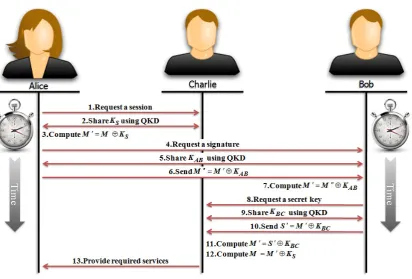
Step1: Charlie and Alice agree on an n-bit binary secret keyKS using QKD at the moment that
Alice makes a request for some services from Charlie. Note thatKS is completely a random
binary string.
Step2: Alice forms her message, M which is an n -bit binary string containing her request. It is assumed that Alice can fit her request in ann -bit string.
4.2 Blinding the message
Step1: Alice uses exclusive OR to transform message
M intoM0 =M ⊕KS. Due to the randomness
of KS, retrieval ofM without knowing KS is
impossible.
4.3 Signing the blind message
Step1: Alice and Bob agree on ann-bit secret key
KAB using QKD.KABis completely random.
Step2: Alice combines her blind message M0 with
KAB using XOR to formM”=M
0
⊕KAB and
sends it to Bob through classical channel using one-time pad protocol.
Step3: Bob receivesM”and use XOR to restoreM0 =
M”⊕K
AB.
Step4: Bob and Charlie share ann-bit random secret keyKBC by applying QKD protocol.
Step5: Bob uses XOR to transform the blind message
M0 into the blind signature S0 = M0 ⊕KBC
which is ann-bit string.
4.4 Verification
Step1: Charlie receives blind signatureS0 from Bob and retrieves blind message M0 by applying XOR, so thatM0 =S0⊕KBC.
Step2: Charlie removes blinding factor to recover orig-inal message by using XOR asM =M0⊕KS.
Hence, Charlie can read Alice’s messageM and provide the requested services.
It is remarkable to note that Alice, Bob and Charlie, as participants in this protocol, use authentication
pro-tocols to identify themselves when performing QKD. Otherwise, any adversary can impersonate them and take advantage of his misbehavior. The procedure of our proposed scheme is illustrated in Figure2. The main goal of our proposed protocol is similar to the ones in [9,11,12,14],i.e.presenting a quantum weak blind signature. Nevertheless, the weak blind signature proposed here only takes advantage of QKD which makes it easier for implementation. We suggest the use of modified QKD protocol in [15].
5
Security analysis
The security of our proposed quantum blind signature is discussed throughout this section. We show that our scheme fulfills all the requirements that an ideal blind signature needs to have including blindness, no-counterfeiting and no-disavowing. The security of the scheme is analyzed in presence of adversaries equipped with quantum technology. We also consider situations in which one or more of the parties may behave ma-liciously and prove that the proposed scheme is still secure.
5.1 Quantum attack failure
Assume an eavesdropper called Eve who has knowledge of our proposed quantum blind signature. Due to the no-cloning theorem [30], it is impossible for Eve to make a perfect copy of a qubit without knowing the basis in which it has initially been created. Hence, eavesdropping can not be done while two parties in the protocol are transferring qubits using QKD since it can be detected by the protocol. This fact has been proved in [15]. From this statement, it can be inferred that Eve is not capable of gaining proper information of the transferred qubits, so she can neither discover the messageM nor the blind signatureS0. This scheme is also secure against intercept-resend and man-in-the-middle attacks due to the unconditional security of both QKD and one-time pad protocols [31].
5.2 No-counterfeiting
Imagine that Charlie is not honest and tries to tamper the message or the blind signature by taking advan-tage of secret keysKS andKBC to get some benefit.
Figure 2. The proposed quantum blind signature protocol
Alice. All data exchanges in the scheme are carried out through QKD and one-time pad protocols, so that no one can eavesdrop or counterfeit the data.
5.3 Blindness
When Alice requests a session from Charlie, they agree on a secret key KS which is completely a random
binary string. No one except them has knowledge of
KS. Alice makes her message illegible using XORi.e. M0 =M⊕KS. Due to the randomness ofKS, it is
impossible for Bob to discover the original messageM
without knowingKS, still with a quantum processor.
Hence, only Alice and Charlie can remove the blinding factor of the message.
5.4 Non-disavowal
The verifier, Charlie receives the blind signatureS0
from Bob, encrypted with secret keyKBC which is
only known to them both. Hence, Bob can not deny his ownership of the blind signature. Similarly, Alice is not able to disavow her messageM due toKS.
5.5 Reliability
QKD protocol and XOR binary operator are only used throughout our proposed quantum weak blind signature. Hence, There is a bit-to-bit correspondence between the blind message and the blind signature in
the scheme which can be verified precisely meaning that the verifier Charlie can testify the signature bit by bit in order to confirm the integrity of both message and the blind signature. Hence it is useful for electronic payment or access control systems. In other words, our proposed quantum blind signature is reliable.
5.6 Comparison
In Wen’s quantum weak blind signature [9], Char-lie can decisively confirm theith bit of the message whenm(i) =Kbc2i−1. However, he knows nothing when
m(i)6= Kbc2i−1. Due to the randomness of Kbc, this
situation happens half the times in a bit-to-bit ver-ification process. Therefore, Wen’s scheme does not lend itself to delicate applications in which high relia-bility is required. This criticism has also been applied by Naseri in [10].
Despite the schemes in [9, 11, 12, 14] which use EPR entangled pairs, our proposed approach uses only QKD and one-time pad protocols together to provide an unconditional secure quantum weak blind signature which is simpler to be implemented. Different types of QKD protocols, as the quantum part of our proposed scheme for generation of fully random shared keys, have been suggested and the security of some of them have been verified in [15]. Hence, our proposed quan-tum weak blind signature is secure against quanquan-tum attacks. Moreover, there is a bit-to-bit correspondence between the blind message and the blind signature in the scheme due to one-time pad protocol. Hence, it can be derived that the proposed protocol is highly reliable and lends itself to many sensitive applications.
6
Conclusion
In this paper, we introduced a novel weak blind signa-ture whose security is guaranteed by quantum physics. The scheme takes advantage of Quantum Key Distri-bution (QKD) in order to provide security for data exchange. To the best of our knowledge, QKD has been commercialized in recent years by several corpo-rations [16,17,32,33]. Thus, our scheme can be truly employed in some applications e.g. electronic payment, access control systems and etc.. Although the message content is invisible to the signatory, it is correlated to the blind signature. Hence, the signatory can trace the owner of the message when a disagreement hap-pens. This is useful in some applications including e-payment to prevent yeggmen and launderers.
References
[1] David Chaum. Blind signatures for untraceable payments. InAdvances in cryptology, pages 199– 203. Springer, 1983.
[2] Morteza Nikooghadam and Ali Zakerolhosseini. An efficient blind signature scheme based on the elliptic curve discrete logarithm problem. ISe-Cure, 1(2), 2009.
[3] Morteza Nikooghadam, Ali Zakerolhosseini, and Mohsen Ebrahimi Moghaddam. Efficient utiliza-tion of elliptic curve cryptosystem for hierarchical access control. Journal of Systems and Software, 83(10):1917–1929, 2010.
[4] Michael A Nielsen and Isaac L Chuang. Quan-tum computation and quanQuan-tum information. Cam-bridge university press, 2010.
[5] Charles H Bennett and David P DiVincenzo. Quantum information and computation. Nature, 404(6775):247–255, 2000.
[6] A Galindo and Miguel Angelo Martin-Delgado. Information and computation: Classical and
quantum aspects. Reviews of Modern Physics, 74 (2):347, 2002.
[7] Guihua Zeng, Wenping Ma, Xinmei Wang, and Hong-wen Zhu. Signature scheme based on quan-tum cryptography. Acta Electronica Sinica, 29 (8):1098–1100, 2001.
[8] Daniel Gottesman and Isaac Chuang. Quan-tum digital signatures. arXiv preprint quant-ph/0105032, 2001.
[9] Xiaojun Wen, Xiamu Niu, Liping Ji, and Yuan Tian. A weak blind signature scheme based on quantum cryptography. Optics Communications, 282(4):666–669, 2009.
[10] Mosayeb Naseri. A weak blind signature based on quantum cryptography.International Journal of Physical Sciences, 6(21):5051–5053, 2011. [11] Su Qi, Huang Zheng, Wen Qiaoyan, and Li
Wen-min. Quantum blind signature based on two-state vector formalism. Optics Communications, 283 (21):4408–4410, 2010.
[12] Chun-Wei Yang, Tzonelih Hwang, and Yi-Ping Luo. Enhancement on “quantum blind sig-nature based on two-state vector formalism”.
Quantum Information Processing, 12(1):109– 117, 2013. ISSN 1570-0755. doi: 10.1007/ s11128-012-0362-2. URLhttp://dx.doi.org/ 10.1007/s11128-012-0362-2.
[13] Qi Su and Wen-Min Li. Cryptanalysis of enhancement on “quantum blind signa-ture based on two-state vector formalism”.
Quantum Information Processing, 13(5):1245– 1254, 2014. ISSN 1570-0755. doi: 10.1007/ s11128-013-0722-6. URLhttp://dx.doi.org/ 10.1007/s11128-013-0722-6.
[14] Siavash Khodambashi and Ali Zakerolhosseini. A sessional blind signature based on quantum cryptography. Quantum information processing, 13(1):121–130, 2014.
[15] R. Renner.Security of Quantum Key Distribution. PhD thesis, PhD Thesis, 2005, 2005.
[16] www.idquantique.com, Sep. 2014. URL www. idquantique.com.
[17] www.magiqtech.com, Sep. 2014. URL www. magiqtech.com.
[18] Douglas R. Stinson. Universal hashing and au-thentication codes. In Joan Feigenbaum, editor,
Advances in Cryptology - CRYPTO ’91, 11th An-nual International Cryptology Conference, Santa Barbara, California, USA, August 11-15, 1991, Proceedings, volume 576 ofLecture Notes in Com-puter Science, pages 74–85. Springer, 1991. doi: 10.1007/3-540-46766-1 5. URLhttp://dx.doi. org/10.1007/3-540-46766-1_5.
13th Annual International Cryptology Conference, Santa Barbara, California, USA, August 22-26, 1993, Proceedings, volume 773 ofLecture Notes in Computer Science, pages 355–367. Springer, 1993. doi: 10.1007/3-540-48329-2 30. URLhttp: //dx.doi.org/10.1007/3-540-48329-2_30. [20] Renato Renner and Stefan Wolf. Unconditional
authenticity and privacy from an arbitrarily weak secret. InAdvances in Cryptology-CRYPTO 2003, pages 78–95. Springer, 2003.
[21] Renato Renner and Stefan Wolf. The exact price for unconditionally secure asymmetric cryptogra-phy. InAdvances in Cryptology-EUROCRYPT 2004, pages 109–125. Springer, 2004.
[22] Claude E Shannon. Communication theory of secrecy systems*. Bell system technical journal, 28(4):656–715, 1949.
[23] Ueli M Maurer. Secret key agreement by public discussion from common information. Informa-tion Theory, IEEE TransacInforma-tions on, 39(3):733– 742, 1993.
[24] C.H. Bennett and G. Brassard. Quantum cryptog-raphy: Public-key distribution and coin tossing. In Computers, Systems and Signal Processing, 1984. IEEE Conference on, page 8. IEEE, 1984. [25] Stephen Wiesner. Conjugate coding.ACM Sigact
News, 15(1):78–88, 1983.
[26] Dagmar Bruß. Optimal eavesdropping in quan-tum cryptography with six states. Physical Re-view Letters, 81(14):3018, 1998.
[27] Helle Bechmann-Pasquinucci and Nicolas Gisin. Incoherent and coherent eavesdropping in the six-state protocol of quantum cryptography.Physical Review A, 59(6):4238, 1999.
[28] Valerio Scarani, Antonio Acin, Gr´egoire Ribordy, and Nicolas Gisin. Quantum cryptography pro-tocols robust against photon number splitting at-tacks for weak laser pulse implementations. Phys-ical Review Letters, 92(5):057901, 2004.
[29] Charles H Bennett. Quantum cryptography using any two nonorthogonal states. Physical Review Letters, 68(21):3121, 1992.
[30] William K Wootters and Wojciech H Zurek. A single quantum cannot be cloned. Nature, 1982. [31] Vishnu Teja, Payel Banerjee, NN Sharma, and RK Mittal. Quantum cryptography: state-of-art, challenges and future perspectives. In Nanotech-nology, 2007. IEEE-NANO 2007. 7th IEEE Con-ference on, pages 1296–1301. IEEE, 2007. [32] Tobias Schmitt-Manderbach, Henning Weier,
Martin F¨urst, Rupert Ursin, Felix Tiefenbacher, Thomas Scheidl, Josep Perdigues, Zoran Sodnik, Christian Kurtsiefer, John G Rarity, et al. Exper-imental demonstration of free-space decoy-state quantum key distribution over 144 km. Physical Review Letters, 98(1):010504, 2007.
[33] Damien Stucki, Nino Walenta, Fabien Vannel, Robert Thomas Thew, Nicolas Gisin, Hugo Zbinden, S Gray, CR Towery, and S Ten. High rate, long-distance quantum key distribution over 250 km of ultra low loss fibres. New Journal of Physics, 11(7):075003, 2009.
Siavash Khodambashireceived the BSc de-gree from university of Isfahan, Iran, in 2008, MSc from the Shahid Beheshti University, Iran, in 2010, and currently he is a PhD stu-dent in computer architecture in the depart-ment of Electrical and Computer Engineering at Shahid Beheshti University, Iran. His re-search focuses on quantum cryptography under Supervisory of Dr. Ali Zakerolhosseini. His current research interests are quantum computing, Cryptography and Network Security.