Simple but effective feedback generation to tutor abstract problem solving
Xin Lu, Barbara Di Eugenio, Stellan Ohlsson and Davide Fossati University of Illinois at Chicago
Chicago, IL 60607, USA [email protected]
bdieugen,stellan,[email protected]
Abstract
To generate natural language feedback for an intelligent tutoring system, we developed a simple planning model with a distinguishing feature: its plan operators are derived auto-matically, on the basis of the association rules mined from our tutorial dialog corpus. Auto-matically mined rules are also used for real-ization. We evaluated 5 different versions of a system that tutors on an abstract sequence learning task. The version that uses our plan-ning framework is significantly more effective than the other four versions. We compared this version to the human tutors we employed in our tutorial dialogs, with intriguing results.
1 Introduction
Intelligent Tutoring Systems (ITSs) are software systems that provide individualized instruction, like human tutors do in one-on-one tutoring sessions. Whereas ITSs have been shown to be effective in engendering learning gains, they still are not equiv-alent to human tutors. Hence, many researchers are exploring Natural Language (NL) as the key to bridging the gap between human tutors and current ITSs. A few results are now available, that show that ITS with relatively sophisticated language interfaces are more effective than some other competitive con-dition (Graesser et al., 2004; Litman et al., 2006; Evens and Michael, 2006; Kumar et al., 2006; Van-Lehn et al., 2007; Di Eugenio et al., 2008). Ascer-taining which specific features of the NL interaction are responsible for learning still remains an open re-search question.
In our experiments, we contrasted the richness with which human tutors respond to student ac-tions with poorer forms of providing feedback, e.g.
only graphical. Our study starts exploring the role thatpositivefeedback plays in tutoring and in ITSs. While it has long been observed that most tutors tend to avoid direct negative feedback, e.g. (Fox, 1993; Moore et al., 2004), ITSs mostly provide negative feedback, as they react to student errors.
In this paper, we will first briefly describe our tu-torial dialog collection. We will then present the planning architecture that underlies our feedback generator. Even if our ITS does not currently al-low for student input, our generation architecture is inspired by state-of-the art tutorial dialog manage-ment (Freedman, 2000; Jordan et al., 2001; Zinn et al., 2002). One limitation of these approaches is that plan operators are difficult to maintain and extend, partly because they are manually defined and tuned. Crucially, our plan operators are automatically de-rived via the association rules mined from our cor-pus. Finally, we will devote a substantial amount of space to evaluation. Our work is among the first to show not only that a more sophisticated language interface results in more learning, but that it favor-ably compares with human tutors. Full details on our work can be found in (Lu, 2007).
2 Task and curriculum
Tutor Moves Answerstudent’s questions Evaluatestudent’s actions Summarizewhat done so far Promptstudent into activity Diagnosewhat student is doing Instruct
Demonstratehow to solve (portions of) problem Support– Encourage student
Conversation– Acknowledgments, small talk Student Moves
Question
Explainwhat student said or did Reflect– Evaluate own understanding Answertutor’s question
Action Response– Perform non-linguistic action (e.g. write letter down)
Completetutor’s utterance
Conversation– Acknowledgments, small talk
Table 1: Tutor and student moves
post-test problems, each 15 letter long: subjects (all from the psychology subject pool) haven trials to extrapolate each pattern, always starting from a dif-ferent letter (n = 6 in the human conditions, and n = 10 in the ITS conditions). While the ear-lier example was kept simple for illustrative pur-poses, our patterns become very complex. Start-ing e.g. from the letter L, we invite the reader to extrapolate problem 9 in our curriculum: BDDFF-FCCEEGGGC, or the second test problem: ACZD-BYYDFXGEWWGI.1
3 Human dialogs
Three tutors – one expert, one novice, and one (the lecturer) experienced in teaching, but not in one-on-one tutoring – were videotaped as they in-teracted with 11 subjects each.2 A repeated mea-sures ANOVA, followed by post-hoc tests, revealed that students with the expert tutor performed signifi-cantly better than the students with the other two tu-tors on both test problems (p <0.05in both cases).
36 dialog excerpts were transcribed, taken from
1
The solutions are, respectively: LNNPPPMMOOQQQM, andLNZOMYYOQXRPWWRT.
2
One goal of ours was to ascertain whether expert tutors are indeed more effective than non-expert tutors, not at all a fore-gone conclusion since very few studies have contrasted expert and non expert tutors, e.g. (Glass et al., 1999).
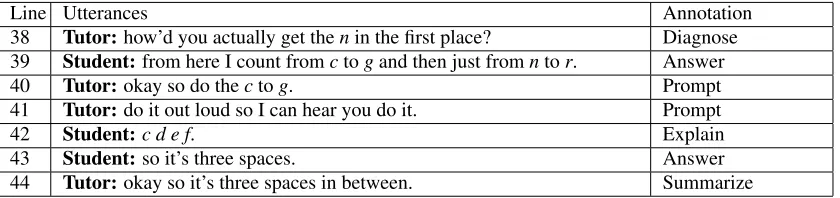
18 different subjects (6 per tutor), for a total of about 2600 tutor utterances and 660 student ut-terances (transcription guidelines were taken from (MacWhinney, 2000)). For each subject, these two dialog excerpts cover the whole interaction with the tutor on one easy and one difficult problem (# 2 and 9 respectively). 2 groups of 2 coders each, annotated half of the transcripts each, with dialogue moves. Our move inventory comprises 9 tutor moves and 7 student moves, as listed in Table 1.3 Table 2 presents an annotated fragment from one of the di-alogues with the expert tutor. Kappa measures for intercoder agreement had values in the following ranges, according to the scale in (Rietveld and van Hout, 1993): for tutor moves, from moderate (0.4
forSupport) to excellent (0.82forPrompt); for stu-dent moves, from substantial (0.64forExplanation) to excellent (0.82 for Question, 0.97 for ActionRe-sponse). Whereas some of these Kappa measures are lower than what we had strived for, we decided to nonetheless use the move inventory in its entirety, after the coders reconciled their codings. In fact, our ultimate evaluation measure concerns learning, and indeed the ITS version that uses that entire move in-ventory engenders the most learning. Please see (Lu et al., 2007) for a detailed analysis of these dialogs and for a discussion of differences among the tutors in terms of tutor and student moves.
The transcripts were further annotated by one coder for tutor attitude (whether the tutor agrees with the student’s response –positive,negative, neu-tral), for correctness of student move and for stu-dent confidence (positive, negative, neutral). Stu-dent hesitation time (long, medium, short) was es-timated by the transcribers. Additionally, we an-notated for the problem features under discussion. Of the 8 possible relationships between letters, most relevant to the examples discussed in this paper are
forward, backward, progressionandmarker. E.g. in ABMCDM, M functions as chunkmarker, and the sequence moves forward by one step, both within
one chunk andacrosschunks.Withinandacrossare two out of 4relationship scopes, which encode the coverage of a particular relationship within the se-quence.
3
Line Utterances Annotation 38 Tutor:how’d you actually get thenin the first place? Diagnose 39 Student:from here I count fromctogand then just fromntor. Answer
40 Tutor:okay so do thectog. Prompt
41 Tutor:do it out loud so I can hear you do it. Prompt
42 Student:c d e f. Explain
43 Student:so it’s three spaces. Answer
[image:3.612.97.517.71.170.2]44 Tutor:okay so it’s three spaces in between. Summarize
Table 2: An annotated fragment from a dialogue with the expert tutor
4 Learning rules to provide feedback
Once the corpus was annotated, we mined the ex-pert tutor portion via Classification based on Associ-ations (CBA) (Liu et al., 1998). CBA generates un-derstandable rules and has been effectively applied to various domains. CBA finds all rules that exist in the data, which is especially important for small training sets such as ours.
To modularize what the rules should learn, we de-composed what the tutor should do into two com-ponents pertaining to content: letter relationship and relationship scope; and two components pertaining to how to deliver that content: tutor move and tutor attitude. Hence, we derived 4 sets of tutorial rules. Features used in the rules are those annotated on the tutoring dialogs, plus the student’s Knowledge State (KS) on each type of letter relationship rel, com-puted as follows:
KS(rel) =bp×0.5 +w
t ×5c (1)
pis the number of partially correct student inputs,w is the number of wrong student inputs andtis the to-tal number of student inputs (“inputs” here are only those relevant to the relationship rel, as logged by the ITS from the beginning of the session).KS(rel)
ranges from 0 to 5. The higher the value, the worse the performance onrel. The scale of 5 was chosen to result in just enough values for KS(rel) to be use-ful for classification.
We ran experiments with different lengths of dia-log history, but using only the last utterance gave us the best results. Three of the four rule sets have ac-curacies between 88 and 90% (results are based on 6-way cross-validation, and the cardinality of each set of rules is in the low hundreds. ). Whereas the tutor move rule set only has 57% accuracy, as for some of the low Kappa values mentioned earlier, our
relation-marker = No, relation-forward = Yes, student-move = ActionResponse
→relation-forward = Yes
(Confidence = 100%, Support = 4.396%) correctness = wrong, scope-within = No, KS(backward) = 0, relation-forward = Yes
→tutor-move = Summarize
(Confidence = 100%, Support = 6.983%)
correctness = wrong, relation-forward = Yes, KS(forward) = 1, hesitation = no
→tutor-attitude = negative
[image:3.612.321.531.210.363.2](Confidence = 100%, Support = 1.130%)
Figure 1: Example Tutorial Rules
ultimate evaluation measure is that the NL feedback based on these rules does improve learning.
Figure 1 shows three example rules, for choosing relationship, move and attitude respectively – we’ll discuss two of them. The first rule predicts that the ITS will continue focusing on theforward relation, if it was focusing onforwardand not onmarker, and the student just input something. The second rule chooses thesummarizemove if the student made a mistake, the ITS was focusing onforwardbut not on relationships within chunks, and the student showed perfect knowledge ofbackward.
Two strength measurements are associated with each rule X → y. A rule holds with confidence
For each Tut-Move-RuleT M Ri,kwhose Left-Hand Side LHS matchesISido:
1. Create and Populate New Planpi,k:
(a) preconditions=ISi;actions= tutor move fromT M Ri,k;strength= confidence and support fromT M Ri,k
(b) Fill remaining slots inpi,k:
i. contents= relationship∪scope (from highest ranked rules that matchISifrom relationship and scope
rule sets);
ii. modifiers= attitude (from highest ranked rule that matchesISifrom tutor attitude rule set)
2. Augment Plan:do the followingntimes :
(a) make copy ofISiand name itISi+1;
(b) changeagentto “tutor”;
(c) change corresponding elements inISi+1to move, attitude, letter relationship and scope frompi,k;
(d) from the two rule sets for tutor move and tutor attitude, retrieve highest ranked rules that matchISi+1,
T M Ri+1,j andT ARi+1,j
(e) add toactionstutor move fromT M Ri+1,j; add tomodifierstutor attitude fromT ARi+1,j
Figure 2: Plan generation
5 From rules to plans
For our task of extrapolating abstract sequences, we built a model-tracing ITS by means of the Tutoring Development Kit (TDK) (Koedinger et al., 2003). Model-tracing ITSs codify cognitive skills via pro-duction rules. The student’s solution is monitored by rules that fire according to the underlying model. When the student steps differ from that model, an error is recognized. A portion of the student inter-face of the ITS is shown in Figure 4a. It mainly in-cludes two rows, one showing theExample Pattern, the other for the student to input the New Pattern
extrapolated starting with the letter in the first cell. In model-tracing ITSs, production rules provide the capability to generate simple template-based messages. We developed a more sophisticated NL feedback generator consisting of three major mod-ules: update, planning and feedback realization.
The update module maintains the context, rep-resented by the Information State (IS) (Larsson and Traum, 2000), which captures the overall dia-log context and interfaces with external knowledge sources (e.g., curriculum, tutorial rules) and the pro-duction rule system. As the student performs a new action, the IS is updated. The planning module gen-erates or revises the system plan and selects the next tutoring move based on the newly updated IS. At last the feedback realization module transforms this move into NL feedback.
The planning moduleconsists of three compo-nents, plan generation, plan selection and plan mon-itoring. A plan includes an ordered collection of tu-toring moves meant to help the student correctly fill a single cell. The structure of our plans is shown in Figure 3.
Plan generation generates a plan set which con-tains one plan for each tutor move rule that matches the currentISi. Each of these plans is augmented at
plan generation time by ‘simulating’ the nextISi+1
that would result if the move is executed but its ef-fects are not achieved. The algorithm is sketched in Figure 2. The planner iterates through thetutor moverule set.4 Recall that our four rule sets are to-tally ordered. Also, note that each rule set contains a default rule that fires when no rule matches the cur-rentISi. In Step 1b, at every iterationonlythe rules
that have not been checked yet from those three rule sets are considered. In Step 2,nis set to 3, i.e., each plan contains 3 additional moves and corresponding attitudes, which will provide hints when no response from the student occurs. Three hints plus one orig-inal move makes 4, which is the average number of moves in one turn of the expert tutor.
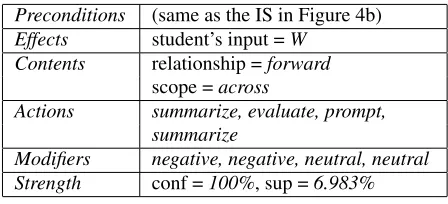
An example plan is shown in Figure 3. It is gen-erated in reaction to the mistake in Figure 4a, and by
4
Preconditions (same as the IS in Figure 4b)
Effects student’s input =W
Contents relationship =forward
scope =across
Actions summarize, evaluate, prompt,
summarize
Modifiers negative, negative, neutral, neutral
[image:5.612.73.297.70.172.2]Strength conf =100%, sup =6.983%
Figure 3: An Example Plan
[image:5.612.325.534.73.150.2]firing, among others, the rules in Figure 1. The IS in Figure 4b reflects some of the history of this interac-tion (in the slotsRelationships, Scopesand KS), and as such corresponds to the situation depicted in Fig-ure 4a in a specific context (this plan was generated in one of our user experiments).
The plan selection component retrieves the high-est ranked plan in the newly generated plan set, se-lects a template for each tutoring move in its “Ac-tions” slot and puts each tutoring move onto the di-alog move (DM) stack. Earlier we mentioned that rules are totally ordered according to confidence, then support and finally rule generation order. When a plan set contains more than one plan, plans are also totally ordered, since they inherit strength mea-surements from the rule that engenders the first tutor move in theActionsslot.
After the student receives the message which realizes the top tutoring move in the DM stack, plan monitoring checks whether its intended effects have been obtained. If the effects have not been ob-tained, and the student’s input is unchanged, the next move from the DM stack will be executed to pro-vide the student with hint messages until either the student’s input changes or the DM stack becomes empty. If the DM stack becomes empty, the next plan is selected from the original plan set and the tutoring moves within that plan are pushed onto the DM stack. Whenever the student’s input changes, or after every plan in the plan set has been selected, control returns to plan generation.
The realization module. A tutor move is pushed onto the DM stack by plan selection together with a template to realize it. 50 templates were writ-ten manually upon inspection of the expert tutor di-alogs. Since several templates can realize each tutor move, we used CBA to learn rules to choose among templates. Features used to learn when to use each
(a) A Student Action in Problem 4
1. Agent:student(producer of current move);
2. Relationships:forward,progress in length
3. Scopes: across (for ‘forward’), within (for ‘progress in length’);
4. Agent’s move:action response;
5. Agent’s attitude: positive(since student shows no hesitation before inputting letter);
6. Correctness:wrong(correct letter isW);
7. Student’s input:X;
8. Student’s selection: 4th cell inNew Patternrow;
9. Hesitation time:no;
10. Student’s knowledge state (KS): 1 (on “for-ward”),3(on “progress in length”).
(b) The corresponding IS
Figure 4: A snapshot of an ITS interaction
template also include the tutor attitude. For the first
Summarizemove in the plan in Figure 3, given the IS in Figure 4b, the rule in Fig. 5 will fire (tutor at-titude does not affect this specific rule). As a result, the following feedback message is generated: “From
VtoX, you are going forward 2 in the alphabet.”
6 Evaluation
To demonstrate the utility of our feedback genera-tor, we developed five different versions of our ITS, named according to how feedback is generated:
1. No feedback: The ITS only provides the basic interface, so that subjects can practice solving the 13 problems in the curriculum, but does not provide any kind of feedback.
2. Color only: The ITS provides graphic feed-back by turning the input green if it is correct or red if it is wrong.
scope-within = No, relation-marker = No, relation-forward = Yes, move= Summarize →
template = TPL11
[image:6.612.327.525.71.167.2][where TPL11: From ”<reference-pattern>” to ”<input>”, you are going <input-relation> <input-number>in the alphabet.]
Figure 5: Example Realization Rule
ITS provides feedback messages when the in-put is wrong.
4. Positive: In addition to the color feedback, the ITS provides feedback messages when the in-put is correct.
5. Model: In addition to the color feedback, the ITS provides feedback messages generated by the feedback generator just described.
Feedback is given for each input letter. Positive and negative verbal feedback messages are given out whenever the student’s input is correct or incor-rect, respectively. Positive feedback messages con-firm the correct input and explain the relationships which this input is involved in. Negative feedback messages flag the incorrect input and deliver hints. The feedback messages for the “negative” and “pos-itive” versions were developed earlier in the project, to avoid repetitions and inspired by the expert tu-tor’s language but before we performed any anno-tation and mining. They are directly generated by TDK production rules.
Although in reality positive and negative feedback are both present in tutoring sessions, one study for the letter pattern task shows that positive/negative feedback, given independently, perform different functions (Corrigan-Halpern and Ohlsson, 2002). In addition, ournegativecondition is meant to embody the “classical” model-tracing ITS, that only reacts to student errors. Hence, in our experiments, we elected to keep these two types of feedback separate, other than in the “model” version of the ITS.
To evaluate the five versions of the ITS, we ran a between-subjects study in which each group of sub-jects interacted with one version of the system. A group of control subjects took the post-test with no training at all but only read a short description of the
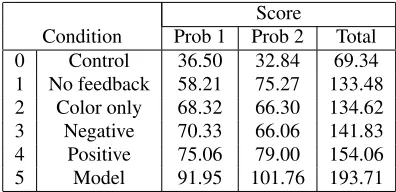
Score
Condition Prob 1 Prob 2 Total 0 Control 36.50 32.84 69.34 1 No feedback 58.21 75.27 133.48 2 Color only 68.32 66.30 134.62 3 Negative 70.33 66.06 141.83 4 Positive 75.06 79.00 154.06 5 Model 91.95 101.76 193.71
Table 3: Average Post-test Scores of the ITS
domain.5 Subjects were trained to solve the same 13 problems in the curriculum that were used in the human tutoring condition. They also did the same post-test (2 problems, each pattern 15 letters long). For each post-test problem, each subject had 10 tri-als, where each trial started with a new letter.
6.1 Results
Table 3 reports the average post-test scores of the six groups of subjects, corresponding to the five ver-sions of the ITS and the control condition. Perfor-mance on each problem is measured by the number of correct letters out of a total of 150 letters (15 let-ters by 10 trials); hence, cumulative post-test score, is the number of correct letters out of 300 possible.
A note before we proceed. In ITS research it is common to administer the same test before (pre-test) and after treatment (post-test), but we only have the post-test. The pre/post-test paradigm is used for two reasons. First, for evaluation proper, to gauge learn-ing gains. Second, to verify that the groups have the same level of pre-tutoring ability, as shown when the pre-tests of the different groups are statistically in-distinguishable, and hence, that they can be rightly compared. Even without a pre-test we can assess this. An ANOVA on “time spent on the first 3 prob-lems” revealed no significant differences across the different groups. Since time spent on the first 3 prob-lems is highly correlated with post-test score (multi-ple regression, p<0.03), this provides indirect evi-dence that all subjects before treatment have equiva-lent ability for this task. Hence, we can trust that our evaluation, in terms of absolute scores, does reveal differences between conditions.
Our main findings are based on one-way ANOVAs, followed by Tukey post-hoc tests:
5
• Amain effectof ITS (p≤0.05). Subjects who interacted with any version of the ITS had sig-nificantly higher total post-test scores than sub-jects in the control condition.
• Amain effectof modeled feedback (p<0.05). Subjects who interacted with the “model” ver-sion of the ITS had significantly higher total post-test scores than control subjects, and sub-jects with any other version of the ITS.
• No other effects. Subjects trained by the three versions “color only”, “negative”, “positive”, did not have significantly higher total post-test scores than subjects with the “no feedback” version; neither did subjects trained by the two versions “negative”, “positive”, wrt subjects with the “color-only” version.
If we examine individual problems, the same pat-tern of results hold, other than, interestingly, the
modelandpositiveversions are not significantly dif-ferent any more. As customary, we also analyze ef-fect sizes, i.e., how muchmoresubjects learn with the ‘model’ ITS in comparison to the other condi-tions. On the Y axis, Figure 6 shows Cohen’sd, a common measure of effect size. Each point repre-sents the difference between the means of the scores in the ’model’ ITS and in one of the other condi-tion, divided by the standard deviation of either con-dition. According to (Cohen, 1988), the effect sizes shown in Figure 6 are large as concerns the compari-son with the “no feedback”, “color only” and “nega-tive” conditions, and moderate as concerns the “pos-itive” condition.6
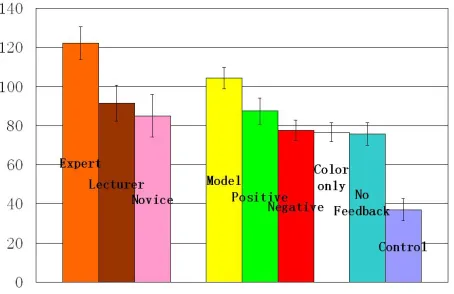
ITSs and Human Tutors. After we established that, at least cumulatively, the “model” ITS is more effective than the other ITSs, we wanted to assess how well the “model” ITS fares in comparison to the expert tutor it is modeled on. Since in the human data each post-test problem consists of only 6 trials, the first 6 trials per problem from the ITSs are used to run this comparison, for a maximum total score of 180 (15 letters by 6 trials, by 2 problems). Fig-ure 7 shows the overall post-test performance of all 9 conditions. The error bars in the figure represent the standard deviations.
6
[image:7.612.318.546.73.226.2]A very large effect size with respect to control is not shown in Figure 6.
Figure 6: Effect sizes: how much more subjects learn with the “model” ITS
Figure 7: Post-test performance – all conditions
Paired t-tests between the model ITS and each of the human tutors show that:7
• on problem 1, the ‘model’ ITS is indistinguish-able from the expert tutor, and is significantly better than the novice and the lecturer
(p= 0.05andp= 0.039respectively);
• on problem 2, the model ITS is significantly worse than the expert tutor (p = 0.020), and is not different from the other two tutors;
• cumulatively, there are no significant differ-ences between the ‘model’ ITS and any of the three human tutors.
[image:7.612.319.546.283.430.2]7 Discussion and Conclusions
Our results add to the growing body of evidence that language feedback engenders more learning not only than simple practice, but also, than less sophis-ticated language feedback. Importantly, our ‘model’ ITS appears intriguingly close to our expert tutor in effectiveness: on post-test problem 1, it is as effec-tive as the expert tutor himself, and significantly bet-ter than the other two tutors, as the expert tutor is. It appears our ‘model’ ITS does capture at least some features of successful tutoring.
As concerns the specific language the ITS gen-erates, we compared different ways of providing verbal feedback. A subject receives both positive and negative verbal feedback when interacting with the “model” version, while a subject receives only one type of verbal feedback when interacting with the “positive” and “negative” versions (recall that in all these versions including the “model” ITS the red/green graphical feedback is provided on every input). While we cannot draw definite conclusions regarding the functions of positive and negative feedback, since the ‘model’ version provides other tutorial moves beyond positive / negative feedback, we have suggestive evidence that negative feedback by itself is not as effective. Additionally, positive feedback appears to play an important role. First, the ‘model’ and the ‘positive’ versions are statisti-cally equivalent when we analyze performance on individual problems. Further, in the “model” ver-sion, the ratio of positive to negative messages turns out to be 9 to 1. In our tutoring dialogs, positive feedback still outnumbers negative feedback, but by a lower margin, 4 to 1. We hypothesize that convey-ing a positive attitude in an ITS is perhaps even more important than in human tutoring since a human has many more ways of conveying subtle shades of ap-proval and disapap-proval.
From the NLG point of view, we have presented a simple generation architecture that turns out to be rather effective. Among its clear limitations are the lack of hierarchical planning, and the fact that dif-ferent components of a plan are generated indepen-dently one from the other. Among its strengths are that the plan operators are derived automatically via the rules we mined, both for content planning and, partly, for realization.
It clearly remains to be seen whether our NLG
framework can easily be ported to other domains – the issue is not domain dependence, but whether a more complex domain will require some form of hierarchical planning. We are now working in the domain of Computer Science data structures and al-gorithms, where we continue exploring the role of positive feedback. We collected data with two tu-tors in that domain, and there again, we found that in the human data positive feedback occurs about 8 times more often than negative feedback. We are now annotating the data to mine it as we did here, and developing the core ITS.
Acknowledgments
This work was supported by awards N00014-00-1-0640 and N00014-07-1-0040 from the Office of Naval Research, by Campus Research Board S02 and S03 awards from the University of Illinois at Chicago, and in part, by awards IIS 0133123 and ALT 0536968 from the National Science Founda-tion.
References
J. Cohen. 1988. Statistical power analysis for the be-havioral sciences (2nd ed.). Hillsdale, NJ: Lawrence Earlbaum Associates.
Andrew Corrigan-Halpern and Stellan Ohlsson. 2002. Feedback effects in the acquisition of a hierarchical skill. InProceedings of the 24th Annual Conference of the Cognitive Science Society.
Barbara Di Eugenio, Davide Fossati, Susan Haller, Dan Yu, and Michael Glass. 2008. Be brief, and they shall learn: Generating concise language feedback for a computer tutor. International Journal of AI in Edu-cation, 18(4). To appear.
Martha W. Evens and Joel A. Michael. 2006. One-on-one Tutoring by Humans and Machines. Mahwah, NJ: Lawrence Erlbaum Associates.
Barbara A. Fox. 1993. The Human Tutorial Dialogue Project: Issues in the design of instructional systems. Lawrence Erlbaum Associates, Hillsdale, NJ.
Reva K. Freedman. 2000. Plan-based dialogue manage-ment in a physics tutor. InProceedings of the Sixth Applied Natural Language Conference, Seattle, WA, May.
Arthur C. Graesser, S. Lu, G.T. Jackson, H. Mitchell, M. Ventura, A. Olney, and M.M. Louwerse. 2004. AutoTutor: A tutor with dialogue in natural language.
Behavioral Research Methods, Instruments, and Com-puters, 36:180–193.
Pamela Jordan, Carolyn Penstein Ros´e, and Kurt Van-Lehn. 2001. Tools for authoring tutorial dialogue knowledge. InProceedings of AI in Education 2001 Conference.
Kenneth R. Koedinger, Vincent Aleven, and Neil T. Hef-fernan. 2003. Toward a rapid development environ-ment for cognitive tutors. In12th Annual Conference on Behavior Representation in Modeling and Simula-tion.
K. Kotovsky and H. Simon. 1973. Empirical tests of a theory of human acquisition of information-processing analysis. British Journal of Psychology, 61:243–257. Rohit Kumar, Carolyn P. Ros´e, Vincent Aleven, Ana
Igle-sias, and Allen Robinson. 2006. Evaluating the Ef-fectiveness of Tutorial Dialogue Instruction in an Ex-ploratory Learning Context. In Proceedings of the Seventh International Conference on Intelligent Tutor-ing Systems, Jhongli, Taiwan, June.
Staffan Larsson and David R. Traum. 2000. Information state and dialogue management in the trindi dialogue move engine toolkit. Natural Language Engineering, 6(3-4):323–340.
Diane J. Litman, Carolyn P. Ros´e, Kate Forbes-Riley, Kurt VanLehn, Dumisizwe Bhembe, and Scott Silli-man. 2006. Spoken versus typed human and computer dialogue tutoring. International Journal of Artificial Intelligence in Education, 16:145–170.
Bing Liu, Wynne Hsu, and Yiming Ma. 1998. Inte-grating classification and association rule mining. In
Knowledge Discovery and Data Mining, pages 80–86, New York, August.
Xin Lu, Barbara Di Eugenio, Trina Kershaw, Stellan Ohlsson, and Andrew Corrigan-Halpern. 2007. Ex-pert vs. non-exEx-pert tutoring: Dialogue moves, in-teraction patterns and multi-utterance turns. In CI-CLING07, Proceedings of the 8th International Con-ference on Intelligent Text Processing and Computa-tional Linguistics, pages 456–467. Best Student Paper Award.
Xin Lu. 2007. Expert tutoring and natural language feedback in intelligent tutoring systems. Ph.D. thesis, University of Illinois - Chicago.
Brian MacWhinney. 2000. The CHILDES project. Tools for analyzing talk: Transcription Format and
Pro-grams, volume 1. Lawrence Erlbaum, Mahwah, NJ,
third edition.
Johanna D. Moore, Kaska Porayska-Pomsta, Sebastian Varges, and Claus Zinn. 2004. Generating Tutorial Feedback with Affect. In FLAIRS04, Proceedings of the Seventeenth International Florida Artificial Intel-ligence Research Society Conference.
Timothy J. Nokes and Stellan Ohlsson. 2005. Compar-ing multiple paths to mastery: What is learned? Cog-nitive Science, 29:769–796.
Jonathan Reed and Peder Johnson. 1994. Assessing im-plicit learning with indirect tests: Determining what is learned about sequence structure. Journal of Exper-imental Psychology: Learning, Memory, and Cogni-tion, 20(3):585–594.
Toni Rietveld and Roeland van Hout. 1993. Statistical Techniques for the Study of Language and Language Behaviour. Mouton de Gruyter, Berlin - New York. Kurt VanLehn, Arthur C. Graesser, G. Tanner Jackson,
Pamela W. Jordan, Andrew Olney, and Carolyn P. Ros´e. 2007. When are tutorial dialogues more effec-tive than reading? Cognitive Science, 31(1):3–62. Claus Zinn, Johanna D. Moore, and Mark G. Core. 2002.