ABSTRACT
CARROLL, ANDREA DORIA. Novice Principals’ Perceptions Regarding the Utilization of Support Systems. (Under the direction of Dr. Lance Fusarelli).
This qualitative study used a single-case study methodology to investigate (a) how six
novice elementary-school principals were supported during their participation in a one-year, unstructured, pilot principal mentoring program, and (b) the novice principals’ perceptions of the support they received during their first three years in the principal role. This study
enabled the participants to articulate their experiences authentically and enabled the
researcher to explore how well the program aligned with and supported the specific needs of
each novice principal. The literature demonstrates that a comprehensive and systematic support program is needed for beginning principals because of the shortage of qualified principals and the difficulty of socialization into the role of principal. The findings of this
study indicated that in order for novice principals to become effectively socialized into their roles, they needed support in various forms, such as peer networking, supervisor support, and
professional development programming. Unexpectedly, the study found that the interrelationship of such support systems appeared to be just as beneficial to novice principals, if not more so, than mentoring programs.
The findings have practical implications for principals, school districts, universities, and state departments of education. School districts can consider implementing their own
pilot mentor programs and non-traditional mentoring opportunities for novice principals; universities can develop partnerships with local school districts; and state departments of education can provide professional development for all novice principals. Future research can
by
Andrea Doria Carroll
A dissertation submitted to the Graduate Faculty of North Carolina State University
in partial fulfillment of the requirements for the Degree of
Doctor of Education
Educational Administration and Supervision
Raleigh, North Carolina 2015
APPROVED BY:
___________________________ __________________________ Dr. Lance D. Fusarelli Dr. Bonnie C. Fusarelli Committee Chair
DEDICATION
I dedicate this dissertation to my mom, Beulah M. Roberson (deceased), for her love of education, her strength, and determination to make sure I received what life would not
BIOGRAPHY
Andrea Doria Carroll was born in Windsor, North Carolina. She later resided in Washington, N.C., as a sharecropper’s daughter. She is a high school graduate of
Washington High School in Washington, N.C. Andrea attended East Carolina University in Greenville, N.C. where she received her Bachelor of Arts degree in Elementary Education and a Masters in Educational Administration. She worked as a first and third grade teacher in
the Washington City Schools System, Washington, N.C. She became an assistant principal for Washington City Schools System and later principal for Beaufort County School System
in Beaufort, N.C. prior to the merging of the two systems. Thirteen years ago, Andrea migrated to Durham, North Carolina where she first became principal at a year-round elementary school and later completed her career as a principal at a traditional elementary
school.
After retirement, Andrea decided to complete her final degree at North Carolina State
University and explore other educational opportunities through contracted positions within Durham Public Schools. Although she has served in various educational capacities, her passion is working with novice principals. Andrea remembered how difficult her beginning
years as a principal had been. Had it not been for a retired principal who came to her rescue, she probably would have thrown in the towel and become another educational statistic. She
ACKNOWLEDGEMENTS
I would like to thank my husband, Earl C. Carroll, for his love, support, and
encouragement during this process. He never doubted my ability to fulfill my dream. A
heart-felt appreciation goes out to my children and tech geeks, Tori, Christol, and Corey. Whenever I called out for help, my kids always came to my rescue. I love them for their relentless devotion to the cause. A special thank you goes to my faithful dog, Sweetie, who
stayed by my side and kept me company in the wee hours of the morning.
I am greatly indebted to my supportive administrative team, co-workers, family, and
friends who held me up and encouraged me in countless ways when I wanted to give up. A special thank you and congratulations goes to Eunice Sanders, my dissertation sister and cohort partner in this great adventure and journey. The labor pains were difficult and
sometimes downright hard but we finally delivered this baby. We did it!
I am also appreciative of the nurturing support that I received from my dissertation
committee chair, Dr. Lance Fusarelli, and the staff of professors from North Carolina State University’s educational leadership program. I would like to thank the dissertation committee members and the participants of this study for volunteering their service and time. I will
never forget everyone’s dedication in aiding me in my quest to obtain this degree.
Above all, I give praises and appreciation to God for giving me the strength to endure
TABLE OF CONTENTS
LIST OF TABLES ... viii
LIST OF FIGURES ... ix
CHAPTER 1. INTRODUCTION ... 1
Background ... 1
Statement of the Problem ... 5
Conceptual Framework ... 7
Purpose of the Study ... 11
Research Questions ... 12
Definitions of Key Terms ... 12
Significance of the Study ... 15
Delimitations, Limitations, Assumptions, and Subjectivity ... 19
Organization of the Study ... 22
CHAPTER 2. LITERATURE REVIEW ... 24
History and Definitions of Mentorship ... 24
Mentoring versus Coaching ... 26
Benefits to the Protégé ... 34
Advantages of Mentoring Programs ... 39
Benefits for Mentors ... 39
Benefits for School Districts ... 40
Mentoring Problems ... 42
Success in Mentorship ... 47
Effective Mentors ... 47
Effective Mentoring Programs ... 49
Trends in Mentoring and Coaching ... 52
Mentoring as Socialization ... 54
Summary ... 55
CHAPTER 3. METHODOLOGY ... 58
Nature of the Inquiry ... 59
Research Site ... 61
Population and Sampling ... 63
Data Collection Methods ... 64
Data Analysis and Emerging Themes ... 69
Protection of Human Subjects ... 70
Credibility, Validity, and Positionality ... 71
CHAPTER 4. FINDINGS ... 74
Results of Principal Needs Assessment Survey ... 74
Overview of Participants ... 77
Participant 1: Mrs. Romo (Cowboy Elementary) ... 85
Meaningful Dialogue Between Novice Principal and Supporters ... 87
Socialization to the Principal Role ... 88
Perceptions of Various Form of Support ... 88
Participant 2: Mrs. Newton (Panther Elementary) ... 91
Different Forms of Leadership Support for Novice Principals ... 92
Meaningful Dialogue Between Novice Principal and Supporters ... 93
Socialization to the Principal Role ... 94
Perceptions of Various Forms of Support ... 95
Participant 3: Mrs. Vick (Eagle Elementary) ... 98
Different Forms of Leadership Support for Novice Principals ... 98
Meaningful Dialogue Between Novice Principal and Supporters ... 101
Socialization to the Principal Role ... 101
Perceptions of Various Form of Support ... 102
Participant 4: Mrs. Smith (Chief Elementary) ... 106
Different Forms of Leadership Support for Novice Principals ... 106
Meaningful Dialogue Between Novice Principal and Supporters ... 109
Socialization to the Role of Principal ... 110
Perceptions of Various Form of Support ... 111
Participant 5: Mrs. Manning (Bronco Elementary) ... 114
Different Forms of Leadership Support for Novice Principals ... 114
Meaningful Dialogue Between Novice Principal and Supporters ... 118
Socialization to the Role of Principal ... 118
Perceptions Of Various Form Of Support ... 119
Participant 6: Mrs. Rodgers (Packer Elementary) ... 123
Different Forms of Leadership Support for Novice Principals ... 123
Meaningful Dialogue Between Novice Principal and Supporters ... 125
Socialization to the Role of Principal ... 126
Perceptions of Various Form of Support ... 127
Summary of the Findings ... 129
Chapter Summary ... 138
CHAPTER 5. DISCUSSION ... 139
Different Forms of Leadership Support for Novice Principals ... 140
Meaningful Dialogue between Novice Principal and Supporters ... 146
Socialization To The Principal Role ... 147
Implications for Practice ... 150
Recommendations for Further Study ... 154
Conclusion ... 154
REFERENCES ... 156
APPENDICES ... 168
APPENDIX A Pre-Interview Survey ... 169
APPENDIX B Informed Consent Form for Research ... 171
LIST OF TABLES
Table 2.1 Differences between Mentoring and Coaching……………….28
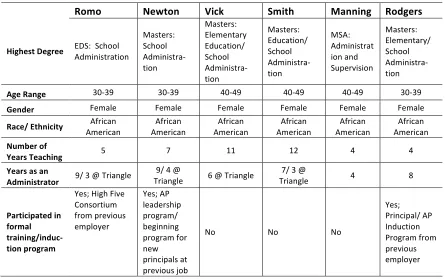
Table 4.1 Participant Demographics ... 78
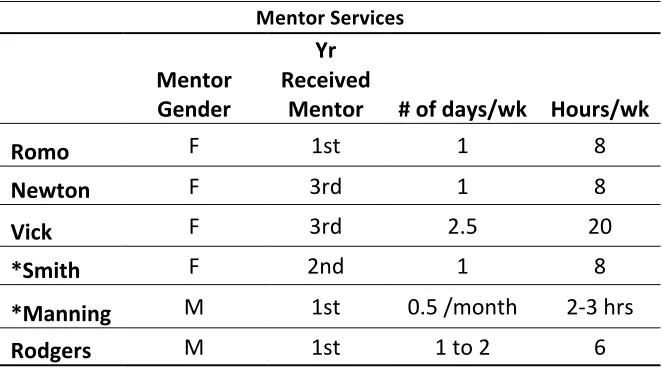
Table 4.2 Mentor Services ... 131
LIST OF FIGURES
CHAPTER 1 INTRODUCTION
Background
The role of the principal has changed drastically over the past 15 years, from manager to instructional leader (Levine, 2005). Confrontational parents, educational public policy and accountability, state education reform, No Child Left Behind legislation, and recent revisions
to the Individuals with Disabilities Education Act have greatly altered the focus, role, and responsibilities of principals. These new roles and pressures have overwhelmed principals,
especially newcomers to the role of principal. As effective leadership has been linked to student achievement, and with an expected principal shortage of 40% within the next decade, school districts are being forced to look to new methods of induction and retention
(Leithwood, Seashore-Louis, Anderson & Wahlstrom, 2004; Seashore-Louis, Leithwood, Wahlstrom, & Anderson, 2010; The Education Alliance of Brown University, 2003).
Therefore, the need for preparing principals for their leadership role is imperative. Leadership is considered second only to classroom instruction among all school-related factors that contribute to student learning (Anderson, 1991; Leithwood et al., 2004).
According to a Carnegie Foundation study, the most effective way to prepare and support principals in their leadership careers is to provide a mentoring program. Mentor
There is a sense of urgency to find qualified applicants for principalships due to
record student enrollment, combined with the estimated 40% of principals preparing to retire in the next decade. The pool of qualified applicants is quickly shrinking (Malone, 2001).
Ironically, education itself does not seem to be the limiting factor in the principal shortage, since nearly half of the nation’s public school teachers have earned advanced degrees. Few of these teachers have expressed a desire to become principals due to the demands of the job.
This drives school systems to call on retired, veteran school leaders to become mentors to those who will be entrusted with our schools and students (Blackman & Fenwick, 2000).
Mentoring gets its name from Homer’s Odyssey. Odysseus, before leavingfor Troy, entrusted his son to a wise friend, Mentor. Mentor served not only as a counselor to the prince during Odysseus’ twenty-year absence, but also as guardian and guide. By no means
did Mentor replace the parental role of Odysseus. The task of the mentor is to define a unique relationship with his or her protégé and fulfill a need unmet by any other relationship
(Samier, 2000). The best mentors are teachers/sages who act to the best of their ability within plain sight of the protégé and who engage in a compassionate and mutual search for wisdom (Bell, 1996).
Although mentoring has existed for thousands of years, it is only in the last thirty years that mentor-protégé relationships in educational administration have received
increasing academic attention and professional interest (Samier, 2000). “Principals have traditionally been thrown into their jobs without a lifejacket, and they are expected to sink or swim,” according to Mark Anderson, former principal and researcher (The Education
“fully frontloaded with skills and knowledge needed to perform their job duties” (Bodger,
2011, p. 23). Their portfolio usually consists of the traditionally required university preparation, training, and licensing program with updated skills and knowledge through
district level staff development with no systematic plan (Ryland, 2005; Villani, 2006;
Wardlow, 2008). According to Leithwood, Aitken, and Jantzi (2006), today’s principals have six forms of leadership required of them: instructional, transformational, moral, participative,
managerial, and contingent leadership. The novice is expected to learn how to apply each one on his or her own without the support or guidance of mentors, coaches, or staff development.
Research provides evidence “that school leaders, throughout all stages of their careers, can benefit from a mentoring system in which seasoned leaders help the protégé place theory and practice in the context of experience” (Malone, 2001, p. 2). Malone
contended that studies show that graduate training alone does not translate into excellently led schools. Studies also indicated that when professional development includes a mentor, the
novice principal’s level of effectiveness is higher and tends to last throughout his or her career.
Mentoring new employees has been an age-old tradition for various professions.
Private industry has widely studied the benefits of mentoring their employees for years. The mentoring of teachers has also been well established, but just recently the concept of
mentoring of school leaders has begun to flourish (Alsbury & Hackman, 2006). There has been a tremendous growth in the adoption of formalized mentoring programs for beginning principals since the 1980s (Brown, 2005; Daresh, 2004; Lashway, 2002, 2003b; Villani,
2003a; Villani, 2006) and the fact that new principals often welcomed the support that
mentoring programs offer (Lashway, 2002, 2003a).
Daresh’s research (2004) described practices, limitations, problems, and benefits of
mentoring programs as an induction method for new principals. Daresh (1995) identified some of the benefits of mentoring for the novice principal as being better communication, reduction in the feeling of isolation, and increased confidence and competency.
Browne-Ferrigno and Muth’s (2004) study of the Principals for Excellence Program, a partnership between a Kentucky University and school district, indicated some other major benefits, such
as the development of collegial relationships with peers, opportunities to problem solve, the development of close networking between school leaders, contributions to the building of leadership capacity within the school district, encouragement and recruitment of teacher
leaders, and the partnership between universities and school districts. Both researchers concluded that the mentoring program benefited the employee and the organization
(Browne-Ferrigno & Muth, 2004; Daresh, 2004).
Another group of researchers sought to identify the benefits of mentoring as a socialization method for new principals. By completing a meta-analysis of mentoring
programs in over 300 studies in the fields of education, business, and medicine, they found wide variations in mentoring programs in terms of structure, mentor training procedures,
mentor assignments, and the location and frequency of mentor–mentee contact (Ehrich, Hansford, & Tennent, 2004). Similar to other researchers (Browne-Ferrigno & Muth, 2004; Daresh, 2004; Lashway, 2002), Ehrich et al. (2004) found that mentees generally accepted
empathy, and encouragement. The challenges that the study identified to mentoring programs
were insufficient time and the difficulty of matching mentors and mentees; however, the authors concluded that the benefits of mentoring programs outweighed the challenges. Ehrich
et al. (2004) concluded that “mentoring is a highly complex, dynamic, and interpersonal relationship that requires, at the very least, time, interest, and commitment of mentors and mentees and strong support from educational or organizational leaders responsible for
overseeing the programs” (p. 533).
Statement of the Problem
The problem addressed in this study is the “lack of systematic, comprehensive support and induction programs” for new school principals (Bodger, 2011, p. 4). Barth (1990) argued that novice principals are expected to assume a very difficult, complex, and
demanding job with little or no support. To sustain the success and results and meet the challenges of diverse communities, all school leaders require support and ongoing staff
development throughout their careers, especially inexperienced new leaders who are in the first years of their profession (Ganter, Daresh, Dunlap, & Newsom, 1999). According to the Educational Alliance of Brown University (2003), “Educators are beginning to recognize
that, given the increasing complexity and importance of the principalship, school districts can no longer afford to leave novice principals alone, isolated from helpful colleagues, when
solving complex problems” (p. 8). The first year can be the most difficult time for novice principals. They tend to struggle and need help and support to be successful (Bloom, 1999; Osterman, Crow, & Rosen, 1993). Fullan (2005) indicated that deep learning is not only for
governments. Therefore, if learning is to be sustained, deep learning is important for all
levels of the system—students, teachers, and, most importantly, principals.
The problem has intensified in recent years due to a shortage of school principals.
This shortage means that it is crucial for school districts to support beginning principals so they will remain on the job. In 1999, an Educational Research Service report found that half of the superintendents’ surveys reported a shortage of qualified candidates for advertised
positions (Tucker & Codding, 1993). This report revealed that almost 40% of all public school principals would retire or leave the principalship by 2010. Elementary school
administrators have experienced a 42% turnover rate since 1998 (Doud & Keller, 1998). In the face of the school administrator shortage, a large number of qualified applicants never apply for the advertised positions.
Despite the shortage of school principals and the large number of eligible teachers with advanced degrees in administration, few teachers are pursuing positions as principals.
Those who do seek this position are often not prepared for the job. Burkhauser, Gates, Hamilton, & Ikemoto (2012) released a study that revealed the annual principal turnover rates as being in the range of 15 to 30%. The study also revealed that these positions were
usually replaced with ill-prepared, inexperienced school leaders. Twenty percent of novice principals tend to leave their new school assignments after one to two years, which
exacerbates the downward decline of the schools’ achievement (Burkhauser et al., 2012). Research from RAND (Burkhauser et al., 2012) has shown a correlation between principal retention and both principal experience and student achievement. The common theme of the
low-performing students experience more principal turnover” (Burkhauser et al., 2012, p. 3). This
is why it is essential to create a systematic and comprehensive support and induction/mentor program for new principals that will provide the support needed to help the novice make the
transition into the new role of school principal (Villani, 2006).
Novice principal support programs vary in content, methods, and material used (Villani, 2006). While some programs focus on instructional leadership preparation, others
focus on leadership development. Some programs include a mentoring and coaching
component, whether formal or informal. The program tends to determine how mentors were
defined (Daresh, 2004; Ehrich et al., 2004; Mertz, 2004). Some training programs for novice principals are less systematic, leaving the coach or mentor and the novice principal to define the topics for discussion. Although the assignment of mentors to protégé is made, there is
sometimes a lack of accountability and consistency in keeping the team working together on a regular basis (Aycock, 2006). Researchers have suggested that written curriculum is
needed to guide the novice principal and school district in principal training programs (Willmore, 2004).
Conceptual Framework
Research suggests that socialization theory can be used to understand the process by which a principal transforms from a newcomer into a seasoned leader. Socialization is the
process by which an individual learns and absorbs the customs, norms, and belief systems of his or her culture, and role socialization is the process by which an individual is socialized into a specific new role or identity. Hertting and Phenis-Burke (2007) states that socialization
sense of belonging to an organization (Crow & Matthews, 1998). Figure 1 presents a
conceptual model of role socialization, which can be used to understand the development of the novice principal.
Figure 1. Conceptual model of socialization of a new role identity.
Socialization
Uncertai nty over role or
Stranger
Complex Learner
Researcher
Reflector
Transitioni ng into new role
Assumptions Practices
The transition process shown in Figure 1 begins with the newcomer coming into the
role of the principalship not totally understanding what is expected or what the new role entail. He or she may lack understanding of the importance of being accepted into their new
organization by their peers and staff members. Learning how to become an effective principal is a complex learning and reflecting process that requires socialization into the practices and assumptions of a new role identity (Wardlow, 2008). New principals are
usually birthed from teacher leaders. Bodger’s qualitative research (2011) stated that teachers may be “already successful teachers, but even the most experienced of veteran teachers
experience culture shock when they leave the classroom to become principal” (p. 25). They move from the familiar and comfort of teaching to the demanding role of school
administrator (Crow, 2006; Lovely, 2004a). Novice principals new to the principalship often
need help transitioning from “stranger to insider” (Aiken, 2002, p. 33) due to the fact that the first year is considered the most crucial for many reasons, with socialization being one of the
major reasons. Cramp (2006) stated that the novice must “learn the ropes, making
connections, and apply what has been learned in daily job situations” (p. 6). Lovely (2004b) also stated that a principal’s long-term success is based on the manner in which he/she
becomes socialized into every school.
One study that involved the application of socialization theory to principals took
place over a three-year period, with 113 new principals in the United States (Parkay, Currie, and Rhodes, 1992). This study led to the development of a series of sequential socialization stages through which principals pass as they become professionally socialized. The stages
actualization. Before districts can provide effective support for novice principals, they must
first understand the stages that new principals experience during the process of socialization to the role of principal. Villani (2006) stated that the district must identify specific
socialization activities to help the novice move quickly from survival and control mode to the educational leadership and professional actualization mode. He also concluded that “the induction of new principals is best achieved when it addresses the need of principals in their
different developmental stages” (Villani, 2006, p. 18).
Researchers have found mentoring to be the “key component of induction, especially
for inexperienced principals” (Villani, 2006, p. 18). The use of mentoring programs in schools “provide(s) needed direction to professional development for educational managers, administrators, and leaders” (Daresh, 1995, p. 7). The support of the mentor means a
reduction in isolation for the novice principal. The mentor also provides a “link from academic theory to the real-world problems for the new principal” (Alsbury & Hackman,
2006, p. 183). They help the novice principal socialize to their new role in the organization by assisting them in making sense of what is happening in their new world (Alsbury & Hackman, 2006; Reynolds, 1999; Young, Sheetz, & Knight, 2005). The mentor is also
responsible for giving important performance feedback to new principals (Daresh, 2004; Strong, Barrett, & Bloom, 2002). “As new group members are inducted into the profession
Purpose of the Study
This qualitative case study focused on the perceptions of a group of elementary novice principals regarding a one-year pilot unstructured principal mentoring program. This
study investigated how well the program supported and aligned with the specific needs of each novice principal. It also afforded the novice principals an opportunity to give their authentic word regarding their experiences during their participation in the program.
The research site for this study is the Triangle Public School District, to be described in greater detail later in this chapter. Within the past decade, the district started experiencing
a surge in the retirement of veteran principals and the hiring of novice principals who were having problems acclimating into their new role as principal. The Assistant Superintendent of Elementary Schools recognized that the new principals under her leadership needed
additional support. An ad hoc mentoring program was put together, but it lacked a formal program, mentoring training, a formal interview for the selection of mentors, criteria for the
assignment or matching of mentors and protégés, feedback from a formal assessment of the program, and other standards that would ensure an effective mentoring program. Mentors were assigned two to three novice principals and were expected to spend one full day per
week with their protégés over the course of one year, and to attend monthly mentor meetings. Not all novice principals received mentor/coaching support, even upon request.
The first year is critical to the success or failure of a novice principal (National
Association for Secondary School Principals, 2000). As new principals assume the role of the principalship, they experience a myriad of changes both professionally and personally.
that good on-the-job training under a fine mentoring principal helped them to make the
connections between theory and practice. Therefore, educational institutions embraced the practice as an invaluable program of providing support and assistance to the novice principal.
When designing and developing an effective novice principal support program, it is important to understand how novice principals experienced and perceived how well the program supported and aligned with principals’ needs within their first three years on the job.
Thus, this study investigated the novice principals’ experience of the program.
Research Questions
The study explored the following two research questions:
How were the novice principals supported during their first, second, or third year in the principalship?
How did the novice principals perceive the support they received within the first three years?
Definitions of Key Terms
To assist readers, the following terms used in the study are defined.
1. Mentoring is defined as a professional relationship in which an experienced person assists
another in developing specific skills and knowledge that will enhance the less experienced person’s professional and personal growth (Kram, 1985).
2. A novice principal is a beginning principal in his or her first three years of the
principalship. In this study, the term is used interchangeably with the phrase new
3. A mentor is the counselor and advisor to the novice or new principal. An experienced,
productive individual who relates to a less-experienced individual, who facilitates his or her personal development for the benefit of the individual as well as the organization
(Kram, 1985).
4. A protégé is “one who is under the care and protection of an influential person for the
furthering of his career” (Woolf, 1979, p. 919).
5. Informal mentoring occurs among principals when mentors are assigned by the
superintendent’s designee to novice principals without a structured process of matching
the two or established procedures or protocols. Some of the attributes of an informal program are unspecified goals, unknown outcome, limited access to the program, self-selection of mentors and protégé, long-term mentoring, no expert training or support, and
indirect organizational benefits (Wareing, 2009).
6. Formal mentoring occurs in an organization when a planned, structured, and coordinated
intervention is stipulated in an organization’s human resource polices to ensure that the protégé and mentor have a clear sense of the goals of the program. Some of the attributes of a formal program are the strategic pairing of mentor and protégé, expert training and
support, direct organizational benefits, connection to a strategic objective of the
organization, established goals, measurable outcomes, open access to those who qualify,
and a designated amount of time to receive services (months or years) (Wareing, 2009).
7. Induction is the act or process of training novice principals; the initial experiences of the
new principal; a systematic organizational effort to minimize problems confronting new
8. E-mentoring/Virtual mentoring is the interaction of mentors and protégés through
electronic technology. This is a naturally occurring relationship or a paired relationship within a program that is established between a senior individual (mentor) and a less
skilled or experienced individual (protégé), in which the mentor and protégé primarily use electronic communications with the intention of developing the skills, knowledge base, confidence, and cultural understanding of the protégé (Single & Muller, 1999). In
this study, the terms virtual mentoring and e-mentoring are used interchangeably.
9. E-mentoring technology is any form of computer-mediated technology used to support
mentoring activities (Single & Muller, 1999).
10.A coach is a formally trained, experienced administrator who is assigned by a school
district to a new administrator. The coach’s role is to provide deliberate support to assist
new principals to clarify and achieve their goal (Starcevich, 2009).
11.Executive coaching is defined as a helping relationship formed between a client who has
managerial authority and responsibility in an organization and a consultant who uses a wide variety of behavioral techniques and methods to help the client achieve a mutually identified set of goals to improve his or her professional performance and personal
satisfaction and, consequently, to improve the effectiveness of the client’s organization with a formally defined coaching agreement (Kilburg, 1996).
12.Double loop learning is an approach to problem solving that focuses on the reasoning
behind one’s behavior (including one’s values, assumptions, and way of framing the problem) rather than on the behavior itself. Whereas single-loop learning enables a
change the beliefs and patterns of reasoning that shape behavior and its outcomes. The
approach is effective for solving problems that are complex and ill structured and that change as problem-solving advances. Double loop learning has been widely applied in
educational settings and professional organizations (Argyris, 1976).
13.The turnaround coaching model is an approach to coaching that began in 2005 with an
initiative to turn around North Carolina high schools by re-culturing or restructuring a
group of persistently low-performing high schools. In 2006, additional high schools and middle schools became a part of this effort, creating a group of sixty-six high schools and
thirty-seven middle schools to be “turned around” (North Carolina Department of Public Instruction, n.d.).
14.The North Carolina Principal Fellows Program is a need-blind, merit-based scholarship
loan program funded by the North Carolina General Assembly. The scholarship loans assist interested individuals in earning a master’s degree in school administration in
preparation for a career as an assistant principal or principal in the public schools of North Carolina (Center for School Leadership Development, University of North Carolina, n.d.).
Significance of the Study
A strong relationship has been demonstrated between effective instructional
leadership of schools and high levels of student achievement (Furtwengler & Furtwengler, 1998). Yet the work of leading schools and districts has become more complex due in part to increased pressure to perform, increased student diversity, and an unstable political
by two national principals’ associations clearly state that multiple demands and conflicting
priorities make it difficult for principals to focus on school improvement to the degree they think they should. The federal No Child Left Behind Act brought even more scrutiny and
accountability to schools and district leaders (Thomas B. Fordham Institute, 2003).
According to the Educational Research Services (1999) there is a national shortage of highly qualified school leaders, especially in under-resourced areas (Pijanowski & Brady,
2009). Stone-Johnson (2014) stated, “At a moment of mounting concerns about the quality of American schools, the shortage of school leaders that are both qualified and interested has
never been more critical” (p. 607). Fink and Brayman (2006) attributed “the shortage of principal candidates” to “the retirement of aging principals, increased principal mobility, and the standardization agenda which undermine the capacity of incoming and outgoing
principals to lead their schools” (p. 83). According to Cruzeiro and Boone (2009), these studies suggested that at a time when United States public schools need new and dynamic
leadership, finding those leaders will be increasingly difficult.
Districts experiencing high population growth or those worried about turnover and retirement among principals are forced to find new building leaders. With high stakes
accountability in place in virtually every state, districts have been searching for building administrators who can deliver results now, not at some point in the vague and indeterminate
future (Roza et al., 2003). In the past, school districts relied on experienced teachers to make the move from the classroom into the principalship to take up the slack of the leadership vacancies (Lortie, 2009). Qualified teachers are not inclined to pursue these leadership
match the work hours (Stone-Johnson, 2009a, 2009b; Donaldson, 2007; The Education
Alliance of Brown University, 2003). Teachers who were certified administrators but not interested in the job listed their reasons for not entering the profession as being “the
increased complexity and responsibility of the job, stressful work conditions, and lack of resources and support” (The Educational Alliance of Brown University, 2003, p. 7). Teachers who do become principals are often ill-prepared for the job and tend to lack longevity. Mark
Anderson, researcher and former principal, stated that “when isolated and without guidance, [novice principals] often make mistakes that may have long-term consequences,” which
personified the sink-or-swim mentality, meaning job success or failure (qtd. in The Education Alliance of Brown University, 2003, p. 8).
Pijanowski and Brady (2009) stated that in spite of the rising vacancies in the
principalship, there are still questions whether or not there is an actual shortage of potential school leaders. One of the reasons for the conflicting findings within the literature is that the
leadership shortage is experienced differently by various types of schools and grade levels (Pijanowski, Hewitt, & Brady, 2009). The study conducted by Roza, Celio, Harvey, and Wishon (2003) questioned whether there truly was a shortage of school principals,
concluding that while “there [were] plenty of certified applicants … there [seemed] to be a dearth of candidates with high-level leadership skills” (p. 7).
In the midst of this shortage, many scholars affirm that support programs for novice school leaders can be a critical element to their success (Barth, 2003; Daresh, 2004; Daresh & LaPlant, 1985; Thody, 1993). Crow and Matthews (1998) found that mentoring was
valued by experienced administrators. In fact, Crow and Matthews (1998) noted that the
establishment of informal mentoring relationships is a common practice among practitioners. In addition, they discovered that principals cited mentors as their primary source of
assistance in becoming successful school leaders as opposed to coursework or educational leadership professors.
The major thing that made this study significant for this school system was realizing
the importance of assessing the needs of the ones being supported, developing and creating a plan of action to fit the need, implementing the plan of action with fidelity, and evaluating
the process and/or plan. As previously stated, many districts, states, universities and colleges, and professional organizations are now recognizing the need to support new principals and have introduced mentoring as a component of their leadership development strategies. These
organizations have also recognized that simply matching mentors and protégés together and calling one a mentor does not produce a supportive relationship or increased capabilities of
the protégés (Daresh, 1995).
The aim is that this research project will start a serious dialogue regarding the need for a support program not only for novice principals but for all principals. If and when a
decision is made regarding the type of support to be given, hopefully it will be a research-based program with an excellent evaluative tool attached to promote continuous growth for
type of research study has already begun to open eyes to a better understanding of the
concept of mentoring and coaching, their differences and similarities.
The goal of this study is to learn and share more about the future trends in coaching
and mentoring such as virtual mentoring and e-mentoring as well as what can be learned from the corporate world regarding executive coaching and double loop learning. It is very significant to this study that school districts begin to utilize all of their resources such as
skilled and knowledgeable, retired principals to support novice principals. They should be trained and kept abreast of the current trends in how to help our school leaders excel in the
leadership role of the principalship. It should be considered a privilege and an honor to be able to still be a contributor to the well-being and future of our children.
Delimitations, Limitations, Assumptions, and Subjectivity
This qualitative research study was subject to several delimitations, limitations, and assumptions. The researchers imposed a delimitation based on the involvement of the
participants. The number of participants involved in this study was limited to six elementary school principals. The selection of this collective group of principals was based on their novice experience (one to three years as a principal) and their participation in a one-year
pilot, unstructured mentoring program. Accessibility and availability to the researcher was also another reason for the selection. All participants lived within the Triangle area of North
Carolina.
The identified limitations in this study were out of the researcher’s control. The limitations may have consisted of the memory of the participants and their comfort and
interviews consisted of their perception of events, people, and programs that occurred as
much as three years ago. Inaccurate memories may have affected their perceptions and responses to the interview questions. It was my intention to put the participants at ease when
conducting the interviews, but some participants may have been more willing to share their perceptions, experiences, and suggestions than others. My relationship with the participants was as a co-worker. One participant served as my assistant principal and another was an
administrative intern. Both served with me over seven to eight years ago. Both left the school district and returned to the system later after my retirement. A bond of trust and respect was
developed during that time. Hopefully, this eased their anxiety about participating in the interview process.
As a qualitative study, this research is based on certain assumptions. Merriam (1988)
identified some assumptions that undergird qualitative research as follows:
Qualitative research assumes that there are multiple realities that the world is not an
objective thing out there but a function of personal interaction and perception. It is a highly subjective phenomenon in need of interpreting rather than measuring. Beliefs rather than facts form the basis of perception. Research is exploratory, inductive, and
emphasizes processes rather than ends. In the paradigm, there are no predetermined hypotheses, no treatments, and no restrictions on the end product. One does not
A bias of this study is the high value that the researcher places on the work of
principals. My motive for studying the effectiveness of mentoring programs for novice principals is that I have previously served as a contracted mentor within this school district.
(None of the participants who were involved in this study were assigned to me during the one-year pilot program.) I tend to favor the mentor–protégé support because of my own novice principal experience years ago and my mentor experience in an unstructured informal
mentoring program, which could be seen as a bias. I retired from this school district with 31 years of service (11 years in this school district). After retirement, I was contracted and
assigned to serve three novice principals three days per week.
Each novice principal had a designated day in which I spent the day with him or her. I was involved in shadowing, observing, discussing, and assisting in problem solving, and
every other facet of the organization with the principal throughout the day. My expertise was based on my success as a principal, my own research on mentoring beginning principals, and
the knowledge acquired throughout my educational profession. Although I was employed and assigned to serve novice principals, I had not received any formal training as a mentor. The state of North Carolina included mentoring certification to my teacher certificate after
serving as a teacher mentor for several years. I have also been a principal pal/buddy for beginning principals during my principalship.
This topic has become an important and major concern for me because of my
experiences as a beginning principal when I moved to a new school district. I am an advocate for novice principals receiving support, whether it’s formal or informal. The aim of this
on mentoring programs. The authentic words of the protégés may provide additional
knowledge regarding how and what can be provided to support and strengthen the skills of new principals entering the profession. Leaving new principals alone to fend for themselves
has never been the answer to ensure successful school improvement.
In qualitative research, the findings cannot be generalized to other sites and samples. This research project only created a first-hand account of six novice principals’ perceptions
of the support they received in their first three years in the principalship with a particular model of a mentoring program. This may not justify mentoring in general. The data analysis
for this research included the search for common themes among the participants. The findings may not be generalized to other individuals.
Organization of the Study
In schools today, principals are no longer just managers; they are also the schools’ instructional leaders and are expected to drive student achievement and school improvement,
among many other roles. Qualified principals are in short supply, and the early years as a principal are the most crucial to success. Thus, this study investigates the perceptions and experiences of novice principals who participate in a mentoring program. This study
analyzed the perception of the principals regarding how well the program supported and aligned with their needs.
Chapter 1 provided the background for this study, including its problem statement, significance, and assumptions. Chapter 2 provides context for this study by examining previous research on the mentoring of principals and other relevant themes such as the origin
mentoring programs. Chapter 3 will describe and justify the single-case study method.
CHAPTER 2 LITERATURE REVIEW
History and Definitions of Mentorship
The concept of mentoring can be traced back to Homer’s Odyssey. Odysseus gave his friend Mentor the task of educating Odysseus’ son, Telemachus, during his 20-year absence at Troy (Conyers, 2004). Literature has given us various definitions for the word mentor.
Daresh (1995) referenced his literary description from the Odyssey by saying a mentor is a “lasting image of the wise and patient counselor who serves to shape and guide the lives of
younger, less experienced colleagues” (p. 8).
Although the concept of mentoring has existed for thousands of years, and although mentors have played a significant role in the development of talents and skills of novices
throughout history, there has recently been a resurgence of interest in the mentor-protégé relationships in the context of academic and professional institutions. About three decades
ago, corporate America and the U.S. government began to introduce formal mentoring programs because managers and officials saw the potential such programs had for helping employees learn and grow on the job (Ehrich et al., 2004).
A variety of definitions of the term have been proposed by researchers. Ragins and McFarlin (1990) referred to the mentor as one with experience, high ranking, who is
influential within the organization as well as committed to promoting others’ careers. Crosby’s (1999) description of a mentor is an entrusted and experienced person who is interested in the development of novice people, and someone whose advice is sought or who
“relationship for the purpose of instruction or guidance or one who is concerned with the
career development of another” (p. 23; Daresh, 1995, 2004). Daresh and Playko (1991) explained mentoring as “the process of bringing together experienced, competent
administrators with beginning colleagues as a way to help them with the transition to the world of school administration” (p. 27). Bush and Coleman (1995) defined a mentor as a peer who gives support intended to assist novice principals in managing the transition from
teacher to principal. Ehrich et al. (2004) refer to the mentor as a father figure who was responsible for the guidance of and who acted as an advisor to a young person.
Daresh (1988) emphasized how mentors could be utilized in welcoming and
introducing new colleagues to their new environment with its customs, values, and resources. Wasden (1988) stated:
The mentor is a master at providing opportunities for the growth of others, by
identifying situations and events that contribute knowledge and experience to the life
of the steward. Opportunities are not happenstance; they must be thoughtfully designed and organized into logical sequence. Sometimes hazards are attached to opportunity. The mentor takes great pains to help the steward recognize and negotiate
dangerous situations. In doing all this, the mentor has an opportunity for growth through services, which is the highest form of leadership (p. 6).
Schein (1978) insisted that the mentor, who is teacher, role model, coach, and
sponsor, is responsible for providing opportunities of growth for the novice. Lastly, Daresh’s (2001) definition of mentoring is an ongoing process of guidance and support to novices so
theme that defines mentoring includes guidance, support, and instruction of an individual in
order to improve his or her effectiveness.
The research of Daresh and Playko (1989) made the assumption that mentoring was a
powerful tool to use in helping novice principals survive the first year in the principalship. Years later, the research of Krajewski et al. (2004) continued to support this assumption after the researchers surveyed principals and found the majority of the principals reported that
mentoring and guidance from their peers was one of the greatest benefits to them. Grogan and Crow (2004) concluded that mentoring could enhance professional development,
personal growth, and learning for the mentor and mentee. Other researchers stated that mentoring was also effective in reducing isolation, increasing collegiality and socialization, and providing networking access (Howley, Chadwick, & Howley, 2002). Although
mentoring may seem to be a great idea in providing support for the novice principal, it should not be seen as a cure-all for the beginning principal (Playko, 1995). Nevertheless, researchers
still assert that there is a lack of systematic and comprehensive support for new principals (Aycock, 2006; Barth, 1990; Villani, 2006; Wardlow, 2008).
Mentoring versus Coaching
There is often confusion regarding the distinction between mentoring and coaching because the main function of a good mentor is to coach a protégé. Starcevich (2009) stated
that mentors, in formal mentoring program or informal relationship focus on the person, their career and support for individual growth and maturity while the coach is job-focused and performance-oriented. Mentors are sounding boards who can give advice, but the partner has
protégé may choose how to get there, but the coach is strategically assessing and monitoring
the progress and giving advice for effectivity and efficiency (Starcevich, 2009). The mentor is biased in the protégé’s favor, but the coach is impartial, focused on improvement in
behavior. The mentor has a deep personal interest, and personally involved―one who cares about the protégé’s long-term development. The coach develops specific skills for the task, challenges and performance expectations at work. According to Starcevich (2009), mentors
are power-free, with a two-way, mutually beneficial relationship. They are facilitators who allow the protégé to discover on his or her own. A coach has a set task to reinforce or change
skills and behaviors. There is a goal or objective for each discussion. In formal or informal mentoring programs, the protégé has choices. Coaching has job expectations or a defined competency.
Starcevich (2009) stated that interpersonal skills determine the effectiveness of influence for the coach and mentor. The coach authority is implied by nature of his or her
position. He or she can insist on compliance. The mentor’s influence is proportionate to the perceived value brought to the relationship. The relationship is power-free, based on mutual respect and value for mentor and protégé. Coaching can be a job title or description, but
mentor is an earned reputation. The coach’s returns are in the form of team harmony and job performance. Mentoring relationships are reciprocal. The mentors empower the protégés to
see what they can accomplish (Starcevich, 2009).
Mentoring can occur informally or formally, and it can deal with every aspect of broader life and career issues. The protégé is usually proactive in seeking the mentor and
deals with improvement of knowledge, skills or abilities to better perform a given task. The
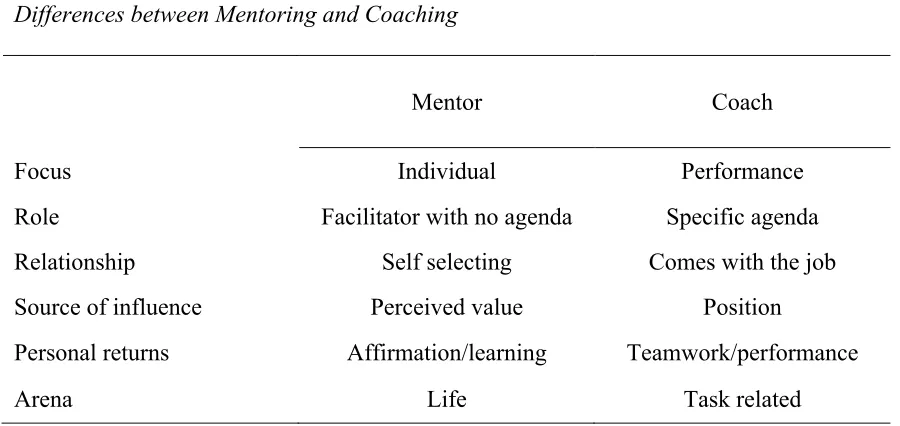
coach develops the need for discussion and is responsible for follow up and holding others accountable (Starcevich, 2009). Table 2.1 displays the differences between mentoring and
coaching (Starcevich, 2009, n.p.).
Table 2.1
Differences between Mentoring and Coaching
Mentor Coach
Focus Individual Performance
Role Facilitator with no agenda Specific agenda
Relationship Self selecting Comes with the job
Source of influence Perceived value Position
Personal returns Affirmation/learning Teamwork/performance
Arena Life Task related
Mentoring and coaching are both ways of cultivating professionalism and expertise among new employees and the veterans who support them. The similarities between
mentoring and coaching are: (a) coaches can also be mentors and mentors can be coaches, or
the roles can be rolled into one; (b) mentors and coaches use the same skills to help people reach significant decisions and take appropriate action; (c) both mentors and coaches depend
Executive coaching. Richard R. Kilburg (1996) defines executive coaching as follows:
a helping relationship formed between a client who has managerial authority and
responsibility in an organization and a consultant who uses a wide variety of
behavioral techniques and methods to help the client achieve a mutually identified set of goals to improve his or her professional performance and personal satisfaction and,
consequently, to improve the effectiveness of the client’s organization with a formally defined coaching agreement. (p. 134)
Lary (1997) stated that it may be more useful to view executive coaching as an ongoing relationship with a client that focuses on life purpose, vision, and goals using the process of inquiry and personal discovery. It is the understanding of the client’s problem behavior in
context, deciding whether the problem can be remedied, and encouraging the person to change the behavior that threatens to derail him or her (Waldroop & Bulter, 1996). The goals
of executive coaching relationships have been explicit and have focused on preventing
executive derailment (Waldroop & Bulter, 1996). The coaching process may concentrate on a specific behavior that is causing managerial conflict (Strickland, 1997), be designed to
develop specific managerial competencies, or solve specific problems (Douglas &
McCauley, 1997; Hall, Otazo, & Hollenbeck, 1999). It also seeks to boost the performance of
high-potential executives (Judge & Cowell, 1997). The goals of executive coaching are shifting and broadening as more executives inquire about coaching for various reasons.
There are two general observations made about the impact of executive coaching: (a)
practical application (Olivero, Bane, & Kopelman, 1997) and (b) in the context of a
leadership development program, an executive coaching component plays a vital role in supporting the changes in behavior and skills that executives must make to further their
leadership abilities for the organization and personal career advancement (McCauley & Hughes-James, 1994; Young & Dixon, 1996). These observations are limited to the lack of empirical research into the impact of executive coaching related to its intended outcomes.
Not much is known regarding the relationship between executive coaching, individual outcomes, and organizational outcomes. The future of executive coaching as a legitimate and
effective professional service depends on empirical data that support its effectiveness as a developmental tool for executive talent (Douglas & Morley, 2000).
Turnaround coaching model. The turnaround coach model originated from the North Carolina Department of Public Instruction School Turnaround Program. The purpose of this program was to turn around North Carolina’s lowest achieving schools during
2005-2010. In 2005, North Carolina started a high school turnaround initiative to re-culture or restructure a group of persistently low-performing high schools. In 2006, other high schools and middle schools became a part of this effort, which included a group of sixty-six high
schools and thirty-seven middle schools to be “turned around”. The plan consisted of high-quality professional development on research-based best practices to create school teams to
resulted in significant student achievement gains (North Carolina Department of Public
Instruction, n.d.).
The turnaround coaches were known as leadership facilitators. They were successful
formal principals who had experienced turning around schools themselves. A typical weekly visit by the leadership facilitator (coach) involved a brief orienting conversation with the principal, several classroom observations, and participations in School Improvement Team
meetings or a meeting with a small group of teachers and/or an assistant principal working on an identified problem. At the end of the day, the instructional facilitator (coach) usually met
again with principals to discuss what they learned and observed during the day. They sometimes served as neutral discussion leaders during leadership team and school improvement team meetings as well as planning retreats. They also initiated special
organized meetings to address problems they identified. The facilitator (coach) produced a written report to share and provide tools such as classroom observation protocols and
common lesson planning formats to principals and teachers while modeling the use of the tools in joint instructional monitoring and feedback sessions. The facilitator (coach) followed up by observing and coaching principals and teachers as they used the tools demonstrated for
them (Thompson, Brown, Townsend, Henry, & Fortner, 2011).
Double loop learning. The double loop learning theory, first proposed by Argyris (1976), is an approach to problem solving that focuses on uncovering and improving the reasoning behind one’s behavior, including one’s values, assumptions, and way of framing the problem, rather than on changing the behavior itself. The more typical approach to
double-loop learning enables the learner to discover and change the beliefs and patterns of
reasoning that shape behavior and its outcomes. Double loop learning has been effectively used for solving complex, ill structured, ever-changing problems in both educational settings
and professional organizations (Argyris, 1976).
Argyris (1976) explained the concept of double loop learning by describing a teacher who, believing that she has a class of stupid students, will communicate expectations such
that the students behave stupidly. The teacher confirms the theory by asking them questions and eliciting stupid answers or creates situations where they behave stupidly. The
theory-in-use is self-fulfilling. In order to break the congruency, the teacher would need to participate in open loop learning in which they deliberately disconfirm the theory-in-use.
The basis for the double loop theory outlined by Argyris and Schon (1974) is the
theory of action perspective. This perspective examines reality from the point of view of human beings as actors. Changes in values, behavior, leadership, and helping others are all
part of, and informed by, the actors’ theory of action. An important aspect of the theory is the distinction between an individual’s espoused theory and their theory-in-use (what they actually do); bringing these two into equivalence is a primary concern of double loop
learning. Interaction with others is necessary to identify the conflict.
Argyris’ intervention research focus is on exploring how organizations may increase
their capacity for double loop learning. He argues that double loop learning is necessary if practitioners and organizations are to make informed decisions in rapidly changing and often uncertain contexts (Argyris, 1974; 1982; 1990). According to Edmondson and Moingeon
employed by individuals in organizations hamper the exchange of relevant information in
ways that make double-loop learning difficult—and all but impossible in situations in which much is at stake. A dilemma is created because these are the very organizational situations in
which double-loop learning is most needed. The theory of double loop learning is relevant to this study because it is a promising technique for solving educational leadership problems.
Continuum of mentoring types. There are various types of formal mentoring programs. The programs vary in their guidelines, requirements, and standards (Ehrich et al., 2004). According to Jacobi (1991), some mentor programs differ in mentor training
requirements, protégé/mentor matching or assignments, meeting and location schedule details, and program evaluations.
Shapiro, Haseltine, and Rowe (1978) presented a continuum of mentoring types based
on their intensity. The types of mentoring in the continuum are listed as the peer pal, the guide, the sponsor, the patron, and the mentor. The peer pal has the least intensity while the
mentor has the most intensity. The peer pal is equal to the protégé because they share information, strategies, and support each other. The guide gives an explanation of the system’s procedures to the protégé but does not lend any support because they are not in a
position to lend such support. The sponsor assists in the promotion and shaping of the
protégé’s career. The patron is more influential in assisting the protégé’s career advancement.
Benefits to the Protégé
A first-year principal who attended a new administrative program described the first year by saying, “At times, it’s like I’m maneuvering in a minefield. Things blow up and I
crawl out of the hole” (Lovely, 2004b, p. 53). This description suggests that the first year of the principalship is the most challenging. The “long hours, excessive workload, and
insurmountable expectations from several opposing factions can lead to unmanageable
stress” (Lovely, 2004b, p. 55). Lovely (2004b) stated that these stressors afflict almost all principals but present an exceptional challenge for the inexperienced first-year principal. The
support of the mentoring program can provide the novice with an invaluable opportunity to strive and not just survive.
Literature on the potential benefits of mentoring programs for the novice is abundant
in the field. Daresh and Playko (1989) emphasized that mentoring programs can be a
powerful instrument that could aid the novice school administrator in surviving the first year
but should not just be seen as a safety net for survival only. It should be an ongoing
professional development that benefits both the mentor and the protégé (Daresh & Playko, 1989; Kelly & Peterson, 2000). Both researchers concurred that mentoring programs would
be most beneficial for the first-year principal. This dissertation study uses the authentic voices of a collective group of elementary principals who shared their first-hand experiences
regarding the support that they received to aid in their success and survival in the
principalship during their first three years. It not only focused on their perceptions of how the unstructured mentor program gave them much needed support but also on the support from
Browne-Ferrigno and Muth (2004) signified that implementing a well-designed and
structured mentor program could possibly be a valuable professional development instrument for both the mentor and the protégé. Their research involved a study of multiple cohorts of
aspiring and practicing principals engaged in professional development. It provided
perspectives on the benefits of mentoring through clinical practice by clarifying issues related to role-socialization, professional development, and leadership capacity building.
Browne-Ferrigno and Muth (2004) made recommendations based on the collected data from participants in several cohorts and reviews of research on clinical practices, leadership
preparation, and mentoring. Those recommendations involved the improvement of university-based preparation programs through models and programs such as teachers on special assignment (TOSAs), job sharing, and 110-day mentoring. These models and
programs enabled aspiring principals to gain authentic administrative work experience guided by leadership mentoring. The authors also reflected on the critical importance of
practice and administrative mentoring in the initial and continuing preparation of principals. Krajewski, Conner, Murray, and Williams (2004) found through the results of a study that mentoring programs were of great benefit to novice administrators. This study involved a
conversation with three experienced high school principals to reveal their growth and
successes in their leadership models. These dedicated leaders were in different locales but all
possess the same characteristics, such as dedication, desire, creativity, and patience.
According to Farkas, Johnson, and Duffett (2003), a survey revealed that “67% of principals believe that school of education leadership programs are out of touch with what it takes to
and guidance from people they work with has the greatest benefit for them” (p. 19).
Krajewski et al. (2004) concluded that principals must be visionaries who collaborate and share in creating a vision and a common goal. They must get the stakeholders (teachers,
parents, and students) to do what is needed to make the vision become reality. The principal must apply pressure when needed and nurture support to get the job done. They must know how to balance the pressure and support. Much of their success as school leaders was not
taught in an administrative leadership class. They spent time observing, reassessing, collaborating with peers, keeping the vision firmly in sight, celebrating when possibilities
become reality, and beginning this cycle over and over again (Krajewski et al., 2004). In an effort to produce qualified school administrators, a number of school districts across the United States are creating formal mentoring programs for aspiring school
administrators (Daresh, 2004). They are becoming more conscious of the benefits that mentoring programs offer to a novice principal when transitioning from teacher to school
leader (Daresh & Playko, 1989). Researchers found some of the potential benefits for the protégé as being:
(a) increased confidence and competence
(b) the ability to blend theory to real-life situations (c) better communication
(d) knowledge and use of effective strategies, and
(e) reduction in the feeling of isolation (Daresh, 1995; Daresh & Playko, 1989) It was also denoted by Browne-Ferrigno and Muth (2004) that mentoring programs have
changed their approach to the job due to better collegial relationships with other
administrators.
Mentoring programs have afforded the protégé the opportunity to feel more
goal-directed, detail-oriented, self-confident, and reflective (Bush & Coleman, 1995). It allows them to gain more knowledge and skills while diminishing the feeling of isolation (Brady, 1993). Daresh (2004) correlated the role of the master teacher to that of a master electrician.
The master’s or mentor’s job is to teach the protégé practical skills. Daresh’s (2004) research revealed that there is so much more to the role of the mentor than just teaching the protégé to
be a practitioner who is only responsible for master schedules, teacher evaluations,
parent/teacher conferences, or other school-related activities. It is the mentor’s role to elicit or raise more questions than they answer. They should provoke thoughts and reflections from
the protégé. Therefore, “mentors hold the key novices need to unlock their professional expertise” (Barnett, 1995, p. 54). Mentors are the means for developing the protégé’s
capabilities in problem solving, reflective thinking, and cognitive development. Novice administrators with their leadership deficiencies will have difficulty developing the expertise needed without the assistance of skilled and experienced
administrators in the area of problem solving. A structured and well-developed mentor program can develop and strengthen the protégé’s skills with cognitive and problem-solving
skills as well as improve upon their reflective thinking skills in order to make better decisions for their schools (Leithwood & Steinback, 1992).
According to Ehrich et al. (2004), the mentor and protégé could gain positive learning