Copyright2001 by the Genetics Society of America
Interchromosomal Gene Conversion at an Endogenous Human Cell Locus
P. J. E. Quintana,* Efrem A. H. Neuwirth
†and Andrew J. Grosovsky
†*Division of Occupational and Environmental Health, Graduate School of Public Health, San Diego State University, San Diego, California 92182 and†Department of Cell Biology and Neuroscience and Environmental Toxicology Graduate Program,
University of California, Riverside, California 92521 Manuscript received July 19, 2000 Accepted for publication February 28, 2001
ABSTRACT
To examine the relationship between gene conversion and reciprocal exchange at an endogenous chromosomal locus, we developed a reversion assay in a thymidine kinase deficient mutant, TX545, derived from the human lymphoblastoid cell line TK6. Selectable revertants of TX545 can be generated through interchromosomal gene conversion at the site of inactivating mutations on eachtkallele or by reciprocal exchange that alters the linkage relationships of inactivating polymorphisms within thetklocus. Analysis of loss of heterozygosity (LOH) at intragenic polymorphisms and flanking microsatellite markers was used to initially evaluate allelotypes in TK⫹revertants for patterns associated with either gene conversion or crossing over. The linkage pattern in a subset of convertants was then unambiguously established, even in the event of prereplicative recombinational exchanges, by haplotype analysis of flanking microsatellite loci intk⫺/⫺LOH mutants collected from thetk⫹/⫺parental convertant. Some (7/38; 18%) revertants were attributable to easily discriminated nonrecombinational mechanisms, including suppressor mutations within thetkcoding sequence. However, all revertants classified as a recombinational event (28/38; 74%) were attributed to localized gene conversion, representing a highly significant preference (P⬍0.0001) over gene conversion with associated reciprocal exchange, which was never observed.
T
HE resolution of mitotic homologous recombina- to occur in conjunction in mitotic yeast, although the tional intermediates in mammalian cells can result majority of mitotic gene conversions occur without asso-in a localized gene conversion, which asso-in some cases may ciated crossover of flanking markers (Peteset al.1991; be associated with a reciprocal exchange or crossover. Paquesand Haber1999). In contrast, relatively little Gene conversion affects highly localized regions of DNA is known about the prevalence and mechanisms of gene and results in the nonequivalent distribution of parental conversion in mammalian cells and the frequency of alleles in the progeny cells. Reciprocal exchange, in coordinate occurrence of gene conversion and recipro-contrast, results in a switch of the linkage relationships cal exchange in the repair of double strand breaks of all alleles from the point of the break to the telomere (DSBs). Most information on this topic has been ob-and therefore involves large tracts of DNA. When com- tained from analyses of artificial intrachromosomal re-bined with an appropriate mitotic segregation, postrep- combination substrates, in which gene conversion is licative reciprocal exchange events can produce loss favored over reciprocal recombination by as much as of heterozygosity (LOH) for all markers distal to the two orders of magnitude (Nickoloff1992;Sargentet reciprocal switch. Homologous recombination is an im- al.1997;TaghianandNickoloff1997). However, few portant pathway for the repair of double strand breaks reports have focused on rigorously discriminating be-(Lianget al. 1998; Thompsonand Schild1999) and tween gene conversion and reciprocal recombination can also result in the loss of functional alleles through products occurring between allelic sequences on homol-LOH, providing a major mechanism for the expression ogous chromosomes. One system used reversion analysis of recessive phenotypes at tumor suppressor loci (Cavenee to study interchromosomal recombination in humanet al.1983;Morley1991;HagstromandDryja1999; lymphoblastoid cells (BenjaminandLittle1992), but
Rousseau-Mercket al.1999). the absence of nearby flanking markers precluded firm
Tetrad analysis of recombination in yeast demon- identification of gene conversion. A recent study from strated that reciprocal exchange of flanking markers our laboratory determined the contribution of localized frequently accompanied gene conversion in meiotic gene conversion to the overall yield of forward muta-cells (FogelandHurst1967;Hurstet al.1972). Gene tions at the heterozygous thymidine kinase (tk) locus conversion and reciprocal exchange are also observed in human lymphoblasts (GiverandGrosovsky1997).
Investigation of interchromosomal recombination has also been studied by using engineered recombinational
Corresponding author:Andrew J. Grosovsky, University of California
substrates integrated into homologous positions within
Environmental Toxicology Graduate Program, 5419 Boyce Hall,
River-side, CA 92521. E-mail: [email protected] the retinoblastoma locus in mouse embryonic stem cells
substitution at positions 12441–2 in exon 6 of allele A of the (MoynahanandJasin 1997). In this study, induction
tkgene (Giveret al.1995) resulting in a change of a threonine of a targeted DSB into one of the integrated alleles
codon (ACC) to lysine (AAG; Figure 1). Cell lines were main-using the rare cutting endonuclease I-SceI resulted in tained in RPMI 1640 with 10% iron-supplemented calf serum, an increase in interallelic recombination events by at and 1%l-glutamine and 1% penicillin/streptomycin mix, and least two orders of magnitude. All of these recombina- were cultured at 37⬚with 5% CO2, with cell density kept
be-tween 2 and 10⫻105cells/ml. tional exchanges were due to localized gene conversion,
Collection of TX545 independent revertants:Independent although reciprocal exchanges were theoretically
recov-flasks of TX545 were pretreated with 2g/ml TfT for 2 days erable in this system (Moynahan and Jasin 1997).
to remove preexisting revertants and expanded to 1⫻ 108 These data suggest that gene conversion is a potentially cells/flask. Up to 2⫻109cells were used for each experiment. important recombinational mechanism in embryonic Cells were treated with either 200cGy ␥-irradiation (137Cs stem cells, although the applicability of this conclusion source; J. L. Shepard and Associates) or 0.3mBPDE [ben-zo(a)pyrene-r-7,t-8,dihydrodiol-t-9,10-epoxide(⫹/⫺) (anti); remains to be determined for interchromosomal allelic
Midwest Research Institute, Kansas City, MO]. Untreated cul-recombination in differentiated somatic cells.
tures were run in parallel. The cultures were allowed 3 days Here, a reversion assay was used to enable
examina-postirradiation to express TK before selection at 40,000 cells tion of the relative frequencies of gene conversion oc- per well in medium containing CHAT [1⫻10⫺5mcytidine, curring alone or in conjunction with reciprocal recom- 1 ⫻10⫺4m hypoxanthine, 4 ⫻10⫺7m aminopterin, 1.6⫻ 10⫺5mthymidine; 100⫻HAT was purchased from GIBCO/ bination. Revertants were derived from a previously
BRL (Gaithersburg, MD) and cytidine was purchased from characterizedtk⫺/⫺mutant of TK6 called TX545 (Giver
Sigma Chemical Co. (St. Louis)]. The BPDE-treated cells (10
et al.1995), and allelotypes could be determined using
flasks with 108cells per flask) were exposed for 24 hr, washed, a set of five polymorphic markers within and closely and then placed in new media. After a 3-day expression period flanking thetklocus. Due to the placement of heteroal- they were selected in CHAT-containing medium as described lelic inactivating mutations, selectable recombinational above. Spontaneous revertants were also collected after similar treatment. Revertant colonies were scored on day 14, but the exchanges are restricted to thetk locus. Linkage
rela-96-well dishes were additionally scored at day 21 to identify tionships in a subset of individual convertants were
un-potential slow growing revertants. Slow growing colonies, at-ambiguously established, even in the event of
prereplica-tributable to recombinational exchange with LOH tracts ex-tive recombinational exchange, by identification of which tending to the telomere, are readily scored in forward muta-alleles become coordinately homozygous at flanking mi- tional analyses in TK6 cells (Liberet al.1989;Amundsonand crosatellite loci in tk⫺/⫺ LOH mutants collected from Liber1992;Doboet al.1995;GiverandGrosovsky2000). A single revertant was picked from each independently treated the tk⫹/⫺ parental convertant. Since none of the
ana-culture for further analysis. lyzed revertants were attributable to reciprocal
ex-Genomic and cDNA analysis of revertant clones:DNA puri-change, this investigation provides direct evidence of a fication was performed either by a phenol:chloroform extrac-highly significant preference for interchromosomal tion (Nelson et al. 1994) or by the use of a spin column gene conversion, without associated crossover, at an en- (QIAamp blood kit; QIAGEN, Valencia, CA). [32P]ATP end labeling, PCR amplification of the intragenic polymorphisms, dogenous human cell locus.
and single C and G lane sequencing of the exon 4 and 7 polymorphisms were each performed as previously described (Grosovskyet al.1993;Giveret al.1995). The products were MATERIALS AND METHODS
run and visualized on 6% polyacrylamide gels and examined for loss of the frameshift insertions. The exon 6 tandem substi-Cell lines and locations of polymorphic markers:The TK6
tution was amplified in the same fragment as the exon 7 cell line is a well-characterized human B-lymphoblastoid cell
polymorphism and was analyzed by PCR sequencing (fmol line that is functionally heterozygous at thetklocus. The
hu-kit; Promega, Madison, WI) for loss of the tandem substituted mantklocus is located on chromosome 17q23-25 (Fainet al.
bases. PCR amplification and electrophoresis of genomic DNA 1991). The gene is 12.9 kb long with 702 bp of coding region
for visualizing flanking microsatellite markers D17S937 and
(Bradshawand Deininger 1984; Flemingtonet al.1987)
D17S802 were performed as described inGiverand
Grosov-and codes for a protein involved in a salvage pathway for
sky(1997). Primers were obtained from Research Genetics thymidine triphosphate biosynthesis. Forward selection (TK⫺)
(Huntsville, AL). can be accomplished by growth in trifluorothymidine (TfT;
For cDNA sequencing of the exons 4, 6, and 7
polymor-Skopek et al. 1978), and reversion to TK⫹can be selected
phisms, total cytoplasmic RNA was isolated using commercial by colony formation in medium containing CHAT (cytidine,
spin columns (RNeasy plant mini kit; QIAGEN). Production hypoxanthine, aminopterin, thymidine; Clive et al. 1973;
and amplification of the cDNA by reverse transcriptase
(RT)-LiberandThilly1982).
PCR were performed as previously described (Grosovskyet al. Cell line TX545 is atk⫺/⫺mutant of TK6. The structure of
1993). RT-PCR oftkcDNA results predominantly in recovery of thetklocus in TX545 is shown in Figure 1. Parental TK6 cells
allele A message, presumably due to rapid degradation of the contain a single base insertion in exon 4 of allele B of thetk
allele B message, which carries an inactivating frameshift in locus, within a run of three C’s at position 4864 of the genomic
exon 4 (Grosovskyet al.1993). As a result only the sequence DNA sequence. In addition, there is a phenotypically silent
of the allele A cDNA is visible when pooled cDNA is used for frameshift insertion on allele A in a run of four G’s at position
DNA sequence analysis (Grosovskyet al. 1993;Giveret al. 12690 in exon 7 (Grosovskyet al.1993). A number of
infor-1995;GiverandGrosovsky1997). PCR single-lane sequenc-mative microsatellite polymorphisms exist on 17q, both
cen-ing of the cDNA was performed for the three polymorphic tromeric and telomeric oftkin the TK6 cell line (Giverand
Figure1.—Map of the human thymidine kinase (tk) gene in cell line TX545. Three polymorphisms in the coding portion of the gene were used for analysis: an inactivating frameshift (fs) insertion at exon 4 on allele B, an inactivating tandem substitution (td) in exon 6 on allele A, and a silent fs insertion in exon 7 on allele A. TX545 differs from the parental cell line TK6 only at the position of the exon 6 tandem base substitution. Polymorphisms at the centromeric and telomeric polymorphic microsatellites D17S937 and D17S802 depicted here were also analyzed to determine the extent of LOH. These microsatellites map to within a region of 1 cM. Exons are shown to scale and are labeled 1–7. The locations of the mutations in the genomic sequence of the coding strand of thetkgene are indicated using the numbering system ofFlemingtonet al.(1987).
Collection and microsatellite analysis of TK⫺LOH mutants any revertant involving LOH of intragenic and flanking fromtkⴙ/⫺convertants:For each convertant clone, three
96-telomeric microsatellite polymorphisms would be classi-well plates were seeded with 4⫻104cells per well in media
fied as recombinational LOH (Figure 2g). It is also containing 2g/ml TfT. Plates were scored and colonies were
possible to recover a reciprocal exchange that directly picked at 14 and 21 days after seeding; a minimum of 12
TK⫺mutant clones were collected for LOH analysis for each results in linkage of wild-type sequences on one allele convertant. Colonies were expanded for DNA isolation using without concomitant LOH (Figure 2, h and i). Direct the QIAMP Dneasy tissue kit. Microsatellite analysis used pro- restoration of TK function by mutational reversion of cedures identical to the analysis of revertant clones as
de-the tandem base substitution in exon 6 is a low probabil-scribed above. TK⫺ clones were initially screened for LOH
ity event requiring specific substitutions at both posi-encompassing microsatellite locus D17S937. A single TK⫺
clone exhibiting LOH at D17S937 was selected from each set tions (Figures 1 and 2, a and d); coincident mutational of 12 mutants for LOH analysis at D17S802. In rare cases reversion involving exons 6 and 7 (Figure 2, b and e) clones exhibiting LOH at D17S937 remained heterozygous at has an even lower probability. LOH at the inactivating D17S802, and additional clones were screened to obtain one
frameshift insertion in exon 4 (Figures 1 and 2, c and exhibiting coordinate LOH at both loci.
f) could occur by localized gene conversion or by a reverting frameshift deletion within the run of four gua-RESULTS nines in the exon 4 sequence (Figure 1). However, the
probability of a frameshift mutation within a specific Genotypes associated with gene conversion and
re-four-base sequence is quite low (BenjaminandLittle
combinational loss of heterozygosity: Spontaneous,
1992;Giver et al. 1995;Giver and Grosovsky1997) ␥-irradiated, and BPDE-induced revertants of TX545
and unlikely to account for a substantial fraction of all were analyzed for LOH using three intragenic and two
recovered revertants involving LOH at exon 4. Although flanking microsatellite markers at thetklocus (Figure
this possibility cannot be fully excluded, the distribution 1; Table 1). Revertants demonstrating LOH involving
of revertants between exons 4 and 6 is equivalent (Table only a portion of the tk locus and not extending to
1), suggesting that this additional potential mechanism flanking microsatellite markers were classified as
local-for generating exon 4 revertants is not contributing ized gene conversions, which could occur with or
TABLE 1
Patterns of loss of heterozygosity among TKⴙrevertants of TX545
Genomic DNA (allelotype) No. of
Revertant category revertantsa D17S937 tkexon 4 tkexon 6 tkexon 7 D17S802
1. Exon 4 conversion 13 (0.34) A/B A A/B A/B A/B
2. Exon 6 Conversion 3 (0.08) A/B A/B B A/B A/B
3. Exon 6 and 7 conversion 12 (0.32) A/B A/B B B A/B
4. No LOHb 6 (0.16) A/B A/B A/B A/B A/B
5. Suppressor mutationc 4 (0.11) A/B A/B Ac/B A/B A/B
Analyses at polymorphic sites were conducted as described inmaterials and methods. Allele A includes thetkwild-type sequence at the exon 4 polymorphism, and allele B includes the tkwild-type sequence for exons 6 and 7. The alleles are listed as they appear on autoradiographs obtained from the analysis of each mutant.
aA total of 9 spontaneous, 7␥-ray-induced, and 22 BPDE-induced revertants were collected. Of these 38,
31 were ultimately confirmed to be convertants, including 3 no LOH revertants with localized reciprocal switch. Analysis of the occurrence of conversion alone, conversion in association with reciprocal exchange, or other categories of reversion, was performed using pooled data from spontaneous and induced treatment groups. There was no statistically significant difference (P⫽ 0.53) in the distribution of conversion events among the treatment classes; 6/8 spontaneous convertants, 4/7␥-ray-induced convertants, and 8/16 BPDE-induced convertants involved exon 6 with the remaining events involving exon 4. Therefore, convertants in each treatment class included events at both sites, and these distributions did not significantly deviate (P⫽0.61) from the null hypothesis of equivalent occurrence of conversion at exons 6 and 4.
bThree of the no LOH revertants involved a localized reciprocal switch of allelotypes at exons 6 and 7 (Table
3, d and e; Table 5).
cA function-restoring point mutation was identified in exon 6 for these mutants and is labeled as a suppressor
mutation. See Table 3 for further details.
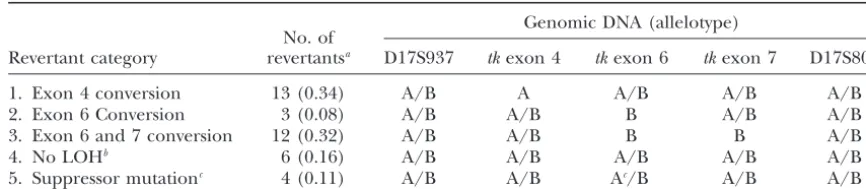
Gene conversion without reciprocal exchange is the selective medium containing CHAT (Table 1, category 4). This pattern could be the result of gene conversion predominant mechanism for generation of revertants:A
total of 38 revertant clones were collected, and genomic associated with a local reciprocal switch (Figure 2i), reciprocal recombination (Figure 2h), or a compensat-DNA was used for analysis of allelotypes (Table 1). A
large fraction of recovered revertants (28/38, 0.74) ing mutation elsewhere in the genome such as amplifi-cation of the DHFR gene (SharmaandSchimke1994). demonstrated one of several genomic allelotypes
consis-tent with localized gene conversion (Figure 2, a and c; To further examine the mechanisms involved in gener-ating the clones that exhibited no LOH, the tkcDNA Table 1, categories 1–3). These events were similarly
distributed at the two opposed inactivating mutations; from these revertants was amplified and sequenced. Due to differences in allele-specific expression this analysis 15 revertants exhibited LOH at exon 6, and another 13
revertants involved LOH at exon 4. Most of the LOH reflects only the sequence of the message transcribed fromtkallele A (Grosovskyet al.1993), thus permitting revertants involving exon 6 (12/15, 0.80) also extended
to the phenotypically silent frameshift polymorphism in the establishment of intraallelic linkage relationships among the sequences at polymorphic positions within exon 7 located 247 bp away (Figure 1; Table 1, category
3), suggesting that recoverable conversion tracts are thetklocus. These data are summarized in Table 3. The cDNA from three revertants retained the inactivating rarely less than several hundred bases in length.
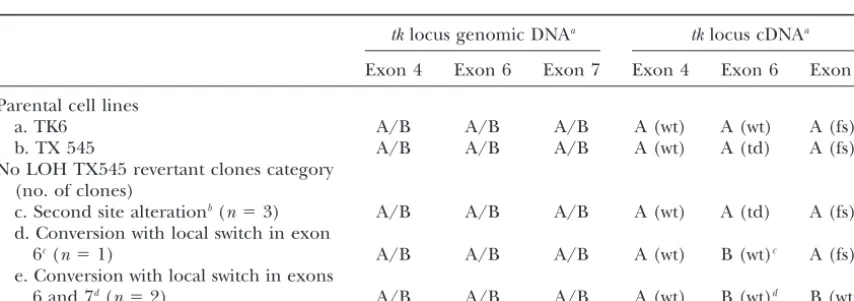
In addition to the revertants exhibiting localized tandem base substitution in a pattern that is unchanged from the parental TX545 cells (Table 3c). Since the LOH, four clones were collected that contained a
func-tion-restoring single base alteration affecting one of the CHAT resistance in these three revertants does not ap-pear to result from a molecular alteration within thetk
tandem-substituted bases at positions 12441–2 in exon
6 (Table 2; Table 1, category 5). Three of these re- locus, these are tentatively categorized as second site compensating alterations. On the other hand, single-vertants are suppressor mutations that encode
aspara-gine, an amino acid that represents a conservative lane cDNA sequencing analysis demonstrated the resto-ration of the wild-type sequence at exon 6 in three other change from the wild-type sequence and that permits
TK function to be restored. The remaining revertant is revertants that remained heterozygous in analysis of ge-nomic DNA (Table 3, d and e). These observations also a single base suppressor mutation, which due to
coding degeneracy restored the wild-type threonine at suggest a restoration of TK expression through a local-ized allelic exchange, resulting in linkage of wild-type the mutated codon (Table 2).
Figure 2.—Possible alle-lotypes of TK⫹ revertant clones due to gene conver-sion or reciprocal ex-change. Distances are not represented to scale. Poly-morphisms are those de-tailed in Figure 1. The allel-otype of the parental TX545 cell line is shown at the top left. Selectable modification of allelotypes may be due to localized gene conversion with or without associated reciprocal exchange (a–f), or by reciprocal exchange with or without associated LOH (g and h). In the case of reciprocal exchange an associated localized gene conversion at the site of the exchange may also occur, but cannot be ascertained if it occurs in a region without polymorphic markers. The localized gene conversion allelotypes (a–c) involve LOH for only a portion of thetklocus, without associ-ated crossover. Parallel gene conversion events with associated distal crossover are depicted in the center column (d–f). Note that in all of the cases represented in a–f flanking microsatellite markers remain heterozygous. The reciprocal exchange allelotypes (g and h) indicate that associated loss of heterozygosity is expected in 50% of postreplicative crossovers, depending on the mitotic segregation patterns of the recombinational partners following resolution of the exchange intermediate.
vertants are also compatible with reciprocal recombina- prereplicative resolution of recombinational intermedi-ates involved reciprocal exchange, these could not be tion with no LOH (Figure 2h), but this explanation is
excluded by subsequent allelotype analysis of TK⫺LOH detected by analysis of LOH at distal markers (Figure 2). This possibility was addressed by allelotype analysis mutants (see Table 5). These revertants may be
straight-forwardly explained by mismatch repair of hetero- intk⫺/⫺LOH mutants derived fromtk⫹/⫺ convertants. The allelotype of selectabletk⫹/⫺convertants, with or duplex DNA on both alleles following branch migration
through the polymorphic position (GiverandGrosov- without reciprocal exchange at distal flanking markers, is shown in Figure 3. Isolation of derivativetk⫺/⫺mutants
sky1997) or by replication through heteroduplex DNA
in conjunction with mitotic segregation of the appro- with flanking marker LOH provides coordinate homozy-gosis of polymorphic markers from the haplotype that priate chromosomes (Marians2000). Alternatively, these
events could theoretically be double crossovers, but includes the nonfunctionaltkallele. Therefore, allelo-type analysis of microsatellite markers in these mutants since not even single crossovers were observed in
associa-tion with any other gene conversion event the probabil- permits the parental linkage relationship to be unam-biguously established, thereby determining whether a ity of double crossovers within such a small intragenic
region seems quite remote. crossover occurred in the parental convertant (Figure 3). To perform this analysis we collected a set oftk⫺/⫺ Taken as a whole, these analyses demonstrate that no
revertant exhibited the expected genomic pattern for mutants from each convertant and screened for flank-ing marker LOH, permittflank-ing establishment of haplotype recombinational LOH (Figure 2g). In contrast, 28
re-vertants (Table 1) could be definitively classified as in- for a subset of 20 convertants (Table 5). All of these LOH mutants exhibited microsatellite allelotypes that terchromosomal gene conversion. The difference in
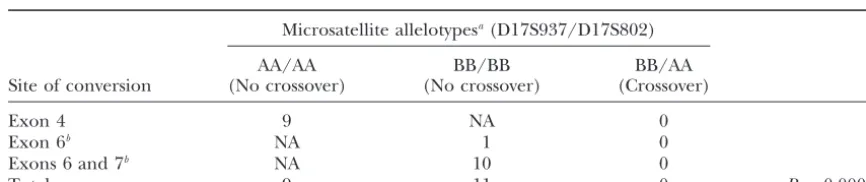
re-covery of gene conversion and recombinational LOH indicate a local gene conversion without associated crossover in the parental convertants (Table 5; P ⫽
is highly significant (P ⬍ 0.0001; Table 4). Random
mitotic segregation patterns following postreplicative 0.0004). Three additional convertants affecting only exon 6 (Table 1, category 2) and one reciprocal switch recombinational exchange should result in equivalent
TABLE 2
Suppressor point mutations in revertant clones
TK6 sequencea TX545 sequencea Revertant sequencesa No. of revertants
TAT ACC AAG TAT AAGAAG TAT AACAAG 1
Tyr Thr Lys TyrLysLys TyrAsnLys
TAT AATAAG 2
TyrAsnLys
TAT ACG AAG 1
TyrThrLys
aSequences shown are from exon 6 of thetklocus (see Figure 1). DNA sequences and amino acids shown
in boldface and underlined type are changed from the predecessor cell line.
analysis to demonstrate the conservation of parental reciprocal exchange was also reported in mammalian cells, largely by analysis of intrachromosomal tandem linkage relationship with the exon 7 frameshift
polymor-phism allele. These findings (Tables 4 and 5) provide arrays carried on integrated plasmid constructs (Liskay
and Stachelek 1983; Godwin and Liskay 1994;
strong evidence that interchromosomal gene
conver-sion in human lymphoblastoid cells is rarely associated Sargent et al. 1997; Taghian and Nickoloff 1997;
YangandWaldman1997;Lianget al.1998;Linet al.
with crossing over.
1999;LukacsovichandWaldman1999;Dronkertet al. 2000). These investigations suggest that, although DISCUSSION
reciprocal exchange may occur without a detectable gene conversion due to the absence of local polymor-Extensive studies in yeast indicate that localized
inter-allelic gene conversion predominates over reciprocal phisms, all recombinational exchanges may proceed by a mechanism that would necessarily produce a conver-exchange in analysis of mitotic recombinational
prod-ucts (Paques and Haber 1999). A substantial prefer- sion within an appropriate sequence context. However, investigation of systems capable of detecting interchro-ence for recovery of mitotic gene conversion rather than
TABLE 3
Genomic and cDNA analysis of no LOH revertant clones
tklocus genomic DNAa tklocus cDNAa
Exon 4 Exon 6 Exon 7 Exon 4 Exon 6 Exon 7
Parental cell lines
a. TK6 A/B A/B A/B A (wt) A (wt) A (fs)
b. TX 545 A/B A/B A/B A (wt) A (td) A (fs)
No LOH TX545 revertant clones category (no. of clones)
c. Second site alterationb(n⫽3) A/B A/B A/B A (wt) A (td) A (fs)
d. Conversion with local switch in exon
6c(n⫽1) A/B A/B A/B A (wt) B (wt)c A (fs)
e. Conversion with local switch in exons
6 and 7d(n⫽2) A/B A/B A/B A (wt) B (wt)d B (wt)d
acDNA status of revertants that exhibited no LOH in genomic DNA analysis (Table 1, category 5). RT-PCR
and cDNA sequencing were conducted as described inmaterials and methods. Alleles A and B indicate sequences shown in Figure 1, with the exception of TK6 cells, which are homozygous wild type at the position of the inactivating exon 6 tandem base substitution. The symbols in parentheses indicate wild type (wt), tandem base substitution (td), or frameshift (fs).
bNo change of any type is detected within thetklocus. Therefore, a second site change is suggested, such
as amplification of thedhfrlocus.
cThis event is classified as a gene conversion involving a localized switch of sequences withintkexon 6 due
to mitotic segregation. Wild-type function is restored on allele A and the tandem base substitution is transferred to allele B.
dThis event can be explained as a gene conversion with a localized sequence switch withintkexons 6 and
TABLE 4 tiated adult cell types. Targeted knockout of DNA-PKcs, which is essential for nonhomologous end joining Recovery of recombinational LOH and gene
(NHEJ), does not result in hypersensitivity to ionizing conversion among revertants
radiation exposure in embryonic stem cells (Gaoet al.
1998). On the other hand, radiosensitivity of embryonic No. of Statistical
Category recovered events significance stem cells is associated with knockout ofRAD54, which is involved in homologous recombinational repair but Gene conversion 28 P⬍0.0001
not NHEJ (Esserset al.2000). In adult tissues the situa-Recombinational LOH 0
tion appears to be reversed; adult mice are not radiosen-Additional recovered
eventsa 10 Not applicable sitized byRAD54deficiency (Esserset al.2000), but loss
of DNA-PKcs function results in significant
radiosensitiv-aThese events include six revertants without LOH (Table
ity (Biedermannet al. 1991;Gao et al.1998). Further 1, category 4; Table 3c) and four suppressor mutations (Table
evidence of high levels of homologous recombinational 1, category 5; Table 2).
repair activity in embryonic stem cells is provided by the relatively high frequency at which gene targeting mosomal allelic gene conversion in human and other can be achieved by homologous recombinational mech-mammalian cells was restricted to only a few studies anisms (Fung-Leung and Mak 1992; te Riele et al.
(Grist et al. 1992; Shulman et al. 1995; Giver and 1992; Rathjen et al. 1998). Taken as a whole, these
Grosovsky1997;MoynahanandJasin1997). The data studies suggest that embryonic stem cells may not be presented here for TX545, a human lymphoblastoid representative of most mammalian cell types since ho-cell line, indicate that a highly significant preference for mologous recombinational repair, rather than nonho-gene conversion without associated reciprocal exchange mologous end joining, appears to be the predominant may be a general feature of interchromosomal recombi- cellular response to double strand breaks. Therefore, nation, extending to more differentiated cell types and extended analysis in additional cell types is essential to human cells. to establish the generality of the conclusion that gene Previous evidence that homologous recombinational conversion without crossover is the predominant mode repair of DSBs is associated with gene conversion rather of homologous recombinational repair in a wide range than crossover has primarily been derived from studies of mammalian cell types.
of I-SceI-induced cleavage of plasmids integrated within Molecular analysis of TK⫹ TX545 revertants initially the genome of mouse embryonic stem cells (Moynahan utilized analysis of loss of heterozygosity in distal mark-andJasin1997;Donohoet al.1998;Elliottet al.1998; ers as an indicator of crossing over associated with
local-Richardsonet al.1998). Recent reports used targeted ized gene conversion within thetklocus (Table 1). If knockouts to further examine pathways of double strand gene conversion occurs in conjunction with crossover, there is a 50% chance of associated LOH that would break repair in embryonic stem cells and other
differen-TABLE 5
Microsatellite allelotypes intk⫺/⫺LOH mutants derived fromtkⴙ/⫺convertants: localized gene conversion is not associated with crossover
Microsatellite allelotypesa(D17S937/D17S802)
AA/AA BB/BB BB/AA
Site of conversion (No crossover) (No crossover) (Crossover)
Exon 4 9 NA 0
Exon 6b NA 1 0
Exons 6 and 7b NA 10 0
Total 9 11 0 P⫽0.0004c
aMicrosatellite analysis was performed ontk⫺/⫺LOH mutants derived fromtk⫹/⫺convertants. The alleles at D17S937 and D17S802 that are coordinately reduced to homozygosity indicate whether linkage relationships in parental convertants were altered by a crossover occurring in conjunction with a localized gene conversion at the indicated site. Although two alleles are listed at each locus, some TK⫺LOH mutants could be attributable to deletion; this would not influence the use of these data in inferring the haplotype of parental convertants. NA, not applicable.
bConversion of the inactivating tandem base substitution within exon 6 generally involved coconversion of
the nearby frameshift polymorphism within exon 7. Data for conversion at exons 6 and 7 include one switch clone that did not involve local LOH.
cStatistical significance is calculated using Fisher’s exact test by comparing the total of no crossovers (20)
Figure 3.—Haplotype analysis using tk⫺/⫺ LOH mutants for detection of reciprocal ex-change in parentaltk⫹/⫺convertants. The antici-pated allelotypes of tk⫹/⫺ convertants at either exons 6 and 7 (top left) or exon 4 (top right) are depicted with or without crossover. The flanking marker allelotypes in convertants restricted to exon 6 alone would be identical to conversion tracts encompassing exons 6 and 7, and only the latter are shown for simplicity. A set of 12tk⫺/⫺ mutants were isolated from each convertant and screened for LOH encompassing flanking micro-satellite markers. The linkage relationship in the parental convertant can be established by identi-fication of which alleles become coordinately ho-mozygous at the flanking microsatellite loci. Con-servation of the parental linkage confirms the absence of crossover associated with the localized gene conversion within thetk locus. Using this approach, no crossovers were observed in haplotype analysis of 20 convertants, indicating a highly significant (P⫽0.0004) preference for conversion without associated reciprocal exchange.
produce a distinguishing allelotype (Figure 2g) if the ure 1), permitting a direct comparison of the relative recovery of gene conversion alone and in association exchange involved DNA that had already been
repli-cated. In contrast, distal heterozygosity would be re- with reciprocal exchange within an individual endoge-nous locus. A complementary estimate can be derived tained in an equal number of postreplicative crossovers
if the two homologous chromosomes involved as recom- from consideration of forward mutation data at thetk
locus in parental TK6 lymphoblasts. In selection of for-bination partners are cosegregated during mitosis, but
this allelotype cannot be distinguished from the paren- ward TK⫺mutants, gene conversion is restricted to the local region surrounding an inactivating heterozygous tal pattern (Figure 2h). LOH was determined to be
restricted to a portion of thetklocus in 28 independent frameshift mutation within exon 4 of thetklocus (Giver
andGrosovsky1997), whereas recombinational LOH revertants (Table 1), which were thus classified as
local-ized gene conversions. These data alone do not exclude can include tracts extending ⬎40 cM proximal to tk
(Dobo et al. 1995; Giver and Grosovsky 2000). By the possibility that all or some of these had undergone
a reciprocal exchange in conjunction with the gene considering the overall TK⫺ mutation frequency and the percentage of each class of event determined by conversion if in each case the mitotic segregation
pat-tern resulted in retention of heterozygosity in the distal molecular analyses of mutant collections (Liber et al.
1989; Amundson and Liber 1992; Giver et al. 1995; markers. Furthermore, in the event of recombinational
exchange occurring in G1 or early S phase, there would GiverandGrosovsky1997), the frequency of recombi-national LOH can be estimated to beⵑ70-fold higher be no possibility for LOH to serve as a marker for
cross-over. This possibility was unambiguously excluded for than that of gene conversion (Table 6). However, this apparent discrepancy with the reversion analysis can be a subset of 20 independent convertants by allelotype
analysis of flanking microsatellite loci in tk⫺/⫺ LOH resolved by factoring in the available target size for the initiation of selectable recombinational exchanges. Tar-mutants collected from the tk⫹/⫺ parental convertant
(Figure 3; Table 5). This sample represents convertants get size approximations were used to calculate a yield per kilobase for gene conversion and recombinational occurring in tk exon 4 as well as clones undergoing
coconversion of the inactivating tandem base substitu- LOH, resulting in a size-normalized estimate that gene conversion is 650- to 1000-fold more frequent than re-tion in exon 6 and the silent frameshift polymorphism
in exon 7 (Figure 1; Table 5). These results provide combinational LOH (Table 7). This approach was ex-tended (Table 8) to calculate that gene conversion was strong evidence (P ⫽ 0.0004) that interchromosomal
gene conversion in human lymphoblastoid cells is rarely recoveredⵑ700-fold more frequently than was recombi-national LOH, when frequency was considered as a func-associated with crossing over. Interestingly, since
co-conversion tracts are a minimum of several hundred tion of the estimated number (Lobrich et al. 1995) of radiation-induced double strand breaks within each bases in length (Figure 1), these findings also extend
to relatively long conversion tracts. Indeed, 4/10 co- target region. This calculation indicates that a minimum of 6% of double strand breaks result in a recoverable convertants were found to encompass theSacI
restric-tion polymorphism situatedⵑ5.5 kb downstream of the gene conversion (Table 8), although this figure repre-sents only selectable outcomes and is therefore expected tandem base substitution in exon 6 (data not shown).
The reversion assay in TX545 cells requires a se- to underestimate the number of double strand breaks that are processed by homologous interchromosomal lectable recombinational exchange to occur between
TABLE 6
Recovery of recombinational LOH and gene conversion among␥-ray-induced and spontaneous forward mutations: Gross yield
Radiation-induced Spontaneous Category of forward mutation mutation frequency mutation frequency
Overall TK⫺mutation frequencya 93⫻10⫺6 7.5⫻10⫺6
Recombinational LOHa 75⫻10⫺6 5⫻10⫺6
Gene conversionb 1.3⫻10⫺6 0.12⫻10⫺6
aThe overall TK⫺mutation frequency in TK6, including normal and slow growth mutants, was reported by Liberet al.(1989). The slow growth mutants contributing to this frequency were classified as recombinational LOH events (AmundsonandLiber1992;Xiaet al.1994;Grosovskyet al. 1996).
bThese frequencies were estimated by multiplying the TK⫺normal growth mutation frequency in TK6 cells
(Liberet al.1989;Giveret al.1995) by the percentage of gene convertants in the spectrum of TK⫺mutants (GiverandGrosovsky1997).
TABLE 7
Recovery of recombinational LOH and gene conversion among␥-ray-induced and spontaneous forward mutations: Yield per kilobase
Gross yield Yield per kilobase Estimated
target size Radiation Radiation
Category (kb) induced Spontaneous induced Spontaneous
Recombinational LOHa 4⫻104 75⫻10⫺6 5⫻10⫺6 2⫻10⫺9 0.12⫻10⫺9 Gene conversionb 1 1.3⫻10⫺6 0.12⫻10⫺6 1300⫻10⫺9 120⫻10⫺9
aTarget size for recombinational LOH was estimated from the 40 cM recombinational distance betweentk
and the most centromeric marker (D17S806) recovered in contiguous LOH tracts on chromosome 17q in TK⫺mutants (Giver andGrosovsky 2000). In this calculation an equivalence of 1 Mb per cM was used, which was chosen as a conservative underestimate of the actual physical distance available for recombinational breakpoints.
bAn estimate of 1 kb was used for the target size of a gene conversion event. The actual length of gene
conversion tracts is poorly defined and probably variable.
TABLE 8
Recovery of recombinational LOH and gene conversion among␥-ray-induced and spontaneous forward mutations: Yield per radiation-induced double strand break
Category Gross yield Target size (kb) DSBs per targeta Yield per DSB
Recombinational LOH 78⫻10⫺6 4⫻104 0.928 8.4⫻10⫺5 Gene conversion 1.3⫻10⫺6 1 2.3⫻10⫺5 0.06
aThe estimate of 5.8⫻ 10⫺3 DSBs/Mb/Gy of ionizing radiation (Lobrich et al. 1995) was used in this analysis. The relevant target was considered to be a 40-Mb tract within each copy of chromosome 17q.
It was recently estimated (Lianget al.1998) that 30– to radiation and BPDE. It remains possible that these gene conversion events are not directly induced by intra-50% of I-SceI-induced double strand breaks in mouse
embryonic stem cells were repaired by homologous re- genic damage within the target gene but rather are secondary effects of an overall increase of recombina-combination, primarily through sister chromatid
ex-change (LiangandJasin1999), since the frequency of tion in exposed cells. Nevertheless, the analyses pre-sented here suggest that homologous recombinational homologous recombination is 100- to 1000-fold less for
substrates requiring interchromosomal or ectopic inter- repair in human lymphoblastoid cells may frequently involve interactions between homologous chromosomes actions. The data presented in this study (Tables 1 and
4) indicate that, in addition to endonuclease cleavage (Tables 4, 6–8) and is not restricted to postreplicative interactions between sister chromatids. Since the spec-sites, gene conversion without crossing over is the
broad and the biochemical structure of strand break cal exchange intermediates in a manner appropriate to cell type, cell cycle position, and developmental stage. ends may be highly variable (Moran and Ebisuzaki
1991;Biggeret al. 1994;MacLeod, et al.1994;Ward The authors gratefully acknowledge Dr. Cynthia R. Giver for many
1995, 1990; Milligan et al. 1999), these recombina- helpful discussions. This work was supported by grant RO1 CA75129 from the National Institutes of Health to A.J.G. E.A.H.N. was initially
tional events may not be fully modeled by endonuclease
supported by a San Diego State University faculty grant-in-aid to
cleavage sites. For example, recombination may be
initi-P.J.E.Q.
ated at sites of radiation-induced clustered damage or at breaks associated with excision repair of closely opposed DNA adducts (Vamvakaset al.1997). Recombinational
LITERATURE CITED exchange at multiply damaged sites could potentially be
Amundson, S. A., andH. L. Liber, 1992 A comparison of induced
linked to the observation of coincident DNA sequence
mutation at homologous alleles of the tk locus in human cells.
alterations (Strathernet al.1995;Giverand
Grosov-II. Molecular analysis of mutants. Mutat. Res.267:89–95. sky1997) in the vicinity of gene conversion events. Benjamin, M. B., andJ. B. Little, 1992 X rays induce interallelic
homologous recombination at the human thymidine kinase gene.
Efforts to explain the strong bias for recovery of
mi-Mol. Cell. Biol.12:2730–2738.
totic gene conversion without associated crossing over
Biedermann, K. A., J. R. Sun, A. J. Giaccia, L. M. TostoandJ. M.
have led to a fundamental reconsideration of recombi- Brown, 1991 scidmutation in mice confers hypersensitivity to ionizing radiation and a deficiency in DNA double-strand break
national mechanisms in recent years. Earlier models for
repair. Proc. Natl. Acad. Sci. USA88:1394–1397.
double strand break-induced homologous recombina- Bigger, C. A., A. Cheh, F. Latif, R. Fishel, K. A. Canellaet al., tional repair (Szostaket al.1983) involved the forma- 1994 DNA strand breaks induced by configurationally isomeric
hydrocarbon diol epoxides. Drug Metab. Rev.26:287–299.
tion of Holliday intermediates. Equivalent resolution of
Bradshaw, H. D., Jr., andP. L. Deininger, 1984 Human thymidine
Holliday junctions as localized conversion or reciprocal kinase gene: molecular cloning and nucleotide sequence of a exchange is generally expected, primarily due to studies cDNA expressible in mammalian cells. Mol. Cell. Biol.4:2316–
2320.
of meiotic yeast (Paques and Haber1999) and early
Cavenee, W. K., T. P. Dryja, R. A. Phillips, W. F. Benedict, R.
studies of mitotic recombination (Szostaket al.1983; Godboutet al., 1983 Expression of recessive alleles by
chromo-somal mechanisms in retinoblastoma. Nature305:779–784. Willis and Klein 1987). In contrast, more recently
Clive, D., W. G. FlammandJ. B. Patterson, 1973 Specific locus
developed models for homologous recombinational
re-mutational assay systems for mouse lymphoma cells, pp. 79–104
pair, including synthesis-dependent strand annealing inChemical Mutagens, edited byA. Hollaender.Plenum Press,
New York.
(SDSA) and break-induced replication (Paques and
Dobo, K. L., C. R. Giver, D. A. Eastmond, H. S. RumbosandA. J. Haber1999), do not require formation of a Holliday Grosovsky, 1995 Extensive loss of heterozygosity accounts for intermediate. Therefore, most variations of these mod- differential mutation rate on chromosome 17q in human
lymphoblasts. Mutagenesis10(1): 53–58.
els exclude the possibility of crossing over (Paquesand
Donoho, G., M. JasinandP. Berg, 1998 Analysis of gene targeting Haber1999). Alternatively, if a mitotic mechanism ex- and intrachromosomal homologous recombination stimulated isted to suppress structural isomerization of Holliday by genomic double-strand breaks in mouse embryonic stem cells.
Mol. Cell. Biol.18:4070–4078.
intermediates prior to their resolution (Meselsonand
Dronkert, M. L., H. B. Beverloo, R. D. Johnson, J. H. Hoeijmakers, Radding1975; Hastings1992; Fosset al. 1999), this M. Jasinet al., 2000 Mouse RAD54 affects DNA double-strand pathway could also significantly contribute to homolo- break repair and sister chromatid exchange. Mol. Cell. Biol.20:
3147–3156.
gous recombinational repair and the generation of gene
Elliott, B., C. Richardson, J. Winderbaum, J. A. Nickoloffand
conversion. M. Jasin, 1998 Gene conversion tracts from double-strand break
repair in mammalian cells. Mol. Cell. Biol.18:93–101.
In summary, the data presented here demonstrate
Essers, J., H. van Steeg, J. de Wit, S. M. Swagemakers, M. Vermeij
that localized conversion without associated crossover
et al., 2000 Homologous and non-homologous recombination
is the predominant pathway for interchromosomal ho- differentially affect DNA damage repair in mice. EMBO J.19:
1703–1710.
mologous recombinational repair at an endogenous
Fain, P. R., E. SolomonandD. H. Ledbetter, 1991 Second
interna-chromosomal locus in human B-lymphoblastoid cells.
tional workshop on human chromosome 17. Cytogenet. Cell
The scarcity of reciprocal exchanges may reflect the low Genet.57:66–77.
Flemington, E., H. D. Bradshaw, Jr., V. Traina-Dorge, V. Slagel
probability of completing all of the events necessary for
andP. L. Deininger, 1987 Sequence, structure and promoter
establishment and successful resolution of a crossover characterization of the human thymidine kinase gene. Gene52: intermediate without diversion to simpler related con- 267–277.
Fogel, S., andD. D. Hurst, 1967 Meiotic gene conversion in yeast
figurations that can only be resolved in gene conversion.
tetrads and the theory of recombination. Genetics57:455–481.
For example, SDSA structural intermediates (Paques Foss, H. M., K. J. HillersandF. W. Stahl, 1999 The conversion
and Haber 1999) may represent an earlier stage of gradient at HIS4 of Saccharomyces cerevisiae. II. A role for mis-match repair directed by biased resolution of the recombinational
formation of the Szostak intermediate; only if formation
intermediate. Genetics153:573–583.
of the Szostak intermediate is completed would a cross- Fung-Leung, W. P., andT. W. Mak, 1992 Embryonic stem cells and over be possible. Alternatively, the differential recovery homologous recombination. Curr. Opin. Immunol.4:189–194. Gao, Y., J. Chaudhuri, C. Zhu, L. Davidson, D. T. Weaveret al.,
of these homologous recombinational products may
1998 A targeted DNA-PKcs-null mutation reveals
DNA-PK-inde-suggest the necessity for a regulatory mechanism that pendent functions for KU in V(D)J recombination. Immunity9:
367–376.
recipro-Giver, C. R., and A. J. Grosovsky, 1997 Single and coincident Nelson, S. L., C. R. GiverandA. J. Grosovsky, 1994 Spectrum of X-ray-induced mutations in the human hprt gene. Carcinogenesis intragenic mutations attributable to gene conversion in a human
cell line. Genetics146:1429–1439. 15:495–502.
Nickoloff, J. A., 1992 Transcription enhances intrachromosomal Giver, C. R., andA. J. Grosovsky, 2000 Radiation specific patterns
of loss of heterozygosity on chromosome 17q. Mutat. Res.450: homologous recombination in mammalian cells. Mol. Cell. Biol.
12:5311–5318. 201–209.
Giver, C. R., S. L. Nelson, Jr., M. Y. Cha, P. Pongsaensookand Paques, F., andJ. E. Haber, 1999 Multiple pathways of recombina-tion induced by double-strand breaks in Saccharomyces cerevis-A. J. Grosovsky, 1995 Mutational spectrum of X-ray induced
TK- human cell mutants. Carcinogenesis16:267–275. iae. Microbiol. Mol. Biol. Rev.63:349–404.
Petes, T. D., R. E. MaloneandL. S. Symington, 1991 Recombina-Godwin, A. R., andR. M. Liskay, 1994 The effects of insertions
on mammalian intrachromosomal recombination. Genetics136: tion in yeast, pp. 477–502 inThe Molecular Biology of the Yeast Saccharomyces: Genome Dynamics, Protein Synthesis and Energetics, ed-607–617.
Grist, S. A., M. McCarron, A. Kutlaca, D. R. TurnerandA. A. ited byJ. R. Broach, J. R. PringleandE. W. Jones.Cold Spring Harbor Laboratory Press, Cold Spring Harbor, NY.
Morley, 1992 In vivo human somatic mutation: frequency and
spectrum with age. Mutat. Res.266:189–196. Rathjen, P. D., J. Lake, L. M. Whyatt, M. D. BettessandJ. Rathjen, 1998 Properties and uses of embryonic stem cells: prospects for Grosovsky, A. J., B. N. Walter and C. R. Giver, 1993
DNA-sequence specificity of mutations at the human thymidine kinase application to human biology and gene therapy. Reprod. Fertil. Dev.10:31–47.
locus. Mutat. Res.289:231–243.
Grosovsky, A. J., K. K. Parks, C. R. Giver and S. L. Nelson, Richardson, C., M. E. Moynahan and M. Jasin, 1998 Double-strand break repair by interchromosomal recombination: sup-1996 Clonal analysis of delayed karyotypic abnormalities and
gene mutations in radiation-induced genetic instability. Mol. Cell. pression of chromosomal translocations. Genes Dev.12:3831– 3842.
Biol.16(11):6252–6262.
Hagstrom, S. A., andT. P. Dryja, 1999 Mitotic recombination Rousseau-Merck, M. F., I. Versteege, I. Legrand, J. Couturier, A. Mairalet al., 1999 hSNF5/INI1 inactivation is mainly associ-map of 13cen-13q14 derived from an investigation of loss of
heterozygosity in retinoblastomas. Proc. Natl. Acad. Sci. USA96: ated with homozygous deletions and mitotic recombinations in rhabdoid tumors. Cancer Res.59:3152–3156.
2952–2957.
Hastings, P. J., 1992 Mechanism and control of recombination in Sargent, R. G., M. A. BrennemanandJ. H. Wilson, 1997 Repair of site-specific double-strand breaks in a mammalian chromo-fungi. Mutat. Res.284:97–110.
Hurst, D. D., S. Fogeland R. K. Mortimer, 1972 Conversion- some by homologous and illegitimate recombination. Mol. Cell. Biol.17:267–277.
associated recombination in yeast. Proc. Natl. Acad. Sci. USA69:
101–105. Sharma, R. C., andR. T. Schimke, 1994 The propensity for gene amplification: a comparison of protocols, cell lines, and selection Liang, F., and M. Jasin, 1999 Extrachromosomal assay for DNA
double-strand break repair. Methods Mol. Biol.113:487–497. agents. Mutat. Res.304:243–260.
Shulman, M. J., C. Collins, A. Connor, L. R. Read andM. D. Liang, F., M. Han, P. J. RomanienkoandM. Jasin, 1998
Homology-directed repair is a major double-strand break repair pathway in Baker, 1995 Interchromosomal recombination is suppressed mammalian cells. Proc. Natl. Acad. Sci. USA95:5172–5177. in mammalian somatic cells. EMBO J.14:4102–4107.
Liber, H. L., andW. G. Thilly, 1982 Mutation assay at the thymidine Skopek, T. R., H. L. Liber, B. W. PenmanandW. G. Thilly, 1978 kinase locus in diploid human lymphoblasts. Mutat. Res.94:467– Isolation of a human lymphoblastoid line heterozygous at the 485. thymidine kinase locus: possibility for a rapid human cell muta-Liber, H. L., D. W. YandellandJ. B. Little, 1989 A comparison tion assay. Biochem. Biophys. Res. Commun.84:411–416.
of mutation induction at the tk and hprt loci in human lymph- Strathern, J. N., B. K. ShaferandC. B. McGill, 1995 DNA synthe-oblastoid cells; quantitative differences are due to an additional sis errors associated with double-strand-break repair. Genetics class of mutations at the autosomal tk locus. Mutat. Res. 216: 140:965–972.
9–17. Szostak, J. W., T. L. Orr-Weaver, R. J. RothsteinandF. W. Stahl, Lin, Y., T. LukacsovichandA. S. Waldman, 1999 Multiple path- 1983 The double-strand-break repair model for recombination.
ways for repair of DNA double-strand breaks in mammalian chro- Cell33:25–35.
mosomes. Mol. Cell. Biol.19:8353–8360. Taghian, D. G., andJ. A. Nickoloff, 1997 Chromosomal double-Liskay, R. M., andJ. L. Stachelek, 1983 Evidence for intrachromo- strand breaks induce gene conversion at high frequency in
mam-somal gene conversion in cultured mouse cells. Cell35:157–165. malian cells. Mol. Cell. Biol.17:6386–6393.
Lobrich, M., B. RydbergandP. K. Cooper, 1995 Repair of x-ray- te Riele, H., E. R. MaandagandA. Berns, 1992 Highly efficient induced DNA double-strand breaks in specific Not I restriction gene targeting in embryonic stem cells through homologous fragments in human fibroblasts: joining of correct and incorrect recombination with isogenic DNA constructs. Proc. Natl. Acad. ends. Proc. Natl. Acad. Sci. USA92:12050–12054. Sci. USA89:5128–5132.
Lukacsovich, T., andA. S. Waldman, 1999 Suppression of intra- Thompson, L. H., andD. Schild, 1999 The contribution of homolo-chromosomal gene conversion in mammalian cells by small de- gous recombination in preserving genome integrity in mamma-grees of sequence divergence. Genetics151:1559–1568. lian cells. Biochimie81:87–105.
MacLeod, M. C., F. E. Evans, J. Lay, P. Chiarelli, N. E. Geacintov Vamvakas, S., E. H. VockandW. K. Lutz, 1997 On the role of
et al., 1994 Identification of a novel, N7-deoxyguanosine adduct DNA double-strand breaks in toxicity and carcinogenesis. Crit. as the major DNA adduct formed by a non-bay-region diol epox- Rev. Toxicol.27:155–174.
ide of benzo[a]pyrene with low mutagenic potential. Biochemis- Ward, J. F., 1990 The yield of DNA double-strand breaks produced try33:2977–2987. intracellularly by ionizing radiation: a review. Int. J. Radiat. Biol. Marians, K. J., 2000 Replication and recombination intersect. Curr. 57:1141–1150.
Opin. Genet. Dev.10:151–156. Ward, J. F., 1995 Radiation mutagenesis: the initial DNA lesions Meselson, M. S., andC. M. Radding, 1975 A general model for responsible. Radiat. Res.142:362–368.
genetic recombination. Proc. Natl. Acad. Sci. USA72:358–361. Willis, K. K., andH. L. Klein, 1987 Intrachromosomal recombination Milligan, J. R., J. A. Aguilera, T. T. Nguyen, J. F. Ward, Y. W. Kow in Saccharomyces cerevisiae: reciprocal exchange in an inverted
et al., 1999 Yield of DNA strand breaks after base oxidation of repeat and associated gene conversion. Genetics117:633–643. plasmid DNA. Radiat. Res.151:334–342. Xia, F., S. A. Amundson, J. A. NickoloffandH. L. Liber, 1994 Dif-Moran, M. F., andK. Ebisuzaki, 1991 In vivo benzo[a]pyrene diol ferent capacities for recombination in closely related human epoxide-induced alkali-labile sites are not apurinic sites. Mutat. lymphoblastoid cell lines with different mutational responses to Res.262:79–84. x-irradiation. Mol. Cell. Biol.14(9):5850–5857.
Morley, A. A., 1991 Mitotic recombination in mammalian cells in Yang, D., andA. S. Waldman, 1997 Fine-resolution analysis of prod-vivo. Mutat. Res.250:345–349. ucts of intrachromosomal homeologous recombination in mam-Moynahan, M. E., and M. Jasin, 1997 Loss of heterozygosity in- malian cells. Mol. Cell. Biol.17:3614–3628.
duced by a chromosomal double-strand break. Proc. Natl. Acad.