Study on Liner Material Using Fly ash -
Bentonite Mixture for Engineered Landfill
Rehana Parveen1, Dr. U.C. Kalita2
P.G. Student, Department of Civil Engineering, Assam Down Town University, Guwahati, Assam, India1
Professor, Academic Director, Department of Civil Engineering,Assam Down Town University, Guwahati,
Assam, India2
ABSTRACT: Landfills must be highly engineered containment systems, designed to minimize the impact of soiled waste on the environment and human health. The design of a liner, in the case of economically developing countries, will vary depending on a number of factors, including the potential of the landfill polluting the land and water environments, the local hydrogeology and meteorology, and the availability of suitable materials and monetary resources..In this paper, Flyash is used as a basic material, the properties of this material are altered by adding bentonite to achieve the required properties of a competent material for landfill liners. Tests were conducted on fly ash with 8,12,16, and 20% of bentonite clay by weight. The main factor affecting the quality of compacted clay liners/covers is its permeability which should not be greater than 1.0 × 10⁻⁹ m/sec. The appropriate Bentonite - Red soil mix and the range of compaction parameters was determined that would give the required hydraulic conductivity, strength characteristics and minimum desiccation crack for their use as liner material.
KEYWORDS: Permeability, bentonite, fly ash, landfill liner.
I. INTRODUCTION
Landfill is a land disposal site for waste. Preparation, management and control of the landfill must be of the highest standard to minimize the risks to human health and the environment. . Well‐constructed and maintained landfills are safer than open dumping sites. Landfill liners are exposed to various types of physical, chemical and biological processes which affected by leachate produced from the decomposition of waste dumps. The aim is to avoid any hydraulic connection between the wastes and the surrounding environment, particularly groundwater. To ensure this, the important characteristics for compacted landfill liners are selection of materials, hydraulic conductivity, strength, compressibility and contaminant retention capacity.
Compacted clay liners are of low cost, large leachate attenuation capacity and resistance to damage. Natural clay is often fractured and cracked and due to non-availability of suitable soil at a site, it is necessary to mix imported clay materials with industrial process wastes to achieve a suitable material. Usually soil rich in clay minerals are used as compacted liner materials. But instead of clay, mixture of expansive soil such as bentonite with fly ash can be used as compacted liner materials for their low hydraulic conductivity which is required to be less than 1.00×10^ -7 cm/sec. Bentonite was mixed with fly ash in 8,12,16,and 20% by dry weight.
II. LITERATURE REVIEW
bentonite-fly ash mixture the plasticity, hydraulic conductivity, swelling and shrinkage properties decreased and the dry unit weight and strength increased with the increase in fly ash content. Mollamahmutoglu et al. [4] mixed Catalagzi fly ash with bentonite at 5 to 30% by weight, to obtain less permeable liner material. With the increase in amount of bentonite, the MDD of the bentonite-fly ash mixtures increased at about same OMC, the permeability decreased, consolidated undrained shear strength parameters increased and the compressibility indices of the mixtures ranged from 0.009 to 0.019. It was concluded that a 20% bentonite-fly ash mixture proved to be a suitable liner material. Younus et al. [5] indicated that up to 70% fly ash content can be used to satisfy the requirements of compacted landfill liners. In this paper, the work is divided into two stages. 1) Experimental work 2) Modelling. Experimental work is done to examine the properties of liner material. Engineering tests have been performed to infer properties of bentonite and fly ash for its suitability in specific purposes. After determined the range of compaction parameters that would give the required hydraulic onductivity, and strength characteristics for their use as liner material, model of landfill liner is made using 25 liter container and the suitability of material is examined.
Paper is organized as follows. Section III describes the Experimental work done and its results for finding an accurate mixture of fly ash and bentonite, feasible for being used as compacted clay liner, to reduce the migration of leachate to the ground water and reduced to reasonable amount and to investigate the physical and chemical properties of different liner material. Section IV shows the modeling process to check the use of liner material as landfill liner. Finally Section V presents conclusion.
III. EXPERIMENTAL WORK AND METHODOLOGY OF MATERIALS COLLECTED
Bentonite used for the experimental purpose was brought from Sogyan Chemicals Corporation and fly ash was brought from Diggaru Railway Station. Bentonite was mixed with Fly ash in 8,12,16,20,24% by dry weight.
DETERMINATION OF MOISTURE CONTENT:
To determine the water content of the materials by oven drying method. Table 1. Moisture Content of materials.
DETERMINATION OF SPECIFIC GRAVITY:
The specific gravity of fly ash and bentonite were found out according to IS: 2720 (part- III, section-1)1980 by using pycnometer. In case of bentonite kerosene was used as it is non-polar in nature and so kerosene will not react with bentonite.
Table 2. Specific Gravity of Materials.
Where,
M1 = Mass of an empty Pcynometer in gram
Sl No. Description Materials
Fly ash Bentonite
1 Mass of the tray in gram, M1 802 805
2 Mass of the tray + Soil in gram, M2 1336 1106
3 Mass of the tray + Dry soil in gram, M3 1279 1100
4 Mass of water, M4 = M2 - M3 57 6
5 Mass of dry sand, M5 = M3 - M1 477 295
6 Moisture Content, × 100% 11.95 2.03
Sl. No Materials M1 (gm) M2 (gm) M3 (gm) M4 (gm) Specific Gravity
1 Red soil 70 80 130 126 1.66
M2 = Mass of an Pycnometer + Sample in gram
M3 = Mass of an Pycnometer +Sample + Water in gram
M4 = Mass of an Pycnometer + Water in gram
Specific Gravity = ( ) ( )
SEDIMENTATION ANALYSIS:
A sample to be tested is placed without drying in a 200cc measuring cylinder, so that the sample is up to the 100cc mark. Add clean water up to 150cc mark. Dissolve one spoon of common salt in half liter of water thoroughly and add this to the measuring cylinder. The mixture is then shaken vigorously, the last few shakes being in sidewise direction. Allow the solids to settle down for a period of three hours.
First the sand and then silt and clay over it. The height of the fine silt visible as settled layer above the sand is expressed as a percentage of the height of the sand below the silt content.
Table 3. Sedimentation analysis.
FREE SWELL INDEX:
To determine the free swell index of soil as per IS: 2720 (Part XL) – 1977, the apparatus used are IS Sieve of size 425µ,Oven,Balance, with an accuracy of 0.01g,Graduated glass cylinder- 2 nos., each of 100ml capacity, and Kerosene.
Take two specimens of 10g each of sample passing through 425µm IS Sieve and oven-dry. Pour each specimen into a graduated glass cylinder of 100ml capacity; now pour distilled water in one and kerosene oil in the other cylinder up to 100ml mark. Remove entrapped air by gently shaking or stirring with a glass rod, allow the suspension to attain the state of equilibrium (for not less than 24hours).Final volume of sample in each of the cylinder should be read out.
Free swell index = [Vd – Vk] / Vk x 100% where,
Vd = volume of soil specimen read from the graduated cylinder containing distilled water.
Vk = volume of soil specimen read from the graduated cylinder containing kerosene.
Table Error! No text of specified style in document.. DFS of materials
Materials Vd (ml) Vk (ml) FSI(%)
Flyash 10 10 0
Bentonite 96 5 540
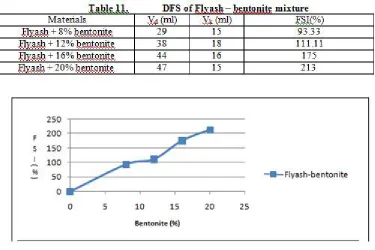
Table Error! No text of specified style in document.. DFS of fly ash – bentonite mixture
Materials Vd (ml) Vk (ml) FSI(%)
Flyash + 8% bentonite 29 15 93.33
Flyash + 12% bentonite 38 18 111.11
Flyash + 16% bentonite 44 16 175
Flyash + 20% bentonite 47 15 213
Materials Vd (ml) Vk (ml) FSI(%)
Flyash 10 10 0
Figure 1:Free swell index of fly ash and bentonite mixtures.
5. ATTERBERG LIMITS:
a) Determination of Plastic Limit:
Plastic limit represents the water content at which a soil would just begin to crumble when rolled into a thread of approximately 3 mm diameter, this test were conducted to determine the plastic limit as per IS 2720(part V)-1985.
Table 6. Plastic limit of fly ash – bentonite mixture Sl
no
Mate-rials Mass of container (M1) in gm
Mass of container+wet thread sample (M2)in gm
Mass of container + dry thread sample
(M3) in gm
Plastic limit
1 Flyash 18 31 29
Non-plastic
2 Bentonite 22 26.5 24 125
3 Flyash + 8% bentonite
18 32 30
Non-Plastic 4 Flyash + 12%
bentonite
18 28 26 25
5 Flyash + 16% bentonite
18 26 25 14.28
6 Flyash + 20% bentonite
18 25 23 41.43
0 50 100 150 200 250
0 10 20 30
FS
I %
Bentonite %
b) Determination of liquid limit:
Test for liquid limit was conducted according to IS 2720 (part V)-1985 in the Cassagrande’s liquid limit device.
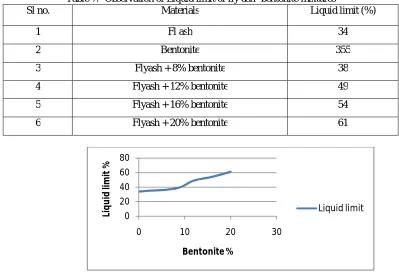
Table 7. Observation of Liquid limit of fly ash- bentonite mixtures
Sl no. Materials Liquid limit (%)
1 Fl ash 34
2 Bentonite 355
3 Flyash + 8% bentonite 38
4 Flyash + 12% bentonite 49
5 Flyash + 16% bentonite 54
6 Flyash + 20% bentonite 61
Figure 1. Liquid limit with increase in % of bentonite in fly ash
c) Determination of Plasticity Index
Plasticity Index (Ip) is obtained by calculating the difference between Liquid Limit and Plastic Limit i.e., PI = (LL-PL).
Table 8. Plasticity index of fly ash- bentonite mixtures
Sl no Materials Liquid limit Plastic limit Plasticity index
1 Flyash 34 Non-plastic Non-plastic
2 Bentonite 355 125 230
3 Flyash + 8% bentonite 38 16.66 21.34 (Non-plastic)
4 Flyash + 12% bentonite 49 25 24
5 Flyash + 16% bentonite 54 32 22
6 Flyash + 20% bentonite 61 41.43 19.57
6. Standard Proctor Test:
To determine the dry density and moisture content relation of soil and to find OMC and MDD from the relationship, standard proctor test is done.
0 20 40 60 80
0 10 20 30
Li
q
u
id
li
m
it
%
Bentonite %
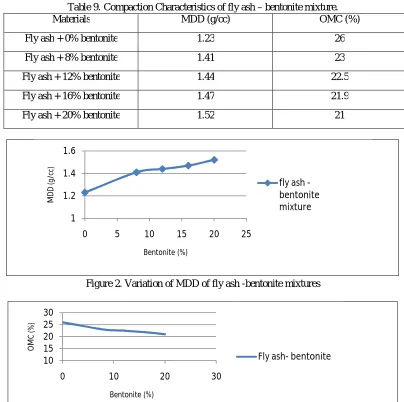
Table 9. Compaction Characteristics of fly ash – bentonite mixture.
Materials MDD (g/cc) OMC (%)
Fly ash + 0% bentonite 1.23 26
Fly ash + 8% bentonite 1.41 23
Fly ash + 12% bentonite 1.44 22.5
Fly ash + 16% bentonite 1.47 21.9
Fly ash + 20% bentonite 1.52 21
Figure 2. Variation of MDD of fly ash -bentonite mixtures
Figure 4. Variation of OMC of fly ash – bentonite mixtures.
7. DETERMINATION OF PERMEABILITY:
The falling head permeability test is a common laboratory testing method used to determine the permeability of fine grained soils with intermediate and low permeability such as silts and clays. This testing method can be applied to an undisturbed sample.
10 15 20 25 30
0 10 20 30
O
M
C
(%
)
Bentonite (%)
Fly ash- bentonite 1
1.2 1.4 1.6
0 5 10 15 20 25
M
D
D
(g
/c
c)
Bentonite (%)
Table 10. Permeability of fly ash - bentonite mixtures
SN Materials Coefficient of Permeability (cm/sec)
1 Flyash+ 0% bentonite 142.3× 10⁻⁷
2 Flyash + 8% bentonite 1.92× 10⁻⁷
3 Flyash + 12% bentonite 1.23× 10⁻⁷
4 Flyash + 16% bentonite 0.8× 10⁻⁷
5 Flyash + 20% bentonite 0.26× 10⁻⁷
8. FREE SWELL INDEX:
To determine the free swell index of soil as per IS: 2720 (Part XL) – 1977, the apparatus used are IS Sieve of size 425µ,Oven,Balance, with an accuracy of 0.01g,Graduated glass cylinder- 2 nos., each of 100ml capacity, and Kerosene. Take two specimens of 10g each of sample passing through 425µm IS Sieve and oven-dry. Pour each specimen into a graduated glass cylinder of 100ml capacity, now pour distilled water in one and kerosene oil in the other cylinder upto 100ml mark. Remove entrapped air by gently shaking or stirring with a glass rod, allow the suspension to attain the state of equilibrium (for not less than 24hours).Final volume of sample in each of the cylinder should be read out. Free swell index = [Vd – Vk] / Vk x 100%
where,
Vd = volume of soil specimen read from the graduated cylinder containing distilled water.
Vk = volume of soil specimen read from the graduated cylinder containing kerosene.
IV. MODELLING OF LANDFILL LINER
1. MODEL OF LANDFILL LINER USING FLYASH – BENTONITE MIXTURE.
A model of landfill is prepared using 25 liter container. At bottom make a hole and place platic bag to collect the leachate.1/3rd of the container is filled with compacted Flyash and 16% bentonite mixture liner at OMC. Then household waste are placed on the liner and covered with soil.Two layers of waste are placed on the liner, watered it at each layer. Sprinkle water everyday and after some days measure the amount of laechate passes through liner. The stepwise process of engineered landfill model is shown in figures given below.
V. CONCLUSION
increasing. The Differential Free Swell of the mixture increased with the addition of bentonite, resulting as a better sealant. At addition of 16% bentonite in fly ash, the material has 0.8×10⁻⁷ cm/sec which is less than 1×10⁻⁷ cm/sec (recommended permeability of liner). Haudraulic conductivity of fly ash- bentonite mixture decreased linearly with increased amount of bentonite. 16% - 20% increase in bentonite content in fly ash, induced plasticity which led to better bonding between particles upon compaction and had the required hydraulic conductivity and strength properties to be used as a liner material. Hence fly ash -bentonite mixture is suitable as liner material with 16% -20%bentonite. Based on model of engineered landfill it is observed that fly ash as liner material alone cannot be good material for engineered landfill whereas a compacted mixture of bentonite with fly ash with the percent of bentonite in the mixture between 16-20 % is good for liner material for engineered landfill.
REFERENCES
[1] Alam J. Alam M.M. And Ahmad A.(2012) ”seepage characteristics and geotechnical properties of fly ash mixed with bentonite",
International Journal of Scientific and Engineering Approach, Vol. 4
[2] Cheremisinoff, P. N., & Gigliello, K. A. (1983). Leachate from hazardous wastes sites.
[3] Daniel, D. E., & Benson, C. H. (1990). Water content-density criteria for compacted soil liners. Journal of Geotechnical Engineering, 116(12), 1811-1830.
[4] George, M., & Beena, K. S. (2011). Geotechnical characteristics of leachate-contaminated lateratic soil. carbon (TOC), 5500(5580), 8370.
[5] Giroud, J. P., Badu-Tweneboah, K., & Soderman, K. L. (1997). Comparison of Leachate Flow Through Compacted Clay Liners in Landfill Liner Systems. Geosynthetics International, 4(3-4), 391-431.
[6] Jayasekera, S., & Mohajerani, A. (2001). A study of effects of municipal landfill leachate on a basaltic clay soil. Australian Geomechanics, 36(4), 63-73.
[7] Katsumi, T., Benson, C. H., Foose, G. J., & Kamon, M. (2001). Performance-based design of landfill liners. Engineering Geology, 60(1), 139-148
[8] Mollamahmutoğlu, M., & Yilmaz, Y. (2001). Potential use of fly ash and bentonite mixture as liner or cover at waste disposal
areas. Environmental Geology, 40(11), 1316-1324.
[9] Nayak, K. (2015). Application of Coal Ash-Bentonite Mixtures as Landfill Liner (Doctoral dissertation).
[10] Phani Kumar, B. R., & Sharma, R. S. (2004). Effect of fly ash on engineering properties of expansive soils. Journal of Geotechnical and Geoenvironmental Engineering, 130(7), 764-767.
[11] Prakash, A., & Poulose, E. (2016). Kuttanad Clay Amended Laterite As A Landfill Liner For Waste Disposal Facilities. International Journal Of Scientific Engineering And Research (Ijser), 4, 75-78.
[12] Tijani, M. N., & Bolaji, O. P. (2007). Sorption and engineering characteristics of some clay/shale deposits from Nigeria as landfill liner. In International meeting, clays in natural and engineered barriers for radioactive waste confinement, Lille, France (pp. 376-378).
[13] Younus, M. M., & Sreedeep, S. (2012). Evaluation of bentonite-fly ash mix for its application in landfill liners. Journal of Testing and Evaluation, 40(3), 357-362.
BIOGRAPHY
1. Rehana parveen, completed B.tech and now persuing M.tech from Assam Down Town University, Guwahati, Assam.