New Constructions and Proof Methods for Large Universe
Attribute-Based Encryption
Yannis Rouselakis
University of Texas at Austin
[email protected]
Brent Waters
University of Texas at Austin
[email protected]
Abstract
We propose two large universe Attribute-Based Encryption constructions. In a large universe ABE construction any string can be used as an attribute and attributes need not be enumerated at system setup. Our first construction establishes a novel large universe Ciphertext-Policy ABE scheme on prime order bilinear groups, while the second achieves a significant efficiency improvement over the large uni-verse Key-Policy ABE systems of Lewko-Waters and Lewko. Both schemes are selectively secure in the standard model under two “q-type” assumptions similar to ones used in prior works. Our work brings back “program and cancel” techniques to this problem.
1
Introduction
Traditionally, public key encryption schemes provided any user with the ability to share data with another specific user in a private manner. However, in many applications we would like to have the additional capability to encrypt data for a set of users according to a specific policy on their credentials. For example, one might want to store data in a public server such that only parties with credentials of specific forms are able to decrypt. Instead of encrypting the data once for each party it would be beneficial to be able to encrypt only once for all desired parties. This encryption notion, calledAttribute-Based Encryption (ABE), was introduced by Sahai and Waters [35]. In this setting, each user possesses a set of attributes/credentials and a secret key that corresponds to these credentials. The encrypting party can define any Boolean formula on the possible attributes and a user can decrypt if and only if his attribute set satisfies the Boolean formula. Several Attribute-Based constructions have been presented since then (see related work below). A com-mon classification property is whether a system is a “small universe” or “large universe” constructions. In “small universe” constructions the size of the attribute space is polynomially bounded in the security pa-rameter and the attributes were fixed at setup. Moreover, the size of the public papa-rameters grew linearly with the number of attributes. In “large universe” constructions, on the other hand, the size of the attribute universe can be exponentially large and is thus desirable to have
Achieving the large universe property can be challenging. Different works either imposed restrictions on the expressiveness of the policies or were proved secure in the random oracle model. For example, in [20] a boundnwas fixed at setup on the number of attributes that could be used while encrypting a message. For constructions that had no bounds on the expressiveness of policies and constant sized public parameters, the random oracle security model was used.
The above restrictions place undesirable burdens on the deployment of ABE schemes. If the designer of the system desires the benefits of avoiding the random oracle heuristic, he has to pick a specific bound for the expressiveness of the system at the setup time; either the size of the attribute universe or the bound on the policies. If the bound is too small, the system might exhaust its functionality and will have to be completely rebuilt. For example, consider the design of a framework that allows Attribute-Based Encryption in a huge multinational company and suppose that, as this company expands, a large number of new attributes have to be added to the system. If this number exceeds the bound set during the initial deployment of the system, then the company would have to re-deploy the (expanded) system and possibly re-encrypt all its data spending a huge amount of expenses. On the other hand, if the bound chosen is too big, the increased size of the public parameters will impose an unnecessary efficiency burden on all operations.
The first large universe constructions in the standard model were presented in the recent work of Lewko and Waters [25]. They presented the first large universe 1 KP-ABE construction, secure in the standard
model. The system was provedselectively secure under static assumptions. They utilized the dual system framework on composite order groups to prove security.
While this framework is highly useful for the proofs, the actual constructions require use of bilinear groups of large composite order. As a result, these schemes sustain a significant efficiency overhead in comparison to prime order ABE constructions. In a recent result [22] building on [30, 32, 23, 17], one can actually “emulate” the effects of the composite order groups by creating special subspaces of vectors, calleddual vector spaces, and construct a large universe KP-ABE scheme on prime order groups. While this improves the efficiency of the original construction, there is still a significant performance penalty due to the required size of the vectors. To the best of our knowledge, no large universe CP-ABE construction secure in the standard model (on prime or composite order groups) and with constant-size public parameters has been published.
Goals and Contributions We present new constructions and proof techniques for Large Universe ABE in the standard model. Departing from recent trends our work constructions that are proved selectivity secure using what is know as partitioning style techniques.
We believe that this is an interesting avenue to explore for two reasons. First, by considering selective
1The authors of [25] refer to their construction as an “unbounded” scheme. We prefer the more specific terminology of small
model of security we are able to get more efficient and more practical constructions. While full security is the strongest notion of security, we believe selective is still a meaningful notion and can be a reasonable trade off for performance in some circumstances. In addition, new partitioning proofs can give different and new insights into the security of a construction or style of construction.
Second, Lewko and Waters [26] recently showed a surprising connection between Dual System Encryption and older selective proofs. Prior fully secure ABE systems [23] required an additional (relative to selective schemes) limitton the number of times an attribute could be used in a formula. The public parameters and ciphertext size for KP-ABE (key size for CP-ABE) grew proportionally to the boundt. Lewko and Waters showed that through a new “delayed parameter” variant of Dual System Encryption this limit could be done away with. An integral part of their proof was that it leveraged older “program and cancel” style techniques. Given this recent work, a reasonable conclusion is that developing selectively secure proofs might typically become a first step to developing full security. (We note that the large universe construction of [25] was only proved selectively secure.)
We aim to get practical large universe ABE schemes by adapting and expanding the system from [25] into the prime order setting. In proving security we go back to more traditional “program and cancel” techniques instead of the dual system framework.
We present two practical large universe ABE constructions (one CP-ABE and one KP-ABE) in prime order bilinear groups both selectively secure in the standard model under two differentq-type assumptions. Our three main objectives in this work were large universe constructions, efficiency, and security in the standard model. Both schemes support a “large universe” attribute space and their public parameters consist of a constant number of group elements. No bounds or other restrictions are imposed on the monotonic Boolean formulas or the attribute sets used by the algorithms of the schemes; thus eliminating the need for design decisions at setup. The efficiency objective refrained us from using composite order groups or dual pairing vector spaces, while to achieve security in the standard model we relied to non static (q-type) assumptions and selective notions. These assumptions are non static in the sense that a polynomial number of terms is given to the adversary and therefore they are intuitively stronger than the static ones. However, the polynomial number of terms gives the ability to the simulator of the proof to embed the additional entropy in the constant number of public parameters. We showcase different techniques for harnessing the power of these assumptions to achieve our large universe constructions. Finally, we demonstrate the efficiency of our constructions by implementing our schemes. We compare performance results to other ABE schemes in prime order groups.
Our Techniques The techniques used to achieve our goals and prove the security of our schemes fall in the category of partitioning methodologies. In this setting the simulator of the reduction sets up the public parameters of the systems in such a way that the set of the possible policies (for KP-ABE) or the powerset of the attribute universe (for CP-ABE) is partitioned in two disjoint sets. One for which he can create the secret keys and answer the attackers’ queries, and one for which this is not possible, where the challenge query should belong. Since we are dealing with selective security notions, the simulator knows in advance the required challenge set and therefore the suitable partition. However due to the fact that we are aiming for large universe ABE, which implies constant size public parameters, the simulator has to embed a polynomial amount of “challenge information” in them. This is achieved by utilizing the non static power of our assumptions. Namely, the assumptions’ “size” depends on the size of the declared challenge query. The additional terms available to the simulator allow him to create all the necessary terms for the reduction.
term” in the public parameters is being used to allow correct decryption using the master secret key. As we will see, the assumptions and the corresponding reductions follow closely this “layer” intuition.
Finally, we mention that both constructions use the “individual randomness” technique from [25] in the “attribute layer” to achieve the large universe functionality. The component for each attribute is masked by a different randomness and as a result no restrictions are imposed on the policies or the attributes, since each component is individually randomized.
1.1
Related Work
Attribute-Based Encryption was introduced by Sahai and Waters [35]. The refinement of the two notions was given in [20] and many CP-ABE and KP-ABE selectively secure constructions followed [6, 15, 19, 33, 34, 43]. Most of them work for non monotonic access structures with the exception of the schemes by Ostrovsky, Sahai, and Waters [33], who showed how to realize negation by incorporating specific revocation schemes into the GPSW construction. Fully secure constructions in the standard model were first provided by Okamoto and Takashima [32] and Lewko, Okamoto, Sahai, Takashima, and Waters [23]. The first large universe KP-ABE construction in the standard model was given in [25] (composite order groups). Okamoto and Takashima initiated the dual pairing vector space framework in various works [30, 31, 32], which lead to the first large universe KP-ABE construction in prime order group groups by Lewko [22]. Parameterized (non static) assumptions were introduced in [7] and used in several subsequent works [18, 43]. The problem of an environment with multiple central authorities in ABE was considered in [13, 14, 24], while several authors have presented schemes that do not address the problem of collusion resistance [40, 28, 11, 2, 3, 4].
We note that several techniques in ABE schemes have roots in Identity-Based Encryption [36, 8, 16, 7, 42, 18, 9]. Finally, we mention here the related concept of Predicate Encryption introduced by Katz, Sahai, and Waters [21] and further refined in [38, 37, 31, 23, 32, 10].
1.2
Organization
In section 2 we introduce some notation, provide background information about linear secret sharing schemes, and introduce the complexity assumption for our CP-ABE scheme. Section 3 contains the algorithms and the selective security definition for CP-ABE schemes. Our CP-ABE construction and the security proof are in section 4. Finally, implementations and efficiency results are presented in section 5. The assumption for our KP-ABE construction is in appendix A. In appendices B and C we present the KP-ABE algorithms with the security definition, and our KP-ABE construction with the security proof, respectively. The generic group model proofs of our assumptions are shown in appendix D.
2
Preliminaries
2.1
Notation
Forn∈N, we define [n]def.= {1,2, . . . , n}. Also, forn1, n2, . . . , nk∈N: [n1, n2, . . . , nk]
def.
= [n1]×[n2]×. . .×
[nm]. When S is a set, we denote by s
$
← S the fact that the variable s is picked uniformly at random
fromS. We writes1, s2, . . . , sn
$
← S as shorthand for s1 $
← S, s2 $
← S, . . . , sn
$
← S. Bynegl(n) we denote a negligible function inn and by PPT probabilistic polynomial-time. F(S1→ S2) is defined to be the set of
functions from setS1 toS2.
The set of matrices of sizem×nwith elements inZpis denoted byZm×n
p . Special subsets are the set of row vectors of lengthn: Z1×n
p , and column vectors of lengthn: Znp×1. A row vector is written explicitly as (v1, v2, . . . , vn), while a column vector as (v1, v2, . . . , xn)⊥. When~v is a vector (of any type), we will denote byvi thei-th element. We denote byh~v1, ~v2ithe inner product of vector~v1 with~v2, where each vector can
2.2
Access Structures and Linear Secret-Sharing Schemes
In this subsection, we present the formal definitions of access structures and linear secret-sharing schemes introduced in [5], adapted to match our setting. Our constructions use these tools to encode authorized sets of attributes, encrypt, and decode.
Definition 2.1 (Access Structures [5]). Let U be the attribute universe. An access structure on U is a collectionAof non-empty sets of attributes, i.e. A⊆2U \ { }. The sets inAare called the authorized sets and the sets not inAare called the unauthorized sets.
Additionally, an access structure is called monotoneif ∀B, C ∈A:if B∈AandB⊆C, thenC∈A.
The idea in the CP-ABE setting is that a user of the system possess a set of attributes that can be either authorized and he can decrypt, or unauthorized and he can not get any information from the ciphertext. In the KP-ABE setting, a ciphertext is encrypted using a set of attributes and each user has one or more keys for specific access structures. The ciphertext is meant to be decrypted only by users’ keys where the set of attributes is authorized for the keys’ access structures.
In our constructions, we only consider monotone access structures, which means that as a user (CP-ABE setting) acquires more attributes, he will not lose his possible decryption privileges. General access structures in large universe ABE can be realized by splitting the attribute universe in half and treating the attributes of one half as the negated versions of the attributes in the other half [20].
Definition 2.2(Linear Secret-Sharing Schemes (LSSS) [5]). Let pbe a prime and U the attribute universe. A secret-sharing schemeΠ with domain of secretsZp realizing access structures on U is linear overZp if
1. The shares of a secrets∈Zp for each attribute form a vector overZp.
2. For each access structureAonU, there exists a matrixM ∈Z`p×n, called the share-generating matrix, and a function ρ, that labels the rows of M with attributes from U, i.e. ρ∈ F([`]→ U), which satisfy the following:
During the generation of the shares, we consider the column vector~v= (s, r2, . . . , rn)⊥, wherer2,. . .,
rn
$
←Zp. Then the vector of `shares of the secretsaccording to Πis equal toM~v∈Z`p×1. The share (M~v)j wherej∈[`] “belongs” to attributeρ(j).
We will be referring to the pair(M, ρ)as the policy of the access structureA.
According to [5], each secret-sharing scheme (not only the linear ones) should satisfy thereconstruction requirement (each authorized set can reconstruct the secret) and thesecurity requirement (any unauthorized set cannot reveal any partial information about the secret).
In our setting, let S denote an authorized set for the access structureA encoded by the policy (M, ρ). Then let I be the set of rows whose labels are in S, i.e. I = {i|i∈[`]∧ρ(i)∈ S}. The reconstruction requirement asserts that the vector (1,0, . . . ,0) is in the span of rows of M indexed byI. This means that there exist constants{ωi}i∈I inZpsuch that for any valid shares{λi= (M~v)i}i∈I of a secretsaccording to Π, it is true that: P
i∈Iωiλi=s. Additionally, it has been proved in [5] that the constants{ωi}i∈I can be found in time polynomial in the size of the share-generating matrixM.
On the other hand, for unauthorized sets S0 no such constants {ω
i} exist. Moreover, in this case it is also true that ifI0={i|i∈[`]∧ρ(i)∈ S0}, there exists a vectorw~ ∈
Z1p×n, such that its first component w1
is any non zero element inZpandhMi, ~wi= 0 for alli∈I0, whereMi= (Mi,1, Mi,2, . . . , Mi,n); thei-th row ofM.
Finally, we note that if the access structure is encoded as a monotonic Boolean formula over attributes2,
there is a generic algorithm that generates the corresponding access policy in polynomial time [5, 24].
2A monotonic Boolean formula consists of only AND and OR gates, for exampleA
1∧(A2∨A3). This means that as a key
2.3
Assumption 1
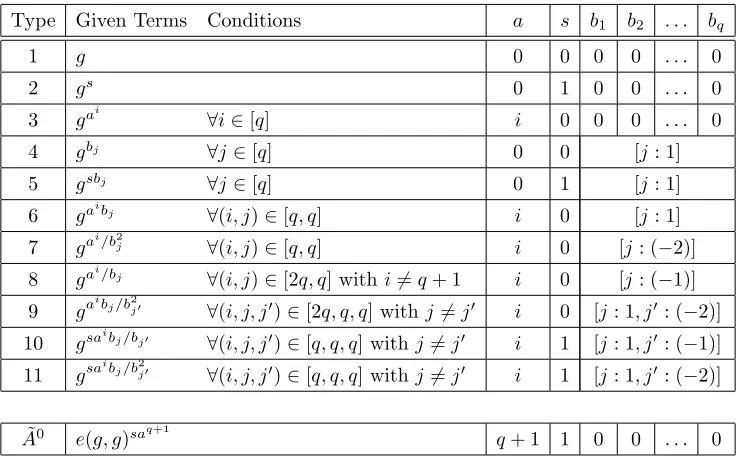
For our CP-ABE construction we will use a q-type assumption on prime order bilinear groups, denoted byq-1, which is similar to the Decisional Parallel Bilinear Diffie-Hellman Exponent Assumption [43]. It is parameterized by a security parameterλ∈Nand an integerq, polynomial inλ. We assume that there exists a group generator algorithmG(1λ)→(p,
G,GT, e) that outputs the description of the (symmetric) bilinear group of orderp= Θ(2λ). The generic security of the assumption is shown in appendix D. It is defined via the following game between a challenger and an attacker:
Initially the challenger calls the group generation algorithm with input the security parameter, picks a
random group element g←$ G, andq+ 2 random exponentsa, s, b1, b2, . . . , bq
$
←Zp. Then he sends to the attacker the group description (p,G,GT, e) and all of the following terms:
g, gs
gai
, gbj, gsbj, gaibj, gai/b2j ∀(i, j)∈[q, q]
gai/bj ∀(i, j)∈[2q, q] withi6=q+ 1
gaibj/b2j0 ∀(i, j, j0)∈[2q, q, q] withj6=j0
gsaibj/bj0, gsaibj/bj20 ∀(i, j, j0)∈[q, q, q] with j6=j0
In the challenge phase, the challenger flips a random coinb← {$ 0,1}and if b= 0, it gives to the attacker
the term e(g, g)saq+1. Otherwise it gives a random term R ←$
GT. Finally the attacker outputs a guess
b0 ∈ {0,1}.
Definition 2.3. We say that theq-1 assumption holds if all PPT attackers have at most a negligible advan-tage inλin the above security game, where the advantage is defined asAdv= Pr [b0=b]−1/2.
Remark: Notice the absence of the termgaq+1/bj in the third line of the assumption. If this term were
given to the attacker, then he could break the assumption trivially by pairing it with the correspondinggsbj
term. On the other hand, the term gaq+1bj/b2j0 is given, and this poses no problems in the generic group
model since j 6=j0 and by possible pairing the adversary cannot get rid of the bj’s. See appendix D for further details.
3
Ciphertext-Policy Attribute-Based Encryption
3.1
Algorithms
A Ciphertext-Policy Attribute-Based Encryption scheme consists of the following four PPT algorithms:
•Setup(1λ)→(pp, msk): TheSetupalgorithm takes the security parameterλ∈Nencoded in unary and outputs the public parameters pp and the master secret key msk. We assume that the public parameters contain a description of the attribute universeU. 3
• KeyGen(1λ, pp, msk,S)→sk: The key generation algorithm takes as inputs the public parameterspp, the master secret keymsk and a set of attributesS ⊆ U. The security parameter is included in the inputs to ensure that it is polynomial time inλ. The algorithm generates a secret key corresponding toS.
• Encrypt(1λ, pp, m,
A) → ct: The encryption algorithm takes as inputs the public parameters pp, a plaintext messagem, and an access structureAonU. It outputs the ciphertextct.
• Decrypt(1λ, pp, sk, ct) → m: The decryption algorithm takes as inputs the public parameters pp, a secret keysk, and a ciphertextct. It outputs the plaintextm.
3In previous CP-ABE constructions the attribute universe U was one of the arguments of the Setup algorithm. In the
Correctness: We require that a CP-ABE scheme is correct, i.e the decryption algorithm correctly decrypts a ciphertext of an access structure A with a secret key onS, when S is an authorized set of A. Formally:
Definition 3.1. A CP-ABE scheme is correctwhen for all messagesm, and all attribute setsS and access structuresAwith S ∈A(i.e. for S authorized):
Pr
Decrypt(1λ, pp, sk, ct)6=m
(pp, msk)←Setup(1λ)
sk←KeyGen(1λ, pp, msk,S)
ct←Encrypt(1λ, pp, m, A)
≤negl(λ)
where the probability is taken over all random coins of all algorithms.
Remarks: According to the above definition of CP-ABE, all algorithms exceptSetuptake as input the security parameter and the public parameters. Since these are meant to be publicly available to anyone, we will omit writing them explicitly in the construction; for example we will write KeyGen(msk,S) meaning
KeyGen(1λ, pp, msk,S).
Also, for the encryption algorithm Encrypt, we will assume that its last input is not an access structure A, but the corresponding policy (M, ρ). Of course the transformation from monotone Boolean formulas to policies is included in the running times of the implementations in section 5.
3.2
CP-ABE Selective Security
In this section we present the definition of selective security for CP-ABE schemes. This is described by a game between a challenger and an attacker and is parameterized by the security parameter λ ∈ N. The phases of the game are the following:
• Initialization: In this phase the attacker declares the challenge access structureA∗, which he will try to attack, and sends it to the challenger.
• Setup: Here the challenger calls theSetup(1λ) algorithm and sends the public parameterspp to the attacker.
•Query Phase 1: In this phase the attacker can adaptively ask for secret keys for the sets of attributes
S1,S2, . . . ,SQ1. For eachSi the challenger calls KeyGen(msk,Si)→ski and sendsski to the attacker. The restriction that has to be satisfied for each query is that none of the queried sets satisfies the challenge access structure, i.e. ∀i∈[Q1] :Si∈/A∗.
• Challenge: The attacker declares two equal-length plaintexts m0 and m1 and sends them to the
challenger. He flips a random coinb∈ {0,1}and calls Encrypt(mb,A∗)→ct. He sendsctto the attacker.
• Query Phase 2: This the same as query phase 1. The attacker asks for the secret key for the sets
SQ1+1,SQ1+2, . . . ,SQ, for which the same restriction holds: ∀i∈[Q] :Si∈/A
∗.
• Guess: The attacker outputs his guessb0∈ {0,1} forb.
Definition 3.2. A CP-ABE scheme is selectively secure if all PPT attackers have at most a negligible advantage inλin the above security game, where the advantage of an attacker is defined asAdv= Pr [b0 =b]−
1/2.
4
Our Large Universe CP-ABE
4.1
Construction
Our scheme consists of the following four algorithms:
• Setup(1λ)→(pp, msk): The setup algorithm calls the group generator algorithmG(1λ) and gets the descriptions of the groups and the bilinear mapping D = (p,G,GT, e), where pis the prime order of the groupsGandGT. The attribute universe isU =Zp.
Then the algorithm picks the random termsg, u, h, w, v←$ Gandα←$ Zp. It outputs
pp= (D, g, u, h, w, v, e(g, g)α) msk= (α)
• KeyGen(msk,S ={A1, A2, . . . , Ak} ⊆Zp)→ sk: Initially, the key generation algorithm picks k+ 1 random exponentsr, r1, r2, . . . , rk
$
←Zp. Then it computesK0=gαwr, K1=gr, and for everyτ∈[k]
Kτ,2=grτ andKτ,3= (uAτh)rτv−r
The secret key output issk= (S, K0, K1,{Kτ,2, Kτ,3}τ∈[k]).
• Encrypt(m∈ GT,(M, ρ)∈(Zp`×n,F([`]→ Zp))) →ct: The encryption algorithm takes the plaintext messagemand picks~y= (s,y2,. . .,yn)⊥
$
←Znp×1. In the terminology of section 2.2,sis the random secret to be shared among the shares. The vector of the shares is
~
λ= (λ1, λ2, . . . , λ`)⊥=M ~y
It then picks `random exponentst1, t2, . . . , t`
$
←Zp and calculatesC=m·e(g, g)αs, C0=gs, and for
everyτ ∈[`]
Cτ,1=wλτvtτ, Cτ,2= (uρ(τ)h)−tτ andCτ,3=gtτ
The ciphertext output isct= ((M, ρ), C, C0,{Cτ,1, Cτ,2, Cτ,3}τ∈[`]).
• Decrypt(sk, ct)→m: Firstly, the decryption algorithm calculates the set of rows inM that provide a share to attributes in S, i.e. I ={i:ρ(i)∈S}. Then it computes the constants{ωi∈Zp}i∈I such that
P
i∈IωiMi= (1,0, . . . ,0), whereMi is thei-th row of the matrixM. According to the discussion in section 2.2, these constants exist if the setS is an authorized set of the policy.
Then it calculates
B= Q e(C0, K0)
i∈I(e(Ci,1, K1)e(Ci,2, Kτ,2)e(Ci,3, Kτ,3))
ωi
whereτ is the index of the attributeρ(i) inS (it depends on i). The algorithm outputsm=C/B.
Correctness: If the attribute set S of the secret key is authorized, we have that P
i∈Iωiλi = s. Therefore:
B= e(g, g)
αse(g, w)rs
Q
i∈Ie(g, w)rωiλie(g, v)rtiωie(g, uρ(i)h)−rτtiωie(g, uρ(i)h)rτtiωie(g, v)−rtiωi = e(g, g)
αse(g, w)rs
e(g, w)rP
i∈Iωiλi =e(g, g)
αs
4.2
Proof of Selective Security
We will prove the following theorem regarding the selective security of our CP-ABE scheme:
Proof. To prove the theorem we will assume that there exists a PPT attackerA with a challenge matrix that satisfies the restriction, which has a non negligible advantageAdvAin selectively breaking our scheme.
Using this attacker we will build a PPT simulatorB that attacks theq-1 assumption with a non negligible advantage.
Initialization: Breceives the given terms from the assumption and a challenge policy (M∗, ρ∗) fromA. We have thatM∗ is an`×nmatrix, where`, n≤q, andρ∗∈ F([`]→Zp).
Setup: The simulator B has to provide Athe public parameters of the system. In order to do that it implicitly sets the master secret key of the scheme to beα=aq+1+ ˜α, wherea, q are set in the assumption
and ˜α ←$ Zp is a known to B random exponent. Notice that this way αis correctly distributed and a is information-theoretically hidden fromA. Then B picks the random exponents ˜v,u,˜ ˜h←$ Zp and using the assumption gives toAthe following public parameters:
g=g w=ga
v=gv˜·Q
(j,k)∈[`,n]
gak/bj
Mj,k∗
u=gu˜·Q
(j,k)∈[`,n]
gak/b2j
Mj,k∗
h=g˜h·Q
(j,k)∈[`,n]
gak/b2j
−ρ∗(j)Mj,k∗
e(g, g)α=e(ga, gaq)·e(g, g)α˜
The termwis properly distributed inA’s view because the the terme(g, g)αhides the exponenta information-theoretically. The termsv, u, hare also properly distributed due to ˜v,u,˜ ˜h, respectively. Notice that all terms can be calculated by the simulator using suitable terms from the assumption and the challenge policy given byA.
As one can see, the “attribute layer”, which consists of the terms u, h, is made up of terms whose exponents haveb2i in the denominator, the “binder term”vhasbi, and the “secret sharing layer”whas only one power ofa. This scaling of the powers ofbi will allow our simulator to properly simulate all terms.
Query phases 1 and 2: Now the simulator has to produce secret keys for non authorized sets of attributes requested byA. In both phases the treatment is the same. We describe here the wayBworks in order to create a key for an attribute setS=A1, A2, . . . , A|S| received byA.
Since S is non authorized for (M∗, ρ∗), there exists a vector w~ = (w1, w2, . . . , wn)⊥ ∈ Znp such that
w1=−1 and hMi∗, ~wi= 0 for alli∈I ={i|i∈[`]∧ρ∗(i)∈ S}(c.f. section 2.2). The simulator calculates
~
wusing linear algebra. Then it picks ˜r←$ Zp and implicitly sets
r= ˜r+w1aq+w2aq−1+. . .+wnaq+1−n= ˜r+
X
i∈[n]
wiaq+1−i
This is properly distributed due to ˜r. Then using the suitable terms from the assumption it calculates:
K0=gαwr=ga q+1
gα˜gar˜ Y
i∈[n]
gwiaq+2−i=gα˜(ga)r˜
n
Y
i=2
gaq+2−i
wi
K1=gr=gr˜
Y
i∈[n]
gaq+1−i
wi
Additionally, for all τ ∈ [|S|] it has to compute the terms Kτ,2 = grτ and Kτ,3 = (uAτh)rτv−r. The
v−r=v−r˜
gv˜ Y
(j,k)∈[`,n]
gakMj,k∗ /bj
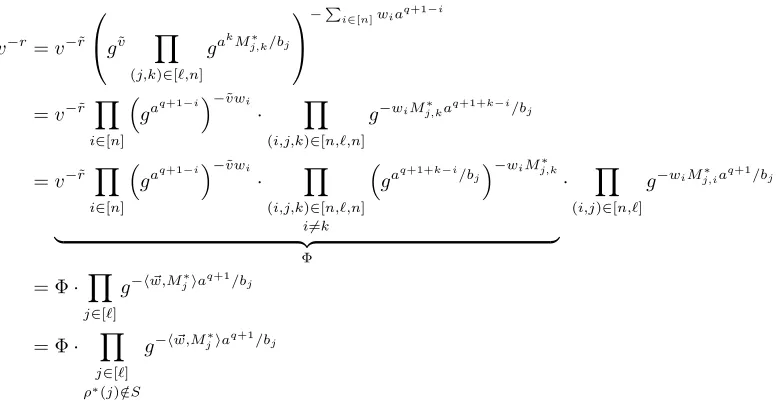
−P
i∈[n]wiaq+1−i
=v−r˜ Y
i∈[n]
gaq+1−i
−vw˜ i
· Y
(i,j,k)∈[n,`,n]
g−wiMj,k∗ aq+1+k −i/b
j
=v−r˜ Y
i∈[n]
gaq+1−i
−vw˜ i
· Y
(i,j,k)∈[n,`,n]
i6=k
gaq+1+k−i/bj
−wiMj,k∗
| {z }
Φ
· Y
(i,j)∈[n,`]
g−wiMj,i∗a q+1/b
j
= Φ· Y
j∈[`]
g−hw,M~ j∗iaq+1/bj
= Φ· Y
j∈[`]
ρ∗(j)∈/S
g−hw,M~ j∗iaq+1/bj
The Φ part can be calculated by the simulator using the assumption, while the second part has to be canceled by the (uAτh)rτ part. So for every attribute A
τ ∈S the simulator sets implicitly
rτ= ˜rτ+r·
X
i0∈[`]
ρ∗(i0)∈/S
bi0
Aτ−ρ∗(i0)
= ˜rτ+ ˜r·
X
i0∈[`]
ρ∗(i0)∈/S
bi0
Aτ−ρ∗(i0)
+ X
(i,i0)∈[n,`]
ρ∗(i0)∈/S
wibi0aq+1−i
Aτ−ρ∗(i0)
where ˜rτ
$
← Zp and thereforerτ is properly distributed. The use of the bi’s in the numerators of the fractions is explained by the “layer” intuition presented before. Namely, these bi will cancel with the b2i denominators in the “attribute layer” and provide a cancellation for the unknown part ofv−r.
Also, notice that rτ is well-defined only for attributes in the specific unauthorized set S or unrelated attributes (outside the policy), since the sum is over thei0 such thatρ∗(i0)∈ S/ . Therefore, for allAτ ∈ S or
Aτ ∈/ ρ∗([`]), the denominatorsAτ−ρ∗(i0) are non zero. If the simulator tries to include more attributes of the policy in the key (and possibly make a key for an authorized set), he would have to divide by zero (c.f. Figure 1).
Zp
ρ∗([`]) S
Therefore the first part ofKτ,3= (uAτh)rτv−r is:
(uAτh)rτ = (uAτh)r˜τ·
g
˜
uAτ+˜h Y
(j,k)∈[`,n]
g(Aτ−ρ∗(j))Mj,k∗ a k/b2
j
˜
r·P
i0 ∈[`],ρ∗(i0)∈/S bi0 Aτ−ρ∗(i0)
·
guA˜ τ+˜h Y
(j,k)∈[`,n]
g(Aτ−ρ∗(j))Mj,k∗ a k/b2
j
P
(i,i0)∈[n,`],ρ∗(i0)∈/Swibi 0aq+1−i Aτ−ρ∗(i0)
= (uAτh)r˜τ·(K
τ,2/g˜rτ)uA˜ τ+˜h·
Y
(i0,j,k)∈[`,`,n]
ρ∗(i0)∈/S
g˜r(Aτ−ρ∗(j))Mj,k∗ bi0a k/(A
τ−ρ∗(i0))b2j
· Y
(i,i0,j,k)∈[n,`,`,n]
ρ∗(i0)∈/S
g(Aτ−ρ∗(j))wiMj,k∗ bi0a
q+1+k−i/(A
τ−ρ∗(i0))b2j
= Ψ· Y
(i,j)∈[n,`]
ρ∗(j)∈/S
g(Aτ−ρ∗(j))wiMj,i∗ bjaq+1+i−i/(Aτ−ρ∗(j))b2j
= Ψ· Y
j∈[`]
ρ∗(j)∈/S
ghw,M~ j∗iaq+1/bj
Where Ψ = (uAτh)r˜τ ·(K
τ,2/gr˜τ)uA˜ τ+˜h·
Y
(i0,j,k)∈[`,`,n]
ρ∗(i0)∈/S
gbi0ak/b2j
r˜(Aτ−ρ∗(j))Mj,k∗ /(Aτ−ρ∗(i0))
· Y
(i,i0,j,k)∈[n,`,`,n]
ρ∗(i0)∈/S,(j6=i0∨i6=k)
gbi0aq+1+k−i/b2j(Aτ−ρ
∗(j))w
iMj,k∗ /(Aτ−ρ∗(i0))
andKτ,2=grτ =gr˜τ ·
Y
i0∈[`]
ρ∗(i0)∈/S
gbi0˜r/(Aτ−ρ ∗(i0))
· Y
(i,i0)∈[n,`]
ρ∗(i0)∈/S
gbi0a
q+1−iwi/(Aτ−ρ∗(i0))
The Ψ and Kτ,2 terms can be calculated using the suitable terms of our assumption4. The second part
of (uAτh)rτ cancels exactly with the problematic part of v−r. Therefore the simulator can calculate K
τ,2
andKτ,3for allAτ ∈ S and hand over the secret keysk= (S, K0, K1,{Kτ,2, Kτ,3}τ∈[|S|]) to the attackerA.
Challenge: The attacker will output a pair of messages (m0, m1) of the same length. In this phase the
simulator flips a random coinb← {$ 0,1} and constructs
C=mb·T·e(g, gs)α˜ and C0=gs
where T is the challenge term andgsthe corresponding term of the assumption.
The simulator sets implicitly~y= s, sa+ ˜y2, sa2+ ˜y3, . . . , san−1+ ˜yn
⊥
, where ˜y2,y˜3, . . . ,y˜n
$
←Zp. We see that the secretsand the vector~y are properly distributed, sinceswas information theoretically hidden fromAand the ˜yi’s are picked uniformly at random. As a result, since~λ=M∗~y we have that
λτ =
X
i∈[n]
Mτ,i∗ sai−1+ n
X
i=2
Mτ,i∗ y˜i=
X
i∈[n]
Mτ,i∗ sai−1+ ˜λτ
4Notice that for the products of Ψ we can havej=i0, but in that case the power ofais different thanq+ 1. So the simulator
for each row τ ∈ [`]. Notice that the terms ˜λτ = P n
i=2Mτ,i∗ y˜i are known to the simulator. For each row the simulator B sets implicitly tτ = −sbτ. This is properly distributed as well, because the bi’s are information theoretically hidden from the attacker. Using the above,Bcalculates:
Cτ,1=wλτvtτ =w ˜
λτ · Y
i∈[n]
gMτ,i∗ sai· gsbτ−˜v· Y (j,k)∈[`,n]
g−Mj,k∗ aksbτ/bj =
=wλ˜τ · gsbτ−v˜· Y
i∈[n]
gMτ,i∗ sa i
· Y
k∈[n]
g−Mτ,k∗ a ksb
τ/bτ · Y (j,k)∈[`,n]
j6=τ
g−Mj,k∗ a ksb
τ/bj =
=wλ˜τ · gsbτ−v˜· Y (j,k)∈[`,n]
j6=τ
gsakbτ/bj
−Mj,k∗
Cτ,2=
uρ∗(τ)h
−tτ
= gsbτ−(˜uρ ∗(τ)+˜h)
·
Y
(j,k)∈[`,n]
g(ρ∗(τ)−ρ∗(j))Mj,k∗ ak/b2j
−sbτ
= gsbτ−(˜uρ ∗(τ)+˜h)
· Y
(j,k)∈[`,n]
j6=τ
gsakbτ/b2j
−(ρ∗(τ)−ρ∗(j))Mj,k∗
Cτ,3=gtτ = gsbτ
−1
Notice that by using tτ =−sbτ we “raised” the exponents of the “binder” term v so that they cancel with the unknown powers ofwλτ. Therefore, the simulator hands over the ciphertextct= ((M∗, ρ∗),C,C
0,
{Cτ,1, Cτ,2, Cτ,3}τ∈[`]) to the attackerA.
Guess: After the query phase 2, where the simulator creates the secret keys as described above, the attacker outputs a guessb0 for the challenge bit. Ifb0 =b the simulator outputs 0, i.e. it claims that the
challenge term isT =e(g, g)saq+1
. Otherwise, it outputs 1. IfT =e(g, g)saq+1
thenAplayed the proper security game, becauseC=mb·T·e(g, gs)α˜=mb·e(g, g)αs. On the other hand, if T is a random term of GT then all information about the messagemb is lost in the challenge ciphertext. Therefore the advantage ofAis exactly 0. As a result ifAbreaks the proper security game with a non negligible advantage, thenBhas a non negligible advantage in breaking theq-1 assumption.
5
Implementation and Evaluation
Implementation Details We implemented our schemes inCharm[1]; a framework developed to facilitate the rapid prototyping of cryptographic schemes and protocols. It is based on the Python language which allows the programmer to write code similar to the theoretical implementations. However, the routines that implement the dominant group operations use the PBC library [27] (written natively in C) and the time overhead imposed by the use ofPythonis usually less than 1%. Charmalso provides routines for applying and using LSSS schemes needed for Attribute-Based systems. AllCharmroutines use formally asymmetric groups (although the underlining groups might be symmetric) and therefore we translated our schemes to the asymmetric setting. Namely, we have three groupsG1,G2 andGT and the pairingeis a function from G1×G2 to GT. The assumptions and the security proofs can be translated to the asymmetric setting in a generic way. For more information on Charm we refer the reader to [12, 1]. The source code of our implementations can be found in [41]5. All our benchmarks were executed on a dual core IntelR XeonR CPU [email protected] with 2.0GB RAM running Ubuntu R10.04 andPython3.2.3.
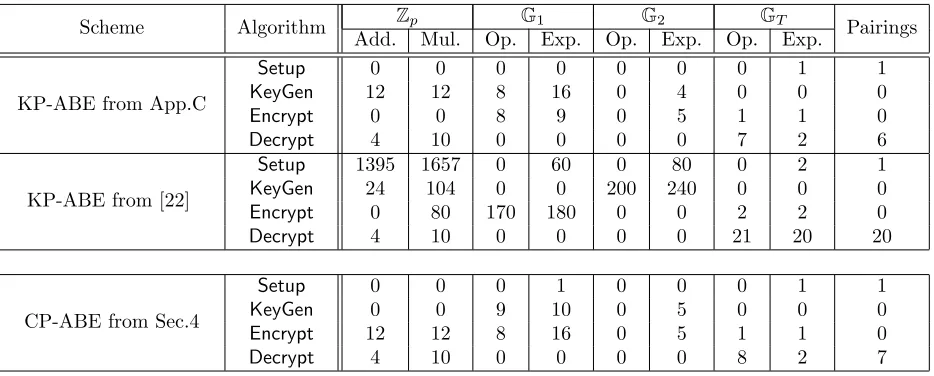
Scheme Algorithm Zp G1 G2 GT Pairings Add. Mul. Op. Exp. Op. Exp. Op. Exp.
KP-ABE from App.C
Setup 0 0 0 0 0 0 0 1 1
KeyGen 12 12 8 16 0 4 0 0 0
Encrypt 0 0 8 9 0 5 1 1 0
Decrypt 4 10 0 0 0 0 7 2 6
KP-ABE from [22]
Setup 1395 1657 0 60 0 80 0 2 1
KeyGen 24 104 0 0 200 240 0 0 0
Encrypt 0 80 170 180 0 0 2 2 0
Decrypt 4 10 0 0 0 0 21 20 20
CP-ABE from Sec.4
Setup 0 0 0 1 0 0 0 1 1
KeyGen 0 0 9 10 0 5 0 0 0
Encrypt 12 12 8 16 0 5 1 1 0
Decrypt 4 10 0 0 0 0 8 2 7
Table 1: Group operation benchmarks. Add. denotes the number of additions and subtractions in theZp group, while Mul. the number of multiplications and divisions. Op. and Exp. denote the numbers of group operations and exponentiations, respectively, in groups G1, G2 andGT. Notice the large number of operations inZp for theSetupof the second scheme, due to the creation of dual vector spaces of dimension 10 (c.f. [22]). We mention that the last scheme is of different type andshould not be compared to the other two.
We implemented our two ABE schemes and the prime order KP-ABE construction from [22]. Actually, in that work a large universe prime order HIBE is provided, but the transformation to KP-ABE is straightfor-ward by substituting in the key generation algorithm the additive shares of the secrets with the LSSS shares and the identities with the attributes ρ(τ). This modified construction is the one we used for comparison to our KP-ABE scheme. At the time of writing this paper only this large universe prime order KP-ABE construction is known. Also, to the best of our knowledge, no large universe CP-ABE constructions in the standard model have been published.
Group Operations (Absolute) In table 1 we show the number of operations in the respective groups for each algorithm of the schemes as counted by theCharmbenchmarking utility. The group operations refer to the number of arithmetic operations in Zp, G1, G2, andGT. These will be the same for all subsequent benchmarks. We notice here that we tried to implement our algorithms so that more operations are executed in theG1 group than in theG2 and that encryption consists mainly of operations inG1, compared to key
generation. The reason is that the time taken to execute them in theG1 group is considerably smaller than
G2 in specific asymmetric groups such as the “MNT224” elliptic curve group. This group was created by
Miyaji, Nakabayashi and Takano [29], where the base field size is 224 bits (see [27] for more information). For the KP-ABE setting the number of group operations during the key generation, encryption, and decryption calls depends linearly on the number of rows in the policy, on the size of the attribute set and the number of rows that are used during decryption, respectively. In the CP-ABE setting the key generation time grows linearly with the size of the attribute set and the encryption time with the number of rows in the policy. In table 1 and all our time benchmarks, we showcase a small example where the policies used are of the form (A∨B)∧(C∨D) and the attribute sets of the form {A, C, E, F}, whereA, B, C, D, E,
F are 6 different attributes. Notice that the attribute set always satisfies the policy; therefore, we measure successful decryptions that utilize 2 rows of the policy (the “A” and “C” row).
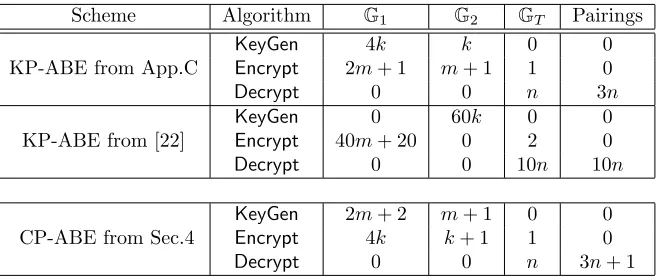
Scheme Algorithm G1 G2 GT Pairings
KP-ABE from App.C
KeyGen 4k k 0 0
Encrypt 2m+ 1 m+ 1 1 0
Decrypt 0 0 n 3n
KP-ABE from [22]
KeyGen 0 60k 0 0
Encrypt 40m+ 20 0 2 0
Decrypt 0 0 10n 10n
CP-ABE from Sec.4
KeyGen 2m+ 2 m+ 1 0 0
Encrypt 4k k+ 1 1 0
Decrypt 0 0 n 3n+ 1
Table 2: Asymptotic growth of the exponentations in the three groups and the pairings. These are the dominant operations in each call. The Setup algorithms have constant size and they are excluded. The
k, m, n parameters denote the number of rows of the policy, the size of the attribute set, and the rows utilized during decryption, respectively. Notice that the parameters k and m have switched algorithms in the CP-ABE case. Thus, the last schemeshould not be compared to the other two.
Time Benchmarks In table 3 we present time benchmarks in different elliptic curve groups by averaging the times of respective algorithms over 10 different instantiations of each scheme. We note that in all of these instantiations the numbers of operations in each group remain the same as the ones shown in table 1, since we used exactly the same attribute sets and policies. One interesting observation is the huge difference between operations in theG1andG2 groups in the asymmetric “MNT” groups. This is most prominent in
the [22]-KP-ABE scheme.
Conclusion Regarding the comparison between our KP-ABE scheme and the only known KP-ABE scheme on prime order groups, we notice the big gap between the asymptotic bounds as well as the timing benchmarks. This is due to the fact that Dual Vector Spaces of high dimension (in this case 10) are utilized, which increase the number of group operations by big factors.
Regarding the practicality, in general, of both our schemes we notice that the KeyGen, Encrypt, and
Curve Scheme Setup KeyGen Encrypt Decrypt
“MNT159”
KP-ABE from App.C 21.0 43.8 44.0 36.9
KP-ABE from [22] 688.2 1671.5 168.5 125.6
CP-ABE from Sec.4 23.3 43.5 53.6 41.9
“MNT201”
KP-ABE from App.C 27.8 59.1 59.2 50.3
KP-ABE from [22] 924.4 2294.2 239.7 173.5
CP-ABE from Sec.4 31.0 58.5 71.5 57.5
“MNT224”
KP-ABE from App.C 34.0 73.6 73.8 61.6
KP-ABE from [22] 1146.1 2878.6 302.3 216.6
CP-ABE from Sec.4 37.8 73.0 87.9 71.6
“SS512”
KP-ABE from App.C 18.9 47.9 30.2 15.1
KP-ABE from [22] 442.8 640.0 480.8 43.8
CP-ABE from Sec.4 24.7 32.6 52.0 16.3
“SS1024”
KP-ABE from App.C 71.2 622.6 393.4 320.8
KP-ABE from [22] 5518.5 9238.7 6931.9 1088.7
CP-ABE from Sec.4 115.5 427.8 665.6 373.0
Table 3: These results are average running times in milliseconds over 10 different instantiations of each scheme. “MNT” are the Miyaji, Nakabayashi, Takano curves (asymmetric pairing groups), while “SS” are super singular curves (symmetric pairing groups). The number after the type of the curve denotes the size of the base field in bits. KeyGenandEncryptare called with attribute sets and policies of size 4, whileDecrypt
References
[1] Joseph A. Akinyele, Matthew Green, and Avi Rubin. Charm: A framework for rapidly prototyping cryptosystems. Cryptology ePrint Archive, Report 2011/617, 2011. http://eprint.iacr.org/.
[2] Sattam S. Al-Riyami, John Malone-Lee, and Nigel P. Smart. Escrow-free encryption supporting cryp-tographic workflow. Int. J. Inf. Sec., 5(4):217–229, 2006.
[3] Walid Bagga, Refik Molva, and Stefano Crosta. Policy-based encryption schemes from bilinear pairings. InASIACCS, page 368, 2006.
[4] Manuel Barbosa and Pooya Farshim. Secure cryptographic workflow in the standard model. In IN-DOCRYPT, pages 379–393, 2006.
[5] Amos Beimel. Secure Schemes for Secret Sharing and Key Distribution. PhD thesis, Dept. of Computer Science, Technion, 1996.
[6] John Bethencourt, Amit Sahai, and Brent Waters. Ciphertext-policy attribute-based encryption. In IEEE Symposium on Security and Privacy, pages 321–334, 2007.
[7] Dan Boneh and Xavier Boyen. Efficient selective-id secure identity-based encryption without random oracles. InEUROCRYPT, pages 223–238, 2004.
[8] Dan Boneh and Matthew K. Franklin. Identity-based encryption from the Weil pairing. In CRYPTO, pages 213–229, 2001.
[9] Dan Boneh, Craig Gentry, and Michael Hamburg. Space-efficient identity based encryption without pairings. InFOCS, pages 647–657, 2007.
[10] Dan Boneh, Amit Sahai, and Brent Waters. Functional encryption: Definitions and challenges. InTCC, pages 253–273, 2011.
[11] Robert W. Bradshaw, Jason E. Holt, and Kent E. Seamons. Concealing complex policies with hidden credentials. InACM Conference on Computer and Communications Security, pages 146–157, 2004.
[12] Charm. http://www.charm-crypto.com.
[13] Melissa Chase. Multi-authority attribute based encryption. InTCC, pages 515–534, 2007.
[14] Melissa Chase and Sherman S. M. Chow. Improving privacy and security in multi-authority attribute-based encryption. In ACM Conference on Computer and Communications Security, pages 121–130, 2009.
[15] Ling Cheung and Calvin C. Newport. Provably secure ciphertext policy ABE. InACM Conference on Computer and Communications Security, pages 456–465, 2007.
[16] Clifford Cocks. An identity based encryption scheme based on quadratic residues. In IMA Int. Conf., pages 360–363, 2001.
[17] David Mandell Freeman. Converting pairing-based cryptosystems from composite-order groups to prime-order groups. InEUROCRYPT, pages 44–61, 2010.
[18] Craig Gentry. Practical identity-based encryption without random oracles. In EUROCRYPT, pages 445–464, 2006.
[20] Vipul Goyal, Omkant Pandey, Amit Sahai, and Brent Waters. Attribute-based encryption for fine-grained access control of encrypted data. In ACM Conference on Computer and Communications Security, pages 89–98, 2006.
[21] Jonathan Katz, Amit Sahai, and Brent Waters. Predicate encryption supporting disjunctions, polyno-mial equations, and inner products. InEUROCRYPT, pages 146–162, 2008.
[22] Allison B. Lewko. Tools for simulating features of composite order bilinear groups in the prime order setting. InEUROCRYPT, pages 318–335, 2012.
[23] Allison B. Lewko, Tatsuaki Okamoto, Amit Sahai, Katsuyuki Takashima, and Brent Waters. Fully secure functional encryption: Attribute-based encryption and (hierarchical) inner product encryption. InEUROCRYPT, pages 62–91, 2010.
[24] Allison B. Lewko and Brent Waters. Decentralizing attribute-based encryption. In EUROCRYPT, pages 568–588, 2011.
[25] Allison B. Lewko and Brent Waters. Unbounded HIBE and attribute-based encryption. In EURO-CRYPT, pages 547–567, 2011.
[26] Allison B. Lewko and Brent Waters. New proof methods for attribute-based encryption: Achieving full security through selective techniques. InCRYPTO, pages 180–198, 2012.
[27] Ben Lynn. The Stanford pairing based crypto library. http://crypto.stanford.edu/pbc.
[28] Gerome Miklau and Dan Suciu. Controlling access to published data using cryptography. In VLDB, pages 898–909, 2003.
[29] Atsuko Miyaji, Masaki Nakabayashi, and Shunzo Takano. Characterization of elliptic curve traces under fr-reduction. InICISC, pages 90–108, 2000.
[30] Tatsuaki Okamoto and Katsuyuki Takashima. Homomorphic encryption and signatures from vector decomposition. InPairing, pages 57–74, 2008.
[31] Tatsuaki Okamoto and Katsuyuki Takashima. Hierarchical predicate encryption for inner-products. In ASIACRYPT, pages 214–231, 2009.
[32] Tatsuaki Okamoto and Katsuyuki Takashima. Fully secure functional encryption with general relations from the decisional linear assumption. InCRYPTO, pages 191–208, 2010.
[33] Rafail Ostrovsky, Amit Sahai, and Brent Waters. Attribute-based encryption with non-monotonic access structures. InACM Conference on Computer and Communications Security, pages 195–203, 2007.
[34] Matthew Pirretti, Patrick Traynor, Patrick McDaniel, and Brent Waters. Secure attribute-based sys-tems. InACM Conference on Computer and Communications Security, pages 99–112, 2006.
[35] Amit Sahai and Brent Waters. Fuzzy identity-based encryption. In EUROCRYPT, pages 457–473, 2005.
[36] Adi Shamir. Identity-based cryptosystems and signature schemes. InCRYPTO, pages 47–53, 1984.
[37] Emily Shen, Elaine Shi, and Brent Waters. Predicate privacy in encryption systems. In TCC, pages 457–473, 2009.
[38] Elaine Shi and Brent Waters. Delegating capabilities in predicate encryption systems. InICALP (2), pages 560–578, 2008.
[40] Nigel P. Smart. Access control using pairing based cryptography. InCT-RSA, pages 111–121, 2003.
[41] Source code of our constructions. www.cs.utexas.edu/~jrous/.
[42] Brent Waters. Efficient identity-based encryption without random oracles. In EUROCRYPT, pages 114–127, 2005.
[43] Brent Waters. Ciphertext-policy attribute-based encryption: An expressive, efficient, and provably secure realization. InPublic Key Cryptography, pages 53–70, 2011.
Appendices
A
Assumption 2
For our KP-ABE construction we will use a q-type assumption on prime order bilinear groups, denoted by
q-2, which is similar to the Decisional Bilinear Diffie-Hellman Assumption augmented withqparametersbi. It is parameterized by a security parameterλ∈Nand an integerq, polynomial inλ. We assume that there exists a group generator algorithm G(1λ) →(p,
G,GT, e) that outputs the description of the (symmetric) bilinear group of order p= Θ(2λ). The generic security of the assumption is shown in appendix D. It is defined via the following game between a challenger and an attacker:
Initially the challenger calls the group generation algorithm with input the security parameter, picks a
random group elementg←$ G, andq+ 3 random exponentsx, y, z, b1, b2, . . . , bq
$
←Zp. Then he sends to the attacker the group description (p,G,GT, e) and all of the following terms:
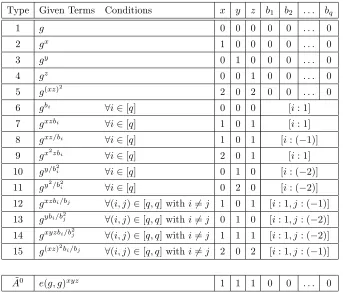
g, gx, gy, gz, g(xz)2
gbi, gxzbi, gxz/bi, gx2zbi, gy/b2i, gy 2/b2
i ∀i∈[q]
gxzbi/bj, gybi/b2j, gxyzbi/b2j, g(xz)2bi/bj ∀i, j∈[q], i6=j
In the challenge phase, the challenger flips a random coinb← {$ 0,1}and ifb= 0 it gives to the attacker
the term e(g, g)xyz. Otherwise it gives a random term R ←$
GT. Finally the attacker outputs a guess
b0 ∈ {0,1}.
Definition A.1. We say that the q-2 assumption holds if all PPT attackers have at most a negligible advantage inλin the above security game, where the advantage is defined asAdv= Pr [b0 =b]−1/2.
B
Key-Policy Attribute-Based Encryption
B.1
Algorithms
A Key-Policy Attribute-Based Encryption scheme consists of the following four PPT algorithms:
•Setup(1λ)→(pp, msk): TheSetupalgorithm takes the security parameterλ∈
Nencoded in unary and outputs the public parameters pp and the master secret key msk. We assume that the public parameters contain a description of the attribute universeU.
• KeyGen(1λ, pp, msk,
A)→ sk: The key generation algorithm takes as inputs the public parameters
pp, the master secret key msk and an access structure A on U. The algorithm generates a secret key corresponding toA.
• Decrypt(1λ, pp, sk, ct) → m: The decryption algorithm takes as inputs the public parameters pp, a secret keysk, and a ciphertextct. It outputs the plaintextm.
Correctness: We require that a KP-ABE scheme is correct, i.e the decryption algorithm correctly decrypts a ciphertext on S with a secret key of an access structure A when S is an authorized set of A. Formally:
Definition B.1. A KP-ABE scheme is correctwhen for all messagesm, and all attribute setsS and access structuresAwith S ∈A(i.e. for S authorized):
Pr
Decrypt(1λ, pp, sk, ct)6=m
(pp, msk)←Setup(1λ)
sk←KeyGen(1λ, pp, msk,A)
ct←Encrypt(1λ, pp, m,S)
≤negl(λ)
where the probability is taken over all random coins of all algorithms.
Remarks: Similar to the CP-ABE case we will omit the public parameters and the security parameter from the list of arguments when referring to calls of the above algorithms. Also, any access structuresAwill be represented by the corresponding policy (M, ρ).
B.2
KP-ABE Selective Security
The selective security game for KP-ABE is described by a game between a challenger and an attacker and is parameterized by the security parameterλ∈N. The phases of the game are the following:
• Initialization: In this phase the attacker declares the challenge attribute setS∗, which he will try to
attack, and sends it to the challenger.
• Setup: Here the challenger calls theSetup(1λ) algorithm and sends the public parameterspp to the attacker.
•Query Phase 1: In this phase the attacker can adaptively ask for secret keys for the access structures A1,A2, . . . ,AQ1. For each Ai the challenger calls KeyGen(msk,Ai) → ski and sends ski to the attacker. The restriction that has to be satisfied for each query is that none of the queried policies is satisfied by the challenge attribute set, i.e. ∀i∈[Q1] :S∗∈/Ai.
• Challenge: The attacker declares two equal-length plaintexts m0 and m1 and sends them to the
challenger. He flips a random coinb∈ {0,1}and calls Encrypt(mb,S∗)→ct. He sendsctto the attacker.
• Query Phase 2: This the same as query phase 1. The attacker asks for the secret key for the access structuresAQ1+1,AQ1+2, . . . ,AQ, for which the same restriction holds: ∀i∈[Q] :S
∗ ∈/ Ai.
• Guess: The attacker outputs his guessb0∈ {0,1} forb.
Definition B.2. A KP-ABE scheme is selectively secure if all PPT attackers have at most a negligible advantage inλin the above security game, where the advantage of an attacker is defined asAdv= Pr [b0 =b]−
1/2.
C
Our Large Universe KP-ABE
C.1
Construction
Our scheme consists of the following four algorithms.
• Setup(1λ)→(pp, msk): The setup algorithm calls the group generator algorithmG(1λ) and gets the descriptions of the groups and the bilinear mapping D = (p,G,GT, e), where pis the prime order of the groupsGandGT. The attribute universe isU =Zp.
Then the algorithm picks the random termsg, u, h, w←$ Gandα←$ Zp. It outputs
pp= (D, g, u, h, w, e(g, g)α) msk= (α)
• KeyGen(msk,(M, ρ)∈(Z`×n
p ,F([`]→ Zp))) →sk: Initially the algorithm picks~y = (α, y2, . . . , yn)⊥ wherey2, . . . , yn
$
←Zp. In the terminology of section 2.2, the master secret keyαis the secret to be shared among the shares. The vector of the shares is
~
λ= (λ1, λ2, . . . , λ`)⊥=M ~y
It then picks`random exponentst1, t2, . . . , t`
$
←Zp and for everyτ∈[`] it computes
Kτ,0=gλτwtτ Kτ,1=
uρ(τ)h
−tτ
Kτ,2=gtτ
The secret key is sk= ((M, ρ),{Kτ,0, Kτ,1, Kτ,2}τ∈[`]).
• Encrypt(m,S={A1, A2, . . . , Ak} ⊆Zp)→ct: Initially, the algorithm picksk+ 1 random exponentss,
r1, r2,. . .,rk
$
←Zp. It computesC=m·e(g, g)αs,C0=gs, and for everyτ∈[k] it computes
Cτ,1=grτ Cτ,2= (uAτh)rτw−s
The ciphertext isct= (S, C, C0,{Cτ,1, Cτ,2}τ∈[k]).
• Decrypt(sk, ct)→m: The algorithm finds the set of rows inM that provide a share to attributes inS, i.e. I={i:ρ(i)∈S}. Then it calculate constants{ωi∈Zp}i∈I such that
P
i∈IωiMi = (1,0, . . . ,0), where
Mi is thei-th row of the matrix M. According to the discussion in section 2.2, these constants exist if the setS is an authorized set of the policy.
Then it calculates
B=Y
i∈I
(e(C0, Ki,0)e(Cτ,1, Ki,1)e(Cτ,2, Ki,2))
ωi
whereτ is the index of the attributeρ(i) inS (it depends on i). The algorithm outputsm=C/B.
Correctness: If the attribute set S of the ciphertext is authorized, we have that P
i∈Iωiλi = α. Therefore:
B =Y
i∈I
e(g, g)sωiλie(g, w)stiωie(g, uρ(i)h)−rτtiωie(g, uρ(i)h)rτtiωie(g, w)−stiωi
=e(g, g)sPi∈Iωiλi=e(g, g)αs
C.2
Proof of Selective Security
We will prove the following theorem regarding the selective security of our KP-ABE scheme:
Theorem C.1. If theq-2 assumption holds, then all PPT adversaries with a challenge attribute set of size
Proof. To prove the theorem we will assume that there exists a PPT attackerAwith a challenge attribute set that satisfies the restriction, which has a non negligible advantage AdvA in selectively breaking our
scheme. Using this attacker we will build a PPT simulatorB that attacks the q-2 assumption with a non negligible advantage.
Initialization: Initially, B receives the given terms from the assumption and an attribute set S∗ =
{A∗
1, A∗2, . . . , A∗k} ⊆ U.
Setup: Now, the simulatorBhas to provideAthe public parameters of the system. In order to do that it implicitly sets the master secret key of the scheme to beα =xy, where x, y are set in the assumption.
Notice that this wayαis properly distributed. ThenBpicks the random exponents ˜u,˜h←$ Zp and gives to
Athe following terms:
g=g w=gx
u=gu˜·Q
i∈[k]g
y/b2i h=gh˜·Q
i∈[k]g
xz/bi·Q
i∈[k]
gy/b2i−A
∗ i
e(g, g)α=e(gx, gy)
Sincexis information-theoretically hidden fromA, because it is multiplied byyinα, the termwis properly uniformly random in G. The terms u, h are properly distributed due to ˜u,˜h respectively. Notice that all terms can be calculated by the simulator using suitable terms from the assumption and the challenge setS∗
given byA.
In the KP-ABE proof we see that the “binder term” of the CP-ABE reduction has been contained in the “attribute layer”; namely thegxz/bi of the hterm. Since in KP-ABE the master secret key αis shared in
all key generation queries, we don’t need any more the extra functionality provided by the powers ofa.
Query phases 1 and 2: The simulator has to produce secret keys for policies requested by A, for which the setS∗ is not authorized. In both phases the treatment is the same. We describe here the wayB
works in order to create a key for a policy (M, ρ)∈(Zp`×n,F([`]→Zp)). SinceS∗is non authorized for (M, ρ), there exists a vectorw~ = (w
1, w2, . . . , wn)⊥ ∈Znp such thatw1= 1
andhMτ, ~wi= 0 for allτ∈[`] such thatρ(τ)∈ S∗ (c.f. section 2.2). The simulator calculatesw~ using linear algebra. The vector~y that will be shared is implicitly
~y=xy ~w+ (0,y˜2,y˜3, . . . ,y˜n)⊥
where ˜y2,y˜3, . . . ,y˜n
$
←Zp. This vector is properly distributed because its first component isxy=αand the remaining components are uniformly random inZp. Therefore for each rowτ∈[`] the share is
λτ =hMτ, ~yi=xyhMτ, ~wi+hMτ,(0,y˜2,y˜3, . . . ,y˜n)⊥i=xyhMτ, ~wi+ ˜λτ As we mentioned above for each rowτ for whichρ(τ)∈ S∗ it is true thathM
τ, ~wi= 0. Therefore in this case λτ = ˜λτ = hMτ,(0,y˜2,y˜3, . . . ,y˜n)⊥i; hence its value is known to the simulator. In that case it picks
tτ
$
←Zp and outputs the termsKτ,0, Kτ,1, Kτ,2 as in theKeyGenalgorithm.
On the other hand, for each row τ for whichρ(τ)∈ S/ ∗ it picks ˜t
τ
$
←Zp and sets implicitly
tτ=−yhMτ, ~wi+
X
i∈[k]
xzbihMτ, ~wi
ρ(τ)−A∗i + ˜tτ
Since ρ(τ)∈ S/ ∗ the above fractions are defined andt
part. Now the simulator can compute the following terms using the assumption:
Kτ,0=gλτwtτ
=gxyhMτ, ~wi+˜λτ ·g−xyhMτ, ~wi+ P
i∈[k]
x2zbihMτ , ~wi ρ(τ)−A∗i ·w˜tτ
=g˜λτ· Y
i∈[n]
gx2zbi
hMτ, ~wi/(ρ(τ)−A∗i)
·w˜tτ
Kτ,1= (uρ(τ)h)−tτ =
=
gρ(τ)˜u+˜h· Y
i∈[k]
gxz/bi· Y
i∈[k]
gy(ρ(τ)−A∗i)/b 2 i
yhMτ, ~wi−Pi∈[k]xzbi
hMτ , ~wi ρ(τ)−A∗i
·(uρ(τ)h)−˜tτ
=gyhMτ, ~wi(ρ(τ)˜u+˜h) Y
i∈[k]
g−xzbi(ρ(τ)˜u+˜h)hMτ, ~wi/(ρ(τ)−A∗i)
· Y
i∈[k]
gxyzhMτ, ~wi/bi Y (i,j)∈[k,k]
g−(xz)2bjhMτ, ~wi/bi(ρ(τ)−A∗j)
· Y
i∈[k]
gy2hMτ, ~wi(ρ(τ)−A∗i)/b2i Y (i,j)∈[k,k]
g−xyzhMτ, ~wibj(ρ(τ)−A∗i)/bi2(ρ(τ)−A∗j)·(uρ(τ)h)−˜tτ
= (gy)hMτ, ~wi(ρ(τ)˜u+˜h) Y
i∈[k]
gxzbi−(ρ(τ)˜u+˜h)hMτ, ~wi/(ρ(τ)−A ∗ i)
· Y
(i,j)∈[k,k]
g(xz)2bj/bi
−hMτ, ~wi/(ρ(τ)−A∗j) Y
i∈[k]
gy2/b2i
hMτ, ~wi(ρ(τ)−A∗i)
· Y
(i,j)∈[k,k]
i6=j
gxyzbj/b2i
−hMτ, ~wi(ρ(τ)−A∗i)/(ρ(τ)−A ∗ j)
·(uρ(τ)h)−˜tτ
Kτ,2=gtτ
= (gy)−hMτ, ~wi· Y
i∈[k]
gxzbihMτ, ~wi/(ρ(τ)−A∗i)
·gt˜τ
ThereforeBcan reply toA’s query with the entire secret keysk=(M, ρ),{Kτ,0, Kτ,1, Kτ,2}τ∈[`]
.
Challenge: The attacker will output a pair of messages (m0, m1) of the same length. In this phase
the simulator flips a random coinb← {$ 0,1}and sets implicitlys=z from theq-2 assumption. Also, it sets
rτ=bτ for every levelτ∈[k]. These parameters are properly distributed sincez, b1, . . . , bq are information-theoretically hidden from the attacker’s view. Now the simulator can compute the following terms using the assumption:
C=mb·T C0=gs=gz
Cτ,2= (uA ∗
τh)rτ·w−s
=gbτ(˜uA∗τ+˜h)· Y
i∈[k]
gxzbτ/bi Y
i∈[k]
gybτ(A∗k−A ∗ i)/b
2 i ·g−xz
= gbτuA˜ ∗ τ+˜h
· Y
i∈[k]
i6=τ
gxzbτ/bi Y
i∈[k]
i6=τ
gybτ/b2i
A∗τ−A ∗ i
As one can see, the choice of rτ = bτ “raises” one of the xz/bi components to xz and achieves the
cancellation with w−s. The simulator hands over the ciphertext ct =S∗, C, C
0,{Cτ,1, Cτ,2}τ∈[k]
to the
attackerA.
Guess: After the query phase 2, where the simulator creates the secret keys as described above, the attacker outputs a guessb0 for the challenge bit. Ifb0 =b the simulator outputs 0, i.e. it claims that the challenge term isT =e(g, g)xyz. Otherwise, it outputs 1.
If T =e(g, g)xyz thenAplayed the proper security game, becauseC=mb·T =mb·e(g, g)αs. On the other hand, ifT is a random term ofGT then all information about the messagemb is lost in the challenge ciphertext. Therefore the advantage ofAis exactly 0. As a result ifAbreaks the proper security game with a non negligible advantage, thenBhas a non negligible advantage in breaking theq-2 assumption.
D
Generic Security of the Assumptions
In this section we consider the security of our assumptions in the generic group model introduced by Shoup [39]. In this model the attacker does not receive the actual representations of group elements in Gor GT, but handles picked from a sufficiently large handle space. Whenever a new group element has to be given to the attacker, he receives a uniformly random handle from the handle space; not picked before. From now on this handle is “fixed” to this specific group element. The attacker is allowed to query for operations on the handles he has already received. Then the challenger executes the operation on the underlying group elements and returns either a freshly picked handle, if the result is new, or an existing handle. The only operations available on group elements to the attacker are multiplications in Gor GT, pairings in G and the equality checking of two group elements inGorGT by checking the equality of handles. The main goal of the generic group model proofs is to provide an indication of the absence of “security holes” which are independent from the specific group representations.
The following theorem will provide an easier way to argue about the security of our assumptions in the generic group model.
Definition D.1 (GT-monomial assumption). A GT-monomial assumption is parameterized by a security parameter λ ∈ N. It refers to a prime order bilinear group D = (p,G,GT, e) with p = Θ(2λ), a matrix
A∈ZL×K and two target vectorsA˜0,A˜1∈Z1×K.
We require that A˜0 6= ˜A1 and that the natural numbers K, L and the the absolute values of the integers
inA,A˜0 andA˜1 are all polynomially bounded inλ.
The assumption is defined via a game between a challenger and an adversary. Initially, the challenger
picksKindependent and uniformly randomvariablesX1, X2, . . . , XK
$
←Zp. Then it constructs the following monomials in these variables:
Yi=
Y
j∈[K]
XAi,j
j for alli∈[L] , Z0=
Y
j∈[K]
XA˜
0 j
j and Z1=
Y
j∈[K]
XA˜
1 j
j
Finally, the challenger picks g ←$ G and b ← {$ 0,1}. He sends to the adversary the description of the group D = (p,G,GT, e), the matrix A, the vectors A˜0,A˜1, the terms
gYi
i∈[L], and the challenge term
e(g, g)Zb. The assumption claims that no PPT adversary has a non negligible advantage in guessing the bit