ISSN 2348 – 7968
Research on Influencing Factors of Body Weight Control by Using
Artificial Neural Network Approach
Pin-Chang Chen1, Ruey-Ming Chao2, Hsiu-Wen Shen3 and Chi-Fu Chung1
1
CTBC Financial Management College, Tainan 709, Taiwan, R.O.C.
2
College of Hakka Studies, National United University, Miaoli City 360, Taiwan, R.O.C.
3
Department and Graduate Institute of Information Management, Yu Da University of Science and Technology, Miaoli County 361, Taiwan, R.O.C.
Abstract
This study sampled 18 to 50 years old adults for questionnaire survey, and collected 261 valid questionnaires which showed the factors of habits and customs which influence the body weight. The data are compiled, the dimension factors which influence the body weight are validated by the software of artificial neural network, and the sequence of the importance of the factors which influence the body weight is analyzed. The results of this study show that the food intake has the maximum effect on the body weight, and then the physique factor, the third factor is food habit, the fourth factor is the behavior and quality of life. The emotion has slight effect on the body weight, ranking fifth. The food preference has little influence on the body weight. This study sequences the factors which influence the body weight according to the findings, hoping to help people who are concerned about the body weight find a solution.
Keywords: Body Weight, Food, Behavior, Weight Control, Artificial Neural Network.
1. Introduction
Keeping a standard body weight is the basic essential of health. Overweight or underweight is not good to human body. Therefore, everybody wants to know how to keep healthy weight. Many domestic and foreign literatures studied the factors which influence the body weight [1]. The people who want to increase or lose weight must want to know the most effective method without side-effect and harmless to health to control body weight [2].
There are many factors influencing body weight [3]. This study used questionnaire survey to collect the habits and customs data of 18 to 50 years old adults at ordinary times, and used artificial neural network program software for data analysis, to validate whether the body weight influencing factors have significant correlation. The influencing factors are collected according to references, six major influencing factors are sorted out, which are
physique, food intake, food habit, food preference, behavior and quality of life, and emotion [4]. Other influencing factors are not listed in this study. When the correlation among various influencing factors is confirmed, the thinking and logic of artificial neural network are used to find the sequence of importance of the body weight influencing factors, the criticality of various body weight influencing factors is analyzed [5]. This study will use artificial neural network as information processing tool, hoping to make specific contribution to the importance ranking for body weight control influencing factors and to the practical application of artificial neural network.
2. Literature Review
The artificial neural network is an artificial neural information processing technology developed by simulating biological neuron. In actual situation, some problems are difficult to be solved by theories, the empirical equation must be deduced from the collected record or test data [6]. Many sets of computer software have been developed for information processing system, which can use adequate historical data for network model for analysis and prediction. The fundamental purpose is to assist human in solving problems [7].
The artificial neural network has a lot of interconnected processing elements, which are usually operated in parallel and placed in the entire network structure. The whole artificial neural network processing mode is like human brain. The operational process can be learned, recalled and deduced by sample or data training [8].
ISSN 2348 – 7968
network is a group of variables representing classification) according to the characteristics of output variables. This study is of classification problems. These problems are difficult to be solved by theories for lacking logistic model, the empirical equation must be deduced from the collected record or test data. There are many kinds of artificial neural network, and each kind of neural network has its applicable model. As the back-propagation neural network is the most universal at present, and it has high learning accuracy, this study uses back-propagation neural network as main tool [9].
3. Methodology
The research process of this study is described below:
Step 1: Find research motives and purposes, set research subject.
Step 2: Collect literature data about body weight influencing factors, and research the literatures about artificial neural network.
Step 3: Compile the literatures of influence factors as "research questionnaire for body weight influencing factors", the questionnaire is answered anonymously.
Step 4: Use the window function of google to collect questionnaires from the internet randomly. When the questionnaires are collected, the repeated and invalid questionnaires are eliminated, the data of valid questionnaires are made into Excel worksheet to be imported into Alyuda NeuroIntelligence software.
Step 5: Execute Alyuda NeuroIntelligence software for logic analysis of artificial neural network, find out the importance of correlation between each influencing factor and body weight. As the neural network has no optimal solution, repeated simulated training validation is required to find out the mean of each result as the optimal solution. The mean values of 10 times, 15 times and 20 times are compared. There are slight differences in the data, but the ranking result is the same. Therefore, for convenient data presentation, this study validates results by 10 executions. The optimum structure layer of each execution, test value and Mean CCR of overall data are registered, and then the mean value of Mean CCR is found.
Step 6: Data classification and compilation. The original data are compiled as Excel worksheets of 6 dimensions. A class of data of the body weight influencing factors shall be extracted from the data of the 6 Excel worksheets. For example, to know the importance of physique to body
weight, three questionnaire data correlated with physique shall be extracted to leave other data, which are compiled into Excel worksheet. The rest can be deduced accordingly, six classes of data are extracted, including A. physique (4 items), B. food intake (4 items), C. food habit (5 items), D. food preference (7 items), E. behavior and quality of life (5 items) and F. emotion (4 items).
Step 7: Execute neural network software repeatedly to obtain the mean value of Mean CCR. The A to F Excel worksheets are imported into Alyuda NeuroIntelligence software again and executed 10 times, so as to obtain the mean value of Mean CCR of each Excel worksheet executed 10 times.
Step 8: Compare the mean values of all dimensions and Mean CCR of various dimensions extracted. The mean value of Mean CCR of A to F extracted is compared with the Mean CCR of original all dimensions. If the value of Mean CCR of A. physique extracted is smaller than the value of Mean CCR of all dimensions, the physique is relatively important to the body weight. If the value of Mean CCR of A. physique extracted is greater than the value of Mean CCR of all dimensions, meaning the physique is of less importance to the body weight. By analogy, the value of Mean CCR of various dimensions influencing body weight is compared with the value of Mean CCR of all dimensions, so as to find the key factor influencing the body weight.
Step 9: Findings. The importance of various influencing factors to body weight is described.
Step 10: Conclusions and suggestions. Present the conclusion and recommendations according to the results of comparison analysis.
4. Data Analysis
ISSN 2348 – 7968
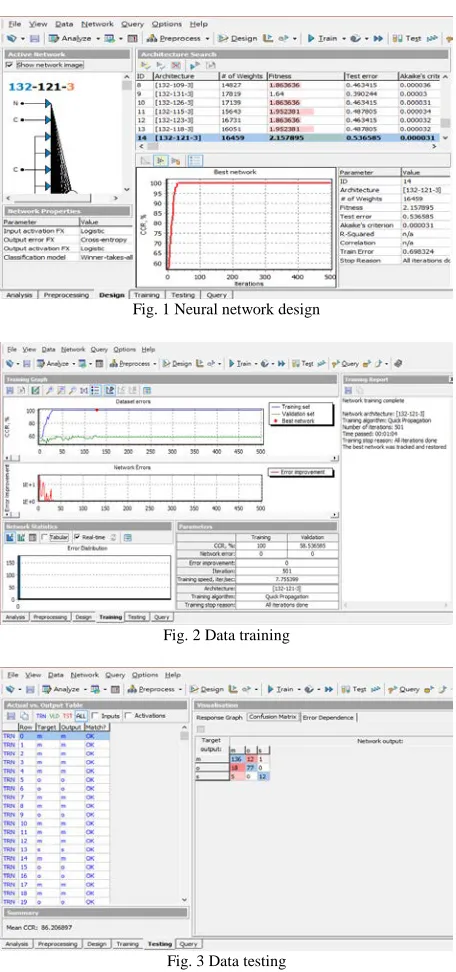
Fig. 1 Neural network design
Fig. 2 Data training
Fig. 3 Data testing
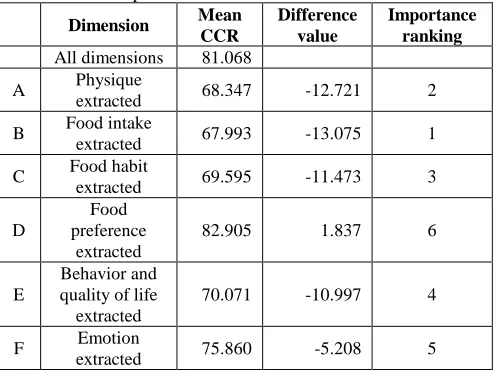
First, the Excel worksheet data without Class 1 "physique" influencing factor are imported into Alyuda NeuroIntelligence software, designed, trained and tested 10 times. The mean value of Mean CCR is 68.347%, meaning the physique has relatively high importance to body weight.
The Excel worksheet data without Class 2 "food intake" influencing factor are imported into Alyuda NeuroIntelligence software, designed, trained and tested 10 times. The mean value of Mean CCR is 67.993%,
meaning the food intake has relatively high importance to body weight.
The Excel worksheet data without Class 3 "food habit" influencing factor are imported into Alyuda NeuroIntelligence software, designed, trained and tested 10 times. The mean value of Mean CCR is 69.595%, meaning the food intake has relatively high importance to body weight.
The Excel worksheet data without Class 4 "food preference" influencing factor are imported into Alyuda NeuroIntelligence software, designed, trained and tested 10 times. The mean value of Mean CCR is 82.905%, meaning the food intake has relatively high importance to body weight.
The Excel worksheet data without Class 5 "behavior and quality of life" influencing factor are imported into Alyuda NeuroIntelligence software, designed, trained and tested 10 times. The mean value of Mean CCR is 70.071%, meaning the food intake has relatively high importance to body weight.
The Excel worksheet data without Class 6 "emotion" influencing factor are imported into Alyuda NeuroIntelligence software, designed, trained and tested 10 times. The mean value of Mean CCR is 75.86%, meaning the food intake has relatively high importance to body weight.
ISSN 2348 – 7968
Table 1: Comparison of Mean CCR of various dimensions
Dimension Mean CCR
Difference value
Importance ranking All dimensions 81.068
A Physique
extracted 68.347 -12.721 2
B Food intake
extracted 67.993 -13.075 1
C Food habit
extracted 69.595 -11.473 3
D
Food preference
extracted
82.905 1.837 6
E
Behavior and quality of life extracted
70.071 -10.997 4
F Emotion
extracted 75.860 -5.208 5
5. Conclusions
This study uses back-propagation neural network software for group comparison of body weight influencing factors. Six major classes of influencing factors in body weight are found, and the importance is ranked. The findings show the importance ranking of body weight influencing factors: (1) food intake, (2) physique, (3) food habit, (4) behavior and quality of life, (5) emotion, (6) food preference.
The two key factors which influence body weight are food intake and physique. The Mean CCR of the food intake and physique influencing factors extracted is smaller than the Mean CCR of all dimensions, and the difference value is maximized, which is 13.075% and 12.721% respectively. The difference is not large, only 0.354%, meaning both the food intake and physique have significant influence on body weight. The first influencing factor is food intake, meaning the calories generated by the eaten food has the most significant influence on body weight. This result breaks the puzzle that even drinking water and breathing lead to fat, proving that the larger the food intake is, the body fat is more likely to accumulate. The food intake in this study includes the number of daily meals, the intake of one meal, the intake of staple food and the allocation of three meals which are key factors influencing the body weight. The secondary body weight influencing factor is the physique, meaning the body shape is highly correlated with the body type of parents. Every person's genes are from parents, so the intestinal tract health status and endocrine disease are influenced by parents, this is an unchangeable fact. Therefore, some people metabolize fast, and some metabolize slowly.
The two secondary important body weight influencing factors are food habit the behavior and quality of life. The Mean CCR of the food habit and the behavior and quality of life extracted is smaller than the Mean CCR of all dimensions, the difference is 11.473% and 10.997% respectively. The difference between the two factors is 0.476%, meaning their importance to the body weight are very close to each other. The difference between the Mean CCR of food habit extracted and the Mean CCR of physique extracted is 1.248%, the difference is small, meaning the influence of food habit, the third important body weight influencing factor, on the body weight is non-negligible. The food habits include eating speed, chewing times, daily water intake and supper time. The fourth important body weight influencing factor is the behavior and quality of life, meaning the influence of sleeping, exercise and sitting time on the body weight shall not be neglected.
The factor with less influence on body weight is the emotion. The Mean CCR after the emotion is extracted is smaller than the Mean CCR of all dimensions, the difference is 5.208%, meaning the emotion has influence on body weight, but the importance is relatively low. The findings show that the four factors of emotion, stress, tension, anxiety and depression, have slight influence on body weight.
The factor with little influence on body weight is food preference. The Mean CCR after the food preference is extracted is slightly larger than the Mean CCR of all dimensions, the difference is 1.837%, meaning the food preference has little influence on body weight. The findings show that the food preference, including dietary taste (salty, mild), food type (meat or fish, vegetable), eating high caloric food (fries, sweet dish and beverage), has little influence on body weight.
Therefore, according to the analysis and comparison in this study, the food intake is the first key factor which influences body weight. Everybody shall cognize his physique and review his food habits at ordinary times. The results of this study are expected to help the people with body weight problems find the most healthful way to adjust weight, to find a healthy and happy life for themselves.
References
ISSN 2348 – 7968
cross sectional survey." British Medical Journal, Vol. 337, No. 7678, 2008, pp. 1091-1093.
[2] S. R. Patel, A. L. Hayes, T. Blackwell, D. S. Evans, S. Ancoli-Israel, Y. K. Wing, and K. L. Stone, "The association between sleep patterns and obesity in older adults."
International Journal of Obesity, Vol. 38, No. 9, 2014, pp. 1159-1164.
[3] B. Bailey, M. Allen, J. LeCheminant, L. Tucker, W. Errico, W. Christensen, and M. Hill, "Objectively Measured Sleep Patterns in Young Adult Women and the Relationship to Adiposity." American Journal of Health Promotion, Vol. 29, No. 1, 2014, pp. 46-54.
[4] M. Shah, J. Copeland, L. Dart, B. Adams-Huet, A. James, and D. Rhea, "Slower Eating Speed Lowers Energy Intake in Normal-Weight but not Overweight/Obese Subjects." Journal of the Academy of Nutrition and Dietetics, Vol. 114, No. 3, 2014, pp. 393-402.
[5] Y. Zhu, and J. H. Hollis, "Increasing the Number of Chews before Swallowing Reduces Meal Size in Normal-Weight, Overweight, & Obese Adults." Journal of the Academy of Nutrition and Dietetics, Vol. 114, No. 6, 2014, pp. 926-931. [6] S. Haykin, Neural Networks: A comprehensive foundation.
New York, USA: Maxwell MacMillian Int., 1994. [7] B. Kosko, Neural networks and fuzzy systems: a dynamical
systems approach to machine intelligence, New Jersey, USA: Prentice Hall, 1992.
[8] E. M. Azoff, Neural network time series forecasting of financial markets, New Jersey, USA: John Wiley & Sons, Inc., 1994.