Vaibhav J. Gadade*1, Ashok B. Gadade1, Dhanvantari K. Shivarkar2, Tushar Katariya3 1
ACS’S College of Pharmacy, Ashti, Beed, India.
2
Pravara Rural College of Pharmacy, Pravaranagar, Ahemdnagar, India.
3
Shri Amolak Jain Vidya Prasarak Mandal’s Pharmacy College, Kada, Beed, Maharashtra, India. *Corresponding author’s E-mail:[email protected]
Accepted on: 21-03-2013; Finalized on: 31-05-2013. ABSTRACT
The current research in the field of drug delivery by which pulsatile release can be achieved has been intensified. The present study was an attempt to develop and evaluate an oral pulsatile drug delivery system using Luffa aegyptica mill powder as a novel superdisintegrant. The basic design of the device consisted of a rapid release tabletted core and a controlled release coat. The rapid release tableted core contained a model drug (Diclofenac sodium) and novel superdisintegrant (Luffa aegyptica mill) and controlled release effect was achieved with a combination of coating material (Polyvinylpyrrolidone K30 and Hydroxypropyl methyl cellulose
K4M. A 32 full factorial design was employed for the optimization of developed formulation considering concentration of
superdisintegrant and coating ratio as independent variables with lag time and drug release as dependent variables. The developed formulations showed uniform appearance, average weight, drug content and adequate hardness. The increase in lag time was
observed with an increase in HPMC concentration and decreased concentration of novel Superdisintegrant. Design expert software®
was used to give the solution for optimized formulation based on the evaluation of the developed formulations. Further comparison of Luffa aegyptica mill powder in concentration suggested in the optimized formulation with pharmaceutically acceptable superdisintegrant in same concentration showed almost similar drug release behavior. It can be concluded from the outcome of the present research that Luffa aegyptica mill powder, a natural superdisintegrant, can prove to be best alternative to the existing semi-synthetic or semi-synthetic superdisintegrants.
Keywords: Pulsatile drug delivery system (PDDS), Press coated pulsatile tablet (PCPT), Lag time, Luffa aegyptica mill, Rheumatoid
arthritis.
INTRODUCTION
ulsatile drug release is such system where drug is released suddenly after well-defined lag time or time gap according to circadian rhythm of disease states. No drug is released from the device within this lag time. This method is good for the drugs that undergoes extensive first pass metabolism and even to target the drugs to specific site in the intestinal tract1-8.
Press coating is a technique that does not require any solvents or special equipment for coating of the dosage form and hence coating can be done at high rate. In this technique a core tablet previously compressed is further coated by multiple compression using different polymeric barriers. This system delivers the drug from the core tablet after swelling/erosion of the hydrophilic or hydrophobic barrier of the coating shell and may exhibit a pulsatile release of the drug9-14.
Despite the increasing demand and interest in controlled/sustained release system, a significant portion of solid dosage forms require fast disintegration and immediate dissolution after administration. For years this requirement has been met using superdisintegrants. Superdisintegrant are another version of super absorbing materials with tailor-made swelling properties. These materials are not intended to absorb significant amounts of water or aqueous fluids, but intended to swell very fast. They are dispersed physically within the matrixof the
dosage form and will expand when the dosage form is exposed to the wet environment. Swelling pressure and isotropic swelling of the particles create stress concentrated areas where a gradient of mechanical properties will exist. In fact, a mild explosion occurs at the stress-concentrated area by which the whole structure will break apart15.
Luffa aegyptica mill belongs to the family Cucurbitaceae.
Its origin can be traced to tropical Asia16. It is climbing annual wild vine with lobed cucumber like leaves that are dark green in coloration with rough surface. The plants with yellow flowers bear fruits that are cucumber shaped but longer in size and contain fibrous sponge in which the hard black seeds are enmeshed. It is lignocellulosic materials composed of 60% cellulose, 30% hemicelluloses and 10% lignin17.It has been discovered that the consumption of sponge gourds can supply some antioxidant constituents to human body. The extracts from vines alive are used as an ingredient in cosmetics and medicine. Alebiowu prepared a powder from the natural sponge Luffa aegyptica mill family Cucurbitaceae. They studied its disintegrant activity with corn starch as the standard. The powder showed promising results in terms of weight uniformity, friability, tensile strength and disintegration time of tablets prepared for evaluation18. Natural materials have been gaining lot of interest in the field of drug delivery because they are readily available,
Evaluation of Novel Superdisintegrant for the Development of
Pulsatile Drug Delivery System
P
cost effective, eco-friendly, capable of multitude of chemical modifications, potentially degradable and compatible due to their natural origin. Thus the main objective of the present study was to develop, evaluate and optimize the oral pulsatile drug delivery system using natural superdisintegrant obtained from Luffa aegyptica
mill.
MATERIALS AND METHODS
The fruits of Luffa aegyptica mill were collected from local area of Chandwad, Maharashtra, India. Diclofenac sodium was donated by Navketan Pharma Pvt Ltd, India. Anhydrous lactose and pregelatinised starch (Emcure Pharma Pvt Ltd, India). Magnesium stearate and purified talc (Loba chemie Pvt Ltd, India) and crospovidone, sodium starch glycolate, and crosscarmellose sodium (FMC Biopolymer, Signet Chemical Corporation) were used as components of core tablets. The coating components were Polyvinylpyrrolidone (Kollidon K30, BASF) and HPMC (K4M, Colorcon Asia Pvt Ltd, India). All other ingredients and reagents were of analytical grade and were used as received.
1. Isolation and physicochemical characterization of Natural Superdisintegrant :
The fresh fruits of Luffa aegypticamill were collected and washed with water to remove the dirt, and dust particles. The epicarp of fruits was scraped by using scraper and sponge of fruits was isolated. The isolated sponge was shade dried at ambient temperature till its color changed from green to light brown. After shade drying it was dried in a hot air oven at 500C, powdered and passed through a sieve no.80 and stored for further use in the desiccator18.Dried powder was then tested for loss on dying, swelling index and flow properties like bulk density, tapped density, compressibility index, angle of repose and Hausner’s ratio as per pharmacopoeial procedure19-22.
2. Experimental Design:
A number of preliminary experiments were conducted to determine the formulation and parameters by which the process resulted in pulsatile press coated tablet. Design expert software®(Design Expert trial version 8.0.1; State-Ease Inc., Minneapolis, MN, USA) was used in our study for to optimize the concentration of superdisintegrant and coating materials. A two-factor, three-level, full factorial design was employed for the optimization procedure. The amount of superdisintegrant in the core tablet (X1, % w/w of core tablet) and coating material
ratio i.e. PVP/HPMC (X2, % w/w of coating), were selected
as the independent variables, whereas lag time (Y1,
minutes) and the amount of Diclofenac released in 450 minutes (Y2, percent) were chosen as the dependent
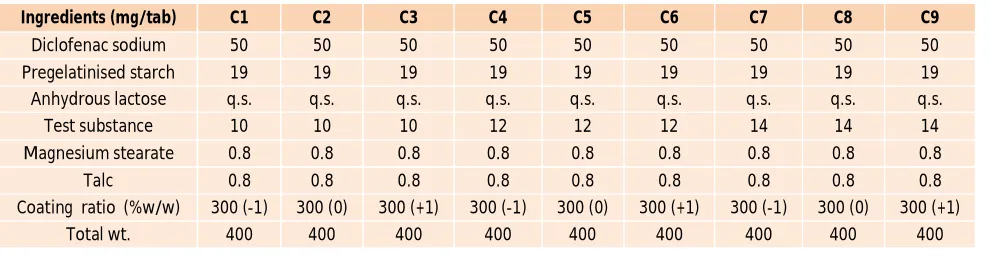
variables23. Table 1summarizes these factors with corresponding levels and the responses studied, whereas experimental formulations are listed in Table 2.
3. Formulation of PCPT of Diclofenac sodium:
Formulation of core tablet:
The core tablets were prepared by direct compression. Numbers of trials as per the experimental design were carried out for the development of core tablets (Table II). Initially tablet excipients were blended for 20 min in a polybag followed by the addition of magnesium stearate (0.8 %w/w) and purified talc (0.8 %w/w). The powder mixture was then blended for 5 min. Core tablets (diameter 6 mm, hardness 3-6kg/cm2, average tablet weight 100 mg) were compressed using a rotatory tableting machine (Rimek, Karnavati Eng. Ltd).
Preparation of polymer blends for press coating:
PVP/HPMC polymer blends were prepared by using the solvent evaporation method. PVP dissolved in water almost immediately (5 wt %),while HPMC (2 wt %) was immersed in water for 7 days to swell while complete dissolution was achieved with gentle heating at 60°C.
Table 1: Two factors, three levels full factorial experimental design; factor selected and responses measured.
Factors
(Independent variables)
Levels Responses
(Dependent variables) (-1) (0) (+1)
Amount of superdisintegrant (%) 10 12 14 Y1 (Lag time of 360 minutes)
Ratio of coating material (%w/w) i.e. PVP/HPMC blend (70:30) (60:40) (50:50) Y2 (Drug release in 450 minutes)
Table 2: Diclofenac sodium PCPT formulations as per the Experimental design
Ingredients (mg/tab) C1 C2 C3 C4 C5 C6 C7 C8 C9
Diclofenac sodium 50 50 50 50 50 50 50 50 50
Pregelatinised starch 19 19 19 19 19 19 19 19 19
Anhydrous lactose q.s. q.s. q.s. q.s. q.s. q.s. q.s. q.s. q.s.
Test substance 10 10 10 12 12 12 14 14 14
Magnesium stearate 0.8 0.8 0.8 0.8 0.8 0.8 0.8 0.8 0.8
Talc 0.8 0.8 0.8 0.8 0.8 0.8 0.8 0.8 0.8
Coating ratio (%w/w) 300 (-1) 300 (0) 300 (+1) 300 (-1) 300 (0) 300 (+1) 300 (-1) 300 (0) 300 (+1)
The two solutions were mixed at different amounts undersonication. Blends with concentrations 50/50, 60/40 and 70/30 in the form of thin films were prepared after water evaporation at room temperature. For the complete drying of the blends, the prepared films were heated in an oven for 24 h at 80°C24, 25.
Formulation of press coated tablet:
The core tablets were further press coated with different weight ratio (%w/w) of PVP and HPMC polymer mixture as per the experimental design (Table 2). Half of the polymer blend (150 mg) required was weighed and transferred in to 10mm die. Next, the core tablet (100 mg) was centrally placed on the polymer bed and remaining half of polymer blend (150 mg) was added in to the die and compressed using a rotatory tableting machine.
4. Physiochemical characterization of core and press coated tablet:
The hardness of tablets (n=6) were determined by using Tablet strength tester (Monsanto, 13-1). The friability (%) of the tablets was determined using a USP-I friabilator (EF 1W; Electrolab), and uniformity of tablet weight (n=20) was evaluated as per pharmacopoeial guidelines. Disintegration time of the core tablet was determined using a disintegration tester (ED-2L; Electrolab) and drug content of the tablet was assayed in triplicate using validated UV-Spectrophotometer (Jasco, V-630) method22.
5. In vitro Release Study:
The dissolution studies were performed according to the USP apparatus II (Electrolab, model TDT-08L, Mumbai, India) using 900ml of 0.1N HCL maintained at 37± 0.5°C stirred at 100 rpm for 2 h. Then the same tablets were removed and placed in 900 ml of phosphate buffer pH 6.8 as dissolution media maintained at 37±0.5°C. At appropriate time intervals dissolution sample were withdrawn and analyzed using UV Spectrophotometer (Jasco, V-630 ultraviolet visible scanning spectrophotometer, Japan) at 276nm.An equal volume of fresh pre-warmed dissolution medium was added after withdrawing each sample to maintain the sink condition. The amount of drug released was then determined with the help of calibration curve and the cumulative percentage of drug released was calculated22.
6. Comparative Studies:
Optimized formulation as suggested by Design Expert® software was selected for further comparative study with pharmaceutically accepted superdisintegrant namely, Sodium starch glycolate (SSG), Crosscarmellose sodium and Crospovidone26.
7. Stability Study:
The stability of optimized formulations was tested according to ICH guidelines27. The formulations were stored at accelerated (40± 2°C/75±5% RH) test conditions
in stability chamber (Remi, CHM-6S) for three months. At the end of month, tablets were tested for drug content and percent drug released.
RESULTS AND DISCUSSION
The objective of the present work was to evaluate natural superdisintegrant in the development of pulsatile dosage form. The pulsatile system described herein consists of two different components, the central rapid release core tablet made up of drug and other excipients and external barrier layer consisting of PVP K30 and HPMCK4M.Central layer consists of natural superdisintegrant, intended to modify the release of drug.
The above system was prepared by a press coating technique which is one of the simplest coating methods and has been applied for many drugs to develop the site and/or time controlled release preparation. This technique has many advantages such as short processing time and limited steps, no use of solvents, low labor and energy requirement.
Characterization of novel superdisintegrant powder:
Novel superdisintegrant was characterized for their physical properties such as weight loss on drying, swelling index and flow properties like density, compressibility index, angle of repose and Hausner’s ratio and the results are shown in table 3. The superdisintegrant powder has a swelling index of 2.66±0.2886 ml, which indicates good swelling property of powder. The bulk densities were found to be 0.5503±0.00866 gm/ml. The angle of repose was found to be 36.13±0.2020o, indicate good flow properties of powder. This was further supported by lower compressibility index value. The tapped densities were found to be 0.6455±0.02080 gm/ml. Hausner’s ratio was found 1.17±0.0264, the values shows the low interparticle friction between the powdered particles. All these results indicate that the isolated superdisintegrant powder possessed satisfactory flow properties and compressibility19-22.
Table 3: Physical characteristics of natural superdisintegrant powder
Parameters Results
Loss on drying (%) 0.1122±0.01004
Swelling index (ml) 2.66±0.2886
Bulk density (g/ml) 0.5503±0.00866
Tapped density (g/ml) 0.6455±0.02080
Compressibility index (% ) 14.43±1.8840
Hausner’s ratio 1.17±0.0264
Angle of repose(˚) 36.13±0.2020
Note: Mean of 6 ± SD
Evaluation of pulsatile press coated tablets:
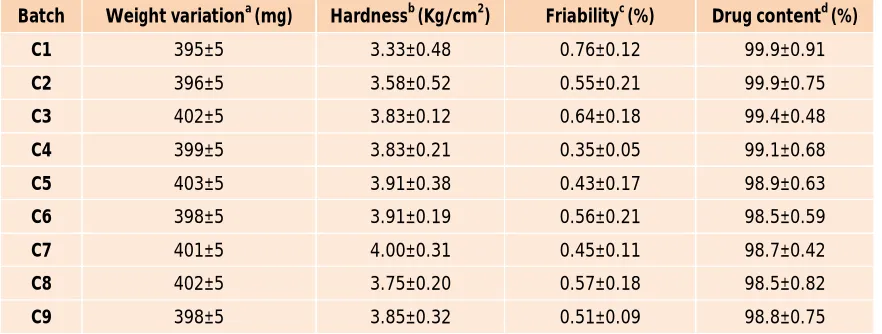
403±5 mg. Hardness of tablets was found to be in the range 3.33±0.48 to 4.00±0.31 kg/cm2, indicate to have better binding properties of granules. Another measure of tablet strength is friability. In the present study the percentage friability for all the formulation was below 1%, indicating that the friability is within the prescribed limits.
Drug content was uniform within the prepared batches and ranges between 98.5±0.59 to 99.9±0.91%. From post-compression studies, it is clear that the above said factors showed acceptable pharmacopoeial limit specifications
19-22.
Table 4: Physical characterization of all the nine formulation of the Diclofenac sodium as per the experimental design
Batch Weight variationa (mg) Hardnessb (Kg/cm2) Friabilityc (%) Drug contentd (%)
C1 395±5 3.33±0.48 0.76±0.12 99.9±0.91
C2 396±5 3.58±0.52 0.55±0.21 99.9±0.75
C3 402±5 3.83±0.12 0.64±0.18 99.4±0.48
C4 399±5 3.83±0.21 0.35±0.05 99.1±0.68
C5 403±5 3.91±0.38 0.43±0.17 98.9±0.63
C6 398±5 3.91±0.19 0.56±0.21 98.5±0.59
C7 401±5 4.00±0.31 0.45±0.11 98.7±0.42
C8 402±5 3.75±0.20 0.57±0.18 98.5±0.82
C9 398±5 3.85±0.32 0.51±0.09 98.8±0.75
Notes: aTest performed on 20 tablets; bMean of 6±SD; cTest performed on number of tablet weighing not less than 4 gm; dMean of 3±SD.
In vitro released studies:
The core tablet should be formulated in such a way that it releases more than 90% drug within 90 minutes. The PVP/HPMC blend was selected as a coating material for to obtained lag time of about 360 minutes. The In vitro drug release study (Figure 1) shows that less or no percent drug released observed during the first 2 hrs, this is due to the low solubility of drug, which does not allow the diffusion of drug through PVP/HPMC coating. The combination of PVP K30 and HPMC K4M is commonly used for preparation of press coated tablets for the adjustment of the drug release time. The coating layer was composed of PVP/HPMC blends at different compositions, acting as a stimulus responsible layer. Polyvinylpyrrolidone (PVP) is a water-soluble tertiary amide and a strong Lewis Base and Hydroxypropyl methyl cellulose (HPMC) is a hardly water-soluble polymer carrier with the ability to swell on contact with aqueous solutions, creating a hydrocolloidgel mass on the external surface. This mass gradually dissolves during time. Therefore, from such a system, the release of the active ingredient is expected to be controlled by the dissolution rate of the polymer gel. Main disadvantage of pulsatile release formulation is that they require a long residence time in the gastrointestinal track. One of the basic mechanisms to extend this time period is the use of bioadhesive polymers. HPMC K4M is well known as one of the most effective mucoadhesive polymers and hence was chosen for combining with PVP K3024, 25.These blends were found miscible in the entire composition range, ensured by the interactions taking place between hydroxyl groups of HPMC and carbonyl groups of PVP. The miscibility of the system enhances the mucoadhesive properties of the blend, compared with those of pure HPMC, which is desired for such applications. The
enhancement was attributed to the higher rate of wetting and flexibility of the new matrices due to the faster dissolution of the PVP macromolecules. Upon exposure of the prepared tablets to the dissolution medium it was found that the coating layer disintegrates first, followed by the immediate release of drug from the active core24,
25
. In vitro drug release study reveals that, as the proportion of novel superdisintegrant in tablet was increase from 10 to 14 %, there was a remarkable change in the release rate of the drug from batches C1- C9. It was observed that when coating barrier comes in contact with dissolution media it gradually erode up to a limited thickness. After that rupture of the shell is observed under the pressure applied by the swelling of the active core. Rupture always develop on the sides of the tablet as the initial thickness of the coating layer in these points is lower than on the top and bottom surface of the tablet. All of this process corresponds to a lag time capable of exhibiting a pulsatile release of the drug. After the delay time, rapid release of the drug takes place within 90 minute. Result also revealed that as the amount of HPMC increases, lag time also increases. A direct relation was found from optimization study between amount of
Luffaaegyptica in core tablet and amount of HPMC in
Figure 1: Dissolution profile of all nine formulations as per
the factorial design
Note: n=3, Error bars indicate standard deviation.
Comparative Study:
Design expert software suggested optimized final batch containing 12.30% of Luffa aegyptica and coating ratio 62.50/37.50 %w/w was selected for further comparative study with pharmaceutically accepted superdisintegrant namely sodium starch glycolate, povidone and cross carmellose sodium. Batch J1, J2 & J3contains cross Carmellose sodium, Povidone &Sodium starch glycolate as superdisintegrant respectively. The dissolution data (Figure 2) of revealed that, optimized batch containing
Luffa aegyptica shows same drug release when compared
with batch J2, J3 and J4, which indicate that Luffa
aegyptica can be used as novel superdisintegrant in
development of pulsatile drug delivery system26.
Stability Study
Therefore, from above studies optimized final batch was selected for further stability consideration. Reproducible batch of optimized formulation was kept for stability studies as per ICH guidelines. Samples were withdrawn according to the sampling protocol after 1, 2 & 3 month
and were analyzed for in-vitro dissolution profiles and drug content (Table 6). From the stability studies, it was found that the tablets remained stable after three months.
Table 5: Result data of responses, i.e. Y1 (Lag time,
minutes) and Y2 (Drug released in 450 min, %) for all the 9 batches of experimental design.
Batch No Y1 (Lag time, minutes)a
Y2 (Drug released in 450 min, %)a
C1 3.5±0.53 70.33±5.35
C2 6.5±1.56 75.83±4.04
C3 8±2.49 76.46±1.04
C4 3.5±1.06 86.42±3.79
C5 6.5±1.35 88.70±3.59
C6 8±2.87 86.86±0.00
C7 3.5±1.07 94.29±2.35
C8 6.5±0.46 96.16±4.98
C9 8±0.01 96.35±6.25
Note: aMean of 3 ± SD
Figure 2: Dissolution Profile for comparative batches
Note: n=3, Error bars indicate standard deviation.
Table 6: Accelerated stability study analyzed data (40± 2°C/75±5% RH)
Parameter Batch No. 01 Batch No. 02 Batch No. 03 Initial 1 2 3 Initial 1 2 3 Initial 1 2 3 Drug content (%) 99.80 97.83 96.93 95.82 98.81 98.69 97.87 96.93 98.92 97.12 96.89 95.12
Drug release (%) 93.83 91.90 90.12 90.02 94.29 93.86 92.82 91.22 94.10 93.18 92.12 92.01
CONCLUSION
The outcome of the present study indicated that natural superdisintegrant like Luffa aegyptica mill powder exhibits excellent disintegrating property. The increase in lag time was observed with an increase in HPMC concentration and decreased concentration of novel superdisintegrant. The comparison of Luffa aegyptica mill as a novel superdisintegrant with pharmaceutically
acceptable superdisintegrant for in vitro drug release study shows almost similar results and thus Luffa
aegyptica mill can be used in development of pulsatile
dosage form. As primary ingredients are cheap, biocompatible, biodegradable and easy to manufacture, they can be used as superdisintegrant in place of currently marketed synthetic super disintegrating agents.
-20 0 20 40 60 80 100 120
0 200 400 600
D
ru
g
re
le
as
e
(
%
)
Time (min)
C1
C2
C3
C4
C5
C6
C7
C8
C9
-20 0 20 40 60 80 100 120
0 100 200 300 400 500
D
ru
g
re
le
as
e
(
%
)
Time(min)
REFERENCES
1. Bussemer T, Peppas NA, Bodmeier R. Evaluation of the
swelling, hydration and rupturing properties of the swelling layer of a rupturable pulsatile drug delivery system, Eur J Pharm Biopharm, 56, 2003, 261–270.
2. Gandhi BR, Mundada AS, Gandhi PP. Chronopharmaceutics:
As a clinically relevant drug delivery system, Drug Del, 18, 2011, 1–18.
3. Alessandra M, Lucia Z, Maria D, Del C, Giulia L, Andrea G.
Oral pulsatile delivery: Rationale and
Chronopharmaceutical formulations, Int J Pharm, 398, 2010, 1–8.
4. Michael HS, Nicholas AP.Chronobiology drug delivery and
chronotherapeutics, Adv Drug Del Re, 59, 2007, 828–851.
5. Botti CY. Chronopharmaceutics: gimmick or clinically
relevant approach to drug delivery,J Cont Rel, 98, 2004, 337–353.
6. Pallab R, Aliasgar S. Review: Multiparticulate formulation
approach to pulsatile drug delivery: Current perspectives, J ContRel, 134, 2009, 74–80.
7. Asim SM, NikhilB, Kazi MK, ArijitG, SugataC, Mamata B,
Ketousetuo K. Drug delivery system based on Chronobiology-A review, J Cont Rel, 147, 2010, 314-325.
8. Shajahan A, Poddar SS. A flexible technology for modified
release of drugs: multi layered tablets, J Cont Re, 97, 2004, 393- 405.
9. Ubaldo C, Lauretta M. Flexible technology for the linear
pulsatile and delayed release of drug.J ContRel, 64, 2000, 263-268.
10. Conte U, Maggi L, Torre ML, Giunchedi P, Manna A.
Press-coated tablets for time-programmed release of drugs, barrier layers for constant drug release in swellable matrix, Biomaterials, 14, 1993, 1017–1023.
11. Taken H, Yasuji T, YamamotoH, Kawashima Y. Spray dried
lactose composite Particles containing an ion complex of alginate-chitosan for designing a dry coated tablet having a time-controlled releasing function, J Adv Pharm Res, 17, 2000, 94–99.
12. Ishino R, Yoshino H, Hirakawa Y, Noda K.Design and
preparations of pulsatile release tablet as a new oral drug delivery system, Chem Pharm Bull, 40, 1992, 3036–3041.
13. Fukui E, Uemura K, KobayashiM. Studies on applicability of
press coated tablets using hydroxypropylcellulose in the outer shell for timed release preparation, J Cont Rel, 68, 2000, 215–223.
14. Fukui E, Uemura K, Kobayashi M. An in vitro investigation of
the suitability of press coated tablets with
Hydroxypropylmethylcellulose acetate succinate (HPMCAS) and hydrophobic additives in the outer shell for colon targeting, J Cont Rel, 70, 2001, 97–107.
15. Omidian H, Park K.Swelling agents and devices in oral drug
delivery, J drug Del Sci Tech, 18, 2008, 83-93.
16. Siqueira G, Bras J, Dufresne A.Luffa cylindrica as a
lignocellulosic source of fiber, micro fibrillated cellulose, and cellulose nanocrystals, BioRes, 5, 2010, 727-740.
17. Mazali I, Alves L. Morph synthesis: high fidelity inorganic
replica of the fibrous network of loofa sponge(Luffa cylindrica), Ana Acad Bras de Cien, 77, 2005, 25-31.
18. Alebiowu G. An evaluation of powder obtained from
natural sponge (Luffa Aegyptica mill) as a disintegrant in lactose tablets, Drug Disc Inn, 15, 2003, 221-225.
19. British Pharmacopeia, Vol. 2, London: HMSO Publication:
2005, p. A-244, A-260, A-267.
20. Lachman L, Lieberman H, Kanig J. The Theory and Practice
of Industrial Pharmacy, 3rd ed, Bombay:Varghese
Pubilishing House, 1990. p. 299-01,303-09.
21. Aulton ME. The design and manufacture of medicines,
3rdEd, Churchill Livingstone Elsevier Publisher, 2007, p.
175-77, 465-66.
22. Indian Pharmacopeia, Controller of Publication, Govt. of
India, Ministry of Health and Family Welfare, New Delhi, Vol. 1, 2007, A477-78.
23. Bolton S.Pharmaceutical statistics practical and clinical
applications, 3rd Ed, Marcel Dekker publisher, New York,
1997, 326-351, 591-626.
24. Evangelos K, Emmanouel G, Dimitrios B. Felodipine
nanodispersions as active core for predictable pulsatile chronotherapeutics using PVP/HPMC blends as coating layer, Int J Pharm, 313, 2006, 189-197.
25. Karavas E, EmmanouelG, Dimitrios B. Application of
PVP/HPMC miscible blends with enhanced mucoadhesive properties for adjusting drug release in predictable pulsatile chronotherapeutics, Eur J Pharm Biopharm, 64, 2006, 115-126.
26. Chakraborty S, Khandai M, Singh SP, Patra NC.Comparative
study on effect of natural and synthetic superdisintegrant in the formulation of fast dissolving tablet, Int J Green Pharm, 9, 2008, 22-25.
27. Ali J, Khar RK, Ahuja A. A Textbook of dosage form design,
3rd Ed, Birla Publications, 2008, p.114-116.