Swapna Velivela*1, Sashmitha Samuel.B1, Konde Abbulu2 1
MLR Institute Of Pharmacy, Dundigal (V), Quthbullapur (M), Hyderabad-43, Andhra Pradesh, India. 2
Malla Reddy Institute of Pharmaceutical Sciences, Maisammaguda, Dhulapally, Hyderabad, Andhra Pradesh, India. *Corresponding author’s E-mail: [email protected]
Accepted on: 02-09-2012; Finalized on: 29-09-2012. ABSTRACT
The purpose of this research was to prepare floating tablets of Ranitidine hydrochloride. Floating tablets of Ranitidine HCl were developed to prolong gastric residence time and increase its bioavailability. The tablets were prepared using different polymers like HPMC 4 K, HPMC 100K, Xanthan gum, Guar gum, Moringa gum and sodium CMC in different ratios. Sodium bicarbonate was incorporated as a gas generating agent. The functionality of Moringa gum powder as a carrier in floating tablets was also studied. A lesser floating lag time and prolonged floating duration could be achieved and also very promising in vitro results were observed with floating tablets of Ranitidine HCl. This designed system could possibly be advantageous in terms of increased bioavailability of Ranitidine HCl.
Keywords: Floating drug delivery systems, Ranitidine HCl, Xanthan gum, Guar gum, Moringa gum, buoyancy, floating lag time.
INTRODUCTION
Pharmaceutical products designed as oral controlled dosage forms suffer from mainly two adversities namely short gastric retention time (GRT) and unpredictable gastric emptying time (GET)1. Controlling these two factors is one of the most feasible approaches for achieving a prolonged and predictable drug delivery in the GI tract. Floating drug delivery systems seem to be the promising delivery systems to achieve this target. Ranitidine HCl, an effective H2- receptor antagonist acts by inhibiting basal and nocturnal gastric acid secretion by competitive inhibition of the action of histamine at the H2- receptors of the parietal cells2, 3. Though it is the drug of choice for the treatment of duodenal and gastric ulcers it suffers from the disadvantage of low bioavailability and half life (2.5 -3 hrs) 4. Hence to overcome these limitations it may be formulated as floating tablets which results in an increased gastric retention time and also bioavailability.
MATERIALS AND METHODS
Materials: Ranitidine HCl, HPMC K-4M and HPMC 100 K
were received as a gift sample from Aurobindo labs, Hyderabad. Guar gum and Xanthan gum were received from Asian scientific instruments, Hyderabad. Moringa gum is a natural gum obtained from Moringa tree. Sodium bicarbonate, magnesium Stearate and talc were received from Darwin scientific labs, Vijayawada. Sodium CMC was received from Lab chemicals, Chennai.
Methods
Calibration curve of Ranitidine HCl floating tablets
A spectrophotometric method based on the measurement of absorbance at 315 nm in 0.1 N HCl was used in the present study of estimation of Ranitidine HCl.
Table 1: Calibration Curve of Ranitidine Hydrochloride in
0.1 N HCl
Absorbance Concentration (µg/ml)
0.115 2
0.22 4
0.32 6
0.42 8
0.52 10
0.75 12
0.91 14
Figure 1: Calibration Curve of Ranitidine Hydrochloride in
0.1 N HCl
Formulation and preparation of Ranitidine HCl floating tablets
Eight formulations were prepared by direct compression methods using various polymers in various ratios. Ranitidine HCl was weighed and the required quantities of all excipients were weighed and passed through sieve no.44 and mixed properly. The powder blend was then lubricated with magnesium Stearate and talc and this lubricated blend was compresed into tablets. The
FORMULATION AND EVALUATION OF FLOATING RANITIDINE HYDROCHLORIDE TABLETS BY USING MORINGA GUM AS A FUNCTIONALITY CARRIER
composition of formulations of batches F1 to F8 is shown in the table 2.
Table 2: Composition of formulations of Ranitidine HCl
floating tablets
Ingredients QUANTITY PER TABLET (mg)
F1 F2 F3 F4 F5 F6 F7 F8
Rantidine hcl 150 150 150 150 150 150 150 150
HPMC k4m 90 0 0 0 0 0 0 0
HPMC 100k 0 90 0 0 0 0 0 0
Xanthan gum 0 0 90 0 0 0 0 0
Guar gum 0 0 0 90 0 0 0 0
Moringa gum 0 0 0 0 90 120 150 190
Sodium bicarbonate 50 50 50 50 50 70 40 50
Sodium CMC 0 0 0 0 0 0 0 50
Magnesium stearate 5 5 5 50 5 5 5 5
Talc 5 5 5 5 5 5 5 5
Total 300 300 300 300 300 350 350 300
Evaluation studies of prepared Ranitidine HCl floating tablets
Micromeritic properties of powders of formulations of Ranitidine HCl floating tablets 5-7:
The powder of different formulations were evaluated for angle of repose, bulk density, tapped density and compressibility index and listed in table 3.
Table 3: Micromeritic properties of powders of
formulations of Ranitidine HCl floating tablets
Formulations Angle of
Repose (o)
Bulk Density
(gm/cm3)
Tapped Density
(gm/cm3)
F-I 28ᵒ.73´±0.53 0.486±0.009 0.614±0.008
F-II 29ᵒ.35´±0.97 0.483±0.007 0.606±0.007
F-III 28ᵒ.96´±0.83 0.488±0.005 0.614±0.009
F-IV 27ᵒ .93´±0.78 0.468±0.003 0.578±0.006
F-V 29ᵒ.82´±0.85 0.463±0.002 0.586±0.004
F-VI 27ᵒ.96´±0.65 0.453±0.004 0.547±0.005
F-VII 28ᵒ.99´±0.89 0.475±0.005 0.594±0.003
F-VIII 27ᵒ.13´±0.42 0.465±0.001 0.574±0.002
In-vitro buoyancy studies8
In-vitro buoyancy was determined by floating lag time and total floating time. The tablets were placed in 100 ml beaker containing 0.1N HCl and the time required for tablet to reach the surface and float was determined as floating lag time.
Table 4: In-vitro buoyancy studies of Ranitidine HCl floating tablets
Formulations Floating Lag Time (min)
Floating Duration (hrs)
F1 1 24
F2 1 24
F3 2 22
F4 3 20
F5 13 18
F6 12 19
F7 13 20
F8 10 20
In-vitro dissolution studies
Release rate of Ranitidine HCl from floating tablets was determined by using dissolution testing apparatus type-II (paddle) with 900 ml of 0.1 N HCl at 37±0.5ᵒC and 75rpm. A sample of the sample solution was withdrawn from the dissolution testing apparatus hourly for 8hrs and the samples were replaced with fresh dissolution medium to maintain sink conditions. Absorbance of these solutions was measured at 315nm using UV-Visible spectrophotometer.
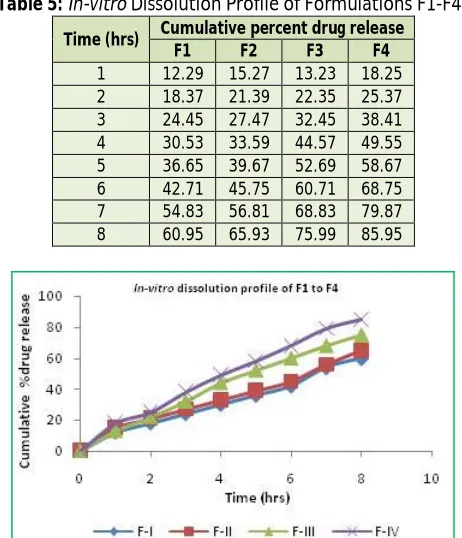
Table 5: In-vitro Dissolution Profile of Formulations F1-F4
Time (hrs) Cumulative percent drug release
F1 F2 F3 F4
1 12.29 15.27 13.23 18.25 2 18.37 21.39 22.35 25.37 3 24.45 27.47 32.45 38.41 4 30.53 33.59 44.57 49.55 5 36.65 39.67 52.69 58.67 6 42.71 45.75 60.71 68.75 7 54.83 56.81 68.83 79.87 8 60.95 65.93 75.99 85.95
Figure 2: In-vitro Dissolution Profile of Formulations F1-F4
Table 6: In-vitro Dissolution Profile of Formulations F5-F8
Time (hrs) Cumulative percent drug release
F5 F6 F7 F8
1 21.35 20.37 19.35 18.45 2 30.41 33.45 26.47 27.53 3 42.57 45.53 49.55 39.67 4 57.63 60.65 48.67 50.75 5 68.75 69.71 59.79 59.85 6 77.83 78.87 69.83 69.73 7 81.75 88.57 80.54 78.43 8 95.73 90.79 87.65 84.78
Kinetic modeling of drug release9, 10
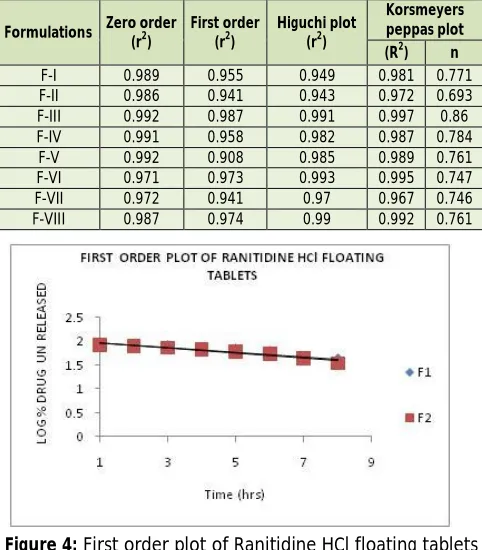
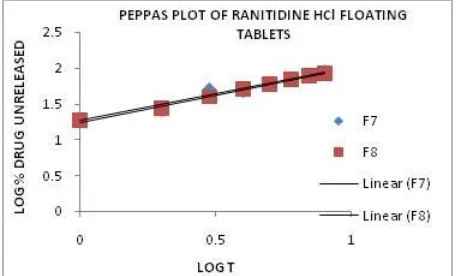
The dissolution profile of all the batches was fitted to zero- order, first order, Higuchi, Korsmeyer and Peppas to ascertain the kinetic modeling of drug release.
Table 7: Curve Fitting Analysis for Different Formulations
Formulations Zero order
(r2)
First order (r2)
Higuchi plot (r2)
Korsmeyers peppas plot
(R2) n
F-I 0.989 0.955 0.949 0.981 0.771
F-II 0.986 0.941 0.943 0.972 0.693
F-III 0.992 0.987 0.991 0.997 0.86
F-IV 0.991 0.958 0.982 0.987 0.784
F-V 0.992 0.908 0.985 0.989 0.761
F-VI 0.971 0.973 0.993 0.995 0.747
F-VII 0.972 0.941 0.97 0.967 0.746
F-VIII 0.987 0.974 0.99 0.992 0.761
Figure 4: First order plot of Ranitidine HCl floating tablets
of formulations F1 and F2
Figure 5: First order plot of Ranitidine HCl floating tablets
of formulations F3 and F4
Figure 6: First order plot of Ranitidine HCl floating tablets
of formulations F5 and F6
Figure 7: First order plot of Ranitidine HCl floating tablets
of formulations F7 and F8
Figure 8: Higuchi plot of Ranitidine HCl floating tablets of
formulations F1 and F2
Figure 9: Higuchi plot of Ranitidine HCl floating tablets of
formulations F3 and F4
Figure 10: Higuchi plot of Ranitidine HCl floating tablets of
Figure 11: Higuchi plot of Ranitidine HCl floating tablets of
formulations F7 and F8
Figure 12: Peppas plot of Ranitidine HCl floating tablets of
formulations F1 and F2
Figure 13: Peppas plot of Ranitidine HCl floating tablets of
formulations F3 and F4
Figure 14: Peppas plot of Ranitidine HCl floating tablets of
formulations F5 and F6
Figure 15: Peppas plot of Ranitidine HCl floating tablets of
formulations F7 and F8
Drug content determination
20 tablets of each formulation were weighed and powdered. The quantity of powder equivalent to 150 mg of ranitidine hydrochloride was transferred into 100 ml volumetric flask and volume is made up with 0.1 N HCl. Further 1 ml of above solution was diluted to 10 ml with 0.1 N HCl and Absorbance of these solutions was measured at 315nm using UV-Visible spectrophotometer.
Table 8: Drug Content Estimation of Ranitidine
Hydrochloride Tablets
Formulations Drug content (mg)
F1 149.97±0.000
F2 147.03±0.070
F3 149.63±0.270
F4 145.09±0.000
F5 154.91±0.000
F6 152.57±0.110
F7 146.78±0.200
F8 149.94±0.070
RESULTS AND DISCUSSION
From the infrared spectra it is clearly evident that there were no interactions of the drug. The powders of different formulations were evaluated for angle of repose, bulk density tapped density and compressibility index. Angle of repose values ranged from 270.13 ‘to 290.35 ‘which indicates good flow property of powders. The results of bulk density ranged from 0.453 to 0.488 gm/ cm3. The results of tapped density ranged from 0.547 to 0.614 gm/ cm3.
Tablets of all the formulations were subjected to many in- process evaluation parameters such as physical appearance, thickness, content uniformity, weight variation, hardness and friability tests.
sodium CMC was added. But there is no much improvement in the floating duration.
Five different polymers and their combinations were used to prepare floating matrix tablets.
The cumulative percent of drug released from formulations F1 & F2 was observed to be 60.85% & 65.93% respectively. The cumulative percent of drug released from formulations F3 & F4 was observed to be 75.91% & 85.95% respectively. The cumulative percent of drug released from formulations F5, F6, F7 & F8 was observed to be 95.73%, 90.79%, 87.65%, & 84.78% respectively. In case of F5, F6 & F7 formulations, it was observed that, as the concentration of Moringa gum increases, the rate of drug release was decreased. The rate of Ranitidine Hydrochloride released was further decreased with the incorporation of Sodium CMC in F8. The in-vitro release data were treated with zero order, first order, and Higuchi & Korsmeyer-Peppas. Interpretation of diffusion exponent (n) values enlightens in understanding the release mechanism from the dosage form. The values of n fell within the range of 0.693 to 0.860, indicating non-fickian type release. This kind of release is the characteristics of swelling-control system in which the rate of solvent uptake into a polymer is largely determined by the rate of swelling and relaxation of the polymer chains.
CONCLUSION
In the present work single unit floating tablets of Ranitidine hydrochloride were formulated to provide controlled release of drug with the aim of providing effective and safe therapy for inhibition of the action of histamine (gastric acid secretion) with a reduced dose and reduced length of treatment. Among all the formulations, F1 and F2 containing HPMC K-4M and HPMC 100 K gave lesser floating lag time and a prolonged floating duration. F5, F6, F7 and F8 gave comparatively higher floating lag
time and not much prolonged floating duration. The drug release was further controlled with the addition of sodium CMC along with Moringa gum. From the results it can be concluded that Moringa gum could be used as an efficient carrier for floating drug delivery systems.
REFERENCES
1. Vyas SP, Khar RK, Controlled drug delivery: concepts and advances, 1st Ed, Vallabh prakashan, New Delhi, 2002, 345-376.
2. St Louis, MO: Wolters Kluwer Co, Histamine H2 antagonists. In: Drug facts and comparisons, 2002, 1192-1197.
3. D. McCarty-Dawson, S. O. Sue, B. Morrill, et al, Ranitidine versus cimetidine in the healing of erosive esophagitis. Clin. Ther, 18, 1996, 1150-1160.
4. A. W. Basit, L. F. Lacey, Colonic metabolism of ranitidine: implications for its delivery and absorption, Int. J. Pharm. Sci., 227, 2001, 157-165.
5. Martin A, Physical pharmacy, 4th Ed, BI Waverly Pvt Ltd, New Delhi, 1994, 443-447.
6. Copper j, Gunn C, Powder flow and compaction In: Carter SJ, Tutorial pharmacy, New Delhi, India, CBS publishers and distributors, 14, 2002, 202-204.
7. Raghurman K.R, Mutalik S. and Reddy S, Once- Daily sustained- Release Matrix tablets of Nicorandil: Formulation and In vitro Evaluation, AAPS Pharm Sci Tech, 4{4}, 2003.
8. M. Rosa, H. Zia, T. Rhodes, Dosing and testing in-vitro of a bioadhesive and floating drug delivery system for oral application, Int. J. Pharm., 105, 1994, 65-70.
9. Korsmeyer R, Gurny R, Peppas N, Mechanisms of solute release from porous hydrophilic polymers, Int. J .Pharm, 15, 1983, 25-35.
10. Peppas NA, Analysis of Fickian and non-Fickian drug release from polymers, Pharm Acta Helv, 60, 1985, 110-111.