1
Ding Wang and Gaopeng Jian, Peking University Xinyi Huang, Fujian Normal University
Ping Wang, Peking University
Despite more than thirty years of intensive research efforts, textual passwords are still enveloped in mysterious veils. In this work, we make a substantial step forward in understanding the underlying distributions of passwords. By conducting linear regressions on a corpus of 97.2 million passwords (a mass of chaotic data), we for the first time show that Zipf ’s lawperfectlyexists in user-generated passwords, figure out the corresponding exact distribution functions, and investigate somefundamentalimplications of our observations for password policies and password-based cryptographic protocols (e.g., authentication, encryption and signature).
As one specific application of this law of nature, we propose the number of unique passwords used in regression and the absolute value of slope of the regression line together as a metric for assessing the strength of password datasets, and prove its correctness in a mathematically rigorous manner. In addition, extensive experiments (including optimal attacks, simulated optimal attacks and state-of-the-art cracking sessions) are performed to demonstrate the practical effectiveness of our metric. In two of four cases, our metric outperforms Bonneau’s
α-guesswork in simplicity and to the best of knowledge, it is the first one that is both easy to approximate and accurate to facilitate comparisons, providing a useful tool for the security administrators to gain a precise grasp of the strength of their password datasets and to adjust the password policies more reasonably.
Categories and Subject Descriptors: C.4.6 [Operating Systems]: Security and Protection–Authentication
General Terms: Theory, Security, Metric
Additional Key Words and Phrases: Internet security, Passwords, Password-based protocol; Zipf ’s law
ACM Reference Format:
Wang, D., Jian, G., Huang, X., and Wang, P. 2015. Zipfs Law in Passwords.ACM Trans. Info. Syst. Sec.1, 1, Article 1 (January 2015), 33 pages.
DOI:http://dx.doi.org/10.1145/0000000.0000000
1. INTRODUCTION
User authentication is the most essential security mechanism for networked systems to safeguard resources and services from unauthorized access. Even though much has been reported about their pitfalls, textual passwords are still the dominant mechanism of user authentication, protecting hundreds of millions of accounts on Internet-scale service providers. Recently, there have been countless attempts in proposing alternative schemes (e.g., graphical passwords [Zhu et al. 2014], single sign-on [Sun et al. 2013] and multi-factor authentication [Huang et al. 2014]) to dislodge passwords, yet passwords are more widely used and firmly entrenched than ever. Since passwords offer many advantages not always matched by other alternative authentication schemes [Bonneau et al. 2012; Zhao et al. 2015; Wang et al. 2014] and moreover, the transition costs of replacing them can not be effectively quantified [Herley and Van Oorschot 2012], they are likely to persist and dominate the authentication systems in the foreseeable future.
Author’s address: D. Wang and P. Wang, School of Electronics Engineering and Computer Science, Peking University, Beijing 100871, China; G. Jian, School of Mathematical Sciences, Peking University, Beijing 100871, China; X. Huang, School of Mathematics and Computer Science, Fujian Normal University, Fuzhou 350007, China. Email:{wangdingg,demscimath}@pku.edu.cn; [email protected]; [email protected].
Permission to make digital or hard copies of part or all of this work for personal or classroom use is granted without fee provided that copies are not made or distributed for profit or commercial advantage and that copies show this notice on the first page or initial screen of a display along with the full citation. Copyrights for components of this work owned by others than ACM must be honored. Abstracting with credit is permitted. To copy otherwise, to republish, to post on servers, to redistribute to lists, or to use any component of this work in other works requires prior specific permission and/or a fee. Permissions may be requested from Publications Dept., ACM, Inc., 2 Penn Plaza, Suite 701, New York, NY 10121-0701 USA, fax+1 (212) 869-0481, or [email protected].
© 2015 ACM 1094-9224/2015/01-ART1 $15.00
Despite its ubiquity, password-based authentication is accompanied by the dilemma of generating passwords which are challenging for powerful attackers to crack but easy for common users to remember. Truly random passwords are difficult for users to memorize, while user-chosen passwords may be highly predictable [Yan et al. 2004]. In practice, users tend to gravitate towards weak passwords that are related to their daily lives (e.g., birthdays, phone numbers, lovers, friends and pet names) [Brown et al. 2004; Florencio and Herley 2007], which means these passwords are drawn from a rather small dictionary and thus are prone to offline/online guessing attacks.
To mitigate this notorious “security-usability” dilemma, various password creation policies have been proposed, e.g., random generation [Yan et al. 2004], rule-based [Bishop and V Klein 1995; Schechter et al. 2010], entropy-based [Burr et al. 2006; Burr et al. 2013] and cracking-based [Houshmand and Aggarwal 2012; Castelluccia et al. 2012]. They force newly created passwords to adhere to some rules and to achieve an acceptable strength. The diversity of password strength meters and rules brings about an enormous variety of requirements between different websites, resulting in highly conflicting strength out-comes for the same password. For example, the password password$1 is deemed “Very Weak” by Dropbox, “Fair” by Google and “Very Strong” by Yahoo!
The above contradictory outcomes of password strength (for more concrete examples, see [de Carnavalet and Mannan 2014; Wang and Wang 2015]) are a direct result of the inconsistent password strength meters employed among different websites, which may in part be further explained by the diverse interests of each website. It is generally believed that stricter policies might make passwords harder to crack, but the side effect is that users may feel harder to create and to remember passwords and thus usability is reduced [Ur et al. 2012]. The work by [Adams and Sasse 1999; Inglesant and Sasse 2010] also reported that, inappropriate password policies in a specific context of use can increase both mental and cognitive workload on users and impact negatively on their productivity, and ultimately they will try every means to circumvent such un-friendly policies.
As a result, different types of application systems typically have quite different favors. For e-commerce sites like eBay, portals like Yahoo! and order accepting sites like Kasper-sky, usability is very crucial because every login event is a revenue opportunity. Anything that undermines user experience impairs the success of the business. So they tend to have less restrictive password policies [Florˆencio and Herley 2010]. On the other hand, it is of great importance to prevent attackers from illicitly accessing valuable resources on security-critical sites, e.g., cloud storage sites (e.g., Dropbox) that maintain sensitive documents and university sites that manage course grades. So they may require that user-selected passwords are subject to more complex constraints (e.g., inclusion of mixed-case, digits and special characters, and rejection of popular passwords likepa$$word123).
As different systems favor varied password policies, a number of critical issues arise: how can the password policy designers evaluate their policies? How can the administra-tors select the right policy for their systems? In addition, usually the users of a system (as well as its services) may dynamically change as time goes on, which highly leads to large variations in the password dataset after some period of time (e.g., one year) even though the password policy1 stays the same, especially true for Internet-scale service providers. In this situation, the security administrators shall quantify the strength of passwords and may need to adjust the password policy. Either failing to notice the changes in the password dataset or conducting improper countermeasures may give rise to great (but subtle) security and usability problems as shown above. So a proper assessment of the strength of password dataset is essential, without which the security administrator is unable to determine the following important question: How shall the password policy be adjusted? Or equally, shall the password policy be enhanced to improve security, kept unchanged or even relaxed a bit to get usability in return? In a nutshell, the core crux
1In this work, the terms “password policy” and “password creation policy” will be used interchangeably, while
of designing and selecting an appropriate password policy or properly adjusting it lies in how to accurately assess the strength of password datasets created under it. Note that, in this work we presume that each existing authentication system has already adopt some password policy (e.g., [Houshmand and Aggarwal 2012; Castelluccia et al. 2012]), and its adjustment mainly involves changing some rules and the password strength threshold.
1.1. Motivations
Surprisingly, as far as we know, existing literature has not provided a satisfactory answer to the above question of how to accurately measure the strength of a given password dataset. The two most commonly used approaches to assess the strength of a password dataset are theoretically measuring its information entropy (e.g., [Burr et al. 2006]) and empirically estimating its “guessability” (e.g., [Kelley et al. 2012; Mazurek et al. 2013]). The former, however, is not based on empirical data and has been shown inaccurate [Weir et al. 2010], while the latter, which largely depends on the choices of the cracking algorithms, parameters, and input dictionaries [Ma et al. 2014; Dell’Amico et al. 2010], has too many uncertainties to accurately characterize the strength of a given dataset. Later on, Bonneau [2012b] introduced an ingenious statistical-based metric Gα(·) (named α
-guesswork) which is parameterized on an attacker’s desired success rateα. This metric is accurate, yet it is intrinsically non-deterministic. For instance, the relationship ofG0.50(A)
> G0.50(B)can never ensure thatG0.49(A)> G0.49(B), whereAandBare two password
datasets. This means no definite conclusions can be reached unless an entireα-guesswork curve (with x-axis ranging from [0,α]) is computed. Failing to catch this subtlety may cause great misconceptions as it did in the case of [Li et al. 2014]. This non-deterministic nature undermines the simplicity ofα-guesswork. Fortunately, in this work we develop a simple, accurate and deterministic (in two of four cases) statistical metric.
Inevitably, the accomplishment of accurately assessing the strength of a password dataset would entail the settlement of a more fundamental question: How to precisely characterize a given password dataset? Or equally,what’s the distribution that real-life user-generated passwords follow? Despite more than thirty years of intensive research efforts, textual passwords are still enveloped in mysterious veils and this same old question is asked year in year out, which may well explain why most of today’s password authenticated key exchange (PAKE) protocols with provable security (in thousands, some notable ones include [Chen et al. 2014; Canetti et al. 2012] in the random oracle model and [Katz and Vaikuntanathan 2013; Halevi and Krawczyk 1999] in the standard model) still rely on a simple but inconceivable assumption: Passwords follow a uniform distribution.
To the best of knowledge, the work by Malone and Maher [2012] may be the most relevant to what we will discuss in this paper. They made an initial attempt to investigate the distribution of passwords and reached the conclusion that their password datasets are “unlikely to actually be Zipf distributed”. Such a conclusion is right contrary to what we will show in the current work. Malone and Maher [2012] also concluded that “Zipf distribution is a relatively good match for the frequencies with which users choose passwords”. A bit self-contradictory? The key is that, they use an inherently flawed method to attempt to model password distribution with Zipf (naturally, they fail), and they compare their model with a uniform model, and their comparison results show that their model is “a relatively good match”. Since nearly any model would outperform a uniform model, the conclusion that their model is “relatively good” is of little, actually no, sense. This confusing, unsatisfactory situation motivates this work.
1.2. Our contributions
As our primary contribution, we adopt techniques from computational statistics to show that Zipf ’s law perfectly exists in real-life passwords, inspired by the applicability of Zipf ’s law to describe surprisingly diverse natural and social phenomena, such as the Internet topology [Faloutsos et al. 1999] and US firm sizes [Axtell 2001]. We prune the least frequent passwords, rank the frequency of each remaining unique password in decreasing order and investigate the mathematical relationships between the frequency and the rank by using linear regression. Extensive experiments on a massive corpus of twelve password datasets (vastly different in terms of service, size, how leaked, localization and language) show that, our Zipf model is able to accurately characterize the distribution of real-life passwords. In other words, each password dataset is a specific sample drawn from the underlying password population which perfectly follows the Zipf ’s law. This invalidates the claim made in [Malone and Maher 2012] that user passwords are “unlikely to actually be Zipf distributed”. Particularly, we show it is the front head of passwordsnativelyfollow the Zipf ’s law, but not “the long tail of password choices” as reported in their work. Then, we figure out why such diametrically opposite observations are made and why our methodology is essential. Furthermore, we demonstrate the general applicability of our observation, highlight its fundamental implications for password policies and password-based cryptographic protocols and suggest a reasonable answer to the open problem left by Wang et al. [2014]. This constitutes a compelling answer to the first question.
Our second contribution is a novel metric that utilizes the concrete knowledge of the password distribution function, and thus it overcomes various problems in existing metrics (e.g., uncertainties in cracking-based approaches [Kelley et al. 2012] and non-deterministic nature in α-guesswork [Bonneau 2012b]). Our metric facilitates the pass-word policy designers and security administrators to have a concise grasp of the strength of their password datasets (either in plain-text or hashed form) in a mathematically rigorous manner, and enable them to precisely evaluate the security property of password policies under examination. This suggests the settlement of the second question.
Another contribution of this paper is to show the effectiveness of our metric for mea-suring the strength of password datasets through empirical evidence. Firstly, we simulate optimal guessing attacks on the collected real-life password datasets. Then, we take a step forward to employ the state-of-the-art cracking algorithm (i.e., Markov-based [Ma et al. 2014]) to approximate optimal password cracking attack. Of independent interest may be our observation that, in some cases, Markov-based cracking success rates are much lower as compared to optimal cracking results, implying that the state-of-the-art cracking algorithm is far from an optimal one and there leaves much room for future improvement. Additionally, we report an inherent flaw in the strength conversion of α -guesswork [Bonneau 2012b] and manage to figure out how to fix it.
Roadmap. In Section 2, we survey related works. Then, we show Zipf ’s law exists in passwords in Section3. Some fundamental implications of our observations are discussed in Section4. The password dataset strength metric is presented, proved, and empirically established in Section5, and Section6conclues the paper.
2. RELATED WORK
In this section, we briefly review some related works on password creation policies and password cracking techniques to provide some background for later discussions.
2.1. Password creation policies
Since Klein’s seminal work, there have been proposed a number of proactive password checkers that aim to reduce the time and space of matching newly-created passwords with a blacklist of “weak” passwords, such as Opus [Spafford 1992b] and ProCheck [Bergadano et al. 1998]. There have also been attempts to design tuneable rules on a per-site basis to shape password creation, among which is the influential NIST Electronic Authentication Guideline SP-800-63 [Burr et al. 2006]. However, by modeling the success rates of current password cracking techniques against real-life user passwords created under different rules, Weir et al. [2010] showed that merely rule-based policies perform poorly for ensuring a desirable level of security. On the basis of Weir et al.’s work, Houshmand and Aggarwal [2012] proposed a novel policy that first analyzes whether a user selected password is weak or strong according to the empirical cracking-based results, and then modifies the password slightly if it is weak to create a strengthened password. This policy facilitates measuring the strength of individual passwords more accurately and in addition, it can be adjusted more flexibly than previous policies due to the fact that its adjustment only involves tuning the threshold within a continuous range. Perhaps the most relevant policy related to our strength metric for assessing password datasets (see Section 5) is suggested by Schechter et al. [2010]. Their intriguing idea is to use a popularity oracle to replace traditional password creation policies, and thus passwords with high popularity are rejected. This policy is particularly effective at thwart-ing statistical-based guessthwart-ing attacks against Internet-scale authentication systems with millions of user accounts. If this policy is in place, our proposed metric would be largely unnecessary. However, how to prevent an attacker from using their oracle to guess passwords is an open question. Moreover, this policy rejects passwords that occur at a probability exceeding a thresholdT (e.g.,T =1016 as exampled in [Schechter et al. 2010]),
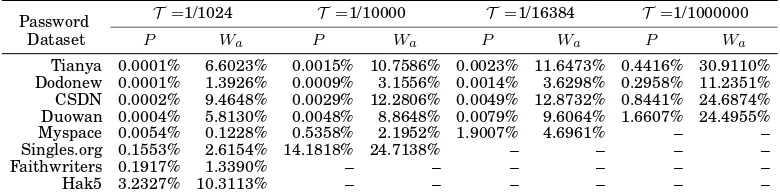
yet whether it would greatly reduce usability has not been evaluated thoroughly (e.g., no actual user case studies are reported). As an immediate consequence of this policy, it might frequently annoy users by forbidding them to use their intended passwords that are typically popular. For instance, about 34.89% of users inwww.tianya.cnuse passwords that are more frequent than T = 1016, which indicates that more than one third of the
users have an equal potential to be annoyed to select and maintain a new password. Nevertheless, such a policy would be very promising if these issues can be addressed.
2.2. Password cracking
Password-based systems are prone to various attacks, such as on-line guessing, offline guessing, keylogging, shoulder surfing and social engineering [Long 2011; Herley 2013]. Here we only consider the on-line and offline guessing attacks, other attacks are unrelated to password strength or password dataset strength and therefore outside the scope of this work. While online guessing can be well thwarted by non-cryptographic techniques, such as locking an account after a threshold number of failed logins or using more flexible lockout strategies [Van Oorschot and Stubblebine 2006; Alsaleh et al. 2012], offline guessing attacks are performed on local hardware that the attacker controls and thus she can make as many guesses as possible given enough time and computational power. Florˆencio et al. [2014] discussed scenarios where offline guessing constitutes a real threat and identified a great “chasm” between a password’s guessing-resistance against these two types of guessing. They found that in this “chasm”, incrementally increasing the strength of passwords delivers little security benefit, and thus they called in question the common practice of nudging users towards stronger passwords beyond online guessing resistance. Yet, it is not difficult to see that such a “chasm” would be largely eliminated (and so is the corresponding doubt), if one considers the cases where passwords (e.g., in salted-hash) have been leaked yet this leakage is detected (and coped with) only after some period of time (e.g., a few days), during which offline guessing indeed poses a realistic threat.
of hashed passwords that would be offline recovered.This measure only depends on the attacking technique and the way users choose their passwords, and it is neither related to the particular nature of the authentication system (e.g., which type of hash function is used, PBKDF2 or SHA-1?) nor affected by the attacker capabilities. The nature of the system and attacker capabilities will instead define the cost that the attacker has to pay for each single guess [Dell’Amico et al. 2010]. For example, system countermeasures against offline attacks, such as salting to defeat pre-computation techniques (e.g., Rainbow tables [Oechslin 2003]) or key strengthening [D ¨urmuth 2013] to make guessing attacks more costly, only constitute a key parameter when evaluating the resilience of a password system to offline attacks. By combining this cost with a measure of the search space, it becomes possible to attain a concrete cost-benefit analysis for offline attacks. This kind of measure is also followed by our work.
Password search space essentially depends on how the users choose their passwords. It is a well known fact that users tend to choose passwords (e.g., words from dictionaries like the famous “dict-0294” [Outpost9.com’s Lab 2014] or something related to their daily lives) that are easily rememberable [Shay et al. 2010; Florencio and Herley 2007]. However, users rarely use unmodified elements from such lists, for instance, because password creation policies prevent this practice, and instead users modify the words in such a way that they can still recall them easily. For example, the popular password pa$$word is generated by leeting two letters of the easily guessable stringpassword.
To model this password generation practice, researchers utilize various heuristic man-gling rules to produce variants of words from an input dictionary like “dict-0294” [Out-post9.com’s Lab 2014], and this sort of techniques has emerged as early as 1979 in Morris-Thompson’s analysis of 3,000 passwords [Morris and Thompson 1979]. This initial work has been followed by independent works by Klein [1990] and Spafford [1992a]. Later on, some dedicated software tools like John the Ripper [Designer 1996] appeared. Subsequent studies (e.g., [Kuo et al. 2006; Dell’Amico et al. 2010]) have often utilized these software tools to perform dictionary attacks as a secondary goal.
It was not until very recently that password cracking began to deviate from art to science. Narayanan and Shmatikov [2005] developed an advanced cracking algorithm that uses Markov chain instead of ad hoc mangling rules to model user password creation patterns. This algorithm generates passwords that are phonetically similar to words. It is tested on a dataset of 142 hashed passwords and 96 (67.6%) passwords were successfully broken. Yet, their algorithm is not a standard dictionary-based attack, for it can only produce linguistically likely passwords. Moreover, the test dataset is too limited to convincingly show its effectiveness.
In 2009, on the basis of probabilistic context- free grammars (PCFG), Weir et al. [2009] suggested a novel technique for automatically deriving word-mangling rules, and they further employed large real-life datasets to test its effectiveness. In this technique, a password is considered as a combination of alphabet symbols (denoted byL), digits (D) and special characters (S). For instance,pa$$word123 is denoted byL2S2L4D3. Then, a set of
word-mangling rules is obtained from a training set of clear-text passwords. To simulate the optimal attack, this algorithm generates guesses in decreasing order of probability, and it is able to crack 28% to 129% more passwords than John the Ripper [Designer 1996]. In 2014, Ma et al. [2014] found that, when tuned with the right order and employing some ways to deal with the problems of data sparsity and normalization, Markov-chain based cracking algorithms would perform better than PCFG-based cracking algorithms. Hence, in this work we follow Ma et al.’s Markov-based algorithms to crack the collected datastets and make comparisons based on the proposed metric.
3. THE ZIPF’S LAW IN REAL-LIFE PASSWORDS
3.1. Linear regression
In statistics, linear regression is an approach for modeling the relationship between two variables by fitting a linear equation to the observed data. One variable is considered to be an explanatory variable, and the other one is considered to be a dependent variable. Usually, linear regression refers to a model in which, given the value ofx, the conditional mean ofy is an affine function ofx:y=a+b·x, wherexis the explanatory variable and
yis the dependent variable. The slope of the line isb, andais the intercept.
The most common method for fitting a regression line is by using least-squares. This method computes the best-fitting line for the observed data by minimizing the sum of the squares of the vertical deviations from each data point to the line. For example, if a point lies on the fitting line exactly, then its vertical deviation is 0. More specifically, from the experiments we collect a bunch of data:(xi, yi),1≤i≤N. We expecty=a+b·x+ε, where a, bare constants andεis the error. If we chooseb=
∑N
i∑=1(xi−x¯)(yi−¯y) N
i=1(xi−x¯)2 anda= ¯y−bx¯, where ¯
xis the arithmetical mean ofxi, and similarly fory¯. Then the sum of the squares of the
errors∑Ni=1(yi−a−b·xi)2is minimized. In regression, the coefficient of determination
(denoted byR2and ranging from 0 to 1) is a statistical measure of how well the regression
line approximates the real data points:the closer to 1 the better. AR2value of 1 indicates
that all data points perfectly dwell on the regression line.
3.2. Description of the password datasets
In our work we collect twelve large-scale real-life password lists different in terms of service, size, how leaked, user localization, language and culture (faith) background, showing that our model is able to accurately characterize the distribution of real-life passwords. All twelve datasets, as summarized in Table I, were compromised by hack-ers or leaked by anonymous insidhack-ers, and were subsequently disclosed publicly on the Internet. Some of them have also been used by a number of scientific works that study passwords (e.g., [Weir et al. 2010; Komanduri et al. 2014; Ma et al. 2014]). We realize that while publicly available, these datasets contain private data such as emails, user names and passwords. Therefore, we treat all user names as confidential and only report the aggregation information about passwords such that using them in our research does not increase the harm to the victims. Furthermore, attackers are likely to exploit these accounts as training sets or cracking dictionaries, while our study of them are of practical relevance to security administrators and common users to secure their accounts.
Table I. Basic information about the twelve datasets (“PWs” stands for passwords)
Dataset Service Location Language When leaked How leaked Total PWs Unique PWs Tianya Social forum China Chinese Dec. 4, 2011 Hacker breached 30,233,633 12,614,676
Dodonew Gaming&Ecommerce China Chinese Dec. 3, 2011 Hacker breached 16,231,271 11,236,220 CSDN Programming China Chinese Dec. 2, 2011 Hacker breached 6,428,287 4,037,610 Duowan Gaming China Chinese Dec. 1, 2011 Insider disclosed 4,982,740 3,119,070 Myspace Social forum USA English Oct. 1, 2006 Phishing attack 41,545 37,144 Single.org Dating USA English Oct. 1, 2010 Query string injection 16,250 12,234 Faithwriters Writer forum USA English Mar. 1, 2009 SQL injection 9,709 8,347 Hack5 Hacker forum USA English July 1, 2009 Hacker breached 2,987 2,351 Rockyou Gaming USA English Dec. 07, 2009 Hacker breached 32,603,388 14,341,564 Yahoo Web portal USA English July 12, 2012 SQL injection 453,492 342,515 Mail.ru Email Russia Russian Sep. 09, 2014 Phishing&malware 4,938,663 2,954,907 Yandex.ru Search engine Russia Russian Sep. 09, 2014 Phishing&malware 1,261,810 717,203
monetary transactions. All the passwords except part of the Duowan dataset are in plain-text. Duowan contains both hashed (MD5) and plain-text passwords, and we limit our analysis to the 4.98 million plain-text ones.
The fifth dataset is the “Myspace” which was originally published in October 2006. Myspace is a famous social networking website in the United States and its passwords were compromised by an attacker who set up a fake Myspace login page and then conducted a standard social engineering (i.e., phishing) attack against the users. While several versions of the Myspace dataset exist, owing to the fact that different researchers downloaded the list at different times, we get one version from [Bowes 2011] which con-tained 41,545 plain text passwords. The following two datasets are the “Singles.org” and the “Faithwriters”. They both are composed of people almost exclusively of the Christian faith:www.singles.orgis a dating site ostensibly for Christians andwww.faithwriters.comis an online writing community for Christians. The former was broken into via query string injection and 16250 passwords were leaked, while the latter was compromised by an SQL injection attack which disclosed 9,709 passwords.
The eighth dataset is from www.hak5.org and it was compromised by a group called ZF0 (Zero for 0wned) [Constantin 2009]. This dataset is only a small portion of the entirewww.hak5.orgdataset. Surprisingly, though Hak5 is claimed to be “a cocktail mix of comedy, technolust, hacks, homebrew, forensics, and network security”, its dataset is amongst the weakest ones (see Section5.1) of all the datasets. In this work, we use this dataset as acounterexamplefor representatives of real-life password distributions.
Besides the above eight datasets, we additionally employ four datasets (i.e., Rockyou, Yahoo, Yandex.ru and Mail.ru) to show the generalizability of our findings of Zipf ’s law in Section3.4and3.5, and due to space constraints, they will not be analyzed elsewhere. The Rockyou dataset includes 32M passwords leaked from the gaming forum Rockyou in Dec. 2009 [Allan 2009]; The 450K Yahoo passwords was made online by the hacker group named D33Ds in July 2012; The last two deatasets (i.e., 4.9M Mail.ru and 1.3M Yandex.ru) were leaked by Russian hackers in Sep. 2014, and about 90% of them are active [Mick 2014], and it is said that these credentials are collected not by hacking the sites but through phishing and other forms of hacking attacks on users (e.g., key-loggers).
3.3. Statistics about the password datasets
In this subsection, we report some statistical information about the collected datasets. Firstly, the character composition information is summarized in TableII. It is interesting to note that Chinese users are more likely to use only digits to construct their passwords, while English users prefer using letters to construct their passwords. A plausible explana-tion may be that Chinese users, who usually use hieroglyphics and are less familiar with English letters on keyboards. Another interesting observation is that, Myspace users tend to generate their passwords by adding the digit “1” to a sequence of lower-case letters.
Table II. Character composition information about each password dataset
Dataset [a-z]+ [A-Z]+ [A-Za-z]+ [0-9]+ Z0-9]+[a-zA- [0-9]+[a-z]+ [a-z]+1 [a-zA-Z]+[0-9]+ [a-zA-Z]+[0-9]+ [0-9]+[a-z]+
Tianya 9.96% 0.18% 10.29% 63.77% 98.05% 14.63% 0.12% 15.64% 4.37% 4.11% Dodonew 8.79% 0.27% 9.37% 20.49% 82.88% 40.81% 1.39% 42.94% 7.31% 6.95% CSDN 11.64% 0.47% 12.35% 45.01% 96.31% 26.14% 0.24% 28.45% 6.46% 5.88% Duowan 10.30% 0.09% 10.52% 52.84% 97.59% 23.97% 0.37% 24.84% 6.04% 5.83% Myspace 7.18% 0.31% 7.66% 0.71% 89.95% 65.66% 18.24% 69.77% 6.02% 5.66% Singles.org 60.20% 1.92% 65.82% 9.58% 99.78% 17.77% 2.73% 19.68% 1.92% 1.77% Faithwriters 54.40% 1.16% 59.04% 6.35% 99.57% 22.82% 4.13% 25.45% 2.73% 2.37% Hak5 18.61% 0.27% 20.39% 5.56% 92.13% 16.57% 2.01% 31.80% 1.44% 1.21%
and thus longer passwords are selected. Of particular interest to our observations is that the CSDN dateset has much fewer passwords of length 6 and 7 as compared to other datasets. This may be due to the fact that www.csdn.net (as well as many other websites) started with a loose password policy and later on a strict policy was enforced (e.g., requiring the passwords to be of a minimum-8 length). We also note that passwords from www.christian-singles.org are all no longer than 8 characters, which may be due to a policy that prevents users from choosing passwords longer than 8 characters. Such a policy still exits in many financial companies [Johnston 2013], and a plausible reason may be that the shift to longer allowed password lengths is a non-trivial issue.
Table III. Length distribution information of each dataset
Length 1-3 4 5 6 7 8 9 10 11 12 13-16 17-30 30+ All
Tianya 0.61% 0.65% 0.55% 33.77% 13.92% 18.10% 9.59% 10.28% 5.53% 2.88% 4.05% 0.07% 0.00% 100%
Dodonew 0.36% 0.70% 0.78% 9.71% 13.45% 18.49% 20.29% 14.69% 3.10% 1.34% 10.24% 6.79% 0.04% 100%
CSDN 0.01% 0.10% 0.51% 1.29% 0.26% 36.38% 24.15% 14.48% 9.78% 5.75% 6.96% 0.32% 0.00% 100%
Duowan 0.02% 0.13% 0.12% 20.62% 17.68% 22.49% 15.12% 11.55% 5.30% 2.72% 4.13% 0.12% 0.00% 100%
Myspace 0.25% 0.51% 0.79% 15.67% 23.40% 22.78% 17.20% 13.65% 2.83% 1.13% 1.15% 0.48% 0.17% 100%
Singles.org 0.68% 4.74% 7.68% 32.05% 23.20% 31.65% 0.00% 0.00% 0.00% 0.00% 0.00% 0.00% 0.00%100%
Faithwriters 0.04% 0.14% 0.99% 31.97% 20.95% 22.71% 10.35% 5.98% 3.24% 1.87% 1.53% 0.20% 0.01% 100%
Hak5 0.10% 0.64% 0.97% 12.96% 8.50% 20.89% 8.94% 30.83% 3.58% 3.08% 6.90% 2.44% 0.17% 100%
Average 0.26% 0.95% 1.55%19.75% 15.17% 24.19% 13.20% 12.68% 4.17% 2.35% 4.37% 1.30% 0.05% 100%
In the 1980s, it was revealed that the most popular password at that time was12345; thirty years later, as can be seen from TableIV,123456takes the lead. It is a long-standing problem that a significant fraction of users prefer the same passwords as if by prior agreement, which is in part due to the inherent limitations of human cognition. Note that, this situation can not be fundamentally altered by simply banning such popular passwords. For example, if passwordis banned, thenpassword1will be popular (see the most popular passwords of Myspace); if password1 is banned, then pa$$word1 will be popular. It is hoped that the adaptive password meters (e.g., [Castelluccia et al. 2012]) will ultimately eliminate this issue. Most of the top 10 Chinese passwords are sole digits, while most of the top 10 English passwords are sole letters.
Table IV. Top 10 most popular passwords of each dataset
Rank Tianya Dodonew CSDN Duowan Myspace Singles.org Faithwriters Hak5
1 123456 123456 123456789 123456 password1 123456 123456 QsEfTh22
2 111111 a123456 12345678 111111 abc123 jesus writer ——
3 000000 123456789 11111111 123456789 fuckyou password jesus1 timosha
Top 3 (%) 5.58% 1.49% 8.15% 5.01% 0.40% 2.10% 1.03% 4.62%
4 123456789 111111 dearbook 123123 monkey1 12345678 christ ike02banaA
5 123123 5201314 00000000 000000 iloveyou1 christ blessed 123456
6 123321 123123 123123123 5201314 myspace1 love john316 zxczxc
7 5201314 a321654 1234567890 123321 fuckyou1 princess jesuschrist 123456789
8 12345678 12345 88888888 a123456 number1 jesus1 password westside
9 666666 000000 111111111 suibian football1 sunshine heaven ZVjmHgC355
10 111222tianya 123456a 147258369 12345678 nicole1 1234567 faithwriters Kj7Gt65F
Top 10 (%) 7.42% 3.28% 10.44% 6.78% 0.78% 3.40% 2.17% 7.20%
tianya
y= 640 505.
x0.905773
1 10 100 1000 104
105
10 100 1000 104
105
106
Rank of password
F
re
q
u
en
cy
o
f
p
as
sw
o
rd
Fig. 1. Zipf ’s law in Tianya (R2= 0.994)
dodonew
y= 41 522.6
x0.753771
1 10 100 1000 104
105
10 100 1000 104
105
Rank of password
F
re
q
u
en
cy
o
f
p
as
sw
o
rd
Fig. 2. Zipf ’s law in Dodonew (R2= 0.996)
3.4. Zipf’s law in passwords
Initially, PCFG is a machine learning technique used in natural language processing (NLP), yet Weir et al. [2009] managed to exploit it to automatically build password mangling rules. Very recently, NLP techniques have also been shown useful in evaluating the effect of grammar on the vulnerability of long passwords and passphrases by Rao et al. [2013] and in dealing with the sparsity problem in passwords by Ma et al. [2014].
Inspired by these earlier works, in this study we make an attempt to investigate whether the Zipf ’s law,2which resides in natural languages, also exists in passwords. The Zipf ’s law was first formulated as a rank-frequency relationship to quantify the relative commonness of words in natural languages by Zipf [1949]. It states that given some corpus of natural language utterances, the frequency of any word in it is inversely proportional to its rank in the frequency table. More specifically, for a natural language corpus listed in decreasing order of frequency, the rankr of a word and its frequencyfr are inversely
proportional, i.e.fr = Cr, whereCis a constant depending on the particular corpus. This
means that the most frequent word will occur about two times as often as the second most frequent word, three times as often as the third most frequent word, and so on. Recently, Zipf ’s law has been shown to account remarkably well for the Internet topology [Faloutsos et al. 1999], US firm sizes [Axtell 2001] and distribution of Linux software packages [Maillart et al. 2008].
Interestingly, by excluding the least popular passwords from the datasets (i.e., pass-words with less than three or five counts in this work) and using linear regression, we find that the distribution of real-life passwords obeys a similar law: For a password datasetDS, the rankrof a password and its frequencyfrfollow the equation
fr= C
rs, (1)
whereCandsare constants depending on the chosen dataset, which in turn is essentially determined by many confounding factors (such as the type of web services to be protected, the underlying password policy adopted by the site, and the demographic factors of users like age, gender, educational level and language). Zipf ’s law can be more easily observed by plotting the data on a log-log graph (base 10 in this work), with the axes being log(rank order) and log(frequency). In other words,log(fr)is linear withlog(r):
logfr= logC−s·logr. (2)
As can be seen from Fig. 1, 30.23 million passwords from the website www.tianya.cn
conform to Zipf ’s law to such an extent that the coefficient of determination (denoted by
R2) is0.994204954, which approximately equals 1. This indicates that the regression line
logy= 5.806522−0.905773∗logxperfectly fits the data from Tianya. As illustrated in Fig.2
2Zipf ’s law distributions are also called Pareto or power-law distributions, and they are different ways of looking
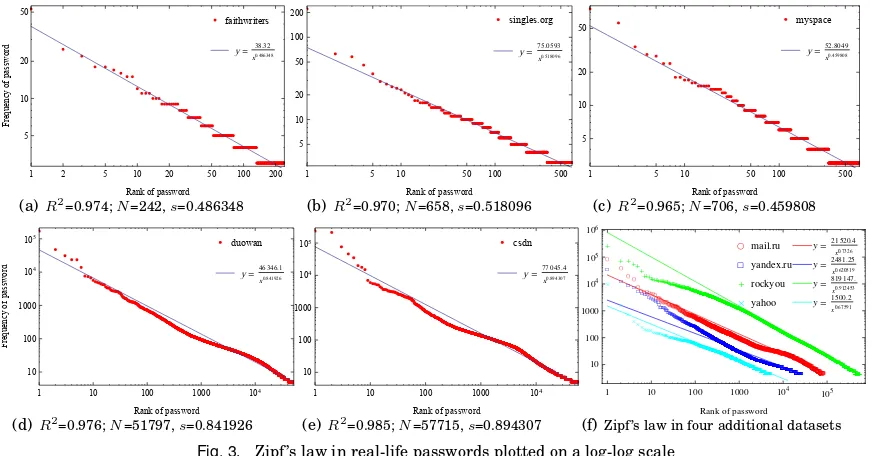
and the miniatures in Fig.3, passwords from the other ten datasets also invariably adhere to Zipf ’s law and the regression lines well represent the data points from corresponding datasets. Due to space constraints and the aforementioned imperfect nature of Hak5 dataset, we do not present its related Zipf curve here, though actually its fitting line also has a high coefficient of determination (i.e.,R2= 0.923).
More precisely, as summarized by the “Coefficient of determination” column in TableV, every linear regression (except for Hak5) is with itsR2 larger than 0.965, which closely
approaches to 1 and thus indicates a remarkably sound fitting. As for “Hak5”, itsR2 is
about 0.923, which is, though acceptable, not as good as that of other datasets. A plausible reason may be that it only contains less than three thousand passwords and probably can not represent the real distribution of the entire password dataset ofwww.hak5.org. It should also be noted that, how the datasets leak may have a direct effect onR2. As can be confirmed by TableV, datasets leaked by phishing attacks are likely to have a lowerR2as
compared to those of datasets leaked by website breaches, because phishing attacks are unlikely to obtain the entire dataset of a website, while website breaches, once succeed, all (or at least an overwhelming part of) passwords of the website will be harvested.
faithwriters
y=38.32
x0.486348
1 2 5 10 20 50 100 200
5 10 20 50
Rank of password
F re q u e n c y o f p a ss w o rd
(a)R2=0.974;N=242,s=0.486348
singles.org
y= 75.0593 x0.518096
1 5 10 50 100 500
5 10 20 50 100 200
Rank of password
(b)R2=0.970;N=658,s=0.518096
myspace
y=52.8049 x0.459808
1 5 10 50 100 500
5 10 20 50
Rank of password
(c)R2=0.965;N=706,s=0.459808
duowan
y=46 346.1
x0.841926
1 10 100 1000 104
10 100 1000 104 105
Rank of password
F re q u en cy o f p as sw o rd
(d)R2=0.976;N=51797,s=0.841926
csdn
y=77 045.4 x0.894307
1 10 100 1000 104
10 100 1000
104
105
Rank of password
d
(e)R2=0.985;N=57715,s=0.894307
ç ç çç ç ççççççç çççççççççççççççççççççççççççççççççççççççççççççççççççççççççççççççççççççççççççççççççççççççççççççççççççççççççççççççççççççççççççççççççççççççççççççççççççççççççççççççççççççççççççççççççççççççççççççççççççççççççççççççççççççççççççççççççççççççççççççççççççççççççççççççççççççççççççççççççççççççççççççççççççççççççççççççççççççççççççççççççççççççççççççççççççççççççççççççççççççççççççççççççççççççççççççççççççççççççççççççççççççççççççççççççççççççççççççççççççççççççççççççççççççççççççççççççççççççççççççççççççççççççççççççççççççççççççççççççççççççççççççççççççççççççççççççççççççççççççççççççççççççççççççççççççççççççççççççççççççççççççççççççççççççççççççççççççççççççççççççççççççççççççççççççççççççççççççççççççççççççççççççççççççççççççççççççççççççççççççççççççççççççççççççççççççççççççççççççççççççççççççççççççççççççççççççççççççççççççççççççççççççççççççççççççççççççççççççççççççççççççççççççççççççççççççççççççççççççççççççççççççççççççççççççççççççççççççççççççççççççççççççççççççççççççççççççççççççççççççççççççççççççççççççççççççççççççççççççççççççççççççççççççççççççççççççççççççççççççççççççççççççççççççççççççççççççççççççççççççççççççççççççççççççççççççççççççççççççççççççççççççççççççççççççççççççççççççççççççççççççççççççççççççççççççççççççççççççççççççççççççççççççççççççççççççççççççççççççççççççççççççççççççççççççççççççççççççççççççççççççççççççççççççççççççççççççççççççççççççççççççççççççççççççççççççççççççççççççççççççççççççççççççççççççççççççççççççççççççççççççççççç á á áá áááá áááááááááááááááááááááááááááááááááááááááááááááááááááááááááááááááááááááááááááááááááááááááááááááááááááááááááááááááááááááááááááááááááááááááááááááááááááááááááááááááááááááááááááááááááááááááááááááááááááááááááááááááááááááááááááááááááááááááááááááááááááááááááááááááááááááááááááááááááááááááááááááááááááááááááááááááááááááááááááááááááááááááááááááááááááááááááááááááááááááááááááááááááááááááááááááááááááááááááááááááááááááááááááááááááááááááááááááááááááááááááááááááááááááááááááááááááááááááááááááááááááááááááááááááááááááááááááááááááááááááááááááááááááááááááááááááááááááááááááááááááááááááááááááááááááááááááááááááááááááááááááááááááááááááááááááááááááááááááááááááááááááááááááááááááááááááááááááááááááááááááááááááááááááááááááááááááááááááááááááááááááááááááááááááááááááááááááááááááááááááááááááááááááááááááááááááááááááááááááááááááááááááááááááááááááááááááááááááááááááááááááááááááááááááááááááááááááááááááááááááááááááááááááááááááááááááááááááááááááááááááááááááááááááááááááááááááááááááááááááááááááááááááááááááááááááááááááááááááááááááááááááááááááááááááááááááááááááááááááááááááááááááááááááááááááááááááááááááááááááááááááááááááááááááááááááááááááááááááááááááááááááááááááááááááááááááááááááááááááááááááááááááááááááááááááááááááááááááááááááááááááááááááááááááááááááááááááááááááááááááááááááááááááááááááááááááááááááááááááááááááááááááááááááááááááááááááááááááááááááááááááááááááá + + + ++ + +++++++++++++++++++++++++++++++++++++++++++++++++++++++++++++++++++++++++++++++++++++++++++++++++++++++++++++++++++++++++++++++++++++++++++++++++++++++++++++++++++++++++++++++++++++++++++++++++++++++++++++++++++++++++++++++++++++++++++++++++++++++++++++++++++++++++++++++++++++++++++++++++++++++++++++++++++++++++++++++++++++++++++++++++++++++++++++++++++++++++++++++++++++++++++++++++++++++++++++++++++++++++++++++++++++++++++++++++++++++++++++++++++++++++++++++++++++++++++++++++++++++++++++++++++++++++++++++++++++++++++++++++++++++++++++++++++++++++++++++++++++++++++++++++++++++++++++++++++++++++++++++++++++++++++++++++++++++++++++++++++++++++++++++++++++++++++++++++++++++++++++++++++++++++++++++++++++++++++++++++++++++++++++++++++++++++++++++++++++++++++++++++++++++++++++++++++++++++++++++++++++++++++++++++++++++++++++++++++++++++++++++++++++++++++++++++++++++++++++++++++++++++++++++++++++++++++++++++++++++++++++++++++++++++++++++++++++++++++++++++++++++++++++++++++++++++++++++++++++++++++++++++++++++++++++++++++++++++++++++++++++++++++++++++++++++++++++++++++++++++++++++++++++++++++++++++++++++++++++++++++++++++++++++++++++++++++++++++++++++++++++++++++++++++++++++++++++++++++++++++++++++++++++++++++++++++++++++++++++++++++++++++++++++++++++++++++++++++++++++++++++++++++++++++++++++++++++++++++++++++++++++++++++++++++++++++++++++++++++++++++++++++++++++++++++++++++++++++++++++++++++++++++++++++++++++++++++++++++++++++++++++++++++++++++++++++++++++++++++++++++++++++++++++++++++++++++++++++++++++++++ ´ ´ ´ ´ ´ ´´´´´ ´´´´´´ ´´´´´´´´´´´´´´´´´´´´´´´´´´´´´´´´´´´´´´´´´´´´´´´´´´´´´´´´´´´´´´´´´´´´´´´´´´´´´´´´´´´´´´´´´´´´´´´´´´´´´´´´´´´´´´´´´´´´´´´´´´´´´´´´´´´´´´´´´´´´´´´´´´´´´´´´´´´´´´´´´´´´´´´´´´´´´´´´´´´´´´´´´´´´´´´´´´´´´´´´´´´´´´´´´´´´´´´´´´´´´´´´´´´´´´´´´´´´´´´´´´´´´´´´´´´´´´´´´´´´´´´´´´´´´´´´´´´´´´´´´´´´´´´´´´´´´´´´´´´´´´´´´´´´´´´´´´´´´´´´´´´´´´´´´´´´´´´´´´´´´´´´´´´´´´´´´´´´´´´´´´´´´´´´´´´´´´´´´´´´´´´´´´´´´´´´´´´´´´´´´´´´´´´´´´´´´´´´´´´´´´´´´´´´´´´´´´´´´´´´´´´´´´´´´´´´´´´´´´´´´´´´´´´´´´´´´´´´´´´´´´´´´´´´´´´´´´´´´´´´´´´´´´´´´´´´´´´´´´´´´´´´´´´´´´´´´´´´´´´´´´´´´´´´´´´´´´´´´´´´´´´´´´´´´´´´´´´´´´´´´´´´´´´´´´´´´´´´´´´´´´´´´´´´´´´´´´´´´´´´´´´´´´´´´´´´´´´´´´´´´´´´´´´´´´´´´´´´´´´´´´´´´´´´´´´´´´´´´´´´´´´´´´´´´´´´´´´´´´´´´´´´´´´´´´´´´´´´´´´´´´´´´´´´´´´´´´´´´´´´´´´´´´´´´´´´´´´´´´´´´´´´´´´´´´´´´´´´´´´´´´´´´´´´´´´´´´´´´´´´´´´´´´´´´´´´´´´´´´´´´´´´´´´´´´´´´´´´´´´´´´´´´´´´´´´´´´´´´´´´´´´´´´´´´´´´´´´´´´´´´´´´´´´´´´´´´´´´´´´´´´´´´´´´´´´´´´´´´´´´´´´´´´´´´´´´´´´´´´´´´´´´´´´´´´´´´´´´´´´´´´´´´´´´´´´´´´´´´´´´´´´´´´´´´´´´´´´´´´´´´´´´´´´´´´´´´´´´´´´´´´´´´´´´´´´´´´´´´´´´´´´´´´´´´´´´´´´´´´´´´´´´´´´´´´´´´´´´´´´´´´´´´´´´´´´´´´´´´´´´´´´´´´´´´´´´´´´´´´´´´´´´´´´´ ´ ´ ´ ´ ´ ´ ´ ´ ´ ´ ´ ´ ´ ´ ´ ´ ´ ´ ´ ´ ´ ´ ´ ´´´´´´´´´´´´´´´´´´´´´´´´´´´´´´´´´´
çmail.ru y=21 520.4
x0.7326
áyandex.ru y=2481.25
x0.620519
+rockyou y=819 147.
x0.912453
´yahoo y=1500.2
x0.67591
1 10 100 1000 104 105 10 100 1000 104 105 106
Rank of password
(f)Zipf ’s law in four additional datasets
Fig. 3. Zipf ’s law in real-life passwords plotted on a log-log scale
The reason why we need to prune the least frequent passwords will be elaborated in Section3.5. The selection of a specific small value (e.g., 3 or 5) as the threshold of least frequency (LF) is essentially based on the findings in statistics that (see Fig. 3 of [Clauset et al. 2009]): whenthe sample size is smaller thanthe sample space, the regression first improves greatly asLF progressively increases until reaching the best pointpˆ, after which the regression deteriorates (because of dwindling the sample size) extremely slowly as
LF increases. We have performed a series of experiments to identify the exact LF that enables the regression to reach pˆ, and find that, as a rule of thumb, for large datasets with millions of passwords, one can setLF = 5, otherwise setLF = 3. More complex ways (see pp.12 of [Clauset et al. 2009]) might be employed to estimate this threshold and to more accurately determine the distribution parameters, yet they are out of the focus of this work. Nonetheless, the regression results in TableVdemonstrate that our selection of the least frequency threshold is satisfactory: every regression attains aR2close to 1.
Nands, we find that: (1) there is a close linking betweenNand the total passwords — the largerN is, the larger the latter will be; (2) the parametersfalls in the range [0, 1], which is different from other natural/social phenomena (e.g., intensity of solar flares, intensity of wars and frequency of family names [Newman 2005]) that are withs >1.
We emphasize that, the exclusion of these least frequent passwords is inherently due to the limited sizes of the samples available: though the password population (i.e., the entire human-chosen passwords) perfectly follow a Zipf-distribution, the million-sized samples (e.g., 30M Tianya and 32M Rockyou) are still too small to wholly exhibit this intrinsic feature. This will be justified in Section3.5. We also conjecture that it is only these popular passwords that will affect (reduce) the strength of a dataset, which will be established by both rigorous proofs and extensive empirical experiments in Section 5. In addition, to qualify as a proper description of a dataset, a distribution functionf(x)shall hold within a rangexmin≤f(x)≤xmaxof at least2∼3orders of magnitude (i.e.,xmax/xmin≥102∼3)
[Maillart et al. 2008]. Except for Hack5, this condition is satisfied by all our regressions. Table V. Linear regression (LR) results of twelve password datasets (“PWs” stands for passwords)
Dataset Totoal Least Fraction of Unique PWs Absolute value Zipf regression Coefficient of de-PWs freq. PWs in LR in LR (N) of the slope (s) line (logy) termination(R2)
Tianya 30,233,633 5 0.50443286 486,118 0.905773 5.806523−0.905773∗logx 0.994204954 Dodonew 16,231,271 5 0.21640911 187,901 0.753771 4.618284−0.753771∗logx 0.995530686 CSDN 6,428,287 5 0.29841262 57,715 0.894307 4.886747−0.894307∗logx 0.985106832 Duowan 4,982,740 5 0.28653592 51,797 0.841926 4.666012−0.841926∗logx 0.976258449 Myspace 41,545 3 0.08094836 706 0.459808 1.722674−0.459808∗logx 0.965861431 Singles.org 16,250 3 0.22135384 658 0.518096 1.875405−0.518096∗logx 0.970277755 Faithwriters 9,709 3 0.12472963 242 0.486348 1.583425−0.486348∗logx 0.974175889 Hak5 2,987 3 0.15400067 76 0.643896 1.579116−0.643896∗logx 0.922662999 Rockyou 32,603,388 5 0.49600581 563,074 0.912453 5.913362−0.912453∗logx 0.997298647 Yahoo 453,492 3 0.22668537 12,608 0.675910 3.176150−0.675910∗logx 0.983232690 Mail.ru 4,938,663 5 0.33034872 83,914 0.732600 4.332851−0.732599∗logx 0.970047769 Yandex.ru 1,261,810 5 0.34210777 26,003 0.620519 3.394671−0.620519∗logx 0.972507203
3.5. Justification for our methodology
We note that Malone and Maher [2012] have also attempted to investigate the distribu-tions of real-life passwords. Yet contrary to our findings that user-generated passwords are Zipf distributed and that it is the popular passwords (i.e., the front head of the whole passwords) that nativelyfollow the Zipf ’s law, they concluded that their datasets (including 32M Rockyou) are “unlikely to actually be Zipf distributed” and that “while a Zipf distribution does not fully describe our data, it provides a reasonable model, particularly ofthe long tailof password choices.” We figure out the primary cause of their different observations — they fitted all the passwords of a dataset to the Zipf model.
More specifically, unpopular passwords (e.g., withfr < 3) are extremely common (see
TableV) and constitute the long tail of password choices (see Fig. 1 of [Malone and Maher 2012] for a concrete grasp) or the “noisy tail” in the statistical domain [Newman 2005], yet they fail to reflect their true popularity according to the law of large numbers. As a result, these unpopular passwords, which constitute a large fraction of each dataset, willgreatly negatively affect the goodness of fitting when the entire dataset is used in regression. This well explicates why different observations are made in [Malone and Maher 2012] and provides a direct reason for the necessity of pruning the unpopular passwords.
We observe that there exists a more essential (yet subtle) reason: even if the pass-word population perfectly follows a Zipf-distribution, the million-sized samples (e.g., 30M Tianya and 32M Rockyou) are still too small to wholly exhibit this intrinsic feature. For example, www.csdn.net adopts a policy that allows passwords consisting of letters and numbers and with a length 8 to 16, which means that a user’s password (denoted by a stochastic variableX) will have about|X|=6216−628≈4.8∗1029possible (distinct) values
under this policy. But we have only got 6.42∗106 CSDN passwords from the leakage,
will overwhelm high probability events in a small sample, and thus such a small sample without exclusion of unpopular events is highly unlikely to reflect the true underlying distribution. It follows that, when fitting all passwords of relatively small datasets, the regression will be negatively affected by these unpopular passwords and no marked rule can be observed even if the front head of passwords exhibits a good Zipf property.
We emphasize that, though these least frequent passwords do notnativelyshow the Zipf behavior, this fact does not contradict our assertion thatthe password population (of a site) perfectly follows a Zipf distribution. TableVshows that, generally, the larger the dataset is (or equally, the larger the sample size is), the larger the fraction of popular passwords (i.e., passwords used in regression) will be. Based on this trend, one can expect that, had the dataset been sufficiently large, unpopular passwords would be few and whether excluding them or not would have little impact on the goodness of the fitting. That is, the entire dataset will exhibit a Zipf property. Fortunately, one of our follow-up work (see http://wangdingg.weebly.com/uploads/2/0/3/6/20366987/pin zipf.pdf) on the distribution of human-chosen PINs, a special kind of passwords, well confirm this inference. One can see that, most of the examined 4-digit PIN datasets can be wholly fitted into a Zipf model — even if PINs withfr<10are excluded, there are still over 94% of the datasets left in the
regression and they perfectly follow the Zipf ’s law (R2>0.97).
To further justify our assertion that user-chosen password samples (i.e., datasets) follow Zipf ’s law, we investigate the regression behaviors of samples that are randomly drawn from a perfect Zipf distribution, and see whether these two types of samples show the same regression behaviors. We explore three parameters, i.e., exact distribution (3 kinds), sample size (8 kinds) and the least frequency concerned (5 kinds), that might influence a regression and thus perform a series of 120(=3·5·8) regression experiments. More specifically, suppose that the stochastic variable X follows the Zipf ’s law and there are
N=103possible values {x1,x2,· · ·,x103} forX. Without loss of generality, the distribution
law is defined to be{p(x1)= C/1 s
∑N
i=1isC
=∑1N/1s i=1is1
,p(x2)= 1/2 s
∑N
i=1is1
,· · ·,p(xN)= 1/N s
∑N
i=1is1 }
, where the sample spaceN and the slopesdefine the exact Zipf distribution function. To be robust, each experiment is run103 times; For better comparison, each experiment is with only
one parameter varying. Due to space constraints, TableVIonly includes 40 experiments where Zipf N is fixed to103 and Zipfs to 0.9, the sample size varies from102 to 2·104
andLF increases progressively from 1 to 5. Readers are referred to all 120 experimental results in [Wang et al. 2015]. Note that some integral statistics (e.g., the fittedN) in Table
VIare with decimals, because they are averaged over 1000 repeated experiments.
Our results on 120 experiments show that, given a Zipf distribution (i.e., when the Zipf parametersNandsare fixed), no matter the sample size is smaller than, equal to or larger thanN, largerLFwill lead to a better regression (i.e., the fittedsis closer to the Zipfs, and
R2 is closer to 1) at the beginning, but will worsen the situation asLF further increases. More specifically, when the sample size issmallerthanN, the fittedsfirst increases and then decreases asLF increases progressively; When the sample size is larger thanN, on the contrary, the fittedsfirst decreases and then increases asLF increases progressively. Thus, we can identify the best fittings (in bold) and from them we can see that, the larger the sample size, the larger the fraction of popular events will be used in regression. This behavior well complies with our observation on real-life password datasets.
Particularly, when the sample size is sufficiently large (e.g.,104 ≫ N = 103), popular events (e.g., withfr ≥ 3) invariably account for over 95% of each sample and perfectly
follow Zipf ’s law (R2≥0.99). This behavior well agrees with our regressions on PINs and
Table VI. Effects of sample size and least frequency (LF) on linear regression when simulating a Zipf distribution
Zipf ZipfZSample LF # of Unique Passwords used Passwords used Fitted Fitted
R2
N s Z size passwords in regression in regression(%) N s
Z
1000 0.9 Z 100 1 71.197 100.000 100.00% 71.197 0.429486 0.754566 1000 0.9 Z 100 2 71.262 41.099 41.10% 12.361 0.641264 0.884263
1000 0.9 Z 100 3 70.963 27.201 27.20% 5.307 0.719897 0.894042
1000 0.9 Z 100 4 71.068 20.585 20.59% 3.173 0.683547 0.916477
1000 0.9 Z 100 5 70.765 17.010 17.01% 2.215 0.622484 0.953243
1000 0.9 Z 200 1 123.933 200.000 100.00% 123.933 0.516278 0.822066 1000 0.9 Z 200 2 124.103 102.971 51.49% 27.074 0.688394 0.923847 1000 0.9 Z 200 3 123.795 73.429 36.71% 12.145 0.761613 0.935451 1000 0.9 Z 200 4 124.121 59.139 29.57% 7.392 0.785336 0.930795
1000 0.9 Z 200 5 123.954 50.151 25.08% 5.242 0.784747 0.921241 1000 0.9 Z 500 1 245.459 500.000 100.00% 245.459 0.633549 0.895852 1000 0.9 Z 500 2 246.040 326.859 65.37% 72.899 0.724630 0.951529 1000 0.9 Z 500 3 245.482 250.498 50.10% 34.245 0.796940 0.969880 1000 0.9 Z 500 4 245.697 211.680 42.34% 21.499 0.819386 0.970288 1000 0.9 Z 500 5 245.586 187.536 37.51% 15.372 0.834885 0.966581
1000 0.9 Z 1000 1 389.360 1000.000 100.00% 389.36 0.730031 0.937941 1000 0.9 Z 1000 2 388.014 760.039 76.00% 148.053 0.756649 0.965318 1000 0.9 Z 1000 3 388.733 611.795 61.18% 74.478 0.807381 0.979783 1000 0.9 Z 1000 4 388.774 530.803 53.08% 47.184 0.833071 0.983395 1000 0.9 Z 1000 5 388.839 476.921 47.69% 33.829 0.847137 0.983550
1000 0.9 Z 2000 1 573.821 2000.000 100.00% 573.821 0.835995 0.964407 1000 0.9 Z 2000 2 573.607 1712.451 85.62% 286.058 0.790817 0.977339 1000 0.9 Z 2000 3 574.446 1455.076 72.75% 158.041 0.818059 0.985691 1000 0.9 Z 2000 4 574.011 1287.865 64.39% 102.03 0.840089 0.989460 1000 0.9 Z 2000 5 574.229 1173.160 58.66% 73.534 0.854452 0.990812
1000 0.9 Z 5000 1 828.243 5000.000 100.00% 828.243 0.963949 0.963691 1000 0.9 Z 5000 2 828.466 4760.094 95.20% 588.56 0.861714 0.989008
1000 0.9 Z 5000 3 827.675 4379.226 87.58% 397.276 0.842637 0.991843 1000 0.9 Z 5000 4 828.601 4014.673 80.29% 276.308 0.849865 0.993588 1000 0.9 Z 5000 5 828.281 3724.258 74.49% 203.349 0.859765 0.994832 1000 0.9 Z 10000 1 953.483 10000.000 100.00% 953.483 1.013698 0.943442 1000 0.9 Z 10000 2 953.545 9884.596 98.85% 838.141 0.929787 0.985080 1000 0.9 Z 10000 3 953.125 9582.080 95.82% 686.791 0.884120 0.994655
1000 0.9 Z 10000 4 953.483 9146.947 91.47% 541.471 0.867965 0.996179 1000 0.9 Z 10000 5 953.365 8683.549 86.84% 425.614 0.866388 0.996641 1000 0.9 Z 20000 1 995.527 20000.000 100.00% 995.527 0.994645 0.943878 1000 0.9 Z 20000 2 995.514 19979.918 99.90% 975.432 0.968837 0.969613 1000 0.9 Z 20000 3 995.521 19886.123 99.43% 928.450 0.938901 0.986291 1000 0.9 Z 20000 4 995.550 19665.232 98.33% 855.099 0.912336 0.994446 1000 0.9 Z 20000 5 995.544 19298.183 96.49% 763.027 0.894282 0.997415 Note: For more detailed results, readers are referred to the supplemental material [Wang et al. 2015] of this work.
space (e.g.,6.42∗106 ≪ |X
csdn| ≈4.8·1029). In a nutshell, all the behaviors shown in our
regressions on twelve password datasets well accord with the 120 simulated experiments.
3.6. General applicability of our observations
In the regressions in previous sections, we only considered datasets that are generated under loose password creation policies. TableII∼IVshow that quite short and letter-only passwords appear in every dataset, which suggests that there is no evident length or composition requirement for generating passwords in any site. We believe a more precise and reasonable explanation for this phenomenon is that most of these passwords are created under a mixture of unknown policies: Initially, there is no rule (policy); Later on, some stricter (or looser) rule(s) is applied; Sometime later, the sites were hacked.
Since we did not have exact examples of passwords exactly generated under some specific creation policies with a length or composition requirement (as far as we know, there is no such ideal data publicly available), we attempted to model such policies by further dividing these datasets based on the minimum length or composition requirement. However, we were cautioned that simply dividing an existing dataset according to some artificial policy may be meaningless, for user behaviors will be largely skewed in this process. A collateral evidence of this caution is the observation that, passwords created under an explicit policy “cannot be characterized correctly simply by selecting a subset of conforming passwords from a larger corpus” and “such a subset is unlikely to be represen-tative of passwords created under the policy in question” [Ur et al. 2012]. Mazurek et al. [2013] have also reported a similar observation. Fortunately, after careful examination of our twelve datasets (see TableIIand TableIII), we find that:
(1) Only 2.17% passwords in CSDN are shorter than eight characters long. These short passwords are highly due to the initial loose policy and the other remaining 97.83% long passwords are due to the later enhanced password policy. This transition in password policies has been confirmed;
(2) As high as 75.79%(=69.77%+6.02%) passwords in Myspace are composed of both letters and numbers, and more than 18.24% users select passwords with a sequence of letters concatenated with the number “1”. This highly suggests that there was a transition in composition requirements at sometime before the hacking happened, though by no means can we confirm this transition.
Consequently, these two datasets constitute useful subsets that are representative of passwords complying with the above two constrained password policies, respectively. More specifically, 97.83% long passwords from CSDN constitute a dataset created under a policy that requires passwords to be at least eight characters long, and 75.79% passwords from Myspace constitute a dataset created under a policy that requires passwords to be at least one letter and one number. And we call them “csdn-lc” and “myspace-cc” for short, where “lc” stands for “length constrained”, and “cc” stands for “character constrained”. The linear regression results on these two refined datasets are depicted in Fig.4(a)and
4(b), respectively. We can see that, the coefficients of determination (R2) of these two
regressions are 0.966 or higher, indicating a sound fitting. This suggests that Zipf ’s law can also be applied to passwords created under very constrained policies.
To investigate whether subsets of a dataset that obeys Zipf ’s law also comply with this law, we further conduct linear regressions on subsets randomly selected from the twelve datasets. As expected, there are no significant differences in fitting effect between any of the subsets and their parent dataset (Fisher’s exact test, p-value≥0.05). Due to space constraints, only four randomly selected subsets (each with a size of 1 million) from Duowan are depicted in Fig.4(c)∼Fig.4(f). As R2of these four regressions are all 0.977 and very close to 1, it indicates Zipf ’s law fits well in these subsets. This implies that if we can obtain a sufficiently large subset of passwords of an authentication system, then the distribution of the whole passwords can be largely determined by conduction a linear regression and fitting them to a Zipf ’s law. Nevertheless, how much fraction of a dataset can be deemed “sufficiently large”? How about one sixth, one tenth, or one hundredth? This suggests a natural direction for future research.