Round-Optimal Password-Protected Secret Sharing and T-PAKE
in the Password-Only model
Stanislaw Jarecki∗ Aggelos Kiayias† Hugo Krawczyk‡ Abstract
In a Password-Protected Secret Sharing (PPSS) scheme with parameters (t, n) (formalized by Bagherzandi et al. [2]), a user Alice stores secret informationsamongnservers so that she can later recover the information solely on the basis of her password. The security requirement is similar to a (t, n)-threshold secret sharing, i.e., Alice can recover her secret as long as she can communicate witht+ 1 honest servers but an attacker gaining access totservers cannot learn information about the secret. In particular, the system is secure against off-line attacks by an attacker controlling up totservers. On the other hand, accounting for inevitable on-line attacks one allows the attacker an advantage proportional to the fraction of dictionary passwords tested in on-line interactions with the user and servers.
We present the first round-optimal PPSS scheme, requiring just one message from user to server, and from server to user, and that works in the password-only setting where users do not have access to an authenticated public key. The scheme uses an Oblivious PRF whose security we define using a UC-style ideal functionality and denote as V-OPRF due to its verifiability, and for which we show concrete, very practical realizations in the random oracle model, as well as standard-model instantiations. As an important application we use this scheme to build the first single-round password-only Threshold-PAKE protocol in the CRS and ROM models for arbitrary (t, n) parameters with no PKI requirements for any party (clients or servers) and no inter-server communication. Our T-PAKE protocols are built by combining suitable key exchange protocols on top of our V-OPRF-based PPSS schemes. We prove T-PAKE security via a generic composition theorem showing the security of any such composed protocol.
1
Introduction
Remarkably, passwords have become a fundamental pillar of electronic security. That’s quite a high task for these low-entropy easily-memorable easily-guessed short character strings. In spite of repeated evidence of their vulnerability to misuse and attack, passwords are still in widespread use and will probably remain as such for a long while. The portability of passwords make them ubiquitous keys to access remote services, open computing devices, decrypt encrypted files, protect financial and medical information, etc. Replacing passwords with long keys requires storing these keys in devices that are not always available to the user and are themselves at risk of falling in adversarial hands, hence endangering these keys and the data they protect.
An increasingly common solution to the problem of data security and availability is to store the data itself, or at least the keys protecting its security, at a remote server, which in turn is accessed using a password. This requires full trust in this single server and the one password. In particular, compromising such a server (or just its password file) is sufficient to crack most passwords stored at it through an off-line dictionary attack. Indeed, loss of millions of passwords to such attacks
∗
U. California Irvine. Email: [email protected].
†
National and Kapodistrian University of Athens. Email: [email protected]. Research partly supported by ERC project CODAMODA.
‡
are common news nowadays [41]. Unfortunately, off-line attacks are unavoidable in single-server scenarios. A natural approach to solving this problem is to distribute the above trust over a set of servers, for example by sharing information among these servers using a secret sharing scheme. However, how does the user access these servers? Using the same password in each of these servers makes the off-line password recovery attack even worse (as it can be performed against any of these servers) while memorizing a different password for each server is impractical.
PPSS. The above problem and a framework for solution is captured by the notion of Password-Protected Secret Sharing (PPSS)that originates with the work of Ford and Kaliski [23] and Jablon [29] and recently formalized by Bagherzandi et al. [2]. In such a scheme, parametrized by a pair of variables (t, n), a user Alice has some secret informationscthat she wants to store and protect, and be able to later access on the basis of a single password pw. (Secret sc can represent any form of information, but it is best to think of it as a cryptographic key which protects some cryptographic capability.) The scheme has aninitialization phase where Alice communicates with each one of a set of n servers S1, . . . , Sn after which each server Si stores some information ωi associated with user Alice (ωi is a function of the secret sc, the password pw and server name Si). When Alice needs to retrieve sc, she performs a reconstruction protocolby interacting with a subset of at least
t+ 1 servers where the only input from Alice is her passwordpw.
The main requirements from this protocol are, informally: (i) an attacker breaking intotservers cannot gain any information on sc other than by correctly guessing Alice’s password and running an on-line attack with it (more on this below). It follows, in particular, that off-line attacks on the password are not possible as long as the attacker has not compromised more thantservers. In this case, the only avenue of attack against the secrecy ofsc is for the attacker to select one valuepw0 from a given dictionary Dof passwords (from which the user has selected a password at random) and check its validity by interacting with the user and servers using pw0 as the password. If the overall number of interactions between the attacker and the user, and between the attacker and the servers, is q then we allow the attacker to break the semantic security of sc with advantage q/|D|
(plus negligible). Moreover, we will require that “testing” a guessed password by impersonating the user to the servers will require interacting with t+ 1 different servers. (ii) Soundness: Even the compromise of all servers cannot lead to the user reconstructing the wrong secret except with probability proportional to the number of on-line interactions between the attacker and the user. This is a necessary exception as the attacker can isolate the user and simulate a run with the servers with a password pw0 and secretsc0 chosen by the adversary; what’s required is thatonly if
pw0 happens to be the user’s password will the attack succeed. Additionally, a desirable property is (iii) Robustness: Alice can correctly reconstruct sc as long as (a) no more than t servers are corrupted and (b) Alice communicates without disruptions with at least t+ 1 honest servers. Note that robustness can only be achieved if 2t+ 1≤n while the other properties do not impose such intrinsic limitation.
T-PAKE.While PPSS schemes have many uses such as for retrieving keys, credentials, data, and so on, the main PPSS application is for bootstrapping a Threshold Password-Authenticated Key Exchange (T-PAKE)[37]. In a (t, n) T-PAKE protocol, a user with a single password is to establish
n authenticated keys with n servers, such that security of the keys established with uncorrupted servers is guaranteed as long as there are no more thantcorrupted servers. PPSS schemes make it possible to build T-PAKE protocols by combining the PPSS scheme with a regular key exchange protocol in a modular and generic way. This allows one to focus on the PPSS design which by virtue of being a much simpler primitive, e.g., avoiding the intricacies of the security of (password) authenticated key exchange protocols, is likely to result in simpler and stronger solutions, as is indeed demonstrated by our results below.
Prior Work and Our Contributions
For the general case of (t, n) parameters, Bagherzandi et al. [2] showed a PPSS scheme in the random oracle model (ROM) where the reconstruction protocol involves three messages between the user and a subset oft+1 servers (effectively 4 messages in the typical case that the user initiates the interaction). However, if any of these servers deviate from the correct execution of the protocol, a protocol needs to be re-run with a new subset of servers, which potentially increases the number of protocol rounds to O(n). Another shortcoming of the PPSS solution from [2] is that it is secure only in the PKI model, where the user can authenticate the public keys of the servers. Indeed, if the attacker can induce the user to run the protocol on an incorrect server’s public key, the protocol of [2] becomes completely insecure. Thus, [2] leaves at least two open questions: Do PPSS protocols withoptimal single-round communicationexist (i.e., requiring a single message from user to server and single message from server to user), and can such protocols work in the password-only model, namely when the user does not have a guaranteed authentic public key.
Our main contribution is a PPSS protocol with optimal single-round communication (in ROM) which works in the password-only model. Concurrently to our work, Camenisch et al. [10] present a PPSS for the general (t, n) setting which also works in the password-only model (and ROM). However, their protocol sends 10 messages between the user and each server and its total communi-cation complexity isO(n2). Moreover, its robustness is fragile in the same way as that of [2], i.e. the user runs the reconstruction protocol with a chosen subset oft+ 1 players, and the protocol must be re-started if any server in this chosen group deviates. By contrast, the protocol we present has 2 messages andO(nlogn) communication complexity, which can be further reduced to O(n) if the user caches O(n) data between reconstruction protocol instances. Our protocol also has stronger robustness guarantee, namely Alice is guaranteed to recover her shared secretscin the single pro-tocol instance as long as it has unobstructed communication with at least t+ 1 honest servers and if 2t+ 1 ≤ n. On the minus side, unlike [10] who formalize a UC functionality for PPSS (which they call “TPASS”) and whose protocol realizes this functionality, we model the security of a PPSS scheme in the password-only setting with a game-based notion. Still, we show that our game-based security notion is strong enough to imply the security of a natural T-PAKE construction built on top of a PPSS scheme.
Since our PPSS construction is based on a novel version of so-called Oblivious Pseudorandom Function (OPRF) [24], our contributions are threefold touching on three distinct elements, OPRF’s, PPSS, and T-PAKE’s, which we discuss separately below.
OPRF. The basic building block of our PPSS construction is a Verifiable Oblivious PRF (V-OPRF). Oblivious PRF (OPRF) was defined [24, 30] as a protocol between two parties, a server and a user, where the first holds the keykfor a PRF functionf while the latter holds an argument
x on which fk(·) should be evaluated. At the end of the protocol the user learns fk(x) and is convinced that such value is properly evaluated while the server learns nothing. Formalizing the OPRF primitive in a way that can serve our application is not trivial. Indeed, the intuitive definition of OPRF [24, 30] as the secure computation of a two-party functionality which on input pair (k, x) returns an output pair (⊥, fk(x)), is limiting for at least three reasons: (1) It does not imply security when several OPRF instances are executed concurrently, as is the case in our PPSS construction; (2) It does not apply to our setting where the existence of authenticated channels cannot be assumed; and (3) It is not clear how to instantiate such functionality in the concurrent setting without on-line extractable zero-knowledge proofs of knowledge, which would add a significant overhead to any OPRF instantiation.
which we show several very efficient instantiations. Expressing V-OPRF in the UC framework is a delicate task, especially in the setting of interest to us where there are no authenticated channels. Our formalism enforces that the server who generates the PRF key k also produces a function descriptor π, which fixes a determnististic function fπ. (For honest servers, π is a commitment to
kand the fixed functionfπ is equal to the PRF fk.) Then, in any (non-rejecting) execution of the V-OPRF protocol executed given the function descriptorπ, the V-OPRF functionality verifies that the user’s output is computed as fπ(x). This ensures, in particular, that repeated V-OPRF runs with the same parameterπ and same inputxalways produce the same output. In other words, the V-OPRF functionality ensures consistency between V-OPRF instances executed under the same function descriptorπ as well asverifiabilitythat the output value is computed using the committed functionfπ.
Our UC V-OPRF formalization bears interesting similarities to UC blind signatures [35, 22, 1]. In a nutshell, instead of on-line extraction of argumentxfrom the (potentially malicious) client in every V-OPRF instance, a V-OPRF functionality issues aticket for every instance executed under a given descriptor π. The user (or adversary) can then use these tickets to evaluate function fπ on inputs of their choice, but with the constraint that m tickets cannot be used to compute fπ values on more thanm distinct arguments. Not surprisingly given this similarity, we observe that an efficient realization of V-OPRF can be achieved (in ROM) by hashing a deterministic blind signature-message pair.
We present three highly efficient variants of this design strategy, which provide three single-round V-OPRF instantiations in ROM, and we prove them UC-secure under “one-more” type of assumptions [4, 31]. Specificially, we show such V-OPRF instantiations in ROM under a one-more Gap DH assumption on any group of prime order, a similar assmuption on the group with a bilinear map, and a one-more RSA assumption. We also provide an efficient standard model V-OPRF construction for the Naor-Reingold PRF [40], based on the honest-but-curious OPRF protocol given by [25]. Our protocol has two rounds (four messages) and is secure under Strong-RSA and the Decisional Composite Residuosity assumptions. Note that a single round protocol is theoretically feasible in the standard (CRS) model, e.g., by encrypting the user input with fully homomorphic encryption and having each server apply a PRF program over the ciphertext and supply a UC NIZK proof, e.g. [28], that this computation was performed correctly using a function committed inπ. However, such generic solution is likely to be much less efficient compared to the Naor-Reingold based construction we present.
We note that the UC formalization of the Verifiable Oblivious PRF functionality that is at the core of our security treatment is likely to have applications beyond this work. Indeed, OPRF’s have been shown to be useful in a variety of scenarios, including Searchable Symmetric Encryption (SSE) schemes, e.g. [18, 14], and secure two-party computation of Set Intersection [24, 30, 31].
PPSS.Armed with our V-OPRF constructions, we proceed to solving PPSS. Our PPSS protocol ispassword-onlyin the Common Reference String (CRS) model, i.e. the user needs no other inputs except of her password and a CRS string defining an instance of a non-malleable commitment scheme, which can be embedded in the user’s V-OPRF software. Our PPSS protocol is single-roundin the hybrid model where parties can access the V-OPRF functionality. Given the V-OPRF instantiations discussed above, this implies three different instantiations of a single-round (i.e. two-message) PPSS schemes in ROM based on different one-more type of assumptions, and a four-message PPSS scheme in the CRS model.
Our PPSS construction follows the strategy of the early protocols of Ford and Kaliski [23] and Jablon [29] who treated the case of t = n: Secret-share the secret sc into shares (s1, . . . , sn), let each serverSi pick keykifor a PRFf, and letc= (e1, . . . , en) whereeiis an encryption ofsi under
ρi =fki(pw). Each serverSi stores1 (ki,c), and in the reconstruction protocol the user re-computes each ρi via an instance of a V-OPRF protocol with each server Si on its inputpw and Si’s input
ki. If the user also gets stringc from the servers, the user can decrypt sharessi using the ρi’s and interpolate these shares to reconstructsc. The first thing to note is that ciphertextsei mustnotbe committing to the encryption keyρi. Otherwise, an adversary could test a password guesspw∗ in an interaction with a single V-OPRF instance (instead oft+1 instances witht+1 different servers), by computingρ∗i =fki(pw∗) and testing if decryption ofei underρ∗i returns a plausible share value. We prevent such tests by sharing sc over a binary extension field F=GF(2`), choosing a PRF f which maps onto `-bit strings, and setting ei tosi⊕fki(pw). Secondly, the above simple protocol can allow a malicious server Si to find the user’s password pw if Si is not forced to use the same functionfπi in each V-OPRF instance. Consider the OPRF protocol of [24] for the Naor-Reingold PRFfki(x) =gv wherev=ki,0·Qxj=1ki,j forki = (ki,0, . . . , ki,`) [40]. If in some PPSS instance, a misbehavingSi uses keyki0 which differs fromki on one index j, i.e. in one component ki,j,Si can conclude that thej-th bit ofpwis 0 if the user recovers its secret correctly from such PPSS instance. Note that the adversary can learn whether user’s secret is reconstructed correctly by observing any higher-level protocol which uses this secret, e.g. a T-PAKE protocol discussed below. We counter this attack by using the verifiability property of our V-OPRF functionality, which ensures that Si computes the function committed in πi, and by extending the user-related information stored by each server to ω = (π,c, C) where π is a vector of function descriptors π1, . . . , πn of each server, andCis a non-malleable commitment to the valuesπ,cand user’s passwordpw. This commitment is the basis for ensuring that the on-line attacker playing the role of the servers can test at most one password guess per one reconstruction protocol instance.
With our efficient instantiations of V-OPRF in ROM we achieve a remarkably efficient recon-struction protocol. The user runs an optimal 2-message protocol with t+ 1 (or more) servers, and in the case of our V-OPRF construction based on the one-more Gap DH assumption on a prime-order group, the protocol involves just 2 exponentiations by the server and 2t+ 3 multi-exponentiations for the user, employing the optimized ROM-based NIZK for discrete logarithm equality of [15], plus one hashing onto the prime-order subgroup, a few symmetric key operations, and a polynomial interpolation operation. The (one-time) initialization stage is also very efficient, involving 2n+ 1 exponentiations for the user and 3 exponentiations per each server. Note that there is no inter-server communication in the protocol and that the user can communicate with each server independently, so it can be done in parallel and/or in any order without the servers being aware of each other. Moreover, the user can initiate the V-OPRF protocol with more than
t+ 1 servers, and it will reconstruct secretsc as long as t+ 1 contacted servers reply with correct triple ω= (π,c, C) and complete the V-OPRF instances on function descriptors πi inπ, provided that the honest servers constitute the majority in the group of servers with whom the user initiates the reconstruction protocol.
Note that a PPSS protocol in the password-only setting enjoys the following security hedging property. While avoiding the need to rely on the authenticity of the servers’ public keys held by the user is an important security property, when such public keys are available they can add significant security, because they render on-line attacks against a user ineffective and strengthen both the security and the soundness properties of the PPSS scheme.2 Thus, to get the benefits of both worlds, i.e. with and without the correctly functioning PKI, our password-only PPSS protocol can be easily amended to achieve the following: If the user happens to have the public keys of the
1
Note that this requiresO(n) storage but it is trivial to bring down toO(logn) using Merkle trees. 2Namely, they remove factorq
U from eq. 1 in Def. 1, and they make the upper-bound on the soundness error (i.e. the probability that anyURecinstance outputsK0 which is neither⊥norKoutput inUInit) to be negligible. (See the
scheme (t+ 1, n) range ROM/std client inter-server msgs total comm. computation C| S
BJKS[8] (2,2) ROM PKI PKI 7 O(1) O(1)
KMTG [32] (2,2) Std/ROM CRS sec.chan. ≥5 O(1) O(1)
CLN [11] (2,2) Std/ROM CRS PKI 8 O(1) O(1)
DRG [21] t < n/3 Std CRS sec.chan. ≥12 O(n3) O(1) |O(n2)
MSJ [37] any ROM PKI PKI 7 O(n2) O(1)|O(n)
BJSL [2] any ROM PKI PKI 3 O(n) 8t+ 17|16
CLLN [10] any ROM Std PKI 10 O(n2) 14t+ 24| 7t+ 28
Our PPSS #1 any ROM CRS none 2 O(n) 2t+ 3|3
Our PPSS #2 any Std CRS none 4 O(n`) O(n`)|O(l)
Figure 1: Comparison between PPSS/T-PAKE schemes. “Our PPSS #1” and “Our PPSS #2” refer to our PPSS construction of Section 5 with V-OPRF instantiated, respectively, with protocol 2HashDH-NIZK of Section 3 (this instantiation is spelled out in Appendix B), and with protocol NR-V-OPRF of Section 3.2. The last column counts (multi)exponentiations in a prime-order group performed by the client and each server in the reconstruction protocol (except for “our PPSS #2” where exponentiations are modulo a Paillier modulus). The costs in the last four rows refer to an optimistic scenario with no adversarial interference. With worst-case adversarial interference, assuming n= 2t+ 1, for schemes MSJ and BJSL all costs (including rounds and communication complexity) grow by the factor of t+ 1, while for our schemes in the last two rows only the client costs grow, and only by the factor of 2. The “total comm.” column counts the number of transmitted group elements and objects of length polynomial in the security parameter, like public-key signatures. Variable`denotes the length of the password string (or its hash).
servers, she gets the additional security benefits stated above. However, if she does not have access to servers’ public keys, or if some of these keys have been replaced by fake ones, she still enjoys the full security of the password-only setting.
T-PAKE. When composed with regular key exchange protocols, our PPSS scheme leads to the most efficient T-PAKE protocols to date even when compared to protocols that assume that the user carries a public key that it can use to authenticate the servers. Figure 1 summarizes the state of the art in T-PAKE protocols and how our protocols compare to this prior work. Interestingly, while there is a large body of work on single-server PAKE protocols (e.g. [5, 33, 34, 7]) that has produced remarkable schemes, including one-round password-only protocols in the standard model, threshold PAKE has seen less progress, with most protocols showing disadvantages in different areas as shown in the above table. In particular, before our work, no single-round (t, n)-PAKE protocol was known, not even in the ROM. Most protocols assume a public key carried by the client (making them non password-only) and all assume secure channels (or PKI) between servers. To improve complexity, several works treated the specific case ofn=t= 2 but even in these cases no one-round protocol was known and all require inter-server secure channels. Our work improves on all these parameters achieving the best known properties in all the aspects reflected in the table.
In particular, we achieve single-round password-only protocol in the CRS and ROM models for arbitrary (t, n) parameters with no PKI requirements for any party and no inter-server commu-nication (secure communication is only assumed when a user first registers with the servers). In addition, the protocol is computationally very efficient (and more so than any of the previous pro-tocols, even for the (2,2) case). We also exhibit a password-only standard-model implementation of our scheme requiring two rounds of communication (4 messages in total) between client and servers. Our T-PAKE protocols are built by combining (existing) suitable key exchange protocols
on top of our V-OPRF-based PPSS scheme. We prove T-PAKE security via a generic composition theorem showing the security of any such composed protocol.
Organization. In Section 2 we present the formalization of the V-OPRFfunctionality in the UC setting and in Section 3 we present efficient realizations of this functionality in the random-oracle model as well as in the standard (CRS) model. In Section 4 we define and formalize the PPSS primitive in the password-only model and in Section 5 we present a realization of such a scheme based on the V-OPRFfunctionality (i.e., the hybrid UC model). Finally in Section 6 we consider T-PAKE schemes obtained by composing a PPSS scheme with a regular key-exchange protocol and prove a general security composition theorem. We illustrate the advantages of this composition approach by showing how to obtain single-round T-PAKE protocols in the password-only model with the remarkable properties discussed above. For concreteness, Appendix B includes a full specification of our most efficient instantiation of the PPSS and T-PAKE protocols.
2
Functionality
F
VOPRFFunctionality FVOPRF
Key generation: Upon receiving (KeyGen,sid) from sender S, forward (KeyGen,sid, S) to ad-versaryA∗.
Upon receiving (Parameter,sid, S, π, M) from A∗, ignore this call ifparam(S) is already de-fined. Otherwise, set param(S) = hπi and initialize tickets(π) = 0, and hist(π) to the empty string. IfS is honest send (Parameter,sid, π) to partyS, else parse M as a polynomial-size circuit with`-bit output and insert (π, M) in CorruptParams.
V-OPRFevaluation: Upon receiving (Eval, sid, S, x) from partyU for senderS, record (U, x) and forward (Eval, sid, U, S) to A∗.
Upon receiving (SenderComplete,sid, S) from A∗ for some honest S output (SenderComplete,sid) to partySand settickets(π) =tickets(π)+1 forπs.t.hπi=param(S).
Upon receiving (UserComplete, sid, U, π,flag) fromA∗, recover (U, x) and proceed as follows:
• If flag = > and hπi = param(S) for some honest S then: If tickets(π) ≤ 0 ignore the UserComplete request of A∗, otherwise proceed as follows. If hist(π) includes a pair hx, ρ0i, setρ=ρ0, else sampleρat random from{0,1}` and enterhx, ρiinto hist(π). Set tickets(π) =tickets(π)−1 and output (Eval, π, ρ) to partyU.
• Else, ifflag=⊥then return (Eval, π,⊥) toU.
• Else, ifflag=>andπis such that (π, M)∈CorruptParams for some circuitM, compute
ρ=M(x) and enterhx, ρiin hist(π). Output (Eval, π, ρ) to partyU.
Figure 2: Verifiable Oblivious PRF functionality FVOPRF.
We introduce the FVOPRF functionality in Figure 2. It represents the notion of a “verifiable oblivious pseudorandom function” as discussed in the introduction. We refer to the holder of function’s key as thesenderand the party providing the input as the user, and identify them with
value x. We will refer to the parameter π as a “function descriptor”. (In all our implementations of FVOPRF functionality,π is a commitment to a PRF key.)
TheFVOPRFfunctionality can be thought of as a collection of tables that are indexed by “labels” denoted by the function parameters π. Users may obtain values from these tables on inputs x of their choice without leaking any information about these inputs (and corresponding outputs) to the adversary. FVOPRF generates these tables dynamically and fills them with random values on demand. Each table is associated by the functionality with a specific sender. In addition to the tables registered to honest senders, the adversary is allowed to register withFVOPRFits own tables. Interacting with an adversary-registered table does not jeopardize the privacy of the user’s input but naturally FVOPRF will provide no pseudorandomness guarantee for the output derived from such tables. However, FVOPRF will ensure that all adversarial tables are completely determined according to a deterministic function that is committed by the adversary at the time of the table’s initialization in the form of a circuit M.
The V-OPRF evaluation cycles through three activations of the functionality: Evalthat defines
the input to a V-OPRF computation and two activations,SenderCompleteandUserComplete,
that signal the completion of the V-OPRF computation by a sender and user, respectively. Refer to Figure 2 for the details of each such activation. Next, we present the rationale for the actions triggered by these activations.
A major consideration in our definition ofFVOPRF is to avoid the need for input extractability (from dishonest users) in the real-world realizations of the functionality. Such need is common in UC-defined functionalities but in our case it would disqualify the more efficient instantiations of
FVOPRF presented here. Thus, instead of resorting to input extraction requirements, we define a “ticket mechanism” that increases a ticket upon function evaluation at a sender and decreases it when this value is computed at the user (or the adversary). The functionality guarantees that tickets remain non-negative, namely, for any function parameterπ registered with a honest sender S, the number of inputs on which users compute the functionπ is no more than the number of evaluations of the function at S. Thus, in FVOPRF, each time that a user completes an interaction with an honest sender, the functionality increases the ticket count associated with the corresponding table of the sender indicating that there is a certain value of that table that is currently being transmitted. Such tickets are redeemed within FVOPRF via either one of two possible routes: the first is when an honest user completes her interaction and receives the value, the other is when the ideal world adversary decides to obtain such a value. This second occurrence reflects the fact that a real world adversary may generate an arbitrary number of malicious users that interact with honest servers and hence the ideal world adversary should be capable of probing the honest tables maintained by
FVOPRF (but only up to the number of tickets issued for the given table). Thanks to the ticket mechanism, in the case of malicious users, the ideal world adversary has to merely informFVOPRF
that an honest sender completed a user interaction (via a SenderComplete message) without
the necessity of submitting a proper Eval action on behalf of the malicious user. Regarding
party corruption, the functionality keeps track of honest and corrupted parties and makes decisions according to their status. We only consider static corruptions.
Another important aspect of our FVOPRF formalism is the way we handle the 1-1 relationship between a sender S and its function parameter π, where S is used to identify a sender and π
describes this sender’s committed function. The unique sender-function binding that is known to the functionality cannot be enforced in a real-world setting where users cannot validate such a binding as is the case when no authenticated channels (or other forms of authenticated information) are available to the user. Since these settings are common in our applications, we defineFVOPRFso that the user can provide a name of a sender whose function it intends to compute but the result returned to the user applies a functionπdetermined by the attacker, and possibly different than the
function associated to the requested S. For example, in the PPSS application this corresponds to a setting where the user is given a network address for contacting a server but she cannot validate that this is indeed a server that holds a share of her secret, let alone test which function parameter corresponds to this server. The PPSS protocol needs to make sure that the ability of the attacker to re-route requests to different servers does not break the security of the PPSS scheme. Therefore, while in anEvalcall the value ofSis specified, theUserCompleteresponse that sets the output
for this call lets the adversary choose π even if this is different than the parameter assigned to S
by FVOPRF.
In spite of the above, note that if FVOPRF is used in a context where the user knows a-priori a correspondence between S and π, the user can reject responses that are not consistent with it. For instance, suppose the user knows that π corresponds to S and after sending (Eval, sid, S, x)
to FVOPRF, she receives a successful output (π0, ρ) with π 6= π0. In this case the user can choose to abort, despite the fact that FVOPRF successfully completes. In our PPSS constructions in the
FVOPRF-hybrid model, we make essential use of this ability of the user to abort during PPSS initialization upon an identified mismatch with an expected value ofπ. Finally, note thatFVOPRF guarantees that the value ρ obtained by the user is in the table π even though such table may not have been the user’s original target. This provides FVOPRF with a verifiability property but one that is verifier-dependent and may not be transferable to others; in particular, it is a weaker guarantee than the verifiability propery of verifable random functions [39].
3
Efficient Realizations of
F
VOPRFIn this section we show efficient realizations of theFVOPRF functionality which we later use as the basis for our instantiations of the PPSS and T-PAKE schemes. We present constructions in the Random Oracle model as well as in the CRS model.
3.1 Realizing FVOPRF in the Random Oracle Model
We present a class of constructions for realizingFVOPRFin the random oracle model. Our construc-tions share the following general structure: the receiver hashes and blinds her input and requests the sender’s secret-key application on this blinded value. The receiver verifies the sender’s response and then obtains the V-OPRF output via applying a second hash function. Due to the double hash-ing action (which is essential in the security proof) we term the constructions with the “2Hash” prefix.
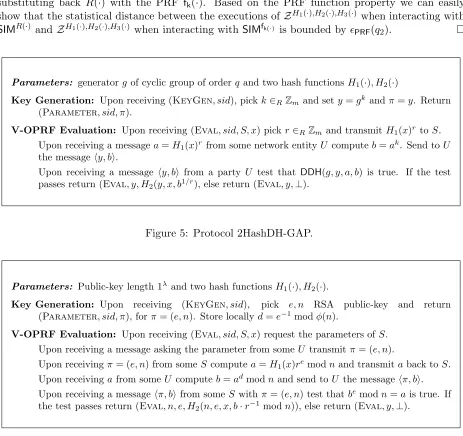
The 2HashDH construction relies on a group of prime ordermwith a generator denotedg. The secret key is k chosen at random in Zm, and the public key y is set to y = gk. The function is defined as fk(x) =H2(π, x, H1(x)k), where π = (g, m, y) and H1 and H2 are hash functions onto, respectively, the group hgi and {0,1}λ where λ is a security parameter. The associated V-OPRF protocol is simple: the client sends a = H1(x)r to the sender and the sender after checking that
a ∈ hgi, it responds by (y, b = ak). The protocol terminates with the client returning the value
H2(π, x, b1/r) after checking that the tuple hg, y, a, bi is a valid DDH tuple (which implies that
is a standard protocol that we recall for completeness: the sender selects t∈R Zm and computes
w=H3(g, y, a, b, gt, at) as well ass=t+w·kmodm. The proof is the pair ζ = (w, s) which we denote as NIZKH3EQ[g, y, a, b]. The receiver verifies ζ by testing w=H3(g, y, a, b, gsy−w, asb−w). We present this latter NIZK version as our firstFVOPRF realization in figure 3.
Parameters: generatorgof cyclic group of ordermand three hash functionsH1(·), H2(·), H3(·).
Key Generation: Upon receiving (KeyGen, sid), pickk∈RZm and sety=gk andπ=y. Return
(Parameter, sid, π).
V-OPRF Evaluation: Upon receiving (Eval, sid, S, x) pick r∈RZmand transmitH1(x)r toS.
Upon receiving a message a=H1(x)r from some network entity U check if a∈ hgi, compute
b=ak, andζ=NIZKH3
EQ[g, y, a, b]. Send toU the messagehy, b, ζi.
Upon receiving a messagehy, b, ζifrom a partyS verify theNIZKζand thatb∈ hgi. If the tests pass return (Eval, y, H2(y, x, b1/r)), else return (Eval, y,⊥).
Figure 3: Protocol 2HashDH-NIZK.
We will argue the security of the construction employing the following assumption: the (N, Q) One-more Gap DH assumption, states that for any PPT A it holds that the following probability is negligible:
Prob[A(·)k,DDH(·,·,·,·)(g, gk, g
1, . . . , gN) ={(gjs, gkjs)|s= 1, . . . , Q+ 1}]
where Q is the number of queries that A poses to the (·)k oracle. The probability is taken over all choices of gk, g1, . . . , gN which are assumed to be random elements of hgi. We denote by omdh,G(N, Q) the maximum advantage of any PPT adversary against the assumption.
Theorem 1 The 2HashDH-NIZK protocol over a group G of order m UC-realizes FVOPRF per
Fig. 2 in the random oracle model assuming (i) the existence of PRF functions, (ii) the (N, Q)
One-More Gap DH assumption onGwhereQis the number of V-OPRF executions andN =Q+q1
where q1 is the number of H1(·) queries.
More precisely, for any adversary against 2HashDH-NIZK there is an ideal-world adversary (simulator) that produces a view in the ideal world that no environment can distinguish with advan-tage better than qS·omdh,G(N, Q) +q3/m2+ 2·qU/m+N2/m+PRF(q2) whereqS is the number of senders, qU the number of users, q2, q3 are the number of queries to the H2(·), H3(·) oracle
respec-tively and PRF(q2) is the security of the PRF function against polynomial-time adversaries posing
q2 queries.
Proof: In Figure 2 we describe the simulator SIM that interacts with the adversary A and the ideal functionality FVOPRF. We assume without loss of generality that A is a dummy adversary, i.e., it is merely a pass-through machine that outsources all its computation to the environmentZ. We describe the simulator in Figure 2. The simulator uses a PRF function family{fk(·)}k that has
output range equal to the output range of the FVOPRF. For simplicity, we will first assume that fk(·) is substituted by a random function R(·) and we will prove that the simulator can simulate
the view of any environmentZH1(·),H2(·),H3(·) that interacts with protocol 2HashDH-NIZK. In this argument R(·) will be a random function that it will not be available directly as an oracle to the
environment Z who will access it implicitly via its own random oracles. After we establish this fact (which will be the main challenge of the proof), we will substituteR(·) back tofk(·) and thus
demonstrate that 2HashDH-NIZK UC-realizes FVOPRF in the random oracle model.
One can examine thatSIMis a valid ideal model adversary against the UC functionalityFVOPRF
and that the simulation ofA by SIM is identical to a real run by A with two possible exceptions: The choice of outputs for honest and dishonest users and the fact thatSIM may end with output
fail,fail0 in Steps 5 and 7 (such events obviously do not exist in the execution of A in the real
world). Thus, we need to show that the outputs of honest users in the simulated run are identical to those assigned by FVOPRF to these users, the dishonest users’ view is indistinguishable between real and ideal and that the events fail,fail0 happen with negligible probability.
We start with an analysis of the NIZK employed in the protocol. We observe that in step 5.I, the simulator will outputfailif it happens thatc6=vk. This happens when an honest user receives
a message (y, b0, ζ0), the proofζ0 is valid but it happens that (b0)1/r 6=vk wherev, r come from the values (v, a, r) thatSIMhas stored for that user instance. Observe thathg, y, v, ciis a DDH tuple if and only ifhg, y, a, b0i is a DDH tuple. In the identified circumstance we have that the verification equation w = H3(g, y, a, b0, gsy−w, as(b0)−w) passes but hg, y, v, ci is not a DDH tuple. Suppose that (g, y, a, b0, gsy−w, as(b0)−w) was never queried to the oracle H3 at the time that the honest user (played by SIM) performs the verification step. The probability of the verification equation to be successful is 1/m. On the other hand, suppose that (g, y, a, b0, e1 = gsy−w, e2 = as(b0)−w) was queried by the adversary at some point prior to delivery to the honest user. It is easy to see that given hg, y, a, b0i is not a DDH tuple and w is random over{0,1}m the probability of success is 1/m. We conclude that the eventfailhappens with probability at most 2/m.
We continue an analysis of the outputs assigned by SIMto honest users in order to prove their equivalence to the FVOPRF output. These outputs in the real world are produced by the hash function H2 on inputs of the form (π, x, u) for u =hk where h is the response to H1(x) and k is the secret key defined in π. In the simulated world the valuesh are elementsgj taken from SIM’s gseq sequence. Inputs toH2 which are not of the above form are answered at random by SIM.
The consistency between outputs of honest users in the ideal world and the simulated world needs to be ensured for the cases handled in step 5 ofSIM. In the ideal world, these are cases where the user receives output (triggered by theUserCompletecommands) while in the real world they
correspond to cases where users receive the correct value b0, namely, b0 =ak where a was chosen by the user and k is defined by the incoming parameter π. The parameter π can correspond to a honest sender or a corrupt sender, two cases hadled by Step 5.I and 5.III, respectively.
In the case of step 5.I, SIM simulates the actions of userU by generating the outgoing value a
asgjr for randomr and gj chosen from thegseq sequence. If at any point the input x of userU is queried fromH1,SIMresponds (according to SIM Step 2) with the next available element ofgseq, saygj0. This, however, will be different than the abovegj chosen to generateU’s valuea. Yet, this
inconsistency is perfectly hidden from the environment and the attacker since all they see isgrj for
r that remains independently random from the adversarial views.
Continuing with step 5.I, SIM will use the UserComplete to ask FVOPRF to deliver output to the user. Contrary to the real world setting, SIM will ask FVOPRF to fix the value of the PRF function on this x without necessarily fixing the corresponding value in the table of H2 that corresponds to (π, x, gj0). This generates a situation that does not happen in the real world but
however is undetectable to the adversary and environment. This is due to the fact that the only way to detect it is via querying (π, x, gj0) toH2(·). In such a case (if it ever happens),SIMusing the
power of theDH(·) oracle will be able to detect that such a critical value is queried toH2(·) and as described in Step 7, it will query the functionalityFVOPRF on this input via a rapid succession of
1. Upon receiving (KeyGen,sid, S) fromFVOPRF, it computesy=gkfor a randomkdrawn from
Zmand returns (Parameter,sid, S, π=y,>) toFVOPRF. It stores (S, k).
2. SIM chooses a sequence gseq = (g1, . . . , gN) of random elements in hgi with gj = grj which
it uses for answering H1 queries and for choosinggj values in Step 3 below. SIMinitializes a
counterjat 1 and when an element fromgseqis needed,gjis selected and counterjis increased
by 1. In addition, SIM maintains a table for the random oracle H1. It answers a new query by selecting an element fromgseqas above (repeated queries get the same answer). Tables for
H2, H3 are also maintained as explained below.
3. Upon receiving (Eval,sid, U, S) fromFVOPRF. Let gj be the next unused value ingseq. The
simulator picks a random element rofZm, storeshU, v=gj, a=gjr, riand sends a=g r j to A
as the userU’s message intended forS.
4. Upon receiving a messagea0 from Aas a message from an honest user U to honest sender S, it recovers the corresponding hU, v, a, ri stored entry, retrievesS’s function descriptor π= (y) with y = gk, checks that a0 ∈ hgi and computes b = (a0)k and a proper NIZK ζ (it ignores
the message if a0 6∈ hgi). It augments the user U’s entry to hU, v, a, r, a0, S, b, ζi, returns to Athe value (π, b, ζ) as the response of S intended for the userU, and simultaneously returns (SenderComplete,sid, S) toFVOPRF.
5. Upon receiving a message (π, b0, ζ0) fromAas a message from some sender back to user U, it recovers the corresponding stored entry forU which is eitherhU, v, a, r, a0, S, b, ζiorhU, v, a, ri, checksb0∈ hgiand computesc= (b0)1/r. It parsesπ= (y) and proceeds as follows.
Case I. Ifζ0 is valid and the parameterπ is registered to some honest sender, then it checks that c = vk for the corresponding key k and thus b0 = vrk = ak. In this occasion we have
a proper completion of the user protocol and S transmits (UserComplete,sid, U, π,>) to FVOPRF. Given thatv=gj for somej the simulator records the triple (π, j, c) = (π, j, gjk). If
c6=vk then return
failto the environment.
Case II. If ζ0 is invalid and the parameter π is registered to some honest sender, then S transmits (UserComplete,sid, U, π,⊥) toFVOPRF.
Case III. Ifπis not registered with any honest sender then ifπhas not been seen before, it picks a new sender tag S, stores (S, π) and sends (Parameter,sid, S, π, Mfk(·)) to F
VOPRF where
Mfk(·)is the TM that givenxreturnsf
k(π, x). Then, it forwards (UserComplete,sid, U, π,flag) toFVOPRF whereflag=>,⊥depending on whetherζ0 is valid or invalid.
6. Upon receiving a messagea0fromAas a message from a corrupt userU for honest senderS, it checksa0∈ hgiand returns toAthe value (π, b= (a0)k, ζ), whereπ, is the parameter of S and
ζ a proper NIZK and sends toFVOPRF the message (SenderComplete,sid, S).
7. It maintains a table for the random oracleH2(·) defining responses to queries (as usual, repeated queries are answered identically). Entries for queries not previously answered are set to random elements of {0,1}`, except in the following case. If the query is of the form (π, x, u), where
π = (y) and for somej the pair (x, gj) belongs to the H1(·) table and (g, y, gj, u) is a
DDH-tuple (which can be tested viau=yrj), then:
Case I. If π = (y) = (gk) is a parameter assigned to an honest sender S, then SIM sends (Eval,sid, S∗, x) on behalf of a corrupted user U∗ directed to an arbitrary sender S∗ and immediately follows it with (UserComplete, sid, U∗, π,>). If theUserCompleteis ignored then SIMoutputs fail0 and terminates. Otherwise it sets the H
2(·) query to be equal to the response ofFVOPRF and records the triple (π, j, u) = (π, j, gjk).
Case II.Ifπ= (y) is not assigned to an honest sender,SIMsets its response to theH2(·) query to be equal tofk(π, x).
Figure 4: The SimulatorSIMfk(·) for the 2Hash-NIZK protocol where {f
k(·)}k is a PRF.
output that was (potentially earlier) assigned to x by theFVOPRF. The DH(·) oracle is available toSIMsince it selects the value keykfor each sender. Note that theEval,UserCompleterapid
command succession issued on behalf of the corrupted user U∗ also sets the value of the function on x if this value was not set before. Therefore, there is no problem of SIMhaving to set H2 on a point for which FVOPRF will only generate an output in the future.
In summary it is evident that SIM jointly withFVOPRF pick values for the table of H2(·) and SIM is capable of querying FVOPRF whenever it needs to answer a H2(·) query that potentially is set already by the ideal functionality via a rapid succession ofEval,UserCompletecommands
on behalf of a corrupted user. Note that getting a response fromFVOPRF on a query of the form (π, x, H1(x)k) is always contingent ontickets(π) >0 but we will show below (with the analysis of thefail0 event) that the probability that this condition is violated is negligible.
The case of 5.III corresponds to an honest user U on input x completing an interaction with a corrupt sender with parameter π0 (and corresponding exponent k0). In this case, FVOPRF sets the value of the function on x using the Turing machine M provided by the attacker and which is defined by SIM in step 5.III. The way this TM is defined ensures that the value given to this point is consistent with previous values of the function table corresponding to π0. In particular, if H2 was previously set by SIM for the triple (π0, x, H1(x)k
0
) then FVOPRF will set the function to this value. This is important since it is possible for the attacker to query this input before a
UserComplete for this x is issued (e.g., even before a user in the ideal world queriedx). Note
that the ideal functionality chooses values for inputs not already set byH2and thereforeSIMneeds a way to query the value of the function on x when presented with input (π0, x, H1(x)k
0
). For this task, SIM uses the rapid succession of Eval,UserCompleteon behalf of the corrupted user U∗
in step 7.
Regarding cases where PRF output is not generated, we have the case at step 5.II where SIM asks fromFVOPRF to return⊥to the user. Finally, we consider the output generated by the sender which is a mere acknowledgement symbol produced in step 4 or 6. The generation of these messages coincides with the termination of the sender to user communication in the real world (as simulated by SIM) hence also indistinguishable from real world execution.
Finally, the adversary is able to produce PRF values via the control of adversarial users. The view of dishonest users is provided in two different steps in the operation of SIM. First in step 6, SIM responds to an adversarial user in a way that is indistinguishable to the real world operation of an honest sender. Second, an adversarial user may seek to complete the evaluation of a PRF value via a suitable query to the H2(·) oracle. As stated already, SIM, via the DH(·) oracle, has the ability to detect such critical queries to the H2(·) oracle and using a rapid succession of
Eval,UserComplete command on behalf of a corrupted user U∗ it can respond properly in a
way that is indistinguishable from real world execution. As mentioned the successful simulation of this step, is contingent on not producing the event fail ever which is something we argue about
next.
Note. The above hypothetical lines of attack where the attacker presents “problematic” queries based on the knowledge of honest users’ inputs are possible in the UC setting. The environment knows (and even chooses) these queries so it can communicate them to the attacker before or after the user was activated with them.
We now show that the probability of SIMoutputtingfail0 in step 7 is related to the One-More
DH assumption and is therefore negligible for groups where this assumption holds.
Note thatfail0happens whenSIMcallsFVOPRFwith a rapid succession ofEval,UserComplete commands with argument π on behalf of corrupted user U∗ but the value of tickets(π) is below 1. We observe several properties of the variable tickets. It is only defined and operated for honest
decreased only if its current value is positive). The only command in FVOPRF that triggers an increase is SenderComplete whichSIM calls in Steps 4 and 6. These calls cover all cases where
SIM computes a (·)k operation for some honest parameter k. The only FVOPRF command that triggers a decrease ofticketsisUserCompletewithM =>and an honest function parameter π.
SIMcalls this command in Steps 5.I and Step 7.I, respectively. In each of these calls,SIMrecords a triple (π, gj, gjk) forgj’s from the gseqsequence. In the case of step 5.I,DDH(g, y, v, c) holds where
v=gj forgj chosen and recorded asvin Step 3. In the case of step 7.I, thegj value is an element from gseq that was chosen as the output of H1(x) upon a query by the adversary A on input x. Note that the sets of gj’s used in the 5.I and 7.I cases respectively correspond to different index sets within thegseq sequence.
Now, assume a run of SIM where event fail0 occurs for tickets(π), π = (y =gk). Denote by Q
the total number of timestickets(π) is increased in that run. Consider the call toUserComplete
bySIM that produces thefail0 event. Let (π, x, v) be the query toH2 that generates this call and let g∗j be such that gj∗ =H1(x) and v =gk
j∗. At the time the call happens the value of tickets(π)
is zero; hence there were Q instances where tickets(π) was increased and Q instances where it was decreased. By the above observations, and assuming there are no collisions between the gseq elements, these instances correspond to exactly Q invocations of (·)k and to the production of Q
triples (π, j, gkj) by SIM with different indexes j. The latter triples do not include (π, j∗, v =gjk∗),
hence considering this triple we have a total ofQ+ 1 triples (π, j, gjk) produced bySIM with only
Q invocations of (·)k. Given that the event of a collision among the gseq elements is bounded by
N2/mwe can condition the simulation on the complement of this event with a failure probability bounded by that (negligible) amount.
Thus, we can build an attacker against the One-More DH (OMDH) assumption as follows. Let (q, g, y, g1, . . . , gN) define an instance of the One-More DH problem. We run the above simulator SIM against the given adversary, choosing one of the honest senders at random and setting its parameter π∗ = (y = gk∗) using the inputs from the above OMDH instance. In addition, we set thegseq sequence to the values g1, . . . , gN from that instance too. SIMruns as before except that each time a (·)k∗ computation is required we invoke the given OMDH oracle. The NIZK proofs on behalf of the (·)k∗ sender will have to be simulated by exploiting the fact that SIMcontrols the
H3(·) oracle. Such proof is generated by choosings, w at random and inserting in the H3(·) table the valueh(g, y, a, b0, gsy−w, asb0−w), wi. The simulator may fail here in case such value was already submitted by the adversary to the oracleH3(·) (and thus corresponded to a different output). This means that Ifq3is the number of queries to theH3(·) oracle performed, there is a probabilityq3/m2 to encounter such event (independently of the choice of the sender).
Finally observe that at step 5.III and step 7 theSIMis supposed to verify that a certain sequence of the form (g, y, gj, u) is a DDH-tuple. In the original version of the simulator this was feasible due to the fact that the simulator knows the value rj = logggj. Nevertheless, now that the value
gj is determined according to the OMDH challenge this validity test cannot be supported by SIM in the same way. However, observe that given that the simulator acts as an OMDH attacker in the Gap setting it therefore has access to an DDH(·) oracle. Hence SIM can invoke this oracle to complete these tests.
By the above analysis, the probability that we find Q+ 1 distinct pairs (j, gkj∗) when we only queriedQtimes the OMDH oracle (·)k∗, is the same as thefail0 probability. Hence, this probability
is upper bounded by the assumed security of the OMDH instance. Note that since the simulator guesses the sender to plug in the OMDH challenge a factor ofqS will be also accrued.
We complete the argument by summarizing the steps that are required in order to show the upper bound in the distance between the real and ideal world. First we have three types of failing
events: (i) failing the simulation of the NIZK proofs for honest senders, (ii) accepting a invalid statement from an impersonated honest sender (the eventfailin the simulation), and (iii) collision
between thegseqelements. These three events have probability upper boundsq3/m2,2qU/m, N2/m respectively. Conditional on any of them not happening, we can argue a bound for the probability
α of fail0. As shown above with probability α/qS we successfully break the OMDH assumption, hence α ≤ qS ·omdh,G(N, Q). This completes the proof that SIMR(·) interacting with the ideal functionality simulates the view of ZH1(·),H2(·),H3(·). We complete the proof of the theorem by substituting back R(·) with the PRF fk(·). Based on the PRF function property we can easily
show that the statistical distance between the executions ofZH1(·),H2(·),H3(·) when interacting with SIMR(·) and ZH1(·),H2(·),H3(·) when interacting withSIMfk(·) is bounded by
PRF(q2).
Parameters: generatorgof cyclic group of orderqand two hash functionsH1(·), H2(·)
Key Generation: Upon receiving (KeyGen, sid), pickk∈RZm and sety=gk andπ=y. Return
(Parameter, sid, π).
V-OPRF Evaluation: Upon receiving (Eval, sid, S, x) pick r∈RZmand transmitH1(x)r toS.
Upon receiving a messagea=H1(x)rfrom some network entityU computeb=ak. Send toU the messagehy, bi.
Upon receiving a message hy, bi from a party U test that DDH(g, y, a, b) is true. If the test passes return (Eval, y, H2(y, x, b1/r), else return (Eval, y,⊥).
Figure 5: Protocol 2HashDH-GAP.
Parameters: Public-key length 1λ and two hash functionsH
1(·), H2(·).
Key Generation: Upon receiving (KeyGen, sid), pick e, n RSA public-key and return (Parameter, sid, π), forπ= (e, n). Store locallyd=e−1modφ(n).
V-OPRF Evaluation: Upon receiving (Eval, sid, S, x) request the parameters ofS.
Upon receiving a message asking the parameter from someU transmitπ= (e, n).
Upon receivingπ= (e, n) from someS computea=H1(x)remodnand transmitaback toS.
Upon receivingafrom someU computeb=admodnand send toU the messagehπ, bi.
Upon receiving a messagehπ, bifrom someS withπ= (e, n) test thatbemodn=ais true. If
the test passes return (Eval, n, e, H2(n, e, x, b·r−1modn)), else return (Eval, y,⊥).
Figure 6: Protocol 2HashRSA.
Following the same logic as the above proof we can prove that two further protocols, 2HashDH-GAP and 2HashRSA, shown in the two figures above, are secure respectively under the One-More Diffie-Hellman Assumption over gap-groups and under the One-More RSA Assumption.
One-More DH assumption on group G (resp. the One-More RSA assumption) where Q is the number of V-OPRF executions and N =Q+q1 where q1 is the number of H1(·) queries.
More precisely, for any adversary there is an ideal-world adversary (simulator) that produces a view in the ideal world that no environment can distinguish with advantage better thanqS·(N, Q)+
PRF(q2) where (N, Q) is the advantage of the corresponding assumption, qS is the number of senders, q2 is the number of queries to the H2(·) oracle and PRF(q2) is the security of the PRF
function against polynomial-time adversaries posing q2 queries. In the case of the One-More DH
assumption the collision probability N2/mis also added to the above.
Proof: We provide a brief sketch of the proof. The simulation argument is essentially the same as that of theorem 1 with some simplifications. First due to the fact that honest users (and the simulator SIM) can verify the validity of the response the sender, the use of NIZK’s and NIZK simulation is obviated. This affects step 4, whereSIM does not need to compute ζ as well as step 5, where SIM decides the three cases based on the validity of the sender’s response (via checking either the bilinear map equation or the verification of the RSA signature). The eventfail in step
5.I is infeasible since the verification check precludes it entirely (so the soundness of the underlying interaction is perfectly upheld). Similarly, step 7 is simplified given that SIM can recognize the critical area of the domain ofH2(·) using the verification check. This has the simplification that it is unnecessary to program the random oracle H1(·) and the responses can be raw random values from the appropriate domain depending on the scheme (either group elements of hgi orZ∗n). The event fail0 will still of relevance and will provide the reduction to the corresponding one-more
assumption. Note that during this step the simulation of NIZK’s on behalf of the selected sender whose parameter is used for the reduction is also obviated.
3.2 Realizing FVOPRF in the Common Reference String model
We next demonstrate how to efficiently realize FVOPRF in the common reference string model without assuming random oracles. Our construction requires 4 communication moves and com-munication complexity of O(`·λ) where λ is the security parameter and ` the number of bits in the domain of the PRF. The construction builds on top of the Naor Reingold (NR) PRF [40] that has been suggested before in the context of V-OPRF [25] but without providing verifiability or a UC-level of security. We recall briefly the NR function: the sender’s key is equal to a secret vector
a1, . . . , a`∈Zm and the function is defined asg
Q` j=1a
xj
j wherex
1, . . . , x` are the`bits of the input string x ∈ {0,1}`. Building an V-OPRF from the NR function is suggested in [25] by having the sender transmit A=g1/r1...r` for some random masking valuesr1, . . . , r` ∈Zm. Subsequently the sender and receiver engage in ` oblivious transfers from which the receiver obtains the ` values
axjj rj modm wherexj ∈ {0,1} is the private input of the receiver. Given these values andA it is
straightforward for the receiver to extract the value gQ`j=1a xj j .
It is worth noting that the above construction cannot realize FVOPRF even when composed on top of a UC-secure oblivious transfer protocol. The main reason is that the sender is not required to commit to a function by providing a function descriptor π against which the receiver can verify the protocol output (see the explicit attack mentioned in the introduction). It follows that in order to implement FVOPRF we need to provide a sender parameter π against which the sender will have to demonstrate the correctness of the computed value. We can easily achieve this as follows. The sender determines its public parameter to be a sequence ga0, ga1, . . . , ga`. The underlying PRF function is then defined asga0Q`j=1a
xj
j and a proof of correct evaluation is also added to the
requirements of the sender side. Note that the revelation ofπ does not hurt the pseudorandomness of the underlying PRF function since without loss of generality the parametersga0, . . . , ga` can be thought of as`+ 1 evaluations of a NR-PRF with domain{0,1}`+1. We combine the above ideas in a protocol that uses 4 communication moves and relies on the existence of a short common random string.
The main idea of the protocol is as follows. In the first move, the receiver encrypts using Paillier encryption a sequence of “indicator ciphertexts” containing either (0,1) or (1,0) according the bits ofx∈ {0,1}`. The receiver sends those ciphertexts and commits to a first moveζ
R,1 of a Σ-proof for the consistency of these ciphertexts. The sender chooses the blinding factorsr1, . . . , r`and prepares the valuesa0j =ajrj modmforj= 1, . . . , `. The indicator ciphertexts are subsequently used by the sender on the pairs of values (rj, a0j), an operation that results in a sequence of`pairs of ciphertexts so that each pair contains the values{0, rja
xj
j modm}). However, the sender should not send these ciphertexts yet. Indeed, the sender runs the risk that the original ciphertexts pairs submitted by the receiver are malformed. For this reason, the sender simply commits to the ciphertext pairs (as well as to the first move ζS,1 of a Σ-protocol for the correctness of these ciphertexts) and provides a challenge for the Σ-protocol started by the receiver. The commitment used by the sender is a perfectly hiding equivocal commitment; at this stage it ensures that no information is leaked. The receiver now opens the commitment for its proof in the first move and the ciphertexts that enable the calculation of the values {rja
xj
j modm}`j=1 which together with A facilitate the computation of the PRF value. It also provides the final move of the proof ζR,2. The sender verifies the proof and opens its own commitment along with its final move ζS,2. Observe that it is possible for the simulator to extract any malicious sender’s key by equivocating the commitment and cheating in the proof of consistency of the indicator ciphertexts. Specifically, the simulator can choose all ciphertexts to encode the value 1, something that will permit the recovery of the sequence of values
rj, a0j. In this case, the simulator can extract the sender’s key by computing aj =a0j(rj)−1 modm forj= 1, . . . , `.
A parallel composition of a number of Σ-proofs are necessary for the completion of the protocol. We first describe the necessary Σ-protocol components. We use the notationCafor somea∈Zmto denote a commitment of the formgrha(where the valuesg, hwill be placed in thecrs). Furthermore we useenc(·) for the variant of Paillier encryption [43] that was proposed in [12]. Ciphertexts are of the formenc(m;ρ) =hgρ, yρ(1 +n)miwhere all operations are taken modulo ˜n2 (we do not require the CCA2 secure version). As in the case of Paillier the scheme is additively homomorphic and can be decrypted by the application of loggy. We note that we will place the modulus ˜nin the crs
and we will select it to be “safe”, i.e., a product of two safe primes. This does not prevent a party from generating a public-key g, y as it can choose random x ∈ [0,bn/4c] and set y = gx mod ˜n2. However it should be noted that the small order elements{−1,1} inZ∗n˜2 are known to all parties and hence it is possible to choose public-keys of the form y = −gx mod ˜n2 or ciphertexts of the form hgr,−hr(1 +n)mi. This can be problematic in some cases, e.g., when a party computes a ciphertextψ0 = (enc(v;r))a·enc(0;r) (here “·” is component-wise multiplication withinZ∗n˜2). Note that assuming an honestly generatedψ, the valueψ0 would be identically distributed to a ciphertext encrypting v·amod ˜n, however for a maliciously generated ciphertext ψ the computation of ψ0
potentially leaks a bit of a. This can be easily fixed by squaring all untrusted elements of Z∗˜n2. Note that this will introduce a factor of 2 in all plaintexts but this can be easily removed after decryption by the receiver since gcd(2, n) = 1.
Parameters: Public-key length 1λ, parameters for a perfectly binding commitment (com,open) over
Zm, verification key vk for a digital signature scheme, safe RSA modulin, ˜n = pq with p=
2p0+ 1, q= 2q0+ 1 and element ˜gof orderp0q0 in Z∗n2. Denoteenc(v;ρ) = (˜g
ρ,˜hρ(1 +n)v).
Key Generation: Picka0, a1, . . . , a`∈RZmand set π= (ga0, . . . , ga`).
V-OPRF Evaluation: Upon receiving (Eval, sid, S, x) choose pk for enc(·), a one-time signature keyvkRand form the valuesψ0,j =enc(xj;ρ0,j) andψ1,j =enc(1−xj;ρ0,j). Prepare a first step
of a proofζR,1 that ψ0,j, ψ1,j are correctly formed, i.e., they encode {xi,1−xi} and transmit
(pk, ψ,vkR, ζR,1).
Upon receiving a message (pk, ψ=hψ0,j, ψ1,ji`j=1,vkR, ζR,1) from some network entityU, choose one-time signature keyvkS andr1, . . . , r`∈RZmand computeaj0 = (aj·rjmodm) and ˜ψ0,j = enc(xj;ρ0,j)rj·enc(0; ˜ρ0,j). ˜ψ1,j =enc(a0j;ρ1,j)rj·enc(0; ˜ρ1,j). Then, compute the commitments:
Caj, Crj, Ca0j and the value A = g
a0/r` as well as the first move of the proof that they are
correctly formed asζS,1. Collect all commitments and values ˜ψ= ( ˜ψ0,1,ψ˜1,1, . . . ,ψ˜0,`,ψ˜1,`, A)
as well asζS,1 and commit to them intoCS. Finally transmit (CS =com(π,ψ, ζ˜ S,1), chS,vkS),
wherechS is the sender’s challenge.
Upon receivinghCS, chS,vkSifrom the network entityScompute the responseζR,2to the proof of well formedness for ψ as well as a signature σR under vkR on the whole communication
transcript; transmit (open(CR), ζR,2, chR, σR) wherechR is the receiver’s challenge.
Upon receiving hζR,2, chR, σRi from party U verify the proof [ζR,1, chS, ζR,2] as well as the signature σR and if the test passes then compute the proof ζS,2 using chR as the challenge;
send to U the message hopen(CS), ζS,2, σSi where the signature σS signs the communication
transcript undervkS.
Upon receiving a message hopen(CS), ζS,2, σSi from a party S verify the proof
[ζS,1, chR, ζS,2], and the signature σ under vkS. If the test passes, decrypt all
cipher-texts ( ˜ψ0,1,ψ˜1,1, . . . ,ψ˜0,`,ψ˜1,`) in order to obtain the plaintexts {0, a01, . . . , a0`} and return
(Eval, π, Aa01·...·a0`). Else, return (
Eval, π,⊥).
Figure 7: Protocol NR-V-OPRF: The Naor-Reingold basedFVOPRF.
1. A proof of knowledge Πsig of a signature on a public-message w.r.t. a given public-key vk.
Many digital signature schemes accept such proof of knowledge, including the standard DSA algorithm [42], however since we will utilize the Strong-RSA assumption we opt to employ as an underlying digital signature scheme of Cramer-Shoup [17].
2. A proof Πmult that Ca, Cb, Cc satisfy c=a·bmodm. A Σ-protocol for this is standard, see [16].
3. A proof Πcross that the commitment Ca and the ciphertext ψ0 = ψa·enc(0;ρ) modn2 are consistent for someinteger awhereψ is a given ciphertext. Observe that the relation here is discrete-log based, and hence a Σ-protocol can be constructed using a so-called generalized Schnorr proof, see [9]. Such proofs rely on integer commitments [26, 19] and have a special soundness property that only holds computationally under the Strong-RSA assumption with respect to the RSA modulus n that is placed in the crs. Note that for this protocol, the soundness property that is provided cannot preclude the existence of small order elements of Z∗˜n2 to be present in ψ0 (note −1 is the only such element that is computable by the parties since the factorization of ˜n is unknown); nevertheless this small soundness deviation is inconsequential. In addition it cannot be precluded that ψ0 contains a value that is of the form a+µ·m for some small integer µ. This soundness deviation is also inconsequential for our purposes: when the ciphertextψ0 will be decrypted, the plaintext will be reduced modulo
m.
4. A proof Πmult0 thatCa and gx, gc satisfy that c=a·xmodm. A Σ protocol for this can be
easily constructed from the protocol of case 1 above.
5. A proof that the ciphertextenc(a) is valid and encrypts a specific valuea(denoted by Πacons) or some valuea∈ {0,1} (denoted by Π{cons0,1}). A Σ protocol can be easily derived from standard
proofs of consistency for Paillier ciphertexts, see [3] and also [12].
We now detail how the (ζS,1, ζS,2) and (ζR,1, ζR,2) proofs are determined (refer to figure 7 for the protocol).
For the sender’s proof (ζS,1, ζS,2), we utilize the compiler of [27] to obtain a universally simulation sound zero-knowledge proof from a Σ-protocol. Specifically, the proof (ζS,1, ζS,2) will be a Σ-protocol that either demonstrates correctness of a sequence of statements detailed below or the knowledge of a signature on the one-time signature key vkS. First, the sender executes of Πmult for the triple
Caj, Crj, Ca0j forj= 1, . . . , `. For each ˜ψ0,j he will show that it is appropriately computed based on
ψ0,jandCrj executing Πcrossand respectively for ˜ψ1,jhe will show that it is appropriately computed based onψ1,j andCa0
j. For each j >1, the sender also computes rj =r1. . . rj modm withr1=r1 and produces the commitments Crj. He will also commit toCrj−1·rj and will show that this value is consistent withCrj−1 and Crj by executing Πmult for each triplej= 2, . . . , `. Finally, the sender shows that that the valuev committed inCrj satisfies that v= loggA·a0modm using the proof Πmult0.
We now turn to the case of the receiver proof (ζR,1, ζR,2). As before the receiver will perform an OR-proof to show that she either knows a signature on vkR under vkor 3`Σ-protocols defined below. Recall, that the receiver will need to show that the ciphertext pairs (ψ0,j, ψ1,j) encrypt the two values{0,1}(in some arbitrary hidden order). This can be done via executing the proof Π{cons0,1}
for each ciphertext of (ψ0,j, ψ1,j). Then it will combine the two ciphertexts ψ0,1,j = ψ0,j ·ψ1,j· enc(0;ρj) mod ˜n2 and show that the ciphertext ψ0,1,j contains the value 1 via the proof Π
{1}