ROBUST SPIHT CODED VIDEO TRANSMISSION
OVER WIRELESS CHANNELS
Mohd Ayyub Khan
University Polytechnic, Faculty of Engineering and Technology,
Aligarh Muslim University, Aligarh, Uttar Pradesh, (India)
ABSTRACT
There is a huge demand of video based services over internet and wireless networks, however, transmission of coded video bitstream over wireless channel is very challenging task. Various schemes have been proposed in the literature to combat the effect of transmission errors. In this paper joint source channel coding (JSCC) scheme is utilized to transmit the SPIHT (set partitioning in hierarchical tree) based Hybrid video coded bitstream such that the channel resources are efficiently utilized. The SPIHT is a bit-plane algorithm that generates embedded bitstream. The embedded bitstream and forward error correction (FEC) codes are exploited to form JSCC that minimize the effect of channel errors. The strength of the scheme is that the quality of the reconstructed video is improved without increasing the transmission bandwidth. Simulation results show that the proposed scheme gives up to approximately 25 dB of improvement over the system which does not incorporates FEC.
Index Terms: SPIHT, FEC, Embedded video bitstream, Error Resilient, Wavelet based video
coding.
I.
INTRODUCTION
Due to recent advancement in compression techniques, the video based services such as You Tube and Skype, are easily accessible over bandwidth constraint channels (e.g. Wifi, WiMax, LTE) [1]. Over the decade many state of the art video coding techniques (e.g. H.264/AVC [2] , JSVM [3], 3D-SPIHT, MC-EZBC, Dirac, WBTC, etc [4]-[8]) have been developed that have not only made the transmission of the video possible but also made it possible to share the channel bandwidth among multiple transmission of video based application. However, to achieve high degree of compression, the coding technique uses motion estimation and compensation with variable length coding that makes the coded bitstream very sensitive to channel errors to the limit that even single bit error some time makes the bitstream un-decodable [9]-[11]. Therefore, error resilient schemes are incorporated to protect the coded video against channel errors [12]-[15].
utilize the fixed bandwidth of the channel by reducing the source coding rate for increased parity bits so that video can be transmitted at constant bit rate.
Wavelet
Transform Quantizer
De-Quantizer
Inverse Wavelet Transform
Motion Compensation
Motion Estimation
SPIHT Encoder
Arithmetic Encoder
MUX Local
Decoder
Output Bitstream Video
in
Intra
Inter
Intra
Inter
Motion Vectors +
-Current
frame Predicted frame
Fig.1. SPIHT based Hybrid Video Encoder
In this paper, we proposed an efficient JSCC scheme over SPIHT based hybrid video coded bitstream. The Reed Solomon (RS) code as FEC are exploited to formulate the JSCC scheme that enables the robust transmission of a video at constant bit rate over noisy channel. The performance of the proposed scheme is tested over AWGN channel.
The rest of the paper is organized as follows: In section II, the SPIHT based hybrid video coder is presented. In section III, Forward Error Correction and RS coder is described. The video communication system using SPIHT based video coder and FEC is proposed in Section IV. In Section V, Simulated results are presented and discussed. Finally, the paper is concluded in Section VI.
II.
SPIHT
BASED
HYBRID
VIDEO
CODER
The SPIHT based hybrid video coder is shown in Fig. 1. The video coder predicts the current frame using motion estimation and compensation. The residual p-frame is obtained by subtracting the predicted frame from the original frame. This residual frame is wavelet transformed and encoded using SPIHT algorithm [22]. Adaptive arithmetic coding is used to lossless code the motion vectors. To encode I-frame, the current frame is directly wavelet transformed and coded using SPIHT algorithm. The SPIHT algorithm is described briefly as follows.
Video bitstream FEC
f
B Bp
Fig. 3 Incorporating FEC bit in the SPIHT based video coded bitstream.
The three color planes (YUV) are transformed using discrete wavelet transform (DWT) to obtain the dyadic decomposed subbands. Interdependency across the three color planes and subbands are exploited using composite spatial orientation tree (SOT) shown in Fig. 2. The SOT is formed in a way that a large number of insignificant coefficients can be compactly grouped in a set. A partition rule is applied to separate significant coefficients from insignificant group of coefficients. The SPIHT algorithm is a bit-plane coding in which firstly the most significant bits of all coefficients are coded (called first pass or first bit-plane) and then followed by the next most significant bits of the coefficients and so on until all the bits of the coefficients are coded. The algorithm uses three lists to store the state of the coefficients in each pass: list of insignificant pixels (LIP), list of insignificant sets (LIS) and list of significant pixels (LSP). At the initialization step, all the coefficients in the lowest subband of luminance plane are added in LIP and those with descendents in the given SOT are also added to LIS. The LSP is kept empty.
The coding process codes the most significant bit-plane first and less significant plane later. For each bit-plane coding, the algorithm works in two passes: sorting pass and refinement pass. In the sorting pass, coefficients in LIP found to be significant are coded as 1 followed with their sign information and moved to LSP. Whereas the insignificant coefficients are coded as 0 and kept remain in LIP. Next, each entry of the LIS is tested for the existence of significant descendants. If there are none, then a 0 is generated. If the entry has at least one significant descendent then a 1 is generated and each of the immediate descendants are tested for significance. If significant, a 1 and a sign bit are generated and the coefficients are appended to the LSP. If not significant, a 0 is generated and the coefficients are appended to the LIP. In refinement pass, the precision of the coefficient listed in LSP is refined with one bit, except those just added in the current sorting pass.
As clear from above algorithm, the SPIHT coder generates embedded bit stream which are hierarchically organized in high to low distortion reduction capability. Furthermore, the bits generated in earlier bit-planes are more important than bits in the later planes. Therefore, bits in the later bit-plane can be dropped to accommodate FEC bits yielding JSCC.
III.
FORWARD
ERROR
CORRECTION
The SPIHT based video coder generates bitstream which is then passed to channel coder that append parity bits to incorporate the forward error correction scheme. By jointly varying the source bitstream and channel rate efficient JSCC can be employed.
k 2t
. . . .
n
. . .
m
symbols
bit
data parity
Let Bs is the bits generated by the SPIHT video coder in a frame and the channel coder appended Bp parity bits using FEC coder as shown in Fig. 3. Then, the channel code rate, r, is defined as
(1)
The r, (0< r ≤ 1) controls the error protection of the coded video. The bit error rate (BER) of coded video can be controlled by varying r.
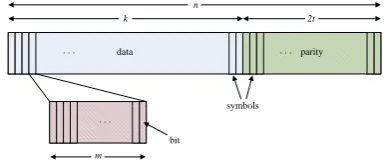
To incorporate the FEC, Reed-Solomon (RS) codes are exploited [23]. A codeword structure of RS Code is shown in Fig. 4. The RS code is specified as RS(n, k) with m-bit symbols, where n is the total symbols in a codeword, k is the data symbols and 2t is the amount of parity symbols added to data symbols to form a codeword. Each symbol in a codeword comprises of m-bit. The relation between n and m is given by n = 2m- 1and the total parity symbols, 2t, is given by 2t = n - k An RS decoder can correct up to t symbol errors in a codeword. When a codeword is decoded, the original transmitted data symbols will always be recovered if s < t, where s is the no of symbol errors. Otherwise original data symbol cannot be recovered and sometime it may unable to decode and recover an incorrect codeword.
The computational complexity of Reed-Solomon codes is related to the number of parity symbols per codeword. A large value of t means that a large number of errors can be corrected but requires more computational power than a small value of t.
Channel coder (r)
QAM Modulator SPIHT
Video Encoder
Channel
SPIHT Video Decoder
Channel Decoder
QAM Demodulator rate
controller Source rate
(Rs)
FEC rate (r)
Fig. 5 Transmission of SPIHT based Hybrid Video coder using JSSC scheme.
IV.
PROPOSED
VIDEO
COMMUNICATION
SYSTEM
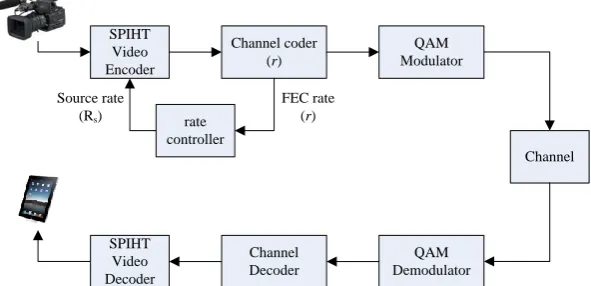
The RS channel codes can be utilized to provide FEC to SPIHT based coded video bitstream. However at fixed source rate, the FEC parity bits will increase the transmission rate of the overall video bitstream that will burden the channel. To overcome this issue, joint source channel coding scheme is employed. In JSCC, the source rate and the channel coding rate are jointly optimized to have best end to end video delivery without increasing the bandwidth of the channel.
finally passed to the SPIHT based Hybrid video decoder to reconstruct the video.
V.
SIMULATION
RESULTS
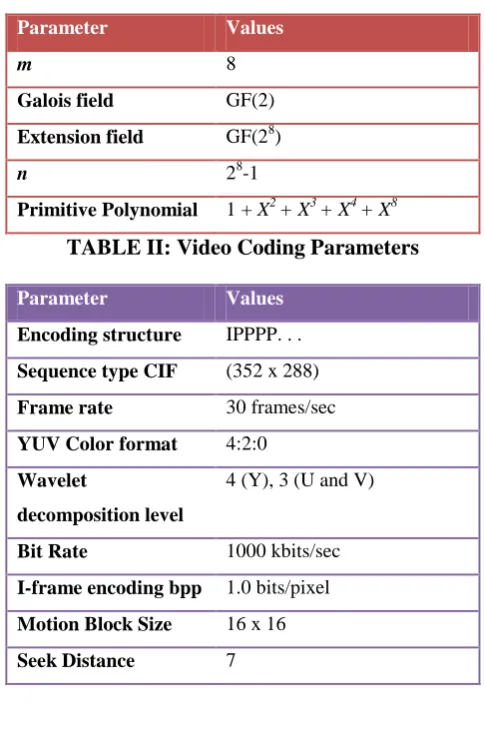
In this section, firstly the BER of RS coder at fixed transmission over Additive White Gaussian Noise (AWGN) channel with zero mean and power spectral density of No/2 is investigate. Then, the performance of proposed communication system that used SPIHT based hybrid video coder and FEC is presented. The parameters used for RS coding in simulations are summarized in Table I. The simulation parameters used for encoding the video sequences are listed in Table II.
TABLE I: RS Channel Coding Parameters
Parameter Values
m 8
Galois field GF(2)
Extension field GF(28)
n 28-1
Primitive Polynomial 1 + X2 + X3 + X4 + X8
TABLE II: Video Coding Parameters
Parameter Values
Encoding structure IPPPP. . .
Sequence type CIF (352 x 288)
Frame rate 30 frames/sec
YUV Color format 4:2:0
Wavelet
decomposition level
4 (Y), 3 (U and V)
Bit Rate 1000 kbits/sec
I-frame encoding bpp 1.0 bits/pixel
Motion Block Size 16 x 16
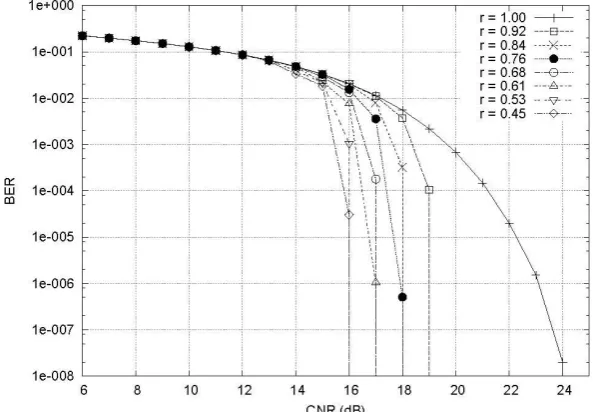
Fig. 6 BER of RS channel codes over AWGN channel
The BER variation in RS coded (with symbol length, m = 8) bitstream, modulated using 16 Quadrature Amplitude Modulation (QAM) and transmitted over AWGN channel is shown in Fig. 6. It is observe from the figure that as CNR increases the BER decreases at a given channel coder rate r. For r = 1 (no channel coding), the BER rate approaches to almost zero at CNR = 24 dB (very good channel condition). It means that at this CNR and beyond QAM demodulator is sufficient to recover errors without the need of only channel coding. Furthermore, the effect of channel coding can be observed in the CNR range of 13 dB to 24 dB only. Above CNR = 13 dB, BER increases as r decreases (or parity bits increases). For example, r = 0.92, the BER approaches zero at CNR = 19 dB, which corresponds to power gain of approximately 5 dB. This is due to the fact that at the same noise condition, the increased parity bits can now correct more channel errors, thereby reducing the BER. Similarly, at r = 0.84, the CNR, at which BER rate approaches zero, goes further down to 18
Fig. 8 Performance of Foreman Sequence transmitted through the proposed system.
dB. Below CNR = 13 dB, varying the channel code rate have no effect on the BER. This is because of the fact that at lower CNR, the noise is so severe that even increased parity bits are unable to correct all the errors. However, it is also observed that the BER improvement for decreased value of r in the range between CNR = 13 dB and 15 dB is almost negligible. Thus, below CNR = 15 dB FEC based equal error protection does not yield very much improvement as compared to no channel protection. The analysis suggests that FEC-based EEP works satisfactorily for AWGN channel for CNR = 15 dB and above.In order to evaluate the performance of FEC-based EEP, SPIHT coded video bitstream is channel coded with RS code, modulated using 16-QAM and transmitted over AWGN channel. For the FEC mechanism, RS channel codes are used with symbol length, m, equal to 8. Owing to random nature of channel errors and their impact on the SPIHT coded video stream, for each value of CNR, experiment were conducted for 20 different and independent simulated AWGN channels. The objective video quality is measured in terms of peak signal to noise ratio (PSNR), which is determined by averaging over 20 runs of experiments.
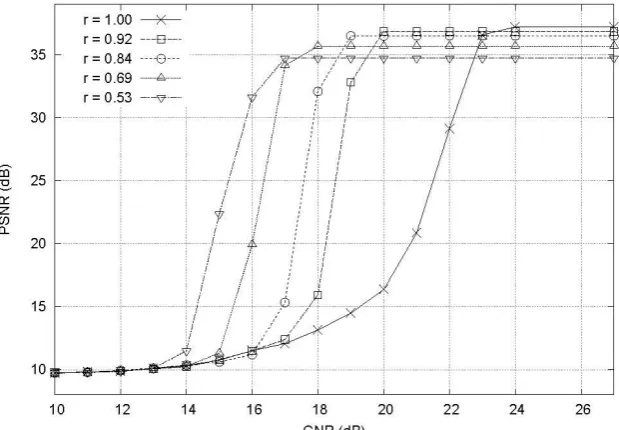
Figs. 7 and 8 show the quality of the reconstructed video for wide range of CNR at different channel code rate, r. Each video was coded at 1000 kbps for Akiyo and Foreman sequences each of 100 frames respectively. It can be observed from these figures that at fixed code rate (i.e. fixed parity bits) at lower CNR, the PSNR increases at fast rate, whereas at higher CNR the quality saturates. Moreover, as the parity bits are increased by decreasing code rate, r, the PSNR increases at fast rate at further lower CNR and the video quality saturates at early CNR values with slightly inferior values. For example, as evident in Fig. 7, that for Akiyo sequence and for r = 0.69 there is an improvement of approx. 27.5 dB at CNR = 17 dB over r = 1 (no protection). However, at CNR = 24 dB video quality is inferior by approx. 1.4 dB compared to no error protection. Similarly, for Foreman sequence in Fig. 8, r = 0.69 results an improvement of approx. 22 dB at CNR = 17 dB, but at CNR = 24 dB, quality deteriorate by approx. 1.5 dB, compared to no error protection case (r = 1).
From these results, it can be inferred that lower code rate (high protection) is required at lower CNR (poor channel conditions), but lesser protection is sufficient at higher CNR (good channel condition). Therefore, adaptive strategy may be applied for varying channel conditions such as fading. The values of r may be optimized for given channel condition so that the transmission of video coded bitstream can be delivered with best end to end quality of the reconstructed video. This may be explored in future work.
VI.
CONCLUSION
In this paper joint source channel scheme is proposed to efficiently transmit the SPIHT based Hybrid video coded bitstream using FEC over AWGN channel such that the channel resources are efficiently utilized. The video coder generates embedded bitstream that are used to exploit the JSSC scheme. The simulation results show that at lower CNR use of JSSC give very large improvement in the quality of the reconstructed video (approx. 25 dB) over unprotected transmission of the coded video. However, at good channel conditions (high CNR), there is little improvement in the quality. Therefore, the channel code rate should be adaptive according to the channel condition. Furthermore, optimize value of r may be obtained to further improve the quality of the reconstructed video. This may be the explored as future scope. It is to be noted that the JSSC scheme does not increase the bit budget of the system and hence is very suitable over constant bit rate channels.
REFERENCES
[1] M. E. Al-Mualla, C. N. Canagrajah and D. R. Bull, Video Coding for Mobile Communication. San Diego, California: Academic Press, 2002.
[2] Advanced Video Coding for Generic Audiovisual Services, ITU-T Recommendation H.264, May 2003. [3] J. Reichel, H. Schwarz, and M. Wien, “Joint Scalable Video Model 10 (JSVM 10),” Joint Video Team, doc.
JVT-W202, San Jose, CA, USA, Apr. 2007.
[4] Beong-Jo Kim, Zixiang Xiong, and W. A. Pearlman, “Low bit-rate scalable video coding with 3-D set partitioning in hierarchical trees (3-D SPIHT),” IEEE Transactions on Circuits and Systems for Video Technology, vol.10, no.8, pp.1374-1387, Dec 2000.
[5] Shih-Ta Hsiang, and John W Woods, “Embedded video coding using invertible motion compensated 3-D subband/wavelet filter bank,” Signal Processing: Image Communication, vol. 16, Iss. 8, pp. 705-724, May 2001.
[6] T. Borer, and T. Davies, “Dirac video compression using open standards”, BBC R&D White Paper, WHP 117, Sept. 2005.
[7] A. A. Moinuddin, E. Khan, and M. Ghanbari, “Wavelet-based low bitrate video coding using block-tree approach,” IET Int. Conf. on Visual Information Engineering (VIE 2006), Bangalore, India, Sept. 26-28, 2006, pp. 287-291.
[8] O. M. Lopez et al., “M-LTW: A fast and efficient intra video codec,” Signal Processing: Image Communication, vol. 23, pp. 637-648, Sept. 2008.
[10]F. Ghani, M. A. Khan, A. A. Moinuddin, E. Khan and M. Ghanbari, “Error Analysis of Zero-Tree Based Image Coders for Noisy Channels,” In Proceedings of International Conference on Robotics, vision and Signal Processing (ROVISP-2005), pp 553-556, Penang, Malaysia, July 20-22, 2005.
[11]M. A. Khan, A. A. Moinuddin, E. Khan and M. Ghanbari, “Error Analysis of SPIHT Based Image Coder,” In Proceedings of National Conference on Modern Trends in Electronics and Communication Systems (MTECS-05),pp. 104-108, AMU, India, March 5-6, 2005
[12]Wang, Y., & Zhu, Q.-F. (1998). Error control and concealment for video communication: a review. Proceedings of the IEEE, 86(5), 974-997.
[13]B. Girod and N. Farber, “Wireless video,” in Compressed Video over Networks, M. T. Sun and A. R. Reibman, Eds. New York: MarcelDekker, 2001.
[14]M. A. Khan, A. A. Moinuddin, E. Khan, and M. Ghanbari, “Optimized unequal error protection of embedded video bitstream using adaptive hierarchical QAM,” Multimedia Tools and Applications, pp. 1– 34, 2015. [Online]. Available: http://dx.doi.org/10.1007/s11042-015-2886-9
[15]M. A. Khan, T Hasan, A. A. Moinuddin and E. Khan, “Physical Layer Unequal Error Protection of Wavelet Coded Video Using Hierarchical QAM,” In Proceedings of 2010 IEEE Symposium on Industrial Electronics & Applications (ISIEA 2010), pp. 211-215, Penang, Malaysia, 3-5 October 2010.
[16]J. Hagenauer and T. Stockhammer, “Channel coding and transmission aspects for wireless multimedia,” Proceedings of the IEEE, vol. 87, pp. 1764-1777, October 1999.
[17]A. Nafaa, T. Taleb, and L. Murphy, “Forward error correction strategies for media streaming over wireless networks,” IEEE Communications Magazine, vol. 46, pp. 72-79, January 2008.
[18]R. Hamzaoui, V. Stankovic, and Z. Xiong, “Forward error control for packet loss and corruption,” in Multimedia over IP and Wireless Networks: Compression, Networking, and Systems (M. van der Schaar and P. Chou, eds.), pp. 271-291, Burlington, MA: Academic Press, 2007.
[19]K. Noh, S. Yoon, and J. Heo, “Performance analysis of network coding with raptor codes for IPTV,” IEEE Transactions on Consumer Electronics, vol. 55, pp. 83-87, February 2009.
[20]C.-Y. Hsu, A. Ortega, and M. Khansari, “Rate control for robust video transmission over burst-error wireless channels,” IEEE Journal on Selected Areas in Communications, vol. 17, no. 5, pp. 756-773, 1999. [21]M. F. Sabir, R. W. Heath, and A. C. Bovik, “Joint source-channel distortion modeling for MPEG-4 video,”
IEEE Transactions on Image Processing, vol. 18, pp. 90-105, January 2009.