Scholarship@Western
Scholarship@Western
Electronic Thesis and Dissertation Repository
7-7-2015 12:00 AM
MNE Ownership, Subsidiary Performance, and Economic
MNE Ownership, Subsidiary Performance, and Economic
Liberalization
Liberalization
Min ZhangThe University of Western Ontario
Supervisor Paul W. Beamish
The University of Western Ontario Graduate Program in Business
A thesis submitted in partial fulfillment of the requirements for the degree in Doctor of Philosophy
© Min Zhang 2015
Follow this and additional works at: https://ir.lib.uwo.ca/etd Part of the International Business Commons
Recommended Citation Recommended Citation
Zhang, Min, "MNE Ownership, Subsidiary Performance, and Economic Liberalization" (2015). Electronic Thesis and Dissertation Repository. 2924.
https://ir.lib.uwo.ca/etd/2924
This Dissertation/Thesis is brought to you for free and open access by Scholarship@Western. It has been accepted for inclusion in Electronic Thesis and Dissertation Repository by an authorized administrator of
MNE OWNERSHIP, SUBSIDIARY PERFORMANCE, AND
ECONOMIC LIBERALIZATION
(Thesis format: Integrated Article)
by
Min Zhang
Graduate Program in Business Management
A thesis submitted in partial fulfillment of the requirements for the degree of
Doctor of Philosophy
The School of Graduate and Postdoctoral Studies Western University
London, Ontario, Canada
i
A foreign subsidiary’s performance depends on its ability to manage the
institutional context of its resource decisions. In response to the evolving institutional
contexts facilitated by economic liberalization, MNEs have dramatically increased their
ownership levels in their FDIs in some emerging economies. Nevertheless, the
international business field has yet to sufficiently understand the consequent performance
of those FDIs with increasingly higher MNE ownership levels. To address this gap, this
dissertation is guided by three research questions. First, how does economic liberalization
influence an MNE’s ownership choice in emerging economies? Second, how does
economic liberalization change the relationship between an MNE’s equity ownership and
its subsidiary’s profitability? Third, how does economic liberalization influence a foreign subsidiary’s survival?
Utilizing a multi-theoretic lens, this dissertation investigates these questions by
comparing Japanese investments from 1990 to 2009 in China, the largest emerging
economy, and in the United States, the largest advanced economy.
Essay 1 investigates how economic liberalization and subsidiary experience
influence an MNE’s ownership choice. It posits that an MNE increases its ownership
level in China to accommodate the process of economic liberalization and that an MNE
tends to maintain equity-based relationships with local actors as subsidiary experience
increases. In contrast, in the United States an MNE only increases its ownership level
with the accumulation of subsidiary experience.
Essay 2 examines the evolving relationship between MNE ownership level and
subsidiary profitability (the O-P relationship). It suggests that China’s economic
liberalization has incurred institutional uncertainty that negatively influences an MNE’s
O-P relationship. Moreover, with declining institutional uncertainty, an MNE’s O-P
relationship positively evolves as China’s economic liberalization expands. Even so, or
most years during 1990-2009, an MNE’s O-P relationship remains negative in China,
ii
Essay 3 examines the survival of a foreign subsidiary under the conditions of
economic liberalization, and the relationship between MNE ownership level and
subsidiary survival (the O-S relationship). It suggests that the profitability of a foreign
subsidiary is associated with its survival. Moreover, institutional uncertainty is positively
associated with subsidiary survival. While the survival rate of Japanese subsidiaries in the
United States does not change, it declines over time in China with decreasing institutional
uncertainty.
This dissertation provides a detailed picture of MNE ownership and subsidiary
performance under the condition of economic liberalization.
Keywords: emerging economy; institutional voids; economic liberalization; institutional
transition; subnational disparity; ownership strategy; subsidiary performance; profitability;
iii
To Heavenly Father –
iv
Ten years ago, when I was still working as an engineer in Shanghai, I had no idea
that eventually I would pursue an academic career in international business. I still
remember the huge excitement when I received the PhD admission letter from Ivey
Business School in the spring of 2010. I still have the first course paper I wrote during my
doctorial studies. Today I still realize how lucky I am to have this priceless opportunity
in my life. It is not only a journey to grow to a junior scholar, but also a journey to
exercise my faith. With faith all things are possible.
A number of people have been highly influential on my development over the
course of my doctoral studies. First is my supervisor Dr. Paul Beamish who guided me
throughout my PhD journey with intellectual and emotional support with no reservation.
His passion for an academic career has strengthened my desire to be a useful scholar, and
his rigorous work style has shaped my good work habits. These influences will benefit
my whole scholarly life. Dr. Matt Thompson, the instructor in my first class at Ivey,
helped me in adapting to the western classroom quickly and establishing my initial
confidence for my doctoral studies. No words can express my gratitude to them.
I also sincerely appreciate my proposal and thesis committee members who
provided valuable assistance to me in completing this thesis, namely, Dr. Glenn Rowe, Dr.
Andreas Schotter, Dr. Brian Pinkham, Dr. Roy Eagleson, and Dr. Lance Brothers. Their
academic rigor has extensively honed my theoretical thinking.
I am grateful to other Ivey faculty members with whom I worked in courses or
other scholarly activities such as teaching, particularly Dr. Rod White, Dr. Chris Higgins,
Dr. Oana Branzei, Dr. Claus Rerup, Dr. Tima Bansal, Dr. Mark Zbaracki, Dr. Christopher
Williams, Dr. Jean-Louis Schaan, and Dr. Lynn Imai. I had the honor of learning from
them and working with each.
I am grateful to my fellow PhD colleagues from all over the world. They shared
with me their wonderful ideas and experiences, particularly Dr. Majid Eghbali-Zarch, Dr.
v
I am grateful to PhD Program Office and all the staff at the Ivey Business School.
They greatly helped me in smoothing all procedures throughout my studies.
I am grateful to my best friends who always acted as cheerleaders during the
course of my doctoral studies. Paul Parker and Min Liu were always available when I
needed them. Wenbei Li always shared with me her philosophy about everything,
enriching me with ideas that are not available from elsewhere. Dr. Li Dai provided
constant inspiration and comfort during my progress. With their care, I never felt lonely
in Canada.
Specifically, I am grateful to Sisters and Brothers at the Church of Jesus Christ of
Latter Day Saints. They made me believe that all truth is one, no matter science or
religion.
Finally, I am grateful to Canada where my academic dream took off. Over the
course of my studies I enjoyed the clean air, water, and food, and peaceful life in this
beautiful country. This precious experience made me believe that there could be a better
vi
Abstract ... i
Dedication ... iii
Acknowledgement ... iv
List of Tables ... ix
List of Figures ... x
Chapter 1. Introduction ... 1
Literature Review ... 3
Emerging Economies ... 5
Research Setting ... 7
Data and Methods ... 8
Dissertation Overview ... 9
Essay 1 ... 9
Essay 2 ... 10
Essay 3 ... 11
Dissertation-Related Presentations ... 11
Writing Style ... 12
References ... 14
Chapter 2. Significance, Substance, and Dynamism of Institutional Response: Japanese MNEs’ Ownership Choices in China and the United States ... 18
Introduction ... 18
Literature Review ... 21
Theories on Ownership Strategy ... 21
Economic Liberalization ... 24
Research Setting ... 25
Hypotheses ... 27
The Influence of Economic Liberalization ... 28
Subsidiary Experience ... 32
Methodology ... 34
Samples ... 36
Dependent and Independent Variables ... 36
Control Variables ... 37
Descriptive Statistics and Multi-Collinearity ... 39
Results ... 40
Discussion ... 45
vii
Contributions and Next Steps ... 49
Conclusion ... 52
References ... 53
Chapter 3. The Evolving Relationship between MNE Ownership (O) and Subsidiary Profitability (P) ... 60
Introduction ... 60
Literature Review ... 63
Emerging Economies ... 65
Research Setting ... 66
Hypotheses ... 68
Evolution of the O-P Relationship ... 68
Methodology ... 72
Samples ... 73
Variables ... 74
Descriptive Statistics and Multi-Collinearity ... 78
Results ... 81
Robustness Checks ... 84
Discussion ... 87
Evolution of the O-P Relationship in China ... 87
Control Variables ... 89
Contributions and Next Steps ... 90
Conclusion ... 94
References ... 95
Chapter 4. MNE Ownership (O), Subsidiary Survival (S), and Economic Liberalization ... 103
Introduction ... 103
Literature Review ... 105
Subsidiary Survival and Institutional Environment ... 105
Subsidiary Survival and MNE Equity Ownership ... 107
Emerging Economies ... 107
Research Setting ... 109
Theory and Hypotheses ... 110
Subsidiary Survival and Profitability ... 110
Subsidiary Survival and Its Evolution ... 111
The O-S Relationship and Its Evolution ... 114
viii
Descriptive Statistics and Multi-Collinearity ... 121
Empirical Tests ... 124
Event History Analysis without Instrumental Variables ... 124
Event History Analysis with Instrumental Variables ... 125
Robustness Checks ... 130
Discussion ... 131
Control Variables ... 131
Contributions and Next Steps ... 132
Conclusion ... 136
References ... 137
Chapter 5. General Conclusions ... 145
Introduction ... 145
Contributions ... 148
Limitations and Future Research ... 150
References ... 154
ix
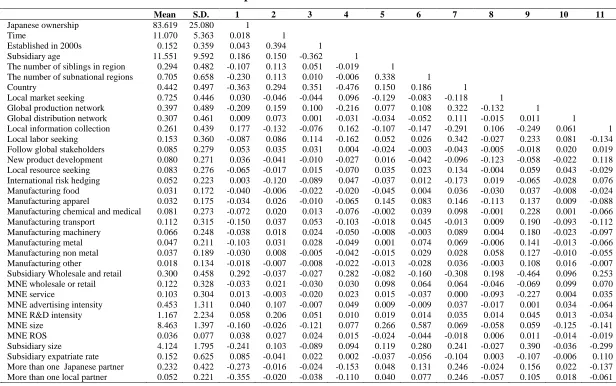
Table 2.1 Descriptive Statistics and Pearson Correlations ... 41
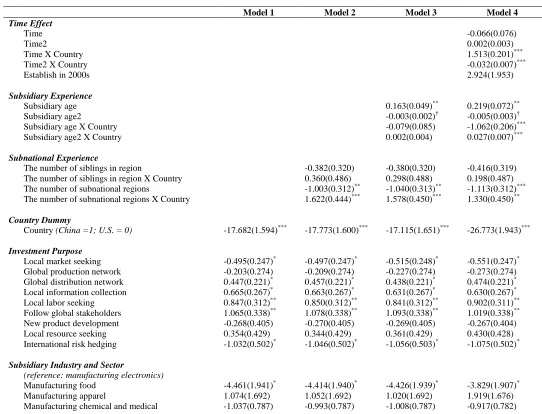
Table 2.2 Four-Level Latent Growth Modeling ... 43
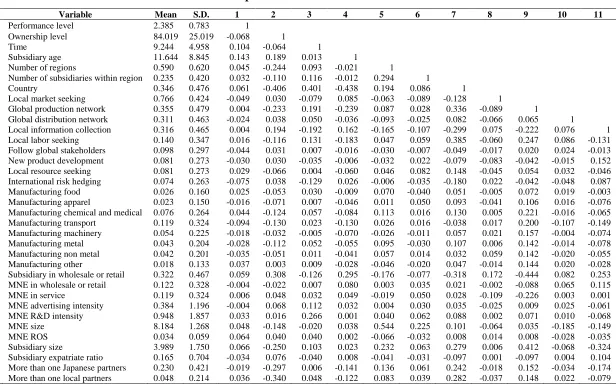
Table 3.1 Descriptive Statistics and Pearson Correlations ... 79
Table 3.2 Three-Level Longitudinal Logistic Regression ... 82
Table 3.3 Robustness Check with Instrumental Variables ... 86
Table 4.1 Descriptive Statistics and Pearson Correlations ... 122
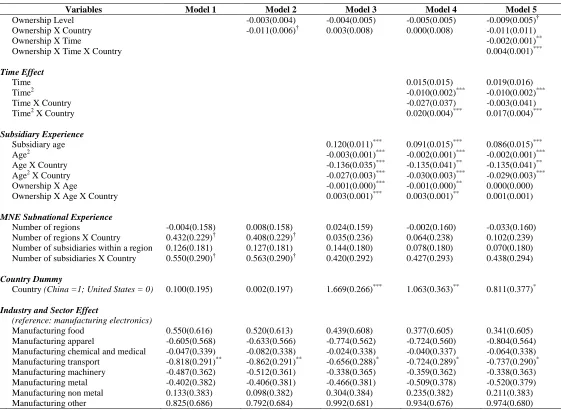
Table 4.2 Event History Analysis without Correcting for Endogeneity ... 126
x
Figure 1.1 Average Values of Japanese Ownership Levels ... 2
Figure 1.2 Dissertation Overview ... 13
Figure 2.1 Theoretical Foundation ... 32
Figure 2.2 Theoretical Model... 34
Figure 2.3 Influence of Economic Liberalization on Japanese Ownership Level ... 47
Figure 2.4 Influence of Subsidiary Experience on Japanese Ownership Level ... 47
Figure 3.1 Performance Projections for Subsidiaries in China (1992, 2000, and 2009) ... 88
Figure 3.2 Performance Projections for Subsidiaries in China (1990 – 2009) ... 89
Figure 4.1 Subsidiary Survival between 1990-2008 ... 132
Chapter 1.
Introduction
Cross-border ownership strategy, defined as the degree of ownership of a
multinational enterprise (MNE) investing abroad, can affect the overseas subsidiaries’
likelihood of success and the overall probability of survival (Dhanaraj and Beamish, 2004;
Woodcock, Beamish, and Makino, 1994). Prior studies, most of which substantiated their
conclusions with data prior to 2000, have investigated how an MNE’s ownership choice
influences its overseas performance, via subsidiary profitability and/or survival. It has
been suggested that the relationship between MNE ownership and subsidiary profitability
(the O-P relationship) in emerging economies might be different from those in advanced
economies. Wholly owned subsidiaries (WOSs) tend to have higher profitability than
international joint ventures (IJVs) established in North America or Europe because of
interest alignment, mutual trust, and security of firm specific assets (Nitsch, Beamish, and
Makino, 1996; Woodcock et al., 1994). In contrast, IJVs have better profitability than the WOSs in emerging economies because governments often limit location-specific
resources that are critical to performance to IJVs so as to protect indigenous enterprises
from the threat of competition (Beamish and Banks, 1987; Makino and Beamish, 1998;
Oman, 1988). Moreover, prior studies also have suggested that the relationship between
MNE ownership level and subsidiary survival (the O-S relationship) is positive and
nonlinear (Dhanaraj and Beamish, 2004; Lu and Hébert, 2005). Therefore, it is of critical
importance for MNEs to adopt an appropriate ownership strategy overseas in order to
generate profits and survive in a foreign country.
The past two decades have witnessed dramatic changes in the global economy.
The time-varying institutional contexts and MNEs’ responses have been challenging
scholars’ prior understanding of an MNE’s ownership choice and corresponding
performance outcomes. One of the most fundamental institutional changes is the rapid
development of emerging economies that use economic liberalization as their primary
engine of growth (Arnold and Quelch, 1998; Hoskisson, Eden, Lau, and Wright, 2000).
When regulatory liberalization of foreign direct investments (FDIs) is an important
dimension of economic liberalization in the host country, MNEs increasingly adopt WOS
Gomes-Casseres, 1990; Puck, Holtbrügge, Mohr, Lee, and Makhija, 2009). Based on data
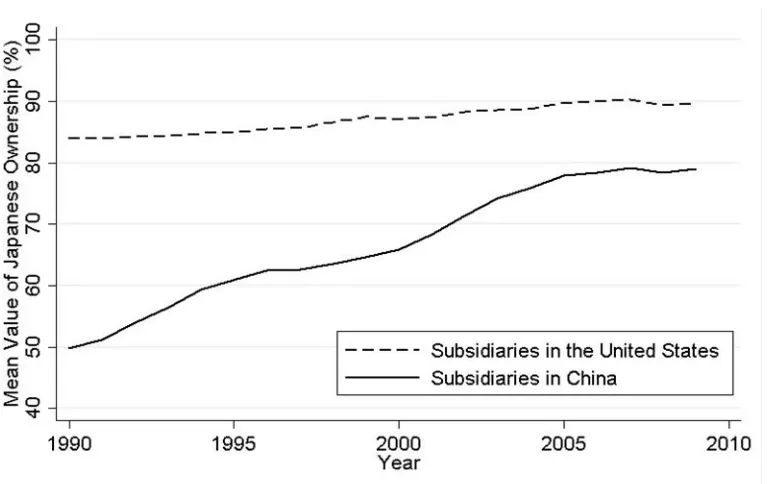
compiled in this dissertation, Japanese MNEs have dramatically increased their average
ownership level in FDIs in China during the period of China’s economic liberalization. In
contrast, over the same period, they have only slightly increased their average ownership
level in FDIs in the United States. Figure 1.1 delineates this emerging phenomenon.
Figure 1.1 Average Values of Japanese Ownership Levels
In spite of a preference by many MNEs for majority or sole ownership, rapid
changes in the institutional environment require MNEs to cope with various uncertainties
which they had never encountered before (Cantwell, Dunning, and Lundan, 2010;
Dunning and Lundan, 2008). Therefore, it is necessary to revisit an MNE’s ownership
choice and the O-P/O-S relationship. Otherwise, scholars are unable to prescribe how
MNEs can utilize their cross-border ownership strategies to secure the success of their
overseas investments.
This dissertation is guided by three research questions. First, how does economic liberalization influence an MNE’s ownership choice in emerging economies? Second,
change the survival prospect of a foreign subsidiary and the relationship between an MNE’s equity ownership and its subsidiary’s survival? By exploring these three questions, this dissertation bolsters MNEs’ comprehension of possible strategies to develop and
secure competitive advantages in foreign countries.
This chapter proceeds with a brief review of the existing literature pertaining to
the research questions. The chapter also identifies research gaps which can be addressed
to further the understanding of MNEs’ ownership strategies and the O-P/O-S relationship.
It then discusses the core theoretical foundations that inform this dissertation research. It
briefly concludes with an outline of each essay as an overview of the research that
constitutes the dissertation.
Literature Review
Historically, IB scholars have studied MNEs’ ownership choice and the O-P/O-S
relationship by considering transactional, institutional and experience influences (Chang
et al., 2013; Delios and Beamish, 1999; Demirbag, Glaister, and Tatoglu, 2007; Dhanaraj and Beamish, 2004). To address the research questions, this dissertation primarily focuses
on institutional influences, but incorporates other types of influences such as asset
specificity into the analysis.
Prior studies of MNEs’ ownership strategy and the O-P/O-S relationship consider
different types of institutional influences. In general, the sources of institutional
influences can be categorized into institutional pressure and institutional uncertainty.
Studies focusing on the influence of institutional pressure mainly examine how an MNE
responds to relevant institutions in its ownership strategy so that its actions can be
perceived as legitimate (i.e., desirable, proper or appropriate) by the host/home country,
peers and the MNE itself (Gomes-Casseres, 1990; Suchman, 1995; Xia, Tan, and Tan,
2008). This stream implicitly assumes that (i) the MNE has clear knowledge of
institutions that are fixed for some meaningful period, and (ii) lack of legitimacy may
result in poor local performance. Based on these assumptions, this stream advocates that
institutions (as a set of norms, cultural beliefs, and regulations) shape an MNE’s practices
2008; Scott, 1995). Moreover, this stream posits that institutional pressure influences an
MNE’s ownership choice by mechanisms that are distinct from transactional or
experience factors. While transactional and experience factors address the question about
what ownership structure the MNE wants in order to achieve better local performance, the
influence of institutional pressure addresses the question about what ownership structure
the MNE should have, irrespective of the optimal performance (Gomes-Casseres, 1990).
In addition, assuming that the MNE has clear knowledge of institutions, this stream does
not consider the influence of experience.
Regulatory restriction/liberalization and peer pressure are two types of
institutional pressure that an MNE must cope with in its ownership choice (Child, 1997;
Peng, 2003). The pressure from regulatory restriction on FDI may bring about a “forced”
local ownership for an MNE, even where transaction cost economics (TCE) does not
predict the existence of the IJV (Contractor, 1990; Gomes-Casseres, 1990). In contrast, an
MNE encounters less pressure when the host country liberalizes this restriction. An MNE
may respond to the institutional pressure stemming from reference groups or peers that it
is associated with, and increase its ownership level irrespective of efficiency
considerations (Chang et al., 2013; Xia et al., 2008).
Institutional pressure influences an MNE’s overseas performance by constraining
resource allocation. For example, with regulatory restriction, an MNE seldom obtains the
necessary subsidies and/or incentives from the host government to ensure profit in WOS
operation (Makino and Beamish, 1998; Oman, 1988). As a result, IJVs tend to have a
better performance than WOSs (Makino and Beamish, 1998; Oman, 1988). In contrast,
WOSs may have a better performance than IJVs in developed countries where MNEs can
arrange their ownership structures based on firm factors such as asset specificity (Nitsch
et al., 1996; Woodcock et al., 1994). This stream implies that an MNE’s ownership
strategy interacts with the institutional pressure inherent in the host country to influence
the subsidiary performance.
Studies focusing on the influence of institutional uncertainty examine how an
MNE arranges its subsidiaries’ ownership structures based on the extent to which it can
Zaheer, 1999; Xu, Pan, and Beamish, 2004). Assuming that it takes time for the MNE to
accumulate experience about the local institutions and corresponding practices, this
stream explicitly or implicitly draws on TCE logics such as the resource complementarity
of potential partners (Hennart, 2009). It has been suggested that an MNE’s local
performance is threatened by the deficiency in the knowledge/capabilities of coping with
a broad array of host country characteristics that constitute the host country’s institutional
environment, including political and legal rules, and the social norms. This produces
significant uncertainty or competitive disadvantage for an MNE (Kostova and Zaheer,
1999; North, 1990). It can be inferred that with adequate local institutional knowledge the
MNE may consider a higher ownership level to secure its specific assets unless it is
prevented by local regulation. In contrast, if an MNE has not acquired the institutional
advantages that are critical to its overseas performance, it may access them by sharing
ownership with indigenous partners (Beamish and Banks, 1987; Delios and Beamish,
1999; Hennart, 2009). Moreover, experience can improve the MNE’s institutional
knowledge and reduce institutional uncertainty over time, leading to positive ownership
adjustment (Delios and Beamish, 1999; Hennart, 1991; Makino and Delios, 1996). This
stream implies that an MNE’s ownership choice interacts with the institutional
uncertainty to influence the subsidiary performance.
Prior studies have contributed to our understanding of an MNE’s cross-border
ownership strategy and the consequent performance within relatively static institutional
environments. Nevertheless, previous research has yet to consider a more dynamic
context that simultaneously reshapes institutional pressure and institutional uncertainty
that an MNE confronts. Studying such a dynamic and complex context is necessary and
important in order to comprehensively understand an MNE’s ownership choice and
subsidiary performance in an emerging economy.
Emerging Economies
The institutional context in an emerging economy is complicated by the
coexistence of institutional voids and economic liberalization (Arnold and Quelch, 1998;
represent underdeveloped capital markets, infrastructure, intermediary markets,
regulatory systems, contract-enforcing mechanisms or other market-supporting
institutions (Khanna and Palepu, 1997). On the other hand, economic liberalization may
fill institutional voids by establishing formal market-oriented mechanisms and structures
that facilitate market exchange (Hoskisson et al., 2000). Taking China as an example,
economic liberalization (i) facilitates regulatory liberalization, (ii) decentralizes
decision-making power from the central government to provincial and/or city governments and
local enterprises, (iii) privatizes property rights, (iv) establishes relevant legal systems to
improve incentive structures and enforcement mechanisms, and (v) formulates favorable
industrial policies that influence resource allocations (Child and Tse, 2001; Davis, Desai,
and Francis, 2000). Therefore, economic liberalization facilitates institutional changes in
terms of both depth and breadth regarding their influences on economic activities.
These institutional changes reshape institutional pressure and uncertainty that an
MNE must cope with in its ownership choice. They also complicate the O-P/O-S
relationship. On one hand, economic liberalization facilitates institutional transition that
replaces institutional voids with market-supporting institutions over time (Peng, 2003).
On the other hand, institutional transition proceeds unevenly across political hierarchies
and geographies, and an MNE increasingly confronts political, social and economic
institutions at the subnational level rather than at the country level (Chan, Makino, and
Isobe, 2010; Shi, Markóczy, and Stan, 2014). Thus the combination of institutional voids
and market-based rules varies in time and space, resulting in subnational disparity in
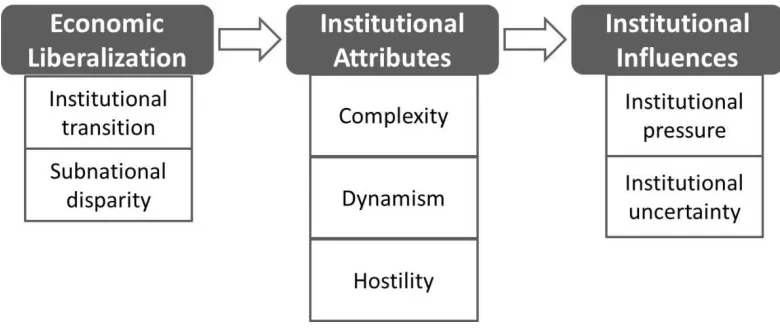
institutional pressure and uncertainty (Chan et al., 2010; Shi et al., 2014). Institutional transition and subnational disparity cause the complexity, dynamism, and hostility of
institutional conditions varying across the geographic scope and over time (Dess and
Beard, 1984; Tan and Tan, 2005). These factors complicate an MNE’s understandings of
the states of institutions and their cause-effect on subsidiary performance, constituting the
main sources of uncertainty that a foreign MNE must cope with in an emerging economy.
Nevertheless, prior literature has yet to synthesize the institutional uncertainty stemming
from institutional transition and subnational disparity into the research on MNE
This dissertation systematically synthesizes time- and space-varying institutional
influences stemming from the process of economic liberalization to further scholarly
understanding of an MNE’s ownership choice and the O-P/O-S relationship in an
emerging economy. Accordingly, this dissertation adopts an institution-based view, in
conjunction with TCE, learning perspective, the resource-based view (RBV), and real
options perspective (Delios and Henisz, 2000; Kogut, 1991; Meyer, 2001; Wright,
Filatotchev, Hoskisson, and Peng, 2005). The performance of a subsidiary is determined
by its sustained competitive advantages (Barney, 1991). A subsidiary’s sustained
competitive advantages depends on its ability to manage the institutional context of its
resource decisions (Brouthers, Brouthers, and Werner, 2008b; Oliver, 1997; Peng, Wang,
and Jiang, 2008). These decisions are usually concerned with securing firm-specific
assets and acquiring/accessing complementary local assets (Dunning and Lundan, 2008;
Hennart, 2009). Moreover, institutional uncertainty increases the importance of keeping
options available (Brouthers, Brouthers, and Werner, 2008a; Cuypers and Martin, 2007;
Vassolo, Anand, and Folta, 2004), thus influencing an MNE’s decision on subsidiary
termination as well. When the institutional context varies over time and across
geographies, its variation should be included in theoretical analysis and empirical testing
in performance research.
Research Setting
This dissertation compares Japanese FDIs in China and the United States. There
are several advantages for such a research setting. First, examining MNEs from one
country such as Japan can control for the endogeneity issue caused by country origin that
influences an MNE’s ownership choice (Erramilli, 1996; Shaver, 1998). Moreover, a
number of prior studies have empirically examined Japanese FDIs (Makino and Beamish,
1998; Woodcock et al., 1994), providing a basis for comparison with this dissertation.
Second, this research setting allows for comparison of Japanese FDIs in China, the
largest emerging economy undergoing an institutional transition, with those in the United
States, the largest advanced economy sustaining a relatively mature free-market
empirical tests. This setting also controls for the confounding effects of multiple host
countries (Makino, Isobe, and Chan, 2004; Pattnaik, Choe, and Singh, 2015). Although
advanced economies advocate free market institutions, they still differ in other
dimensions of their institutional environments (e.g., country culture) that influence a
foreign MNE’s ownership choice (Xu et al., 2004). In addition, emerging economies employ heterogeneous approaches to economic liberalization (Lau, Qian, and Roland,
2000). These different approaches may facilitate distinct institutional changes in scope,
intensity, and duration (Brouthers and Lamb Jr, 1995; Roland, 2002), potentially
complicating theoretical analysis and empirical testing when involving more than one
emerging economy.
Third, China advocates a gradualist, dual-track strategy for economic
liberalization, a process by which a market track is introduced and gradually strengthened
while the central planning track is maintained and progressively diminished (Lau et al., 2000; Park, Li, and Tse, 2006). This dual-track nature results in incremental economic
liberalization lasting for a lengthy period of time, making it possible to identify the
overall trends of China’s institutional conditions by accessing well-documented
governmental policies and relevant academic studies.
Data and Methods
Data used in this dissertation is from the Merged Toyo Keizai and Needs Datasets
(2012 Edition). Many prior studies referred to in this dissertation used earlier editions of
the Toyo Keizai datasets (Makino and Beamish, 1998; Nitsch et al., 1996; Woodcock et al., 1994). Using the data from the same organization improves the reliability of this dissertation. The dissertation adopts longitudinal and multilevel methodologies so that the
evolutionary nature of an MNE’s ownership choice and its subsidiary performance can be
empirically identified (Hitt, Beamish, Jackson, and Mathieu, 2007; Hoskisson et al., 2000). Moreover, this dissertation also addresses endogeneity issues caused by an MNE’s
ownership choice with panel data and instrumental variables (Hamilton and Nickerson,
Dissertation Overview
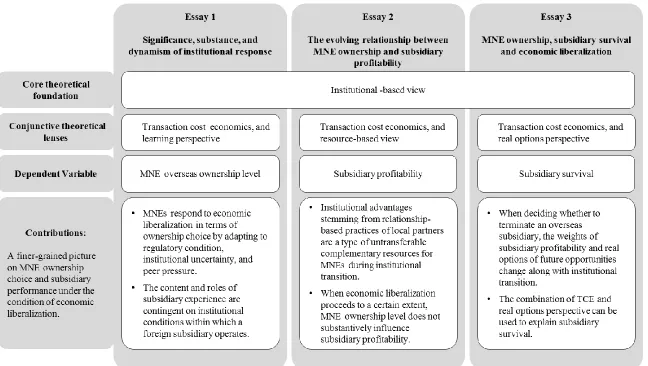
This dissertation is organized as a collection of three integrated essays. Figure 1.1
delineates the structure of the dissertation, detailing the focal phenomena, the theoretical
foundations underpinning this dissertation, and the contributions that link the essays
together. Essay 1 integrates regulatory liberalization, institutional uncertainty and peer
pressure into the analysis of MNE ownership choice. Essay 2 and Essay 3 jointly
investigate the evolution of subsidiary performance, and the O-P/O-S relationships under
the conditions of economic liberalization. In particular, Essay 3 identifies the association
and differentiation between subsidiary profitability and survival.
Essay 1
The first essay (Chapter 2), entitled “Significance, Substance, and Dynamism of Institutional Response”, investigates how Japanese MNEs are adapting their ownership choices to accommodate China’s gradual economic liberalization process and the
relatively mature free-market system in the United States. Prior studies focus on China’s
regulatory condition on foreign equity ownership. They suggest that regulatory
liberalization allows decisions about partner choice to be increasingly based on rational
considerations of strategic intention, risk and transaction costs. In contrast to existing
research, Essay 1 involves broader aspects of economic liberalization such as political
decentralization and corresponding subnational disparity in institutions. Moreover,
existing literature suggests that subsidiary experience reduces an MNE’s reliance on local
partner(s) and leads to higher MNE ownership level. While this statement remains true in
an advanced economy where rule-based exchanges dominate, Essay 1 argues that it
should be re-examined within China’s institutional context. The institutional uncertainty
stemming from economic liberalization increases the importance of relationship-based
exchanges. In this vein, subsidiary experience in China is associated with
relationship-based operation rather than rule-relationship-based operation. As such, Essay 1 posits that a Japanese
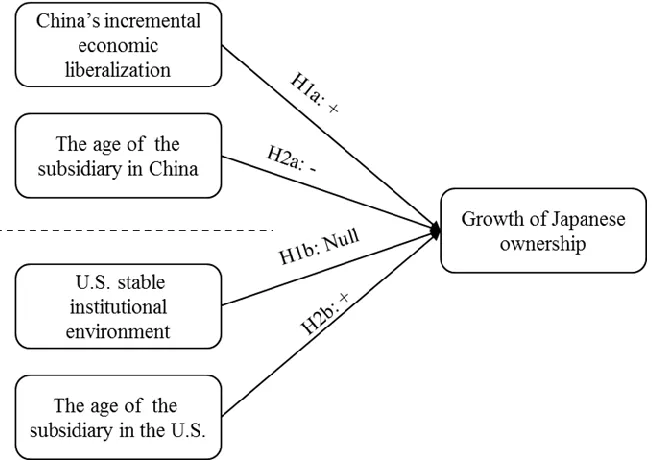
MNE increases its ownership levels in China to accommodate the process of economic
liberalization. However, a Japanese MNE also tends to maintain equity-based
a Japanese MNE only increases its ownership levels in the United States with the
accumulation of subsidiary experience.
Empirical tests based on growth-curve models support the theory developed in
Essay 1, showing the significance, substance, and dynamism of an MNE’s institutional
response in terms of overseas ownership choice.
Essay 2
The second essay (Chapter 3), entitled “The Evolving Relationship between MNE Ownership and Subsidiary Profitability”, examines the O-P relationship under the condition of economic liberalization. Existing literature suggests that a Japanese MNE’s
ownership level is positively associated with the subsidiary profitability in developed
countries and negatively associated with those in developing countries. Essay 2
investigates an underexplored topic: the evolution of the O-P relationship during China’s
economic liberalization. Consistent with Essay 1, Essay 2 argues that China’s economic
liberalization not only has improved institutional openness towards foreign investments,
but also has incurred institutional uncertainty that an MNE must cope with. While
institutional openness positively adjusts an MNE’s O-P relationship, institutional uncertainty negatively alters it. Moreover, along with the economic liberalization, China’s
institutional openness is increasing, reducing an MNE’s reliance on local partners to enter
the market. Meanwhile, China’s institutional uncertainty is declining, reducing an MNE’s
reliance on local partners to understand the state of local institutions and their
cause-effect on subsidiary performance. Therefore, a Japanese MNE’s O-P relationship
positively evolves with China’s economic liberalization. Empirical tests based on
multilevel longitudinal models support this proposition. Even so, for most years during
1990-2009, a Japanese MNE’s P relationship remains negative in China. A negative
O-P relationship indicates that high equity control does not lead to superior subsidiary
profitability in China. Even after addressing the endogeneity issue caused by ownership
Essay 3
The third essay (Chapter 4), entitled “MNE Ownership, Subsidiary Survival and Economic Liberalization”, examines the survival prospect of a foreign subsidiary and the O-S relationship under the condition of economic liberalization. Prior studies suggest that
an MNE’s ownership level is positively associated with subsidiary survival (Dhanaraj and
Beamish, 2004; Lu and Hébert, 2005), and leave two research gaps. First, an MNE
chooses it overseas ownership level according to the institutional context within which it
operates. This highlights the necessity of addressing the endogeneity issue caused by
organizational choices when investigating an MNE’s O-S relationship (Reeb et al., 2012; Shaver, 1998). Second, the survival of a foreign subsidiary is associated with its
short-term profitability and future opportunities. Although Essay 2 addressed subsidiary
profitability and the O-P relationship, it is necessary to investigate how the real options of
future opportunities influence subsidiary survival and the O-S relationship.Accordingly,
Essay 3 suggests that institutional uncertainty positively relates to the survival of a
foreign subsidiary because of the importance of keeping options available. With declining
institutional uncertainty in China, there is a decreasing need for an MNE to seize future
opportunities by maintaining non-performing subsidiaries. This results in a declining
survival rate of foreign subsidiaries in China. Essay 3 also identifies the association and
differentiation between subsidiary profitability and survival. After controlling for
endogeneity issues caused by ownership choices and subsidiary profitability, an MNE’s
O-S relationship is constantly insignificant in China and the United States.
Dissertation-Related Presentations
Prior to the submission of the dissertation for final examination, the theoretical
and empirical analyses presented in the following three essays have evolved through
extensive developmental feedback received from my supervisor and proposal committee
members as well as multiple public forums including doctorial consortiums, academic
conferences and invited scholarly presentations. With respect to Essay 1 (Chapter 2), the
author presented an early version at the Academy of International Business Annual
Environment of IB interest track. It was nominated for the 2014 Temple/AIB Best Paper Award. With respect to Essay 2 (Chapter 3), the author presented an early version at the 2014 Association of Japanese Business Studies Annual Conference. It was nominated for
the Palgrave Macmillan/AJBS Best Paper Award.
Writing Style
The three essays adopt the same research setting and a comparative methodology.
Therefore, they use the same procedure to select samples, and involve similar arguments
about institutional conditions in China and the United States. Inevitably, there is some
repetition regarding methodology and institutional contexts. The author retains them for
the completeness of each essay. Any repetition within essays will be eliminated at the
journal submission stage.
References
Arnold DJ, Quelch JA. 1998. New strategies in emerging markets. Sloan Management Review, 40(1): 7-20.
Barney J. 1991. Firm resources and sustained competitive advantage. Journal of Management, 17(1): 99-120.
Beamish PW, Banks JC. 1987. Equity joint ventures and the theory of the multinational enterprise. Journal of International Business Studies, 18(2): 1-16.
Brouthers KD, Brouthers LE, Werner S. 2008a. Real options, international entry mode choice and performance. Journal of Management Studies, 45(5): 936-960.
Brouthers KD, Brouthers LE, Werner S. 2008b. Resource-based advantages in an international context. Journal of Management, 34(2): 189-217.
Brouthers LE, Lamb Jr CW. 1995. National ideology, public policy, and the business environment: A contingency approach to economic reform in Hungary, Poland and Eastern Europe. International Business Review, 4(3): 355-372.
Cantwell J, Dunning JH, Lundan SM. 2010. An evolutionary approach to understanding international business activity: The co-evolution of MNEs and the institutional environment. Journal of International Business Studies, 41(4): 567-586.
Chan CM, Makino S, Isobe T. 2010. Does subnational region matter? Foreign affiliate performance in the United States and China. Strategic Management Journal, 31(11): 1226-1243.
Chang S-J, Chung J, Moon JJ. 2013. When do wholly owned subsidiaries perform better than joint ventures? Strategic Management Journal, 34(3): 317-337.
Child J. 1997. Strategic choice in the analysis of action, structure, organizations and environment: Retrospect and prospect. Organization Studies, 18(1): 43-76.
Child J, Tse DK. 2001. China's transition and its implications for international business.
Journal of International Business Studies, 32(1): 5-21.
Contractor FJ. 1990. Ownership patterns of U.S. joint ventures abroad and the liberalization of foreign government regulations in the 1980s: Evidence from the benchmark surveys. Journal of International Business Studies, 21(1): 55-73. Cuypers IRP, Martin X. 2007. Joint ventures and real options: An integrated perspective
In J. J. Reuer, and T. W. Tong (Eds.), Real Options Theory (Advances in Strategic Management, Volume 24), Vol. 24: 103-144. Bingley: Emerald Group.
Davis PS, Desai AB, Francis JD. 2000. Mode of international entry: An isomorphism perspective. Journal of International Business Studies, 31(2): 239-258.
Delios A, Beamish PW. 1999. Ownership strategy of Japanese firms: Transactional, institutional, and experience influences. Strategic Management Journal, 20(10): 915-933.
Delios A, Henisz WJ. 2000. Japanese firms' investment strategies in emerging economies.
Academy of Management Journal, 43(3): 305-323.
Demirbag M, Glaister KW, Tatoglu E. 2007. Institutional and transaction cost influences on MNEs' ownership strategies of their affiliates: Evidence from an emerging market. Journal of World Business, 42(4): 418-434.
Dess GG, Beard DW. 1984. Dimensions of organizational task environments.
Dhanaraj C, Beamish PW. 2004. Effect of equity ownership on the survival of international joint ventures. Strategic Management Journal, 25(3): 295-305.
Dunning JH, Lundan SM. 2008. Multinational Enterprises and Global Economy (2nd ed.). Cheltenham: Edward Elgar.
Erramilli MK. 1996. Nationality and subsidiary ownership patterns in multinational corporations. Journal of International Business Studies, 27(2): 225-248.
Gomes-Casseres B. 1990. Firm ownership preferences and host government restrictions: An integrated approach. Journal of International Business Studies, 21(1): 1-22. Hamilton BH, Nickerson JA. 2003. Correcting for endogeneity in strategic management
research. Strategic Organization, 1(1): 51-78.
Hennart J-F. 1991. The transaction costs theory of joint ventures: An empirical study of Japanese subsidiaries in the United States. Management Science, 37(4): 483-497. Hennart J-F. 2009. Down with MNE-centric theories! Market entry and expansion as the
bundling of MNE and local assets. Journal of International Business Studies, 40(9): 1432-1591.
Hitt MA, Beamish PW, Jackson SE, Mathieu JE. 2007. Building theoretical and empirical bridges across levels: Multilevel research in management. Academy of Management Journal, 50(6): 1385-1399.
Hoskisson RE, Eden L, Lau CM, Wright M. 2000. Strategy in emerging economies.
Academy of Management Journal, 43(3): 249-267.
Khanna T, Palepu K. 1997. Why focused strategies may be wrong for emerging markets.
Harvard Business Review, 75(4): 41-51.
Kogut B. 1991. Joint ventures and the option to expand and acquire. Management Science, 37(1): 19-33.
Kostova T, Roth K, Dacin MT. 2008. Institutional theory in the study of multinational corporations: A critique and new directions. Academy of Management Review, 33(4): 994-1006.
Kostova T, Zaheer S. 1999. Organizational legitimacy under conditions of complexity: The case of the multinational enterprise. Academy of Management Review, 24(1): 64-81.
Lau Lawrence J, Qian Y, Roland G. 2000. Reform without losers: An interpretation of China's dual-track approach to transition. Journal of Political Economy, 108(1): 120-143.
Lu JW, Hébert L. 2005. Equity control and the survival of international joint ventures: A contingency approach. Journal of Business Research, 58(6): 736-745.
Makino S, Beamish PW. 1998. Local ownership restrictions, entry mode choice, and FDI performance: Japanese overseas subsidiaries in Asia. Asia Pacific Journal of Management, 15(2): 119-136.
Makino S, Delios A. 1996. Local knowledge transfer and performance: Implications for alliance formation in Asia. Journal of International Business Studies, 27(5): 905-927.
Makino S, Isobe T, Chan CM. 2004. Does country matter? Strategic Management Journal, 25(10): 1027-1043.
Meyer KE. 2001. Institutions, transaction costs, and entry mode choice in Eastern Europe.
Journal of International Business Studies, 32(2): 357-367.
North DC. 1990. Institutions, Institutional Change and Economic Performance. Cambridge: Cambridge University.
Oliver C. 1997. Sustainable competitive advantage: Combining institutional and resource-based views. Strategic Management Journal, 18(9): 697-713.
Oman CP. 1988. Cooperative strategies in developing countries: The new forms of investment. In F. J. Contractor, and P. Lorange (Eds.), Cooperative Strategies In International Business. New York: Lexington Books.
Park SH, Li S, Tse DK. 2006. Market liberalization and firm performance during China's economic transition. Journal of International Business Studies, 37(1): 127-147. Pattnaik C, Choe S, Singh D. 2015. Impact of host country institutional context on
subsidiary performance. Management Decision, 53(1): 198-220.
Peng MW. 2003. Institutional transitions and strategic choices. Academy of Management Review, 28(2): 275-296.
Peng MW, Wang DYL, Jiang Y. 2008. An institution-based view of international business strategy: A focus on emerging economies. Journal of International Business Studies, 39(5): 920-936.
Puck JF, Holtbrügge D, Mohr AT, Lee S-H, Makhija M. 2009. Beyond entry mode choice: Explaining the conversion of joint ventures into wholly owned subsidiaries in the People's Republic of China. Journal of International Business Studies, 40(3): 388-404.
Reeb D, Sakakibara M, Mahmood IP. 2012. From the editors: Endogeneity in international business research. Journal of International Business Studies, 43(3): 211-218.
Roland G. 2002. The political economy of transition. Journal of Economic Perspectives, 16(1): 29-50.
Scott WR. 1995. Institutions and Organizations. Thousand Oaks, CA: Sage Publication. Shaver JM. 1998. Accounting for endogeneity when assessing strategy performance:
Does entry mode choice affect FDI survival? Management Science, 44(4): 571-585.
Shi W, Markóczy L, Stan CV. 2014. The continuing importance of political ties in China.
Academy of Management Perspectives, 28(1): 57-75.
Suchman MC. 1995. Managing legitimacy: Strategic and institutional approaches.
Academy of Management Review, 20(3): 571-610.
Tan J, Tan D. 2005. Environment–strategy co-evolution and co-alignment: A staged model of Chinese SOEs under transition. Strategic Management Journal, 26(2): 141-157.
Vassolo RS, Anand J, Folta TB. 2004. Non-additivity in portfolios of exploration activities: A real options-based analysis of equity alliances in biotechnology.
Strategic Management Journal, 25(11): 1045-1061.
Woodcock CP, Beamish PW, Makino S. 1994. Ownership-based entry mode strategies and international performance. Journal of International Business Studies, 25(2): 253-273.
Xia J, Tan J, Tan D. 2008. Mimetic entry and bandwagon effect: The rise and decline of international equity joint venture in China. Strategic Management Journal, 29(2): 195-217.
Chapter 2.
Significance, Substance, and Dynamism of
Institutional Response: Japanese MNEs’ Ownership
Choices in China and the United States
Introduction
The OLI paradigm describes that a multinational enterprise (MNE) always has a
configuration of firm specific ownership advantages (O), location specific advantages (L),
internalization advantages (I), and strategic objectives as well (Dunning, 1977; Dunning
and Lundan, 2008). As one means of realizing internalization advantages (Dunning,
1977), ownership strategy is critical for multinational enterprises (MNEs) as it affects the
overseas subsidiaries’ likelihood of success as well as the probability of survival
(Dhanaraj and Beamish, 2004; Gaur and Lu, 2007; Stopford and Wells, 1972; Woodcock,
Beamish, and Makino, 1994). International business (IB) research has investigated the
predictors of MNEs’ ownership patterns in foreign countries by considering various
transactional, institutional, and experience influences (Delios and Beamish, 1999;
Demirbag, Glaister, and Tatoglu, 2007).
The past two decades have witnessed dramatic institutional changes in emerging
economies facilitated by their economic liberalization. To cope with these evolving
institutional contexts, MNEs have increasingly adopted WOS entries and sometimes even
converted existing IJVs to WOSs (Chang, Chung, and Moon, 2013; Gomes-Casseres,
1990; Puck, Holtbrügge, Mohr, Lee, and Makhija, 2009). Based on data compiled in this
dissertation, Japanese MNEs have dramatically increased their average ownership level in
FDIs in China during the period of China’s economic liberalization. In contrast, over the
same period, they have only slightly increased their ownership levels in FDIs in the
United States. This emerging phenomenon delineated by Figure 1.1 in Chapter 1, requires
scholars to understand the influence of economic liberalization on MNEs ownership
choice.
Prior studies have particularly been concerned with two competing institutional
hand, emerging economies are frequently characterized by “institutional voids”. The term
refers to the absence of market-oriented regulatory systems or contract enforcing
mechanisms which facilitate the efficient functioning of free markets (Khanna and Palepu,
1997). Thus, MNEs must develop relevant cross-border strategies to manage
underdeveloped institutions that either prevent market transactions or increase their costs
(Cuervo-Cazurra and Genc, 2008). IB theorists have suggested that MNEs may respond
to institutional voids, such as foreign ownership restriction, through partnerships with
local firms (e.g., Gomes-Casseres, 1990; Delios & Beamish, 1999). On the other hand,
emerging economies are recognized as rapid-growth countries using economic
liberalization as their primary engine (Arnold and Quelch, 1998; Hoskisson, Eden, Lau,
and Wright, 2000). Since economic liberalization will fill institutional voids with
market-based rules, foreign MNEs must respond to the liberalization process to continuously
reconfigure and secure their competitive advantages in emerging economies. Several
studies have posited that regulatory liberalization as an important aspect of economic
liberalization, may reduce the number of minority affiliates and even facilitate the
conversion of existing international joint ventures (IJVs) into wholly owned subsidiaries
(WOSs) (Contractor, 1990; Puck et al., 2009).
Nevertheless, most studies assume that economic liberalization is a singular event
or a steadily proceeding reform over time and across geographic space. These studies
have not sufficiently incorporated the complexity, dynamism, and hostility of the
institutional environment of an emerging economy into the research on MNEs’ ownership
strategies. For a variety of reasons, this issue deserves more attention. First, when
regulatory liberalization proceeds incrementally, it creates a changing threshold for levels
of foreign ownership and influences the extent to which an MNE can secure its
firm-specific advantages and acquire/access local complementary resources. Whether and how
the MNE responds to the dynamics of regulatory liberalization reflects the MNE’s ability
to simultaneously reconfigure and secure its competitive advantages in a context with
rapid dynamics (Teece, 2007).
Second, regulatory liberalization influences the extent to which other factors play
bring about a “forced” local ownership even where transaction cost economics (TCE)
does not predict the existence of the IJV (Contractor, 1990; Gomes-Casseres, 1990).
Incremental regulatory liberalization relaxes the threshold over time, allowing MNEs to
increasingly decide their ownership levels based on firm-specific factors. If this threshold
effect is not considered in the theoretical model, particularly when investigating the
MNE’s ownership strategies with longitudinal data, a study may under- or over-estimate
the influence of other factors.
Third, the process of economic liberalization usually unevenly proceeds within the
political hierarchy and across the breadth of geographic scope (Boisot and Child, 1996;
Park, Li, and Tse, 2006). It results in prominent institutional transition and subnational
variation for a long time period (Chan, Makino, and Isobe, 2010; Peng, 2003). These
important characteristics of task environments may influence the cross-border ownership
strategy of MNEs in a more complicated way than has been incorporated into existing
studies.
Fourth, prior studies suggest that the experience in the host country may be
associated with higher foreign ownership levels (Contractor, 1990; Delios and Beamish,
1999; Puck et al., 2009). Nevertheless, frequent institutional changes in an emerging economy may invalidate an MNE’s prior experience with local conditions. In addition,
the influences of both economic liberalization and subsidiary experience can be perceived
as functions of time. Without simultaneously including them in theoretical analysis and
empirical testing, it is unclear whether they are still respectively associated with a higher
foreign ownership level when they coexist.
This study purports to shed light on these underexplored and important research
gaps by examining the growth trajectories of ownership levels of Japanese MNEs in the
past two decades. To address such a challenge, this study adopts an institution-based view,
which draws upon TCE and the learning perspective (Delios and Henisz, 2000; Meyer,
2001; Wright, Filatotchev, Hoskisson, and Peng, 2005). A subsidiary’s sustained
competitive advantage depends on its ability to manage the institutional context of its
resource decisions (Brouthers, Brouthers, and Werner, 2008; Oliver, 1997; Peng, Wang,
assets and acquire/access complementary local assets (Dunning and Lundan, 2008;
Hennart, 2009). When institutional context varies over time, its evolution should be
included in theoretical analysis and empirical testing. In addition, this study focuses on
the influences of economic liberalization and subsidiary experience, and examines
whether and how they are empirically distinguished from each other. The present study
also includes other influences identified in existing literature as control variables.
This paper proceeds with a literature review and a description of the research
setting that was used. Then it develops a set of hypotheses to delineate the distinct
influences of the economic liberalization process and subsidiary experience on MNE
ownership choice. It proceeds to examine hypotheses using a latent growth-curve model
and data spanning a wider period of time. Finally, it discusses empirical results that
confirm or diverge from existing work and presents implications to IB research and
practitioners.
Literature Review
Theories on Ownership Strategy
The IB field has extensively investigated the predictors of MNEs’ ownership
strategies by considering transactional, institutional, and experience influences (Anderson
and Gatignon, 1986; Delios and Beamish, 1999; Demirbag et al., 2007; Jung, Beamish, and Goerzen, 2010).
TCE discusses the most efficient governance structures – markets, hierarchies, or
a hybrid of the two – to govern a specific set of transactions (Williamson, 1975, 1985). It
has been particularly useful in understanding the establishment of an MNE’s ownership
levels in its overseas subsidiaries by answering two questions: (1) what specific assets
does the MNE possess to exploit in the host country; and (2) what complementary assets
does the MNE purport to acquire or access in the host country (Hennart, 2009). For the
first question, TCE posits that the degree of ownership assumed in the foreign operation
confers a proportional degree of control over the uses to which the firm-specific assets
higher the considered level of the ownership when the MNE invests in a foreign country
(Chen and Hennart, 2002; Delios and Beamish, 1999; Demirbag et al., 2007). With greater control comes increased resource commitments and risk. This means that the
ownership decision involves a trade-off between control and resource commitments
(Anderson and Gatignon, 1986). Regarding the second question, TCE suggests that when
complementary resources are subject to market inefficiency or asymmetric information,
an MNE may adopt a relatively lower level of ownership in order to access the local
based assets and/or to keep the real options open (Hennart, 2009). To secure firm-specific
advantages and access complementary resources, an MNE should be able to manage the
institutional context of its resource decisions in the host country (Brouthers et al., 2008; Oliver, 1997; Peng et al., 2008).
Although institutional influences are usually analysed based on institutional
theory, they are closely associated with TCE because one critical locally based resource is
institutional knowledge, and a lack thereof constitutes a significant competitive
disadvantage for the MNE (Hymer, 1976). Institutions encompass a broad array of
political and legal rules, and the social norms that constitute the home/host country’s
institutional environment for business operation (Delios and Beamish, 1999; North, 1990).
To formulate appropriate organizational choices, an MNE needs to have knowledge of the
state of institutions and their cause-effect on firm performance (Dunning and Lundan,
2008; Milliken, 1987). In this vein, institutional influences are associated with two
aspects of MNE operations: (1) the establishment of legitimacy in the host country, i.e.,
the local responsiveness; and (2) the transfer of strategic orientations and organizational
practices shaped in the home country to the foreign subsidiary, i.e., the internal
consistency (Kostova, 1999; Kostova and Zaheer, 1999). While the former is associated
with acquiring or accessing complementary resources in the host country, the latter is
concerned with the security of firm-specific advantages developed in the home country.
The IB field investigates the local responsiveness and internal consistency with
two streams of literature. One stream explores how the unilateral national characteristics
avoidance may be positively related to the MNE’s ownership levels in a foreign country
(Erramilli, 1996; Hennart and Larimo, 1998; Hofstede, 1980). Another example is that
underdeveloped property rights in the host country may be associated with a higher level
of MNE control in order to secure firm-specific assets (Delios and Beamish, 1999). The
other stream focused on institutional distance explores the influence of the similarities or
dissimilarities between the host and home institutional environments. Institutional
distance raises the uncertainty, risk, and hence the cost of operating in the foreign country
(Hennart and Larimo, 1998). Some studies posit that greater institutional (or cultural)
distance predicts higher ownership control levels in order to enhance internal consistency
and minimize transaction costs (Hennart and Larimo, 1998). Other research proposes that
greater institutional distance is associated with lower equity ownership so as to maintain
local responsiveness (Barkema and Vermeulen, 1998; Xu, Pan, and Beamish, 2004). A
trade-off between internal consistency and local responsiveness is thus important.
Nevertheless, the institutional uncertainty that an MNE confronts ultimately stems from
the complexity, dynamism and hostility of institutional environments in the host country
(Dess and Beard, 1984; Tan and Litschert, 1994), as these factors retard the MNE in
understanding the state of institutions and their cause-effects on the firm performance
(Dunning and Lundan, 2008; Milliken, 1987). Neither unilateral national characteristics
nor institutional distance can sufficiently capture these three dimensions.
As argued by IB theorists, firms with experience in the host country may learn
about local institutions and develop organizational capabilities adapted to the
environment. They therefore face fewer institutional disadvantages (Johanson and Vahlne,
1977). Multiple studies have suggested a positive relationship between an MNE’s
ownership level and its experience in the host country (Delios and Beamish, 1999;
Hennart, 1991; Makino and Delios, 1996; Wilkinson, Peng, Brouthers, and Beamish,
2008). Nevertheless, an experienced MNE may also develop capabilities in managing
local partners to access institutional advantages that are difficult to acquire (Cantwell,
Dunning, and Lundan, 2010; Hennart, 2009). In particular, an MNE would have a weaker
need to rely on a high equity ownership to deal with unexpected contingencies in a
rapidly changing environment (Jung et al., 2010). The experience in the host country
institutions and their cause-effect on firm performance, and it does not always result in
higher equity control.
Prior literature has contributed to our understanding of cross-border ownership
strategy by analyzing transactional, institutional and experience influences. As
institutional conditions determine the cause-effect of transactional and experience factors
on firm performance, these three types of influences are not independent from each other.
The literature has not sufficiently investigated their interdependence. To address such a
challenge requires an institutional setting with remarkable dynamism so that their
interdependence can be theoretically and empirically identified. An emerging economy
employing economic liberalization can satisfy such a requirement.
Economic Liberalization
When studying an MNE’s ownership strategy in an emerging economy, prior
studies mainly focus on influences of the regulation and/or deregulation of foreign
ownership. Regulatory restriction on foreign equity participation may bring about a
“forced” local ownership even where TCE does not predict the existence of the IJV,
resulting in a lower MNE ownership level (Contractor, 1990; Delios and Beamish, 1999;
Delios and Henisz, 2000; Gomes-Casseres, 1990). In contrast, with regulatory
liberalization, an MNE may reduce the number of 50-50 and minority affiliates and
convert existing IJVs to WOSs in order to secure firm-specific advantages or to be
isomorphic to successful peers (Chang et al., 2013; Puck et al., 2009; Xia, Tan, and Tan, 2008). Nevertheless, most studies assume either regulatory restriction or liberalization as
the basis for their arguments (Gomes-Casseres, 1990; Puck et al., 2009). This assumption
leaves the influence of regulatory transition on MNE ownership level unexplored.
Moreover, economic liberalization involves other components in addition to
regulatory liberalization. It may also involve the decentralization of political power,
privatization of property rights, establishment of legal systems, and formulation of
industrial policies (Child and Tse, 2001; Davis, Desai, and Francis, 2000; Park et al., 2006). Along with economic liberalization, the interaction of existing institutional voids
political hierarchy and across geographies over time (Boisot and Child, 1996; Hoskisson
et al., 2000; Khanna and Palepu, 1997; Park et al., 2006). This can result in institutional transition and subnational variation for a long period of time (Chan et al., 2010; Peng, 2003). Therefore, although regulatory liberalization increasingly relaxes the threshold of
foreign ownership, the changing complexity, dynamism, and hostility of institutional
environments incur fluctuating institutional uncertainty (Dess and Beard, 1984). These
factors complicate an MNE’s ownership choice.
In brief, studying the foreign investments in an emerging economy can further
scholarly understanding about how transactional, institutional and experience influences
will interdependently affect an MNE’s ownership choice.
Research Setting
This study compares Japanese FDIs in China and the United States from 1990 to
2009 for multiple reasons. First, the country of origin may influence an MNE’s overseas
ownership choice (Erramilli, 1996; Makino and Neupert, 2000; Zhao, Luo, and Suh,
2004). Focusing on MNEs from a single country such as Japan can reduce the
endogeneity issue caused by organizational choices. Moreover, a number of prior studies
have empirically examined Japanese MNEs’ ownership choices in their FDIs (Delios and
Beamish, 1999; Jung, Beamish, and Goerzen, 2008; Jung et al., 2010), providing a basis for comparison with the present work.
Second, such a research setting allows for comparison of Japanese ownership
choices in China, the largest emerging economy undergoing an institutional transition,
with those in the United States, the largest advanced economy sustaining a relatively
mature free-market institutional environment (Chan et al., 2010). This provides a large sample size for empirical tests. Moreover, this research setting controls for the
confounding effects of multiple host countries as well (Makino, Isobe, and Chan, 2004;
Pattnaik, Choe, and Singh, 2015). Although advanced economies advocate free market
institutions, they still differ in other dimensions of their institutional environments (e.g.,