BIROn - Birkbeck Institutional Research Online
Grubert, Anna and Eimer, Martin (2018) The time course of target template
activation processes during preparation for visual search.
Journal of
Neuroscience 38 (44), pp. 9527-9538. ISSN 0270-6474.
Downloaded from:
Usage Guidelines:
Please refer to usage guidelines at or alternatively
1
Full Manuscript Title
The time course of target template activation processes during
preparation for visual search
Running Title:
Time course of search template activation
Anna Gruberta & Martin Eimerb
aDepartment of Psychology, Durham University, South Road, Durham, DH1 3LE, UK.
b
Department of Psychology, Birkbeck College, University of London, London
WC1E 7HX, United Kingdom.
Corresponding Author: Martin Eimer, Department of Psychological Sciences, Birkbeck,
University of London, Malet Street, London WC1E 7HX, United Kingdom. E-mail:
Number of Pages: 41, including Figure references, plus 7 pages with Figures
Number of Figures: 7
Number of words: Abstract: 235 words; Introduction: 643 words; Discussion: 1498 words
Conflict of Interest: The authors declare no competing financial interests.
Acknowledgment: This work was funded by grant ES/L016400/1 from the Economic and Social
2
Abstract
Search for target objects in visual scenes is guided by mental representations of target features
(attentional templates). However, it is unknown when such templates are activated during each
search episode and whether this can be controlled by temporal expectations. We used
electrophysiological measures to track search template activation processes in real time. In
three experiments, female and male humans searched for a colour-defined target object in
search displays where targets were accompanied by distractors in different nontarget colours.
Brief task-irrelevant colour singleton probes that matched the target template were flashed
rapidly (every 200 ms) throughout each block. Probes presented at times when the target
template is active should capture attention, while probes presented at other times should not.
To assess this, N2pc components were measured as markers of attentional capture, separately
for probes at each successive temporal position between two search displays. Results
demonstrated that search templates were active from about 1000 ms prior to the arrival of the
next search display, and were de-activated after each search episode, even when the preceding
search display did not contain a target object. Templates were activated later when the
predictable interval between search displays was increased. Results demonstrate that search
templates are not continuously active, but are transiently activated during the preparation for
each new search episode. These activation states are regulated in a top-down fashion by
3
Significance statement
It is often assumed that observers prepare for a visual search task by activating mental
representations of search target objects (attentional templates). However, the time course of
such template activation processes is completely unknown. By using a new sequential probe
presentation technique and electrophysiological measures of attentional processing, we
demonstrate that target templates are rapidly activated and de-activated before and after each
successive search display, and that these template activation states are tuned to observers’
temporal expectations. These results provide novel insights into the temporal dynamics of
cognitive control processes in visual attention. They show that attentional templates for visual
search are preparatory states that are activated in a transient fashion prior to each new search
4
Introduction
In visual search tasks, observers have to find task-relevant target objects and ignore
task-irrelevant distractors. When attributes of search targets are known in advance, the search
process can be controlled by attentional templates – working memory representations of the
features that distinguish targets from nontarget objects (e.g., Duncan and Humphreys, 1992;
Wolfe and Horowitz, 2004). Search templates guide selective attention towards objects with
template-matching features. Once selected, these objects can then be identified as targets or
distractors (e.g., Cunningham and Wolfe, 2014). To facilitate search, target templates must be
available at the right moment in time. For this reason, it is often assumed that attentional
templates are activated in a preparatory fashion prior to a particular search episode (e.g.,
Desimone and Duncan, 1995), but little is known about the time course of such template
activation processes. Search templates may become activated as soon as the identity of a target
is known, and remain active until they are no longer task-relevant. Such sustained activation
processes have been found in recent fMRI studies that used decoding methods to detect
memorized target templates during the preparation for a memory test (e.g., Lewis-Peacock et
al., 2014). Another possibility is that template activation is triggered in a reactive fashion by the
onset of a search display. In this case, templates may be represented in working memory during
the preparation for search, but remain dormant until they are activated by the arrival of the
search display (see Olivers et al., 2011, for the distinction between active target templates and
accessory working memory representations). A third possibility is that target templates are
5
process is controlled flexibly by temporal expectations. In this case, search templates should be
activated transiently only during the period when a search display is likely to appear.
To dissociate these possibilities, methods are required that can track the activation
states of search templates with high temporal precision. In this study, we used a new rapid
serial probe presentation procedure and employed on-line electrophysiological markers of
template activation during the preparation for search. Participants’ task was to find and
discriminate target objects defined by a particular colour in multi-colour displays – a task that
requires a colour-specific search template. Task-irrelevant colour singleton probes were
presented at a fast rate (every 200 ms) before, during, and after each search display, at
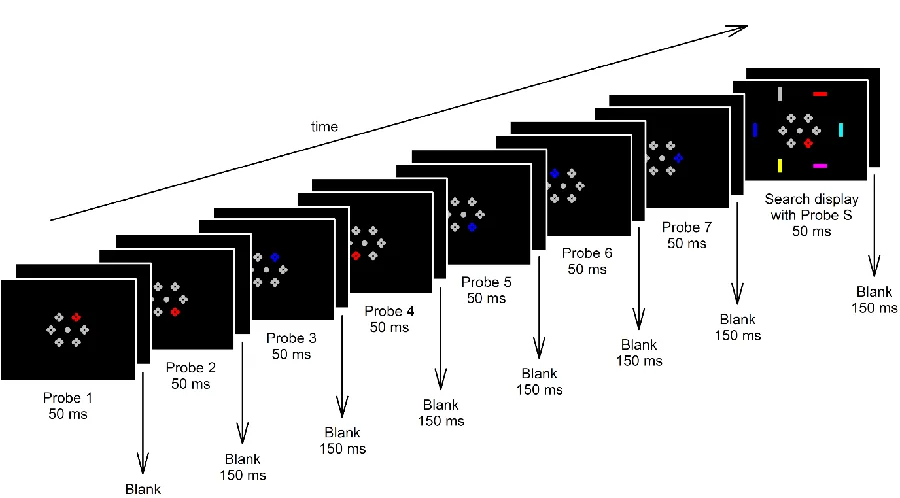
different locations closer to fixation (see Figure 1). Critically, half (Experiment 1) or all
(Experiments 2 and 3) probes appeared in the target colour, and thus matched the search
template. These target-colour probes should therefore attract attention when the search
template is activated (task-set contingent attentional capture; e.g., Folk et al., 1992), but not
when they appear at a time when the template is inactive. To measure probe-induced
attentional capture, we recorded EEG during task performance, and computed N2pc
components for probes at each temporal position between two successive search displays. The
N2pc is an enhanced negativity at posterior scalp electrodes contralateral to candidate target
objects that typically emerges 180-200 ms post-stimulus, is generated in ventral extrastriate
visual areas (Hopf et al., 2000), and reflects the rapid allocation of attention to candidate target
objects in multi-stimulus displays (e.g., Luck and Hillyard, 1994; Eimer, 1996; Woodman and
Luck, 1999; see Eimer, 2014, for review). Previous work has demonstrated close links between
6
they match current target features and also trigger behavioural capture effects (Eimer and Kiss,
2008; Lien, Ruthruff, Goodin, and Remington, 2008; Eimer, Kiss, Sauter, and Press, 2009). By
measuring N2pc components to each successive target-colour probe, we assessed which of
these probes captured attention, to track the temporal profile of template activation processes
and to determine whether search templates are activated in a sustained, reactive, or transient
fashion.
Materials and Methods
We conducted four experiments to track the temporal profile of template activation
processes. In Experiment 1, participants searched for a colour-defined bar in circular search
displays. This target bar appeared among five nontarget bars in five different colours to ensure
that a feature-specific attentional template (e.g., “red”) was required to find the target. For
each participant, the target colour remained constant for the entire experiment. The task was
to report the orientation of the target bar (horizontal or vertical). Throughout each
experimental block, circular displays that contained a colour singleton probe were flashed every
200 ms, and participants were told to ignore them. These probe displays appeared at a
different eccentricity (closer to fixation) than the target displays because pilot testing had
shown that presenting multiple rapidly flashing colour singleton probes at the same eccentricity
as the target displays was extremely distracting, and made it very difficult for observers to find
7
a different distractor colour were equally likely, and randomly intermixed. The interval between
two successive search displays was constant (1600 ms) and thus fully predictable. One probe
display appeared simultaneously with each search display (probe S), and seven others were
presented successively at 200 ms intervals between two search displays (probes 1-7). N2pc
components were measured independently for each of these probes, separately for
target-colour and distractor-target-colour probes. N2pcs were also computed for target objects in the search
displays. Target-colour probes that appear at a time when the search template for the target
colour is active should be able to capture attention and thus trigger N2pc components. The
critical question was when during the preparation for the next search episode these probe
N2pcs would emerge. If colour templates are activated in a sustained fashion until they are no
longer relevant, N2pcs should be triggered by all target-colour probes, regardless of their
temporal position. If these templates are only triggered reactively, probes that appear in the
interval between two search displays should not elicit any N2pc components. Finally, if search
templates are activated transiently, and in line with temporal expectations, probes that appear
in close temporal proximity to the predicted onset of the next search display (e.g., probe 7)
should elicit N2pc components, while no N2pc should be found for earlier probes (e.g., probes
presented shortly after the previous search display). Distractor-colour singleton probes were
included in Experiment 1 to confirm that any capture of attention by target-colour probes was
mediated exclusively by active colour templates, and not by the bottom-up salience of these
probes. If this was correct, distractor-colour probes should never trigger any N2pc components,
8
In Experiment 2, we investigated whether and how the selection and processing of the
target object in a search display would affect the subsequent activation of an attentional
template during preparation for the next search episode. Here, only half of all search displays
contained a target, while the other half included six nontarget-colour objects. All probe displays
now contained a target-colour probe, and N2pc components were computed separately for
probes that followed target-present and target-absent search displays. If the processing of a
search target on the previous trial influences template activation processes on the next trial,
the time course of N2pc components should differ between these two types of probes.
Experiment 3 investigated whether and how the time course of template activation
processes can be modulated by temporal expectations. In the first two experiments, the
interval between two successive search displays was always constant (1600 ms). In different
blocks of Experiment 3, this interval was either short (1000 ms, including four probes),
intermediate (1800 ms, eight probes), or long (2600 ms, twelve probes). If the moment when a
search template becomes active can be regulated in line with the expected time of arrival of the
next search display, template activation processes should start later when intervals between
search displays are longer, and this should be reflected by corresponding temporal differences
in the emergence of probe N2pc components. Another condition of Experiment 3 investigated
the time course of search template activation under conditions where the intervals between
successive search displays were no longer fixed and predictable, but varied randomly across
trials (1000 ms, 1400 ms, or 1800 ms).
Because singleton probes and targets always appeared at different locations (i.e.,
9
responses for targets at locations previously occupied by a colour-matching probe; Folk et al.,
1992) could be measured as additional markers of attentional capture by target-colour probes.
In Experiment 4, probe and search display items were presented at the same positions, so that
targets could appear at the same location that was previously occupied by a target-colour
probe on some trials. Seven probe displays were presented successively between two search
displays. To avoid the processing of search displays to be compromised by the preceding rapid
sequence of multiple target-colour singleton probes at possible search target locations, only
one of the probe displays (probe 2, 5, or 7) included a target-colour singleton on each trial.
Behavioural spatial cueing effects and N2pc components were measured separately for these
three probe positions. Target-colour probes presented in close temporal proximity to the next
search display (i.e., probe 7) were expected to elicit clear N2pc components and also trigger
reliable spatial cueing effects for target RTs. Such a link between behavioural and
electrophysiological markers of attentional capture would confirm that N2pcs to probe stimuli
were associated with the allocation of attention to these probes. In contrast, no behavioural
spatial cueing effects and no reliable N2pc components should be triggered by probes
presented early after the previous search display (i.e., probe 2).
Participants
Sixteen paid participants were tested in Experiment 1. One was excluded due to
exceedingly high error rates (more than 40%). Of the remaining 15 participants, aged between
25 and 42 years (mean age 31.4 years), eight were female and three were left-handed. The
10
different session on a different day. Eighteen different paid participants took part in Experiment
3. Three were excluded due to excessive eye movement activity, resulting in a loss of more than
50% of all data. The remaining fifteen participants were between 23 to 43 years of age (mean
age 31.8 years). Seven were female, three were left-handed. In Experiment 4, nine different
paid participants were tested. They were between 23 and 44 years of age (mean age 33.4
years). Seven were female, one was left-handed. All participants tested had normal or
corrected-to-normal vision and normal colour vision (tested with the Ishihara colour vision test;
Ishihara, 1972).
Stimuli and procedures
Participants were seated in an electrically shielded and dimly illuminated testing booth.
Visual stimuli were presented on a computer monitor at a viewing distance of 100 cm. In
Experiments 1 and 2, a 17-inch Samsung wide Syncmaster 753S CRT monitor (1280x1024 pixels
resolution, 100 Hz refresh rate) was used. Stimulus presentation, timing, and response
collection were controlled by a LG Pentium PC running under Windows XP, using the Cogent
2000 toolbox (RRID:SCR_015672; www.vislab.ucl.ac.uk/cogent_2000.php) for MATLAB
(RRID:SCR_001622; www.mathworks.com/products/matlab/). Experiments 3 and 4 were run in
a different laboratory than the first two experiments, using a 24-inch BenQ GL2450HE HD
monitor (1280x1024 pixels resolution, 100 Hz refresh rate) for stimulus presentation and a
corsair desktop computer with 3.3 GHz quad-core processor (running on Windows 7) for
stimulus presentation, timing, and response collection, using MATLAB and the Cogent 2000
11
Figure 1 shows the time course of stimulation in Experiment 1. Stimuli were presented
against a black background. A grey fixation point (CIE x,y colour coordinates: .287/.312; 0.2° x
0.2° of visual angle) was continuously presented throughout each experimental block. Each trial
contained eight consecutive displays which were presented for 50 ms and separated by a
stimulus onset asynchrony (SOA) of 200 ms. The interval between the offset of the eighth
display in a trial and the onset of the first display in the next trial was 150 ms, so that all
displays were shown in a continuous serial presentation stream within each block. Seven
successive displays contained probe displays (probes 1-7), and the eighth displays contained
both a probe display and a task-relevant search display at different eccentricities (simultaneous
target and probe: probe S). Because search displays were presented in every eighth display, the
SOA between two successive search displays was 1600 ms. Search displays contained six
differently coloured vertical or horizontal bars (each covering 0.2° x 0.6°) which were presented
at the 1, 3, 5, 7, 9, and 11 o’clock positions of an imaginary clock face at an eccentricity of 1.4°
from central fixation. The six bar orientations were independently and randomly selected in
each trial. Possible bar colours were red (.609/.327), green (.296/.581), blue (.174/.149), yellow
(.389/.512), cyan (.227/.376), magenta (.216/.110), and grey (.287/.312). All colours were
equiluminant (~10.9 cd/m2). Participants’ task was to report the orientation of the target-colour
bar (vertical, horizontal) by pressing the respective of two purpose-built vertically aligned
response keys. The response-to-key mapping and the hand-to-key mapping was
counterbalanced across participants but was kept constant for each participant for the duration
of the whole experiment. For each participant, one of three colours (red, blue, or green) served
12
chosen from the same set of three colours. Each of these three colours served as target or
distractor colour for five participants. Search displays always contained one target-colour bar,
one distractor-colour bar, and four bars in yellow, cyan, magenta, and grey.
All probe displays contained six items (0.25° x 0.25° per item) presented at the 1, 3, 5, 7,
9, and 11 o’clock positions of an imaginary clock face at an eccentricity of 0.5°. Each item in
these probe displays consisted of two closely aligned vertical and horizontal pairs of dots (0.1° x
0.1° per dot). In each probe display, one of the items was a colour singleton, the other five
items were uniformly grey (.287/.312). The coloured probe item either matched the target or
the distractor colour for each individual participant. The colour and location of a singleton
probe were selected independently for each probe display, with the exception that immediate
repetitions of colour probes at the same location were not allowed, and that successive probes
would equally likely appear on the same or opposite display sides across displays (to ensure
that each colour probe was preceded equally often by a target- or a distractor-colour probe on
the same or opposite display side). Participants were informed that probe displays were
task-irrelevant. Because target-colour singleton probes appeared in 50% of all probe displays, these
probes were predictive of the colour of the target (as in most contingent attentional capture
experiments; e.g., Folk et al., 1992). However, previous studies have shown that task-irrelevant
colour-matching items retain their ability to attract attention even when they appear among
other items in multiple different colours and are thus no longer uniquely predictive of the
current target colour (Lamy, Leber, and Egeth, 2004; Eimer et al., 2009).
Experiment 1 contained 40 blocks, with twelve trials per block. Blocks were short to
13
by seven additional probe displays to keep response conditions identical across all trials in a
block. Consequently, each block contained twelve search displays and 103 probe displays (13
for probes 1 to 7, and twelve for probe S, which was presented together with the search
display). Before the first experimental block, participants received two practice blocks.
In Experiment 2, the same stimuli and procedures were used, except for the fact that
there were no distractor-colour probes, as all probe displays contained a target-colour
singleton. The critical difference to Experiment 1 was that on half of all trials, a target-absent
search display was shown that contained six differently coloured nontarget bars but no
target-colour bar. On the other 50% of trials, a target-present search display appeared that was
identical to Experiment 1. Target-present and target-absent search displays were randomly
intermixed within each block. Participants’ task was to indicate the orientation of the
target-colour bar (vertical, horizontal) and to refrain from responding to target-absent displays. Red,
green, or blue served as target colour for five participants each. Experiment 2 contained 40
blocks, with twelve trials per block (six trials with target-absent and six with target-present
search displays).
In Experiment 3, the critical new manipulation concerned the interval between two
successive search displays. In different blocks, there were three constant (predictable) stimulus
onset asynchronies (SOAs) between successive search displays. These displays were separated
by SOAs of 1000 ms (with four intermediate probe displays), 1800 ms (with eight intermediate
probe displays), or 2600 ms (with twelve intermediate probe displays) in short, medium, and
long SOA blocks, respectively. In addition, there were also variable SOA blocks, with three
14
and eight intermediate probe displays, respectively) that varied randomly and unpredictably
between trials. Each of the three constant SOA conditions (short, medium, long) was tested in
20 successive blocks. The variable SOA condition was tested in 60 successive blocks. All blocks
included twelve trials. Eight participants were presented with the three constant SOA
conditions first (with order of SOA condition randomised between participants), the other
seven started with the variable SOA blocks. All probe displays in Experiment 3 contained a
target-colour singleton.
Experiment 4 contained 100 blocks, with 12 trials per block. Procedures were similar to
Experiment 1, with the following exceptions. All probe and search display items were now
presented at the same locations, at an eccentricity of 1.4° from central fixation. Seven probe
displays were presented in the interval between two search displays, and only one of them
(probe 2, 5, or 7) contained a target-colour singleton on each trial. The other six probe displays
contained six grey items. Trials with a target-colour singleton in probe 2, 5, or 7, were randomly
intermixed in each block. The location of these singleton probes was independent and thus not
predictive of the location of the target in the next search display. Target-colour probes and
target objects could only appear at the 1, 5, 7, and 11 o’clock positions and never at the 3 or 9
o’clock positions, so that the likelihood of a target being presented at the same location as a
target-colour probe was 25%.
The stimulus colours employed in Experiments 3 and 4 were the same as in Experiment
1 and 2, but due to the use of a different monitor, colour parameters were slightly different
(red: .635/.329, green: .291/.599, blue: .155/.086, yellow: .471/.458, cyan: .214/.308, magenta:
15
EEG recording
In all four experiments, EEG was DC-recorded from 27 scalp sites at standard positions
of the extended 10/20 system with a sampling rate of 500 Hz. It was digitally low-pass filtered
at 40 Hz with no other filters applied after data acquisition. Impedances were kept below 5 kΩ.
All channels were referenced to the left earlobe during recording and were re-referenced
offline to the average of both earlobes. Data from the first seven and the last seven probe
displays in each block, as well as trials with incorrect, anticipatory (faster than 200 ms), very
slow (slower than 1500 ms), or missing responses did not enter analysis. Furthermore, data
contaminated with artefacts (eye movements exceeding ±30 µV in the bipolar HEOG channel;
blinks exceeding ±60 µV at Fpz; muscular movements exceeding ±80 µV in all other channels)
were excluded from EEG analyses This led to the removal of 6.6% of all data (ranging between
0.3% and 20.5% across participants) in Experiment 1, 5.7% (ranging between 0.8% and 13.7%)
in Experiment 2, of 9.6% (ranging between 1.3% and 24.5%) in Experiment 3, and of 8.9%
(ranging between 3.3% and 23.4%) in Experiment 4. The remaining EEG was segmented into
500 ms time windows ranging from 100 ms prior to 400 ms after the onset of a particular
display. For colour probes, averages were computed for each of the probe displays presented
during the interval between two successive search displays (probes 1 to S, where probe 1 is the
probe that immediately followed the preceding search display, and probe S is the probe that
was presented simultaneously with the next search display). All EEG data processing was
16
Experimental design and statistical analyses
The experiments were designed to track the activation of target templates during the
preparation for an upcoming search display by measuring N2pc components to each of the
colour singleton probes that were presented at different times during the preparation interval.
N2pc components to probes were quantified on the basis of ERP mean amplitudes measured at
lateral posterior electrodes PO7 and PO8 contralateral and ipsilateral to the side of a probe
within an 80 ms time window starting at 190 ms after probe display onset. The start of this time
window was determined in Experiment 1 by measuring the point in time when the ascending
flank of the averaged probe N2pc (pooled across all eight target-colour probes in a trial)
reached 50% of the peak amplitude (at -0.26 µV). In Experiments 1 and 2, N2pcs were
computed for each of the eight successive probes on each trial (probes 1-7 and probe S),
separately for target-colour and distractor-colour probes (Experiment 1), or for probes that
appeared concurrently with or followed a target-present or a target-absent search display
(Experiment 2). In Experiment 3, probe N2pc components were computed separately for each
of the three constant (short, medium, long) and for variable SOA blocks. Since the different
SOAs were presented in an intermixed fashion in variable SOA blocks, and participants could
not know whether the next search display would appear after a short (four intermediate
probes), medium (six intermediate probes) or long interval (eight intermediate probes), ERPs
triggered in response to probes 1 to 4 were pooled across all three SOAs, and ERPs in response
to probes 5 and 6 were pooled across trials with medium and long SOAs. In Experiment 4, probe
N2pc components were computed separately for probes 2, 5, and 7. In addition, RTs to targets
17
displays were compared to RTs on trials where targets appeared at a different location than the
preceding target-colour singleton probe. In all four experiments, N2pc components were also
computed for target objects in the search displays, within the same 190-270 ms post-stimulus
time window used for the probe N2pc analyses.
The presence of reliable N2pc components in response to singleton probe items at
different temporal positions was assessed with repeated measures ANOVAs of ERP mean
amplitudes with the factors laterality (electrode contralateral or ipsilateral to the side of the
probe) and probe number (temporal position of the probe relative to the preceding search
display). In Experiment 1, the additional factor probe colour (target-colour or distractor-colour
probe) was included. Experiment 2 included the additional factor probe context (probes
following target-present or target-absent search displays). In Experiment 3, analyses included
the additional factor SOA condition (see Results of Experiment 3 for details). Whenever these
analyses revealed a significant interaction between laterality and probe number, planned
follow-up comparisons (paired t-tests) were conducted on contralateral and ipsilateral ERPs for
individual probes. Additional Bonferroni-corrected t-tests were conducted to compare N2pc
components for probes at different temporal positions. Effect sizes are reported in terms of
Cohen’s d (Cohen, 1988), with a confidence interval of 95%, for t-tests, and partial eta squared
(ηp2) for F-tests. All statistical analyses were performed with SPSS software (Version 22;
RRID:SCR_002865; www-01.ibm.com/software/uk/analytics/spss).
18
Experiment 1
Behavioural results: Mean correct reaction times (RTs) and error rates in response to search
targets in displays where they were accompanied by a target-colour or a distractor-colour
probe (523 versus 522 ms) and error rates for these two types of displays (3.5 versus 3.4%) did
not differ, both t(14) ≤ 0.7, p ≥ .482, d ≤ .05.
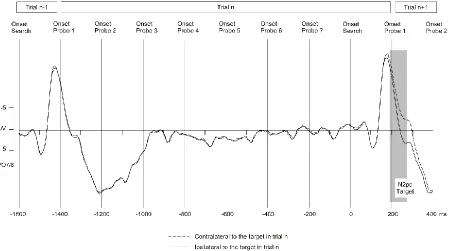
N2pc components: To illustrate the temporal pattern of ERPs to target and probe displays in this
RSVP task, Figure 2 shows grand-averaged ERPs across all trials for two successive search
displays and the seven probe displays that appeared in the interval between them. These
waveforms show ERPs at electrodes PO7/8 contralateral and ipsilateral to the target-colour bar
in the second search display. Search displays triggered large visual P1 and N1 components.
Much smaller P1/N1 components are also visible for each of the probe displays that were
presented during the interval between successive search displays. Clear N2pc components were
triggered contralateral to target objects in the search displays (comparison of contralateral
versus ipsilateral mean ERP amplitudes in the 190-270 ms interval after search display onset),
t(14) = 10.6, p < .001, d = .49.
Because the location of targets in a particular search display was independent of the
locations of the preceding colour probes or target location in the previous search displays, no
N2pc components to these items are visible in Figure 2. N2pcs to target-colour and
distractor-colour probes were extracted by computing ERPs at posterior sites PO7/8 contralateral and
19
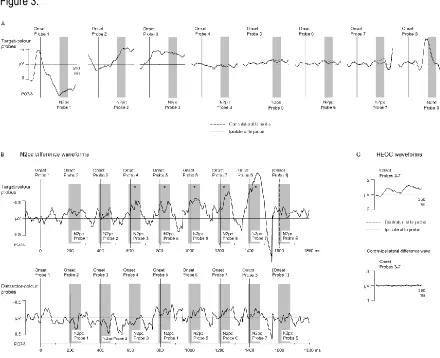
positions. The resulting ERP waveforms for target-colour probes are shown in Figure 3A for the
350 ms interval after the onset of a particular probe display, relative to a 100 ms pre-stimulus
baseline. To visualize the time course of probe N2pc components across the seven successive
probes between two search displays directly, Figure 3B shows continuous N2pc difference
waveforms (obtained by subtracting ipsi- from contralateral ERPs), separately for target-colour
and distractor-colour probes. To present these difference waves in a temporally continuous
fashion, Figure 3B shows 200 ms post-stimulus time segments for each probe, which
correspond to the 200 ms SOA between successive probes. For probe 1, difference waves are
shown from 100 ms before to 350 ms after probe onset. For all other probes (probe 2 to probe
S), Figure 3B shows the time interval from 150 ms to 350 ms after probe onset, interpolated
between adjacent data points from intervals obtained for two successive probes (resulting in
some positive-going offsets that can be seen in Figure 3B between adjacent probe intervals at a
latency of 150 ms relative to probe onset). The onset of each probe is marked with vertical
lines, and the N2pc time windows for each probe (190-270 ms post-stimulus) are indicated with
grey bars. Because probes were presented every 200 ms, the onset of each individual probe n
in Figure 3B occurs within the N2pc time interval for the preceding probe n-1.
Figure 3 shows that target-colour probes that appeared simultaneously with or
immediately after a search display (probes S, 1, and 2) did not elicit any N2pc components.
N2pcs emerged from probe 3 onwards, and were largest in size for probe 7, immediately before
the onset of the next search display. In contrast, no N2pcs appear to be present for any of the
distractor-colour probes. A similar temporal pattern of probe N2pc components was also found
20
on N2pc mean amplitudes to colour probes with the factors probe colour (target-colour,
distractor-colour), probe number (probes 1-7, probe S), and laterality (electrode ipsilateral,
contralateral to the side of the probe) obtained a main effect of laterality, F(1,14) = 9.0, p =
.009, ηp2= .39. Importantly, laterality interacted with probe colour, F(1,14) = 18.1, p = .001, ηp2=
.56, as well as with probe number, F(7,98) = 7.9, p < .001, ηp2 = .36, indicating that N2pc
components were larger for target-colour than for distractor-colour probes, and larger for later
as compared to earlier probes. There was also a three-way interaction, F(7,98) = 2.4, p = .029,
ηp2 = .14, reflecting differences in the time course of N2pc components between target-colour
and distractor-colour probes. To assess this, ANOVAs were conducted separately for both types
of probes. For distractor-colour probes, there was no effect of laterality, F(1,14) = 0.04, p =
.854, ηp2 < .01, and no interaction between laterality and probe number, F(7,98) = 1.6, p = .131,
ηp2= .11. This confirms that probes which did not match the target colour template did not
trigger N2pc components and thus did not capture attention at any point in time.
For target-colour probes, a main effect of laterality, F(1,14) = 16.6, p = .001, ηp2= .54,
was accompanied by an interaction between laterality and probe number, F(7,98) = 8.2, p <
.001, ηp2 = .37. Follow-up t-tests showed that the first two probes (Probes 1 and 2), as well as
Probe S, which was presented together with the search display, did not trigger reliable N2pcs,
all t(14) ≤ 1.5, p ≥ .154, d ≤ .05. All other probes (Probes 3 to 7) elicited significant N2pc
components, all t(14) ≥ 2.4, p ≤ .030, d ≥ .14, suggesting that the target colour template was
active from about one second prior to the start of the next search episode. As shown in Figure
3B, N2pc components to target-colour probes were largest for probe 7, just prior to the fully
21
t(14) = 3.8, p = .004, d = .92, whereas there were no reliable differences between N2pc
amplitudes between probes 3 and 4, 4 and 5, and 5 and 6, all t(14) ≤ 1.2, p ≥ .472, d ≤ .35. This
suggests that template activation states were not constant but changed in line with temporal
expectations. To rule out the possibility that the N2pcs elicited to probes 3 to 7 were
contaminated by eye movements towards these probes, horizontal EOG (HEOG) waveforms
obtained in the 350 ms interval after the onset of a particular target-colour probe display
(averaged across probes 3 to 7) were computed for EOG electrodes contralateral and ipsilateral
to the side of a target-colour singleton probe. These are shown in Figure 3C, together with the
corresponding contralateral/ipsilateral difference waveforms. Any tendency to move the eyes
towards the side of a target-colour probe would be reflected by an enhanced contralateral
negativity in these HEOG waveforms, but no such effect was found.
The absence of an N2pc for probe S is presumably due to competitive interactions with
the search target object, which itself triggered substantial N2pcs (Figure 2). The absence of
N2pcs to probes 1 and 2 that immediately followed the preceding search displays suggests that
template activation was not sustained, and that templates were briefly de-activated after each
search episode. However, it could also reflect a phenomenon similar to the attentional blink
(e.g., Raymond et al., 1992), that is, an impaired sensitivity of selective attention to
task-relevant information after a target has been encountered. As can be seen in Figure 2, probes 1
and 2 coincided with the target P3 component, which is linked to target-related identification
and response selection processes (e.g., Polich, 2007). The inability of these probes to capture
attention may thus not be due to a transient template de-activation, but to a sustained
22
should be triggered by all probe stimuli that follow search displays which do not contain a
target. This was tested in Experiment 2, where target-absent search displays containing six
nontarget-colour objects were presented on half of all trials, and probe N2pcs were computed
separately for probes that followed target-present and target-absent displays.
Experiment 2
Behavioural results: Mean correct RT on target-present trials was 561 ms, and error rate on
these trials was 4.6%. False alarms were present on 3.7% of all target-absent trials. The
inclusion of target-absent trials in Experiment 2 resulted in slower RTs relative to Experiment 1,
t(14) = 4.7, p < .001, d= .76, but error rates did not differ between these two experiments, t(14)
= 1.5, p = .148, d= .46.
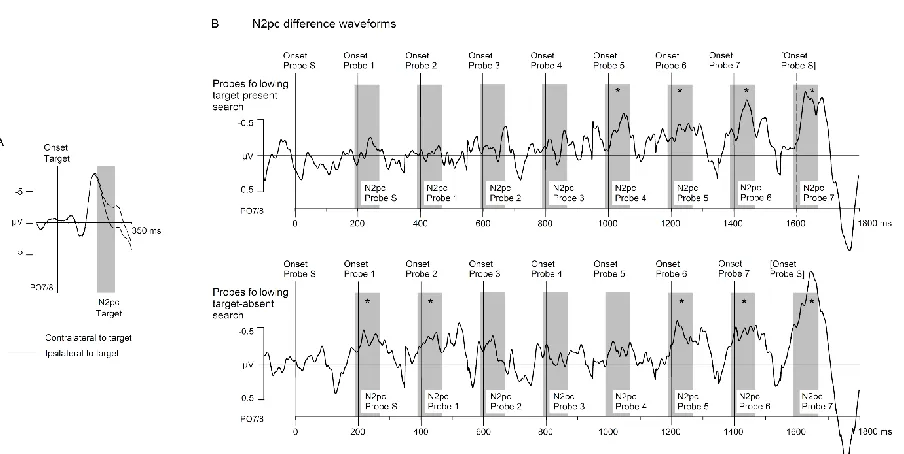
N2pc components: Figure 4A shows ERPs at posterior sites PO7/8 contralateral and ipsilateral to
the side of the target in target-present search displays. As expected, a clear N2pc was triggered
by targets, and a comparison of contralateral versus ipsilateral mean amplitudes obtained in
the 190-270 ms time window confirmed that this target N2pc was reliably present, t(14) = 8.2, p
< .001, d = .54. Figure 4B shows N2pc difference waveforms illustrating the time course of
probe N2pc components when these probes appeared concurrently (probe S) or after (probes
1-7) a target-present search display (top row) or a target-absent search display (bottom row).
These difference waves were generated and plotted in the same way as the N2pc difference
23
temporal pattern of N2pc components confirmed the results of Experiment 1 (except that
reliable probe N2pcs only emerged from probe 4 onwards). A different pattern was found for
probes that followed target-absent search displays. N2pc components were triggered by probes
that appeared simultaneously with or immediately after a target-absent display (probes S and
1), then disappeared for intermediate probes (probes 2-4), and re-emerged for probes that
preceded the subsequent search display (probes 5-7).
An ANOVA of mean N2pc amplitudes measured in the 190-270 ms post-probe time
window with the factors probe context (concurrent with/following a target-present versus
target-absent search display), probe number (probe S, probes 1 to 7), and laterality obtained a
main effect of laterality, F(1,14) = 13.9, p = .002, ηp2= .50, and an interaction between laterality
and probe number, F(7,98) = 10.8, p < .001, ηp2= .44, showing that probe N2pcs differed across
time. There was no interaction between laterality and probe context, F(1,14) = 2.8, p = .117, ηp2
= .17, but a three-way interaction between laterality, probe number, and probe context, F(7,98)
= 3.1, p = .005, ηp2= .18, indicating that the time course of probe N2pcs was different after
target-present and target-absent search displays. To assess this directly, we ran separate
ANOVAs with the factors probe context and laterality for probe N2pcs at each of the eight
temporal positions. Interactions between laterality and probe context were present for probe S,
F(1,14) = 8.6, p = .011, ηp2 = .38, and probe 1, F(1,14) = 6.5, p = .024, ηp2 = .32. As in Experiment
1, these two probes failed to elicit an N2pc with and after target-present search, both t(14) ≤
0.7, p ≥ .509, d≤ .03, but triggered reliable N2pcs in the context of target-absent displays (probe
S: t(14) = 3.1, p = .008, d= .09; probe 1: t(14) = 2.5, p = .024, d= .08). In other words, probes
24
display that included only distractors, but not when this display contained a competing
task-relevant target object. Critically, the N2pc results for probes 2 to 4 confirmed that target
templates are temporarily deactivated between two successive search episodes even when the
previous search display does not contain a target. Probes 2 and 3 did not trigger N2pcs in either
context. There were no effects of laterality, both F(1,14) ≤ 2.5, p ≥ .137, ηp2 ≤ .15, or interactions
with probe context, both F(1,14) ≤ 0.4, p ≥ .551, ηp2 ≤ .03. Probe 4 elicited reliable N2pcs only
after target-present, t(14) = 3.5, p = .003, d= .14, but not after target-absent search displays,
t(14) = 1.6, p = .130, d= .13, as confirmed by a significant laterality x probe context interaction,
F(1,14) = 5.7, p = .031, ηp2 = .29. In the final 600 ms prior to the onset of the next search display,
evidence for re-activated search templates was found following both absent and
target-present displays. For probes 5 and 6, there were significant main effects of laterality, both
F(1,14) ≥ 17.5, p ≤ .001, ηp2 ≥ .56, but no interactions with probe context, both F(1,14) ≤ 0.2, p ≥
.660, ηp2 < .01, demonstrating that these probes elicited reliable and equivalent N2pcs in both
contexts. Probe 7 also elicited reliable N2pcs in both contexts, both t(14) ≥ 3.7, p ≤ .002, d≥ .41,
which were larger following target-absent displays (interaction between laterality and probe
context), F(1,14) = 10.7, p = .006, ηp2 = .43.
Experiment 3
Behavioural results: RTs were faster and errors more frequent for shorter versus longer
constant SOAs (short: 533 ms, 5.5%; medium: 574 ms, 3.5%; long: 596 ms, 3.2%), with
25
differences were reflected by main effects of SOA condition for both RTs and error rates, both
F(3,42) ≥ 6.5, p ≤ .001, ηp2≥ .32.
N2pc components: Figure 5A shows target N2pc components (averaged across all four SOA
conditions). Reliable N2pcs were triggered by target objects in search displays in all SOA
conditions. A repeated-measures ANOVA on N2pc mean amplitudes revealed a main effect of
laterality, F(1,14) = 87.5, p < .001, ηp2 = .86, but no interaction between laterality and SOA
condition, F(3,42) = 2.2, p = .101, ηp2= .14, indicating that target N2pc amplitudes did not differ
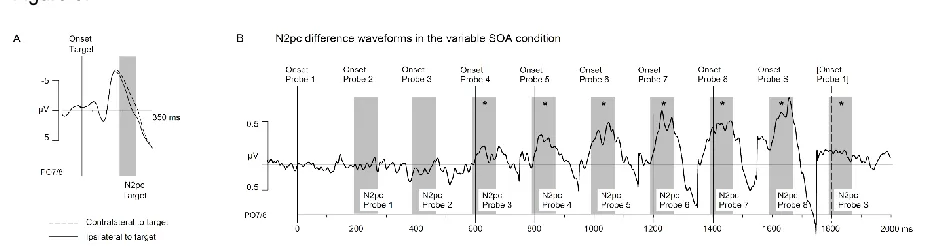
between blocks with different SOAs. Figure 5B shows contralateral-ipsilateral N2pc difference
waveforms illustrating the time course of probe N2pc components for the variable SOA
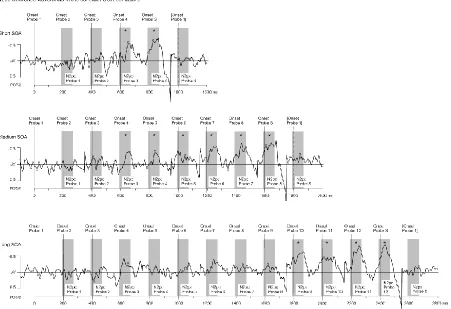
condition. Figure 6 shows the same probe N2pc difference waves for the three constant SOA
conditions. These continuous difference waves illustrate the time course of probe N2pcs during
the interval between two search displays in the same way as Figures 3B and 4B for Experiments
1 and 2, respectively.
The probe N2pcs found when two search displays were separated by a constant SOA of
1800 ms (medium SOA blocks) mirrored the results of Experiments 1 and 2, with probe N2pc
components emerging from probe 3 onwards, and increasing in amplitude towards the
expected arrival of the next search display. Reducing the SOA between two successive search
displays to 1000 ms did not result in an earlier emergence of probe N2pcs relative to medium
SOA blocks. The first two probes that immediately followed the preceding search display still
failed to trigger N2pc components. To confirm this statistically, an ANOVA compared N2pcs to
26
laterality, F(1,14) = 3.9, p = .068, ηp2 = .22, but an interaction between probe number and
laterality, F(3,42) = 7.7, p < .001, ηp2= .36, reflecting the absence of N2pcs for the earliest
probes and their presence for subsequent probes. Critically, there was no significant interaction
between SOA condition and laterality, F(1,14) = 2.7, p = .123, ηp2 = .16, and no three-way
interaction between SOA, probe number, and laterality, F(3,42) = 2.0, p = .133, ηp2 = .12,
suggesting this temporal pattern of probe N2pc components did not differ between blocks with
short and medium constant SOAs. Follow-up t-tests (pooled across these two SOA conditions)
confirmed that reliable N2pcs were triggered by probes 3 and 4, both t(14) ≥ 2.9, p ≤ .011, d≥
.07, but not by probes 1 and 2, both t(14) ≤ 1.3, p ≥ .218, d≤ .03.
In contrast, increasing the constant SOA to 2600 ms had a strong impact on the time
course of search template activation processes, reflected by a marked delay of probe N2pcs,
which only emerged from probe 9 onwards in long SOA blocks. This delay was statistically
assessed in an ANOVA that compared N2pcs to probes 5 to 8 in medium and long SOA blocks.
There was a main effect of laterality, F(1,14) = 16.6, p = .001, ηp2 = .54, and, critically an
interaction between SOA condition and laterality, F(1,14) = 18.8, p = .001, ηp2= .57. In medium
SOA blocks, probes 5 to 8 all triggered reliable N2pc components, all t(14) ≥ 2.2, p ≤ .045, d ≥
.14. In long SOA blocks, N2pcs to these probes were entirely absent, all t(14) ≤ 1.5, p ≥ .155, d ≤
.19. Here, only the four probes that preceded the next search display (probes 9 to 12) triggered
significant N2pcs, all t(14) ≥ 4.6, p < .001, d ≥ .35. This shows that search templates were
activated much later in long as compared to medium SOA blocks, in line with the objective
27
The temporal pattern of probe N2pcs in the variable SOA blocks was equivalent to the
pattern observed with a constant medium SOA (1800 ms). This was confirmed in an ANOVA
that compared N2pcs to probes 1 to 8 between these two types of blocks. A main effect of
laterality, F(1,14) = 17.4, p = .001, ηp2= .55, was accompanied by an interaction between probe
number and laterality, F(7,98) = 13.6, p < .001, ηp2= .49, reflecting larger N2pcs for later probes
and the absence of N2pcs for early probes. Critically, there was no interaction between SOA
condition, probe number, and laterality, F(7,98) = 1.1, p = .400, ηp2= .07, indicating that the
time course of template activation did not differ between blocks with constant and variable
SOAs. The same result was found in a second ANOVA that compared N2pcs to probes 1 to 4
between blocks with short constant SOAs (where the next search display always appeared after
probe 4) and blocks with variable SOAs (where search displays followed probe 4 only on one
third of all trials). A main effect of laterality, F(1,14) = 6.8, p = .021, ηp2= .33, was accompanied
by a probe number x laterality interaction, F(3,42) = 15.5, p < .001, ηp2= .53, reflecting the fact
that N2pcs were triggered by probes 3 and 4, but not by probes 1 and 2. Again, there was no
three-way interaction between SOA condition, probe number, and laterality, F(3,42) = 1.4, p =
.257, ηp2= .09, indicating that template activated processes were unaffected by whether or not
the onset of the next search display was fully predictable. Probes that appeared together with
search displays in variable SOA blocks elicited a very small N2pc (mean amplitude of probe S:
-0.16 µV; see Figure 5B) that was however significant, t(14) = 2.8, p = .013, d = .06. The absence
of a reliable N2pc to probe S in all other task conditions of the present study and the presence
28
attract attention in blocks where they coincide with a search display which could not be
precisely anticipated.
Experiment 4
Behavioural results: For RTs, the presence of spatial cueing effects indicative of attentional
capture was assessed in an ANOVA with the factors target location (same versus different as
the location previously occupied by a target-colour probe) and probe number (probe 2, probe
5, probe 7). There was a main effect of target location, F(1,8) = 22.7, p = .001, ηp2 = .74,
reflecting faster RTs for targets at the same location as the preceding colour singleton probe.
Importantly, this effect interacted with probe number, F(2,16) = 15.6, p < .001, ηp2 = .66. A
reliable spatial cueing effect was present on trials where the colour probe display appeared
immediately prior to the search display (probe 7), with faster RTs to targets at the same
location as the colour probe (558 ms) relative to targets at a different location (577 ms), t(8) =
8.1, p < .001, d = .30. No such spatial cueing effects were found for trials where the colour
singleton appeared in probe display 2 (567 ms versus 571 ms), t(8) = 1.4, p = .187, d = .06, or in
probe display 5 (572 ms versus 570 ms), t(8) = 1.0, p = .368, d = .03. There was no main effect of
probe number on RTs, F(2,16) = 0.6, p = .561, ηp2= .07. Error rate was 3.3% in Experiment 4.
There was no effect of target location, F(1,8) = 3.7, p = .090, ηp2 = .32, and no interaction
between target location and probe number, or main effect of probe number for error rates,
29
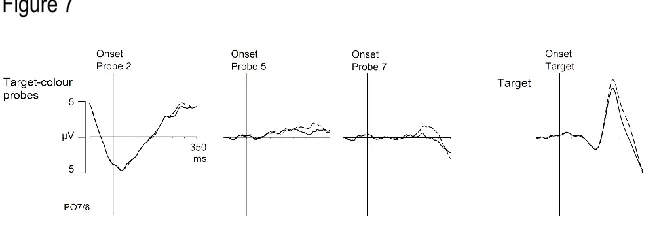
N2pc components: Figure 7 shows ERPs at posterior sites PO7/8 contralateral and ipsilateral to
the side of a target-colour singleton in probe displays 2, 5, and 7, together with ERPs triggered
contralateral and ipsilateral to the target in the search displays (right panel). The probe N2pc
results were very similar to those observed in the previous experiments, with a clear N2pc for
probe 7, a smaller N2pc for probe 5, and little lateralised activity in the N2pc time range for
probe 2. This was confirmed in an ANOVA of mean N2pc amplitudes measured in the 190-270
ms post-probe time window with the factors probe number (probe 2, probe 5, probe 7), and
laterality. There was a main effect of laterality, F(1,8) = 15.7, p = .004, ηp2= .66, and, critically,
an interaction between laterality and probe number, F(2,16) = 14.9, p < .001, ηp2= .65.
Follow-up t-tests revealed a significant N2pc for probes presented immediately prior to a search
display (probe 7), t(8) = 4.5, p = .002, d = .58, which also triggered behavioural spatial cueing
effects indicative of attentional capture. No significant N2pc was present for probe 2, t(8) = 1.6,
p = .154, d = .04. For probe 5, a small but reliable N2pc was observed, t(8) = 4.0, p = .004, d =
.39, confirming similar observations from Experiments 1 to 3, and suggesting that these probes
were able to capture attention. The absence of spatial cueing effects for these probes suggests
that this attentional capture was relatively short-lived, and thus no longer affected RTs when
search display targets appeared 600 ms later, and after the presentation of two additional
uniformly grey probe displays at positions 6 and 7 (see also Fukuda & Vogel, 2010, for evidence
that the recovery time from contingent attentional capture is typically 150-300 ms). As
expected, target objects in search displays elicited reliable N2pc components, t(8) = 7.1, p <
30
Discussion
We employed a new rapid serial probe presentation procedure and recorded
electrophysiological markers of attentional capture to investigate the time course of target
template activation processes in visual search. Participants searched for colour-defined target
objects and ignored colour singleton probe displays that were flashed every 200 ms. To
determine when a colour-specific target template was active, N2pc components to
template-matching probes were measured at successive time points between two search displays.
Experiment 1 showed that probes matching the current target colour template triggered N2pcs
whereas non-matching probes did not, demonstrating that the ability of these probes to
capture attention was mediated by the current target template (see also Folk et al., 1992; Eimer
and Kiss, 2008). Target-colour probes presented well ahead of the next search episode elicited
N2pc components, demonstrating that attentional templates were activated in a preparatory
fashion, and were not triggered purely reactively by the arrival of a search display. The
observation that N2pcs were typically triggered from probe 3 onwards shows that search
templates are activated as early as 1000 ms prior before the next search display is expected to
appear.
Results also demonstrate that template activation states are not maintained in a
sustained fashion between and across successive search episodes. In all experiments, N2pcs
were absent for the earliest probes, increased in amplitude towards the end of the interval
31
to the next search display. Experiment 4 demonstrated that the presence of large N2pcs for late
probes and the absence of N2pcs for early probes was associated with the presence versus
absence of behavioural spatial cueing effects indicative of attentional capture. These
observations suggest that the target template activation states vary across time, with higher
activation levels when the next search episode is imminent. Alternatively, the increase of probe
N2pc amplitudes at the end of the preparation period could reflect temporal variability in the
start of template activation processes between trials. In this case, the target template would
have been active on only a subset of all trials during the period when probes 3 to 6 were
presented, but on virtually all trials when the probe that preceded a search display appeared.
Because probe N2pcs were computed by averaging across many individual trials, this would
result in larger N2pcs for later probes. Both interpretations imply that the activation of search
templates is not constant, but changes rapidly when observers prepare for the next search
episode. The absence of N2pcs to probes that appeared simultaneously with or shortly after a
search display is most likely due to competition with concurrent target objects preventing these
probes from attracting attention. This was shown in Experiment 2, where reliable N2pcs were
triggered by probes that were presented together with or immediately after a target-absent
search display, suggesting that search templates remain active for a brief period after a search
display has been encountered. However, the absence of N2pcs for probes that followed
target-absent displays at intermediate latencies in this experiment shows that search templates were
still temporarily de-activated even when the preceding search episode did not include a target
32
The clearest evidence for rapid changes in the activation states of search templates, and
for the ability of observers to control these changes strategically in line with temporal
expectations, was provided in Experiment 3. Here, probe N2pcs emerged much later during the
interval between two search displays when this interval was known to be long (2600 ms) than
when it was shorter (1800 ms). With long intervals, probes that appeared during the initial 1600
ms interval after the previous search display did not elicit any N2pcs, demonstrating that target
templates were inactive in this period. The absence of an active search template during this
period cannot be due to ongoing target processing from the previous search episode, and thus
is likely to reflect a strategic and presumably voluntary postponement of preparatory template
activation processes during time periods where this template is not needed. The absence of
N2pcs to some probes in Experiment 1 and 2 could in principle have been due to the fact that
probes were presented at task-irrelevant locations (i.e., outside the focus of spatial attention),
resulting in a general attenuation of N2pc amplitudes, making it more difficult to detect the
effects of sustained template activation for each probed time point. However, this explanation
is very unlikely to account for the observation that probe N2pcs were consistently absent for
the first eight successive probes in the long SOA condition of Experiment 3. In the variable SOA
blocks of Experiment 3, the temporal pattern of probe N2pcs did not differ from a condition
where the next search display was known to appear after a short interval. This suggests that
when intervals between two search episodes were not predictable, participants always
prepared for the earliest possible arrival time of the next target.
The transient nature of template activation states revealed by the current results is not
33
suggest that working memory representations in matching-to-sample tasks are typically
sustained for extended periods. However, the representations activated in such tasks may
differ from attentional templates that control target selection in visual search tasks. Also, and in
contrast to EEG-based measures, the poor temporal resolution of fMRI signals limits their ability
to track template activation processes in a temporally precise fashion. Evidence for transient
template activation processes was provided in a recent eye tracking study by Olmos-Solis et al.
(2017). These authors found that microsaccades elicited during the preparation for a search
task with colour-defined targets were biased towards task-irrelevant distractor objects that
matched the target colour, and that these biases were sensitive to observers’ expectations
about when the next search display would appear.
It has previously been suggested that in tasks where observers search for the same
target object for extended periods, target templates are only held in working memory for a
brief time, and are then transferred to a different longer-term memory store where they are
retained in a stable fashion without the involvement of active attentional maintenance
processes (Woodman et al., 2007; Carlisle et al., 2011). Such a transfer of search templates to
long-term memory could also have occurred in the present experiments, where participants
always searched for the same colour-defined target object throughout the entire experimental
session. However, the time course of template activation observed here suggests otherwise.
The transient pattern of template activation and de-activation processes before and after
individual search episodes, and the sensitivity of these processes to temporal expectations
indicate that target templates were controlled by top-down attentional mechanisms that
34
current task requirements. Because such characteristics are generally associated with
maintaining and processing information in working memory, it appears implausible to assume
that target templates were held in a different more permanent long-term memory store.
This raises the general question why observers would choose to switch search templates
on and off across successive search episodes in a task where the same colour remained
task-relevant throughout. Under these circumstances, automatizing colour-based target selection by
maintaining a stable colour template in long-term memory would presumably be less
demanding than exerting continuous top-down control over template activation processes in
working memory. To resolve this puzzle, it may be important to take account of the fact that
target templates play two roles in the control of visual search. During an early stage of visual
processing, these templates guide attention towards objects with template-matching features,
thus increasing the probability that these objects will be selected for further analysis. During a
later object identification stage, selected objects are compared to the currently active target
template, to determine their target or nontarget status (see Cunningham and Wolfe, 2014). It is
possible that the termination of each memory matching process results in the de-activation of
the target template involved in this process, which would render it unavailable for subsequent
attentional guidance processes (see Grubert et al., 2017, for additional electrophysiological
evidence for rapid template deactivation). In this case, this template would have to be
re-activated by top-down control mechanisms during the preparation for the next search episode.
The fact that memory matching processes are typically terminated later when no target is
35
template de-activation and re-activation processes were both delayed following target-absent
as compared to target-present search displays.
In summary, the current study has provided new insights into the time course of
template activation processes in visual search. Search templates are not triggered reactively by
the arrival of a search display, but are activated proactively, and can already be on-line from
about 1000 ms prior to the next search episode. Template activation states are not maintained
in a sustained fashion, but change rapidly across time, and these changes are regulated by
36
References
Carlisle NB, Arita JT, Pardo D, Woodman GF (2011) Attentional templates in visual working
memory. J Neurosci 31:9315-9322.
Chun MM, Wolfe JM (1996) Just say no: How are visual searches terminated when there is no
target present? Cogn Psychol 30:39-78.
Cohen J (1988) Statistical power analysis for the behavioral sciences. Hillsdale, NJ: Lawrence
Earlbaum Associates.
Cunningham CA, Wolfe JM (2014) The role of object categories in hybrid visual and memory
search. J Exp Psychol Gen 143:1585-1599.
Desimone R, Duncan J (1995) Neural mechanisms of selective visual attention. Annu Rev
Neurosci 18:193-222.
Duncan J, Humphreys GW (1989) Visual search and stimulus similarity. Psychol Rev 96:433-458.
Eimer M (1996) The N2pc component as an indicator of attentional selectivity.
37
Eimer M (2014) The neural basis of attentional control in visual search. Trends Cogn Sci 18:
526-535.
Eimer M, Kiss M (2008) Involuntary attentional capture is determined by task set: Evidence
from event-related brain potentials. J Cogn Neurosci 20:1423-1433.
Eimer M, Kiss M, Press C, Sauter D (2009) The roles of feature-specific task set and bottom-up
salience in attentional capture: An ERP study. J Exp Psychol Hum Percept Perform 35:
1316-1328.
Folk CL, Remington RW, Johnston JC (1992) Involuntary covert orienting is contingent on
attentional control settings. J Exp Psychol Hum Percept Perform 18:1030-1044.
Fukuda K, Vogel, EK (2011). Individual differences in recovery time from attentional
capture. Psychological Science, 22:361-368.
Grubert A, Fahrenfort J, Olivers CNL, Eimer M (2017) Rapid top-down control over
template-guided attention shifts to multiple objects. Neuroimage 146:843-858.
Hopf JM, Luck SJ, Girelli M, Hagner T, Mangun GR, Scheich H, Heinze HJ (2000) Neural sources
38
Ishihara S (1972) Tests for color-blindness. Tokyo: Kanehara Shuppan.
Lamy D, Leber A, Egeth, HE (2004) Effects of task relevance and stimulus-driven salience in
feature-search mode. J Exp Psychol Hum Percept Perform 30: 1019-1031.
Lewis-Peacock JA, Drysdale AT, Postle BR (2014) Neural evidence for the flexible control of
mental representations. Cereb Cortex 25:3303-3313.
Lien MC, Ruthruff E, Goodin Z, Remington RW (2008) Contingent attentional capture by
top-down control settings: Converging evidence from event-related potentials. J Exp Psychol Hum
Percept Perform 34: 509-530.
Luck SJ, Hillyard SA (1994) Spatial filtering during visual search: Evidence from human
electrophysiology. J Exp Psychol Hum Percept Perform 20:1000-1014.
Olivers CNL, Peters J, Houtkamp R, Roelfsema PR (2011) Different states in visual working
memory: when it guides attention and when it does not. Trends Cogn Sci 15:327-334.
Olmos-Solis K, van Loon AM, Los SA, Olivers CNL (2017) Oculomotor measures reveal the
39
Polich J (2007) Updating P300: An integrative theory of P3a and P3b. Clin Neurophysiol
118:2128-2148.
Raymond JE, Shapiro KL, Arnell KM (1992) Temporary suppression of visual processing in an
RSVP task: An attentional blink? J Exp Psychol Hum Percept Perform 18:849-860.
Wolfe JM, Horowitz TS (2004) What attributes guide the deployment of visual attention and
how do they do it? Nat Rev Neurosci 5:495-501.
Woodman GF, Luck SJ (1999) Electrophysiological measurement of rapid shifts of attention
during visual search. Nature 400:867-869.
Woodman GF, Luck SJ, Schall JD (2007) The role of working memory representations in the