Nuclear structure of superheavy nuclei – state of the art and
per-spectives (@ S
3)
DieterAckermann1, 1GANIL, 14076 Caen, France
Abstract. Decay spectroscopy is a powerful tool to study the low lying nuclear structure
of heavy and superheavy nuclei (SHN). Single particle levels and other structure fea-tures likeKisomerism, being important in the fermium-nobelium region as well as for the spherical shell stabilized SHN, can be investigated. The new separator-spectrometer combination S3, presently under construction at the new SPIRAL2 facility of GANIL,
Caen, France, together with the high intensity beams of SPIRAL2’s superconducting linear accelerator (SC LINAC), will offer exciting perspectives for a wide spectrum of
nuclear and atomic physics topics. The installation is designed to employ nuclear physics methods like decay spectroscopy after separation or atomic physics methods like laser spectroscopy and mass measurements. The nuclear physics studies will include particle and photon correlation studies, attacking the open questions in the field, which have been revealed in earlier studies at facilities like e.g. GSI in Darmstadt, Germany, with the velocity filter SHIP and the gas-filled separator TASCA, the cyclotron accelerator lab-oratory of the University of Jyväskylä, Finland, with RITU and its numerous auxiliary detection set-ups, and FLNR/JINR in Dubna with the DGFRS and VASSILISSA/SHELS
separators.
1 Introduction
Heavy nuclear systems in the region of the chart of nuclides starting at fermium and extending to-wards the predicted area of shell stabilized superheavy nuclei (SHN) owe their existence to quantum mechanical effects only. A liquid drop of a system with more than 100-104 protons becomes unstable against fission mainly due to the repulsive Coulomb force created by the high density of the many positive charges in the limited volume of the nucleus. Quantum mechanic features, often referred to as shell effects and taken into account as shell corrections in so called microscopic-macroscopic models (see e.g. [1]), lead to a modification of the nuclear potential which is the basis for the exten-sion of the chart of Segré to highZ andA. This makes these nuclei, in turn, to an ideal laboratory to study in detail the quantum mechanic nature of the strong nuclear interaction which is responsi-ble for this. The experimental tools for their investigation are traditionally decay spectroscopy after separation (DSAS) and since the end of the last millennium more and more in-beam spectroscopy, made possibly by major advances in detection technology and signal processing by so called digital electronics [2].
While in-beam nuclear structure studies will not be discussed here, some recent achievements obtained by DSAS revealing the low lying nuclear structure of heavy and SHN will be discussed in section 2, K isomerism occurring for the heaviest deformed nuclear species will be the subject of section 3, and an outlook will be given in section 4, showing the perspectives offered by the progress in the development of existing instrumentation and by the advent of new installations presently under construction like the Superconducting Separator Spectrometer S3at SPIRAL2/GANIL.
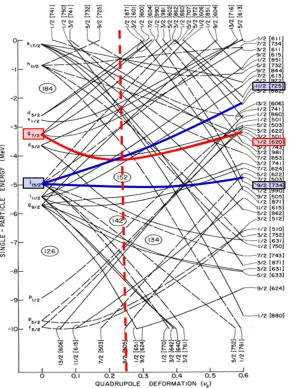
Figure 1.Neutron single particle energies as a function of quadrupole deformation from a momentum-dependent
While in-beam nuclear structure studies will not be discussed here, some recent achievements obtained by DSAS revealing the low lying nuclear structure of heavy and SHN will be discussed in section 2, K isomerism occurring for the heaviest deformed nuclear species will be the subject of section 3, and an outlook will be given in section 4, showing the perspectives offered by the progress in the development of existing instrumentation and by the advent of new installations presently under construction like the Superconducting Separator Spectrometer S3at SPIRAL2/GANIL.
Figure 1.Neutron single particle energies as a function of quadrupole deformation from a momentum-dependent
Woods-Saxon model by R.R. Chasman et al. [3]; figure was taken from there and adopted as in reference [2].
2 Systematic study of nuclear structure features
In a special issue of Nuclear Physics A in 2015, volume 944, all major topics concerning the field of superheavy element (SHE) research have recently been reviewed. Asai and collaborators [4] sum-marized the recent achievements of DSAS for isotonic chains in the vicinity of the closed neutron subshellN=152 in a region ranging form fermium to meitnerium. In particular, the N=151 and 153 isotones with one hole in and one particle more than the subshell closure, respectively, are well suited to trace single particle levels which are important for the predicted spherical shell gaps. This can be seen in the Nilsson diagram in figure 1.
243Es (23±3)s
δ 52,1 + Δ <100 + Δ 209.6 + Δ
(7/2+[633]) (3/2-[521]) 9/2+ 1/2-[521] 7/2-[514]
247Md(1.3±0.1)s
±
±
247mMd(0.25±0.04)s
<264 + δ + Δ
(7/2-[514]) 1/2-[521]
878 3
SF (21.5±5)%
245Es (1.1±0.1)m
δ 52.8 + Δ 253.2 + Δ
(7/2+[633]) (3/2-[521]) 9/2+ 7/2-[514]
249Md(21.7±0.2)s
± (7/2-[514]) 1/2-[521] 841 6 802 6
253Lr(7/2-[514])(0.57+0.07-0.06)s
(1/2-[521])
9/2+(?)
257Db(2.3±0.2)s
(9/2+[624]) (1/2-[521])
247Es (4.7±0.3)m
51.0 + Δ 293.7 + Δ
(7/2+[633]) (3/2-[521]) 9/2+(?) 7/2-[514]
251Md(4.0±0.5)m
±
(7/2-[514]) (1/2-[521])
755 0
255Lr(31.1±1.1)s
(7/2-[514]) (1/2-[521])
259Db(0.51±0.16)s
(9/2+[624])
249Es (102.2±0.6)m
353,2 + Δ
(7/2+[633]) 7/2-[514]
253Md(6+13-3)m
±
(7/2-[514]) (1/2-([521])
710 3
257Lr(7/2-[514])4s 261Db(1.8±0.4)s
(9/2+[624])
251Es (33±1)h
55.8 461.4 (7/2+[633]) (3/2-[521]) 9/2+ 7/2-[514]
255Md(27±2)m
±
(7/2-[514])
727 4
259Lr(7/2-[514])(6.2±0.3)s 263Db(27+10-7)s
(9/2+[624])
253mLr(1.49+0.30-0.21)s
879 4 872 2 916 3 907 4 896 7 55 37+ 135 (11/2-)
842 0 836 5 37 845 7 842 0-y
255mLr2.54±0.05s
947 4
49.0 + Δ 9/2+(?) 881 1 887 8 993 0 732 7 8.3 523
9/2-253Es 24.7d
46.3 371.4 (7/2+[633]) (3/2-[521]) 9/2+ 7/2-[514] ± 9/2-844 5 936 0 434.8
257Md(5.52±0.05)h
(7/2-[514])
732 7 (1/2-[521])
Figure 2. Decay scheme for odd-Z isotopes from einsteinium to dubnium in the vicinity of theN=152 closed
shell. For the origin of the data see references in [2]. For the ground state (g.s.) assignment for243Es, the
presentation of Antalic et al. has been chosen who propose two possible scenarios [5]. For the shown case with theπ7/2+[633] Nilsson level being the g.s,δwould be the excitation energy of theπ3/2−[521] level and∆=0.
For the opposite assignment∆would be the excitation energy of theπ7/2+[633] state. For the other einsteinium
g.s. assignments the representation of [6] has been adopted here. Insert (top left): Comparison of the energy differences of the lowest levels in the isotopes243Es to253Es (see main part of this figure 2) with quadrupole and
hexadecapole deformation obtained by a macroscopic-microscopic model calculation [7]. See also Heßberger et al. [8]. (Figures and captions are taken from reference [2])
microscopic-Table 1.Update of the table of knownK-isomers in even-even nuclei in heavy and SHN from [10] as given in [11]. (Table and caption are taken from reference [2])
nucleus Kπ T
1/2 Ex detected decay configuration reference
244Cm 6+ 34 ms 1.040 MeV γ 5/2+[622]
ν⊗7/2+[624]ν [12, 13]
246Cm 8− - 1.179 MeV γ 7/2+[624]
ν⊗9/2−[734]ν [14]
248Fm (6∗) 8 ms - γ [15, 16]
250Fm 8− 1.92 s 1.195 MeV γ 7/2+[624]
ν⊗9/2−[734]ν [17]
256Fm 7− 70 ns 1.425 MeV γ,SF 7/2+[633]
π⊗7/2−[514]π [18]
250No (6+) 42µs - SF,γ? (5/2+[622]
ν⊗7/2+[624]ν) [19]
252No 8− 110 ms 1.254 MeV γ 7/2+[624]
ν⊗9/2−[734]ν [20]
254No 8− 266 ms 1.293 MeV γ 7/2−[514]
π⊗9/2+[624]π [21, 22]
8− 263 ms 1.297 MeV γ 9/2−[734]
ν⊗11/2−[725]ν [23]
254No - 184µs 2.5 MeV γ - [21, 22]
- 184µs 2.928 MeV γ - [23]
254Rf 6,7 5µs ? MeV IC1 2-quasiparticle [24]
254Rf 6,7 240µs ? MeV IC1 4-quasiparticle [24]
256Rf 6,7 25µs 1.12 MeV IC1 - [25]
256Rf 10+ 17µs 1.4 MeV IC1 (9/2−[734]
ν⊗11/2−[725]ν) [25]
256Rf - 27µs 2.2 MeV IC1 - [25]
266Hs - 74 ms 1.2 MeV α - [11, 26]
270Ds 9−,10− 6 ms 1.13 MeV α 11/2−[725]ν⊗7/2+[613]
ν [11, 27, 28]
11/2−[725]ν⊗9/2+[615]
ν 1detection by electrons from internal conversion
from the g7/2 shell and crossing the latter at the same deformation, forms the g.s. of the N=153 isotones for the same elemental range (see figure 9 in reference [4]). Whereas the 11/2−[725] SPL has been experimentally determined for theN=153 isotones, it was seen for theN=151 isotones up to now only for255Rf. The 1/2+[620] SPL was measured only for the lighterN=151 isotones up to
251Fm, making the observation of both SPLs in253No a key issue for the determination of their
pos-sible crossing, and hence the confirmation of this peculiar behaviour predicted by theory on the same grounds as the prediction of the neutron shell closure for the spherical SHN atN=184. In a recent DSAS attempt studying levels populated byαdecay of257Rf, only the population of the 7/2−[743] SPL in253No could be established, in a short run at the velocity filter SHIP at GSI [9].
Apart from α decay, 257Rf has an EC decay branch into 257Lr with branching ratios bEC of
0.094±0.014 and 0.115±0.015 for the g.s. and the isomer decay, respectively [9]. The subsequent
αdecay then populates the g.s. and excited states in253Md, providing access to the low lying
struc-ture of this odd-Zeven-Aisotope. This data is shown together with the at present known experimental nuclear structure information from DSAS of odd-Z odd-Aisotopes in the region from einsteinium to dubnium in figure 2 [2]. An interesting feature here was pointed out by Heßberger et al. [8] with the consistent behaviour of the energy difference for the two SPLs 7/2−[514] and 7/2+[633] in einsteinium isotopes and the g.s. deformation of these nuclei, predicted by the microscopic-macroscopic model calculations by Parkhomenko and Sobiczewski [7] (insert in figure 2).
3
K
isomerism in heavy and superheavy nuclei
Table 1.Update of the table of knownK-isomers in even-even nuclei in heavy and SHN from [10] as given in [11]. (Table and caption are taken from reference [2])
nucleus Kπ T
1/2 Ex detected decay configuration reference
244Cm 6+ 34 ms 1.040 MeV γ 5/2+[622]
ν⊗7/2+[624]ν [12, 13]
246Cm 8− - 1.179 MeV γ 7/2+[624]
ν⊗9/2−[734]ν [14]
248Fm (6∗) 8 ms - γ [15, 16]
250Fm 8− 1.92 s 1.195 MeV γ 7/2+[624]
ν⊗9/2−[734]ν [17]
256Fm 7− 70 ns 1.425 MeV γ,SF 7/2+[633]
π⊗7/2−[514]π [18]
250No (6+) 42µs - SF,γ? (5/2+[622]
ν⊗7/2+[624]ν) [19]
252No 8− 110 ms 1.254 MeV γ 7/2+[624]
ν⊗9/2−[734]ν [20]
254No 8− 266 ms 1.293 MeV γ 7/2−[514]
π⊗9/2+[624]π [21, 22]
8− 263 ms 1.297 MeV γ 9/2−[734]
ν⊗11/2−[725]ν [23]
254No - 184µs 2.5 MeV γ - [21, 22]
- 184µs 2.928 MeV γ - [23]
254Rf 6,7 5µs ? MeV IC1 2-quasiparticle [24]
254Rf 6,7 240µs ? MeV IC1 4-quasiparticle [24]
256Rf 6,7 25µs 1.12 MeV IC1 - [25]
256Rf 10+ 17µs 1.4 MeV IC1 (9/2−[734]
ν⊗11/2−[725]ν) [25]
256Rf - 27µs 2.2 MeV IC1 - [25]
266Hs - 74 ms 1.2 MeV α - [11, 26]
270Ds 9−,10− 6 ms 1.13 MeV α 11/2−[725]ν⊗7/2+[613]
ν [11, 27, 28]
11/2−[725]ν⊗9/2+[615]
ν 1detection by electrons from internal conversion
from the g7/2 shell and crossing the latter at the same deformation, forms the g.s. of the N=153 isotones for the same elemental range (see figure 9 in reference [4]). Whereas the 11/2−[725] SPL has been experimentally determined for theN=153 isotones, it was seen for theN=151 isotones up to now only for255Rf. The 1/2+[620] SPL was measured only for the lighter N=151 isotones up to
251Fm, making the observation of both SPLs in253No a key issue for the determination of their
pos-sible crossing, and hence the confirmation of this peculiar behaviour predicted by theory on the same grounds as the prediction of the neutron shell closure for the spherical SHN atN=184. In a recent DSAS attempt studying levels populated byαdecay of257Rf, only the population of the 7/2−[743] SPL in253No could be established, in a short run at the velocity filter SHIP at GSI [9].
Apart from α decay, 257Rf has an EC decay branch into 257Lr with branching ratios bEC of
0.094±0.014 and 0.115±0.015 for the g.s. and the isomer decay, respectively [9]. The subsequent
αdecay then populates the g.s. and excited states in253Md, providing access to the low lying
struc-ture of this odd-Zeven-Aisotope. This data is shown together with the at present known experimental nuclear structure information from DSAS of odd-Z odd-Aisotopes in the region from einsteinium to dubnium in figure 2 [2]. An interesting feature here was pointed out by Heßberger et al. [8] with the consistent behaviour of the energy difference for the two SPLs 7/2−[514] and 7/2+[633] in einsteinium isotopes and the g.s. deformation of these nuclei, predicted by the microscopic-macroscopic model calculations by Parkhomenko and Sobiczewski [7] (insert in figure 2).
3
K
isomerism in heavy and superheavy nuclei
TheKquantum number is defined by the projection of the total spin, i.e. the sum of the nuclear spin
Table 2.Beam intensities expected for the SC LINAC of SPIRAL2, taken from [31].
ion intensity [pµA] intensity [pµA]
A/Q=3 A/Q=6 or 7
16O 216 375 19F 57 50 36Ar 35 40 40Ar 5.8 30 48Ca 2.5 15 58Ni 2.2 10 84Kr 0 20 124Sn 0 10 139Xe 0 10 238U 0 2.5
in angular momentum and possibly parity of the isomeric state and the next available state into which the isomer can decay. Such isomeric states have been predicted for the whole region of deformed heavy and superheavy nuclei [29].
The heaviest nucleus for which such an isomeric state has been observed is270Ds [27]. Recently
such a state has been reported also for itsα decay daughter 266Hs [11, 26]. For both nuclei the
isomeric state is longer lived than the g.s., a feature which is rarely occurring in atomic nuclei. As the necessary precondition for the formation ofKisomers is nuclear deformation, their development towards increasingZcan be used to trace deformation towards the predicted spherical shell stabilized SHN for which it should vanish. Together with the nuclear structure information gained from the respective implications of the involved quasiparticle states which form those metastable states, this can be used to develop and adjust theoretical model predictions to eventually localize the long sought forisland of stabilityof SHN. Table 1 lists the knownKisomeric states in the region from curium to darmstadtium [11]. As an example energy density functional (EDF) calculations predict a particular pattern for highKstates inN=162 isotopes with respect to their neighbours for isotopic chains from rutherfordium to darmstadtium [30].
4 Technical development and perspectives
The success of DSAS relies on the major instrumentation, necessary to perform this type of investi-gations: high intensity heavy ion accelerators, and efficient and selective separators combined with comprehensive particle and photon detection systems. High beam intensities require additional effort for target development in order to make them withstand the increased energy deposit [32]. The study of heavy and superheavy nuclei is pursued in various laboratories which possess such instrumenta-tion. For the separation, gas-filled separators are employed as well as vacuum devices. Examples for the latter are the velocity filter SHIP of the GSI Helmholtzzentrum in Darmstadt, Germany [33], the Separator for Heavy ELement Spectroscopy SHELS at FLNR/JINR in Dubna, Russia [34], the frag-ment mass analyzer FMA at ANL in Argonne, U.S.A. [35], or the separator-spectrometer set-up S3
Table 3.Proposed nuclei for “day 1” experiments at S3and for the phase 1++when an injector with the
capability to prepare ions withA/Q=6 or 7 will be available at the SC LINAC presently under construction at
the SPIRAL2 facility of GANIL. Courtesy of the S3collaboration. (Table and caption are taken from
reference [2])
nuclide reaction feature reference x-section rate # of events
[pbarn] (ER) [h−1] per 7 days
254No 48Ca+208Pb K-isomer 2×10⁶ 6×10⁴ 6×10⁷
256Rf 50Ti+208Pb K-isomer 17×103 550 540.000
266Hs 64Ni+207Pb ER 15 (270Ds) 0.34 285
266mHs 64Ni+207Pb K-isomer 15 (270Ds) 0.01 12.5
270Ds 64Ni+207Pb ER 15 0.45 380
270mDs 64Ni+207Pb K-isomer 15 (270Ds) 0.22 190
262Sg 64Ni+207Pb α-decay 15 (270Ds) 0.02 25
276Cn 70Zn+207Pb K-Isomer 0.5 (277Cn)1 0.01 12.5
288Mc 48Ca+243Am ER 10 0.3 300
288Mc 48Ca+243Am L X-rays 10 1,82 18002
1as no experimental value is known for276Cn the one for277Cn is given, assuming a similar situation as for270Ds/271Ds 2esimate from the L/K X-ray detection efficiency ratio in a lighter system and the assumption of the observation of 1 K X-ray
in 23 decay chains from [46]
nuclear and atomic structure studies (in-beam and DSAS). The detailed knowledge of atomic and nuclear properties like binding energies, ionisation potentials and atomic excitation levels, as well as the single particle and collective nuclear excitations are essential for a successful progress towards the eventual localization for the next proton and neutron shell closures. But the foremost important aim is the understanding of the strong interaction, promising a detailed insight into fundamental physics.
As the heart of the new SIRAL2 facility at GANIL in Caen, France, a high intensity super conduct-ing linear accelerator (SC LINAC) is presently under construction with specifications which respond to this need of highest intensities [31]. The planned intensities for the two envisaged construction phases are listed in table 2. The superconducting separator spectrometer (S3) set-up [36] combined
with the decay spectroscopy detection array SIRIUS (Spectroscopy and Identification or Rare Iso-topes Using S3) in combination with the high intensity beams from SC LINAC will be one of the most
powerful facilities for SHN/SHE research worldwide together with the SHE Factory presently under construction at JINR/FLNR [43, 44].
The community of scientists interested in exploiting the capabilities of the SC LINAC-S3facility
for SHN/SHE research has developed and presented its scientific program to be pursued in various letters of intent. A summary is given in table 3 [2, 11]. The possible features to be studied by this ini-tiative for the various heavy and superheavy nuclei range from evaporation residue (ER) cross section measurements to detailed spectroscopy topics likeKisomerism,αfine structure or x-ray spectroscopy.
The latter has the potential of settling the still open question ofZidentification for the heaviest nuclei produced in48Ca induced reactions for the first time at the FLNR (see e.g. reference [43, 45]), due to
the precise prediction capabilities for atomic transitions by theory.
Table 3.Proposed nuclei for “day 1” experiments at S3and for the phase 1++when an injector with the
capability to prepare ions withA/Q=6 or 7 will be available at the SC LINAC presently under construction at
the SPIRAL2 facility of GANIL. Courtesy of the S3collaboration. (Table and caption are taken from
reference [2])
nuclide reaction feature reference x-section rate # of events
[pbarn] (ER) [h−1] per 7 days
254No 48Ca+208Pb K-isomer 2×10⁶ 6×10⁴ 6×10⁷
256Rf 50Ti+208Pb K-isomer 17×103 550 540.000
266Hs 64Ni+207Pb ER 15 (270Ds) 0.34 285
266mHs 64Ni+207Pb K-isomer 15 (270Ds) 0.01 12.5
270Ds 64Ni+207Pb ER 15 0.45 380
270mDs 64Ni+207Pb K-isomer 15 (270Ds) 0.22 190
262Sg 64Ni+207Pb α-decay 15 (270Ds) 0.02 25
276Cn 70Zn+207Pb K-Isomer 0.5 (277Cn)1 0.01 12.5
288Mc 48Ca+243Am ER 10 0.3 300
288Mc 48Ca+243Am L X-rays 10 1,82 18002
1as no experimental value is known for276Cn the one for277Cn is given, assuming a similar situation as for270Ds/271Ds 2esimate from the L/K X-ray detection efficiency ratio in a lighter system and the assumption of the observation of 1 K X-ray
in 23 decay chains from [46]
nuclear and atomic structure studies (in-beam and DSAS). The detailed knowledge of atomic and nuclear properties like binding energies, ionisation potentials and atomic excitation levels, as well as the single particle and collective nuclear excitations are essential for a successful progress towards the eventual localization for the next proton and neutron shell closures. But the foremost important aim is the understanding of the strong interaction, promising a detailed insight into fundamental physics.
As the heart of the new SIRAL2 facility at GANIL in Caen, France, a high intensity super conduct-ing linear accelerator (SC LINAC) is presently under construction with specifications which respond to this need of highest intensities [31]. The planned intensities for the two envisaged construction phases are listed in table 2. The superconducting separator spectrometer (S3) set-up [36] combined
with the decay spectroscopy detection array SIRIUS (Spectroscopy and Identification or Rare Iso-topes Using S3) in combination with the high intensity beams from SC LINAC will be one of the most
powerful facilities for SHN/SHE research worldwide together with the SHE Factory presently under construction at JINR/FLNR [43, 44].
The community of scientists interested in exploiting the capabilities of the SC LINAC-S3facility
for SHN/SHE research has developed and presented its scientific program to be pursued in various letters of intent. A summary is given in table 3 [2, 11]. The possible features to be studied by this ini-tiative for the various heavy and superheavy nuclei range from evaporation residue (ER) cross section measurements to detailed spectroscopy topics likeKisomerism,αfine structure or x-ray spectroscopy.
The latter has the potential of settling the still open question ofZidentification for the heaviest nuclei produced in48Ca induced reactions for the first time at the FLNR (see e.g. reference [43, 45]), due to
the precise prediction capabilities for atomic transitions by theory.
Apart from allowing for the investigation ofK-isomers, isotopic and isotonic trends of low lying nuclear excitations by exploitingγ-electron-α/fission and x-ray coincidences, SIRIUS is also an ideal tool to study delayed processes like isomeric states andβ-delayed fission. In addition, a low energy set-up including a gas stopping cell, laser spectroscopy instrumentation and a multi-reflection time-of-flight spectrometer (MR ToF) will be used to study nuclei in theN=Zregion as well as the heaviest
AcknowledgementThe research and development reported here was performed and/or planned with the SHE research group at SHIP and TASCA of GSI, and the French scientific community interested in SHN/SHE research. The author would like to express his gratitude to all participants in these activities, in particular to the SHIP and TASCA groups with F.P. Heßberger, A. Mistry, S. Heinz, S. Hofmann, J. Khuyagbaatar, M. Block, M. Laatiaoui and A. Yakushev; the S3team at GANIL with
D. Boilley, L. Caceres, F. Déchery, P. Delahaye, N. Lecesne, J. Piot, H. Savajols, Ch. Stodel, and the colleagues from the French SHN/SHE community O. Dorvaux, A. Drouart, B. Gall, K. Hauschild, A. Korichi, W. Korten, A. Lopez-Martens, B. Sulignano, Ch. Theisen, M. Vandebrouck, M. Zielinska, and my colleagues from theory E. Litvinova, B. Lu, V. Prassa and D. Vretenar. The author is supported by the European Commission in the framework of the CEA-EUROTALENT program.
References
[1] A. Sobiczewski, K. Pomorski, Prog. Part. Nucl. Phys.58, 292 (2007) [2] D. Ackermann, C. Theisen, Phys. Scr.92, 083002 (2017)
[3] R.R. Chasman, I. Ahmad, A.M. Friedman, J.R. Erskine, Rev. Mod. Phys.49, 833 (1977) [4] M. Asai, F.P. Heßberger, A. Lopez-Martens, Nucl. Phys. A944, 308 (2015)
[5] S. Antalic, F.P. Heßberger, S. Hofmann, D. Ackermann, S. Heinz, B. Kindler, I. Kojouharov, P. Kuusiniemi, M. Leino, B. Lommel et al., Eur. Phys. J. A43, 35 (2010)
[6] F. Heßberger, S. Antalic, B. Streicher, S. Hofmann, D. Ackermann, B. Kindler, I. Kojouharov, P. Kuusiniemi, M. Leino, B. Lommel et al., Eur. Phys. J. A26, 233 (2005)
[7] A. Parkhomenko, A. Sobiczewski, Acta Phys. Pol. B35, 2447 (2004)
[8] F.P. Heßberger, S. Antalic, D. Ackermann, Z. Kalaninovà, S. Heinz, S. Hofmann, B. Streicher, B. Kindler, I. Kojouharov, P. Kuusiniemi et al., Eur. Phys. J. A48, 75 (2012)
[9] F.P. Heßberger, S. Antalic, A.K. Mistry, D. Ackermann, B. Andel, M. Block, Z. Kalaninova, B. Kindler, I. Kojouharov, M. Laatiaoui et al., Eur. Phys. J. A52, 192 (2016)
[10] R.D. Herzberg, P. Greenlees, Prog. Part. Nucl. Phys.61, 674 (2008) [11] D. Ackermann, Nucl. Phys. A944, 376 (2015)
[12] R.W. Hoff, T. von Egidy, R. Lougheed, D.H. White, H.G. Börner, K. Schreckenbach, G. Barreau, D.D. Warner, Phys. Rev. C29, 618 (1984)
[13] P.G. Hansen, K. Wilsky, C.V.K. Baba, S.E. Vandenbosch, Nucl. Phys.45, 410 (1963) [14] L.G. Multhauf, K.G. Tirsell, R.A. Meyer, Phys. Rev. C13, 771 (1976)
[15] R.D. Herzberg, D.M. Cox, Radiochim. Acta99, 441 (2011) [16] H. Liu, P. Walker, F. Xu, Phys. Rev. C89, 044304 (2014)
[17] P. Greenlees, R.D. Herzberg, S. Ketelhut, P. Butler, P. Chowdhury, T. Grahn, C. Cray-Jones, G. Jones, P. Jones, R. Julin et al., Phys. Rev. C78, 021303(R) (2008)
[18] H.L. Hall, K.E. Gregorich, R.A. Henderson, D.M. Lee, D.C. Hoffman, M.E. Bunker, M.M. Fowler, P. Lysaght, J.W. Starner, J.B. Wilhelmy, Phys. Rev. C39, 1866 (1989)
[19] D. Peterson, B. Back, R. Janssens, T. Khoo, C. Lister, D. Seweryniak, I. Ahmad, M. Carpenter, C. Davids, A. Hecht et al., Phys. Rev. C74, 014316 (2006)
[20] B. Sulignano, S. Heinz, F.P. Heßberger, S. Hofmann, D. Ackermann, S. Antalic, B. Kindler, I. Kojouharov, P. Kuusiniemi, B. Lommel et al., Eur. Phys. J. A33, 327 (2007)
[22] S.K. Tandel, T.L. Khoo, D. Seweryniak, G. Mukherjee, I. Ahmad, B. Back, R. Blinstrup, M. Car-penter, J. Chapman, P. Chowdhury et al., Phys. Rev. Lett.97, 082502 (2006)
[23] R. Clark, K. Gregorich, J. Berryman, M. Ali, J. Allmond, C. Beausang, M. Cromaz, M. Dele-planque, I. Dragojevic, J. Dvorak et al., Phys. Lett. B690, 19 (2010)
[24] H.M. David, J. Chen, D. Seweryniak, F.G. Kondev, J.M. Gates, K.E. Gregorich, I. Ahmad, M. Albers, M. Alcorta, B.B. Back et al., Phys. Rev. Lett.115, 132502 (2015)
[25] H.B. Jeppesen, I. Dragojevic, R.M. Clark, K.E. Gregorich, M.N. Ali, J.M. Allmond, C.W. Beau-sang, D.L. Bleuel, M. Cromaz, M.A. Deleplanque et al., Phys. Rev. C79, 031303(R) (2009) [26] D. Ackermann, F.P. Heßberger, S. Antalic, M. Block, H.G. Burkhard, V.F. Comas, P.T.
Green-lees, S. Heinz, S. Hofmann, S. Ketelhut et al., GSI Sci. Rep. 2011 p. 208 (2012)
[27] S. Hofmann, F.P. Heßberger, D. Ackermann, S. Antalic, P. Cagarda, S. ´Cwiok, B. Kindler, J. Ko-jouharova, B. Lommel, R. Mann et al., Eur. Phys. J. A10, 5 (2001)
[28] D. Ackermann, F.P. Heßberger, S. Antalic, M. Block, H.G. Burkhard, V.F. Comas, P. Greenlees, S. Heinz, J.A. Heredia, S. Hofmann et al., GSI Sci. Rep. 2010 p. 200 (2011)
[29] F. Xu, E. Zhao, R. Wyss, P. Walker, Phys. Rev. Lett.92, 252501 (2004)
[30] V. Prassa, B.N. Lu, T. Nikši´c, D. Ackermann, D. Vretenar, Phys. Rev. C91, 034324 (2015) [31] E. Petit,Status Report on the SPIRAL2 Facility at GANIL, inProc. of North American Particle
Accelerator Conference (NAPAC’16), Chicago, IL, USA, October 9-14, 2016(JACoW, Geneva, Switzerland, 2017), 3, pp. 240–245, ISBN 978-3-95450-180-9
[32] C. Stodel, J. Libin, C. Marry, F. Lutton, M. Saint-Laurent, B. Bastin, J. Piot, E. Clement, S. Moal, V. Morel et al., J. Radioanal. Nucl. Ch.305, 761 (2015)
[33] G. Münzenberg, W. Faust, S. Hofmann, P. Armbruster, K. Güttner, H. Ewald., Nucl. Instr. Meth. 161, 65 (1979)
[34] A. Yeremin, O. Malyshev, A. Popeko, V. Chepigin, A. Svirikhin, A. Lopez-Martens, K. Hauschild, O. Dorvaux, B. Gall, J. Gehlot, Eur. Phys. J. Web Conf.86, 00065 (2015) [35] C.N. Davids, J.D. Larson., Nucl. Instr. Meth. B40/41, 1224 (1989)
[36] F. Déchery, A. Drouart, H. Savajols, J. Nolen, M. Authier, A.M. Amthor, D. Boutin, O. Delfer-riére, B. Gall, A. Hue et al., Eur. Phys. J. A51, 66 (2015)
[37] A. Semchenkov, W. Brüchle, E. Jäger, E. Schimpf, M. Schädel, C. Mühle, F. Klos, A. Türler, A. Yakushev, A. Belov et al., Nucl. Instr. Meth. B266, 4153 (2008)
[38] Y.S. Tsyganov, J. Phys. G Nucl. Partic.25, 937 (1999)
[39] M. Leino, J. Äystö, T. Enqvist, P. Heikkinen, A. Jokinen, M. Nurmia, A. Ostrowski, W.H. Trza-ska, J. Uusitalo, K. Eskola et al., Nucl. Instr. Meth. B99, 653 (1995)
[40] K. Morita, A. Yoshida, T. Inamura, M. Koizumi, T. Nomura, M. Fujioka, T. Shinozuka, H. Miy-atake, K. Sueki, H. Kudo et al., Nucl. Instr. Meth. B70, 220 (1992)
[41] V. Ninov, K.E. Gregorich, C.A. McGrath,The Berkeley Gas-Filled Separator, inProceedings of ENAM98(AIP Conf. Proc., 1998), Vol. 455, p. 704
[42] D. Seweryniak, Nucl. Instr. Meth. B317, 274 (2013) [43] Y. Oganessian, V. Utyonkov, Nucl. Phys. A944, 62 (2015)
[44] S. Dmitriev, M. Itkis, Y. Oganessian, Eur. Phys. J. Web Conf.131, 08001 (2016) [45] Y.T. Oganessian, A. Sobiczewski, G.M. Ter-Akopian, Phys. Scr.92, 023003 (2017)
![Figure 2. Decay scheme for odd-hexadecapole deformation obtained by a macroscopic-microscopic model calculation [7]](https://thumb-us.123doks.com/thumbv2/123dok_us/8028817.1335865/3.482.40.441.198.442/figure-decay-hexadecapole-deformation-obtained-macroscopic-microscopic-calculation.webp)
![Table 1. Update of the table of known K-isomers in even-even nuclei in heavy and SHN from [10] as givenin [11]](https://thumb-us.123doks.com/thumbv2/123dok_us/8028817.1335865/4.482.38.447.103.344/table-update-table-known-isomers-nuclei-heavy-givenin.webp)
![Table 2. Beam intensities expected for the SC LINAC of SPIRAL2, taken from [31].](https://thumb-us.123doks.com/thumbv2/123dok_us/8028817.1335865/5.482.150.329.93.238/table-beam-intensities-expected-sc-linac-spiral-taken.webp)