COMPUTATIONAL MATERIALS SCIENCE Computational Materials Science 10 (1998) 33-37
ELSEVIER
Mesoscopic study of laser absorption by a transparent ceramic
R. Mendes Ribeiro a,*, Marta M.D. Ramos a, A.M. Stoneham b a Departamento Fisica, Vniversidade do Minho, Large do PaGo, 4709 Braga Codex, Portugal
b Physics Department, Vniversify College London, Gower Street, London WCIE 681: UK
Abstract
The understanding of the processes occurring on the target in pulsed laser deposition (PLD) is crucial for a fast optimisation of the deposition parameters in order to obtain high quality thin films.
Phenomenon occurring in the target like the ejection of large particulates that deposit on the substrate or the formation of a rough cone shaped morphology that affect the deposition process cannot be understood in the framework of atomistic simulations, since the processes involve very large volumes. Integration of the heat equations does not seem to be the appropriate approach for the study of PLD, since it ignores the actual ways by which the energy is transferred to the target
and transported through it.
Mesoscopic modelling provide solutions in an intermediate scale where both results from atomistic studies and methods characteristic of macroscopic modelling are used. We are developing a mesoscopic model for PLD. In this paper, we show the results for the evaporation of a transparent material in which, only structural defects can absorb light. The preliminary results show that the generated electric fields play a dramatic role in the process. Copyright 0 1998 Elsevier Science B.V.
Keywords: Mesoscopic modelling; Pulsed laser deposition; PLD
1. Introduction
The evaporation of materials using a nanosecond pulsed laser in the near UV (PLD, pulsed laser deposi- tion) is a promising technique for thin film deposition of high technological materials [ 11. Our work concerns the understanding of the role of the target microstruc- tum in the process of pulsed laser ablation. Here we limited the problem to the UV regime and to pulse duration of 30 ns (which include the excimer lasers). The reason is that different wavelengths, pulse dura- tions and other deposition regimes will lead to very different results and physical phenomena, and would
*Corresponding author. Tel.: 351 53 604335; telex: 32135 RUTMIN P; fax: 351 53 678981; e-mail: [email protected].
therefore compromise our objective of understanding PLD. We are interested in laser ablation for evapora- tion in order to produce thin films, and so we will study the process for fluences above laser ablation threshold, which usually is in the range of a few J/cm’.
In PLD, there are specific problems that need to be solved or controlled. The main problem of this tech- nique is that it is frequent that some aggregates of particles, typically of submicronic size, deposit on the film, invalidating some of the possible applications. A good quality target [2] and a careful choice of the de- position parameters minimises this problem, but fre- quently some other system is needed, like a chopper that cuts the low velocity particles [3].
Another important problem is the variation in the morphology of the target as the evaporation proceeds
34 R.M. Ribeiro et al./Computational Materials Science 10 (1998) 33-37
[4], which can lead to a change in the deposition rate and an increase in the number of large particulates deposited on the substrate [5].
Here, we shall look at the beginning of the process, studying the interaction of the laser beam with the target, the processes of absorption and energy transfer and the removal of the material.
Typically, these problems have been studied by two different approaches: an atomistic one, where an atom by atom evaporation process is considered; the mech- anism can be as sophisticated as quantum molecular dynamics (MD) calculations [6], in a cluster frame- work or as a Monte Carlo (MC) calculation [7]. The other approach, more generally employed, is to inte- grate the diffusion equations of heat, leading to a tem- perature distribution in the target [8], or to make some energy balance calculations [9] in order to estimate the amount of material removed.
In both approaches, the problem is studied from a limited point of view that ignores the other: atomistic calculations cannot be performed on a large amount of material; on the other hand, heat or energy balance equations cover the description and understanding of the physical microscopic phenomena, like energy con- version, transfer and accumulation, as well as the ac- tual mechanisms of particle and aggregate ejection. which are important for the global understanding of the process.
We believe that a better understanding of PLD will come from mesoscopic modelling, like the one we present here. The conceptual idea is that one should start from the results obtained in atomistic models, see what is relevant in, them for our specific problem and use these results (not repeat the calculations) in a larger scale, including microscopic features that can- not be included in an atomistic model, like micron size surface morphologies and grains.
2. Description of the model
In this model, we consider four types of particles: atoms, neutral defects, ionised defects and electrons. We simulated a transparent target like MgO, that typ- ically has a high density of absorbing defect centres
in places like dislocations [lo] and where the surface atoms absorb radiation with energy of 5 eV [ 1 l] which we consider here as the photon energy. Defects are considered the only radiation absorbents, ionising and emitting electrons. At the beginning, we assumed that the target only has a small density of defects except in very tiny regions as the surface and some dislocations, where the density of defects is high.
The electrons are assumed nearly free (in the con- duction band) and, if their density is high enough, they can absorb laser radiation collectively. Electrons are free to move and can transport energy to other target places. The only means of energy transfer to the lattice is by the recombination of the nearly free electrons with ionised defects. In this case, all the energy of the electron plus the recombination energy is given to the lattice. We do not consider any other heat diffusion process explicitly, which means that phonon diffusion is not considered, for instance.
The model can trace as a function of time the total energy of the electrons and the lattice, the density of electrons, neutral defects and ionised defects, as well as the number of evaporated species. The sample is divided in cubic elements in which calculations are performed. The number of atoms in each element is calculated by substracting from the initial value the number of evaporated atoms in each time step. The atoms have a binding energy. If their energy is higher than the binding energy, they are assumed to evaporate. We have the lattice energy for each element and we consider a Maxwell-Boltzmann energy distribution to know the number of atoms evaporated in each time step.
R.M. Ribeiro et al. /Computational Materials Science IO (1998) 33-37 35
The number of electrons generated by defect ioni- sation is proportional to the defect cross-section, the density of defects and the number of photons per unit area. Diffusion and drift are calculated using a fi- nite element method. For diffusion we adopt periodic boundary conditions; for the calculation of the elec- tric field we use periodic boundary conditions, but assume that the surface and the bulk are uncharged. Electrons can evaporate only from the elements at the surface, and are assumed to evaporate if their energy is higher than the work function, including the gener- ated electric fields. To know how many electrons have sufficient energy to evaporate, we assume a Maxwell- Boltzmann distribution of energies in each element.
The neutral and ionised defects are treated similarly to the electrons, except that they are not allowed to diffuse nor drift, and they are assumed to evaporate at the same rate as the atoms (they belong to the lattice) and so the actual density of ionised defects is different from the density of electrons; this generates an elec- tric field which changes the work function and makes electrons drift.
3. The numerical implementation
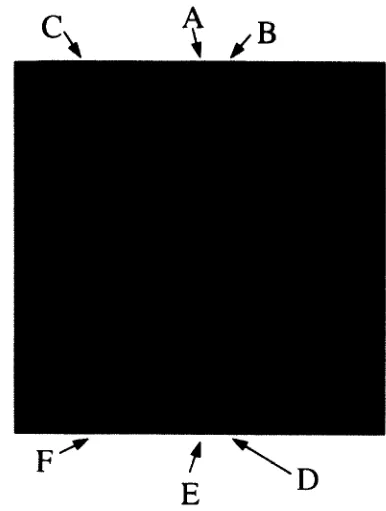
A plane set of 15 x 15 cubic elements 5 nm size is considered (Fig. 1). The atom density is equal to 5.35 x lo** atoms/cm3 everywhere. In the calculations described here, the density of defects varies from el- ement to element, in the following way: the surface elements (region C) are assumed to have a density of defects which is 1% that of the atoms. The bulk ele- ments have 0.01% defects (region F). The central col- umn (region E) is considered to be a grain boundary, and so the density of defects there is 100 times that of adjacent material, including the surface element (re- gion A). The two columns near the grain boundary (region D) are considered to have 10 times the density of defects of the material, in order to allow a softer de- crease in the density of defects. So, in region B, 10% of the atoms are defects, and in region A 100% are defects.
The initial density of electrons, ionised defects and the initial temperature are set to zero. Other parameters
Ff
t
‘II
E
Fig. 1. Schematic of the ensemble; letters identify regions of different defect concentration (see text).
are listed in Table 1. The electron mobility is very low, as is expected for a material like MgO.
4. Results and discussion
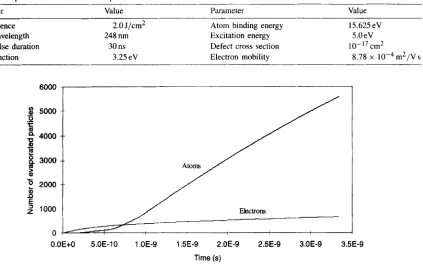
The calculations were performed for the first 3 ns of the laser pulse, assuming a square profile of the pulse. The electrons that are generated by the ionisa- tion of defects are the first to evaporate (Fig. 2), be- cause their concentration increases fast and they start absorbing radiation strongly. The electron evaporation rate is limited by the positive electric field they leave behind (Fig. 3).
36 Table 1
R.M. Ribeiro et al. /Computational Materials Science 10 (I 998) 33-37
Some of the parameters used in the computer calculations
Parameter Value
Laser fluence 2.0 J/cm2 Laser wavelength 248 nm Laser pulse duration 30 ns Work function 3.25 eV
Parameter
Atom binding energy Excitation energy Defect cross section Electron mobility
Value 15.625 eV
5.0eV 1 O-t7 cm2
8.78 x 10e4 m2 /V s
Fig.
This recombination process is stronger where the de- fects are more abundant, and so the increase in the en- ergy released is very localised to these places (Fig. 4).
6000 , .-
$ 5000 -~ $
$ 4000 -- g!
[ ---
; 2000 ~~ 2
; 1000 Ekctrom
0*
O.OE+O 5.OE-10 1 .OE-9 1.5E-9 2.oE-9 Time (s)
4
2.5E-9 3.OE-9 3.5E-9
Fig. 2. Number of evaporated atoms and electrons as a function of time.
su
/ rlkcce
3. The electric potential 1 ns after the beginning of the
pulse.
Fig. 4. Mean atomic energy in each element after 3 ns (log scale).
In fact, the material starts to evaporate in the grain boundary and around it.
R.M. Ribeim et al./Computational Materials Science 10 (1998) 33-37 37
specific grain structure [ 121. As the target evaporates, some surface roughness shows up as a consequence of preferential evaporation at the grain boundaries. The target with wide grain boundaries develops a cone morphology as observed in laser ablation experiments. The electric potential plays an important role in this model. It keeps electrons in the target, allowing their density to increase and so they can absorb laser ra- diation more strongly. It also drives electrons gener- ated in the bulk towards the surface. This effect is counterbalanced by diffusion of electrons, which tends to reduce the concentration of electrons where it is higher.
The generated electric field is very high and may nucleate dislocations, increasing the number of de- fects. This effect is not included in this model, but will be soon. We expect that this effect will lead to an increase in the heated volume and so to a wider evaporation.
We studied the influence of the work function on the qualitative behaviour of the model, and it does not af- fect significantly. This is because the electric potential generated by evaporation of electrons increases very soon to values that are much greater than the work function, and this determines the subsequent evolution.
5. Conclusions
A new type of mesoscopic modelling of pulsed laser ablation is introduced. A key point of this model is to consider a variety of physical processes taking place in the target, namely a specific absorption pro- cess (in this case, absorption by defects and electrons), as well as diffusion and drift by charge carriers, in a large scale. This model is readily scaled to larger volumes.
In transparent targets, the absorption of the laser radiation occurs mainly in places of high defect con- centration, such as grain boundaries and dislocations, and material evaporation starts preferentially at those places. We believe that this preferential evaporation at grain boundaries (where the defect concentration is higher) may be a plausible explanation for target cone formation during laser ablation, and is a factor in par- ticulate generation.
Acknowledgements
We wish to acknowledge the JNICT for its financial support under the project No. PBIC/C/PIS/2151/95.
References
[l] D.B. Chrisey and A. Inam, MRS Bulletin 2 (1992) 37; J.C. Miller, ed., Laser Ablation: Principles and Applications (Springer, Berlin, 1994).
[2] 0. Auciello, AI. Kingon, A.R. Krauss and D.J. Lichtenwalner, NATO ASI Series, Vol. E234.
[3] T. Venkatesan, X. Wu, R. Muenchausen and A. Pique, MRS Bulletin 2 (1992) 54.
[4] W. Kantek, B. Roas and L. Schultz, Thin Solid Films 191 (1990) 317.
[5] 0. Auciello, A.I. Kingon, A.R. Krauss and D.J. Lichtenwalner, N&TO AS1 Series, Vol. E234.
[6] H. Gai and G.A. Voth, J. Appl. Phys. 71 (1992) 1415 [7] N. Itoh, J. Kanasaki, A. Okano and Y. Nakai, Ann. Rev.
Mater. Sci. 25 (1995) 97.
[8] D. Bhattacharya, R.K. Singh and P.H. Holloway, J. Appl. Phys. 70 (1991) 5433.
[9] R.K. Singh and J. Narayan, Phys. Rev. B 41 (1990) 8843. [lo] J.T. Dickinson, S.C. Langford and J.J. Shin, Phys. Rev.
Lett. 73 (1994) 2630.
[ll] A.M. Stoneham and P.W. Tasker, Mat. Res. Sot. Symp. 40 (1985) 291.