Modeling dynamic deformation and failure of thin-walled
structures under explosive loading
Ivan Volkov1,*, Leonid Igumnov1, Svetlana Litvinchuk1, and Igor Vorobtsov 1
1Research Institute for Mechanics, National Research Lobachevsky State University of Nizhni Novgorod, 23, bldg. 6, Prospekt
Gagarina (Gagarin Avenue), Nizhny Novgorod, Russian Federation
Abstract. In the framework of mechanics of damaged media, behavior of thin-walled structures under pulsed loading is described. Account is taken of the interaction of the processes of dynamic deformation and damage accumulation, as well as of the main characteristic features of the dynamic failure process: the multi-staged character, nonlinear summation of damage, stressed state history and accumulated damage level. The chosen system of equations of thermo-plasticity describes the main effects of dynamic deformation of the material for random deformation trajectories. The equations of state are based on the notions of yield surface and the principle of gradientality of the plastic strain rate vector. Evolutionary equations of damage accumulation are written for a scalar parameter of damage level and are based on energy principles. The effect of the stressed state type and the accumulated damage level on the processes of nucleation, growth and merging of microdefects is accounted for. Results of numerically modelling processes of dynamic deformation and failure of spherical and closed cylindrical shells with plane and hemispherical bottoms under single pulsed explosive loading are presented. The computational results are compared with experimental data.
1 Introduction
One of the main tasks of mechanical engineering is to substantiate the operational resource of the machinery being designed, to evaluate spent resource and to predict residual resource of its structural units in the process of its exploitation, and to prolong service life of objects which have spent their rated resource. The task of determining strength characteristics of materials and of their prediction can be approached using the notions of mechanics of damaged continua, with integrated account of the special features of the structure of such materials and certain general physical aspects [1].
The failure process proper, as well as the processes preceding and accompanying the formation of a macroscopic crack, depend on such factors as physical-mechanical properties of the material, temperature-rate regime of loading, the history and type of the stressed-strained state, etc. There exist a large variety of types and mechanisms of failure, which makes the development of a substantiated classification of failure types a very complicated problem, hence, the existence of a large number of such classifications [2].
It is assumed for the simplification that materials fail by tearing or shearing, and that the failure process is multi-stage.
Explosive expansion of shells and rings is a unique tool for studying a number of issues of dynamic theory of plasticity and failure mechanics. This problem also has purely a practical application connected with the
strength analysis of thin-walled structures under dynamic loading regimes. Numerous experimental investigations show that a defining role here is played by the effects related with high rate deformation and the strain-rate effect, as well as the nonlinear effects, resulting from the specific character of pulsed loading. Finite perturbation regions resulting from the effect of explosive loading propagate through the body in the form of intensive stress waves, interacting with the boundary surfaces, media interfaces and with each other. The process of the interaction of stress waves yields, as a rule, complex material deformation trajectories. For thin-walled vessels failing in the region of pronounced plasticity, the criteria of ultimate plasticity, of local critical strain, of the critical value of the energy of plastic yielding are often used. For thick-walled vessels and pipes, the variety of such criteria is even wider [3].
In [5], based on a large number of experiments on dynamic failure of spherical and cylindrical vessels and pipes, and energy approach was presented. According to that concept, the necessary condition of failure of dynamically loaded objects consists in that the margin of elastoplastic energy was sufficient for the work of the propagation of at least one through crack. The energy approach to the problem of failure is further developed in [6] in the assumption that a certain part of kinetic energy is the source of forces causing failure of objects.
Also, worth mentioning are the investigations based on the concept of damaged media, in which failure of objects is described as a process of accumulation of microdefects, [7–9]. Such approaches open a possibility of globally modeling failure processes, accounting for the effect of the damage level on the deformational characteristics of materials, and its dependence on the history of loading and temperature, with including the damage level into the analysis of service life of structures.
In the present paper, a version of defining relations of MDM has been developed to describe dynamic deformation and failure of shells under internal explosive loading. The reliability of the developed defining relations of MDM was assessed by comparing the experimental and numerical data on the dynamic deformation and failure of spherical and cylindrical shells under internal explosive loading [10, 11], which corroborated the adequacy of modeling and determining material parameters.
2
Defining relations of damaged
medium mechanics
The damaged medium model consists of three interrelated parts [2, 12, 13]: the relations of thermal-plastic behavior of the material, accounting for the effect of the failure process; the equations of damage accumulation kinetics; the strength criterion of the damaged material.
The defining relations of thermal plasticity are based on the following basic assumptions: components of tensors of smalls trains eij and strain rates eij are the
corresponding sums of elastic e ij e , e
ij
e and plastic – eijp, p
ij
e parts; the initial yield surface for various
temperatures is described by a Mises-type surface; the evolution of the yield surface is described by the evolution of its radius Cp and displacement of its center
ij
ρ ; the principle of orthogonality of the plastic strain rate vector to the yield surface in the loading point holds;
the body volume changes elastically, i.е. p 0
ii
e ≡ ; the
initial medium is isotropic; only anisotropy due to the processes if irreversible deformation is taken into account.
In the elastic region, the correlation between the spherical and deviatoric components of the stress and strain tensors is described by Hook law:
[
0]
3 ( ) , 2 , ,
3 ) / , 2 / ,
e e p
ij ij ij ij ij e ij ij ij
K e T T Ge e e e
K e T T K K Ge G G
σ α σ σ α α σ σ σ ′ ′ ′ ′ = − − = = − ′ ′ ′ = − − + = +
where , , ,σ σ e e are spherical parts, and σ σij′, ij′ ′ ′, ,e eij ij
are deviatoric parts of the components of the tensors of stresses σij, strains eij and their rates σij, eij,
respectively; T is temperature; T0 is initial temperature;
( )
K T is bulk compression modulus; G T( ) is shear
modulus; α( )T is coefficient of linear thermal
expansion of the material.
The relation between spherical components of stress and strain tensors is described with Mie-Grüneisen
equations, and shear modulus G is a function of the
hydrostatic component of the stress tensor:
( ) (
)
( )
(
)
/ , ,
/ 1 /
x o Т x Т
m
x o
p p V V V E Е Е E
p V K V V m
σ γ
− = = + = +
= −
where px, Ex is elastic (potential) component of
pressure and energy, ET is thermal component of
internal energy, γ is Grüneisen coefficient, m is
experimental parameter.
Effects of plastic deformation in the stress space are described using equations [9, 12]:
2 1 2 1/ 2 0 0 0 0 0
2 1 1
1 1
2
1 2
0, , ,
2
, ,
3
, ( ),
(1 ) , 0 1,
(1 )
1 сos , cos ,
,
( ) (
s ij ij p ij ij ij p
t
p p p p p ij ij
t p p е s ij ij ij ij е s ij ij
ij ij ij
F S S C S C q q T
C C C dt e e
dt C C t q А Аq q
A A
A n n
е S
n n
е е S S
χ σ ρ χ χ χ χ ψ ψ ψ θ θ ′ = − = = − = + = +∫ = =∫ = + − = ≤ ≤ + − = − = ′ = = ′ ′
12
1 2 3
0 , ) , , , ij D р
p p ij ij ij ij t
ij ij
С kC g e g g Т
dt
ρ ρ χ ρ
ρ ρ
= = − − < >
=
∫
where Cp is static radius of the yield surface; Cp0 is
initial value of the yield surface radius; D p
C is dynamic
(momentary) radius of the yield surface; ρijare
coordinates of its centre; q1 and q2 are isotropic
hardening moduli; χ is length of the plastic strain path
of the material; Т is temperature; k is dynamic
amplification factor depending on strain rates; g1 >0
and g2 >0 are anisotropic hardening moduli.
yield surface at the loading point р ij ij
е = λS ,where λ is
proportionality coefficient determined from the condition that a new yield surface passes through the end of the stress deviator vector at the end of the loading stage.
At the stage of the development of fatigue defects scattered over the volume, the effect of damage on the physical-mechanical properties of the material is observed. This effect can be accounted for by introducing effective stresses [13]:
( )
(
)
(
)
( )
(
) (
)
1 2 , 6 12 1 1(9 8 )
,
4 1 / 4 3
i j i j F i j GG i j K G
K G
К F
G G K
К σ σ ω σ σ ω ω σ σ ω σ σ ω ω ′ ′ = ′ = ′ = + − − + = = = − +
where G, К – are effective moduli of elasticity
determined using McKenzie formulas [7]. Effective variable ρijis determined in a similar way:
( )
1 ij F ij
ρ = ω ρ .
The rate of the damage accumulation process will be determined using the following evolutionary equation [9, 13]:
( ) ( ) ( )
( )
1 2 3 4
f f f W f W
ω= β ω , (1)
where functions fi, i=1...4 account for: volumetric
character of the stressed state ( f1( )β ), level of
accumulated damage (f2( )ω ), accumulated relative
energy of damage spent for the nucleation of defects ( f W3( )), and rate of variation of the damage energy
( f W4( ) ).
In equation (1):
( )
( )
(
)
(
)
1 1 2 3 3 23 13 23
3 4
exp( ),
0,
1
1 3
16 1 1
9 3
( ) ( ) / , ( ) / ,
а
а
а
а f f
f
W W
f W W
W W f W W W W f W W W
β β ω ω ω ω ω− ω − ω − = ≤
= − ∧ > ∧ ≤
− ∧ > ∧ >
= =
where β is volumetric parameter of stressed state
(β σ σ= / u), Wa is value of the damage energy at the
end of the stage of nucleation of scattered defects, and
f
W is value of the energy corresponding to the
nucleation of a macroscopic crack.
The duration of the microdefect nucleation phase is then related with the value of parameter Wa.
The process of merging of microdefects (breakage of the remaining continuous gaps between the defects) starts when they grow up to the dimensions comparable with the average distance between them. In the present
paper, the authors did not construct a detailed model of the merging of cavities, but, to account for that effect,
the kinetic equation (due to member f2( )ω ) was
formulated so that, when the damage reaches the value of ω =1 3, relation ω= f1( )ω accounts for the
"snowballing" growth of the damage value. The
condition when damage ω reaches its critical value
1
f
ω ω= ≤ is taken as a criterion of the termination of the phase of the development of scattered microdefects. In the numerical computations, the critical value of the damage of the material was taken to be ωf =0,8.
The methodology of determining the material parameters and scalar functions of the derived defining relations of MDM is presented in [9].
3 Investigation results
A series of experiments [10] were numerically analyzed, in which the behavior of air-filled closed spherical shells with the outer radius of R0 and the wall thickness of δ0,
loaded by exploding a spherical explosive charge inside them, was studied. By successively increasing the mass of the charge, the shell was brought to failure (the formation of a through crack). The shells were made of Steel 35. Five test groups were analyzed, in which the charge mass, the internal radius and the shell thickness were varied. The problem of describing the behavior of the shells was solved in two stages: at the first stage, the profile of the pressure acting on the internal surface of the shell was determined; at the second one, the obtained values of the pressure were used to evaluate the stressed-strained state and the process of damage accumulation in the shells.
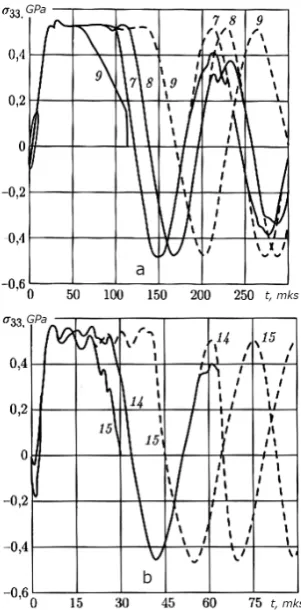
The problem of evaluating the stressed-strained state and the strength of the shells was solved numerically, using an explicit finite-difference scheme in Lagrange variables, with introducing Richtmyer-Neumann’s artificial viscosity [14] in the zones of impact compression. The initial data, the experimental and numerical results are presented in Figs. 1–3 and in Table
1, where m is mass of the explosive charge,
ξ
isparameter characterizing the ratio of the mass of the charge to that of the shell, еmax is maximal deformation
of the shell at the time of stop or failure of the vessel,
max
ω is maximal value of ω, chosen from the diagram
of the distribution of damage through the shell thickness. The last column shows the state of the shell after testing (А – no visible damage, В – formation of a through crack in the shell). The curve numbers in Figs. 1–3 correspond to the test numbers in Table. 1.
Fig. 1. History of the stresses and of the value of the stressed state in the failure zone.
Fig. 2. History of the damage value as a function of time of the process.
Fig. 3. Diagram of the distribution of damage through the shell thickness.
The history of stresses and of the damage value in the cross-section corresponding to the maximal damage level is presented in Fig. 1 (the dashed curves were obtained in the assumption of infinite strength of the material. For the thinner shells of the same dimensions,
increasing the charge only prolongs the effect of the tensile stresses. For the thicker shells, the prolongation of the effect of the stresses is also accompanied by the increase in the amplitude (see Table. 1) and a volumetric character of the SSS.
When the critical criterion is satisfied (the energy spent on the nucleation of microdefects reaches its threshold value) the process of defect growth starts in the shell (Fig. 2). The increasing concentration of defects is accompanied by relaxation of the material in the failure zone (Fig. 1). When the damage value reaches its critical level, a macrocrack is formed (the process of formation of a macrocrack was observed in tests No 9, 11, and 15; a similar situation is observed in test No 13, where maximal damage reaches the value of ωmax=0,34).
Fig. 3 shows the distribution diagram of the damage value through the shell thickness. It can be observed that in this case a macroscopic crack is nucleated in the vicinity of the internal surface of the shells. In what follows, the failure process develops mainly through the growth of the already formed macrocracks.
The Wilkins method [14] was used to numerically analyze a series of experiments [11] on the behavior of closed steel cylindrical shells with flat (the shell material is steel 17 GS) and hemispherical (the shell material is steel 20) bottoms filled with the air under atmospheric pressure, loaded by exploding a spherical explosive charge inside them.
The shell was brought to failure (formation of a through crack in the walls of the vessel) by gradually increasing the mass of the charge. In the experiments, the following parameters were registered in the central cross-section of the vessels: time interval t1 from the
beginning of the displacement of the vessel walls to the
time they reached maximal velocity υ1 and the
corresponding to that moment circumferential strain е1;
е2 is value of the circumferential strain at the moment
corresponding to failure in the shell or the moment when deflection reaches its maximum and the vessels do not fail; periods of eigen vibrations of the vessels τ .
The loading conditions, the computational results and their comparison with the experimental data are presented in Figs. 4–7 and Tables 2, 3, where R0is
internal radius of the shells; δ0 is wall thickness; m is
mass of the explosive charge;
ξ
is parametercharacterizing the ratio of the mass of the charge to that of the shell (in [11] parameter
ξ
is a measure of strength of the vessels). Table 3 shows maximal damage valuemax
ω chosen from the distribution diagram of the
damage value through the shell thickness. In Table 3, А
Table 1. Initial data, experimental and numerical results.
№ R0,sm δ0, sm m, g
ξ
⋅103 еmax, % σ*, GPa ωmaxexperiment calculation
1 15,3 0,26 61 10 0,5+0,05 - - - А
2 15,3 0,26 80 13 07±0,05 0,86 0,52 0,31х10-5 А
3 15,3 0,26 105 17,4 1,8±0,4 1,44 0,53 0,55х10-4 В
4 15,3 1,348 80 2,4 0,09 - - - А
5 15,3 1,348 186 5,5 0,2±0,02 - - - А
6 15,3 1,348 460 13,6 0,7±0,05 - - - А
7 15,3 1,348 576 17 1,2±0,1 1,42 0,59 0,18х10-3 А
8 15,3 1,348 700 20,7 1,9±0,2 2,07 0,58 0,22х10-2 А
9 15,3 1,348 945 28 3,2±0,2 3,75 0,54 0,82 В
10 15,3 4,162 1346 10,9 0,7±0,05 0,70 0,75 0,18 А
11 15,3 4,162 1953 15,8 1,8±0,2 2,53 0,86 0,80 В
12 3,81 0,33 10,5 19,8 1,6±0,1 2,08 0,54 0,21х10-2 А
13 3,81 0,33 14,85 28,1 5,0±0,5 3,94 0,63 0,34 В
14 3,81 1,038 37 19,2 2,5±0,2 2,16 0,80 0,27 А
15 3,81 1,038 46 23,9 3,5±0,3 3,37 0,95 0,81 В
Table 2. Characteristics of the vessels and the loading conditions.
№ R0, sm δ0 R0, % m, g
ξ
⋅1031 15,25 2,49 245 9,4 2 15,25 2,49 370 14,2 3 21,3 4,7 1327 9,9 4 21,3 4,7 1900 14,2
Table 3. Numerical and experimental results.
№ t1,
mks 1
υ , m/s
е1,
% mkst2, е% 2, mksτ , ωmax State of vessel after testing
1 А 40 65 0,9 200 6 250 - С
В 20 81 0,6 245 6,7 210 0,002
2 А 40 95 1,8 260 12,5 240 - D
В 20 12 1,0 415 15,3 - 0,8
3 А 40 90 1,5 300 10 240 - С
В 31 96 0,8 706 13 - 0,02
4 А 50 115 1,7 350 13 240 - D
В 31 138 1,1 510 19 - 0,8
The main physical-mechanical characteristics, as well as the material parameters of the defining relations of MDM for steel 17GS are listed in [9].
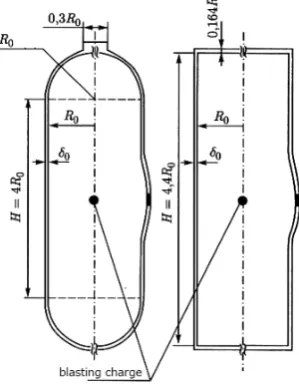
Fig. 4 shows a computational scheme of the problem (to the left of the symmetry axis, as well as the picture of deformation and failure of the vessels (tests 4 and 2 in Tables. 2, 3). The region of the formed macrocrack is shown in black.
Fig. 5 depicts the history of the damage value as a function of the time of the process (the dotted curves were obtained in the assumption of an infinite strength of the material). All the computed data is given for the cross-section situated near symmetry axis х2 for the
points belonging to the internal surface of the shells. The diagram of the damage value distribution along the
generatrix of the internal cylindrical surface of the shells is presented in Fig. 6. Curve numbers in Figs. 5, 6 correspond to the test numbers in Tables. 2, 3.
The analysis pf the stressed-strained state for both types of the vessels showed that the most hazardous cross-section is that situated near symmetry axis х2,
where the highest stress level is observed (whereas the values of component σ33 it is assumed that the value of
the remaining components of the stress tensor is considerably lower). The SSS in the vessels of the first type has its special features.
When analyzing the stress and strain histories in the cross-section near rotation axis х1, the following laws
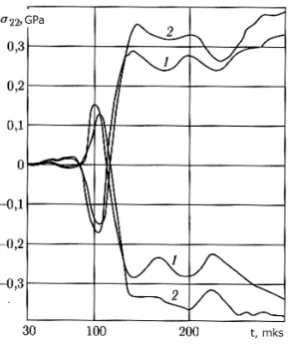
can be observed: in the process of deformation, the internal fibers of the flat bottom are loaded in compression, whereas the external ones are, at the same time, loaded in tension (Fig. 7). This is analogous to the SSS of a circular plate supported along the contour and loaded by pressure.
Fig. 5. Time history of the damage value.
Fig. 6. Distribution of damage value along the generatrix of the cylindrical surface of the shells.
Fig. 7. History of stress σ22 in the cross-section near rotation
axis х1 for the points of the internal and external surfaces.
The process of deformation and failure of the shells develops in the following way. At initial times, considerable compression stresses (especially radial ones) arise in the cylindrical part of the shells as a result of the applied pressure pulse. Then, after acquiring a certain momentum, the vessel begins to expand and to deform plastically (under explosive loading, cylindrical vessels undergo only circumferential plastic deformation, whereas plastic deformation along the generatrix of the cylinder do not appear up to failure [11]), the displacement of the vessel walls slows down. The behavior of the shells corresponds to the rigid-plastic model. The most severely deformed cross-sections are those adjacent to the symmetry plane, where breakage of continuity may occur (in the process of failure of cylindrical vessels, formation of cracks of a small length was observed in the most stressed central cross-section, leading to local failure of the structure; in
what followed, the cracks propagated only in the direction of the generatrix of the cylinder [11]).
Qualitative and quantitative agreement of the results, adequate for practical engineering computations, can be observed.
The macrocrack nucleation region is formed on the symmetry axis, in the points adjacent to the internal surface of the shell.
4 Conclusion
A mathematical model of mechanics of damaged media has been developed, which describes processes of dynamic deformation and failure of shells under explosive loading. The reliability of the defining relations of MDM was assessed by comparing the computational results and experimental data, which corroborated the adequacy of modeling the dynamic deformation process.
This work was supported by a grant from the Government of the Russian Federation (contract No. 14.Y26.31.0031)
References
1. L.M. Kachanov, Fundamentals of mechanics of
destruction (M.׃ Science, 1974)
2. D.R. Curran, L. Simen, D.A. Shocki, Zhurn. shock waves and phenomena of high-speed deformation of metals, 387-412 (1984)
3. V.A. Odintsov, Zhurn. problems of dynamics of elasto-plastic environments, 5, 85-96 (1975)
4. D.R. Curan, Zhurn. dynamics of blow, 275–293 (1985)
5. A.G. Ivanov, Zhurn. Reports of academy of Sciences of the USSR, T. 220, №3, 552–554 (1975) 6. D.E. Grady, J Impact Engen., vol. 5, №6, 272–279
(1987)
7. J.N. Jonson, J Appl Mech, vol. 50, № 3, 668–674 (1983)
8. V.A. Odintsov, E.F. Gryaznov, A.B. Kolobanova, Zhurn. mechanics of pulse processes, № 436, 178– 216 (1985)
9. I.А. Volkov, Yu.G. Коrotkikh, Equations of state of damaged viscoelastoplastic media (М: Fizmatlit, 2008)
10. V.I. Tsypkin, A.M. Cheverikin, A.G. Ivanov, Zhurn. durability problems, №10, 94–105 (1982)
11. V.I. Tsypkin A.G. Ivanov, V.N. Mineev, Zhurn. atomic energy, T 41, issue 5, 303–308 (1976) 12. F.M. Mitenkov, I.A. Volkov, L.A. Igumnov, Yu.G.
Коrotkikh, etc. Applied theory of plasticity (M.: Fizmatlit, 2015)
13. I.А. Volkov, L.A. Igumnov, Introduction into
continuum mechanics of damaged media (М: Fizmatlit, 2017)