Summation calculation of delayed neutron yields for
235U,
238U
and
239Pu, based on various fission yield and neutron emission
probability databases
DanielaFoligno1,,PierreLeconte1,OlivierSerot1,OlivierLitaize1, andAbdelhazizeChebboubi1
1CEA Cadarache, 13115 Saint-Paul-lez-Durance
Abstract.Summation calculations have been performed in order to compare the quality
of several nuclear data libraries. The objective was to obtain the average delayed neutron yield, as well as the average delayed-neutron half-life for different fissioning systems
(235U,238U and239Pu) at different energies (thermal and fast) by using microscopic data. Each quantity is presented with a first evaluation of the uncertainty, computed under the assumption that the variables are all independent of each other.
1 Introduction to Summation calculation
TheSummation Method consists on using microscopic data to compute a macroscopic quantity of interest by summing the contribution of each component (e.g. the contribution of each isotope).
• Average delayed neutron yield (νd): average number of delayed neutrons emitted per fission. It can be computed from the cumulative fission yields (CY) and the delayed-neutron-emission-probabilities (Pn1) from different libraries:
νd=
N
i
CYi·Pn,i (1)
whereiidentifies a delayed neutron precursor and N the number of precursors. Notice that the use of the cumulative yields implies that the full decay chain has been considered and therefore Equation 1 is only valid for aninfiniteirradiation2.
• Precursor’s importance (Ii):the contribution of the precursorito theνd.
Ii=CYi·Pn,i
νd (2)
e-mail: [email protected]
1Defined asPn,i=Pn,i+2·P2n,isince it takes into account bothβ−
• Average delayed-neutron precursors’ half-life life (<T1/2 >):average of the precursors’ half-lives weighted on the precursor’s importance. This parameter is typical of the fissioning system and it is an indication of the time dependence of the DN decay curves.
<T1/2>= n
i Pn,i·CYi·T1/2,i
n
i Pn,i·CYi
=
n
i
Ii·T1/2,i (3)
A calculated<T1/2 >smaller than the experimental value would point out an underestimation of the long-lived precursors’ contribution or an overestimation of the short-lived precursors’ contribution in the summation process, and vice-versa. It is worth mentioning that the reactivity (ρ) is not a
measurable quantity and it can only be estimated through a reactor period (T) measurement. The two quantities are linked to each other through thesimplified Inhour equation, which contains the
<T1/2 >. It is obvious that an incorrect value of the average precursors’ half-life would lead to a wrong estimation of the reactivity, even in the case of accurate period measurements.
2 Results
The recommended values for the average delayed neutron yields are shown in Table 1, while the results of the calculations are shown in Tables 2 to 6. Notice that two error-values are shown for each quantity. One should be aware that in absence of measurements, nuclear data is computed through theoretical models. In this case, the values are estimations, and should be accompanied by a range of confidence. In reality, theoretically-derived data is presented in the libraries without any uncertainty value. The difference between the two presented errors is that the first one has been
computed considering the theoretical values as completely reliable, and the second one by imposing the relative uncertainty on the data to be 100%. Table 7 reports the three most important precursors for all the considered fissioning systems, while Table 8 the average delayed neutron precursors’ half-life, where the errors have been computed with the first of the two previously mentioned ways of dealing with theoretical models.
Table 1.νdrecommended values from the literature: Spriggs et al. [2] and WPEC-6 [3] respectively.
235U
th 235Uf ast 238Uf ast 239Puth 239Puf ast
[2] 1.62E-02(3.1%) 1.63E-02(1.8%) 4.65E-02(2.4%) 6.50E-03(6.2%) 6.51E-03(2.5%)
[3] 1.62E-02 1.66E-02 4.65E-02 6.50E-03 6.55E-03
Table 2.νdcalculation by Summation Method -235Uthermal
235U thermalCY
JEFF-3.1.1 ENDF/B-VII.0
Pn
ENDF/B-VII.1 1.57E-02 (5.2-5.3%) 1.90E-02 (5.5-8.4%) JEFF-3.1.1 1.48E-02 (5.3-6.0%) 1.73E-02 (3.4-11.5%)
Table 3.νdcalculation by Summation Method -235Uf ast
235U f astCY
JEFF-3.1.1 ENDF/B-VII.0
Pn
ENDF/B-VII.1 1.72E-02 (5.0-5.0%) 1.76E-02 (6.6-6.8%) JEFF-3.1.1 1.70E-02 (5.2-5.6%) 1.66E-02 (5.5-6.5%) Pfeiffer 1.81E-02 (5.5-5.5%) 1.81E-02 (6.9-6.9%)
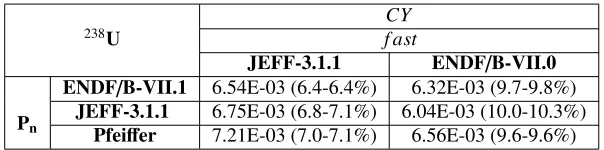
Table 4.νdcalculation by Summation Method -238Uf ast
238U f astCY
JEFF-3.1.1 ENDF/B-VII.0
Pn
ENDF/B-VII.1 4.51E-02 (3.5-5.5%) 4.22E-02 (6.6-7.7%) JEFF-3.1.1 4.04E-02 (3.2-5.9%) 3.79E-02 (6.0-8.0%) Pfeiffer 4.53E-02 (4.4-4.5%) 4.29E-02 (7.1-7.1%)
Table 5.νdcalculation by Summation Method -239Puthermal
238U thermalCY
JEFF-3.1.1 ENDF/B-VII.0
Pn
ENDF/B-VII.1 6.03E-03 (6.5-6.6%) 7.18E-03 (3.2-3.5%) JEFF-3.1.1 6.05E-03 (7.1-7.5%) 7.02E-03 (4.0-8.0%) Pfeiffer 6.52E-03 (7.1-7.2%) 7.45E-03 (4.4-4.4%)
Table 6.νdcalculation by Summation Method -239Puf ast
238U f astCY
JEFF-3.1.1 ENDF/B-VII.0
Pn
ENDF/B-VII.1 6.54E-03 (6.4-6.4%) 6.32E-03 (9.7-9.8%) JEFF-3.1.1 6.75E-03 (6.8-7.1%) 6.04E-03 (10.0-10.3%)
Pfeiffer 7.21E-03 (7.0-7.1%) 6.56E-03 (9.6-9.6%)
3 Analysis
3.1 FY-Libraries:
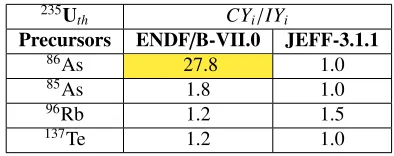
• An overestimation of the86As’s CY is present in the ENDF/B-VII.0 library, especially considering the fact that in JEFF-3.1.1 there is no difference between the independent and the cumulative yield
for this isotope (see Table 9). An explication for this large discrepancy has been found in the paper from A. Sonzogni [5], who noticed an overestimation in his summation calculation of antineutrino spectra due to the excessive CY of86Ge (86As’s father). Looking at the previous versions of the library he found out that in 1993, when passing from ENDF/B-VI.1 to ENDF/B-VI.2, the86Ge
Table 7.Precursors’ Importance computed withCYfrom JEFF-3.1.1 andPnfrom Pfeiffer
TOP 3 Precursors 235U
th 235Uf ast 238Uf ast 239Puth 239Puf ast
1st 137I (15.5%) 137I (12.3%) 137I (8.7%) 137I (24.7%) 137I (17.1%)
2nd 89Br (11.5%) 94Rb (12.3%) 94Rb (6.7%) 98mY (9.7%) 94Rb (12.5%)
3rd 94Rb (8.4%) 89Br (12.0%) 90Br (6.6%) 94Rb (9.7%) 98mY (11.2%)
Table 8.Average delayed-neutron half-life
Summation 6-groups 8-groups Recommended
JEFF-ENDF JEFF-Pfeiffer ENDF/B-VII.1 JEFF-3.1.1 [2]
235U
th 9.42±0.40 9.01±0.44 7.67 9.02±0.27 9.02±0.34
235U
f ast 8.69±0.27 8.20±0.40 7.67 9.11±0.09 9.03±0.08
238U
f ast 5.03±0.15 4.93±0.22 3.05 5.32±0.11 5.32±0.14
239Pu
th 11.22±0.70 10.34±0.75 9.21 10.69±0.85 10.69±1.11
239Pu
f ast 9.86±0.65 8.97±0.68 9.21 10.35±1.09 10.09±1.26
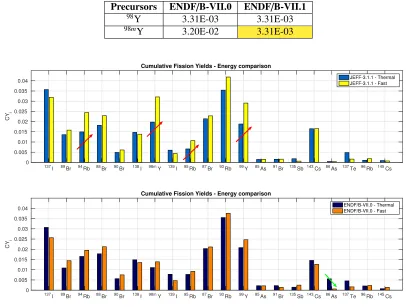
• Precursors’ CYs increase with energy (0.025 eV→400 keV) in the JEFF-3.1.1 library much more than in the ENDF/B-VII.0 library (see Fig. 1), leading to an increase of theνd, which is supposed to be energy-insensitive until the MeV scale. In the same figure, one could also notice the large decrease in the86As CY with energy according to the ENDF/B-VII.0 library. However, the apparent reduction is only due to the wrong value at thermal energy, as mentioned before
• A sensitivity analysis showed that most of the uncertainty on the delayed neutron yield comes from the uncertainty on the fission yields. Furthermore, it has to be stressed thatFY-data comes from measurements and it is always accompanied by uncertainties.
3.2 Pn-Libraries:
• JEFF-3.1.1 Pn-library always gives an underestimated νd because several precursors’ emission probabilities are missing
• 98mY’sP
nunderwent an order of magnitude change from ENDF/B-VII.0 to ENDF/B-VII.1, leading to a huge difference in the239Pu’s importance list. Indeed, this precursor contributes to 10% of the νdaccording to ENDF/B-VII.0 and to 1% according to ENDF/B-VII.1 because, in the most recent version of the library, the metastable state has been given the samePnas the ground state (see Table 10). This is likely to be a typing mistake, since JEFF-3.1.1 and ENDF/B-VII.0 agree on the98mY’s Pnvalue
Table 9.Cumulative vs Independent Yield Ratio for some precursors
235U
th CYi/IYi
Precursors ENDF/B-VII.0 JEFF-3.1.1
86As 27.8 1.0
85As 1.8 1.0
96Rb 1.2 1.5
Table 7.Precursors’ Importance computed withCYfrom JEFF-3.1.1 andPnfrom Pfeiffer
TOP 3 Precursors 235U
th 235Uf ast 238Uf ast 239Puth 239Puf ast
1st 137I (15.5%) 137I (12.3%) 137I (8.7%) 137I (24.7%) 137I (17.1%)
2nd 89Br (11.5%) 94Rb (12.3%) 94Rb (6.7%) 98mY (9.7%) 94Rb (12.5%)
3rd 94Rb (8.4%) 89Br (12.0%) 90Br (6.6%) 94Rb (9.7%) 98mY (11.2%)
Table 8.Average delayed-neutron half-life
Summation 6-groups 8-groups Recommended
JEFF-ENDF JEFF-Pfeiffer ENDF/B-VII.1 JEFF-3.1.1 [2]
235U
th 9.42±0.40 9.01±0.44 7.67 9.02±0.27 9.02±0.34
235U
f ast 8.69±0.27 8.20±0.40 7.67 9.11±0.09 9.03±0.08
238U
f ast 5.03±0.15 4.93±0.22 3.05 5.32±0.11 5.32±0.14
239Pu
th 11.22±0.70 10.34±0.75 9.21 10.69±0.85 10.69±1.11
239Pu
f ast 9.86±0.65 8.97±0.68 9.21 10.35±1.09 10.09±1.26
• Precursors’ CYs increase with energy (0.025 eV→400 keV) in the JEFF-3.1.1 library much more than in the ENDF/B-VII.0 library (see Fig. 1), leading to an increase of theνd, which is supposed to be energy-insensitive until the MeV scale. In the same figure, one could also notice the large decrease in the86As CY with energy according to the ENDF/B-VII.0 library. However, the apparent reduction is only due to the wrong value at thermal energy, as mentioned before
• A sensitivity analysis showed that most of the uncertainty on the delayed neutron yield comes from the uncertainty on the fission yields. Furthermore, it has to be stressed thatFY-data comes from measurements and it is always accompanied by uncertainties.
3.2 Pn-Libraries:
• JEFF-3.1.1 Pn-library always gives an underestimated νd because several precursors’ emission probabilities are missing
• 98mY’sP
nunderwent an order of magnitude change from ENDF/B-VII.0 to ENDF/B-VII.1, leading to a huge difference in the239Pu’s importance list. Indeed, this precursor contributes to 10% of the νdaccording to ENDF/B-VII.0 and to 1% according to ENDF/B-VII.1 because, in the most recent version of the library, the metastable state has been given the samePnas the ground state (see Table 10). This is likely to be a typing mistake, since JEFF-3.1.1 and ENDF/B-VII.0 agree on the98mY’s Pnvalue
Table 9.Cumulative vs Independent Yield Ratio for some precursors
235U
th CYi/IYi
Precursors ENDF/B-VII.0 JEFF-3.1.1
86As 27.8 1.0
85As 1.8 1.0
96Rb 1.2 1.5
137Te 1.2 1.0
Table 10.Neutron emission probabilities - Transcription Error (ENDF/B-VII.0→ENDF/B-VII.1)
Precursors ENDF/B-VII.0 ENDF/B-VII.1
98Y 3.31E-03 3.31E-03
98mY 3.20E-02 3.31E-03
137I 89Br 94Rb 88Br 90Br 138I 98mY 139I 95Rb 87Br 93Rb 99Y 85As 91Br 135Sb143Cs 86As 137Te 96Rb 145Cs 0 0.005 0.01 0.015 0.02 0.025 0.03 0.035 0.04 CY i
Cumulative Fission Yields - Energy comparison
JEFF-3.1.1 - Thermal JEFF-3.1.1 - Fast
137I 89Br 94Rb 88Br 90Br 138I 98mY 139I 95Rb 87Br 93Rb 99Y 85As 91Br 135Sb143Cs 86As 137Te 96Rb 145Cs 0 0.005 0.01 0.015 0.02 0.025 0.03 0.035 0.04 CY i
Cumulative Fission Yields - Energy comparison
ENDF/B-VII.0 - Thermal ENDF/B-VII.0 - Fast
Figure 1.Precursors’ Cumulative Yields - Thermal vs Fast Fission - JEFF-3.1.1 vs ENDF/B-VII.0
4 Conclusions
1. About 90% of delayed neutrons are emitted by odd-Z fission products [6], which at thermal incident neutron energies are less likely to be produced than even-Z isotopes. At higher exci-tation energies the proton pairing energy loses its importance and the even-odd effect weakens.
A small increase of the DN yield with energy is therefore expected up to about 4 MeV, where the second chance fission occurs. Another drop in theνd is expected around 12 MeV due to the third-chance fission. This phenomenon seems to be compensated by the fact that at higher incident neutron energies the fission becomes more and more symmetric, leading to a reduction in theνd. Since thePndo not change with energy, the ony way to study this effect is to analyse theCY s
2. The best results are obtained when coupling CY data from JEFF-3.1.1 and Pn data from ENDF/B-VII.1, but the energy-dependence of JEFF-3.1.1 fission yields has to be improved.
3. The eight-groups DN set from JEFF-3.1.1, unlike the six-groups set from ENDF/B-VII.1, gives
good estimations of the average DN precursors’ half-lives, always in the range of the uncertainty with respect to the recommended values
4. Further work needs to be done on uncertainties, aiming at both reducing the uncertainties on fission yields, and estimating the uncertainty on the Pn derived by theoretical models when experimental data was missing.
References
[1] L. Mathieu, O. Serot, T. Materna, A. Bail, U. Köster, H. Faust, O. Litaize, E. Dupont, C. Jouanne, A. Letourneau, S. Panebianco, New neutron long-counter for delayed neutron investigations with the LOHENGRIN fission fragment separator, JINST 7, P08029 (2012). http://iopscience.iop.org/article/10.1088/1748-0221/7/08/P08029.
[2] G.D. Spriggs, J.M. Campbell, V.M. Piksaikin, An 8-group delayed neutron model based on a consistent set of half-lives, Prog. Nucl. Energy 41, 223 (2002).
[3] G. Rudstam, Ph. Finck, A. Filip, A. D’angelo, R.D. McKnight,
De-layed neutron data for the major actinides, NEA/WPEC-6 (2002).
https://www.oecd-nea.org/science/wpec/volume6/volume6.pdf.
[4] V. Zammit-Averlant, Validation Intégrale des Estimations du Parametre Béta Effectif pour les Réacteurs MOX et Incinérateurs, Ph.D. thesis, Université Aix-Marseille I (1998).
[5] A.A. Sonzogni, E.A. McCutchan, T.D. Johnson, P. Dimitriou,Effects of Fission Yield Data in the Calculation of Antineutrino Spectra for 235U(n,fission) at Thermal and Fast Neutron Energies, Phys. Rev. Lett. 116, 132502 (2016).